Friday, March 2, 2012

Random Shots! Gas Prices, IRS Threats, Forced To Join Union, and More!


First Shot!

Obama Secretary Doing Nothing To Lower Gas Prices

Yes, that's according to the Energy Secretary himself!

President Barack Obama's Secretary of Energy Stephen Chu admitted that the Administration doesn't find a problem with High Gas Prices. In fact, he admitted that the Obama Administration is doing nothing to lower gas prices. 

Think I'm kidding, well I wish I were. 

On Tuesday, Energy Secretary Stephen Chu sat in front of Congress explaining what the Obama Administration is actually doing to help Americans survive the huge spike at the pumps. The explanation amounted to admitting that they are doing nothing about it!

Mississippi Republican Rep. Alan Nunnelee asked if the Department of Energy is actively trying to lower fuel costs. "Is the overall goal to get our price of gasoline down?" Nunnelee asked.

"No, the overall goal is to decrease our dependency on oil, to build and strengthen our economy," Secretary Chu responded - without hesitation.

The first time Secretary Chu stepped on Republican toes was when he told the Wall Street Journal in 2008 that, "Somehow we have to figure out how to boost the price of gasoline to the levels in Europe."

That is the dream of the Liberal Left that the Democrat Party. Why? Well because they believe that if Americans are forced to pay $5 to $8 or more per gallon, that those prices would "encourage Americans to get serious" about using alternatives instead of oil and gas.

However, that logic leaves Republicans like Sen. John Thune from South Dakota scratching their heads.

"When you are doubling, literally doubling the price per gallon of gasoline, how does that strengthen your economy?" Thune said.

Their answer is silence, because they have no answer to that question. Fact is that $5 or more for a gallon of gallon is going to have a horrifying effect on our economy.

But they don't see a  problem, instead they see high gas prices as an incentive for alternate energy technology to take off.

The Heritage Foundation points out that hammering the American consumer with high gas prices to make electric and hybrid cars more appealing is consistent with Obama administration policy and Chu's philosophy. That explains the refusal to allow the building of the Keystone XL pipeline and to allow drilling in wide areas of the U.S. and offshore areas.

But wait, Secretary Chu wasn't done yet. I believed he returned today with a whole different outlook on things.

No surprise about that, I was pretty sure that after talking with the White House about his performance in front of Congress that he'd return with different answers.

I don't fault Secretary Chu for saying what he did. The man was only telling the truth. The truth is that the Obama Administration does not care about lowering prices for Americans.

Secretary Chu has not been tasked with bringing down gas or oil prices, but instead is tasked with the job of pushing alternative energy. After all, that is the basket that Obama has stuck all of his eggs when it comes to his energy policy.  And that, that is that truth!

Sort of tunnel vision if you ask me, but then again that's Washington D.C.!

Second Shot!

We're Paying For Obama Propaganda

Two senators have launched an investigation into "taxpayer-funded spin" by the Obama administration, following reports that the administration is spending millions of taxpayer dollars to promote Obama Care and other policies.

Sens. Rob Portman, R-Ohio, and Claire McCaskill, D-Mo., on Wednesday blasted out letters to 11 Federal agencies asking for detailed information about public relations and advertising contracts over the past three years.

Portman said the probe is "not a partisan exercise." Instead, he said the senators want to bring "to the light of day" how much money the administration is spending to promote its own policies.

The concern here goes to the question of how much money is being spent on spinning their policies around to make them look good and subsequently making the message inappropriate propaganda and lies?

Among the many recipients of the senators' letters was the Department of Health and Human Services. A Portman aide, who said the "major document request" was aimed at probing publicly funded "spin," cited a report last summer by watchdog group Judicial Watch that flagged millions of dollars spent on promotion of the federal health care overhaul.

That report detailed documents that showed federal health officials discussing their campaign with the public relations firm The Ogilvy Group. The officials discussed ways to draw Americans to the health care website to inform them about provisions in the law.

The conversations reflected  a strategy of targeting women and minorities. One 2010 email from an Ogilvy executive noted that officials wanted to use the "bulk" of paid media efforts "on media that reaches African Americans and Hispanics."

At the time of the report, HHS confirmed that $3.5 million was spent promoting the site, but argued that the campaign was not out of the ordinary. According to HHS, it was a "critical" way to make sure people are aware of their "rights, protections and benefits" under the health care law.

But that begs the question, what other Federal Program spends Millions of Taxpayer Dollars advising people of their "rights, protections, and benefits"?

And what other Federal Program spends Millions of Taxpayer Dollars on targeting Blacks and Hispanic citizens?

The Portman and McCaskill investigation is going way beyond the Health and Services Department. The Senators also sent requests to the Department of Energy, Department of Justice, Environmental Protection Agency, Department of Defense, National Labor Relations Board, and other agencies.

The Senators are asking for the names of contractors, the amount of money spent, descriptions of the work and other details. These two Senators are the top lawmakers on the contracting oversight subcommittee within the Senate Committee on Homeland Security and Governmental Affairs - and now they want answers.

One of Senator Portman's aide, in explaining the broad request, pointed to a 2010 report by the House Oversight and Government Reform Committee that claimed that "ordinary Americans have financed and been exposed to an unprecedented number of public relations and propaganda efforts"  - since the start of the Obama administration.

"The Obama administration frequently used federal resources to promote the President's agenda," the report said. "The President's right to sell his policy recommendations to Congress and the public is not disputed; however, using the resources of the federal government to activate a sophisticated propaganda and lobbying campaign is an abuse of office and a betrayal of the president's pledge to create 'an unprecedented level of openness in government'."

I said it when this gang in the White House first got put in business, they came with Chicago politics and a Nazi know-how when it came to using their propaganda machine. Frrom what I say in 2008, the Liberal Media Machine was all but salivating over Obama's arrival - that made them ripe for manipulation, cooperation, and complicity.

The Left in America has been using propaganda for years, mainly to demonize Conservatives and others who don't agree with their Socialist agenda. Liberals use Propaganda Techniques started ages ago, but were used during the Russian Revolution - and honed to a science during the regien of Nazi Germany. 

Third Shot!

Forced To Join A Union

This American was forced to join a Union against her own free will because she was caring for a family member in her home. She was forced to join a Union because the law said they had to.

Yes, the law made her bow to their wishes - not because of some safety rule, but because of politicians and Socialist Ideology!

Sally Coomer takes care of her disabled adult daughter in Duvall, Washington. The State of Washington considers her a "Home-Care Worker". And yes, under current law, she is forced to become a member of the SEIU (Service Employees International Union).  

To me, what the State and the Union are doing is a case of Complicity and Extortion.

How? Well, by being forced by the State to join the SEIU - she becomes a Union member. As a Union member of the SEIU, she is forced to pay Union Dues!

So now, because of the State forcing her to join the SEIU, $95 a month is taken from Sally Coomer for Union dues - which of course also goes to fund causes she does not support.

As for that $95 that the State and the Union is forcing her to pay, well that $95 could provide an additional 9 to 10 hours of care for her daughter. But that is no concern for both the State of Washington and the SEIU.

As long as the Union gets their money, the Liberal politicians in Washington State can still get their Union Contributions. It is quite the arangement.


I can't understand how this is legal?

This is disturbing in so many ways. I can't understand how this is legal?

The State ordering you to do something because you are caring for a family member, that's one part of this that isn't right. Making you join a Labor Union when you don't want to, that's a horrible step for Americans to let by without being addressed.

What more can the State of Federal governments ORDER you to do against you will?

And yes, as far as I'm concerned, this is just more proof that the government is overstepping its authority - and it needs to be addressed.

Another Shot!

IRS Threats - How The IRS Wants Information From Tea Party Chapters? 

Talk about overstepping your authority, this is an interesting twist of history.

It seems that the Sons of Liberty of 1765 are being resurrected all over again.

It was in Boston, Massachusetts, in early summer of 1765, when a group of Shopkeepers, Artisans got together to protest unfair laws and taxes placed upon them what they saw as a tyrannical government. 

They called themselves The Loyal Nine. As the group grew, it came to be known as the Sons of Liberty. Frustration with the government was so bad that by the end of 1765, the Sons of Liberty existed in every American colony.

Knowing the ways of the world, they were not so naive to think that the government would not seek reprisals to their protests. Because of this, the Sons of Liberty met in secret out of fear of retribution from the government.

After the British government passed the Tea Act, American colonists viewed it as another example of "taxation without representation."

The American colonists were angry and helpless. They wanted to do something to let the British government know about the unhappiness that the Tea Act was causing.

As a way to protest the Tea Act, colonists in Philadelphia and New York turned the tea ships back to Britain. In Charleston the cargo was left to rot on the docks. In Boston, the Royal Governor was stubborn and kept the ships in port - but the colonists dock workers would not allow them to unload. Cargoes of tea filled the Boston harbor, as the British ships weren't moving either way.

The Sons of Liberty discussed how best to get their message across to Great Britain, that the American colonies wanted more of a role in governing themselves.

The year was 1773 and Christmas was approaching. The American Colonists faced another year of unopposed and unrepresentative taxes. The Sons of Liberty decided to take action - it would later be called "The Boston Tea Party."

The Boston Tea Party was a symbolic act. It was meant to be an example of how far Americans were willing to speak out for their freedom. But the Sons of Liberty were not fools, they knew that they must remain a secret organization. If not, then they'd be open to harsh reprisals and imprisonment from their government.

Now fast forward to 2012.

Unlike the Sons of Liberty, Americans who joined in on the Tea Party rallies in 2009 never thought that they would be subject to reprisals and retribution from the United States government.

But now, now its happening!

Tea Party chapters around the nation are blasting the IRS (Internal Revenue Service) after the Federal agency sent them letters demanding information about their politics, contributors, and even family members.

In letters sent from IRS offices in Cincinnati earlier this month, chapters including the Waco, Texas, Tea Party and the Ohio Liberty Council were asked to provide a list of donors, identify volunteers, financial support for and relationships with political candidates and parties, and even printed copies of their Facebook pages.

The chapters that received requests were registering for nonprofit status as a 501(c)4 organizations. The classification mainly differs from 501(c)3 groups in that donors cannot deduct their contributions from their taxable income.

The tax code places fewer restrictions on 501(c)4 groups, allowing them to lobby in furtherance of their organizations' mission. They are also permitted to engage in political activity like endorsing candidates and donating money and time to specific campaigns, though it cannot be their primary activity.

Tea Party leaders said that they were particularly offended by demands that they name donors and volunteers, which is required by law, but were also asked to list any political ambitions of board members or their relatives.

Colleen Owens, spokeswoman for the Richmond, Virginia, Tea Party, claims that her chapter had a similar letter sent to them just two weeks before they were to hold a local convention in which they were asked to provide nearly 500 pages in documents.

They were required to return the requested documents two days before the start of the convention.

"Most of these groups are not wealthy and they've had their applications for 501(c)4 status since 2010," Owens said. "We only had two weeks to gather everything. The timing was suspicious."

"When determining whether an organization is eligible for tax-exempt status, including 501(c)(4) social welfare organizations, all the facts and circumstances of that specific organization must be considered to determine whether it is eligible for tax-exempt status. To be tax-exempt as a social welfare organization, they must be primarily engaged in the promotion of social welfare. Career civil servants make all decisions on exemption applications in a fair, impartial manner and do so without regard to political party affiliation or ideology," said a spokesman for the IRS.

But if that's so, then why ask questions about the political ambitions of board members or their relatives? If this is just an innocent inquiry, then why demand information about their politics, contributors, and even family members?

If this is so routine, I can't help but wonder why would they ask for to provide a list of donors, identify volunteers, financial support for and relationships with political candidates and parties, and even printed copies of their Facebook pages?


Tom Zawistowski, of the Ohio Liberty Council, a Tea Party chapter, called the questions about the names of donors, volunteers and members' relatives as "intelligence gathering."

"This has nothing to do with tax status," Zawistowski said. “It has to do with political affiliation. The questions are too close to home."

I agree with Colleen Owens, who is the spokeswoman for the Richmond, Virginia, Tea Party, when she said, "It's very intimidating and people are scared."

Last Shot!

Caterpillar Bypasses Illinois for Georgia

So let's see if my heart can take this news. An American company that relocated to China is coming back.

The only hiccup is that its not going back to the place it left which was Illinois. By why not Illinois?

Well, there is a short and simple reason that the construction-equipment manufacturer moved its factory from China to Georgia bypassing Illinois. The answer is that Illinois is not exactly known as a business friendly State.

Even in the days when I was going to Illinois on jobs, it was pretty well known that the workers there are hard working folks - but the State has a way, just like here in California, to place to many demands on a business, over-regulate them, and drive them out of the State.

States that are not business friendly are finding out that business are either moving out or simple avoiding building there at all.  It has to make people wonder when exactly will some States, like California, finally admit to being the problem and not the solution.


Story by Tom Correa

Monday, February 27, 2012

Random Shots! Cruise Ship Passengers Robbed, Obama Not Welcome, and More!

First Shot!

President Obama Not Welcome In Southern California?

It seems that President Obama is not as welcome across the country as he thinks he is.

One report says hundreds, while another puts the number at a few thousand, protesters lined the Pacific Coast Highway to give Obama at least a little of what they think is going on. 

Unlike at violent liberal protests, such as the Occupy protests, there were no signs of hate or racism. This was all business. Yes, business!

Business, you ask?  Well, a peaceful protest is like a simple non-confrontational discussion between and Employer and an Employee. And yes, contrary to what the Politicians think, they are not "Royalty" but instead are simply employees.

Whether its in our Nation's capitol in Washington D.C., or for us out here California' state capitol in Sacramento, the Politicians who work there are supposed to be working for us. 

I know it seems odd. The employer, us, having to hold rallies and carry signs to get them to notice what we are not happy with - might seem odd. And of course adding to the scene is our employee, in this case the President, rolling by in his bullet proof Limo - and that also might seem odd.

But really, he works for us! And although I know it doesn't look like it, I believe that that rich guy in the Limo really does work for us. Well OK, so maybe I'm wrong? But I sure hope not!

I'm angry that at a time when gasoline prices are at record highs, and yes, today I paid $4.29 a gallon to get home from town - the President is off raising Campaign money instead of doing his job!

You would think the Jerkweeds that we have in Office would be hard at work figuring how to give the American people some relief at the pumps!  Instead the President plays golf, raises money, and sings with BB King! And yes, the Congress sits on their ass doing nothing because its split between Democrat and Republican control.

So the result is that the Actor & Chief does nothing and laughs about it, the Congress remains on its ass, and we suffer having to make the choice between food and gas, or work and gas, or the mortgage and gas, or simply not being able to hold a job because you can't get there because you can't afford to buy gas.

Second Shot! 

Fund Raisers! Why Are There So Many Wealthy Liberals?

This has a lot to do with Obama, His Royal Self, at another Fund Raiser. This time in Newport Beach.  

Total monies raised from the fundraising stop in Southern California were not released, but a ticket to hear Obama read his teleprompter costs a lot of money. Those tickets ranged from $2,500 to a whopping $38,500!

Imagine that! So answer me this, where are all of these Rich Liberals getting their money from? The media is always talking about "Wealthy Republicans," but the fact is that it seems that the Liberal Left is the real Wealthy in this country!

It's true, it is statistically a proven fact. Yes, the majority of rich people in the United States are not Republicans or Conservative - but instead are Liberal far-left Democrats.

I'm sorry to say that that Red & Blue State Map shows more than just Democrats and Republicans. Those Blue States are places like New York and Hollywood and San Francisco and Chicago and Silicon Valley. And friends, that's not what I'd call Conservative areas of the country.

Fact is that most of the richest Congressional Districts in America are represented by Democrats. And yes, from everything that I've read, most of the richest people in the United States Congress are Liberals.

Don't believe me? Well, ask yourself this, who are the Conservative equivalent to Liberal Millionaires and Billionaires like George Soros, Tom Hanks, George Clooney, Arthur Blank, Warren Buffett, Barry Diller, Michael Eisner, David Geffen, Charles Gifford, Jeffrey Katzenberg, Norman Lear, John Kerry and his wife, Ted Turner, Penny Pritzker, Steven Spielberg, or even Oprah Winfrey?  No one!

Liberals in America are the Super Rich. But why do they have the money to throw at politicians? Why can't Conservatives match their wealth?

And honestly, I'd really like to know why there are so many extremely rich Liberals? Especially when they're always talking about helping people in need, yet they don't. 

How come the majority of the money given to relief victims in national emergencies, like to who were affected in Hurricane Katrina, come from Conservative Americans and not extremely wealthy Liberals?

How come they support things like the Occupy protest riots? And really, how come there are so many filthy rich Liberals across the nation who can afford $38,000.00 for breakfast with the President?

I'm sorry, but their hypocrisy stinks!

Third Shot!

Cruise Ship Passengers Robbed.

The Los Angeles Times reported on Sunday that hooded bandits robbed 22 Carnival Splendor Cruise Ship passengers at gunpoint.

The robbery happened several days into their cruise while the passengers took part in one of the excursions from the ship when it pulled into Puerto Vallarta, Mexico.

The passengers, who departed Long Beach, California, on February 19th and returned Sunday, were traveling on a bus after going on a nature hike Friday when the bandits struck near the Mexican port city.

The gunmen, armed with fully automatic weapons, stole the passengers' valuables which included their cameras and money. No one was reported to have been hurt during the robbery.

"Carnival sincerely apologizes to its guests for this very unfortunate and disturbing event and is providing its full support and assistance," the Miami-based company said in a statement.

"Carnival is working with guests to reimburse them for lost valuables and assist with lost passports or other forms of identification."

The company has suspended the nature trail tour from its list of activities for cruise passengers.

For me, this is too close to home!

You see, many years ago, I took the opportunity to take an excursion that was offered as an activity when I was in a foreign port - and something very similar happened.

It was when I was a young Marine. The ship that I was on pulled into port in Subic Bay in the Philippines. It was an American base so it was OK on base. Outside of the gates was another story. In those days the Philippines were under Martial Law, and the local police had way too much power.

As something to do, a friend and I signed up for a bus trip up to Bagio City. It was going to be my second trip to Bagio.

We had to take the Liberty Bus to travel up there from Olongapo.

If you have ever seen the movie "Romancing the Stone" and saw the bus that Kathleen Turner was on in Colombia. The wrong bus she took to Cartagena. Well the Liberty Bus was a lot like that. It was a mix of local folks who also had with them their chickens and pigs and produce.

The locals were pretty understanding of us tourist. The year was 1975. 

Along the way, the bus stopped at a Police Check Point. The Police in the Philippines are called the Constabulary. They were all armed with fully automatic weapons had ordered everyone to get off the bus.

They separated the men from the women, and moved the women around the back of the bus. For my friend and I, along with two other Americans, we and the other men were told to kneel with our hands behind our head. We did so without resistance.

The Philippine Constabulary is part of the Armed Forces of the Philippines. I knew there reputation to shoot first and ask questions later, so I did as I was ordered and knelt there with my hands behind my head.

One Constabulary officer, who was positioned behind us, kept walking back and fourth behind us. He would laugh and tell us that he was going to shoot us. He would now and then put his rifle's muzzle to the back of my head and tap my head forward.

I can still remember keeping my head up and looking forward. I can still remember feeling like a Prisoner of War (POW).

They took our money, rings, watches, and some of our clothing. In those days, I traveled with my ID in my socks and only carried a my money in my front pocket - so all in all they got my money but not my ID.

For a moment when the Constabulary was arguing behind us, I have to say that I really thought that they were going to kill us Americans. Once they drove off, we all got back into the bus and headed up the road to another small village. Since we had no money, we went back to Subic.

I've always found it interesting that the things that happen to us - always stay with us. I remember being stopped once for a speeding ticket by a California Highway Patrol years later.

He ordered me to kneel and place my hands behind my head. But I refused and told him that he could cuff me and take me in to be booked - something that I've never had done to me yet - but I told him that I do not kneel like that.

I am not a POW!

I think he was sort of shocked because I was cold sober and refused to be treated like a POW. Instead of pushing the issue, which I'm sure he could have very easily, the Officer gave me a warning for speeding and let me go. 

Last Shot!

Scientist Now Think They Know What Caused The Collapse Of The Mayan Civilization.

Bottom line, they still don't know. Its all conjecture. Fact is that there is no universally accepted theory to explain their collapse.

Personally, I think they screwed up their calender the same way they screwed up their civilization. Their downfall came in 900AD, but they did not disappear.

But wait, if you listen to the so-called scientist - they give you the idea that the Mayans are gone. Well, they're not.

After the human sacrifices stopped and the Spanish came in to take over, they simply blended into the culture that followed theirs.

Fact is that the Maya peoples never disappeared, neither at the time of the Classic period decline or with the arrival of the Spanish conquistadors or with the subsequent Spanish colonization of the Americas.

Today, the Maya and their descendants form sizable populations throughout the Maya area and maintain a distinctive set of traditions and beliefs that are the result of the merger of pre-Columbian and post-Conquest ideas and cultures.

Believe it or not, many Mayan languages continue to be spoken as primary languages today.

Pretty enlightening stuff huh! Have a great day!

Story by Tom Correa
Saturday, February 25, 2012

Smith & Wesson - A Tough Success Story - Part 1

By Tom Correa

Talking with a few friends at the American Legion, the conversation got around to American manufacturers of anything. We all agreed that because of Government regulations, American manufacturing is at an all time low.

I believe that more things are now made for us overseas than are made here at home. One friend mentioned that Smith & Wesson was bought out by the British and is no longer an American company. I remember hearing something about that, but honestly, I just didn't know if a British company still owned Smith & Wesson or not.

Smith & Wesson has been around for a long time. The association between Horace Smith and Daniel B. Wesson started their first company in 1852 when they entered into a gunmaking partnership in Norwich, Connecticut. Because of financial problems related to the failure of the fist lever action pistol design they were forced to sell the company to Oliver Winchester.

Just as Colt was established on the production of the first successful  cap and ball repeating revolver, Smith & Wesson were first founded with the development of the first practical cartridge revolver. It was actually formed in 1854 after they developed on Walter Hunt's idea of what was called "Rocket Ball" ammunition and a lever-action mechanism.

They made an improved version of the "Rocket Ball" ammunition, and eventually produced a pistol version of a lever-action gun to fire it. Their lever-action pistol was called the "Volcanic" pistol, and with that the company became known as the "Volcanic Repeating Arms Company."  But because of financial difficulties, Volcanic went into receivership. Interestingly enough, the firms assets were purchased by Oliver Winchester who was a Volcanic stockholder. 

Volcanic was then reorganized as the New Haven Arms Company under Winchester. Production was discontinued entirely in 1860, but the company survived, and by 1866 it became known as Winchester Repeating Arms Company.  

Soon after the purchase of the Volcanic Repeating Arms Company by Oliver Winchester, Horace Smith and Daniel Wesson left to strike out on their own once again. So in November of 1856, Smith and Wesson formed a second partnership to develop and manufacture a small revolver that chambered metallic rimfire cartridges that they had already patented in August of 1854.

In mid-November 1856, Horace Smith & Daniel Baird Wesson reformed their partnership and opened their books in Springfield, Massachusetts. Smith & Wesson rented a building on Market Street and hired 25 men to manufacture the Model 1 revolver and its cartridges.
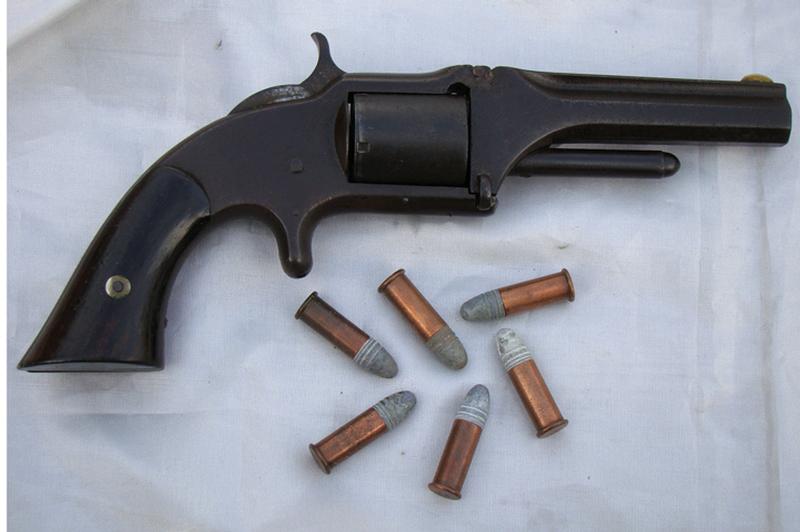
By 1857, they came out with the newly-designed revolver-and-cartridge combination firearm. They produced the first metallic cartridge breech-loading revolver in America, and the small pistol was a success. It would become known as the Smith & Wesson Model One.

The Smith & Wesson Model One


S&W Model One, First Issue

File:Smith & Wesson Model 1, 2nd Issue.jpg
          S&W Model One, Second Issue

It was a revolver that everyone was looking for. It was small, easy to carry and conceal, and they sold like hot cakes! Everyone wanted one!

Introduced in 1857, the tiny 7 shot .22 caliber S&W Model One is what began the Smith & Wesson legacy. It was the foundation for all modern cartridge handguns. And yes, the Model 1 was a 7-shot chambered for the original .22 rimfire, which is dimensionally about identical to the modern .22 Short.

Now, if you are lucky enough to own a Model One, please be advised that although it is dimensionally about identical to the modern .22 Short -- it is important that you know that today's modern .22 Short is loaded to much higher pressures because of today's use of smokeless powder.

Simply put, this means we should not use modern .22 Short ammo in an old S&W Model 1.  It just might blow up in your hands! 

The success of the Smith & Wesson Model 1 was due to a combination of new innovations. First, it had a bored through cylinder, and second, it took self-contained metallic cartridges. The patent to the bored-through revolver cylinders for metallic cartridge use was held by a gunsmith by the name of Rollin White who had patented his invention. Smart man!

Smith and Wesson owned the famous April 3, 1855, "Rollin White patent" covering the right to make a revolver cylinder bored-through end to end which was an obvious requirement for an effective cartridge revolver. Both Smith and Wesson personally negotiated with Rollin White for assignment of the patent. In the end, they agreed to pay him a 25 cent royalty on every pistol sold. In return, Rollin White agreed to pay any legal fees associated with the defense of his patent against any infringements.

After that, for more than a decade, Smith & Wesson was the sole proprietary manufacturer of this technological improvement. However, the success did not come without a fight -- and in some cases the technology was stolen. There were many firms who proceeded to make the highly popular cartridge style revolvers with the S&W design.

Some of these firms used their own designs, and some just produced outright copies of the S&W pattern. Other manufacturers quickly developed unique metallic cartridges and cylinders designed to circumvent White's patent - and of course, Rollin White would take those manufactures to court.

With S&W seeking redress in court, several gunmakers were required to mark their revolvers "Made for S&W" or words to that effect. But no, that didn't stop foreign companies from making copies, and some domestic makers from borrowing the design after the patent had expired.

It is interesting to note that though Jack McCall was said to have used a .45 caliber handgun to shoot Wild Bill Hickok in the back of the head while Hickok sat at a poker table in Deadwood, North Dakota - it was later reported that he used a Model One Smith & Wesson pistol.

The 1860s was a great time for gunmaking in America. Innovations and new designs were coming out of everywhere, and many small gunmakers found a great deal of opportunity show what they had to offer.

Just for the record, in November of 1865, Colt did attempt to purchase a license to the Rollin White patent from their competitor Smith & Wesson. I was surprised to find out that Rollin White and Smith & Wesson would take no less than $1.1 Million -- so Colt decided it was too large an investment on a patent that would expire in 1868.

For one thing the onset of the American Civil War was just a few years away. With the coming war, there would be a great demand for all sorts of arms and munitions.

Smith & Wesson Model 1 was produced with two generations between 1857-1882, but that doesn't mean they sat on their success. Just four years after the Model 1, they came out with the Model 2 Army revolver.

The S&W Model 2


File:Smith & Wesson Army No 2.JPG

And yes, for you folks who know what took place in 1861, Smith & Wesson brought out their Model 2 in 1861 just in time for the start of the Civil War. Gun-manufacturers of all kinds went into mass production of just about anything that shoots, and that included Smith & Wesson pistols.   

Unlike the small Model One, the Model 2 was a full sized revolver with a 6" barrel and .32 caliber rim fire ammunition. It was chambered for both the .32 short and long cartridges. 

Of the 77,000 made from 1861 to 1874, approximately half were made during the Civil War. Because the Model 2 was much bigger and more powerful pistol than the S&W Model One, the Model 2 was much more effective. After all, anything up from a .22 caliber ball had to be considered an improvement by those needing a more effective pistol.

So why was it called the "Army" or even the "Old Army"? So why, especially since the pistol was non-military? Non-military meaning that it was never officially purchased through the military system.

Well, believe it or not, the S&W Model 2 picked up the moniker of "Old Army" because of its popularity. It was just that popular. In fact, it was bought in very large quantities by Officers and Enlisted men alike during the Civil War as the sales numbers show.

As with some other arms carried during the Civil War, many in the militarys on both sides purchased their own arms so that they would be able to carry something other than the antiquated firearms being issued at the time. This tradition of going to war after purchasing your own weapons was carried on for many years even in the early 1900s.


Part of the popularity of the Model 2 can is due to the way it loaded. It was like the second generation Model One in that it was a "tip up" design. A "tip up" loading system is where the barrel tips up and the entire cylinder can is replaced with a full cylinder if needed.

That, my friends, was a big deal! You see, with the exception of Smith & Wesson pistols, all other pistols during the Civil War were tediously loaded with either combustible paper cartridges or with loose powder and ball.

Both loading methods consisted of inserting the powder and bullet from the front, and then with the rammer was built into the gun you would swage the bullet into place. The swaging held the bullet from falling out when the gun recoiled when fired. Finally, a percussion cap was individually fitted to the back of the cylinder with one required for each of the five or six chambers.

Because reloading could take minutes, if extra cylinders could be found, two or more spare cylinders were carried pre-loaded. The cylinders would be switched much more quickly than reloading a fired one.

Because of this, and even though it was under-powered with its small .32 caliber round, the Smith & Wesson Model 2 Army can hold the distinction of probably being the most popular secondary pistol carried in the Civil War.

And please remember that the Great Western Migration was still going strong after the Civil War, so the Model 2 was not only popular during the Civil War - but it also very popular afterwards on the Western frontier.

I've read lately where General George Armstrong Custer, who owned a lot of different makes of guns, owned a pair of Model 2 Smith & Wesson pistols.  I've also read that Wild Bill Hickok carried one on the night that he was shot in the head and killed, but I haven't been unable to confirm that.

There is one Model S&W pistol hardly talked about. It is the "Model One and a Half." It appears that after Smith & Wesson produced the Model 2, they then set out to provide the more powerful .32 rimfire in a more handy "pocket" size revolver. That's when they came up with a five shot .32 rimfire with a shorter 3½" barrel.

Since they already had the small Model One and the large Model 2, and the new model was in between and size, Smith & Wesson came up with the somewhat awkward name of "Model One and a Half."

No kidding, it's might sound dumb - but it's true.

Some say the original Model 1½ looked like a shrunken Model 2, others say it looked more like an enlarged Model One Second Issue. In reality, in 1868, S&W redesigned the Model 1½ to look more like an over-sized Model One as a Third Generation Issue. Because of that, we have the Model 1½ "Old Model" with the square butt, octagon barrel, and the unfluted cylinder, and we have the Smith & Wesson Model 1½ "New Model" with bird’s head butt, fluted cylinder, and round ribbed barrel.

In 1867, Smith & Wesson began a global sales campaign that introduced the company's revolvers and ammunition to new markets, such as Russia, and established the company as one of the world's premier makers of firearms.

Then came the year 1870 and the Smith & Wesson Model 3, and as far as I'm concerned - it was actually a pistol ahead of its time in many ways.

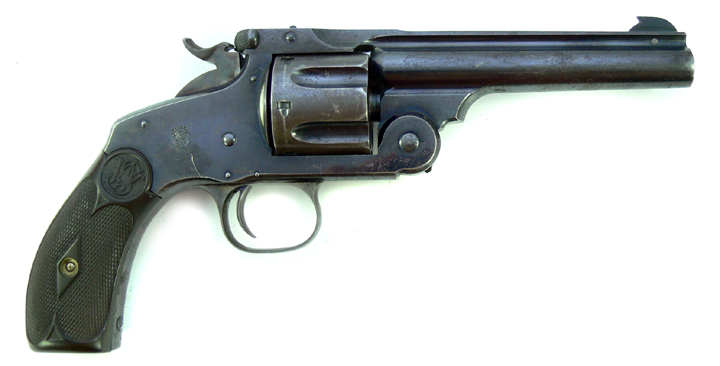
The S&W Model 3
All in all, when looking at the Smith & Wesson Model 3. it was a single-action, cartridge-firing, top-break revolver that saw a production from 1870 to 1915. It was produced in several variations and sub-variations.

One version of the Smith & Wesson Model 3 eventually became known as the "American Model." Other versions became known as the "Russian Model," the "Schofield Model," and the New Model 3 which was a favorite of none other than Wyatt Earp.

The US Army adopted the Model 3 as the "Schofield" and used it throughout the Indian Wars of the West. This is large frame Smith & Wesson top-break revolver with a trigger guard, manufactured in three variations from 1870 to 1915. The Model 3 includes the American, the Russian, and the Schofield models.

Unlike the "tip up," this was a "top-break" revolver. So realistically, a shooter could easily fire his last round, crack her open, dump the used shells, and reload. Later models actually had an ejector when it was opened so that the spent shells would automatically be tossed out.

There is some disagreement if half-moon clips were designed as an 1870s version of a speed-loader for the S&W Model 3. I've read where they were designed to assist Cavalry soldiers who were reloading while in the saddle. And yes, I've read where they were around in some crude form.

Years ago I read that it was the British gunmaker P. Webley & Son who was the first to develop the "top-break" system. But frankly, there is proof that Webley and others got the "tip up"  and the "top break" systems of reloading from Smith & Wesson. As for who copied who, let's just say that there were a lot of gunmakers who used that system after the 1870s. Among them were Harrington & Richardson, Iver Johnson, Forehand & Wadsworth, and others. 


The pistol above, illustrated the top-break reloading system. The ejector rod extended to rid the pistol of its spent rounds. This auto-eject system was quite a technological break through. 

Compare the loading procedure of the S&W Model 3 to that of the Colt Peacemaker which arrived on the scene after it was designed for the U.S. government service revolver trials of 1872 by Colt's Patent Firearms Manufacturing Company. You will quickly learn why the Model 3 was a fan favorite of lawman, outlaws, and our military. 

And remember, in the Old West, sometimes the lawman who carried the Model 3 in his job as a lawman was also outlaw wanted somewhere else at the same time. Either way, many stayed with the firearm that gave them the best reliability and ease of reloading in a hurry.

All in all, the Model 3 has been reportedly used by Jesse James, John Wesley Hardin, Pat Garrett, Virgil Earp, Wyatt Earp, Billy the Kid, and many others. In fact, the Smith & Wesson Model 3 American was famously used by notorious Wyatt Earp at the shootout near the OK Corral. 

Wyatt Earp's Model 3 was given to him by the mayor of Tombstone just a few days before the famous gunfight took place. It is believed that Wyatt Earp used a Smith&Wesson "New Model" Model 3 revolver during the OK Corral gunfight.

How popular was it? The Smith & Wesson Model 3 was produced in the newly developed .44 S&W caliber round in great numbers and the U.S. Army adopted the Model 3 American in 1870. That made it the first standard-issue cartridge-firing revolver in the history of the U.S. military. Most military pistols up until that point were black powder cap and ball revolvers.

But wait, I'm sure someone is going to write me to inform me that Colt's first metallic-cartridge revolver was produced in 1871 as an open-top revolver. They will probably inform me that that was a completely new design for Colt as the parts would not interchange with the older percussion pistols.

The caliber was .44 rimfire and it was submitted to the U.S. Army for testing in 1872. Actually, the U.S. Army rejected the Colt pistol. And yes, the Army did in fact ask Colt to come back with a more powerful caliber with a stronger frame if they wanted a contract.

Colt redesigned their frame to incorporate a top-strap, which was strangely similar to the Remington revolvers that were already out at the time, and placed the rear sight on the rear of the frame. The first prototype was chambered in .44 rim fire, but the first model was in the new caliber known as the .45 Colt. That model Colt revolver was chosen by the U.S. Army in 1872. Their first order was for 8000 revolvers.

Shipping in the summer of 1873. the Colt Single Action Army or "Peacemaker" was born. And yes, it became one of the most prevalent firearms in the American West. 

In 1875, the U.S. Ordnance Board granted Smith &Wesson a contract to outfit the military with the new Model 3 Smith & Wesson revolver that incorporated the design improvements of Major George Schofield.

His improvements on the Model 3 made the Model 3 loading system that much more easier to use. The design became known as the Smith & Wesson Model 3 "Schofield" or simply the "Schofield revolver" as a tribute to the Major.

So why did I talk so much about Colt? Well, that's because of what happened next.

The U.S. Army loved the new design of the S&W Model 3 but demanded that they make their new Model 3 Schofield revolvers work with the new .45 Colt round.  First, it was proven to be more potent than the 44 S&W caliber rimfire round that the Model 3 had been chambered for. And second, besides the issue of it being a more potent round, the Army had all sorts of .45 Colt ammo in it's supply chain to be used and could not justify bringing in another pistol with a whole new cartridge to content with.

Because the Army already had the 45 Colt Peacemakers in service, along with the ammunition to go with them, the U.S. Army working with the Navy and Marine Corps wanted to standardize their weapons.

You would think that re-chambering their pistol's design to accommodate the longer .45 cartridge would not be that hard to do. In 2012, Smith & Wesson sold a Model 3 Schofield exactly like the one that the Army asked for back in 1875.

All that Smith & Wesson had to do was to just re-chamber its design, then sell them by the thousands! But no, instead of doing so, Smith & Wesson decided to develop their own slightly shorter .45 caliber round - it was called the ".45 Schofield."  Later it would be called the ".45 S&W" - and yes, it was less potent than what would become known as the ".45 Long Colt."

When it became obvious to the U.S. Army that the .45 Colt and the .45 S&W cartridges were not interchangeable between the Smith & Wesson Model 3 Schofield  and the Colt Peacemaker - yet both rounds did work in the Colt - the U.S. Government decided to take action.

They decide to adopt the Smith & Wesson Model 3 Schofield with the shorter .45 S&W cartridge as their standard pistol and cartridge.

But wait a minute, why the Model 3 Schofield?

Granted the Army sees that the .45 round used in the Army's S&W Model 3 Schofield will also work in their Colt Peacemakers which they already had on hand, but the Army also sees that the .45 S&W cartridge is an inferior round to the .45 Colt.  So why did the U.S. Army adopt the inferior round?

Well it appears that Major George Schofield had patented his locking system used on the Schofield revolvers - and earned a payment on each gun that Smith and Wesson sold.  That it itself might not be illegal, but when the Army brass found out that his older brother, John M. Schofield, was the head of the Army Ordnance Board - well that was not a good thing for Smith &Wesson and the Schofield revolver.

Imagine that! Having your brother on the Board that may approve the purchase of thousands of guns with your patented locking system might be seen as being inappropriate? Some might see it as an "unfair edge" to have your brother on the board approving the purchase of the equipment that you're selling?

Maybe, but that's not what really killed the Schofield for the U.S.Army.

You see despite the official change, old stock of the longer and more potent .45 Colt rounds were still in the supply line.  This availability of a proven "man-stopper" caused the Soldiers to stop using the new Schofields and go with the knock-down power of the .45 Colt Peacemakers.

So between the Soldiers not wanting the Schofields, though they did load easier, and of course the potential scandal regarding the conduct of the Army Ordnance Board, the U.S. Army ended their purchases of arms from Smith & Wesson.

And all in all, the .45 S&W Schofield revolver was manufactured from 1875 to 1878 with just under 9000 manufactured. Supposedly, many Schofield revolvers saw service in the Indian Wars. And yes, there are even reports that some of them saw some small use in the Spanish-American War and Philippine-American War.

It is believed that Teddy Roosevelt used a Smith & Wesson .45 Schofield revolver in Cuba with the Rough Riders. As for the Schofield, well after the Spanish American War in 1898 - the U.S. Army sold off all their surplus Schofield revolvers.

Personally, I can see why Teddy Roosevelt would have used the S&W Model 3 Schofield. Its ease to load, it's reliability, and it's ruggedness really make it a great pistol.

But then again, I really believe that the .45 S&W round that it was chambered to use was anemic in comparison to the knockdown power of the .45 Colt - and frankly, from what I've read about TR, I really don't know if he would want anything anemic in his arsenal.

Of course he could have opted for another maker, like say Colt, or he could have opted for a double-action revolver from an an assortment of makers at the time.

Of the two top gun makers in America, Colt came out with their double-action revolvers in 1877 and Smith & Wesson came out with theirs 5 years later. 

As stated before, the U.S. Army adopted the .44 S&W American caliber Smith & Wesson Model 3 revolver in 1870, making the Model 3 revolver the first standard-issue cartridge-firing revolver in US service. Prior to that, most military pistols until that point were black powder cap and ball revolvers.

S&W "New Model" Model 3 ( 1878 to 1915)
In 1877, Smith & Wesson discontinued production of its other Model 3 variation's such as the American, Russian, and Schofield -- in favor a new improved design called the New Model 3 in 1878.

Smith & Wesson New Model 3 was their perfected single action top break revolver, generally smaller and lighter than previous models. And yes, because it was smaller and lighter, it was more concealable.

It returned to the original Smith & Wesson barrel latch system of the American model, a change stemming mainly from the company's desire to stop paying royalties to George W Schofield.

It was one of the most popular revolver of the later frontier era. In fact, according to records, more Smith & Wesson New Model 3's were made than Colt Single Action Army pistols during the 19th century -- though the majority went to foreign military contracts.

The S&W Fourth Model -- A Double Action Revolver
Smith & Wesson's Fourth Model was a .38 caliber pistols, again using the popular top-break design, but these were in the newly created double-action firing system. And yes, they were known as "Self Cockers."

Usually these were smaller "pocket" pistols, but they did make a "Target" version - as well as a Combo Set which came with two different length barrels.

Though S&W had their huge overseas Russian contracts with a Russian version top-break design first introduced in 1870 in their large frame Model 3, they followed the Model 3 with medium frame top-breaks in .38 and .32 centerfire in 1876 and 1878.

The .38 S&W CF cartridge was more briskly loaded with a 16 grain black powder charge, topped by a 145 round nosed bullet.

Smith and Wesson manufactured and shipped in excess of 130,000 “New Model” or “Baby Russian” .38’s before finally taking it off line in 1891.

This medium powered round went on to be one of the most popular calibers of its time. All in all, the Fourth Model was a downsized Model 3 and were produced until 1907.

The Smith & Wesson Fourth Model differs from the S&W "New Departure" because the "New Departure" is hammerless and has a grip safety. The gun was offered with white Mother of Pearl grips or black hard rubber grips as standard.

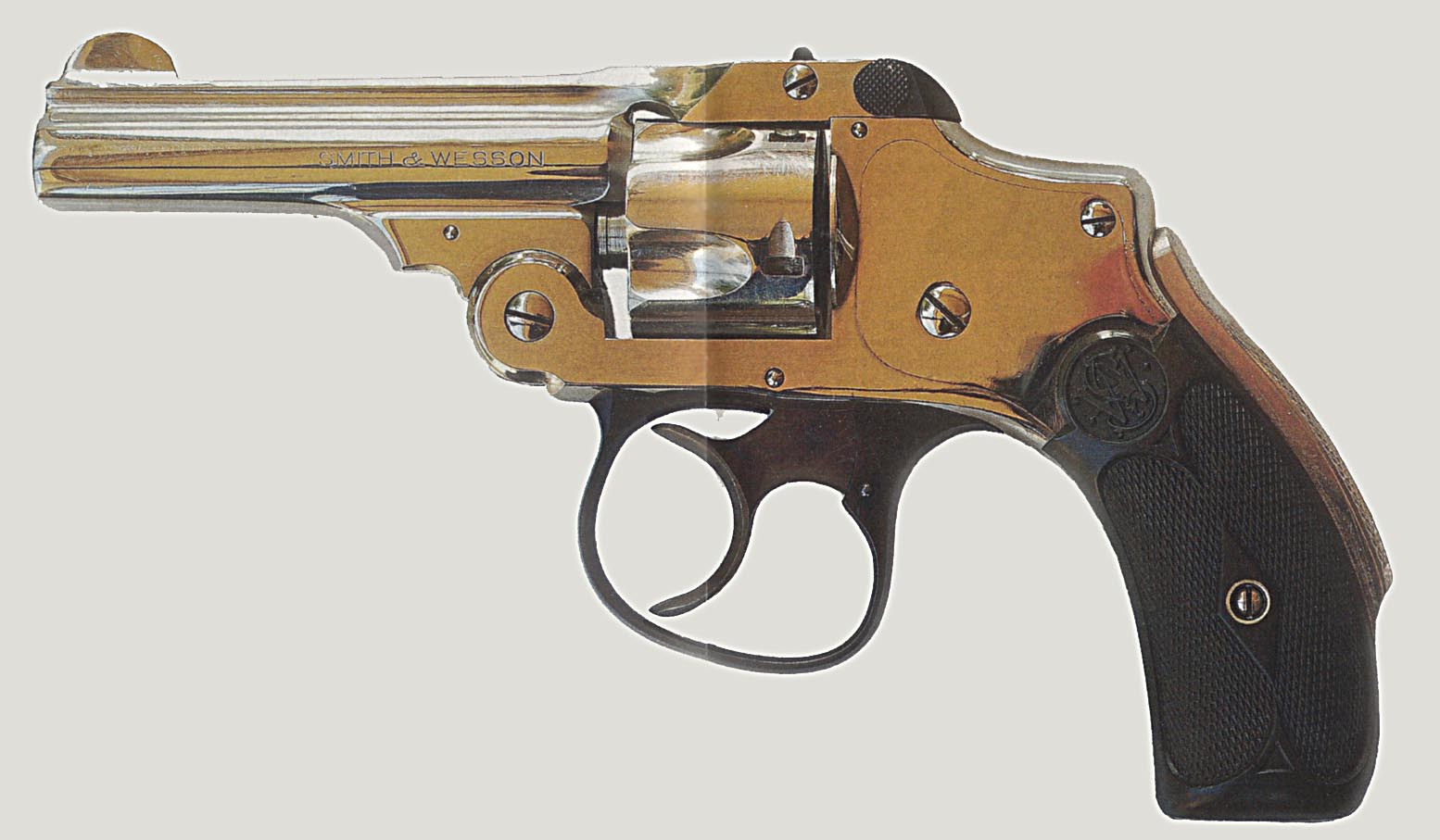
The S&W Double Action -- The New Depature aka the  Lemon Squeezer
Magazine Article photo
This "pocket pistol" was also known as the S&W Safety Hammerless was also known as the S&W "Lemon Squeezer". 

The "New Departure" got the nickname "Lemon Squeezer" because the grip safety had to be squeezed in order to fire the pistol. 

They were blued or nickel plated, and manufactured from 1888 to 1937, and they were chambered in the small .32 S&W (.32 Short) and fairly weak .38 S&W (aka .38 Short) 

Both of these calibers were discontinued at Smith & Wesson just before World War II for economic reasons and practicality. Simply put, there were better .32 and .38 caliber rounds out there to chose from.

With a five-shot cylinder, they were produced with a 2 inch, 3 inch, and 3.5 inch barrels. The first generation was manufactured between 1887-1902. It was followed by two more generations until it discontinued production in 1937.

The .38 caliber model was based on S&W's medium Model 2 frame, and the .32 caliber model was based on the small  Model One and a Half frame.

They did come out in a few different variations including "Hammerless" with a "Grip Safety."  It was because of this Grip safety that the New Departure Model "Safety Hammerless" is known fondly as the "Lemon Squeezer."

As requests for them went through the roof, the double-action pistol took the place of the single-action pistols in no time.

The "New Departure" was a very popular little gun selling over 500,000 during its production.

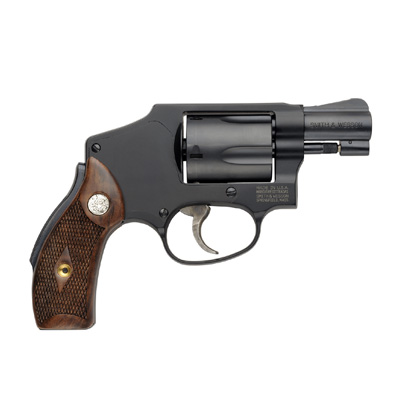
It should be noted that in 1952, S&W introduced its Centennial Model revolver, so named because it commemorated the 100th year of the company's history.
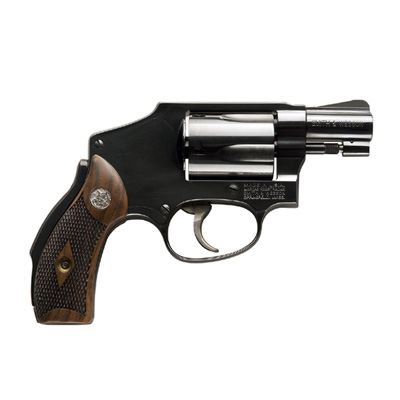
Model 40 - Smith & Wesson website
S&W Model 40
It was a .38 Special J-frame 2" barreled revolver with no external hammer. It had a grip safety almost identical to that used on the Safety Hammerless models.

This was a swing-out cylinder type, of course, but the concept was very much in line with the immensely successful "Lemon Squeezer" which was its ancestor.

In fact, that nickname stuck with the newer gun, as well.

The Centennial Airweight model with an aluminum frame was also introduced in 1952, with full-scale production beginning in August 1963. At first the Airweights had aluminum cylinders, but were replaced with steel cylinders quickly for safety reasons.
Model 42 - Smith & Wesson website
S&W Model 42

They became the Models 40 and 42 in 1957, when model names were replaced by model numbers at the S&W factory.

In 1974, these two revolvers were dropped from the S& W production line.

The S&W Model 640 stainless steel Cenntenials, with no grip safety have been made since 1989 and the Model 642 Centennial Air weights (aluminum frame and stainless cylinder) since 1990.

The blackened aluminum/stainless Model 442 Centennial Airweight came on stream in 1993. Then in 2007, an updated and strengthened all-carbon steel modern "Lemon Squeezer" version of the Model 40 was introduced as the Model 40-1, available in blue, nickel, and case-hardened finishes.

These revolvers are complete with grip safeties and their heritage goes back to the original Safey Hammerless models of 1886.

Unlike many other revolvers in the Smith & Wesson lineup, the 2007 version Model 40-1 has no politically correct internal key-lock on the left side of the frame.


So yes, during the 1800s, Smith & Wesson would produce some of the most iconic firearms in history -- and many would influence the production of other designs many many years later. But frankly, that was only their beginning, they would became even more famous during the 20th Century!