Sunday, July 28, 2013

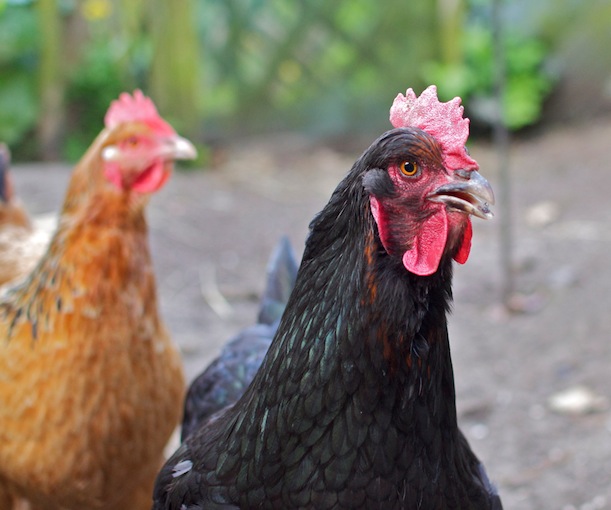
Chicken Facts & Trivia


Have you ever wondered how a hen can lay an egg every day? Why some eggs are brown and some eggs are white? How many days an egg takes to hatch?

Here are the answers to those questions and many more.

Hens and eggs

• Female chickens are called pullets for their first year or until they begin to lay eggs. For most breeds, around 20 weeks is a typical age for the first egg.

• Some breeds lay eggs daily, some every other day, some once or twice a week.

• Some individual hens never lay eggs, due to narrow pelvises or other anomalies.

• Normal laying routines can be interrupted by molting, winter daylight shortage, temperature extremes, illness, poor nutrition, stress, or lack of fresh water. Hens usually return to normal laying habits when the disruption-causing factor ends or is corrected.

• Most hens are productive layers for two years before declining in production, but some continue to lay eggs for several years.

• Hens will lay eggs whether or not they’ve ever seen a rooster. Roosters are necessary only for fertilization of eggs.

Egg development and laying process

• A female chick is born with thousands of tiny ova, which are undeveloped yolks. Once she reaches maturity, an ovum will be released into a canal called the oviduct and begin its journey of development.

• At any given time a productive hen will have eggs of several stages within her reproductive system. The eggs most recently discharged from the ovary are just tiny yolks, and the eggs farther down the oviduct are progressively larger and more developed.

• From the time an ovum leaves the ovary, it takes approximately 25 hours for the egg to reach the vent for laying. During that time period, the yolk will grow larger while being surrounded by albumen (egg white), wrapped in a membrane, and encased in a shell. Pigment is deposited on the shell as the last step of the egg production process.

• If sperm is present, the yolk will be fertilized before the albumen is deposited.

• As a chick embryo develops in a fertilized egg, the yolk provides nourishment and the albumen cushions the embryo.

• Although a hen has only one exterior opening (the cloaca or vent) for egg laying and elimination, eggs are not contaminated during the laying process. Two separate channels, the oviduct and the large intestine, open into the cloaca. As the egg nears the end of the oviduct, the intestinal opening is temporarily blocked off. The egg passes through the cloaca without contact with waste matter.

• The typical interval between eggs laid is about 25 hours, so a hen that lays an egg every day will lay a bit later each day.

• Hens don’t usually lay eggs in the dark, so once a hen’s laying cycle reaches dusk time, she will usually not lay till the following morning.

• Eggshell production drains calcium from the hen’s body. The comb, wattles, legs, and ear lobes will fade as the calcium leaches out.

Calcium must be replenished through either feed containing calcium, supplements such as oyster shell, or high amounts of calcium in the soil of birds with outdoor access.


Egg variations
• Young pullets often lay malformed eggs before getting established in a normal laying routine. Older hens may occasionally lay abnormal eggs due to age, stress, or illness.

• Pullet eggs--the first ones produced by each pullet--are smaller than the eggs that the same hen will produce as an older hen.

• “Fart egg” and “oops egg” are terms for tiny eggs that quickly pass through the oviduct without reaching full size.

• Shell-less eggs are released before they have time to develop a shell. They may have membrane holding them together or just be loose yolk and white.

• Double eggs or “egg in an egg” are created when an egg with a shell is encased by the next egg in the oviduct and a shell is produced over the outer egg as well.

• Double yolkers may have a normal amount of egg white with two or more yolks. In the shell, the egg may be unusually large.

• Yolkless eggs, also called no-yolkers, dwarf eggs or wind eggs, consist of egg white alone.

• Occasionally an egg will come out with a wrinkly, misshapen, rough, bumpy, or unusually colored shell.

• Egg size is dependent on breed, age, and weight of the hen. Larger chicken breeds tend to lay larger eggs; banty breeds lay small eggs. Older hens tend to lay larger eggs than younger hens.

• The shell color is a breed characteristic. Most chicken breeds lay light-to-medium brown eggs. A few breeds lay white, dark brown, green, blue, or cream colored eggs.

• Shell color is only “skin deep”-- the eggs inside are the same as eggs of other colors.

• The shell color intensity of eggs laid by one hen can vary from time to time, with an occasional darker or lighter eggshell.

• While most eggs have a slight sheen to the shell, some breeds or individual hens tend to lay eggs with a chalkier texture.


Chicken-and-egg behavior

• Most hens will lay eggs in the same nest box as flockmates, so it’s not necessary to have a nest box for each hen.

• Some hens like to lay their eggs in private and others will join their sisters in the nest box. Often two or three hens will crowd into one box while another nest box remains empty.

• Sometimes a hen will sit on previously laid eggs and add her egg to the clutch. Another might prefer to sit in another area and deposit one egg by itself.

• Often a hen will sing “the egg song” before or after she lays an egg.

Some will sing during the process of laying. It is a cheerful song that seems to be a proud announcement.

• Chickens learn by example, so a fake or real egg left in a designated nest box may encourage hens to lay there instead of on the floor or outdoors.

• Unconfined hens may lay eggs anywhere outdoors if they don’t want to return to the nest box. Sometimes a free-ranging hen will go missing and reappear weeks later with a parade of chicks.

• Chickens like to eat eggs, even their own. An egg that gets accidentally broken will likely be eaten by one of the chickens.

If you occasionally find pieces of shell or egg yolk in the nest box, it’s usually nothing to be concerned about.

• Some chickens become habitual egg-eaters that break eggs open and eat them. An egg-eater should be culled from the flock if you wish to have eggs for the kitchen.

Not only will that chicken continue to eat eggs, but others will learn from watching and you may end up with several egg-eaters.

• Holes in eggs and cracked eggs do not necessarily mean there is an egg-eater in the flock.

A hen can accidentally crack an egg in the nest when she sits down or adjusts the nest to lay her own egg.

Sometimes curiosity or boredom leads a chicken to peck at an egg without the intention of eating it.

• Chickens can be fed their own or other eggs either raw or cooked.

Eggs provide protein and the calcium in the shell is beneficial for laying hens. A potato masher can be used to break boiled eggs into pieces of egg and shell.

• Empty eggshells from the kitchen can be fed back to chickens as a calcium supplement without concern for developing egg-eaters.

However, to be safe, crushing the shells or running through a blender is a good idea.

Chicken birds and bees

• Baby chickens are chicks. Female chickens are pullets until they’re old enough to lay eggs and become hens.

• Male chickens are called roosters, cocks or cockerels, depending on the country you’re in.


• A rooster announces to a flock of chickens that he’s found food with a “took, took, took.” But the hens don’t pay attention if they already know that there is food around.

• Roosters perform a little dance called ‘tidbitting’ in which they make sounds (food calls) and move their head up and down, picking up and dropping a bit of food.

Researchers have found that females prefer males that often perform tidbitting and have larger, brighter combs on top of their heads.

• A female chicken will mate with many different males but if she decides, after the deed is done, that she doesn’t want a particular rooster’s offspring and can eject his sperm.

This occurs most often when the male is lower in the pecking order.
• Scientists think that the rooster’s wattle–the dangly bit beneath his beak–helps him to gain a hen’s attention when he is tidbitting.

• The only reason a rooster would be required with a flock of hens is to fertilize eggs.

As a side job, a good rooster also serves as a watchman, warning his hens of predators and other dangers. He also seeks out food for his harem.

• Even with a virile rooster in residence, not all eggs will be fertile.

Some hens just don’t interest a rooster and others never get caught. And yes, often, roosters will have favorite hens that get most of their attention and others remain unnoticed.

• Hens do not have an estrus cycle. They can mate and develop fertile eggs at any time.

• Sperm can remain viable in the hen’s oviduct for three to four weeks, so one mating will fertilize numerous eggs.

Brooding and hatching

• A broody hen of any breed can be used to hatch eggs and raise chicks from other hens of any breeds.

• A broody will sit on any eggs, whether or not they are fertile and regardless of who laid them.

To gather a suitable clutch of eggs, she will not only lay her own eggs but may roll other hens’ eggs into her nest.

• While a hen is brooding, you can remove daily any extra eggs she gathers into her clutch.

Drawing pencil “equator” lines around the eggs you want her to brood will help with identification.

• A setting hen will usually leave the nest at least once a day to eat, drink, and defecate.

The eggs are not in danger of cooling off too much during a normal foray into the coop or run.

• Typically, chicken eggs hatch about 21 days from the beginning of incubation or nesting by a broody hen.

A few days early or late is not unusual, and some breeds lean toward earlier or later hatches.

• Not all fertile eggs will develop into embryos. Some never develop due to egg deficiencies or temperature fluctuations.

• Not all chick embryos will successfully hatch. They can die any time before hatching, even after pipping a hole in the egg.

Double yolk eggs rarely hatch due to crowding during embryo development.

• If a broody hen has pushed an egg out of the nest, she probably knows something is not right with that egg or embryo.

In the kitchen

• A normal fresh egg has a yellow yolk, a layer of thick albumen (egg white) surrounding the yolk, and a thinner layer of albumen surrounding that.

• At opposite sides of the yolk are two chalazae, short white twisted strands of albumen that anchor the yolk to the white. A large chalaza does not indicate embryo development.

• Every egg yolk has a white disc called a blastoderm. It is usually visible but may be very pale.

In an infertile egg, the blastoderm is solid white. In a fertile egg, the disc has a faint or distinct ring that makes it look like a donut or bulls-eye.

• Fertile eggs are completely edible.

In fact, some people consider fertile eggs more nutritious than infertile eggs, but scientific research does not confirm this.

• Fresh fertile eggs collected daily will not have embryos in them.

Embryos do not begin to develop unless the eggs are in a favorable warm environment under a broody hen or in an artificial incubator.

• The yolk of a chicken egg may be any shade from pale yellow to orange, depending on what the hen has eaten.

The color is usually consistent if hens are fed only one type of feed, but foraging hens and those fed kitchen scraps will often produce a variety of yolk colors.

• The egg yolk or egg white may have red or brown specks in it.

These “blood spots” and “meat spots” are harmless bits of tissue and are allowed in commercial Grade B eggs.

If they look unappealing, the spots can be removed with a spoon or knife before cooking.

• An eggshell has a protective coating that prevents bacteria from entering the egg. To retain this coating, eggs should not be washed until just before use.

• Some eggs are soiled with blood from minor tissue damage or mud or feces from the nest box. This can be wiped off carefully; the shell should be thoroughly dried.

• If you aren’t sure how old an egg is, you can submerge it in water.

The freshest eggs will remain at the bottom of the container, while old eggs will float.

Floaters should either be discarded or opened far from your nose.

Did you Know? List of Facts about Chickens

Facts are statements which are held to be true and often contrasted with opinions and beliefs.

Our unusual and interesting facts about Chickens, trivia and information, including some useful statistics about animals will fascinate everyone from kids and children to adults.

Interesting Facts about Chickens are as follows:

Definition: The chicken (Gallus gallus domesticus) is a domestic fowl bred for meat or eggs.

Gallinaceous birds are described as heavy-bodied ground-feeding domestic or game birds including Turkeys, grouse, quail, pheasant and chickens.

The chicken, Gallus gallus domesticus, is a domestic subspecies of the red junglefowl, a member of the pheasant family that is native to Asia. Genetic studies have found that the grey junglefowl also contributed to the chicken’s evolution.


The chicken is the most populous bird in the world. With 50 billion chickens in the world, there are more of them than any other bird species.

Over 50 billion chickens are reared annually as a source of food, for both their meat and their eggs

Chickens farmed for meat are called broiler chickens, those farmed for eggs are called egg laying hens

It is believed that chickens were first domesticated over 10,000 years ago in the far east

Males chickens are referred to as "roosters" in the United States and Canada and "cockerels or cocks" in the United Kingdom.
Castrated roosters are called capons

Female chickens, over a year old, are called hens, and younger females are called pullets

Lifespan between 5 - 10 years, however, a free range meat chicken will usually be slaughtered at about 14 weeks

Domestic chickens are not capable of long distance flight unlike birds

A group of chickens is called a flock

Coxcomb - A coxcomb is the the fleshy red crest on the head of the domestic fowl

The direct ancestor of the domestic chicken is believed to be the Red Jungle fowl (Gallus gallus) which is a tropical member of the Pheasant family

Eggs contain just 85 calories each but are packed with nutrients including protein, zinc, iron, iodine and vitamins A, D, E and some B vitamins.

General dietary recommendations from the American Heart Association are that adults eat no more than 3-4 eggs yolks each week

Chicken diseases: Chickens are susceptible to parasites including lice, mites, ticks, fleas and intestinal worms

Bird Flu is a virus known as Avian Influenza. Avian influenza (a.k.a. bird flu) is extremely contagious and can make chickens very sick and kill them.


The highly pathogenic form of the disease can kill off 90 to 100 percent of birds in a flock in just 48 hours.

"Which came first, the chicken or the egg?"
Answer: Recent studies show that the chicken came first, because of the methodology of evolution. An egg cannot occur unless a a chicken is able to lay that egg

Chickens are the closest living relative of the dinosaur called the tyrannosaur

Ameraucana and Araucana can lay eggs colored in shades of green or blue, depending on the breed

Chicken are pretty fast. The chicken can travel up to 9 miles per hour when it wants to.

Little Known Chicken Facts:

The largest ever recorded chicken egg weighed nearly 12 ounces, and measured 12.25 inches around.

Chicken language has real meanings. The birds give different alarm calls depending on which type of predator is threatening them.

There are more chickens on Earth than there are humans.

Chickens can cross breed with turkeys. The result is called a 'Turkin'.

There are four cities in the United States that have the word "chicken" in their name: Chicken, Alaska; Chicken Bristle, Illinois; Chicken Bristle, Kentucky; and Chicken Town, Pennsylvania.

The greatest number of yolks ever found in a single chicken egg was nine!

Chickens experience REM (rapid eye movement) sleep.

The chicken is the closest living relative of the tyrannosaurus-rex.

In Gainesville, Georgia, (the chicken capital of the world), a local ordinance makes it illegal to eat your chicken with a fork.

The waste produced by one chicken in its lifetime can supply enough electricity to run a 100 watt bulb for five hours.

China has the most people in the world, and also has the most chickens.

There are over 3,000,000,000 chickens in China! That's 3 billion chickens!

The United States has only 450 million.

The longest recorded distance flown by any chicken was 301.5 feet.

The record for laying the most eggs in one day was seven.

There are more chickens in the world than there are of any other domesticated bird. In fact, there's more than one chicken for every human on the face of this earth.

Chickens can fly, but not for long. The longest recorded flight of a chicken is only thirteen seconds.

A chicken will lay bigger and stronger eggs if you adjust the lighting in their cages to make them think each day is 28 hours long, instead of 24.

Chickens eggs come in colors sometimes, (other than white and brown). Some breeds lay eggs in shades of blue or green. Ready-made Easter Eggs!
The fear of chickens is called 'Alektorophobia'.

Laid head to claw, all the chickens consumed from KFC worldwide would circle the Earth at the equator 11 times.

This bird was probably first domesticated for the purpose of cockfights, not as food.

Chickens aren’t completely flightless—they can get airborne enough to make it over a fence or into a tree.

These birds are omnivores. They’ll eat seeds and insects but also larger prey like small mice and lizards.

There are dozens of chicken breeds, such as the Dutch bantam, leghorn and Rhode Island red.

Chickens are sometimes kept as pets and can be tamed by hand feeding, but roosters can sometimes become aggressive and noisy, although aggression can be curbed with proper handling.

Some have advised against keeping them around very young children. Certain breeds, however, such as silkies and many bantam varieties are generally docile and are often recommended as good pets around children with disabilities.

Some people find chickens entertaining and educational, while others just find them tasty!


Saturday, July 27, 2013

Basic Beef Production Guidelines

Melanie Barkleyby Melanie Barkley,
Bedford county extension agent,
Penn State Extension, College of Agricultural Sciences.

Raising beef cattle for profit can be a satisfying enterprise. However, there are several management skills that each beef producer should have to be successful.

Each beef cattle enterprise has different resources: land, labor, capital, feed and management.

To raise beef cattle profitably, you must manage these resources to maximize returns.


Below are some other guidelines to make this enterprise successful.

Where Can I Get Information?

A large amount of information is available on beef production through books and magazines.

With the electronic age, you can also access information over the internet from many universities and in particular, their Cooperative Extension systems. For copies of printed information, you can also visit your local Cooperative Extension Office.

Other suggestions for developing a working knowledge of beef production are to join a local beef producers organization and visit with other local producers.

Most producers are more than happy to share their knowledge. Be sure to visit their operations also for ideas on handling, management, and breeds.

Another important person to gain knowledge from is your veterinarian. Discuss health concerns and management suggestions with your vet.

What Type of Cattle Should I Raise?

Normally, the sole source of your income from a beef operation will come from the calves produced each year.

So, it is important that your cows produce a calf at least every 12 months.

Be conscious of selecting as well as keeping good productive cows who will produce a calf every year without assistance, maintain their body condition without becoming overly thin or fat, and raise a calf with an average weaning weight that meets your goals.

Other considerations to make when choosing cows are the breed and what type of operation (purebred vs. commercial).

Breeds of Beef Cattle

Beef cattle are generally divided into two different groups: maternal breeds vs. terminal breeds.

Generally, maternal breeds are known for their milk production and mothering ability while terminal breeds are known for their growth and meat producing ability.

As with anything in life, there are some exceptions to this rule.

Some breeds are also known as dual purpose breeds because they combine muscling for meat production with excellent maternal characteristics.

For more information on breeds of beef cattle, visit the Oklahoma State Beef Breeds Directory at www.ansi.okstate.edu/BREEDS/cattle.

Crossbreeding can help you to combine the best attributes of individual breeds into one package.

Choose traits that are important to you and then seek a breed or a crossbred that exhibits those traits.

Type of Operation

Before you get started in the beef business, you will need to ask yourself what type of operation you would like to run.

Some of the typical options are cow/calf, backgrounding feeder calves, or feedlot.

The cow/calf producer keeps a herd of cows to produce calves.

The backgrounder buys weaned calves and turns them out on pastures until they reach 800 to 900 pounds.

The feedlot operator purchases weaned calves or backgrounded calves and feeds them to market weight.

If you choose to become a cow/calf oepration, you will also need to decide whether you would like to run a purebred or a commercial operation.

A purebred operation typically raises cattle of one breed.

Often a purebred operation will have all registered cattle that can also be sold through purebred sales.

A commercial operation may have unregistered purebred cattle or they may have crossbred cattle.

Commercial producers can have the benefit of hybrid vigor which is simply the ability of crossbred offspring to increase in productivity over the average of the breeds that were part of the cross.

This means that a crossbred calf could grow faster and thus weigh more at a certain age than either of its parents.

Many purebred sales are held across the country throughout the year.

Sales may offer only one breed or they may offer a large variety of breeds for sale.

Also, you may want to become familiar with trends in the beef industry when choosing breeding stock.

Choose bulls that will compliment the outstanding traits in your cows and improve their weaknesses.

Cows for a commercial operation can be bought at a purebred sale and then used in a crossbreeding program or you can contact individual producers to buy larger numbers of heifers that could be purebreds or crossbreds.

Another option is to buy animals through an auction barn. Be aware however, that you are more likely to buy problem cattle through an auction barn.

Unless a producer sells all his calves through the auction, he may be selling only cull calves.

Beef producers who purchase calves to background or place in a feedlot often purchase calves directly from a cow/calf operator.

They may also purchase calves through feeder calf sales.

Most buyers will pay more for calves that have been weaned, dewormed and vaccinated because the likelihood of calves getting sick is greatly reduced.

Beef Operation Management

Management of a beef operation depends largely on the interests of the producer as well as the resources available such as land, feed, facilities, and others.

Management systems will vary depending on the climate.

Operations that have hard winters will want to provide access to shelter for the cows during extremely cold weather and during periods of cold rain.

Facilities

Facilities for beef operations will vary from fencing to barns, sheds or shelters.

Again, facility requirements will depend on whether your operation runs cattle only through the summer months or all year.

Any operation should have some type of handling system that allows a producer to easily catch and restrain an animal for routine health care procedures.

The handling system should include a corral system with a chute that leads to a head-gate.

A beef facility may also need feeding facilities.

This could be as simple as a mineral feeder for a backgrounding operation. Or, it may include barns and grain and hay feeders for the cow/calf operation.

In addition, a feedlot operation will need to account for adequate bunk or feeder space for the number of animals that are being fed.

A general rule of thumb for feeder space is to provide 18 to 22 inches for calves up to 600 pounds, 22 to 26 inches per head for calves 600 pounds to market weight, 26 to 30 inches per head for mature cows, and 14 to 18 inches per head for calves.

If you have feed available at all times, these sizes can be decreased.

Equipment

Regardless of what type of operation you run, you will need to keep a certain amount of equipment on hand.

Some of the smaller equipment that you would need might include syringes and needles along with medications for treating sick animals and halters for restraining those animals.

Large equipment needs will depend on your type of operation.

If you plan to grow your own feeds, you will need a tractor and the various planting and harvesting equipment.

For operations with pastures, you should have a brush hog or some type of mower to clip off the seed heads of pasture plants to keep them growing in a vegetative state.

A pasture plant will stop growing once it has produced seeds for the year.

Feed Requirements

Beef cattle will have varying requirements depending on their age and stage of production.

Calves will need a higher level of nutrition to allow for their growth, while mature dry cows will need a relatively low level of nutrition.

Pregnant cows in the last third of pregnancy require more nutrients than dry cows. Feed requirements also increase for cold weather and especially for cold rains.

Calves can be creep fed before weaning by setting up an area accessible to only the calves. The creep feed may contain grain, hay or both.

Creep rations can vary greatly depending on the price of grains.

The protein requirement decreases as the calves mature.

For example a creep ration for nursing calves could start at 18% protein.

Near weaning time (generally around 6 to 8 months of age) the level can be reduced to 14%.

This level can be maintained until you stop feeding grain daily.

This will depend on what type of operation you have and how much importance you put on maximum growth.

Backgrounded calves often receive only pasture.

This allows them to grow slowly until the fattening phase when they are in a feedlot.

The purpose of backgrounding is to add weight to calves using a cheap feed source.

Because these calves are older they are much less likely to become sick once they enter a feedlot.

Typically these calves have also been through a rigid preventive health program.

Mature cows should receive adequate nutrition so that they gain weight during the last third of pregnancy.

The protein level for cows is not as important as the energy.

The body condition of cows at calving has a large impact on their ability to rebreed.

Therefore, cows that are thin going into the winter months may need higher quality hay or possibly grain to help them improve their body condition for calving in the spring.

Bulls can be fed similar to cows.

When they are young and growing or while they are in production (breeding cows) they will need higher quality feed.

Bulls should be in good body condition at the start of breeding season to insure adequate sperm production for breeding the cows.

Breeding Season

Breeding seasons will vary depending on when you want your calves born.

Many producers will breed cows to calve in the spring so that they can take advantage of the flush growth of spring grass.

Other producers may breed cows to calve in the fall for the same reason.

Regardless of when the calves are born, the bull should be allowed to run with the cows for a specified period of time, typically 60 to 90 days.

This allows you to feed all your cows as one group, wean calves at the same time and feed those calves in the same group.

If you sell your calves at weaning time, you should also have a more uniform group of calves in terms of weight and age.

When breeding cows you will need to consider how many bulls can cover the number of cows you plan to breed.

A mature bull will be able to cover up to 30 cows on average. For yearling bulls, decrease the number of cows to 20.

In preparing bulls for breeding season, they should be in good body condition, not overly fat or thin.

Many producers use artifical insemination or A.I. to breed their cows.

This practice allows them to use very high quality bulls that they may not otherwise be able to afford.

These cows can be bred through visual identification of cows who are in heat or cows can go through an estrus synchronization program so that all the cows are bred at the same time.

This allows a producer to time the breeding as well as when he expects the cows to calve.

Be sure to have a back up plan or a "clean up" bull who can breed any cows who don't settle through the artifical breeding process.

Regardless of whether the cows are bred naturally or through A.I., a producer can use performance data to help select bulls to mate to certain cows.

This information tells a producer what to expect for birth weights, weaning weights and yearling weights.

This information can also predict milk production in females as well as carcass characteristics in feedlot cattle.

Calving Season

Producers have different methods for calving cows.

In general, you will need to decide if you want to calve the cows outside on pasture or inside the barn.

The time of year that you calve will determine to some extent where you calve.

Cows calved in the colder part of winter or during periods of cold rains should have those calves inside to decrease the chance of losing calves.

Keep in mind, however, that inside calving can increase the incidence of calf scours (diarrhea).

Warmer times of the year, cows can calve outside on pasture.

Be sure to observe the cow and her calf to make sure the calf is receiving adequate amounts of colostrum, the first milk that is rich in antibodies that protect the calf against sickness.

Weaning Time

Most calves are weaned at 6 to 8 months of age.

You can increase the weaning weights of your calves by deworming them 1 to 2 months prior to weaning.

In addition, calves will be less stressed at weaning if they have access to dry feed, either hay or grain prior to weaning.

Health Programs

The old adage "an ounce of prevention is worth a pound of cure" is very true in the cattle business.

Time and money spent preventing diseases is much less costly than treating the disease once it occurs in the herd.

Calves should be dewormed one to two months before weaning and then vaccinated for IBR, PI3, and BVD as a minimum.

Vaccination programs will often include HS (haemophilus somnus), BRSV (bovine respirator syncytial virus), pasteurella haemolytica, Lepto, and clostridia. Mature cattle should receive an annual booster vaccine.

Where Can I Sell My Calves?

Two of the easiest places to sell your calves are through a local auction barn or through a local feeder calf sale.

This is always a gamble because you never know what you will receive for your calves.

Sometimes that gamble can work in your favor as well as against you.

When taking calves to the market, look for those times of the year when demand is high and you are more likely to receive higher prices.

For example, early fall and early spring are good times to sell your calves.

Other options for selling calves are to develop your own direct market.

This might be selling freezer beef, breeding stock, or feeder calves to a feedlot.

Other options are to produce a value-added product such as beef stew or market your beef through your own restaurant.

Producing a unique product can also develop niche markets.

Be sure to check on any government requirements for selling processed products. Or, you may want to focus on organic beef or grass fed beef.

Use your ingenuity to come up with your own special product, but be prepared to spend some time and effort on marketing that product.

Closing Thoughts

Whether you raise purebred breeding stock or commercial cattle for market, you will need to sit down prior to getting started and make some decisions.

Spend some time thinking about what you would like to do as well as developing a business and marketing plan.

Developing the plans will help you to focus on the goals you wish to achieve as well as provide a valuable source of information to lenders if you plan to borrow money.


EDITOR NOTE:

I'm always looking for good information, even if it basic information, to pass on to my readers. And yes, sometimes my readers are my best source.

This article was sent to me by a reader who wanted me to pass it along. Hopefully the information that Melanie Barkley put together will be of assistance when researching information on Beef Production.

My attitute these days is that any information, even if it does seem like very basic info, can't hurt when we're just starting out or looking to improve what we have going.

Until later,
Tom


Thursday, July 25, 2013

The Second Battle of Adobe Walls - The Indian Perspective


In the spring of 1874, a Comanche medicine man by the name of "Quenatosavit," which translated means White Eagle, took the opportunity to promise to make the tribes impervious to bullets if they would drive the white men off their land.  For the sake of this article, and since I can't pronounce "Quenatosavit," I will refer to him by his translated name White Eagle. 

Now some readers who have read about the Second Battle of Adobe Walls are going to say that his name was not "Quenatosavit" but instead "Isa-tai." Please bear with me,  I do get around to answering the whole name issue at the end of this.

White Eagle was a Comanche medicine-man among the Quahada (or Quahadi) Comanches. He gained prominence in 1873–74 as a self-proclaimed prophet and "messiah." He succeeded, at least temporarily, in uniting the autonomous Comanche bands as no other leader had ever done before. He organized what was said to be the first Comanche Sun Dance, a Plains Indian ritual that his tribe had not previously adopted.

He claimed wonderful and miraculous powers had been given him by the Great Spirit. His prophecies were based on his claim that he had ascended above the clouds and had conversed with the Great Spirit and been granted extraordinary powers. Among these powers was the ability to cure the sick and bring the dead back to life, to control the weather and other natural phenomena, and to make the "white man's bullets fall harmlessly to the ground." Imagine that.

He claimed to have belched up a wagonload of cartridges and then swallowed them.

Fraud or not, he is said to have correctly predicted "the disappearance" of a comet in 1873 and a drought later that year. Those prognostications helped to convince the Comanches of his supernatural abilities. Motivated in part by a desire for personal revenge because his uncle had been killed in a battle with United States troops, White Eagle brought the Comanches together for the sun dance in May 1874.

At that time he preached a war of extermination and promised the warriors that they would be invincible against their enemies both Indian and American. Other tribes, mainly the Kiowas and Cheyennes, found his message appealing as well.

He also managed to convince a large number of Cheyennes and almost one-half of the Kiowa's to join the Comanches on a raid into Texas to fight the Tonkawa's, avenging an earlier killing of Comanches. However, the raid would not take place as word of the intended attack reached Ft. Griffin, and arrangements were made for the Tonkawas to be safely housed at Fort Griffin.

Primed for a fight, the Indians were not about to let the removal of the Tonkawas deprive them of a battle. There were more than the Tonkawas deserving of "revenge." So after discarding their plan to annihilate the Tonkawas, who were believed to be cannibals and who had long served as scouts for the whites, the Comanches decided to attack the hunters in the Texas Panhandle.

White buffalo hunters were destroying the buffalo at a frightening rate and thus endangering their chief source of food. And yes, it is sadly true, the government policy at the time was to kill the buffalo (bison) and starve the Indians. Knowing that everyone understood what was taking place, and the anger that knowing that brought with it, White Eagle convinced the Comanches and others that now was the time to rise up and fight.

The Slaughter Of Buffalo Was Unconscionable
The Buffalo Hide Hunters

As if the illegal killing of thousands of buffalo on Indian land by the hide hunters was not enough to incite the Indians, the Indians also had to contend with horse thievery. There was a great deal of stealing of Indian horses by gangs of white men going on at the time, with Dodge City being the headquarters where horses of "questionable ownership" could be sold without questions or proper papers of ownership.

In 1873, Little Robe and several other Cheyenne and Arapaho chiefs traveled to Washington, D.C. to complain about violations of the Medicine Lodge Treaty, specifically the killing of the buffalo and the stealing of Indian horses on their land. The Treaty specifically prohibited such activity and the chiefs wanted the Treaty enforced. The tribes received the usual assurances, but the illegal activity continued.

In his report, contained in the 1874 Report to the Commissioner of Indian Affairs, U.S. Indian Agent John D. Miles stated:

"As it is now, and as it always has been, the laws, as administered, referred to in the intercourse-law as regulating trade and intercourse with the Indians, amount to simply nothing. In the last three o four years there has been apprehended, on this reservation, 46 persons, not one of whom have received the punishment merited. A few convictions, passed over by a merely nominal fine, has been about the total of our efforts.

This state of affairs tends to make horse-thieves, whisky-peddlers, buffalo-hunters, and law breakers generally bold and defiant, as was the case a short time since when I was threatened with mob-law by a prominent paper in Southern Kansas, for having a party of buffalo-hunters removed room the reservation in order to keep the peace between Whites and Indians.

The lack of power to administer the law — to remove improper characters from this reservation, to break up the various bands of dissolute white men, horse and cattle thieves known to be operating in our vicinity — is the prime cause that may be assigned for the serious outbreak among the Cheyennes on this reservation.

As elsewhere stated, the Cheyennes and Arapaho's were assured by the President on their recent visit to Washington, that improper white men and buffalo-hunters should be kept from their country at all hazards, and they very naturally expected that some effort would be made to keep that promise; but they have looked in vain, and the Cheyennes, being the most restless of the two tribes, grew tired, and Endeavored to avenge their own wrongs.”

When 43 valuable horses were stolen from Little Robe, a band of young Cheyennes, led by Little Robe's son, Sitting Medicine, attempted to recover the horses but were unsuccessful. The band of young Cheyennes, in turn, decided to right the wrong by stealing some cattle but were engaged by a party of United States Cavalry who happened to be patrolling the southern Kansas border.

Sitting Medicine was badly wounded during that fight. With rumors of his death spreading throughout the region, war parties began to exact revenge on whatever white men happened to cross their paths.

If the Government wasn't going to enforce the Treaty, the Indians would. At least, some of the Indians would.

Not all of the Cheyennes and Arapahoes chose revenge. Chief Powder Face of the Arapahoes, Chiefs Little Robe, Old Whirlwind, and Whiteshield of the Cheyennes, all moved their camps closer to the agency. Even though the white man's peace was far from desirable, they had had enough of the white man's war.

Chief Quanah Parker
Undaunted by the unavailability of the Tonkawas to satisfy their thirst for revenge, approximately 700 warriors of a mix of Cheyenne, Comanche, and Kiowa, led by Quanah Parker, Chief of the Comanche, were massing to attack a small outpost called Adobe Walls.

While the exact number of Cheyennes participating is unknown, the 1874 Report of the Commissioner of Indian Affairs lists approximately 300 Cheyenne lodges as "absent without leave and supposed to be hostile."

Adobe Walls was known by the Indians to be the headquarters of buffalo hunters who were killing what the Indians considered to be "their buffalo" by the thousands. Adobe Walls was nothing to look at, but yet many there saw it as an Oasis in the desert.

In June 1874, ten years after the first battle of Adobe Walls, a group of enterprising businessmen had set up two stores near the ruins of the old trading post in an effort to rekindle the town of Adobe Walls. It was located on the north side of the Canadian River in the Texas Panhandle, it was situated on a low knoll surrounded by open ground which sloped towards the tree-lined East Adobe Walls Creek.

It was named after a near-by old abandoned supply post, built in the 1840s.  And no, there was nothing "adobe" about it as it consisted of 4 "wood and sod" structures and a corral. The structures were logs standing on end, placed in a trench, with sod filling the spaces between the logs. The roofs were also made of sod piled on supporting logs. The three structures were in a line facing east, running north and south, approximately 700 feet long.

The complex quickly grew to include two stores (Leonard & Meyers and Chas. Rath & Co.), a corral, a saloon owned by James Hanrahan, and a blacksmith shop (Tom Keif), all of which served the population of 200-300 buffalo hunters in the area.  Crude even in its day, it nonetheless did represent the best security from the Indians for miles around, to say nothing of having the only Saloon. And as they say in the real estate business, "location is everything." And frankly, Adobe Walls had it. Used by as many hide hunters, it provided a close-by market for their hides as well as a base from which they could operate.

By late June there had been talk of imminent Indian problems and, in recent weeks, hunters had actually been killed. White Eagle had the band of warriors primed for battle. Convincing the warriors that the white man's bullets would, "stop in their guns — and bullets will not pierce shirts," the leader of the war party, Quanah Parker, Chief of the Comanche, didn't need to provide any sort of pep talks. Before the attack, on the south bank of the Canadian River, the Indians paused long enough to paint themselves for war.

One warrior, Okuhhatuh described his "battlefield" appearance:

"...painted face Indian red, with black triangles at the four cardinal points and a black circle representing the camp circle. [ I ] applied body paint in stripes of Indian yellow or red. With yellow body stripes, the lightening lines and circles on limbs would be red, with stripes black."

Okuhhatuh also prepared his horse for battle as prescribed by the tradition of his Dream Shield:

"...a corresponding yellow for the front body to represent rain clouds, and a crescent at his back and a circle on his legs. From the bridle hung a red cloth pendant and an eagle feather with a yellow quill down the center. [ I ] tied up his tail with red cloth, fastening it in a small hawk tail and the stuffed skin of a swallow."

Okuhhatuh carried a full-feathered lance and a headdress and whistle that "belonged to the lance." The headdress consisted of a single upright eagle feather with an attachment of yellow porcupine quills, black at both ends.

He also carried a whistle made out of plain eagle bone without down, on a yellow buck string which he blew during the fighting. The feather bow-lance had four sets of crow feathers of six each, alternating with five sets of hawk feathers. There were also two hawk feathers of the same kind as on the horse's tail. The feathers were attached to a sheath of blue-painted hide crossed in four places by the old folded buffalo hide. A bowstring ran along the underside.

White Eagle met with individual warriors to boost their morale. He met with Okuhhatuh before the battle and told him that he would not be wounded in the oncoming battle. White Eagle told him that as Okuhhatuh charged the structures at Adobe Walls he would be able to see the bullets of the white man coming toward him and he would be able to dodge these bullets.

On June 27th, 1874, 700 Indians, mostly Comanches, Kiowas, and Cheyennes, attacked the buffalo hunters' headquarters.

At dawn on June 27th, Billy Ogg, a buffalo hunter at Adobe Walls, rather than going back to sleep or engaging in whiskey at dawn, decided to go to the nearby creek and bring back some horses in an effort to get ready for the day's activities.

Whether Billy Ogg found the Indians or the Indians found Billy Ogg is uncertain. What is certain is that Billy Ogg survived the quarter-mile sprint from the creek to the structures at Adobe Walls. Ogg collapsed to the floor in utter exhaustion just as the first shots from the Indians began hitting the saloon's doors.

The first fatalities of the fighting were two white men, Ike and Shorty Shadler. Due to the horrible heat, they had decided to spend the night outside in their wagon. It was a decision that would cost them their lives.

Keeping hidden in their wagon, under covers, they hoped to ride out the attack undiscovered - but the prying of a Comanche named Mihesuah sealed their doom. Killed and scalped, the Indians taunted those inside the Walls by remaining just outside of rifle range and dangling the Shadler brother's scalps.

The initial stages of the attack gave much credence to White Eagle's medicine. The Indians had surprised the hide-hunters. They had taken two scalps early. They had captured a few wagons full of hides. They had made repeated charges with few casualties. However, they had not been able to penetrate any of the structures.

Quanah Parker himself had raced straight for the front door of one of the structures, backed his horse up to the front door, and tried kicking the door down. But the door held. At one point Quanah Parker even dismounted and tried to knock the door down with the butt of his rifle, but the door held.

White Eagle, sitting naked on his horse, yes naked, both horse and warrior painted yellow for battle, began to see his big medicine quickly go downhill.

He watched as the whites recovered from the initial shock of the attack, and realizing that the Indians were not going to be able to penetrate the structures, the buffalo hunters began to realize certain confidence in survival which began to equate to more accuracy in their shooting.  Yes, once calm took over among the whites, their shooting slowed and became much more accurate.

The Indians found that after having killed just about all of the hide hunter's horses and stock, as the battle wore on the only thing being killed were other Indians. A meeting was quickly held by the Indian leadership to determine whether it was wise to continue the attack.

Quanah Parker, himself wounded, questioned whether White Eagle's medicine had run its course. When a bullet suddenly killed White Eagle's horse which must have looked like quite the target because it was painted yellow, the matter was pretty well resolved. The Indians decided to move away to what they considered out of range and made no more attacks on the structures.

The Indians did however maintain a sporadic lookout and siege. But this too ended a day later however when a group of about twenty warriors, observing the activity of the whites from a little over half-a-mile away, heard the boom of a rifle -- and suddenly one of the warriors was hit by a bullet. Amazingly, it is said that warrior was none other than White Eagle.

It was then and there that the warriors knew for certain that White Eagle's medicine wasn't worth a buffalo chip. And yes, at that point, as the Indians were concerned -- the battle of Adobe Walls was essentially over.

Billy Dixon, who had a reputation as an excellent marksman, had fired the shot that had hit the astonished warrior. Dixon's shot was later measured at precisely 1,538 yards, about eight-tenths of a mile. Dixon himself was always humble about it.

A few days after the attack had ended, a party of Cheyennes went back to Adobe Walls hoping to retrieve the bodies of the dead warriors they had not been able to retrieve immediately after the battle.
By then Adobe Walls was abandoned, but the heads of 13 dead warriors had been cut off and stuck on sharpened sticks and stuck into the sides of the huts. It was retaliation for the scalps that were taken.

Many have said the Indians learned scalping from the Europeans, but that isn't true. Indians had taken scalps of their enemies long before the Europeans ever set foot on this continent. As for whites taking scalps, they preferred the whole head as they did throughout Europe to frighten their enemies for centuries. Historically, Europeans usually decapitated their enemies to make a statement to others.

In the eyes of the Indians, the Battle of Adobe Walls was a huge defeat. The supposedly strong medicine of White Eagle proved non-existent, and there were many dead warriors to account for.

The Battle of Adobe Walls was in fact a humiliation for the Indians. Within the ranks, their attack was seen as a fiasco.

Isa-Tai
To add insult to injury, White Eagle himself was wounded when his horse was shot from under him. Thoroughly discredited, White Eagle was seen as the fraud that he was. His magical "protections" were illusions.

After the first white casualties were inflicted as a result of the element of surprise, the white defenders held the Indians at bay throughout the several days of the battle.

Revolvers and buffalo rifles proved White Eagle's prophecy false. And yes, after a legendary long shot by Billy Dixon in which a brave was knocked from his horse at a distance variously given as from 1028 to 1538 yards, the warriors lost heart.

White Eagle tried to absolve himself of the blame for the disastrous defeat by trying to throw the blame on others by claiming that his magic had been weakened before the battle when one of the Cheyennes violated a sacred taboo by killing a skunk.

The Cheyennes took this poorly, especially the Dog Soldiers who lacked a sense of humor at this point. They responded by beating White Eagle severely.

Now As For His Name?

After being discredited with his tribe, and beaten up by the Dog Soldiers and others, White Eagle was then publicly humiliated when the tribe decided to rename him "Isa-Tai." Yes, the tribe actually renamed him after the Second Battle of Adobe Walls because he was found out to be nothing but a fraud.

Originally his name was Quenatosavit, which means White Eagle, but after the debacle at Adobe Walls and the loss of lives there, the tribe renamed him "Isa-tai".  By renaming him Isa-tai, his tribe must have truly wanted him to go through the rest of his life in shame. Isa-tai is not an Indian word that one wants to be known as.

You see "Isa-tai" translates to "Wolf's Vulva" or "Coyote Vagina". Some say it means "Coyote Droppings," "Rear-End-of-a-Wolf," or literally "Coyote Anus." The exact meaning of Isa-tai is said to simply mean "Coyote Shit!" It was his name after the battle and not before.

All in all, the point is this, you know you're in deep trouble with your people when they start calling you Coyote Shit or worse!  And yes, that's just the way I see it.

This Memorial Sits At The Site Today.
Tom Correa


The Salt Creek Massacre of 1871

Kiowa Chief Satanta
Not to be confused with the Salt Creek Canyon Massacre where on June 4th, 1858, four Danish immigrants were ambushed and killed by Indians in Salt Creek Canyon, a winding canyon east of Nephi, Utah. That event became known as the Salt Creek Canyon Massacre.

That took place in early June, 1858, when Danish immigrants Jens Jorgensen and his wife, Jens Terklesen, Christian I. Kjerluf, and John Ericksen were journeying, bel;ieve it or not unarmed, to settle with other Scandinavian immigrants at the Mormon colony in the Sanpete Valley.

On the afternoon of June 4th, they came within a mile and a half of the canyon's opening into the Sanpete Valley when some Indians emerged from hiding places and attacked them. The group was travelling with an ox team hitched to a wagon and another ox hitched to a handcart.

Two of the men were killed and burned with their wagon. Another was killed after running about 50 yards. The pregnant woman was killed with a tomahawk near the wagon. John Ericksen, who had been walking some distance ahead of the others, escaped unharmed, and made it to Ephraim around dark. The attack frightened the ox attached to the handcart, and it fled back to Nephi. The victims' bodies were brought to Ephraim for burial.

There is a Daughters of Utah Pioneers monument (number 11) marking the site of the massacre, between Nephi and Fountain Green, Utah.

The Salt Creek Massacre of 1871

The Salt Creek Massacre was also known as the Warren Wagon Train Raid.

At the end of the Civil War with the defeat of the Confederacy, Union troops slowly began to reoccupy their old forts on the Texas frontier. While that was going on, the U.S. Army also decided to establish three new forts, Richardson, Concho, and Griffin. However, there was still no fort on the Red River, leaving the frontier vulnerable to attacks from Indians across the border at Fort Sill in Indian Territory (Oklahoma). In addition to the federal troop presence, federal officials also resumed negotiations with the Southern Plains tribes.

In October 1867, they held a summit with Kiowa and Comanche leaders in Barber County, Kansas, resulting in the Medicine Lodge Treaty. For a number of reasons, the treaty was a failure. As usual, many Indian bands did not recognize it as valid. Similarly, the federal government was lax about enforcing the treaty once it was signed, allowing white outlaws to prey upon reservation Indians.

The late 1860s was a time of intense frustration and hopelessness for both white Texans and Indians. For both groups, the frontier remained unsafe and unpredictable. The federal garrisons that were supposed to protect white settlers, but in reality they were under-manned. Texas wanted to provide rangers to supplement frontier defense, but was ruined financially by the defeat in the war. There was simply no money to wage war, and Texans faced a situation that appeared virtually unchanged from two decades earlier. Despite appearances, however, things were changing, and for the Indians the end was near.

General William Tecumseh Sherman was the commander of the U.S. Army, and General Philip H. Sheridan was the commander of U.S. troops in Texas. Both men were legends in their own time, and both were hardened veterans of some of the worst fighting of the Civil War. During the Civil War, thousands of their troops had fallen in battle to achieve victory. And yes, Sherman and Sheridan had learned not only to wage war on the battlefield but also to break the enemy's will to resist. To this end, they began a policy of encouraging the slaughter of the southern buffalo herds.

A fateful raid marked the turning point.

In May, 1871, a party of more than one hundred Kiowas, Comanches, and others, left Fort Sill and crossed into Texas. Led by Satank, Satanta, and Big Tree, they took up positions on the Salt Creek Prairie.  Hidden in a thicket of scrub in the Salt Creek Prairie, they observed the slow approach of several wagons accompanied by 17 Buffalo soldiers of the 10th Cavalry Regiment, the black troopers. Yes, as relatively easy pickings as it was -- no one moved. The previous night, an Indian shaman had prophesied that this small party would be followed by a larger one with more plunder for the taking.

History would later record their mistake, because unknown to the Indians, the unit they allowed to pass unmolested was the military escort for General Sherman himself. He just so happened to be conducting an inspection tour of Texas. The braves were rewarded a while later when 10 mule-drawn wagons filled with Army corn and fodder trundled into view.

The Kiowa attacked and quickly overwhelmed this convoy. Seven muleskinners were killed, while five managed to escape. Henry Warren was contracted to haul supplies to forts in the west of Texas, including Fort Richardson, Fort Griffin, and Fort Concho.

Traveling down the Jacksboro-Belknap road heading towards Salt Creek Crossing, they encountered William Tecumseh Sherman. Less than an hour after encountering the famous General, they spotted a rather large group of riders ahead. They quickly realized that these were Indian warriors, probably Kiowa and/or Comanche. 

The wagon train quickly shifted into a ring formation, and all the mules were put into the center of the ring. The warriors captured all of the supplies, killing and mutilating seven of the wagoners' bodies. Of the 12 white men there, the Indians killed seven teamsters. They then looted the wagons, and returned immediately to the reservation. Five men managed to escape, one of which was Thomas Brazeale who reached Fort Richardson on foot - some 20 miles away. 

It was well after dark before the white survivors reached Fort Richardson and told their harrowing tale. As soon as Col. Ranald S. Mackenzie learned of the incident, he informed General Sherman. Both Sherman and Mackenzie accompanied units to search for the warriors responsible for the raid. General Sherman then ordered the arrests of the Indian war chiefs, and had them sent to the fort. It's said when Sherman heard the news from a teamster who escaped the slaughter, he ordered ruthless reprisals and reversed an earlier order that prohibited soldiers from pursuing Indians on to the reservations.

Sherman traveled to Fort Sill, where he personally arrested Satank, Satanta, and Big Tree and ordered them transported back to Texas to be tried for murder. In the end, 3 of the 4 war leaders involved were arrested at Fort Sill: Satanta (White Bear), Satank (Sitting Bear), and Addo-etta (Big Tree).

Satank was killed in the train as he tried to escape the column of United States soldiers. The rest were tried in the first Indian trial in history. It resulted in Satanta and Big Tree were convicted of murder. By early July, both Chiefs had been sentenced to hang. 

In the weeks that followed, hundreds of Indians left the reservation and joined their relatives on the Staked Plains. To avert all-out carnage, Governor Edmund J. Davis commuted their sentences to life in prison. The Indian chiefs were eventually paroled, but it would be Satanta's fate to commit suicide in 1878 while serving another prison term at Huntsville prison. Big Tree was more fortunate. When the Indian Wars came to a close, he counseled his people to accept peace. Big Tree converted to the Baptist faith and lived to be 80 years of age.

The Salt Creek Massacre would have far-reaching consequences for Texas Indians. Because of the raid, General Sherman developed a policy of all-out offensive against the Plains Indians.

The next few years would be bloody indeed.

Famous in the American Civil War for the burning of Atlanta and his devastating "March to the Sea" through Georgia, the fearsome General General William Tecumseh Sherman became commander of the U.S. Army in 1869. General Sherman's Indian policy became the turning point that led to the final military defeat of the Indians in the United States.

In Texas, General Sherman had believed that tales of Indian raiding in Texas were exaggerated. After the Salt Creek Massacre, he changed his mind. It was the event that changed everything. General Sherman ordered the Army to wage merciless warfare against Indians in Texas and elsewhere.

Civil and military policies towards the Indians often stood in stark contrast. In 1868, President Grant adopted a peace policy towards the Indians, and selected the Society of Friends (Quakers) to run the reservations in Indian Territory.

Relations between the Quakers and the military were often strained. The Quakers proved unequal to their mission of transforming Kiowas, Comanches, and other Plains tribes into peaceful farmers. The policy was judged a failure, and they were withdrawn.

Texas was home to four main herds of buffalo, and at the height of their population, their trails could be several miles wide.  What became known as the "great slaughter" took place in the 1870s, and by 1878 the buffalo in Texas was all but exterminated. Yes, it was an effort to cut off their food supply and starve the American Indians into submission. While the Salt Creek Massacre was not the most destructive of Texas Indian raids in terms of loss of life, its importance cannot be understated because none held more significance for the future of the Plains Indians.

As stated previously, the Salt Creek Massacre caused General Sherman to change his opinion about conditions on the Texas frontier, which signaled the end for his own defensive policy and the Quaker peace policy as well.

Because of the Salt Creek Massacre, General Sherman ordered soldiers to begin offensive operations against all Indians found off the reservation. To give you, my reader, an idea of how General Sherman saw things, let's remember that he is known for saying, "War is cruelty. There is no use trying to reform it. The crueler it is, the sooner it will be over."

As horrible as it was, his policy culminated in the Red River War of 1874 – 75 and the end of Indian raids in North Texas.

Tom Correa