Monday, August 5, 2013

The M1911A1 Pistol - How's it work?

In the following paragraphs, the cycle of operation of the M1911A1 is shown.

Since any operating cycle should begin at some point, the basic M1911A1 operating cycle illustrated here is based on a full magazine first being inserted into the pistol and the slide either having been manually pulled back and released or having been released from the slide locked open position under the pressure of the stored energy in the compressed recoil spring.

Cartridge Feeding Phase

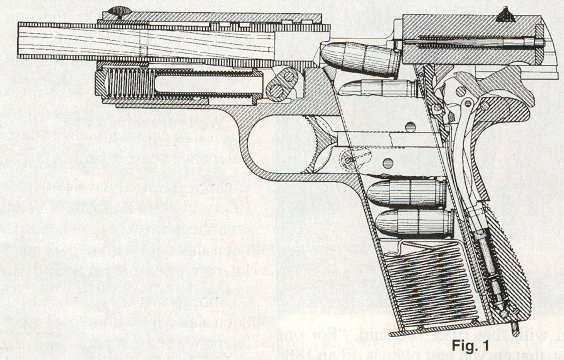
The cutaway in Fig.1 illustrates the relative position of components in the M1911A1 during the feeding phase. Cartridge feeding is defined in two ways:

(1) The successive upward movement of all rounds in the magazine. From an ordnance viewpoint, cartridge feeding takes place when a round in the magazine is moved upward into the path of the slide by the magazine follower and spring assembly; and

(2) the cartridge ramping action that occurs as the slide moves forward and begins to strip and thereby feed a round forward from the magazine.


Cartridge Chambering Phase

Chambering occurs when a round is fed from the magazine and placed in the chamber.

This action takes place as the slide moves forward under compressed recoil spring pressure; strips a cartridge from the magazine; and pushes the cartridge up the frame/barrel ramp and into the chamber.

The initial portion of the chambering phaw is completed as the cartridge breaks over the horizontal plane, aligns with the chamber and the cartridge case rim is engaged by the extractor.
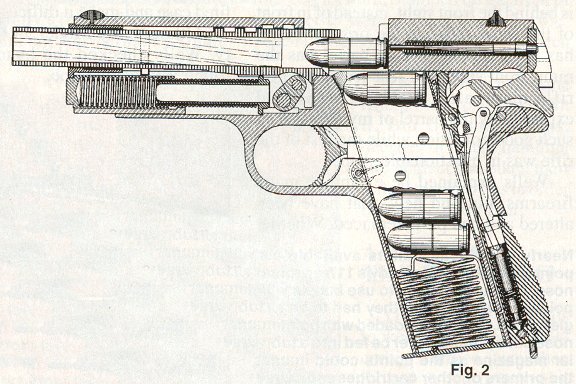


Locking Phase A: Barrel Link-up

Barrel link-up or link-up/cam-up in pistols without custom fit bottom lugs, occurs as the slide assemble continues to move forward and the barrel extension contacts the breechface causing the barrel to pivot upward on the barrel link (arrow).

This causes the locking lugs on the top of the barrel to index with the corresponding locking recesses in the slide.

Barrel link-up/cam-up in M1911A1 pistols with custom-fit bottom barrel lugs is assisted by the camming action of the radiused, bottom front barrel lug surfaces as they bear on and cam upward on the slide lock crosspin.


Locking Phase B: Barrel and slide locking

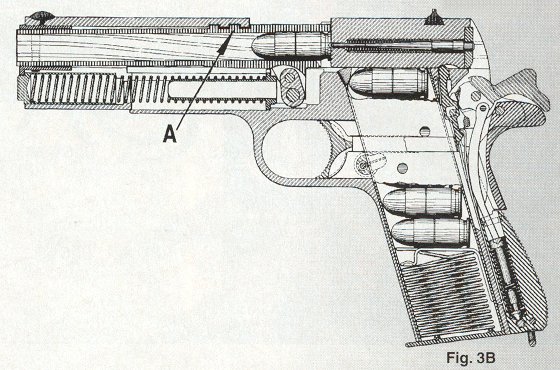
Vertical barrel and slide locking occurs as the slide causes the barrel to swing upward on the barrel link as in figure 3A.

Aggregate barrel, slide, frame, slidestop and barrel link dimensional tolerances determine the extend to which a given barrel will link upward and locking lugs will vertically engage in any given M1911A1 pistol.

Locked slide position (arrow, fig 3B) permits the disconnector to move upward.

This action -see disconnector function below- connects the trigger and sear and prepares the pistol for firing.


Firing Phase A: Lugs horizontally engaged

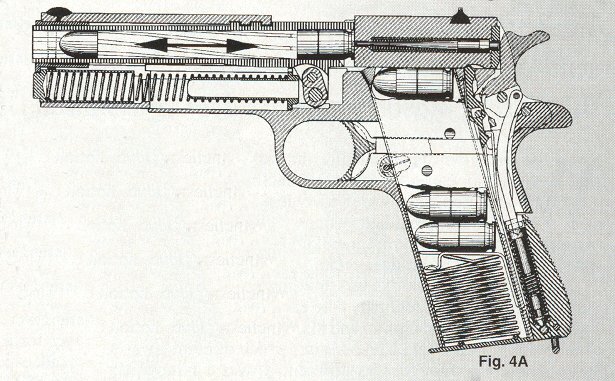
Firing is split into two phases because of the thrust vector existing between the bullet and the breechface, which horizontally engages the locking lug surfaces while the bullet is under pressure in the barrel.

Firing occurs in the M1911A1 pistols when the grip safety is depressed; the trigger is squeezed; and the interaction of the trigger, disconnector and sear releases the hammer.

The released hammer then transfers its energey to the inertial firing pin, which, in turn, strikes the primer.

As the primer ignites the propellant charge in the chambered cartridge, the hot powder gasses expand, building pressure that forces the bullet down the barrel.

As shown, the barrel and slide remain locked together both horizontally and vertically during the initial firing phase.


Firing Phase B: Horizontal disengagement

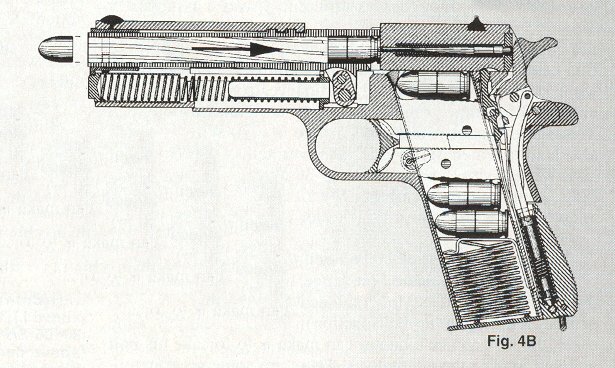
At the end of the firing phase, the bullet exits the muzzle and drops gas pressure inside the barrel.

Bullet departure breaks the balanced thrust vector established when the bullet was in the barrel as in fig. 4A.

In terms of the effect on the pistol, this action enables the top locking lugs to horizontally disengage (see National Match barrel note in next phase) and imparts a rearward force on the slide assembly equal to the inertia of the departing bullet.

Then, because the slide assembly has a greater relative rest mass -plus the added benefit of the recoil spring- inertial energy is absorbed as the slide recoils to the rear.

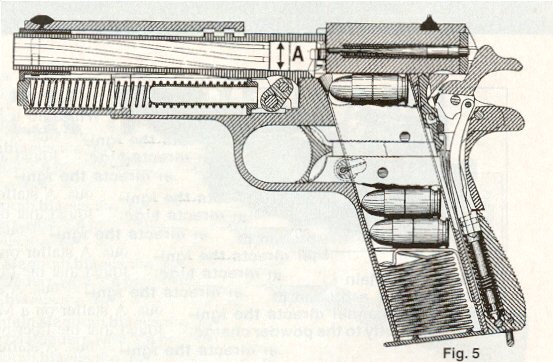
Unlock/Linkdown Phase: Vertical locking lug disengagement

In pistols with standard ordnance dimension barrels, barrel linkdown and vertical locking lug disengagement begin momentarily after the lugs horizontally disengage at zero breech pressure just after the firing of a chambered round.

Fired cartridge case extraction (see next phase) actually begins at the start of barrel linkdown with the initial breaking of friction between the fired/expanded cartridge case and chamber wall, as show at A below.

Note: National Match barrel hoods are hand-fit to maintain horizontal lug engagement until the barrel links down.


Fired case extraction phase

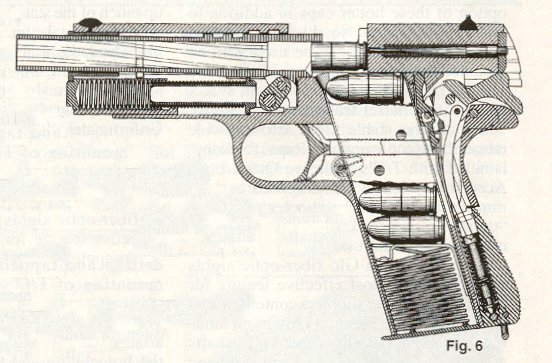
As shown in fig. 6, fired cartridge case extraction occurs with continued rearward movement of the slide and as the breech begins to open when the barrel links down.

The rim of the fired cartridge case is held firmly against the breech face by the extractor as it is drawn back by the energy of the recoiling slide.

Continued rearward movement of the slide then fully withdraws and thereby extracts the fired cartridge case from the chamber.


Fired case ejection phase

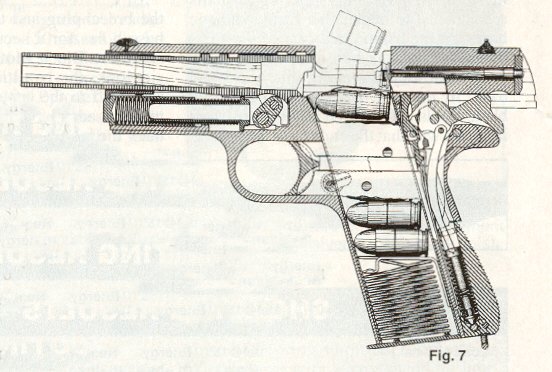
As the slide moves further rearward after firing, the fired case is extracted from the chamber as shown in fig. 6.

The extractor hook retains the cartridge rim and holds the case against the breech face.

Continuing rearward slide movement then brings the left side of the case into sharp contact with the front of the ejector located on the left side of the frame.

This action causes the fired cartridge case to pivot upward and to the right; frees it from the extractor; and ejects the case through the ejection port.


Cocking Phase

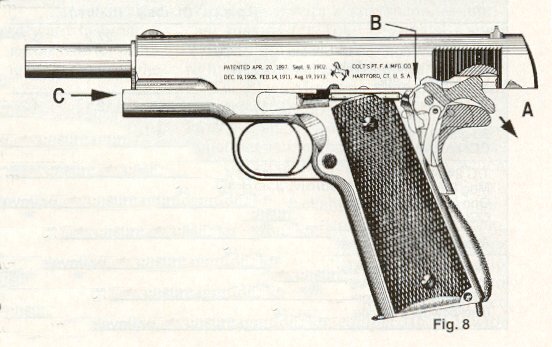
Cocking occurs as the hammer is positioned to fire the next round by the continuing rearward movement of the slide.

Specifically, the slide rotates the hammer back, as shown at A below; moves the hammer strut downward; compresses the hammer spring and enables the sear, under sear spring pressure to engage the hammer's full cokc notch at B.

Further rearward slide movement, C, then fully compresses the recoil spring for the next firing cycle.

When the magazine is empty, the magazine follower forces the slide stop upward to engage the slide stop notch in the slide and thereby locks the slide open.


The above description was taken from the "American Rifleman", from an article by Jerry Kuhnausen, in the August 1999 issue.

Tiburcio Vasquez - California Bandido & Pistolero

Tiburcio Vasquez was born April 10th, 1835 and died March 19th, 1875.  He was born in Monterey, California, to Jose Hermenegildo Vásquez and Maria Guadalupe Cantua.

His great-grandfather came to Alta California with the De Anza Expedition of 1776.

Vasquez was not a very big man, in fact he was slightly built at only about 5 feet 6 inches in height. But his family had money, so they sent him to school where he became fluent in both English and Spanish.

He was a Californio bandido active in California from 1854 to 1874. Aside from Joaquin Murrieta, Tiburcio Vasquez was probably the most notorious bandit California ever saw.

His gang murdered the innocent while committing armed robberies and rustling horses and cattle up and down central and southern California for 20 years before being stopped.

In 1852, Vasquez fell under the influence of a noted pistolero Anastacio Garcia -- who was in fact one of California's most dangerous bandits of the time. But it was in 1854 that Tiburcio Vasquez was accused of shooting Monterey Constable William Hardmount in a fight with Anastacio Garcia at a fandango.

Fandango is a lively couples-dance from Spain and Portugal, traditionally accompanied by guitars and castanets or hand-clapping. Fandango can both be sung and danced. Fandango is still one of the main folk dances in Portugal today.

Constable Hardmount was shot and killed when he attempted to break up a fight between several men -- some from the East Coast, Mexico and Ireland. The suspects were fighting over rum. Vasquez shot and killed Constable Hardmount when he attempted to stop the fight.

Vasquez's accomplice was wounded by return fire. Vasquez escaped, but his accomplice was arrested and hung the following day in the center of town. 
Vasquez denied any involvement in the killing, but that was when he became an outlaw.

Vasquez and Garcia also played leading roles in Monterey County's murderous Roach-Belcher feud, which reached its end when Garcia was lynched in the Monterey jail in 1857.

Tiburcio Vasquez murdered while robbing and rustling horses and cattle. 

A sheriff's posse caught up with him near Newhall, convicted of horse-stealing, he spent the next five years behind bars in San Quentin prison in 1857. There he helped organize, and participated in, four bloody prison breaks which left twenty convicts dead.

He briefly escaped in 1859, was recaptured for (again) horse-stealing and was finally released after serving his full term in 1863. After his release, Vasquez is said to have made attempts to be law abiding but eventually returned to crime.

He committed numerous burglaries, cattle thefts, and highway robberies in Sonoma County in 1866.
Though members of the gang changed throughout the years, some included Abdon Leiva, who turned State's evidence against Vasquez.

In 1870, Vásquez organized a bandit gang which included the the blood-thirsty villain Juan Soto; Tomas Redondo, alias Procopio Bustamante, Procopio, or Red-Handed Dick; and Vasquez's chief lieutenant Clodovio Chavez.

In 1871, Juan Soto was killed in a gunfight with Alameda County Sheriff Harry Morse. Sheriff John H. Adams from San Jose pursued the band to Southern California where Vasquez escaped after a sharp gunfight.

After that Vasquez was shot and badly wounded in a gunfight with Santa Cruz police officer Robert Liddell. He managed to escape and his sisters nursed him back to health. Vasquez hid for a while in Southern California, where he was less well known.

With his two most trusted men, he rode over the old Tejon Pass, through the Antelope Valley, and rested at Jim Heffner's ranch at Elizabeth Lake. Vasquez' brother, Francisco, lived nearby. After resting, Vásquez rode on to Littlerock Creek, which would become his first Southern California hideout.

Vasquez was popular in the Mexican community, and had many friends and family members from Santa Rosa in Northern California to Los Angeles in the south. Legend says he was handsome, literate, charming, played guitar, and was a good dancer.

Of course, I don't know about playing guitar, being a good dancer, or being literate, but by looking at a picture of Vasquez - most would not call him handsome. That said, and no accounting for taste, legend has it that all sorts of women were attracted to him and he had many love affairs.

To add to the legend, he supposedly enjoyed reading romantic novels and writing poetry for his female admirers and also had several affairs with married women. It's said that one such affair would eventually prove his downfall. Vasquez returned to the San Joaquin Valley.

In 1873, he gained statewide, and then nationwide, notoriety when the robbed and murdered three unarmed innocent men who just happened to be in the wrong place at the wrong time.

Vasquez and his gang stole $2,200 from Snyder's Store in Tres Pinos, now called Paicines, in San Benito County, killing three innocent bystanders in the process. Posses began searching for him, and Governor Newton Booth placed a $1,000 reward on his head.

Then on November 10, 1873, Kern County Constable Mettler was shot and killed while attempting to serve an arrest warrant near Tehachepi. The man who killed him was a member of a gang of desperados whose leader was Tiburcio Vasquez.

On December 26, 1873, his band sacked the town of Kingston, robbing all the businesses and making off with $2,500 in cash and jewelry.

Governor Booth was now authorized by the California state legislature to spend up to $15,000 to bring Vasquez to justice. This brought out lawmen from Fresno, Tulare, San Joaquin, Santa Clara Kern and Monterey counties, all scrambling after the elusive leader. Posses were formed in Santa Clara, Monterey, San Joaquin, Fresno, Kern, and Tulare Counties.

In January 1874, Governor Booth increased the reward and offered $3,000 for Vasquez's capture alive, and $2,000 if he was brought back dead. These rewards were increased in February to $8,000 and $6,000, respectively.

Alameda County Sheriff Harry Morse was assigned specifically to track down Vasquez. Heading towards Bakersfield, Vasquez and gang member Colodeoveo Chavez rode to the rock promontory near Inyokern now known as Robbers Roost.

Near that spot, at Coyote Holes, they robbed a stagecoach from the Cerro Gordo Mines, silver mines near Owens Lake. During the robbery Vasquez shot and killed one of his own men who didn't obey his orders.

The gang moved to Elizabeth Lake and Soledad Canyon, robbing a stage of $300, stealing six horses and a wagon near present day Acton, and robbing lone travelers. Vasquez was believed to be hiding out at Vasquez Rocks 40 miles north of Los Angeles. For the next two months, he escaped attention. However, he then made an error that led to his capture.

On April 15, 1874, he and his band held the prominent sheepman Alessandro Repetto for ransom. Pursuing posses from Los Angeles almost trapped the gang in the San Gabriel Mountains, but once again, Vasquez and his men escaped.

Vasquez took up residence at the adobe home of "Greek George" Caralambo in the northwest corner of Rancho La Brea, located 200 yards south of the present-day Sunset Strip in West Hollywood.

Greek George was a former camel driver for General Beale in the Army Camel Corps. Supposedly, Vasquez seduced his own niece. Either the girl's family or Greek George's wife's family betrayed Vasquez to Los Angeles Sheriff William R. Rowland.

He was finally captured in the Arroyo Seco area of Los Angeles when Sheriff Rowland sent a posse to a ranch there and captured Vasquez on May 14, 1874. He was moved from Los Angeles to San Benito County - then to San Jose for trial.

Greek George's adobe was situated near the present day Melrose Place in West Hollywood. This was coincidentally very close to where the movie industry would, in a few decades, set up shop.

Vasquez remained in the Los Angeles County jail for nine days. Once there, he had numerous requests for interviews by many newspaper reporters. But strangely, he only agreed to see three: two from the San Francisco Chronicle and one from the Los Angeles Star. He told them his aim was to return California to Mexican rule. He insisted he was an honorable man and falsely was claimed innocence because he had never killed anyone.

In late May, Vasquez was moved by steamship to San Francisco, California. He would eventually stand trial in San Jose.

Tiburcio Vasquez quickly became a celebrity among many of his fellow Hispanic Californians. He admitted he was an outlaw, but again denied he had ever killed anyone. A note purportedly written by Clodoveo Chavez, one of his gang members, was dropped into a Wells Fargo box. Chavez wrote that he, not Vasquez, had shot the men at Tres Pinos.

Nevertheless, at his trial Vasquez admitted participating in the Tres Pinos raid. Since all the participants in the robbery were equally guilty of any murder that took place during its commission, whether Vasquez actually pulled the trigger was legally irrelevant.

In January 1875, Vasquez was convicted and sentenced to hang for murder. His trial had taken four days and the jury deliberated for two hours before finally finding him guilty of one count of murder in the Tres Pinos robbery.

Vasquez started bargaining for clemency before being convicted by saying that their gang never took advantage of Hispanics, and that whites forced them into becoming criminals. Because some people will readily believe anything, even that which comes out of the mouth of a killer and thief, their gang was sometimes viewed as "folk heroes."

In fact, yes, his jail cell became a major tourist draw. Thousands, most of them women, came to visit. And supposedly Vasquez was charming to all, even posing for photographs and giving out autographs. Yes, believe it or not, he signed autographs and even posed for photographs. Vasquez sold the photos from the window of his cell and used the money to pay for his legal defense.

After his conviction, he appealed for clemency - but it was denied by Governor Romualdo Pacheco.

Tiburcio Vasquez met his fate on the gallows in San Jose on March 19th, 1875, when he was hanged at the age of 39 years old.

The Vasquez gang did not say that they were just lining their pockets with money taken at the point of a gun because they were too lazy to find honest work like the majority of the people in the world even back then. Instead, they tried to excuse their killings and robberies by saying that they were simply "punishing” the whites for discrimination against those of Mexican and Spanish decent.

And yes, some people are dumb enough to believe that line of bull. In fact, so much so, that before he was hanged on March 19, 1875, Vasquez was asked to dictate a statement explaining his actions:

"A spirit of hatred and revenge took possession of me. I had numerous fights in defense of what I believed to be my rights and those of my countrymen. I believed we were unjustly deprived of the social rights that belonged to us."

Once on the gallows, he was brief. The only word he uttered from the gallows was, "Pronto."

Vasquez's loyal lieutenant, Clodovio Chavez, fled to Arizona, where he was killed by lawmen in November, 1875, near Yuma, Arizona.

As for Vasquez' claims that his crimes were "the result of discrimination by the norte-americanos and insist that he was a defender of Mexican-American rights," well, doesn't that sound familiar? It should, after all, it sounds just like most of the excuses that come from criminal types - even today.

And yes, that's the way I see it,
Tom Correa

The M14 Rifle - Part Two

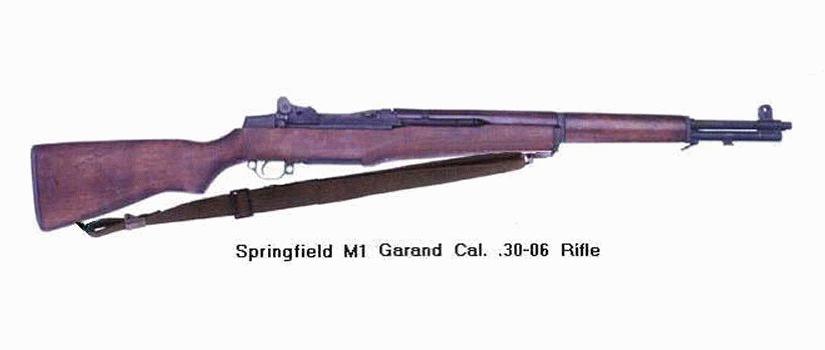
What came first was the M1 Garand.

General George S. Patton called the M1 Garand, "the greatest battle implement ever devised."

And yes, our military loved the M1. In fact, they loved it so much that after World War II they wanted to improve on it - but not change it.

The M1 Garand was the direct predecessor of the M14 rifle, which replaced it.

The experience gained by US troops during World War II and then the Korean War demonstrated that the beloved M1 Garand rifle had a lot of things to be improved.

The first was the feeding system with its 8-round en-bloc clips that did not allow the refilling, or topping off, of the partially full magazine.

Others were excessive length and weight of the rifle.

The cartridge used in M1 Garand and known as .30-06 (7.62x63mm) was too long and too heavy, effectively limiting the load of ammunition carried by each soldier.

First attempts to improve M1 were made during the war, and numerous experimental modifications in .30-06 were built, mostly using the 20-rounds detachable magazines from Browning BAR M1918 automatic rifle.

One of such prototypes was the T20 ("T" means "test") of 1944.

The T20 was basically the M1 Garand rifle fitted with 20 rounds BAR magazine and with selective fire capability.

This prototype latter evolved into the T37 rifle, which had gas cylinder moved back a little and was chambered for newest American prototype cartridge - T65.

The T65 was no more than .30-06 case, shortened by 1/2 inch (12 mm), but retaining the original ballistic properties due to modern propellants used.

It was slightly lighter and cheaper to made than .30-06, and has long effective range and good potential for accuracy, both desired by US Army.

The idea of a truly "intermediate" round was not acceptable to the US Military during that time.

In the early 1950s T37 evolved into the T44 experimental rifle, which featured redesigned, self-regulated gas system with short stroke gas piston.

Further development and tests lead to the slightly modified T44E4 and T44E5 (heavy barreled squad automatic weapon) prototypes, which were finally adopted by US Army as M14 and M15 rifles in the 1957.

The M15, a heavy barreled weapon, however, was never brought into production.

It must be noted that T44E4 was extensively tested against the only other entree in the US trials, the T48 rifle which was a Belgian FN FAL rifle made under license in USA by H&R Inc..

Both rifles passed the trials with equally high results, but US finally settled on the T44 because it was slightly lighter, similar to M1 Garand in manufacturing and operation, and, above all, it is a "Native American" design.

The contracts to produce M14 rifles were issued to some US companies, such as Thompson-Ramo-Wooldridge (TRW Inc), Harrington and Richardson Arms Co (H&R), Winchester-Western Arms Division of Olin Mathieson (Winchester) and Springfield Armory Inc (Springfield).

Initial production contracts for the M14 were awarded to the Springfield Armory, Winchester, and Harrington & Richardson.  Thompson-Ramo-Wooldridge Inc. (TRW) would later be awarded a production contract for the rifle as well.

There were 1,376,031 M-14 service rifles were produced from 1959 to 1964

Yes, it's true, production was ceased by US Government in 1964 with some 1,380,000 weapons made. That is a lot of weapons to stockpile in armories.

The termination of the production was the result of combat experience in the SE Asia, particularly in Vietnam.

It was said that the M14 was too long and too heavy to be carried all day long in hot and wet climate.

The 7.62mm NATO ammunition was thought to be too heavy, limiting the amount of ammunition carried by troops on patrols.

It was said that the selective fire capability was mostly useless, since the M14 was way too light for powerful cartridge it fired, and climbed excessively when fired in bursts.

In fact, most of the M14s were issued to troops with fire selectors locked to semi-automatic mode, to avoid useless waste of ammunition in automatic fire.

The squad automatic version, known as M14E2, also was not too successful in its intended role.

As soon as those deficiencies of the M14 became obvious for US Army Command, they started the search for lighter rifle, and finally settled on the Colt/Armalite AR-15 5.56mm assault rifle, adopting it as the M16A1.

After reading some of the negatives attributed to the M14, I figured that this was the conjecture of guys who were never troops - or were biased and trying to get rid of the M14 in favor of the inferior M16A1.

I carried the M14 as a Marine. After using both the M14 and M16, I could never understand the desire to swap a great rifle for one that had so many design flaws.

Note if you will that the M16 rifle is the only rifle ever designed with a "forward assist" to "pound" on if the round doesn't fully seat. Imagine that, designing a rifle with a part that needs to be "pounded" so the rifle operates properly?

While the M14 can take a pounding, it never needs to be pounded on to operate saticfactory.

M14 was replaced as a first line weapon in the late 1960s, but is still used by the United States Marine Corps.

It also served as a platform to build M21 Sniper rifles. Semi-automatic only versions of the M14 rifle are commercially manufactured for civilian and police markets by the Springfield Armory Inc since 1974 under the name of M1A.

Some other US companies are assembling the M14-type semi-automatic rifles using military surplus M14 parts kits.

Beginning in the early 1970s thousands of M14 rifles were given to several nations under military aid programs.

In the 1990s alone, over 100,000 of these rifles have been given away to Estonia, Latvia, Lithuania, the Philippines, South Korea, Taiwan, and Turkey.

In USA, for some time M14 was mostly relegated to Honor Guard and similar duties, but during recent campaigns in Iraq and Afghanistan many old M14 rifles were withdrawn from warehouses, dusted off and issued to troops in the field to improve range and lethality of troops armed with 5.56mm weapons.

Some M14 rifles are issued as is, some are fitted with new telscope sights to serve as a designated marksman rifles DMR - a concept similar to Russian SVD rifle.

The United States Marine Corps also re-issued M14 rifles for use in Designated Marksman role (DMR), and those rifles are fitted with newly made polymer stocks with adjustable buttstocks and pistol grips, and other accessories such as detachable bipods or sound moderators (silencers).

Recently US Special Forces, operating under the US Navy flag, stepped forward with the Mk.14 Mod.0 Enchanced Battle rifle, which is an M14 fitted with many new commercially available parts, new stock with adjustable butt and plenty of Picatinny rails, and new accessories such as noise suppressors and optical equipment.

The Mk.14 Mod.0 EBR is currently being used by US Navy SEAL's and possibly some other special operation forces within US Military.

In general, the M14 was developed as a means of taking the place of four different weapons systems—the M1 rifle, the M1 Carbine, the M3 "Grease Gun" and the M1918 Browning Automatic Rifle (BAR).

It was thought that in this manner the M14 could simplify the logistical requirements of the troops by limiting the types of ammunition and parts needed to be supplied.

It proved to be an impossible task to replace all four, and the weapon was even deemed "completely inferior" to the World War II M1 in a September 1962 report by the comptroller of the Department of Defense. 

The cartridge was too powerful for the submachine gun role and the weapon was simply too light to serve as a light machine gun replacement for the BAR.

Though it has the accuracy and range of the "old school" military rifles, it was considered too long, too heavy and it lacked the automatic fire firepower of a "true assault rifle" said to be required in modern close combat.

Of course, this is not true. And yes, the M14 being issued today to our troops overseas is a testiment to that fact that it is a vital weapon being used today on battle fields and in towns in the Middle East and elsewhere.

The M14 is a gas operated, magazine fed, selective fire (originally) design.

The gas system is located under the barrel, and has a short stroke (about 1 1/2 inch - 37 mm) gas piston which operates the M1 Garand style action rod.

The gas system features an automatic gas cutoff feature, which limits the amount of gases used to operate the weapon.

The rotating bolt is quite similar to one found in M1 Garand but it has a roller instead of the simple lug, which connects the bolt to the operating rod.

The fire mode selector is located at the right side of the receiver, above the trigger, and could be removed if rifle should not be fired in bursts, or re-installed if required.

The rear receiver bridge features the stripper clips guides, so the detachable magazine could be refilled in place by using standard stripper clips.

The bolt stop device is incorporated into the left wall of the receiver and holds the bolt open when last round from the magazine is fired.

The safety switch is similar to M1 Garand and is located at the front of the triggerguard. Standard sights consist of the blade front sight with two protective "ears" and diopter-type adjustable rear sight, mounted on the rear of the receiver.

Barrel is equipped with long flash suppressor.

To be used in selective fire mode, M14 can be equipped with light detachable bipod.

The M14A1 Squad Automatic rifle differs from M14 in the following: the fire selector is always installed.

The standard wooden single-piece stock with semi-pistol grip is replaced by the "straight line" wooden stock with separate pistol grip and with folding front grip under the forearm.

The hinged shoulder rest is attached to the buttplate. Special removable muzzle jump compensator is fitted to the barrel, as well as lightweight bipod.

General George S. Patton called the M1 Garand, "the greatest battle implement ever devised."

And since the M1 Garand was the direct predecessor of the M14 rifle, I believe, that like me, he would have fallen in love with the M14 because of all of its improvements.

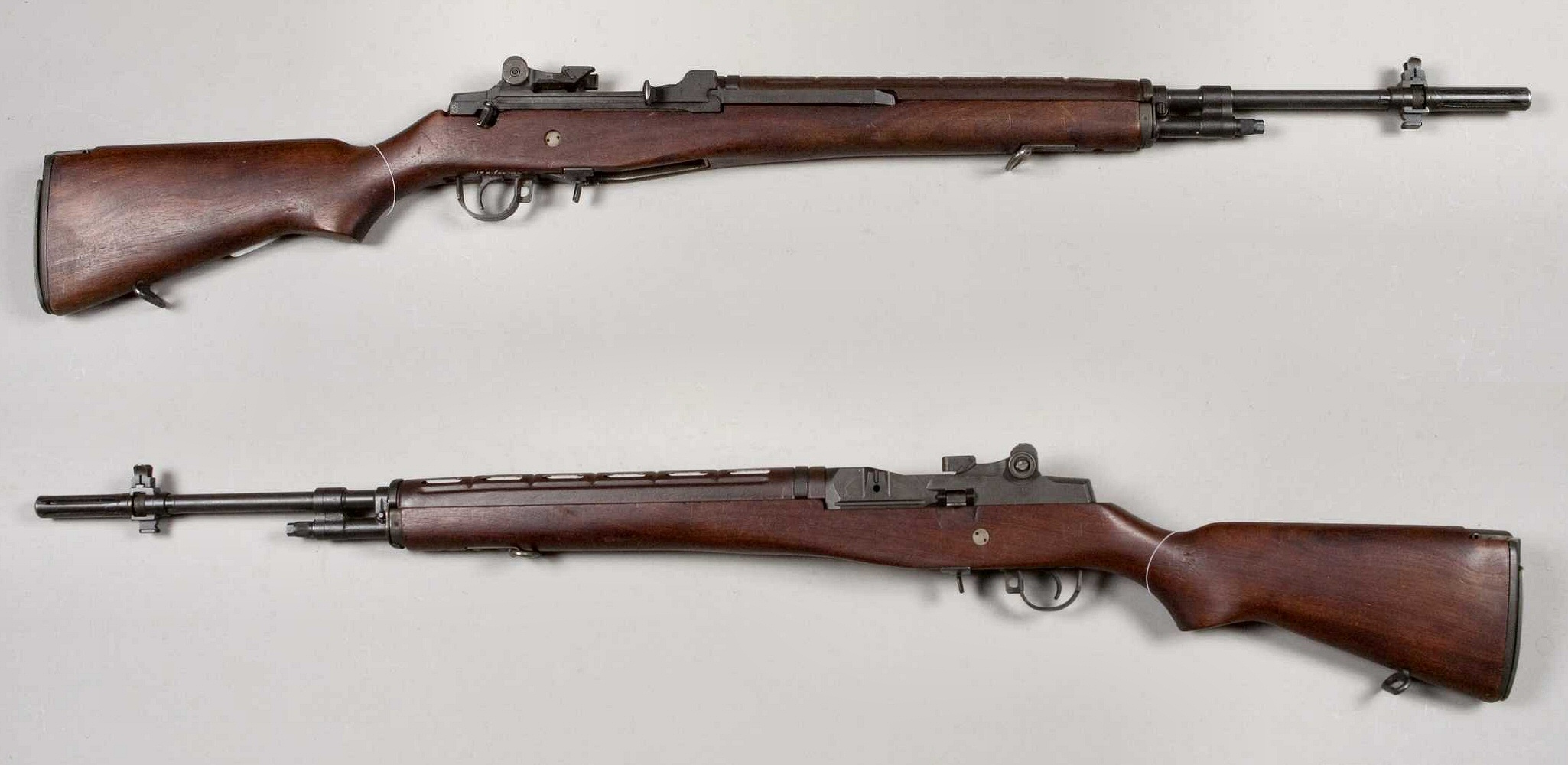
File:M14 rifle - USA - 7,62x51mm - Armémuseum.jpg
Story by Tom Correa

Thursday, August 1, 2013

The M14 Rifle - Part One

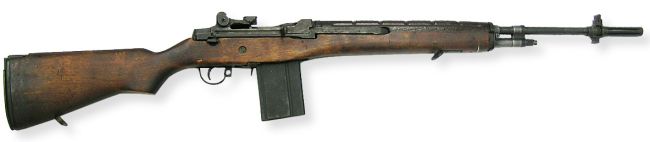
The M-14 Rifle
For my money, the greatest rifle ever created.

Caliber: 7.62x51 mm NATO (.308 Winchester)
Weight: 9.2 lb (empty), 10.7 lb (with loaded magazine)
Feed system: 20-round detachable box magazine
Magazine: 20 rounds, detachable box
Rate of fire: 700 -750 rounds per minute
Length: 44.3 inches
Barrel length: 22 inches
Action:  Gas-operated, rotating bolt
Muzzle velocity: 2,800 fps
Maxium Effective Range: 460 m (500 yd)
Sights Aperture rear sight, "barleycorn" front sight

Yes, for my money, the M14 is the greatest battle rifle ever created! So do I have a bias when it comes to this rifle? Absolutely!

You see after enlisting in the Marine Corps at the age of 17, over 40 years ago, I went to Boot Camp at MCRD in San Diego, California. Once there, among other issued items was my first M14 rifle.

Was the M14 the only rifle ever issued to me in my years in the Corps? No it wasn't.

I went through Boot Camp with it, then Infantry Training School with both the M14 and the M16A1, then to Sea School with the M14, and was issued an M14 when part of Marine Detachment USS Hancock. After that when with 1st Battalion/1st Marines, I was issued an M16A1 rifle. Years later in the Marine Reserves, I was issued an M16A2.

And while I have used the M14, the M16A1 and the M16A2, after using all of these and other weapons, in my humble opinion no infantry weapon is better than the M14 rifle. It is just that good.

Officially known as the "United States Rifle, 7.62 mm, M14," to the U.S. Army, is an American selective fire automatic rifle that fires 7.62×51mm NATO (.308 Winchester) ammunition. It was the standard issue U.S. rifle for the U.S. Army from 1959 to 1970, and the standard issue rifle for U.S. Marines even further until 1974. Some Marine units never stopped using the M14, such as Marines aboard ship in Detachments.

The M14 was used for U.S. Army and Marine Corps basic training and advanced individual training, and was the standard issue infantry rifle for U.S. military personnel in the United States, Europe, and South Korea, until it was replaced by the M16 rifle, in the 1970s. Today, the M14 is also used as a ceremonial weapon by honor guards, color guards, drill teams, ceremonial guards, and the like.

The M14 rifle was the last American "battle rifle" - a weapon that fires full-power rifle ammunition, such as the 7.62×51mm - issued in quantity to U.S. military personnel. The M14 also serves as the basis for the M21 and M25 sniper rifles.

So was that the end of its story? Did it all end in 1974? Not for the United States Marine Corps.

While the M14 remains in limited front line service within all branches of the U.S. military, the Marine Corps returned the M14 to service during the Iraq and Afghanistan Wars. The reason, the anemic 5.56mm round of the M16 couldn't get the job done.

The DMR

The United States Marine Corps used the M14 to create the DMR (Designated Marksman Rifle) which is more formally the "United States Rifle, 7.62 mm, M14."


The DMR (aka the M14) is a semi-automatic, gas-operated rifle chambered for the 7.62x51mm NATO cartridge. It is simply a modified version of the M14 rifle built and utilized by the United States Marine Corps.

The big difference between the M14s that I was issued in the Corps and the DMR being issued is with all of it's modification and match-grade M118LR 175-grain Long Range ammunition.

The "basic" DMR, without secondary sight, magazine, sling, basic issue items, cleaning gear, suppressor and bipod, weighs 11 pounds or less. The DMR design facilitates repairing or replacing of the sight mount, barrel, bolt, and other key assemblies at the third echelon maintenance level.

The USMC Precision Weapons Section at Marine Corps Base Quantico built all DMRs. The Marine Corps replaced the DMR with the M39 Enhanced Marksman Rifle and the Mk 11 Mod 0 on a one-for-one basis.

There are several notable differences between the basic M14 and the DMR:

  • Barrel: 22 inches, stainless steel, match-grade barrel by Krieger Barrels, Inc.
  • Stock: McMillan Tactical M2A fiberglass stock. This particular stock features a pistol grip and a buttstock with adjustable saddle cheekpiece.
  • Optics: An over-action MIL-STD-1913 Picatinny rail sourced from either GG&G Armament Arizona or Smith Enterprise, Inc. allows for the use of any optic compatible with the rail; this includes a rather large variety of military scopes and imaging devices.

The most common scope used on the USMC DMR are TS-30.xx series Leupold Mark 4 day scopes, AN/PVS-10 or AN/PVS-17 night vision scopes, and Unert M40 10× fixed power scopes.

  • Muzzle device: Most DMRs utilize the traditional M14 muzzle device, although since deployment in 2001 in Iraq and Afghanistan, some DMRs are now equipped with the OPS, Inc. 2-port muzzle brake, which is threaded and collared to accept an OPS-Inc. 12th Model sound suppressor.
  • Bipod: A Harris S-L bipod is used on the USMC DMR.

For the Marine Corps, a grunt operating as the Designated Marksman (DM) using a DMR is an intregal part of Squad Tactics. The Marine DM's role fills the gap between a regular infantryman and a sniper typically being deployed at ranges of 250–500 metres or 270–550 yards and DMRs have been developed with this middle ground in mind.


These rifles have to be effective, in terms of accuracy and terminal ballistics, at ranges exceeding those of ordinary assault rifles and battle rifles typically 250 m or 270 yd or less, and up to 500 m or 550 yd, respectively, but do not require the extended range of a dedicated sniper rifle which is typically employed for targets at ranges from 500–2,000 m or 550–2,200 yd.

DMRs, however, often share some basic characteristics with sniper rifles in difference to the weapons carried by others in the DMs unit. DMRs may have an attached telescopic sight, quickly deployed stabilizing bipod to allow optimized accuracy and low-recoil in temporarily fixed situations or an adjustable stock.

They will, though, generally retain semi-automatic firing capability, to be more rapid than bolt-action sniper rifles, and a larger magazine capacity of 10, 20, or 30 rounds depending on the firearm in question.

 A designated marksman primarily uses DMRs for enhanced accuracy and range.
The DMR fills the need for a lightweight, accurate weapon system utilizing a cartridge more powerful than the M16A4's standard 5.56x45mm NATO—the 7.62x51mm NATO.

Most DMRs are a battle rifle, semi-automatic or full-automatic, that fires 7.62mm NATO or similar full-power rounds - and not under-powered rounds of assault rifles such as that of an M16.

Marine Corps Explosive Ordnance Disposal Teams, Scout Snipers and sniper spotters also used DMRs when the mission requires rapid, accurate fire at long range.


The EMR


The Marine Corps is replacing the DMR with the M39 Enhanced Marksman Rifle and the Mk 11 Mod 0 on a one-for-one basis. Where the DMR looked like an up to date modernized tricked out M14, the M39 EMR looks like the M14 on steroids!

The M39 Enhanced Marksman Rifle (EMR) or more formally the Rifle, 7.62 MM, M39 Enhanced Marksman Rifle (EMR)) is a semi-automatic, gas-operated designated marksman rifle chambered for the 7.62x51mm NATO cartridge.

It is a modified and accurized version of the M14 rifle and is based on the current United States Marine Corps Designated Marksman Rifle (DMR), which it is replacing. The rifle is currently issued with match-grade M118LR 175-grain Long Range ammunition.

The "basic" EMR  - that without telescopic sight, magazine, sling, basic issue items, cleaning gear, suppressor and bipod -- weighs 13 pounds or less. The EMR is primarily used by a Designated Marksman, to provide precision fire for units that do not rate a Scout Sniper.

As a replacement for the DMR, the EMR fills the need for a lightweight, accurate weapon system utilizing a cartridge more powerful than the M16A4's standard 5.56x45mm NATO—the 7.62x51mm NATO.

The EMR is also used by Marine Scout Snipers when the mission requires rapid accurate fire and by Marine Corps Explosive Ordnance Disposal teams. While the EMR stays in service with Marines in the field as its Designated Marksman weapon, in early 2012, the Marine Corps started replacing the M39 with the M110 Semi-Automatic Sniper System for its snipers.

The EBR

The Mk 14 Enhanced Battle Rifle (EBR) is a variant of the M14. It was built for use with units of the United States Special Operations Command. The EBR is being made with the intention of carrying out both designated marksman and CQB roles in combat. The weapon takes the standard M14 action and replaces the standard 22.0" barrel with an 18.0" barrel. 

The barreled action is then bolted into a telescoping chassis stock system, with a pistol grip, a different front sight, Harris bipod, four Picatinny accessory rails (which surround the barrel), and a more effective flash hider in place of the standard lugged USGI flash suppressor. A paddle-type bolt stop similar to that of the M4 carbine is used on the rifle. 

The EBR chassis system stock is made up entirely of lightweight aircraft alloy.

A Kydex hand guard and M68 CCO are also added as standard external accessories, though they are almost always replaced with a vertical fore-grip and magnifying scope for better handling and for use in a designated marksman role. A Wind Talker suppressor can be mounted on the DC Vortex flash hider, though the U.S. military did not adopt one to active service.
No, the M14 EBR isn't anything like the M14 that I trained with in Boot Camp or carried overseas. But, it is certainly its great-grandson on steroids with a 7.62 attitude. And yes, this is very close to the sort of M14 that my father-in-law would build -- but that's a story for another day.

One other thing that is really important to note. Because the M14 is so reliable and powerful, it is often favored by users for high lethality at longed ranges with great penetration. Those are features much appreciated by US troops in operations in Afghanistan and Iraq and other places around the world.

Since the start of the conflicts in Afghanistan and Iraq, many M14s have been employed as Designated Marksman and Semi-Auto Sniper Rifles.

These are original production M14s with common very easy modifications including scopes, fiberglass stocks, and other accessories.

In 2009, a study conducted by the U.S. Army claimed that more than half of the all enemy engagements in Afghanistan occurred from beyond 300 meters (330 yards).

The study claimed that America’s 5.56x45 mm NATO service rifles, the M16 and M4, are ineffective at these ranges. Yes, now they had a report that told them what troops already knew. That report prompted the reissue of thousands of M14s to our troops.

So now, can you see why for my money the M14 is greatest battle rifle ever created? And really, can you see why I have a bias when it comes to this rifle? It is just that good.

And yes, that's just way I see it.
Tom Correa