John "Rip" Ford John Salmon Ford, better known as “Rip” Ford, would epitomize the saying “win the battle but lose the war,” as he would command the Confederate forces that won the Battle of Palmito Ranch, the last engagement of the Civil War.
Ford was born on May 26, 1815 in Greenville District, South Carolina, and moved to Texas in 1836.
He served for a time in the Texas Army, and then settled in San Augustine to practice medicine until 1844.
That year, he was elected to the Texas Congress, where he supported annexation to the United States. In 1845, he moved to Austin, and became a newspaper editor.
Ford served as an adjutant in the Mexican War and was cited for “gallant service.”
It was during this time that he would acquire his nickname of “Rip” for sending out official death notices with the citation “Rest in Peace” written at the top.
In 1849, Ford would explore and map the country between El Paso and San Antonio.
He would also become a captain in the Texas Rangers and participate in various fights with local Native American tribes.
Ford was elected to the Texas Senate in 1852, and in 1858 he led state troops against both Native American and Mexican uprisings.
With the growing tension between North and South escalating in 1861, Ford served as a member of the Secession Convention, and after Texas left the Union, he initiated a trade agreement between the Confederacy and Mexico.
Ford served as colonel of the 2nd Texas Cavalry based in the Rio Grande district, and was assigned to protect trade routes with Mexico. Between 1862 and 1865, he was also commandant of conscripts.
Ford’s greatest military exploit was the Battle of Palmito Ranch on May 12-13, 1865, when he defeated attacking Union forces under Colonel Theodore H. Barrett.
Barrett had attempted to surprise Confederate forces at Fort Brown, outside Brownsville, but was repulsed by Ford’s daring frontal attack.
The battle was considered a Confederate victory, with Union troops retreating and suffering 118 casualties.
Ford’s men had an estimated six killed, wounded or missing. Unfortunately for Ford, all Confederate forces in Texas surrendered two weeks later.
After the war, Ford continued his interests in politics and newspaper editing, serving as a delegate to the Democratic convention in 1868, and working on the Brownsville Sentinel.
He would become the mayor of Brownsville in 1874, and serve again in the Texas Senate from 1876 to 1879.
In his later years, Ford would spend his time writing his memoirs and promoting an interest in Texas history through the Texas State Historical Association.
Ford died on November 3, 1897 in San Antonio, having the dubious distinction of being the last victorious Confederate commander of the Civil War.
Editor's Note:
The article above comes from The Civil War Trust.
The Civil War Trust is America's largest non-profit organization (501-C3) devoted to the preservation of our nation's endangered Civil War battlefields. They also promote educational programs and heritage tourism initiatives to inform the public of the war's history and the fundamental conflicts that sparked it.
I did not edit this article in any way. It's being served as is.
Back in the mid-1980s, I had a chance to leave the Security field and go back to sheetmetal construction.
About 8 years earlier, I worked as a sheetmetal worker and welder for a few months until Jimmy Carter's economy - which I refer to as the truly last Economic Depression in America - took my job and many others.
Those years, if you wanted to survive, you simply weren't choosy about what you were doing for work. Yes, you took a job wherever you could find one.
And yes, that meant doing things that you might not have wanted to be doing to keep a roof over your head and pay your bills. For me, well since I had only been out of the Marine Corps about a year when the construction layoff came - I really considered going back in to the Corps.
Instead, I made a plan to join the Marine Corps Reserves to keep my rank and looked for a job in anything that I could find. Give myself a year, and than if I couldn't find some work - well I could always go back to my beloved Corps. Besides, I should have never gotten out in the first place - but that's a story for another time.
Since I had so much experience in security in the military, a friend asked me to work for him in the private security field.
I worked in security and put myself through a nearby community college. After getting my degree in Criminal Justice, I started putting in applications with police departments.
At the same time, I had the chance to get back into construction. Since I'd always enjoyed working with my hands. I jumped at the opportunity for many reasons - mostly it was to get away from working nights and weekends.
Working in construction was good and bad. I enjoyed building things, whereas unlike security, you can actually see the fruits of your labor. But frankly, I might have made more money an hour than I ever had at that point in my life - but I made a lot less money a year than I ever did in my entire life.
The layoffs, the jobsites not being ready, only working 7 months out of the year, it was a killer. Frankly, if it weren't for the fact that I did Security Consulting on the side - I don't know how I would have made it and kept from ending up on the street.
So what does any of this have to do with ground-water contamination?
Well, the construction company that I worked for built and remodeled gas stations throughout Northern California.
For a few years there, that's what I did. Along with my foreman, the company that we worked for sent us all over Northern California building and remodeling gas stations.
It was while I was working in that field that I got my first look at soil contamination from leaking underground fuel storage tanks and how bad it was.
Lately, there are people out there who are trying to say that fracking which takes place 5,000 to 8,000 feet beneath the earth is responsible for contamination of ground-water in different locations around the country.
Of course, the problem with this is that they can't explain why there is the same sort of soil contamination in areas where oil and gas drilling operations are no where near - or that the ones that may be close don't use fracking?
My belief, and this is based on what I saw years ago, is that leaking underground fuel storage tanks are to blame for a lot of what people are experiencing.
The reason that I'm writing about this is that I have received e-mail from readers who read my article Fracking - Let's Talk About It.
It seems that they want to know more about what I said in that article about ground-water contamination from service stations (gas stations) tank leakage.
Following World War II and the boom in automobile manufacturing in the United States, the construction of thousands of gasoline stations across the country was also at a fever pitch.
At these new stations, bare steel tanks were installed underground to store gasoline. The average life expectancy of a steel tank was 30 to 50 years depending on the rate of corrosion of the steel.
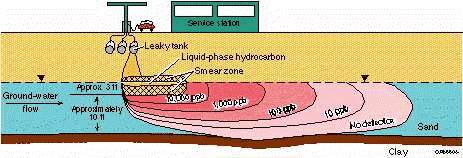
In the early 1980s, corrosion of these steel tanks, along with faulty installation and operation, have resulted in all sorts of ground-water contamination by gasoline.
Back when I was working construction, way before anyone even heard about "fracking," I knew a man who lit his house water faucet on fire because of all of the gasoline in his well water.
Today, because nearly half of all Americans depend on ground-water for their drinking water, leaking gasoline tanks represent a significant public health hazard.
Leaking gasoline tanks can also present the risk of fire and explosion because vapors from leaking tanks can travel through sewer lines into buildings.
The majority of these underground storage tanks (USTs) contain petroleum products which include gasoline, diesel, heating oil, kerosene, and even jet fuel.
Many other substances classified as hazardous by the Resource Conservation and Recovery Act and the Comprehensive Environmental Response, Compensation, and Liability Act ("Superfund") are stored in USTs.
Today, these leaking tanks, the USTs, are called LUSTs.
In September 1999, the U.S. Environmental Protection Agency (EPA) was monitoring about 370,000 LUST sites in the United States.
About 21,000 site cleanups were planned for fiscal year 2001. Cleanups are funded by the EPA's LUST Trust Fund, which is currently funded at a level of about $70 million per year.
So how much gasoline does it take to contaminate ground-water - and subsequently our drinking water?
Well, prior to the EPA's 1988 UST regulations and their final implementation deadline in 1998, a slow leak from a 10,000 gallon gasoline storage tank at the neighborhood service station was virtually undetectable to the station operator - but is still hazardous to nearby groundwater supplies.
The hazards of gasoline are mainly attributable to the BTEX compounds. BTEX compounds are benzene, toluene, ethylbenzene, and xylenes.
The benzene content of typical gasoline is 0.76% by mass (gasoline composition).
A spill of 10 gallons of gasoline which is only 0.1% of the 10,000 gallon tank, a quantity that is undetectable by manual gauging and inventory control, contains about 230 grams of benzene.
The EPA's Maximum Contaminant Level (MCL) for benzene is 5 parts per billion, or 5 micrograms per liter, in drinking water.
What this means is that the benzene in a 10 gallon gasoline leak can contaminate about 12 million gallons, of water.
So now, you really think fracking is what's doing it?
Benzene, toluene, ethylbenzene, and xylenes together are the most common hazardous components of gasoline leaks - and subsequently ground-water contamination.
Benzene is the most hazardous of these compounds. Long-term exposures to benzene in drinking water at levels above the MCL increase the risk of cancer.
Toluene and ethylbenzene are not considered carcinogenic or cancer-causing. Over the long term, toluene and ethylbenzene damage the liver, kidneys, and central nervous system.
Xylenes are a mixture of compounds. Xylenes also affect the liver, kidneys, and nervous system, but they are not considered nearly as hazardous as the first three - benzene, toluene, and ethylbenzene.
MTBE (Methyl tertiary butyl ether) is an additive used to increase the oxygen content of gasoline to improve air quality.
In the language of the 1990 Clean Air Act, oxygenated gasoline is referred to as "reformulated gasoline" or "oxyfuel."
At concentrations as low as 20 parts per billion, MTBE makes drinking water unfit for human consumption because of taste and odor.
MTBE is classified as a potential human carcinogen, but as yet there is no Maximum Contaminant Level for drinking water.
So, as many as 9,000 community water wells in 31 states may be affected by MTBE contamination.
The U.S. Geological Survey reports that about 20% of groundwater in areas where reformulated gasoline is sold is contaminated by MTBE.
Concerns about air quality will kill us by way of the MTBE in our water.
MTBE is highly soluble in groundwater. The high solubility of MTBE allows it to be readily dissolved into groundwater from leaked gasoline and transported over great distances.
In some cases, MTBE transport has exceeded the transport distances of BTEX compounds by 10 times.
Compared to MTBE, the BTEX compounds are less soluble and more readily sorbed to aquifer sediments.
So yes, when I said, that back in the 1980s, I remember that inspector telling me that the underground fuel storage tanks leaked as they got older and were a genuine problem for us all - I believed him.
I remember him saying that he trailed one set of old tanks 40+ miles as he tested the water from one service station to another down the peninsula.
Since ground-water runs on plates beneath the surface, I have no doubt that he did in fact trail that ground-water contamination as far as he did.
The compounds in the ground-water that is cancer causing isn't the result of fracking thousands of feet below the ground-water tables.
In many if not most cases in the United States, it is the result of old tanks at gas stations leaking some amount of fuel that have compounds which even in the smallest amounts can cause us all great harm.
Folks are writing asking me if fracking will kill us all one day like Liberal Hollywood wants us all to believe?
So since now the press is attacking fracking during the flooding in Colorado, I figured I'd address your e-mails.
But before I start, as a matter of full disclosure, I did once upon a time work in the energy industry.
Today though, I have no ties to the energy industry in any way shape or form - other than a consumer like you.
So where do we start?
Well first off, I don't believe fracking will kill us all.
After all it's been used for more than 60 years and has been safe during that entire time.
It's true. There is no proof that fracking hurts us.
Of course that fact does not stop liberal hysterics who want to find something to use to attack America's energy industry.
Facts don't stop Hollywood and the liberal media from attacking something they know nothing about!
In a hydraulic fracturing job, "fracturing fluids" or "pumping fluids" consisting primarily of water and sand are injected under high pressure into the producing formation, creating fissures that allow resources to move freely from rock pores where it is trapped.
Typically, steel pipe known as surface casing is cemented into place at the uppermost portion of a well for the explicit purpose of protecting the groundwater.
The depth of the surface casing is generally determined based on groundwater protection, among other factors.
As the well is drilled deeper, additional casing is installed to isolate the formations from which oil or natural gas is to be produced, which further protects groundwater from the producing formations in the well.
Casing and cementing are critical parts of the well construction that not only protect any water zones, but are also important to successful oil or natural gas production from hydrocarbon bearing zones.
Industry well design practices protect sources of drinking water from the other geologic zone of an oil and natural gas well with multiple layers of impervious rock.
While 99.5 percent of the fluids used consist of water and sand, some chemicals are added to improve the flow.
The composition of the chemical mixes varies from well to well.
To recap, the oil and gas industry injects water at a very high pressure of around 9,000 psi or more, which breaks though the rock and holds the cracks open - otherwise they would close when the fluid stops flowing.
That's the key, without the pressure being they would close on their own from the pressure within the earth itself. So yes, when the pressure is stopped - the cracks close from the pressure release.
And by the way, hydraulic fracturing offshore has been going on now for several decades, and the Bureau of Safety and Environmental Enforcement (BSEE) has permitted it.
Thanks to fracking, for the 5th time in the past six years, North Dakota recorded the nation’s fastest growing personal income, which increased by 12.5%.
It's a fact, according to the U.S. Bureau of Economic Analysis, average personal income in North Dakota increased by 12.4 percent in 2012 thanks in large part to an increase in hydraulic fracturing.
Thanks to hydraulic fracturing, 2012 natural gas production in the U.S. is at its highest level ever.
At 24,062,889 million cubic feet, dry natural gas production in the U.S. in 2012 was at its highest level ever recorded.
So What Is Fracking?
According to the Bureau of Safety and Environmental Enforcement (BSEE): "Hydraulic fracturing is not a drilling method, but rather one of the many operations that an operator can propose to use on an Application for Permit to Drill or Modify."
Hydraulic fracturing, or “fracking,” is a proven and well-regulated technology.
First used in the 1940s, hydraulic fracturing has unlocked massive new supplies of oil and clean-burning natural gas from dense deposits of shale — supplies that increase our country’s energy security and improve our ability to generate electricity, heat homes and power vehicles for generations to come.
Fracking has been used in more than one million U.S. wells, and has safely produced more than seven billion barrels of oil and 600 trillion cubic feet of natural gas.
In addition to enhancing our domestic energy supplies, shale development has irrefutable economic benefits.
Hydraulic fracturing in the Marcellus and Barnett Shale has boosted local economies—generating royalty payments to property owners, providing tax revenues to the government and creating much-needed high-paying American jobs.
Engineering and surveying, construction, hospitality, equipment manufacturing and environmental permitting are just some of the professions experiencing the positive ripple effects of increased oil and natural gas shale development.
Some opponents of oil and natural gas production claim that fracking has serious environmental consequences.
Fracking's Track Record
The truth is, while all development has challenges, hydraulic fracturing technology has a strong environmental track record and is employed under close supervision by state, local and federal regulators.
Studies by the Environmental Protection Agency (EPA) and the Ground Water Protection Council (GWPC) have confirmed no direct link between hydraulic fracturing operations and groundwater contamination.
Studies estimate that up to 80 percent of natural gas wells drilled in the next decade will require hydraulic fracturing technology.
In fact, EPA Administrator Lisa Jackson recently testified that she was “…not aware of any proven case where the fracking process itself has affected water.”
Fracking makes it possible to produce oil and natural gas in places where conventional technologies are ineffective. Access to new wells encourages economic growth and provides energy for all Americans.
The oil and natural gas industry is committed to the continued safe and responsible development of our domestic resources and ensuring that the public is part of the conversation.
Let's let's talk about ground-water contamination and how it "could" take place.
I have two very deep water wells on my property. One is at almost 3oo feet and the other is at almost 400 feet down.
They are very deep in comparison to water wells in the San Joaquin Valley and the San Francisco Bay Area towns like say Livermore.
If there were oil drilling in my area, say right next door to my property, even at the depths of my wells, my ground-water would be safe from contamination.
The reason is that though water accounts for about 90 percent of the fracturing mixture and sand accounts for about 9.5 percent - which means that chemicals account for the remaining .5% (one half of one percent) of the mixture - the fracking process is taking place too deep for it to effect my wells.
"It's our experience in Pennsylvania that we have not had one case in which the fluids used to break off the gas from 5,000 to 8,000 feet (1,500-2,400 m) underground have returned to contaminate ground water."
--John Hanger, former Secretary of the Pennsylvania Department of Environmental Protection.
That's right! We're talking about wells that extend 5,000 to 8,000 feet beneath the earth!
To give you an idea of how deep that really is, imagine this:
On November 17th, 2011, Shell Oil Company broke its previous record for the world’s deepest underwater well.
Shell says it has started producing oil from a well 9,627 feet below the surface of the Gulf of Mexico.
That depth is more than six times greater than the Empire State Building’s height.
Try to imagine the Empire State Building one on top of another 5 times. That's close to the depth that the fracking process is taking place.
Do you really thing that at that depth, that the process way down there can be effecting you ground-water a few hundred feet from the surface?
Let's Look At The Well Construction For A Moment - and where water contamination "could" come from.
And yes, all oil and gas wells use piping, sleeves and concrete when putting in a well - whether its a conventional well of one used in a fracking.
It's simply a part of the construction process of putting in an oil or gas well - for fracking or not!
Here's a short video about the process of Drilling an Oil Well, its construction.
Please note:
1) How the construction of the well piping to ensure no contamination enters the water tables close to the surface;
2) How the oil enters the well pipe - it does so through a perforated pipe.
This method has been used longer than most can remember; the only difference between a standard well and once used with a fracking method is the introduction of high pressure fluid to open the ground to allow more oil to be gathered.
3) Note the safeguards and safety measures that the video shows are put in place before any oil or gas can be pumped out of the ground;
4) And please note the fact that this video comes from the extremely liberal State of California.
Since underground water runs on plates and sideways, the only way my ground-water could become contaminated is if there were a problem with the casing, the piping and sleeves, and the concrete put into place to protect the ground-water.
But how "could" oil, or say gasoline, get into our my ground-water?
If there is any ground-water contamination, then it has to come from the area near the surface - it has to be bad well construction.
It cannot be coming from a many thousands of feet at the actual well openings in the perforated pipe.
We've used this system for more than a hundred years, and contamination comes from the rig and not way down below.
Other than that, there is one more possibility that has nothing to do with oil and gas well drilling.
Years ago I met a man who did inspections of gasoline levels in the ground-water in the San Jose California area.
Those were the days before the fuel recovery systems used today under gas station underground tanks.
That was back in the mid-1980s, and I remember the inspector telling me that the underground fuel storage tanks leaked as they got older.
Their age and deterioration of the tank walls meant that gasoline leaked into the soil under the tank.
The seeping gasoline would of course rise atop the water (as oil separates itself from water) then it would travel on those underground plates.
I remember him saying that he trailed one set of old tanks 40+ miles as he tested the water from one service station to another down the peninsula.
He showed me on a map where he trailed the ground-water contamination. Plotting it out, all he had to do was connect the dots and find its source.
But friends, even back then gas in the ground-water wasn't the result of a fracking module down in the holes those thousands of feet below the ground-water tables.
In that case, it would have been the old leaking tanks at the service stations.
Other than in that case where there is leakage into the soil from old gasoline underground storage tanks, and someone was absolutely certain that it was coming from an oil rig operations?
If there were ground-water contamination from the oil well?
Then anything in the ground-water from an oil or gas well would have to be a result of a problem with its protective measures during the initial construction of the well, or the waste water ponds.
It would be a problem with the safeguards near the surface and not what's taking place thousands of feet below the earth.
It has nothing to do with any process, standard or fracking, used after the well was put in.
About this Information
All of the information above has been researched so that we can get an unbiased view of fracking.
While the information comes from many different sources, most come from the energy industry which uses fracking.
I used mostly Energy Industry information because when I'm looking for technical expertise, I like going to the source. Since they use it, and I needed to know how it was done - so I consulted the experts.
Besides I didn't want to go to some Hate Fracking website to find out what they "think" takes place, I wanted to get the technical information.
It's sort of like going to a lawyer to find out the law, instead of going to someone who hates the law, lawyers, the whole justice system, government and everyone in it.
And yes, that's how I see so-called "environmentalists". They hate everything about mankind and society, and have no respect for our needs.
They don't understand the balance that has to be struck between our needs as a nation and the needs to keep our environment as perfect as possible.
No one that I know wants polluted rivers and streams and harbors like we had before President Richard Nixon created the EPA, but at the same time to attempt to produce an environment before the existence of man and animals is insane.
Environmental extremists accuse fracking of causing earthquakes, sinkholes and all other sorts of calamities.
It seems that if it were left to them, 9/11, the Johnstown flood, Hurricane Katrina, the Rim Fire, and creation of Big Foot would all be blamed on fracking by the oil and gas industry.
Fact is, after 60+ years of use, fracking has not been linked to any natural or made-up disasters.
Environmental extremists are simply too biased and unbalanced to trust.
The headline read: Boston High School Reads Students Muslim Poem On 9/11, Skips Pledge Of Allegiance
It was reported that one school in Boston has a strange way of Remembering 9/11, just skip it and instead read a Muslim poem.
Students at Concord Carlisle High School marked the anniversary with no Pledge of Allegiance.
Instead, they all listened to a Muslim poem.
That's right, a Muslim poem which had nothing to do with 9/11.
Instead of teaching our children about what took place on 9/11, the facts of what took place, who and why we were attacked, the self-sacrifice, the heroism, the valiant work involved to rescue those buried alive, the loss of loved ones, the rebuilding, the unity that it inspired throughout America - no, instead the school made the decision to instead turn the focus of attention of the children on Muslim hardship in the United States.
The Islamic poem was called "My Grandmother Washes Her Feet in the Sink of the Bathroom at Sears" by Mohja Kahf.
The poem is about the poet's "grandmother [who] puts her feet in the sink of the bathroom at Sears to wash them in the ritual washing for prayer, wudu, because she has to pray in the store or miss the mandatory prayer time for Muslims" and the reactions of other women in the restroom.
So what does this poem about Muslim rituals and the way it is perceived by women in a bathroom, who probably wish she had stayed home and done it there, have to do with Remembering 9/11?
Nothing! Nothing at all! The poem is designed to gain some sort of sympathy for Muslims in America.
Yes, it's as if the school was trying to say, "look at how the old Muslim women is looked at? Isn't that horrible."
Instead of saying, "Children, let's talk about what toke place 12 years ago that changed the entire country in one single moment of time. Let's talk about why we have become the Big Brother society that we have become. Let's talk about the self-sacrifice and heroism that took place that day, those virtuous attributes that were on display for the world to see on 9/11 those 12 years ago."
They did none of that!
The school could have taken the time to educate and enlighten those children about the most significant event in U.S. modern history, but the failed to do so!
Instead, they purposely steered the their attention away from what took place on 9/11 - and focused onto something "they thought" mattered - the strangeness of Muslim religious rituals to Mid-West women in a bathroom at Sears.
Please understand, on the 12th Anniversary of the Muslim Attack on America, on 9/11, and the 1st Anniversary of the Americans, who the Obama administration let die in Libya, the Pledge of Allegiance was skipped altogether that day and instead a Muslim poem was read.
The incident immediately caused outrage with parents in the Massachusetts community, and the school apologized promptly.
In a statement, the school said, "Yesterday was the first Wednesday of the school year; we were unaware that our student Pledge reader had an internship commitment on this day. We humbly apologize that this oversight and communication gap occurred."
"Pledge reader"? What the hell kind of a half-ass excuse is that?
You telling me that there is no one else in the school that can recite the Pledge of Allegiance when someone is absent?
That's pure bullshit! Someone made the decision to "skip" the Pledge and that's the simple unvarnished truth!
The school’s principal, Peter Badalament, said the poem was read for "cross-cultural understanding."
He said, "We had the well-being of students at the forefront of our thinking when we chose to acknowledge 9/11 by reading a poem that focused on cross-cultural understanding rather than unsettling words and images associated with the event."
Allow me to translate that liberal crap for you:
They ignored the anniversary of 9/11, consciously made the decision not to remember those lost in the attack on 9/11, prevented the children from knowing what took place in what American History will call the worse attack on American soil in the entire history of the United States.
"Unsettling"? That is just insulting!
Ask yourself, if they won't show their High School Students "images" (ie: pictures) of 9/11, did they skip Civil War images of Lincoln or Gettysburg, or images of the bombing of Pearl Harbor on December 7th, of D-Day on June 6th, or any World War II pictures?
Did they show their students pictures of the Korean War, the Vietnam War, or the Gulf War? How about the images of President John F Kennedy being assassinated - are those also too "unsettling"?
How about the "unsettling words and images associated" with the Civil Rights marches of the 1960's with police dogs, water hoses, armed Black Panthers, or KKK rallies?
Is a picture of Martin Luther King Jr laying shot dead an "unsettling" image? How about "unsettling" images of when Bobby Kennedy was shot? Or of the Watts Riots and the anti-War protests of the 60's?
How about the "unsettling" image of President Reagan being shot?
How about pictures of President Obama taking office? Are they "unsettling"?
And yes, it's a legitimate question since I was told that schools withheld pictures of George W. Bush from classrooms when he was president, do teachers withhold images of Obama because it might be "unsettling" because Obama has become the worse president in American History?
The term "unsettling" is a scam that liberals use for things that they want to exclude from students today.
Let's see, how about the current administration telling lies to the American people, emboldening racism and divisiveness, ObamaCare mandates and fines, Big Brother, high unemployment, a record number of people on Food Stamps, poverty rate higher than ever before, NSA spying, IRS criminal activities, Fast and Furious gun running into Mexico to Drug Cartels, the Obama family going on lavish taxpayer paid trips abroad while school kids can't tour the White House?
How about Benghazi and the Obama administration letting four Americans die without help that was only a few hours away?
Are all of these things "unsettling words" that teachers and school administrators feel students should not be exposed to?
Yes, the term "unsettling" is a scam to make you the parent think that they are looking out for your child - when in fact they aren't.
What they try to pass off as "logic" and caring is nothing but a scam, a con game.
It is a scam that liberal teachers and school administrators try to pull on parents while they carry out their agenda of liberal political correctness.
What they are doing is depriving students of a quality education. And yes, it is criminal to deprive students of a proper education because "you've decided" that that subject is taboo!
And yes, that's what they are doing in Boston at Concord Carlisle High School as well as other schools around the country.
People talk about the "dumbing down" of American kids. Well, this is part of the reason - teachers and school administrators who should be fired are teaching in American schools.
Yes, this is part of the reason why I have such a problem with teachers and the educational system in America these days.
Liberals running the schools have an agenda of anti-Americanism. And yes, don't kid yourself, it is absolutely anti-American to skip the remembrance of 9/11 - or of those who were killed.
Yes, this is just one more example of teachers and school administrators who are out of control should be fired.
The good news is that parents aren't letting this sort of thing take place without consequences to those who want to perpetuate the scam.
Yes, more and more parents are simply not taking it anymore!