Friday, January 19, 2018

Hanged By The Neck Until Dead

1877

I love it when I get a letter from a reader that makes me really look at history in connection to my own beliefs on a subject. One reader had written a while ago to ask me about Old West style of hangings and if I thought we should bring it back?

While a few places such as California and Utah executed criminals by using firing squad in the 1800s, hangings were the go to form of capital punishment in America during that time. And though that's the case, we should also recognize that hangings took place in North America long before the American Revolution.

The first recorded hanging in North America was in the British Colonies. It was a cattle thieve by the name of Daniel Frank in Virginia on March 1st, 1622. The first hanging of a murderer was John Billington in Plymouth, Massachusetts. That was back on September 30th, 1630. And believe it or not, Billington had come to America on the Mayflower. He was executed for shooting another settler with a blunderbuss.

If you've never heard of a blunderbuss, basically its a single shot muzzle-loading flintlock firearm with a short large caliber barrel that's flared at the muzzle. Most folks believe the blunderbuss is the granddaddy to the shotgun. That's especially true if we look at how it was used in the military and defensive use of the time. Like the shotgun, it was really effective at only short range.

And here's a bit of trivia for you, the term "blunderbuss" is said to have originated with the Dutch for their word "donderbus." That was a combination of "donder," which means "thunder," and "bus" which means "pipe." Also, you might find it interesting that a blunderbuss in the form of a handgun was called a "dragon". That's where we got the term "dragoon."

As for hanging a woman? The earliest recorded hanging of a woman was Jane Champion in 1632 in Virginia. I couldn't find out why she was hanged. as for the  first woman hanged for murder? She was Margaret Hatch who was hanged on June 24th, 1633. Of course, on December 6th, 1638, a woman named Dorothy Talby was hanged in Salem, Massachusetts, for killing her three year old daughter.

Most of these executions were for murder although a few of the early ones were for other crimes such as witchcraft and even adultery. It's said that 13 women were hanged in Salem, Massachusetts, in 1692 as a result of the infamous "Witch Trials" there. Of course, as I said before, that was before Americans stopped being part of Great Britain.

Still working with British laws, the youngest person ever to be hanged by the neck until dead in America was a 12 year and 9 month old girl. Imagine that. Her name was Hannah Ocuish. She was convicted of the murder of a 6 year old girl who she beat to death. Described as a "half breed Indian," she was hanged in Connecticut on December 20th, 1786.

Up to the end of the 1800s, hangings were mostly local events and not always reported by news services of the time. Some say national circulation meant that the newspapers saw it their duty to get the word out. They say because it was of national interest. Let's be frank here, the newspapers circulated sensationalism to sell loads of papers. Fact is, there was very little altruism when it came to the news media even back then. As today, the news media has very little to do with them having some sort of social conscience. They're all about the all mighty dollar and always have been.

For example, the largest mass hanging in our history took place on December 26th, 1862, when 38 Sioux Indians were hanged all at the same time in Minnesota. President Abraham Lincoln himself ordered the mass hanging after the Sioux had slaughtered settlers, men, women and children.

That was big news across the country. And while the basic story may have been the same, newspaper friendly to Lincoln wrote it one way while those newspapers who hated him wrote it another. If you're thinking that it was the same as how the newspaper the Tombstone Nugget reported the shootout near the OK Corrals versus how the Tombstone Epitaph reported the same shooting, you're right. Neither newspaper was very impartial.

The fact that the Tombstone Epitaph survived even though they were always extremely gracious and complimentary toward the Earps makes my skeptical of most of what they wrote It's actually very hard to take whatever that paper wrote as being an unbiased chronicle of event. Then again, the Tombstone Nugget was just as bad for the Earp opposition. But as they say, the lack of professionalism and biased nature of newspapers then and now is really a subject for another article on another day.

Of course, another multiple hanging that was seen as a big event was the hangings of the Lincoln conspirators. Most know President Lincoln was shot and fatally wounded on April 14th, 1865, in Ford's Theater by actor John Wilkes Booth. We also know that Booth himself was also shot dead while on the run. His co-conspirators were not so lucky in that they were quickly rounded up and tried by a military court.

Co-conspirators Mary Ann Surratt, George Atzerodt, David Herold and Lewis Paine were sentenced to hang for their part in the conspiracy to assassinate President Lincoln. The death sentences were confirmed by President Andrew Johnson on July 5th. The execution was set for 1 o'clock in the afternoon on July 7th, 1865.

A gallows was built in the yard of the Washington Arsenal prison, it had two trap doors and two ropes suspended above each. The prisoners were led out and seated on chairs while they were prepared. Mrs. Surratt was left to be last.

Captain Christian Rath officiated as hangman. He placed a noose around each of the prisoner's necks and then put white canvas hoods over their heads. Assistants bound their arms and legs with white cloth strips. From left to right on the gallows were Mary Surratt, Lewis Powell, David Herold and George Atzerodt.

At 1:21 p.m., Rath signaled to the people on the platform to stand away from the trap doors. He then clapped his hands three times. At the final clap, four soldiers knocked away the supporting planks and the traps fell, dropping the prisoners five feet. About 25 minutes later, Army surgeons certified them all dead.

After the hanging, Captain Rath is said to have commented, "They bounded up again like a ball attached to a rubber band then they settled down.''

The Boston Post wrote, "Payne's limbs were drawn up several times, and for a moment or two his whole frame quivered violently, but within five minutes all was still. Harold struggled some and some emissions of water took place from the body such as is frequently the case with persons dying a violent death. There was no perceptible movement of the body of Atzerott, and he apparently died easy. There was only a slight movement of the limbs of Mrs. Surratt observed."

With her execution, Mary Ann Surratt is said to have become the first woman to be executed under a Federal law for a crime.

Now as for terrorism, it may be surprising to some to find out that its not new to America. In fact, Leftists and Anarchists have been a problem for Americans for more years than most can imagine. Anarchists seems to have appeared from the political movement that caters to the Socialist movement. Fact is hate groups are not something new. We should not think that violent so-called Social Democrat groups are something new at all.

Leftists have called for murder, the systematic killing of political opponents, political assassinations, and have used violence against police for years. And no, believe it or not, Democrats calling for the assassination of President Trump in 2017 is not something new either. Democrats did the very same thing after President Abe Lincoln was elected in 1860.

As for extremeists, the Haymarket Bombing that took place on May 4th, 1887, is a great example of their handy work. That sorry episode in our history took place when Leftist terrorists, anarchists, threw a bomb at police officers who were trying to control an anti-government demonstration in Chicago. That terrorist attack became known as "The Haymarket Bombing."

Those murderers killed seven policemen. And believe it or not, they didn't care that they also killed four of their own demonstrators. Of course many more were injured as well.

Eight of the anarchists were arrested and charged with murder. And after a trial, and a verdict of guilty was found, on November 11th, 1887, four of the anarchists were hanged right there in Chicago. In reality seven of them were sentenced to hang, but two had their sentences commuted to life in prison. One of them committed suicide while sitting on death row.  The remaining four, August Spies, Albert Parsons, George Engel and Adolph Fischer were hanged by the neck until dead at noon right in front of an audience of some 200 people.
.
The Chicago Tribune wrote,

"For a moment or two the men stood like ghosts.

At 11:45 a.m., Chief Deputy Cahill ordered the witnesses to remove their hats and a few moments later the condemned men were led in one at a time. Each was dressed in a white shroud and had his hands pinioned behind him. The nooses were placed around their necks and the white hoods pulled over their heads. 

Spies said something that was inaudible, but Fischer shouted "Long live anarchy" as did Engel. Parsons began to speak but all were silenced by the crash of the falling trap, released from a booth behind the gallows. They fell four feet and twisted and writhed at the ends of their ropes. The bodies were examined by doctors and one by one they were declared dead, Fischer taking the longest at 7 minutes and 45 seconds."

Now as for the main tool of the trade, let's talk about the "Hangman's Noose"? 

There's some question it as a few readers have written to ask how's it different. It is just a coiled noose. It was normally formed from Manila rope and has from 5 to 13 coils which slide down the rope delivering a heavy blow to the side of the neck, hopefully rendering the prisoner unconscious. I've read somewhere that a "hangman's noose" is illegal to possess on a U.S. Navy vessel. The punishment if one is found with such a noose is said to be a Court Martial. Since I spent time about ship when in the Marine Corps, I remember hearing that. But frankly, I really don't know if that's true of not.

The modern noose is prepared in accordance with a procedure laid down in a U.S. Army manual on capital punishment. It states that a rope from 30 feet in length and of three quarter of an inch to one inch in diameter is to be boiled to take the stretch out of the rope. It's needed to stop any tendency or the rope coiling. It is formed into six coils and then waxed, soaped or greased to ensure that the knot slides easily. The knot is normally placed beneath the prisoner's left ear and the noose drawn fairly tight. This is so the neck will break and the guilty will not just dangle and strangle.

After years of hangings, folks realized that it was necessary to take out the stretch from the rope to prevent the prisoner bouncing up again in the trap, as often happened in earlier times. In some states this was done by dropping a bag of sand of approximately the same weight as the prisoner and then leaving it suspended for some hours prior to the execution.

As for the use of a hood, it became normal in later times to hood the prisoner on the gallows. The hood was either white, or more commonly black. In modern times, the hood is said to have served the purpose of preventing the prisoner from seeing the hangman pulling the lever and moving at the crucial moment.

It is also said that the hood prevented witnesses from seeing the prisoner's face afterwards. It was not a pretty site. Especially if they died by strangulation. And hears a concern that it's a safe bet most did not know, it was normal to put the noose on after the hood so that the material of the hood reduced rope burn. Imagine that.

During the 19th and early part of the 20th centuries, the sheriff of the county in which the defendant was sentenced officiated as the hangman. One American hangman went on to become President.

It's true, Grover Cleveland was Sheriff of Erie County in the 1870's and hanged 28 year old Peter Morrissey on September 6, 1872 for murder. A few months later on February 14th, 1873, he actually officiated the hanging of another murderer. His name was Jack Gaffney. After being Sheriff of Erie County in 1871, he became Mayor of the City of Buffalo. Then he became Governor of the State of New York before he was elected President of the United States in 1884. So among U.S. presidents, he's the only one who ever hanged someone.

Having the Sheriff as a hangman did lead to a few bungled hangings where things simply went wrong. For example, the length of drop was not calculated correctly, or the size of the rope was not big enough, or the rope was not strong enough for such a thing. But frankly, that's very understandable since sheriffs were not professional hangmen.

A problem with a rope breaking took place in the 1876 during the hanging of James Murphy in Ohio. He was condemned to hang after stabbing Colonel William Dawson to death in Dayton. Prior to the hanging, the rope which was said to be unusually thin had been stretched and tested using a barrel of nails. Doing that apparently weakened the rope. So when the trap was sprung, James Murphy dropped but the rope snapped at the beam above him.

Murphy is said to have fallen to the ground and was unconscious for a moment. But then after a few moments, people heard a groan and him shouting, "My God! Oh my God! Why I ain't dead, I ain't dead!"

To his surprise, after a good rope was located and used to replace the one that broke, he was hanged again a few minutes later. The second time was definitely successful. His a hanging put to rest the notion that if one survives a hanging that he is said to have been set free. James Murphy probably heard that wife's tale and believed it up to the point of them finding another rope.

No article on hanging would be complete without talking about the hanging of Thomas "Black Jack" Ketchum. In his case, his drop was too long and his extra weight hadn't been calculated into what was needed to hang him correctly.

There is myth out there that says Thomas "Black Jack" Ketchum was so mean that the other outlaws in his outlaw gang asked him to leave because he was too mean. While I don't really know if that's true or not, he is said to have been as mean as they come. Along with his brother Sam, he was responsible for countless train robberies. He was by himself when he was captured during such a robbery in August of 1899.

He was taken to Clayton, New Mexico to stand trial. He was found guilty and sentenced to hang. Supposedly, contrary to the Hollywood myth that every Old West town saw hangings, the town of Clayton had never seen or preformed a hanging before.

It turned out to be an event that pulled in a large crowd from the surrounding area. And while local lawmen actually sold tickets to the best seating, a number of sources say that small Black Jack Ketchum dolls were sold. They were a lot like small "raggedy anne" dolls hanging from sticks. It's true. The hanging was a big event and the even all of the saloons did a lot of business that day.

Spectators there really weren't ready for what took place as they truly got more than they bargained for. The town's officials had never hung a man before, and were unsure of the correct procedure. The evening before the execution, they'd experimented with the correct length of rope to use. During their practice they used a two-hundred pound sandbag to simulate the weight of a body.

The hanging was scheduled on April 26th, 1901 at 8:00 a.m.  After the initial hoopla, at 1:13 p.m., Thomas "Black Jack" Ketchum was lead to the scaffold. While they were adjusting the hood, Ketchum is reported to have said, "Hurry up boys, get this over with." 

At that moment, Sheriff Garcia used two blows with a hatchet to cut the rope that released the trap door. That sent Ketchum through the trap and into history. 

The moment that he dropped is when everything went wrong. Because no one there was experienced at that sort of thing, the Sheriff and others forgot about the sandbag that they had used to test the rope. So between all of the weight that Ketchum had gained over his time of being in jail, a rope that was too small being used, and the weight of that sandbag, that rope is said to have become as rigid as a wire cable when it went taunt. 

What did that do? Well, when Ketchum fell through the trap door, he was immediately decapitated. Yes, his head popped right off his shoulders. 

There are two stories to what happened next. One story goes that witnesses were horrified to see his head ripped from his body. That story goes on to say his head actually fell to the ground on its feet and stood up for a few moments before falling over. All of this while blood poured from the severed neck. The other story says that witnesses were horrified to see his head ripped from his body, but the only thing that kept his head from rolling away and into the spectators was the black hood that happened to be pinned to his shirt in that case.  

Either way, right after he was decapitated, a doctor pronounced him dead. And believe it or not, then the Sheriff is said to have ordered his severed head sewn back to his torso prior to his burial. And by the way, while some sources say he was hanged at 12:17 p.m. and others say it was at 1:13 p.m., he was buried at Clayton's Boothill by 2:30 p.m.. 

There is something else that should be noted. While witnesses were said to be horrified to see his head ripped off, there were some in the crowd who took the time to have their photograph taken with the headless corpse. Some of those photographs were later printed as souvenir postcards. Originals of those photographs are said to be worth more than $2,000 at auction.

Why was he hung? Well, it's said that he is the only person who was ever hanged for the offence of "felonious assault upon a railway train" in the State of New Mexico. And while I don't know if he last the dubious honor or not, Thomas Black Jack Ketchum was said to be the only man in American history to be decapitated during a public hanging.

Hanging was seen to be a slow cruel death as the prisoner strangled on the rope if it didn't break the neck. This led to the invention of the electric chair which came into use in New York state in 1891. Then Nevada introduced the gas chamber in 1921.

Hangings became less and less commonly used in the 20th century as many states more and more used the electric chair or the gas chamber, believing that the chair or gas was supposedly more humane. And though that's said, there were 2718 legal hangings between 1900 and 1967. The last hanging under Federal jurisdiction was 27 year old Victor Harry Feguer at the Fort Madison prison in Iowa on March 15th, 1963. Feguer was hanged for the murder of Dr. Edward Bartels.

In Washington state hanging still remains a legal option to lethal injection if a prisoner chooses it. I can't help but wonder if that the reason that Washington state had two hangings since 1977. Those two were Charles Rodman Campbell & Westley Allan Dodd.

The state of Delaware has had one hanging since 1977. That was Billy Bailey on January 25th, 1996. Delaware now only permit lethal injection. In New Hampshire, the option of being hanged is supposedly still on the books and can be picked if it looks as though lethal injection is not practical.

As I stated earlier, a reader wanted to know if I thought we should bring back hangings? To me, I'd like to see hangings being brought back into use as an option. And frankly, I don't know or care if it would or wouldn't deter capital crimes or not.

What we're talking about is "consequences" for one's crimes against others. I'm not sorry to say that I could care less if some child murderer dances a while at the end of a rope. He should have never crossed the line.

Like it or not, hanging as with other methods of capital punishment stops the worse of the worse from committing other crimes that violate humanity. It stops recidivists from being let loose to do their dirty deeds again. And of course, hangings will definitely stop convicts from dying of old age on death row.

That's just how I see it.

Tom Correa


Monday, January 15, 2018

"Dixie" Is More Than The Confederacy


On January 10th, singer Dolly Parton announced that she was eliminating the word "Dixie" from the name for her dinner show formerly known as the "Dixie Stampede."

According to its website, the "Dolly Parton Stampede is an extraordinary dinner show with thirty-two magnificent horses and a cast of top-notch riders. They will thrill you with daring feats of trick riding and competition, pitting North against South in a friendly and fun rivalry. You will enjoy a barrel full of music, dancing, special effects and family friendly comedy along the way. Celebrate as the North and South join together in a patriotic salute of Red, White and Blue featuring COLOR ME AMERICA, written and recorded by Dolly herself. The Patriotic Grand Finale soars with flying Doves of Peace, luminous costumes and fireworks, reminding you of the pride and spirit of America."


Since her announcement, I've received a number of emails asking me a couple of questions about this. Yes, while I'm sort of shocked, I've been asked for my opinion on this. But though that's the case, I'm going to put my opinion aside for a moment or two and instead try to answer a couple of other more important questions pertaining to this.

The first question that a few readers have asked is "what does the word Dixie mean and where did it come from?" The second question that's being put to me is something that I hope to find a suitable answer for. Basically, my readers want to know what's so wrong with the word "Dixie" that Dolly Parton had to say she was removing the word over "cultural concerns"?

So let's take the first question first. Dixie is an area of our great nation. Yes, it is an historical nickname for the South. Yes, the states in the Southern part of the United States. Yes indeed it's a nickname for the area below the Mason-Dixon Line.

Most agree that the word "Dixie" is in reference to the states below the Mason-Dixon Line which was also once called the "Mason and Dixon Line". In fact, the most popular theory of where the word "Dixie" originated has to do with the Mason-Dixon Line.

It is believed by many that the Mason-Dixon Line was a direct result of the secession of states from the Union at the outbreak of the Civil War. But before folks start jumping to conclusions that it was established when the South seceded from the Union, fact is that's not true. The Mason-Dixon Line was created before we broke away from England and became the United States. It's true, it was actually created before the United States became the United States. 

In reality the Mason-Dixon Line was actually created because of colonial borders. It was established after a survey was undertaken in 1767 by Charles Mason and Jeremiah Dixon. It was done in an attempt to resolve border disputes which involved Pennsylvania, Maryland, and Delaware which were still British colonies. It is said that the Dixon side of the line is the South. Yes, "Dixie"!

The Mason-Dixon Line set by the Missouri Compromise of 1820 is the white line.
Fifty-three years later, it was the result of the Missouri Compromise of 1820 that made the Mason-Dixon Line important to the history of slavery. It was during the Congressional debates leading up to the Missouri Compromise that the term "Mason-Dixon Line" was first used to designate the geographical and political boundary between free states and slave states.

So all and it might be surprising to know that the nickname "Dixie" for the South was already widely in use over 50 years before the political boundaries of the Missouri Compromise and almost 100 years before the establishment of the Confederate States of America and the Civil War.

So knowing that, ask yourself if you think that's the reason the South is known as "Dixie"? I believe that's the case. Yes, even thought there are others who give other reasons why that area is called what it is.

For example, some say that the name "Dixie" is in reference to "Dix Notes" which is what $10 bills in Louisiana were called. "Dix Notes" was paper money issued by the Bank of New Orleans up to 1860. 


On one side of the banknote is the word "Dix". The word "Dix" is French meaning "Ten". Since folks in Louisiana spoke French before they ever spoke English, "Dix" appeared on the bilingual notes which were issued in New Orleans long before the Civil War.

Remember, with the Louisiana Purchase in 1803 from France, President Thomas Jefferson doubled the size of the United States. The Louisiana Purchase, western half of the Mississippi River basin was purchased in 1803 from France at less than three cents per acre for 828,000 square miles. The purchase not only doubled the size of the United States, but it also strengthened the country materially, strategically, while also providing the motivation for America's westward expansion.

New Orleans being the gateway to the Mississippi River had a huge financial impact on the South. The New Orleans $10 bills were used as currency throughout the South. And no, it wasn't unusual for someone on the Mississippi River to say that he just left New Orleans with a "pockets full of Dixies." After a while, all of the area South of the Ohio River was being referred to as "Dixieland" or simply "Dixie". 

Another theory about the word "Dixie" has to do with a farm on Long Island, New York. That story about the origin of "Dixie" goes to a the story of a man named Johan Dixie, some say his surname was Dixy. He was said to have been a a Manhattan farmer who was also a slave owner in the mid 1800’s. With the abolition of slavery on Manhattan Island where slavery is said to have been legal until 1827, Johan Dixie relocated his farm and slaves somewhere in the South. Supposedly his slaves missed their treatment on Mr. Dixie's farm in New York state and reminisced about "Dixieland."

Frankly, I don't put a lot of credence in the story of a New York farmer as being the origin of the word "Dixie". And as for the song "I Wish I Was in Dixie," that song was very popular song throughout the United States. The song was extremely popular, and soon simply became known as "Dixie."


While it was about Southern pride and love for the South, it's said to have actually been written by a Northern from Mount Vernon, Ohio. His name was Daniel Emmett. He supposedly published the song in the 1850s as a minstrel show tune. It's said the song was performed on stage with the singers in blackface using what's termed "an exaggerated negro vernacular" of the times.

How popular was the song? Well, it's said that the song was played at the inauguration of Confederate President Jefferson Davis in 1861. It's also said that the song became the "unofficial" anthem of the Confederate States of America. Of course, the man responsible for freeing the slaves, President Abraham Lincoln, is said to have loved the song. In fact, it should be noted that when President Lincoln heard about General Robert E. Lee's surrender at Appomattox Court House, he asked the military band to play "Dixie". As he was reported as saying at the time, "I've always loved that song." He must have since he also used it during his 1860 presidential campaign.

But since the song is associated with the Confederacy, despite the fact that it was written in the North by a Yankee, a Northerner, a man from Ohio, some people today perceive the song as offensive, racist, and about Southern slavery. Those same people say the song "Dixie" is a racist reminder of the Confederacy and decades of white domination. In my opinion, that's a lot to get out of a song that does not talk about slavery or oppression of others. After all, no where in it's lyrics is there a mention of buying, selling, or owning slaves.

And while those same people see the song as offensive with hidden connotations of racism in every note, I've always loved the tune and have always seen it as a song celebrating a sense of Southern pride that goes a lot farther back in time than just the Civil War. I've never seen it about slavery or racism. And frankly, though I love the entire song, my favorite version is "An American Trilogy" sung by Elvis Presley where he combines "Dixie" with the parts of the "Battle Hymn of the Republic" and parts of "All My Trials" which is referred to as an "old negro hymn."

I see my liking the song "Dixie" as simply a song of Southern pride versus those individuals out there who see the song as offensive and racist, as a perfect example of the divide in our nation these days. Even though nowhere in the song does it talk about racism, people like Dolly Parton are going along with the political correctness in a time when our past as a nation is being attacked by those who want to rewrite and change America into some place that they envision.

Their notion of what America is supposed to be eliminates regional pride. They have the desire to cleanse us of our past by wiping out those things which we honor, our defenders, our local heroes, our heritage and history as a nation.

In Seattle, Washington, those same people see it as OK that a statue of the founder of Communist Russia, the Soviet Union, is located where the public can view it. Yet those same people are upset by Civil War monuments in the South. Monuments of those who heard to call and went to war to fight for their states. Right or wrong, those Southern men waged war against those who they saw as invaders. They answered the call to mostly defend their towns and cities. It was to hold back the destruction that was being waged on the South. Yes, destruction in terms of "Total War."

We forget that towns, cities, manufacturing plants, and farms were wiped out by advancing Union armies. Horses, mules, and cattle were in many cases consumed as food to stave off starvation because of the destruction of food sources and because of the block-aid of the South.

Over a half of the South's livestock were killed by the end of the war. The South's transportation infrastructure was in ruins with little to none railroad and riverboat service. As for the railroads, two-thirds of the South’s rails, rail yards, and bridges were systematically destroyed by the Union Army. During the war, Southerners went hungry. When the war was finally over, Southerners still went hungry for a long time.

Thank God for their resilience, fortitude, and perseverance. Thank God they pulled together and rebuilt. Thank God for those who fought to save towns and cities from the onslaught of the Union Army. Many of those who defended towns or ran the block-aids to get food to starving Southerners had statues raised in their honor over the years.


Today, there are people who work diligently to tear down those statues, to remove the word "Dixie," to remove Confederate battle flags, all because they see those things as offensive relics. Sadly, I see Dolly Parton as joining those who believe in censuring speech and removing our history.

These are the same people who want to add the inscription to President Thomas Jefferson's monument to say that he was a "slave owner." Of course these same people aren't intelligent enough to know that Thomas Jefferson also ended the importation of black slaves into the United States in 1806 because he was anti-slavery. They're too busy trying to re-write our history to actually know what the real history of our great nation really is.   

And now, Dolly Parton has joined their ranked. Personally, I find it hard to believe that she dropped the word "Dixie" from her Stampede Show. Her company says that they did it to make the show more "palatable" for a "broader audience." But frankly, I can't help but wonder if she understands that the word "Dixie" is the longtime nickname of our Southern states. A nickname that predates our nation ever being established. I can't help but wonder if she realized that the word's origin has zero to do with slavery and is derived from when the Mason-Dixon Line was surveyed by the British before we were Americans.

Dolly's Stampede Show is located in Pigeon Forge, Tennessee, and Branson, Missouri. Both are tourist destinations that specifically cater to the Southern culture and country music fans. I can't help but wonder if she understands that her removal of "Dixie" will be seen as her surrendering to those who want the Confederate battle flag removed from the South, that her actions embolden those who want statues of Southern heroes removed, or that she has now joined the Snowflakes who want all symbols of the South removed permanently. 

To me, it appears she has now joined the few very vocal people out there who have made it their mission in life to remove all aspects of our history from America. First they started with the Confederate battle flag, next they attacked Southern monuments, and in recent months they've attacked George Washington and Thomas Jefferson. It's sad to see her associated with such people. Very sad. After all, the word "Dixie" is more than just the South. Dixie is a way of life.

You wrote to ask for my opinion, and that's the way I see it. 

Tom Correa 


Sunday, January 7, 2018

Hunter versus Moose 1905


So now you're looking at the accompanied picture of a wild hog and asking what's that about? Well, last November, a close friend Kevin Haight and his dad and brother all went on a long awaited hunting trip. After 3 days, they all returned with the great news that they all got their boars. Kevin's was the biggest of the three. His came in at almost 300 pounds. So now, his freezer is filled.  

When he was telling me about the trip, he told me about how at one point his dad Jeff shot a boar but the wild hog did something strange. After being hit, the wild hog turned and charged his father. Fortunately, his dad remained calm. Then at just less than 50 yards away, my friend's dad put a round directly into the oncoming boar's head.

While the round traveled through the boar and exited out its ass end, it was proof that such things take place more than some folks think. Of course if people don't think boars can be deadly, think again.

On December 4th of last year, the Associated Press reported that a German hunter died after being attacked by a wild boar. The Berlin Police said that the man who was out hunting on a game preserve had actually died after being attacked by the boar as he was trying to shoot it.

The 50-year-old hunter was said to be on the boar hunt with a dozen other hunters near the northeastern town of Greifswald. Germany has a huge wild pig problem. It is such a problem that while about 500,000 wild boars are killed each year there, that's not enough to stop the population from growing. If that sounds like what going on in Texas and other states in the South, it is.

As for the man who was killed? Witnesses said that he fired off a shot and then moved into some reeds. It was there that he apparently came face to face with the wild pig. After the struggle he suffered serious injuries to his left thigh and fell into nearby water. He was retrieved and rushed to a hospital, but sadly he died at the hospital.

If for some reason there is someone out there reading this who thinks this is a modern phenomena, it isn't. For example, there's the story of the hunter who is believed to have killed a moose back around 1905. No one knew that he killed that moose until 1923.

In 1923, the skeleton of the moose was found. Actually, the skeletal remains of the moose that he killed was found. The skeleton of the hunter was found beneath the remains of the moose. It's true.

After finding the skeleton of the moose, it became obvious as to what happened. The hunter died in the process of killing the moose after it charged him.

We know about this because the story was reported by The Daily Inter Lake newspaper out of Kalispell, Montana. The first article about this was written in their newspaper back on July 16th, 1923:

FIND EVIDENCE OF OLD TRAGEDY 

Mute evidence of a tragedy of the woods was discovered a few days ago by Joe McKelvey, park ranger, in the vicinity of Many Glaciers chalet, Glacier National park.

In a thicket. about three miles north of Many Glaciers, Mr. McKelvey ran across the skeleton of a moose and upon closer investigation found parts of a human skeleton which clearly showed that some hunter years ago had shot and wounded a moose and then been killed by the animal. 

Close by was found a Springfield 45.70 rifle with the breech open, and a shell which had stuck told how the hunter had lost his life. He had evidently fought to a finish for a broken hunting knife was found on the ground. 

Old-timers in the vicinity of the park are of the opinion the skeleton is that of a French Canadian trapper who disappeared about 18 years, ago, but none remember his name. There is no doubt that the man lost his life a long time ago, for the bones are bleached, and the rubber shoes which the hunter was wearing are badly weather-worn. 

Mr. McKelvey got an excellent photograph of this tragedy of the hills. It shows the two skeletons where the combatants fell after their finish fight together with the rifle and other equipment of the hunter. 

-- end of article. 

Below is that photograph taken by Joe McKelvey after finding the remains of both the moose and the missing hunter.


The July 17th, 1923 article with picture states:

KALSPELL, MONTANA, July 17 -- Mute evidence of a bygone tragedy of the woods was discovered a few days ago by Joe McKelvey, Glacier Park Ranger, near Many Glaciers. 

In a thicket about three miles from the chalets, Mr. McKelvey found the skeleton of a moose and upon closer investigation, discovered a human skeleton underneath. An inspection of the position of the bones, the remains of an old 45-70 rifle with an empty shell jammed in the breech and an old Hudson Bay knife with the shaft broken revealed plainly enough that the unfortunate man fired one shot, mortally wounding the moose which had charged. 

Upon his attempt to pump in a fresh shell, the ejector had jammed. Recourse was had to the hunting knife, which was unavailing in defending him against the charge. 

Evidently the man had been trampled to death before the moose succumbed to the gunshot. Old timers in the vicinity recall the disappearance of a French-Canadian trapper about 18 years ago, but none remember his name. 

-- end of article.

When I was telling my friend Kevin about the story of the hunter versus the moose, he said that he couldn't imagine trying to get out from under a dead moose that probably weighed a ton. Even if that hunter was still alive and broken up, the weight of that moose much have been way to much to get out from under. 

As for the ejector jamming on the hunter's 45-70? His being found with a "45-70 rifle with an empty shell jammed in the breech" and his "attempt to pump in a fresh shell, the ejector had jammed"? While I don't know what sort of rifle or ammunition that hunter was using, it does remind me of the story of what happened to Custer's soldiers at the Little Bighorn. 

In 1983, a grass fire burned the Little Bighorn battlefield right down to the dirt. The results of that fire enabled something to take place for the first time since those fateful days back in June 25th and 26th of 1876, when 268 U.S. Army soldiers were killed there. 

The result was that for the first time, forensic archaeologists were able to explore the battlefield in depth. And in the process, they dug up thousands of expended copper-cartridge cases and other artifacts. The spent cases were sent to the FBI forensic lab for examination. 

The forensic examination results showed that the old myth of those troopers being massacred because their copper-cased Springfield .45-70 cartridges jammed in their carbines was only partly true. Fact is, of the over 1,700 cases of the .45-70 shells that were recovered, it was found that about only 1 percent showed signs of being pried from a rifle chamber. 


The Springfield Trapdoor Model 1873 rifle that was carried by Custer's men at Little Bighorn was known to fire as many as 13 rounds a minute of .45-70 caliber ammunition. That rifle has a top-loading hinged breech. It originally used copper-shells that had a habit of expanding when fired. That shell expansion is what caused the weapon to jam. When a soldier experienced a jam, he would usually use his knife to manually pry out and remove the spent shell. Imagine having to do that during a combat situation! 

Of course failure to clear the weapon of a jam meant that the 32 inch rifle was only good as a club at best. So thank goodness that the copper shells were later replaced with the use of brass shells. That small fix of using brass instead of copper stopped that jamming problem from happening. And frankly, there's no telling how many lives that small fix saved.   

Tom Correa


Thursday, January 4, 2018

James "Doc Middleton" Riley

In the same graveyard where cattle rustler and horse thief George W. Pike lies, you'll find the remains of James Middleton Riley who was also a cattle rustler and horse thief. Some call him the "King of Horse Thieves."

James Middleton Riley was a known cattle rustler, horse thief, the leader of a gang of rustlers, and murderer, who was better known to everyone by the alias "Doc Middleton." Where the term "Doc" came from is a mystery that I couldn't find the answer to.

And though he was known as Doc Middleton, he also used the aliases David C. Middleton, Henry Shepard, Texas Jack, Jack Lyons, Gold-Tooth Jack, and even Gold-Tooth Charley. One source that I read said that his real name was Henry Shepard, and that James M. Riley was an alias. So yes, he used a lot of aliases. It's speculated that he used some aliases that no one knows about even today. So for the sake of this story, while some know this outlaw as Doc Middleton which was one of his many aliases, I'll be using his real name.

James Riley's said to have been born on February 9th, 1851, in Bastrop, Texas. Although some sources say he was born in Arizona while other sources say Iowa. If he was born in 1851, then he was the age of 10 when the Civil War broke out. According to sources, it is pretty much agreed that Riley stole his first horse by age 14.

At the age of 19 in 1870, supposedly he was convicted of murder and sentenced to life in prison at the Huntsville Prison. I couldn't find who he killed or any records to prove that he killed anyone at that age, or if he really was sentenced to life in Huntsville prison. Though that's the case, his biographies regularly mention that after almost four years behind bars he escaped Huntsville in 1874 and was next seen in Iowa.

Not too long after arriving in Iowa, he was arrested while in the act of stealing horses there. It's said that he served 18 months in jail before being released. After that, he is said to have moved to Sidney, Nebraska.

It was there that he had a run-in with U.S. Army Pvt. James Keith of the 5th Cavalry Regiment. Keith was stationed in Fort Sidney. I found several records that said the run-in took place on January 13th, 1877. But there's at least one source that said the soldier's name was "Keefe" and not "Keith". Since most say, Keith, I'll go with that.

What most reported as a simple bar fight where Riley was getting his butt kicked, ended up with Riley shooting and killing Pvt James Keith. The story goes that Riley got into an argument with Keith. During the argument, the soldier knocked Riley to the floor with one punch. Supposedly Riley got up from the floor only to be knocked on his butt again. Riley was getting the snot knocked out of him every time he tried getting off the floor.

Finally, after being knocked down a few times, while on the floor Riley pulled his revolver and shot Pvt. Keith in the belly. Though beaten up, Riley was soon arrested and was being held in jail while the soldier teetered on the brink of death. The whole time while folks waited to find out the fate of the soldier, a citizen's committee started to gather outside of the jail.

It's said that Riley escaped from that jail after hearing the news that Pvt. Keith died. Some say he was about to be lynched when he "somehow" escaped. One source said that the town Marshall set him free before the good citizens of Sidney could get to him. Either way, he fled about one step ahead of a noose.

So was he a killer, a murderer? Well, we know for a fact that he killed Army Pvt James Keith on January 13th, 1877. But remember, he was getting a beating when he pulled his pistol and fired. With the way things were in those days, in those days when self-defense was seen as justifiable by someone merely being scared for their life, he may have gotten off or handed a light sentence. So whether or not a real jury would have determined that it was self-defense or not, we will never know. We will never know because a citizens committee wanted to skip the trial and string him up.

After fleeing Nebraska, he made his way into Wyoming where he formed a small gang to rustle cattle and steal horses. It was apparent by the number of horses that they were stealing that their focus was more on horses than it was on cattle. Though that may have been the case, they didn't rule out stealing cattle if they had the opportunity.

Soon enough, his gang was known as the "Pony Boys." They were said to have operated in Nebraska, Iowa, the Dakotas, and as far south as Kansas and Texas. All of the sources that I found said they were responsible for stealing thousands of horses and a large number of cattle.

In fact, his gang stole so many cattle in Wyoming, that Riley and his gang became wanted by the Wyoming Stock Growers Association and Union Pacific Railroad. Both offered $1000 rewards for his capture. I read where they wanted him dead or alive. Of course, there were provisions that one needed to meet if one was to claim the reward money. Supposedly one provision was that those bringing him in had to produce his body or his head as proof that he was actually killed.

The people putting up that reward money were not planning on being hoaxed. Someone just saying that he was dead was not good enough with the folks who were putting up a $1000 reward for Riley, who remember was also known as Doc Middleton and several other aliases. The Wyoming Stock Growers Association and Union Pacific Railroad weren't going to be cheated out of reward money.

They weren't going to take anyone's word for killing Riley. No, they weren't merely going to take someone's word for it. An example of that was the case of Wyatt Earp who claimed in 1882 that he shot and killed Curly Bill Brocius. No one ever witnessed his killing of Brocius, and a body was never produced. It was just a matter of taking Earp's word for it that it happened. That wasn't going to happen in Wyoming in the case of Riley alias Doc Middleton. 

Now as for his capture, we have a choice in how we think he was caught since there are at least two stories of how that took place:

The first tale says that after his gang stole about 40 horses and several cattle in Wyoming in 1878, the Wyoming Stock Grower’s Association had range detective Billy Lykins put together a posse to go after the gang. Supposedly Lykins caught up with Riles and the others near Julesburg, Colorado. Soon a shootout ensues. As a result, the stolen horses were retrieved and Riley was captured. But, like a cat with nine lives, during the night, Riley escaped.

Range detective Billy Lykins then joined forces with the Union Pacific Railroad police special agents and a Department of Justice Special Agent. Their huge posse tracked down Riley to the Niobrara Valley in Nebraska. It was there that a shootout takes place in which Riley is shot in the stomach while being captured.

He was first taken to Sidney, Nebraska, and then later was transferred to Cheyenne, Wyoming to stand trial. At his trial he pleaded guilty to stealing horses, and he received a five-year sentence. He was placed in a Nebraska prison on September 18, 1879, and released on "good behavior" on June 18, 1883.

That sounds pretty believable. Now here's the second version of his capture. It goes like this:

Riley was as uncaring as could be when it came to stealing from folks. He certainly didn't discriminate since he was known to steal horses and cattle from whites, blacks, Mexicans, and even from Indians. In fact, his stealing from the Indians at the Pine Ridge Reservation had gotten so bad that the U.S. Army had General George Cook dispatch a detachment of troops to take care of the problem.

General George Crook dispatched troops to Pine Ridge to ensure the Indians that the Army was doing everything it could to stop the stealing. Those troops had orders to protect the herds of cattle and horses at Pine Ridge and to capture Riley and his gang of rustlers. To do that, it's said that the Army actually lured Riley and his gang to a meeting with a promise of a pardon from the Wyoming territorial governor.

The "meeting" is said to have turned into a shootout within moments. The outcome was two of Riley's gang members being shot dead, and a deputy and a soldier being wounded during that gun battle. As for Riley, he was arrested and taken to Cheyenne, Wyoming.

While I haven't confirmed the numbers, Riley is said to have stolen more than 2,000 horses and a great number of cattle in just over a couple of years. In fact, when he was arrested, it was determined that his gang had also made off with a number of cattle and a great number of horses from many ranchers even as far back as 1877 that had gone unreported.

After going to trial, he was convicted of grand larceny and went to prison on September 18th, 1879. Believe it or not, he was never tried for the killing of Pvt Keith but instead got sentenced to only five years behind bars for grand larceny. With "good behavior", he spent a little under four years in prison and was released on June 18th, 1883.

Yes, justice didn't work really well even back in those days. The fact is Riley's light sentence was really no different than how John Wesley Hardin only got sentenced to 25 years in prison for killing two Texas lawmen. Knowing that's how it really was in the Old West, folks should stop wondering why there were so many vigilante groups, citizens committees, back then. Sometimes those vigilante groups worked really well for the good after weighing what took place. Other times it may have been done a little too precipitously without looking at everything involved. Either way, it ended up, people took justice into their own hands because the law was seen as not very effective at times. 

As for James M. Riley, besides stealing horses, and cattle, and going to jail, it's said that he had gotten married three times. His last wife was a 16-year-old girl that he married in 1884. He was 33 years old at the time. After leaving prison, they moved to Gordon, Nebraska. Since most of his gang were either dead or in prison, it's said that he worked at a variety of jobs including as a bartender and gambler all in an attempt to go straight.

Some reports say he was also a deputy sheriff in Sheridan County for a short time. Frankly, that really doesn't surprise me since it was commonplace for outlaws, even former outlaws, to put on a badge. Some did it in one place while being known as an outlaw somewhere else. Besides, there were no such things as background checks and such. And frankly, no one really knows what aliases he was known by while living there at the time. He could have been known as any one of the aliases that he used. Remember, one alias used by the outlaw and killer Jesse James was "Thomas Howard." Frank James used the alias "B. J. Woodson." John Wesley Hardin used the aliases "Wesley Clements" and "James W. Swain." And while there's no telling how many other names Riley went by, it's believed that he may have been going by "Doc Middleton" there in Gordon, Nebraska.

There is a story about how his feat of stealing so many horses supposedly got him hired on as a cowboy with Buffalo Bill's Wild West Show. That story is tied to the Chicago World's Fair. The Chicago World's Fair was officially known as the World's Columbian Exposition. It was held in Chicago in 1893. It was meant to celebrate the 400th anniversary of Christopher Columbus's arrival in the New World, actually the Bahamas, in 1492.

The great showman Buffalo Bill Cody offered a race to help kick off the Chicago World's Fair. Supposedly, it was Cody's idea to recruit a number of cowboys, horsemen, wranglers, and even the horse-thief "Doc Middleton" also known as James Riley, among others, to participate in a 1,000-mile horse race from Chadron, Nebraska, to Chicago, Illinois. It was known as the "Great Cowboy Race of 1893,"

James "Doc Middleton" Riley is said to have completed the race. Though he finished, he didn't win. In fact, it's said that though he did ride a horse for quite a few miles, there are stories about how he actually boarded a train at one point to take him the rest of the way. Imagine that.

During the late 1890s, he relocated to Edgemont, South Dakota. There he operated a saloon for several years. Some reports say he was even a lawman there. In his later years, Riley is said to have opened a saloon in Douglas, Wyoming.

As for his death? It's said that a knife fight took place in his saloon. Riley got in the middle of it and was stabbed in the stomach. But besides being stabbed, he was arrested for dispensing liquor illegally and held in the county jail. While in jail, it is believed that his stab wound developed an infection. A few days later on December 13th, 1913, James "Doc Middleton" Riley died. He is buried in the Douglas Park Cemetery in Douglas, Wyoming.

I read where James "Doc Middleton" Riley was described as a likable individual, but still a horse thief and cattle rustler who didn't care about stealing from others. Likable or not, I'm surprised that he was never hanged.


George W. Pike -- Wyoming Rustler

It's not everyday that we can compare criminals with the same name. It's also pretty strange that those criminals live over a hundred years apart. 

So what am I talking about? Well, back on February 12th, 2016, a newspaper article in the Saginaw News reported how local prosecutors issued warrents for the former assistant Saginaw Township Fire Chief. The reason is that he supposedly embezzled at least $100,000 from a Saginaw, Michigan, church.

George W. Pike, age 70, was charged with embezzling large amounts of money from the trust fund of St. John Lutheran Church which is located at 915 Federal Ave in downtown Saginaw. That church is one of Michigan's oldest as it was founded in 1852. It belongs to the Evangelical Lutheran Church in America.

Pike served as St. John's council president. His arrest warrant stated that he had embezzled more than $100,000 in a period from 2011 through 2015. In the state of Michigan, embezzlement is a felony that carries a maximum penalty of 20 years in prison. Besides the embezzlement charge, 70 year old George Pike was charged with two counts of "forgery and uttering and publishing a forged check with intent to defraud."  Those charges carry 14 year maximum penalties if he gets the max.

George W. Pike turned himself in and went before Saginaw County District Judge M.T. Thompson. The judge entered a not guilty plea on his behalf, and Pike posted a $25,000 bond and was scheduled to appear.

On June 28th, 2016, George W. Pike appeared in court and pleaded no contest to embezzlement of the more than $100,000 from the church. In his defense, Pike said that he wrote checks to himself for cash and then gave the cash to needy churchgoers. He also spent it on church functions. Supposedly it was only later that he had began writing checks for himself. 

According to reports, George W. Pike of Saginaw, Michigan, was sentenced to a year in jail after paying $25,000 in restitution. 

While George W. Pike may have became known as an embezzler in Saginaw in 2016, there was another George W. Pike who was a known rustler and horse-thief in the Wyoming Territory in the late 1800s and very early 1900s. And frankly, why he wasn't taken out and hanged is a true mystery to me.

That George W. Pike was supposedly born in 1863 in Iowa. His story is sketchy at best, but supposedly he left his family home at age 13 and headed to Texas where he worked for a few cattle outfits during a number of cattle drives headed north to Kansas railheads starting in the late 1870s. 

Pike is believed to have arrived in the Fort Fetterman area in the Wyoming Territory in 1886. There are a lot of myths that Pike himself was known to bolster regarding George W. Pike. One such myth has to do with his gun handling capabilities. He supposedly attracted a great deal of attention with his ability to shoot better than anyone alive. One story about his skills with a pistol talks about how he was able to shoot the buttons off of a man's vest from 40 feet away with any pistol handed to him. This is the sort of Old West myth that's bait for sucker-fish who believe things like this hook, line, and sinker. 

As for his livelihood, how he made money to support himself, some say he was a cowboy, a stock tender, a gambler, and even a miner. But mostly, people say he was a rustler and horse-thief who lived in a shack in Douglas. Douglas was established in 1886 when the railroad arrived.  The area was actually settled in 1867 with the establishment of Fort Fetterman which is about 11 miles north of Douglas.

Another legend about George W. Pike has to do with his gambling. That story has to do with his being cheated in a card game. After losing all of his money, he simply got up and left the poker game without saying a word. Then, as the story goes, a bandit walked in to rob the game a few minutes later. The bandit was the same height and weight as Pike but was supposedly dressed in ragged clothing with his hat pulled down low. The bandit held up the poker game and took $500 before leaving.

The rest of the story goes that after a few minutes, Pike returned with more money and the victims never knew the bandit was Pike. So imagine if you would no one suspecting that it was Pike? This myth is as laughable as old Western movies where a bandit puts a handkerchief over his mouth and nose, and that's all it takes to disguise himself. Another version of this story says that he came back dressed as a hobo so that no one knew who he was, supposedly because he was such a spiffy dresser.

While the truth behind such myths are really anyone's guess as to whether or not it's true or not, it's said that Pike was employed by Lee Moore who was a Douglas rancher.  Moore is said to have been suspected of increasing the size of his herd through rustling and Pike became a part of that shady business.

After Pike got married, he too started a ranch outside of Douglas said to have been stocked with other people's cattle and horses. So besides being known as a cattle rustler, he was purportedly a known horse-thief as well. In fact, legend says that everyone around there knew that George W. Pike was a rustler and horse-thief. And supposedly, he wasn't a dumb criminal. In fact, it's said that whenever ranchers "filed complaints" with the law, or took him to court, in every instance Pike had an alibi. 

At one point, Pike was arrested for stealing a horse and saddle. His attorney, Fred Harvey who was known to defend rustlers in the area, argued that Pike didn't steal the horse even though the law had found the stolen saddle at Pike's home. Harvey said that finding the stolen saddle did not prove that Pike stole the horse since the horse was no where to be found. In that instance, supposedly Pike argued that someone else had placed the saddle at his home to get even with him. Believe it or not, he was not convicted and set free.

There is a story about how a Wyoming cattle baron by the name of Robert Carey stormed into a saloon where Pike was drinking. He accused Pike of stealing cattle in front of everyone there. Carey told Pike that he ordered his cowboys to shoot and kill him if he was ever seen stepping foot on CY ranch land. Pike is said to have turned white and quickly offered to pay Carey twenty dollars to forget the whole matter.

Soon after that, George W. Pike is said to have sold his ranch and hired out as a cowboy. I read where he got a number of offers to go to work for the very ranches that he stole from. The idea behind that myth is that they felt having him as an employee was a way to safeguard their own stock. The idea being that their own stock would be safe from the biggest rustler around. Of course, that doesn't make any sense since it wasn't completely out of the question for a hand to rustle from their employer. Yes, no different than any other sort of employee theft.

I have a hard time believing that Wyoming ranchers let Pike live while knowing that he was a rustler and horse-thief. Wyoming has a history of hanging rustlers during that time period. Some of those that were hanged were merely suspected of rustling. Some were hanged as rustlers merely as an excuse to hang them.

That was the case on July 20th, 1889, when a Wyoming Stock Growers Association range detective accused Ella Watson of stealing cattle from a fellow rancher by the name of Albert John Bothwell. Riders were sent to seize Ella, and they also capturing her husband Jim Averell as well. Some say both of them were hanged over water, and that the accusations of rustling was just an excuse to hang them. So knowing this, I have a hard time believing that George W. Pike was somehow allowed to live consequence free to rustle whenever he pleased.

As for Pike's death in 1906, there's a myth about that as well. Believe it or not, there's a version of his death that's incredibly hard to believe. That story says Pike actually died of a heart attack after winning a large hand in a poker game in a local saloon in 1908. But frankly, that's not all there is to that tall tale as it gets better.

Supposedly, as the story goes, even though Pike was dead, the other gamblers saw it as impolite for him to quit while ahead. Yes, even though he was dead. So the remaining players supposedly propped up Pike while a bystander kept playing the hands dealt to the dead George W. Pike. The rest of that tale is that Pike's winning streak actually continued. The myth goes on to say that his winning streak kept going to the point that the dead man actually made enough money to give himself an extravagant funeral and buy a massive headstone.

While that's another wonderful Old West myth, fact is it was reported by a local newspaper that George W. Pike actually died in 1906 in a local hospital. He died from a long standing liver ailment. It was also reported that donations were taken to pay for his burial and suitable marker.  

In the Douglas Park Cemetary lie the remains of a rustler and horse-thief. A man who was what most believed to be a colorful character who spun many a tall tale about how he outsmarted the Wyoming Stock Growers Association and lived to talk about it.

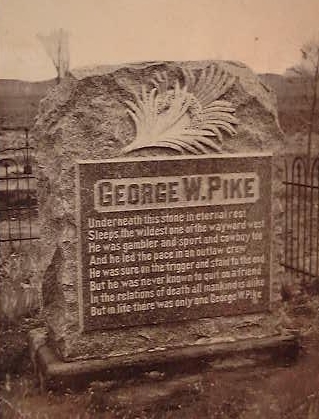
George W. Pike Grave Stone, Douglas Park Cemetery:

Underneath this stone in eternal rest
Sleeps the wildest one of the wayward west
He was a gambler and sport and cowboy too
And he led the pace in an outlaw crew
He was sure on the trigger and staid to the end
But he was never known to quit on a friend
In the relations of death all men are alike
But in life there was only one George W. Pike

Pike was buried north of the town of Douglas in 1906. He is said to have been moved to the Douglas Park Cemetery in 1908 when his headstone arrived from Denver. As for his colorful poetic epitaph? No one knows who really composed what's written on Pike's gravestone. A popularly myth about that says that it was written by a close friend of his who worked as a bartender at Lee Pringle's College Inn Bar. Imagine that.

Tom Correa 


Thursday, December 28, 2017

Believing God Is Not Dead Nor Does He Sleep


Below are the original words of Henry Wadsworth Longfellow's poem "Christmas Bells":

I heard the bells on Christmas Day
Their old, familiar carols play,
and wild and sweet the words repeat
Of peace on earth, good-will to men!

And thought how, as the day had come,
The belfries of all Christendom
Had rolled along the unbroken song
Of peace on earth, good-will to men!

Till ringing, singing on its way,
The world revolved from night to day,
A voice, a chime, a chant sublime
Of peace on earth, good-will to men!

Then from each black, accursed mouth
The cannon thundered in the South,
And with the sound the carols drowned
Of peace on earth, good-will to men!

It was as if an earthquake rent
The hearth-stones of a continent,
And made forlorn the households born
Of peace on earth, good-will to men!

And in despair I bowed my head;
"There is no peace on earth," I said;
"For hate is strong, and mocks the song
Of peace on earth, good-will to men!"

Then pealed the bells more loud and deep:
"God is not dead, nor doth He sleep;
The Wrong shall fail, the Right prevail,
With peace on earth, good-will to men."

As most know, the Civil War was fought from 1861 to 1865, While the war itself would have been enough to give anyone at the time a feeling of hopelessness, the poet Henry Wadsworth Longfellow's second wife of 18 years died in 1861 after sustaining burns when her dress caught fire. That tragic accident took place on July 9th, 1861.

His first wife, Mary Potter Longfellow, died in 1835 after a miscarriage. His second wife Frances Appleton Longfellow's death came as an accident while supposedly putting locks of her children's hair into an envelope. She was attempting to seal the envelope with hot sealing wax as was the custom of the times. Her dress suddenly caught fire. Henry heard her screams and jumped off a sofa where he was taking a nap. He rushed to help her and immediately threw a rug over her to try to put out the flames.

Fanny, as she was known to all, was badly burned and was rendered unconscious during the ordeal. She was taken to her room while a doctor was sent for. It's said she drifted in and out of consciousness. At around 10am on the next morning, she awoke and asked for a cup of coffee. She then closed her eyes and died.

Henry burned his face and hands very badly while trying to save her. His burns were so bad that he wasn't able to attend her funeral a few days later. The burns to his face were so severe that he stopped shaving and he wore a beard from then on. Today, we know the poet's beard as a sort of trademark.

After her death, America's most popular poet of the times, a man who used some of the income from the sale of his poetry to discreetly buy slaves their freedom, Henry Wadsworth Longfellow stopped writing for years. Devastated by her death, it's said that he never ever fully recovered. It's even said that he resorted to using laudanum to help deal with his grief.

In March of 1863, Henry Longfellow receives a letter from his oldest son Charles. His letter states in part, "I feel it to be my first duty to do what I can for my country and I would willingly lay down my life for it if it would be of any good."

In 1863, Charles Longfellow joined the Union Army without his father's knowledge or blessings. During his service, he would be promoted to the rank of Lieutenant and become severely wounded. In 1864, his father traveled to a Union Army hospital in Washington D.C. to find his son. He then took Charles home. His wounds were serious enough to where that was the end of the war for Charles Longfellow.  

In the winter of 1863, with the war raging and no solution for peace in sight, months before finding out that his son Charles was not dead, and still reeling from the death of his wife, despair fell over the great poet. It is then that he penned his poem "Christmas Bells." 

Longfellow is believed to have written his poem on Christmas Day in 1863. Some say he was in such sorrow over the way the war was going, and the possible loss of his son, that his spirits were lifted when he himself heard the local church bells ring out. It's said that with hearing those bells, he felt as though God was reminding him that he has not abandoned him and all there.

His poem speaks to a Christian nation being overwhelmed by the roar of cannons and hate. It speaks to having despair, yet finding hope despite that gloom. His poem "Christmas Bells" was first published in February of 1865.

Christmas carols are inspirational, heart warming, and some songs can be absolutely fun and goofy as with "Grandma Got Ran Over By A Reindeer." Most spiritual Christmas carols speak to the miracle of the birth of our savior Jesus Christ. They speak to our faith as Christians.

As with all of us, I have my favorite Christmas songs. And depending on my mood, there are a few that I will still play into the ground just as I did when I was a kid with my 45s and small record player. Among my favorites is a relatively unknown carol called "I Heard the Bells on Christmas Day."

This carol actually comes from Longfellow's poem "Christmas Bells." Though it was written and published in the midst of the dark days of the Civil War, the poem was not set to music until 1872.

As Christmas songs go, this one never reached the Top Ten list. As a song, it was recorded in 1956 by singer Bing Crosby. And while many others including Harry Belafonte and Frank Sinatra have recorded the song, it is Bing Crosby's rendition that has met the test of time.

While Longfellow's poem "Christmas Bells" references the Civil War in his poem, including the lines "Then from each black, accursed mouth, the cannon thundered in the South. And with the sound, the carols drowned."

Those words don't appear in the song "I Heard the Bells on Christmas Day" as you can see for yourself below:

Joy to the world
Let earth receive her King

I heard the bells on Christmas day
Their old familiar carols play
And wide and sweet the words repeat
Of peace on earth, good will to man

I thought as now this day had come
The belfries of all Christendom
Had rung so long the unbroken song
Of peace on earth, good will to man

And in despair I bowed my head
There is no peace on earth I said,
"For hate is strong and mocks the song
Of peace on earth, good will to man."

Then pealed the bells more loud and deep
God is not dead nor does he sleep
The wrong shall fail, the right prevail
With peace on earth, good will to man

I believe this small Christmas carol speaks to one of the reasons why Christmas means so much to all of us. Our desire for peace on earth and good will to all of mankind speaks to our having faith in God during our darkest hours. It speaks to our not giving up even when giving up may seem so easy to do. It speaks to our faith and how we can overcome the hate and those against us. 

While peace and goodwill seem so rare, even in this day and age of conflicts and strife, that small Christmas carol speaks to our faith in God. Our faith that good will triumph over evil no matter how bad things appear because "God is not dead, nor does he sleep." 

Tom Correa

Saturday, December 23, 2017

A Christmas Long Ago

By the late 1940s, he started his own ranch with two friends. It was hard to keep it afloat but they did. Soon the others wanted out, and after a while, he was the only one left. He kept it going for years until that thing called the "economy" made it a losing proposition in the late 1970s during what my grandfather called the "Second Great Depression".

He used to tell me a lot of stories about "the old days," especially how it was during the Great Depression. I remember once I had asked my grandfather what were the hardest days that he'd ever gone through?

I expected him to say it was when he had to leave school after finishing the 3rd grade to work in the fields, or when he was 12 and told to run away from home because his step-father beat him and his mother worried that he'd be killed, or maybe the time his merchant ship was torpedoed during World War II.

Without hesitation, he told me that it was the Christmas of 1934. Work was hard to find. A huge Longshoreman's Union strike in San Francisco crippled the West Coast and Hawaii ports for months earlier in the year. That strike hurt a lot of men for the rest of the year even after it ended. It put a lot of good men out of work. He had been a merchant marine seaman for a couple of years by then and couldn't find a ship to save his soul. After doing this job and that, he said he lucked out and found work as a cowboy again to make ends meet.

He said he got up Christmas morning and opened the few presents they had. He and my grandmother got my mother a doll. He was able to get my grandmother a small necklace. My grandmother actually made him a work shirt that Christmas. They were living with his in-laws, my great-grandmother and great-grandfather. They helped them a lot. He said that they all went to church for a Christmas Mass. After returning home, they ate and visited.

"It was your mother's first Christmas," he said. "I worked that Monday which was Christmas Eve. No one worked on Christmas. We had very little. That is, other than our love for each other. It was a very rough Christmas, but we were better off than many many others."

As a young couple, they had no choice but to move in with my great-grandparents. They were fine with them moving in. In fact, they encouraged it by telling them that they would be able to save money by doing so.

My great-grandparents knew what hard times were. They had seen it when they were first married. They knew really well the struggle that takes place when you have nothing and your husband is taking whatever work he can. They knew really well that hard times do pass. They also knew that in its midst, it feels as though it'll never end.

Years later, he took a job on a ranch. He told me about on raining day when he sat on his horse with his rubber raincoat pulled up to his ears. He would have loved to have a slicker, but it was not a slicker. Instead of a slicker that extends the length of one's body, he only had his heavy rain jacket that he used on ship when at sea. Because it wasn't a slicker, it was too short and the rain dripped into that spot between his saddle's cantle and his trousers. So now as he sat there, he thought how his butt was wet, how his cigarettes were wet, how even his matches were wet.

He sat there as the first truck loaded. He spurred his horse to move the cows closer to the loading chute. Every now and then, he'd move his horse right and then left, left and then right, forward to nudge the cows forward down the alleyway and into the chute. It was a job. And frankly, that's all that mattered.

It was common for a Merchant Marine Seaman to find a job between ships. Since there wasn't Unemployment Insurance at the time, people took whatever jobs they could get to bring in an honest dollar. And while he knew real well that crews were needed for this ship and that, hard times made it so that he was being bumped by hands who had more seniority than him. 

As he once said, "Since sitting at the Union Hall and playing cards with the other guys waiting to get assigned to crew aboard an outgoing ship didn't feed his family, he needed work and would take any job he could." Of course, that was the attitude that most good men had during the Great Depression. They took whatever work they could get. 

He'd only been a Merchant Marine for a few years at that point. He didn't mind the work. He stepped aboard his first steamer in 1928. He was 15 years old and hired on as an "Oiler." He did it because it was work. He had never dreamed of going to sea or working aboard ship. He did it because it was work. Because it was a job. That in itself was reason enough to do it to the best of his abilities.

As with most things, we remember the good times instead of the bad. While he was now working as a cowboy again, for a moment he remembered how wonderful it was to go to sea. He was young back then, and he liked the hard work and being part of a crew. He liked the ports, the sights, and meeting the different people in faraway places that he only heard about.

He remembered his first Chief Boatswain. It was his Boatswain who made sure that he put most of his pay in an envelope for the Captain to hold. He told him that that was so he'd have money to send home after being out on the town. He remembered how his Chief stopped him from being taken for a ride in a clip joint in Seattle.

Most of the "clip-joints" were bars near the piers. All employed inside those joints were out to cheat young sailors out of their hard-earned cash. It was the same story with most clip-joints in any port. Most of those places had your standard young women who wore hardly anything. Those hustlers got sailors to buy them "campaign cocktails" that were three times the price of a regular drink. In reality, their so-called "campaign cocktail" was only a little orange juice mixed with 7up for the bubbles. 

Crooked bartenders were usually in on the scam. After getting a young sailor drunk, the bartender would charge him twice to three times what his drinks cost all to make it appear legit. In many cases, the bar would get a sailor drunk quickly. It was then that the bouncers would help them out the back door and into an alley where the sailors would be rolled for the money they had on them.

He remembered how his Chief Boatswain made sure he was paired up with another crew member so that he wouldn't be found later with his head bashed in and his money gone. He remembered that Chief telling him what bars to stay out of and how not to flash too much of his cash around. He also remembered how he gave him a roll of pennies to put in his pocket and his first night ashore in Hong Kong. The Chief Boatswain told him to wrap his fist around those pennies nice and tight before punching someone. Certainly before having to fight his way out the door.

He remembered that Chief padding him on the back when he found out that he'd met a gal who he wanted to marry. How happy the Chief was that it wasn't some barroom floozy but instead a nice local gal about his age. He wasn't yet 20 at the time.

Between ships, he'd found a temporary job working a jackhammer for a construction company, driving a bus, and even selling Singer sewing machines among other things. He was between ships and selling sewing machines when he met his future wife -- the wonderful woman who would be my grandmother.

It was soon after that when he asked permission from her parents to "court" her. It was then that he would show up and sit with her in their parlor. What we today call a living room. All while her mother sat in a chair across from them as they talked. They were soon married, and soon after that, his new wife became pregnant.

He remembered how much he loved being at sea at first. But then it swept over him, it was his remembering that lonely feeling when being aboard ship at sea. Not all of the time, but there were certainly those times when he knew that feeling of longing for home. He remembered how it would hit him now and then especially at night when on watch and the sea is black and the moon glimmers its reflection on every passing wave.

Now he was wet and shook his head thinking, that though waiting for a ship, here he was again working as a cowboy. Yes, it was something that he thought he'd never do again. Not because he didn't like being a cowboy, it was just because he didn't think he'd go back to something after leaving it behind him.

Another truck pulled their load of cows out. He sat there and waited for the next truck to come in and load up. The rain was constant and he wanted a smoke in the worst way. He gigged his horse as he had all day to move the cows into the alleyway and up closer to the loading chute. As had been taking place all day, every now and then he'd move his horse right and then left, left and then right, forward to nudge the cows forward down the alleyway and into the chute.

It had been about six years since he'd worked for his first cattle outfit. It was one of the times in his life when he was very happy. That outfit was great in that they treated him no differently than any of the other ranch hands, even though he was only 12 when he walked into the place looking for a job.

He was used as "the gopher" at first. He would go for anything the boss and others wanted. He was tasked with mucking stalls, cleaning, painting, loading, and unloading this or that. He learned how to string barbed wire and fix fences, repair water pipes and replace valves at troughs, And of course, he was there on the ground during brandings learning to cut horns, castrate, and run the hot irons to the cowboys doing the branding.

That's the way it was for six or eight months until that one day when the boss told him to make a saddle and a headstall and bridle out of the old stuff sitting around the tack room. He remembered going in there and finding what he thought he needed out of the old tack hung here or there in cobwebs and dust.

He found an old A-fork saddle that he cleaned up and oiled its leather. He changed out its worn bucking rolls, its cinch straps, latigo, and even replaced a stirrup with one that he found on another old saddle that looked cannibalized.  He used whatever old tack that still looked usable that the other cowboys didn't claim. He made sure he didn't touch any of their gear.

Sitting on that horse in the rain, he remembered how he enjoyed being a cowboy those few years of working for that outfit. He felt a bit sad when remembering that day when his boss showed up to let him and a few others go. He'd never heard the word "economy" before. He remembered his boss saying he was letting him and some of the other hands go because of the "economy."

He had forgotten about the times he had worked in the mud mugging some steer or being wet when he wished he were dry and drinking a warm cup of coffee. He'd forgotten the long days during calving season, getting cattle out of a neighbor's property after they escaped through a break in a fence, or nursing the sick back to health.

Pushing cows to a loading chute can be sort of boring when having to wait for a new truck to back in. He shook his head remembering how this all started as a short conversation outside a grocery store. He was buying a loaf of bread when he overheard a local rancher say how he couldn't find good help who knew anything about cows, never mind horses.

It was then that the between-ships sailor said that cows and horses were no problem if a hand knew what he was doing. When the old rancher asked if he knew what he was doing around cows, he told him the name of the outfit that he'd worked for before this thing called the "economy" cut his job out from under him.

He told that rancher how he went to sea to make an honest dollar, how there were those times when he missed being in the saddle, how he was between ships, and how he was looking for work because he had responsibilities since he was recently married and had a new daughter.

The old rancher took a piece of paper out of his pocket and wrote down his address, saying, "Be there at 8 o'clock and I've got work for you. If you show me that you're experienced, you'll be paid what I think you're worth."

He was brought up to understand hard times. He had worked full time since leaving home right after he finished the 3rd grade. His first job was in the fields as a picker and he did that for almost 4 years before finding work on that ranch as a cowboy.

He liked being a cowboy. He liked the hard work and the cattle. He liked the horses and learning to do an assortment of different jobs. He liked that no day was the same as the next, especially during gatherings. He liked being a cowboy more than any job that he'd ever had.

He knew jobs were hard to come by, so getting a job was half the battle to making a dollar. The other half of course was being able to hold a job. So when he was hired on somewhere, he ran with it and gave his boss everything he had. He knew what it was to be hungry. He didn't like being hungry.

The last of the cattle were loaded onto the trucks that rainy day. It was getting dark and the rain was coming down harder than earlier. He didn't know how long he'd be working as a cowboy but he liked it. He had something to eat for breakfast and they worked through lunch to get the trucks loaded. He didn't mind because he always loved the work. It was honest money and he felt good about giving his boss a good day's work even in the worse of conditions.

He liked knowing that he had a good reputation. That he was seen as a good hand, a hard worker, someone reliable and dependable, meant a lot to him. He liked knowing that he was a cowboy again even if it was only until this boss comes over to tell the boys that he was letting some of the hands go because of the "economy".

Even though it was Christmas Eve, he felt good about working hard and knowing that he was taking a few bucks home to his wife who just gave birth to their daughter in early November.  The boss paid him for the week and he knew he could spend those needed dollars on presents, but they needed food and clothing more than Christmas presents.

The years would grow harder still. He knew that he would take any job as long as it was honest work. He knew jobs were few and the bread lines seemed longer every day. His attitude of taking whatever job that came along made all the difference in surviving the tough days of the Great Depression.

My grandmother used to say, "A man feels good about himself when he's working."

Since providing for your wife and children is the number one duty of a husband and father, she was probably right. My grandfather did whatever it took. Whether it was between ships when he needed to find work, or later when he finally gave up on the sea, among other things, he'd cowboy to pay the bills and keep food on the table. He liked it and felt good about himself because he was working.

Tom Correa


Tuesday, December 19, 2017

Light For Rural America

Dear Friends,

Back in the mid-1980s, I had a foreman who was a hard-working man with a great work ethic. Above all else, he understood hard times, and I respected that most about him.

I found out later that he was born in 1932, which made him 6 years younger than my Dad. Yes, like my parents, he was born and raised during the Great Depression.

Besides working together, he being my boss, we became pretty good friends over the years. For me, I mostly enjoyed his stories about growing up in Arkansas. In reality, it was because of him that I actually learned a great deal about how it was to grow up during those Great Depression years in the rural South.

It wasn't as if I didn't hear a lot about how it was during the Great Depression. My Dad and my Grandfather had both told me a lot about the hard times that were everyday life for the vast majority of Americans during that time. My friend's experiences were different from that of my Dad and Grandfather because my family is from Hawaii. During that same time period, conditions in Hawaii were very similar to what was going on the "mainland" or "in the states." But at the same time, things were also very different as well.

For example, where my family worked for the pineapple and sugar plantations on Oahu, my friend's family were sharecroppers in Arkansas. Where my family was poor, they still had a roof over their heads because it was provided to them by the plantations. In contrast, my friend's family was essentially homeless after losing their farm. And where my family was able to have a small garden where they could grow vegetables to help save money that they didn't have, his family didn't have any of that for a long time after losing their farm. Because of that, he remembered going hungry at times because his father just couldn't find work. 

Besides telling me about how bad it was, he once talked about growing up without electricity. The only thing that I could compare that to was how my family's ranch in Hawaii did not have electricity. We made do with kerosene lanterns and a Navy generator that refused to work when it had the mind to no run. Of course, our not have electricity was not the same as my friend's family. For us, it was because our ranch was in a very remote area of the island at the time. My friend's family didn't have electricity even though they weren't all that far out of town. 

Fact is, like many rural Americans of the time, he was raised on candles and oil lamps. Yes, up until the passage of the Rural Electrification Act of 1936, which created the Rural Electrification Administration (REA), many rural Americans lived in the dark compared to their urban cousins. 

The REA was one of President Franklin D. Roosevelt's "New Deal" Federal programs. Like the others, it was meant to spur economic growth and improve the sad state of America's economy. Specifically, the Rural Electrification Administration was set up to better the working conditions of those working in American agriculture and their families, which were hit especially hard by extended drought and flooding during the Great Depression. In essence, the REA, the Rural Electrification Administration, gave incentives to corporations to build power plants and put in power lines in areas where there were none.

For some odd reason, President Franklin D. Roosevelt doesn't get a lot of credit for working with big corporations. People forget that part of the New Deal was to jump-start employment. The fact is President Roosevelt did work closely with corporations in huge ways to create jobs. For example, the president's federal REA program provided low-interest 25-year loans, loans at just 3 percent interest, to energy corporations to construct power plants and put in power lines in rural areas. 

With those REA low-interest federal loans, corporations could make electricity available to rural Americans like my friend's family, who never had it before. Farmers, ranchers, dairymen, schools, small businesses, local courthouses, small towns that dot our nation all could afford to have electricity in their homes, farms, businesses, and much more. 

President Roosevelt's Rural Electrification Act of 1936 was passed to believe that electrified agriculture would improve incomes and raise standards of living in rural America. 

Before the REA, electricity to rural America was costly simply because of fewer customers per mile of electric line than urban areas. Because of the cost of building lines and still making a profit, many private power companies, energy corporations charged rural customers more per kilowatt-hour than they charged urban residents simply because they were trying to recoup costs. Before the Rural Electrification Administration (REA), it's just that electric service to rural Americans was minimal. 

Before the passing of the Rural Electrification Act of 1936, the federal government had already tried to provide rural Americans with electricity by way of creating the Tennessee Valley Authority (TVA). In 1934, the TVA began providing fairly inexpensive electricity to rural Americans in the Tennessee River valley. Because the TVA was such a success, everyone, including the politicians in Washington D.C., saw that agriculture benefited by using electricity. 

It is said that those in agriculture saw processing made easier and production increase. It's also said that their families saw the benefits of electric lights, electric well pumps, electric washing machines and stoves, and even radio. It was the TVA that actually spurred demand in rural areas for inexpensive electricity.

The Rural Electrification Administration was created to meet that demand. The Tennessee Valley Authority's (TVA) success proved that getting power to rural Americans as possible and financially feasible. 

Rural electrification has fulfilled the promise of improving the standards of living in rural communities across our nation. Ranchers, farmers, dairymen, their families, and their communities all benefited, and their lives became better for it. 

I remember my friend telling me that he was about 9 years old when his family got their first light bulb. He told me about how his Mother stayed up for hours during their first Christmas after getting that first bulb. He said his Mother sat and waited for the bulb to go out just as if it were a candle. He said his Dad had to explain to her how she didn't have to worry about it running out of oil or about it burning down to nothing as a candle would. He told her it would stay on as long as she kept didn't flip the switch to turn it off.

I remember my Arkansas friend tearing up when remembering how his Mother refused to flip the switch because she was afraid that it wouldn't come back on again. How she just sat watching that lonely bulb. All the while with tears of joy running down her face. All over the mere thought of having a light a hundred times brighter than an oil lamp. Light as she never experienced. Light with the flip of a switch.

He said she saw that light as a gift from God and Franklin Delano Roosevelt.  
I think she was right on both counts. That's just the way I see it. 

Tom Correa