

Saturday, January 12, 2019


Wednesday, January 9, 2019
Horse Down -- Getting Cast

Our stall kicker is a tall gelding. I got him, Gunner, and an older Arab mare, Tango, as a pair looking for a new home. Gunner and Tango are tied at the hip. Yes, as herd bound as can be. Separate one and the other is in distress, and vice versa.
Now before you start typing to tell me how bad it is to have herd bound horses, I'd normally agree with you if I were riding either. If either were being ridden, then riding a herd bound horse is a pain since they don't want to be too far from the other. But frankly, these two rescues are not ridden.
Also, I see horses being herd bound as a plus of sorts. In nature, in the wild, horses are herd bound. Because horses are prey animals, being herd bound is a matter of survival. Yes, their survival depends on being a herd because they see safety in numbers. A herd works together to use their senses of smell, hearing and sight to be on guard to possible danger. When the alarm sounds, a herd can go from grazing to a dead run in an instant. Because of this, their instinct for survival leads them to join up with others. My tall gelding joined up with my old Arab mare a long time before I got them. When she is in trouble, he throws a fit to alert me. Yes, he sees me as part of his herd as well. And yes, that's the plus of horses looking to be part of the herd. Horses can and will bond with people just as strongly as they do with other horses.
If you're around horses for a while, you can't help but see that horses are thinking caring animals. They're not the dumb animals that some seem to think. For example, introduce a new horse to the mix and watch how they will instantly form opinions of that horse. From establishing a pecking order, to instant hostility, to establishing respect for a leader, they are more keenly aware of each other than we are of each other. And don't fool yourself, horses establish relationships within the herd. They partner up. I have a few horses and they've all paired up to a certain extent.
While walking to our barn last night, I noticed that Gunner who was in the stall next to Tango was in a lather. Not kicking, just agitated as if something were wrong.
My barn is built to where each 12 foot by 12 foot enclosed stall leads out to a 12 by 12 pen. Those outside pens were considered "outside" the barn until fairly recently when I built a lean-two over them. So now, in effect each stall is actually a 12 by 24 foot stall.
Well, Gunner was agitated because Tango was down and stuck. She couldn't get up. She had cast against and under the outer fence rails of the outside portion of her stall. Yes, a horse can get stuck. It's called "cast" or "casting" in a stall. A horse is said to be "cast" when they lay down or rolled and managed to position themselves with their legs are so close to a wall or fence that they can't get up or re-position themselves to roll over.
In this case, that was the situation with Tango under the fence rails of her pen. Her legs were positioned in a way that she was caught and couldn't get up or roll over.
Frankly, the last time that I saw such a thing take place was about 35 years ago. At the time, a neighbor's horse was stuck against a stall wall and I was called to help get his horse out. After a great deal of trial and error, with my neighbor almost being kicked a few times, it took him, me, and two other men to drag his horse out and away from that stall.
I remember how we tried rolling him over and he nearly kicked the hell out of us. We tried one thing or another before we ended up tying a loop around it's neck and a loop around its hind quarters and dragged it out of that stall. He was a 1,200 pound horse and it took everything we had to pull it out of that stall. Once out, once the horse was on its front feet it worked to get it on its feet completely.
I haven't seen it happen since but I know full well that horses have a talent for getting themselves in trouble. Having a horse cast is said to take place in the wild, and while it can happen to horses in pastures in regards to rolling too near a fence or in a pen near a panel, it's a lot more common for horses to get cast in a stall.
What Is Cast?
"A horse is said to be cast when it gets stuck on its back or side and a bit like a turtle, can't get its feet under it to stand up again. The horse's legs may get jammed against a wall or fence, caught in a rope, its own halter, or blanket straps, stuck under a feeder, rail or another object, or the horse might lie down in a hole or hollow in the ground and not be able to scramble out of it."
How Does A Horse Get Cast?
"Horses that lie down in their stalls may lie down too close to a wall, and be unable to stretch out their legs to get up again. A horse may roll in its stall and get stuck with its legs up against a wall, or tangled in a hay feeder, or under stall boards. A horse will roll to scratch itself and get comfortable, or a horse might roll if it has colic. If a stable blanket gets shifted while the horse lies down, it can get tangled in the leg straps and be unable to stand up. In the pasture, horses can get cast when they lie down too close to fences or other objects. Even lying down in a hollow, or against a hill can prevent a horse from regaining its feet. Sometimes soft footing makes it hard for a horse to stand up after lying down. In the winter time, horses that lie or fall in deep snow can become cast. Horses can fall in trailers, and be unable to get up. Many horses, especially youngsters scratch their ears with a hind toe and can get tangled in their halter. Once tangled, the horse may fall and be unable to get up."
What Happens When a Horse Gets Cast?
"When a horse becomes cast, two things may happen: Feeling entrapped and unable to regain its feet can cause a horse to panic. As it flails and struggles, it can injure itself. The struggling horse can also hurt anyone who comes near. Although it seems trivial compared to what the panicking horse can do to itself and to the people trying to help it, it can also damage the stables, fences or anything else it strikes."
What Are "Reperfusion" Injuries?
Besides a struggling horse possibly injuring itself, there is the problem of "reperfusion." If a horse is cast too long, there is the possibility that "reperfusion" injuries can take place.
"The weight of their own bodies restricts blood flow to various areas of the body. When the horse stands on its feet again the blood flowing back into the affected areas causes pain and inflammation. Besides reperfusion injury, blood can pool in the muscles on the underside of the horse and nerves can become damaged by the pressure of the horse's own body weight. If the injuries from struggling and/or damage due to pooling blood are severe enough the horse may have to be euthanized. Blood can also pool in the lungs. If that happens, after a while, the horse can suffocate."
This is why time is so important and the horse has to get back on its feet. If the horse is not found for many hours when it becomes cast, it may die.
What to Do When a Horse Becomes Cast?
For me, I knew I had to stay calm and act quickly. After checking out the situation, I checked Tango's breathing and I looked for injuries. While I couldn't see anything in her dimly lit outside pen, I figured that I'd recheck her for injuries once I got her back on her feet. I knew the clock was ticking and I had no idea if she were down for minutes or hours.
I put a loop around her neck and tried to roll her over while making sure that I wouldn't get hit with a flailing hoof. I noticed that at first she tried to get up even though she was stuck, then she calmed down almost as if knowing that I was there to help. Even though that's what I thought it seemed like at the moment, I've been around horses long enough to know that a horse that appears calm can start up again without notice. I was hoping to just roll her over, but that was not going to happen.
When I couldn't roll her over, I knew I needed a longer rope, more light, help, and more muscle. As I made my way back up to my house, I formulated a plan to get Tango out of there and back on her feet. The first thing was to get my wife Deanna to help. Since she was still up, I told her we have a horse down and we have to get her on her feet. She joined me in the rain to help without even asking me what I planned to do. Yes, that's trust.
I took my pickup and pointed it toward Tango, and left it running with the high-beams on for light. I retrieved a few ropes, and then had my wife drive our Chevy Tahoe around the side of our barn. She then faced the front of the vehicle toward Tango's pen/stall.
I moved a board Tango had knocked loose and I removed as many of the fence pen's enclosure that I could. About then, the rain started to come down harder. I took a rope and slipped a loop around her neck and tried to set a loop around her hind quarters as well as I could. I tied the end of the rope to the tow hook on the front of our Chevy Tahoe.
I asked my wife to reverse very slowly when I gave the signal. Besides not wanting to hurt Tango, the rain made for traction problems that I wanted to avoid.
Deanna watched my hand signals and reversed our Tahoe. Tango was tugged very slowly out from that predicament. When I though she was free, I signaled Deanna to stop. When I saw that she wasn't free yet, I signaled Deanna to pull more. And stop!
Tango was away from the fencing and free. Almost immediately she worked her front feet and then her back to stand up. I gave her room as she stood. The poor thing was shaken and looked exhausted. I checked her again for cuts and injuries. Then after a few minutes, when I thought she was able to walk, I walked her around and into another pen.
It's said that we shouldn't just pull on a horse's head and neck because that can possibly cause spinal injuries. But if that's all that we can do to save our horse, than that may be the only alternative that we have to solve the problem and save our horse.
I knew time was huge factor and that I had to get her on her feet quickly or run into all sorts of problems which meant that I might lose her. I knew better than to put myself between her and the fencing that she was under. I knew that I tried to get her to roll over and couldn't, and with that I knew that I needed ropes, help, and more muscle to drag her out of her predicament. My wife jumped in and helped as we used a lunge line and our Chevy Tahoe to get her out of trouble.
If you find yourself in a similar situation, here's my advice:
Above all else stay calm and be careful of not getting hurt when approaching a horse that's thrashing. Wait for the horse to calm down. Don't pull on a halter to try to move a downed horse, instead loop the neck. Also, don't pull on the horse's legs. They will resist that and permanent injuries can result in pulling the legs.
If in a stall, make sure you have enough room to roll a horse that's cast. Stay as far back from the horse as you can after re-positioning her. As soon as the horse feels that she may be able to get up, there's a chance that she may start thrashing around trying to do just that.
Once a cast horse is on her feet, she'll calm down. Give her a few minutes before moving her. Take that time to check her for cuts or injuries like swellings. It's said that most horses escape casting unscathed. But others, especially a horse that was down for a long time until someone discovered her, can be pretty banged up.
I rechecked Tango a few times today. It may have been my imagination, but I somehow think she appreciated seeing me even more than usual.
Tom Correa
Wednesday, January 2, 2019
The Cutthroat Gap Massacre 1833

In 1833, there were only 24 stars on Old Glory. The map of the United States was called the "eagle map" because of the configuration of our states and territory. It resembled an eagle.
On March 4th of that year, President Andrew Jackson was sworn in for his second term. On May 11th, a French-American farmhand by the name of Antoine le Blanc murdered a family of three and was properly hanged. On June 6th, Andrew Jackson became the first U.S. President to ride a train.
On August 12th, the town of Chicago was established at the estuary of the Chicago River by 350 American settlers. It would very quickly become a large city. That year, from November 12th to the 13th, what was called "the Leonid meteor shower" took place. It was observed in Alabama. The spectacular site came to be known as the days the "Stars Fell on Alabama."
The whole Louisiana Purchase land deal included lands from the Mississippi River to the Rocky Mountains, and from Louisiana to Montana and up into what is present day Canada. The area belonged to the French from 1699 until 1762. As crazy as it sounds, that's when it became Spanish property. France gave the whole thing to Spain as a present. Yes, as a present. Supposedly France gave it to Spain because they were allies against the British.
As for how it got back into French hands, well it didn't last very long in Spanish hands because Napoleon Bonaparte of France was an Indian giver and took it back in 1800. Of course, at the time Napoleon was at war with the British and he need money because his war was getting expensive. Because he needed cash to fight the Brits, Napoleon sold the land to the United States for $15 Million.
The territory was huge. It was actually bigger than most of Western Europe and included what is today Iowa, Missouri, Kansas, Nebraska, and Arkansas, parts of Minnesota and Louisiana west of Mississippi River, a huge chunk of northeastern New Mexico, South Dakota, northern Texas, some parts of Wyoming, Montana, and even Colorado. Yes, also portions of Canadian provinces Alberta and Saskatchewan. And of course Oklahoma, which was known as Indian Territory.
The territory was huge. It was actually bigger than most of Western Europe and included what is today Iowa, Missouri, Kansas, Nebraska, and Arkansas, parts of Minnesota and Louisiana west of Mississippi River, a huge chunk of northeastern New Mexico, South Dakota, northern Texas, some parts of Wyoming, Montana, and even Colorado. Yes, also portions of Canadian provinces Alberta and Saskatchewan. And of course Oklahoma, which was known as Indian Territory.
Of course that's the other part of those European imperialists giving gifts of land to each other, taking them back, and then selling it. They didn't really care about who was already living there. Or should I say, who was waging war there. For example, in 1833 in Oklahoma, the Osage and the Kiowa were at war and had been for a long time. No, not against the French or the Spanish or the Americans, but against each other. And in reality, those tribes hated each other for a long time.
Some say that the Osage and the Kiowa were at war for decades or longer. In the Spring of 1833, that's when the Cutthroat Gap Massacre took in what is today Cooperton, Kiowa County, Oklahoma.
History tells us that the Kiowa gathered their tribes on the Plains near the Rainy Mountain Creek to organize their annual Sun Dance ceremony. The Sun Dance is considered the most important spiritual ceremony of the Plains tribes. During the ceremony, the tribes also hold their tribal council meetings. When the Kiowa arrived near the Rainy Mountain Creek, it's said they found a warning sign and decided to leave the area as quickly as possible. The warning sign was an Osage arrow left there for the Kiowa to find.
Why leave and run away? Well, the Osage were simply a bigger tribe and such a warning was taken seriously. The Osage had more warriors and more weapons. They were the Kiowa's biggest enemy. The Kiowa's mortal enemy.
The problem for the Kiowa was one of grave concern. The situation they faced was one of having to make a difficult choice between two equally undesirable choices. Their Sun Dance religious ceremony was at the heart of who they are as a people and because it was extremely important to them, it needed to take place. It was already agreed upon that all of the Kiowa would have to come back to take part in the ceremony.
Some say that the Osage and the Kiowa were at war for decades or longer. In the Spring of 1833, that's when the Cutthroat Gap Massacre took in what is today Cooperton, Kiowa County, Oklahoma.
History tells us that the Kiowa gathered their tribes on the Plains near the Rainy Mountain Creek to organize their annual Sun Dance ceremony. The Sun Dance is considered the most important spiritual ceremony of the Plains tribes. During the ceremony, the tribes also hold their tribal council meetings. When the Kiowa arrived near the Rainy Mountain Creek, it's said they found a warning sign and decided to leave the area as quickly as possible. The warning sign was an Osage arrow left there for the Kiowa to find.
Why leave and run away? Well, the Osage were simply a bigger tribe and such a warning was taken seriously. The Osage had more warriors and more weapons. They were the Kiowa's biggest enemy. The Kiowa's mortal enemy.
The problem for the Kiowa was one of grave concern. The situation they faced was one of having to make a difficult choice between two equally undesirable choices. Their Sun Dance religious ceremony was at the heart of who they are as a people and because it was extremely important to them, it needed to take place. It was already agreed upon that all of the Kiowa would have to come back to take part in the ceremony.
Kiowa Chief Islandman's group headed by the left the creek and went southwest. They found a place west of a mountain that had good grazing and looked as though it could be defended if need be. Thinking they were safe there, they set up camp. Then almost right after arriving, most of their warriors decided to leave their new camp to raid a nearby Ute camp. Some say they left to hunt buffalo. Either way, they left their camp undefended. Most of the men left to raid a Utes camp and to hunt buffalo.
Kiowa Chief Islandman sent out his warriors not realizing that they had been noticed by a hunting party of Osage warriors from Three Forks. The Osage warriors had been out hunting buffalo on the Kiowa lands when they spotted Chief Islandman small group on the move looking for a place to set up camp. They stalked Chief Islandman’s group every since they quickly left the meeting site near the Rainy Mountain Creek.
Besides being mortal enemies, the Osage saw that the Kiowa had horses in their camp. The Osage wanted the Kiowa's horses. But also, they wanted their food and supplies. The Osage knew that they needed more warriors to launch an attack and take what they wanted. And no, it didn't matter to the Osage if they killed every Kiowa there in the process.
The small band of Osage warriors attacked the Kiowa camp and mercilessly slaughtered all of the women and children, included the elderly. The attack was easy because the Osage found the camp defenseless. While they were after the horses and supplies, they also saw it as their chance to wipe out that small group.
Genocide being what it is, "the deliberate killing of a large group of people, especially those of a particular ethnic group or nation." No one can argue the point that the Osage intention was genocidal in nature. Like it or not, killing warriors is warfare. Killing women and children to halt the existence of a people is genocide.
The Kiowa warriors who were said to have either been away from camp buffalo hunting or raiding a Ute camp left the camp unprotected and the Osage killed approximately 150 Kiowa because of that fact. The Osage did take a couple of children as slaves, but also took the Kiowa's sacred Tai-me medicine bundle.
It was a surprise attack, and the Kiowa women found themselves outnumbered. Panic sent the Kiowa women and children in every direction hoping to find safety. Though mayhem swept through the camp, a visiting Pawnee warrior attempted to fight off the Osage warriors to help the Kiowa women flee with their children. One Kiowa father who had not left the camp is said to have grabbed his young son and actually carry him with his teeth as he tried to fight his way out of the carnage. the story goes that he would put his son down, fire arrows at the Osage invaders, pick him up again and run.
There's another story of a young Kiowa boy who put himself between the Osage warriors and the other children while firing arrows at the Osage. Some of the Kiowa women fought as hard as they could while telling their children to run and hide. Some gathered up their babies and fled but were no match for the Osage who roared into the camp. Though screaming for mercy, the Osage ruthlessly decapitated, scalped, and murdered all there. After the killings, the Osage then burned down their teepees to deprive shelter to those returning. And no, the horror didn't stop there. The worse was found later when the Kiowa warriors returned to camp.
It's said someone escaped and alerted a nearby Kiowa camp. This had their warriors rushing to the help Chief Islandman's tribe. By the time the Kiowa warriors arrived, Chief Islandman's warriors returned to the camp. They found the decapitated and dismembered bodies of their wives and children, and even their elderly. To their horror they also found that the Osage warriors had taken the heads of their victims and placed them in cooking pots where they were left there to be found.
The Kiowa warriors also found that two sibling children were taken. One was a small boy named Thunder and a girl named White Weasel. As for White Weasel, she was returned to the Kiowa a few year later. Her brother, Thunder, had later died a slave of the Osage.
After the massacre, Chief Islandman was blamed for not providing proper security, for not setting up some sort of a perimeter, for not leaving enough warriors behind to protect the camp. He was held responsible for the camp being attacked and was replaced by Chief To-hau-san. Besides the horses and supplies that they were after, the Osage also took the Kiowa's sacred Tai-me medicine bundle that was necessary in order to perform the Sun Dance. Because of that, the Kiowa were not able to perform the Sun Dance ceremony for two years after the massacre. It took Chief To-hau-san a long time to talk the Osage into giving their Tai-me bundle back to the Kiowa.
The place of the massacre became known as Cutthroat Gap. After the massacre, the Kiowa never used it again for their Sun Dance ceremony. In fact, legend has it that the spirits of the Kiowa dead still wander the area. Some say their screams for mercy can still be heard in the wind.
Tom Correa
Wednesday, December 19, 2018
Christmas at Valley Forge 1777

During the American Revolution, defeats were plentiful. By September of 1777, British forces captured the United States capital, which was Philadelphia. After he failed to retake the city, General George Washington led his 12,000-man Army into winter quarters at Valley Forge, which is located about 20 miles northwest of Philadelphia. Of course, the Continental Congress had fled Philadelphia and was about one step ahead of British troops who swore an oath to hang everyone who signed the Declaration of Independence.
With a third of his 12,000 men without shoes, their feet wrapped in rags, George Washington led his Army into Valley Forge just before Christmas in 1777. It was in Valley Forge on December 19th that the Continental Army and George Washington would change the course of history and reverse the course of the war, which was not going well for America.
Upon arriving in Valley Forge, Washington ordered his men to build wood huts as shelters for the long winter months ahead. To do this, his men cleared 16 by 14 foot square dugout to build their shelters on. They dug two feet into the ground to remove the permafrost. Using logs for the walls, they also gathered stones for makeshift fire-pits that really didn't resemble fireplaces. The dirt floors of the huts were used to sleep 12 men each. With openings but no actual doors to block the freezing cold, the men attempted to keep the frigid air out with the use of blankets and canvas placed over the doors. It is believed that 1,300 to 1,600 huts were constructed.
In 1777, the Continental Congress was seen as making all sorts of empty promises when it came to supporting the Continental Army. Support for General Washington had dwindled in Congress after a series of brutal losses that year. So much so that Congress reorganized the Board of War and stripped the Commander in Chief of some of his authority.
And while this was going on, Washington's Army lacked equipment. But worse, thanks to an indecisive Congress, the American Army was starving. It was a miserably desperate situation for General Washington. While battling the British, he was also fighting Congress. His men went hungry as promised food provisions were withheld. Knowing that Congress may let them starve before acting, Washington's men competed with the British while foraging for wild game. Of course, because they were competing for what game there was available, and soon game too became scarce.
Washington used Valley Forge as a defensive position to re-group, train, and reorganize his units. It was also a place from which he was able to keep an eye on British troops. That was the number one reason that Valley Forge was selected by Washington as a place to winter his Army.
It's said that Congress either didn't care about the situation taking place at Valley Forge or simply thought that Washington was exaggerating the horrible conditions. The fact is, what took place there was horrible indeed. Washington's men were starving, malnourished, battle-weary, discouraged, and feeling betrayed by Congress.
As General Washington saw things unfold and get worse, some say that during the Christmas of 1777, he became despondent over their fate. I really believe that those who say such things really don't understand who Washington was as a man. They don't understand what sustained him through the hardest of times. He was deeply spiritual, and his faith gave him strength.
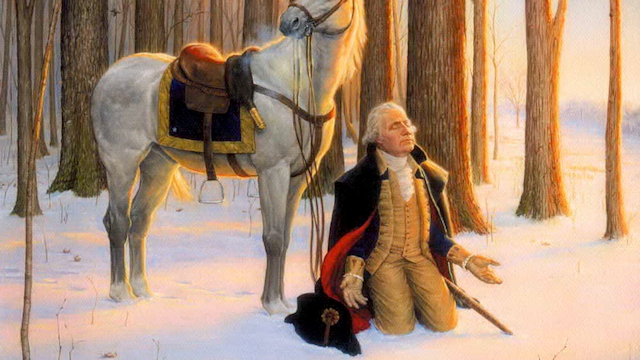
Whether merely a myth or not, there's the story about General Washington in prayer. That story has to do with the Potts family, who actually owned the land at Valley Forge. It was their land that Washington chose to regroup and winter on. During his time there, Washington requisitioned the Potts family home, some say it was the Potts family business, to use as his headquarters at Valley Forge.
The story goes that while Isaac Potts was initially a British loyalist because he had felt that the British were simply too strong a power to go up against, his opinion changed after observing Washington and the other officers train the troops there. And among other things, Potts saw that Washington was a religious man, a good Christian.
Potts supposedly later recalled, "It was a most distressing time of the war. All were giving up the ship but that great and good man. In those woods, I heard a plaintive sound, as of a man at prayer. I tied my horse to a sapling and went quietly into the woods, and to my astonishment, I saw the great George Washington on his knees alone, with his sword on one side and his cocked hat on the other. He was at prayer to the God of the Armies, beseeching to interpose with his Divine aid, as it was a crisis, and the cause of the country, of humanity, and of the world. Such a prayer I never heard from the lips of man. I left him alone, praying. I went home and told my wife I saw a sight and heard today what I never saw or heard before. We never thought a man could be a soldier and a Christian, but if there is one in the world, it is Washington."
We are all reminded that the militia was only so-so effective during the Revolutionary War. But the fact is, General Washington was not in charge of professional soldiers, as was the case with the British, who we were fighting. Washington's men were the militia who stepped forward to defend rights they saw as being from God and not some King atop a throne in England.
Those were American farmers, cobblers, tinkers, craftsmen, tradesmen, who left to take up arms in a cause that was new to the world. The cause of men declaring their freedom from lords and nobles. And while there were certainly those who deserted and returned home to tend to the needs of their families, others stayed the course and soldiered during the worst of circumstances that winter.
There is a story of something that took place at Valley Forge. It has to do with when General Washington took pen in hand to make a plea for assistance from Congress. In his letter, he told Congress of the dire situation. Some say that the letter was supposed to be his resignation. Some want to say it was when he declared the cause hopeless.
Washington supposedly wrote the following letter: "I am now convinced beyond a doubt that unless some great and capital change suddenly takes place, this Army must inevitably be reduced to one or other of these three things. Starve – dissolve – or disperse, in order to obtain sustenance in the best manner they can. Rest assured, Sir, this is not an exaggerated picture, and that I have abundant reasons to support what I say."
It's said that he heard a commotion outside his tent while writing that letter. Without a hat or wearing his coat, he left his tent and went out to see what was taking place. It was there that he found his men huddled together around fires, all making merry as best they could for Christmas. They found game to feed on. Many saw their bounty as gifts from God. Many were right.
Washington himself wrote later that he was astonished at the level of good cheer among the men. He wrote how he joined in the fellowship and wished every man there a very Merry Christmas. And then and there, yes, there in the worst conditions, on that Christmas, his men cheered, "Long live the United States! Hail to our Chief! May Liberty prevail!"
General George Washington is said to have been moved to tears. There, his men, starved and wrapped in blankets with rags wrapped around their frostbitten feet, cheered him that snowy day. As he watched his men brave the elements, he asked if they had not suffered enough.
To his question, a lieutenant quickly replied, "Having come this far, we can but go the rest of the distance."
Washington was taken by the lieutenant's heartfelt response. But even more so, upon his return to his tent. When he returned to his tent, Washington was amazed to see that, in his absence from his tent when joining the others in fellowship, some of his men gathered garlands of holly and cedar and decorated the outside of his tent.
How anyone knows what was in that letter that General Washington was supposedly writing to Congress is a bit of a mystery because it's said that he took the letter and burned it. Instead, he's said to have turned and said to his men, "May God relieve your sufferings, if the Congress will not. And a good Christmas to you!"
A historian noted that the "clouds did not part and the burdens were not lifted on that Christmas Day of 1777. But from the depths of that Christmas came a resurgence in the hope and confidence of George Washington."
At Valley Forge, Americans struggled to manage a disastrous supply crisis while retraining and reorganizing. They remained in Valley Forge from December 19, 1777, to June 19, 1778. During that time, about 1,700 to 2,000 American troops died due to disease and starvation.
While it was a terrible ordeal, history shows that what took place at Valley Forge was the turning point of the American Revolution. The Christmas of 1777 was the start of an incredible story of survival, self-sacrifice, and redemption. It's said that it was during that winter, during that horrible test of endurance, that General Washington retrained but also re-inspired his men to the cause. I believe it probably worked both ways. He was probably re-inspired as well.
As Americans, in addition to remembering that Christ, our savior, is the reason for the season, we should remember the sacrifices made by our forefathers this Christmas. We should remember that our liberty is preserved because we fight for it. Ensuring our liberty and fighting for our freedoms is a cause to which we should all rededicate ourselves to keeping alive.
So with that, long live the United States! Hail to our Chief! May Liberty prevail!
Merry Christmas!
Tom Correa
Monday, December 17, 2018
Army Brings Back WWII-Era Greens Uniform

What is it?
The U.S. Army is adopting the Army Greens as its new service uniform, based on the iconic "pink and green" uniform worn during the World War II. This will be the everyday service uniform starting in 2020, and it will reflect the professionalism of the Soldier.
The Army Greens Uniform will include khaki pants and brown leather oxfords for both men and women, with women having the option to wear a pencil skirt and pumps instead.
There will be a leather bomber jacket as an outerwear option.
The Army Blues Uniform will return to its role as a formal dress uniform, and the Army Combat Uniform also known as the Operational Camouflage Pattern, or OCP will remain the duty/field uniform.
What are the current and past efforts of the Army?
In March 2017, Program Executive Office Soldier (PEO Soldier), under direction from the Chief of Staff of the Army, prepared a "Greens" Uniform demonstration and options to support the decision-making process. Extensive polling data showed overwhelming support for this uniform.
On Veterans Day, 2018, the Army announced the new uniform, which will be made in the U.S., and have no additional cost to the American taxpayer. This uniform will be constructed of high-quality fabrics and tailored for each Soldier. This will be cost-neutral and covered under enlisted Soldiers' annual clothing allowance. The new uniform and associated materials will comply with all Berry Amendment statutory requirements for Clothing and Textiles.
What continued efforts does the Army have planned?
The Army will conduct a Limited User Evaluation (LUE), using Soldiers that interact with the public. These Soldiers will wear the new uniform for a few months and then provide feedback for possible last-minute changes to the final design. The mandatory wear date for all Soldiers will be 2028.
This is the information on the uniform components:
Male Coat:
Dark drab green, four-button design with a belt and likely with a bi-swing back. Officers have ½-inch brown braid
Female Coat:
Similar to the above, but without the top pockets (PEO Soldier acknowledges the difficulty of aligning accouterments without top pockets, but struggles with how to maintain a bust line that lays well when it incorporates top pockets or flaps). The prototype coat is about 2 inches shorter than the current ASU Coat
Male Trousers:
Taupe color and similar to current design, but without trouser braid for enlisted and NCOs. Officers’ braid is still not decided
Female Slacks:
Incorporates side-seam pockets, but no back pockets. Likely will have some hidden waistband pockets to provide added utility for Class B wear. Will likely incorporate a comfort waistband
Female Skirt:
Pencil design with comfort waistband, likely cut with a “V.” Skirt will incorporate a “V” or kick pleat at back hem
Male Shirt:
Currently proposed as a poly-wool plain-weave tan cloth. Tapered design will have the similar pockets as the ASU shirt, but no creases. Enlisted will not have shoulder loops, but will wear sleeve chevrons. Officers might have shoulder loops, but may also wear collar rank (TBD)
Female Shirt:
Similar to the untuck version of the ASU shirt in general design
Ties:
For both males and females, likely the same color as the coat
Headgear:
Unisex Service Caps with “walnut” brown leather visors and chin straps, incorporating the iconic “crushed” look of WWII. The uniform will also have garrison caps
Footwear:
Brown leather with brown socks
Overall CSA Guidance:
Make the uniform as functionally comfortable as possible without giving up a sharp, military appearance. Make the female uniforms as close as possible to the male uniforms without compromising female anatomical fit. Reduce the “bling” on the uniform by limiting pin-on items, perhaps incorporating subdued buttons, etc.
Why is this important to the Army?
The reintroduction of this uniform is an effort to create a deeper understanding of, and connection to, the Army in communities where awareness of the Total Army needs to increase.
The Army believes this high-quality uniform will instill pride, bolster recruiting and enhance readiness.
Loyalty, Duty, Respect, Selfless Service, Honor, Integrity and Personal Courage are core Army Values, and the new uniform is at the center of demonstrating Soldiers' values, professionalism and accountability to each other and the American people.
The Army Greens will be worn by America's next Greatest Generation as they develop into the smart, thoughtful and innovative leaders of character outlined in the Army Vision.
-- end of article.
As a personal note, I think this is a great move. I really believe this is the best idea that the U.S. Army has had in more than 50 years. It will create a link to the Army's rich history and traditions of the past while building more of a sense of Esprit de Corps in today's Army. Great move!
Tom Correa
Sunday, December 16, 2018
An Unknown Place -- America’s First National Cemetery

I've talked about how during my travels while working around the country, my love of history had me stopping at Indian burial grounds, both Civil War and Indian-War battlefields of all sorts, places where stage coaches were held up, places where gunfights took place, places where vigilantes took folks out for a necktie party. I've been fortunate to have visited many small out of the way museums from Northfield, Minnesota, to Manitowoc, Wisconsin, to Skagway, Alaska, to Virginia City, Nevada.
In Northfield, I saw first hand what took place at the Northfield Raid where the James and Youngers met their Waterloo. In the Manitowac maritime museum, I saw Earnest Hemingway's fly fishing gear and was absolutely shocked to learn that we Americans built submarines there in World War II. Yes, in Wisconsin. As for the small museum in Skagway, it was there that I found the small pistol that Soapy Smith was carrying the night that he was killed. A pistol that contradicted the claims of his gang who said that he was unarmed. And while there is still a great museum in Virginia City, sadly a smaller museum there closed.
As morbid as it may sound, I've also visited a number of graveyards over the years. I've visited the grave site we all know as the Little Big Horn, Arlington National Cemetery, Boot Hill in Tombstone, Arizona, and many others. I cannot count how many out of the way tiny pioneer graveyards that I walked through. The first was a pioneer graveyard out the back gate of Camp Pendleton which lead to the town of Fallbrook. It was the first time that I realized that settlers lived a long time after coming West. For some reason, I thought they all died young which wasn't the case at all. And as for those solitary graves out in some pasture or standing vigil in some patch of ground that used to be a cemetery of sorts, I cannot tell you how many lone weathered headstones that I've tried to read.
In 1992, while visiting Washington D.C. after a job ended, I had some time to explore the area. I remember finding what turned out to be America's First National Cemetery. Yes, it was established long before Arlington National Cemetery. It is a place where rests hundreds of congressmen, a few Indian chiefs, American composer and conductor John Philip Sousa, Civil War photographer Mathew Brady, Elbridge Gerry who is a signer of the Declaration of Independence, as well as J. Edgar Hoover who was the first director of the FBI. And yes, Veterans from every American war can be found there.
It is the small District of Columbia’s Congressional Cemetery. And I'm not kidding when I say it is America's First National Cemetery.
Congressional Cemetery is a 35 acre historic burial ground located on Capitol Hill in Washington, DC. Initially known as the Washington Parish Burial Ground, Congressional Cemetery became the first truly national burial ground as Congress bought sites, buried noted civil servants, and funded the infrastructure. While still active, there are scores of noteworthy citizens who left their mark on that city and the nation.
While it is said that to be buried there reflected no "special status," because of its location, Congressional had served for more than half a century as America’s national cemetery. Its 35 acres cover a bluff on the west bank of the Anacostia River, and it lies less than two miles from Capitol Hill. It was seen "as a place most desirable for the interment of members of Congress, any heads of departments of General Government and members of their families."
On the cemetery grounds is what looks like a round bomb shelter, but in fact is an iron-doored vault. It actually functioned as a morgue for many years. For example, it held the bodies of a few presidents before permanent arrangements were made. Believe it or not, the "storage fee" for holding a body there was $5 per month.
President William Henry Harrison take the oath of office in 1841. He died of pneumonia 31 days into his term. Yes, his was the shortest tenure in presidential history. Because he was the first president to die in office, his death sparked a Constitutional crisis regarding presidential line of succession. Harrison was the first of three Presidents to be temporarily entombed there, and his body remained for two months before being transported to North Bend, Ohio.
Ex-President John Quincy Adams died in the Speaker’s chambers and was taken to the vault prior to his return to Quincy, Massachusetts. Zachary Taylor became a national hero as a result of his victories in the Mexican–American War. He died in 1850 during his second year in office. Yes, just 16 months into his term.
It's said that when he was placed in the vault, that he wasn't alone. Taylor was there with none other than Dolley Madison. Here full name was Dorothea "Dolley" Dandridge Payne Todd Madison. She was the wife of President James Madison. She was noted for holding Washington social functions in which she invited members of both political parties to gather and socialize in a somewhat cordial manner. It's said that she sort of spearheaded the whole concept of "bipartisan cooperation" before the term was ever in use.
As for meeting socially to discuss political policy, Thomas Jefferson would only meet with members of one party at a time. It's said his gatherings would often turn into brawls and even result into duels.
Dolly Madison helped to create the idea that members of each party could amicably socialize, network, and negotiate with each other without things becoming violent. It's said that she did a great deal to define the role of the President's spouse. And no, the term "First Lady" came about later. As for helping Thomas Jefferson with social events, she did that after he became a widow.
Dolly Madison was in that vault for a year before Taylor arrived. She would remain there for 18 months before being moved to a family vault for six years, before finally joining her long-departed husband James Madison at Montpelier, Virginia.
In the early 1800s, congressional funerals had post-ceremony gatherings which included paying their respects while drinking free brandy and biscuits -- all paid for at government expense. Then they would join the procession to make the trek to the graveyard on foot. They were called "walking funerals" and they were known to stretch from Capitol Hill to the cemetery.
Later, coaches and carriages were included in the ceremonies. It was then that more mourners rode than walked. And here's something that must have been a sight for those watching. It's said that if the mourners who hired the coaches and carriages didn't show up for some reason, the hired carriages and coaches would simply join the funeral procession even though they were empty.
And here's something else, while we all associate black with funerals, it was customary at the time for the coach drivers to wind white bands around their stovepipe hats, and attending officials flung white linen scarfs over their shoulders as badges of mourning. And believe it or not, another strange custom was that the black bunting that was draped on buildings along the route were left in place for the wind to shred.
In 1812, newspaper reports of the funeral of Vice President George Clinton described his funeral as "a concourse of people greater than has ever been gathered in this city on any similar occasion."
When Elbridge Gerry of Massachusetts succeeded to Clinton’s office, he was only there for two years before he died in his carriage on the way to the Senate. President James Madison had first lost Vice President Clinton and then Gerry back to back.
Vice President Gerry's precession was the same as Clinton's on the route to the Congressional Cemetery. But unlike Clinton who was removed from the vault to rest in his home state of New York, Gerry was interned in Congressional Cemetery. His memorial is a marble pyramid capped with urn and flame, with the inscription, "It is the duty of every citizen, though he may have but one day to live, to devote that day to the good of his country." By the way, he is what "gerrymandering" is name after.
In the process of setting electoral districts, gerrymandering is a practice that attempts to establish a political advantage for a particular party or group by manipulating district boundaries to create partisan-advantaged districts. The resulting district apportionment is known as a "gerrymander" but the word can also refer to the process.
Near Gerry’s grave is the grave of Tobias Lear who was George Washington's personal secretary. During the Barbary Wars, Lear served as consul who negotiated the release of American prisoners. It was his decision to pay the pirates for their release. It was a decision that would destroy his life. Because of that decision, his career was over and he had to take minor government positons, once as an accountant, to feed his family. It's said that he was so disliked for bowing to the Muslim pirates, that people crossed the street to avoid him. He was shunned and later committed suicide.
Among those buried there is Sergeant-Major John W. Hunter, who was a drummer boy in the Revolution. Annie Royal is buried there. She was sentenced to a ducking in the Potomac for ranting in court. David Herold is buried there. He was hanged for helping John Wilkes Booth escape after Booth shot President Lincoln. For a long time the parish had regulations which prohibited the burial of "persons of color," but that rule was broken when a former slave became a member of the church.
According to sources, there is at least one request inscribed in stone in the cemetery. That inscription is on the monument of Choctaw Chief Pushmatahaw. It reads, "When I am gone, let the big guns be fired over me."
Chief Pushmatahaw died while in Washington negotiating payment for tribal lands. I read where his Choctaw delegation charged the government about $7,500 for "living expenses" while in Washington. It's said that a great deal of that money was spent on liquor and cigars. False reports later said that the Chief had died because he drink himself to death but that was just a vicious rumor. Fact is, Chief Pushmatahaw's death was medically diagnosed as being the result of Croup.
Croup, also known as laryngotracheo-bronchitis, is a type of respiratory infection that is usually caused by a virus. The infection leads to swelling inside the trachea, which interferes with normal breathing and produces the classic symptoms of "barking" cough and a hoarse voice. Fever and runny nose may also be present. These symptoms may be mild, moderate, or severe. Often it starts or is worse at night. It normally lasts a few days.
The croup is still a relatively common condition that affects about 15% of children at some point. Back in the day before antibiotics and vaccination, croup was frequently caused by diphtheria and was often fatal.
As for Chief Pushmatahaw, it's said that over two thousand mourners attended his funeral. It was led by Andrew Jackson himself. As per his dying request, it was granted. His funeral was held on the day after Christmas in 1824. And on that day, Andrew Jackson ordered cannon fire which roared from Capitol Hill and three musket volleys echoed at Chief Pushmatahaw's graveside.
Why such honor you ask? It was Chief Pushmatahaw and his braves that had fought beside Jackson and the American forces during the Battle of New Orleans. It was Chief Pushmatahaw and his braves who helped stop the British Invasion during the War of 1812. Some believe his help was the factor that turned the tide of that battle.
Of course not all of the Indians seeking redress of abuses were treated as well. The story of Chief Scarlet Crow, a Santee Sioux chief from Minnesota, is one of those stories. Chief Scarlet Crow was actually accosted on a Washington D.C. street and kidnaped. Sadly, even though the federal government paid his kidnappers the ransom that they demanded for the Chief’s release, his kidnappers killed Scarlet Crow anyway. His body was interned at Congressional Cemetery. Chief Scarlet Crow's funeral was well attended and given military honors befitting the respect given to fellow warriors.
That wasn't the case for Taza who was son of Cochise. Taza succeeded his father Cochise as Chief of the Chiricahuas when his father died in 1874. That was two years after the Chiricahua Reservation was established by General Howard. In 1876, the tribe was removed from the Chiricahua reservation and relocated to San Carlos. In September of the same year, Chief Taza was one of a delegation of Apaches taken to Washington D.C. for a visit. During that visit, he fell ill and died there of pneumonia on September 26, 1876. He had only been Chief for about two years.
After his burial in Congressional Cemetery, an Indian agent being too interested in leaving Washington D.C. to get married made the mistake of forgetting to order Chief Taza's headstone. Since that Indian agent didn't order one before leaving the city, because of that horrible mistake, Taza’s grave remained unmarked until the 1970s when a granite headstone bearing his likeness was donated. Yes, almost 100 years later, Taza's grave finally received a proper marker.
Of course, there were those who didn't want to be buried in Congressional Cemetery. Some were very vehement about not being buried there. For example, one congressman once stated, "I would not die in Washington, be eulogized by men I despise and buried in the Congressional Burying Ground. The idea of lying by the side of so-and-so! Ah, that adds a new horror to death!"
In modern times, it's said homeless would break into the vault to sleep or get out of the weather. From about 1930 to 1976, the cemetery went into decline. It's disrepair during that period has been described as follows: "... like the neighborhood in which the cemetery lies, and except for the government owned areas and the few privately maintained sites, the old burial ground deteriorated sadly. Waist-high weeds and climbing vines obscured modest stones such as those marking the graves of Civil War photographer Mathew Brady and his family. Stray dogs roamed the grounds and snakes slithered through the tall grass. Broken stained glass littered the turn-of-the-century stucco chapel that stands in the center of the cemetery. Toppled stones and sunken graves bore witness to the years of neglect, and vandals recently damaged more than a hundred of the tombstones."
As shocking as it may sound, the expense of maintaining the private part of Congressional Cemetery actually had their administrators considering a plan to remove the remains of thousands of graves. The land would then be sold to developers. But fortunately, in 1977 a group of concerned citizens joined together to save the neglected landmark.
They formed the non-profit Association for the Preservation of Historic Congressional Cemetery and assumed the growing financial burden for the old burial ground. The group raises funds from various civic and patriotic groups and from individuals. Events are also scheduled to help as fund raisers.
The Association for the Preservation of Historic Congressional Cemetery is strives "to maintain the historic, cultural, and aesthetic qualities of this natural landscape along the Anacostia River." To do that, each year the Association has over 1,000 volunteers to help maintain and promote the cemetery. The association has over 500 members and is also well staffed with preservation experts.
The future preservation of that important place appears in good hands.
Tom Correa
Wednesday, December 5, 2018
Doug Cox Custom Saddles -- An Old World Artist

Every once in a while, while researching something on the Internet, I stumble on something that I really want to share with others. In this case, I was looking up leather working when I found saddles made by Doug Cox.
Doug Cox is a saddle maker. But more so, he's a true artist. While he makes handcrafted custom designs for clients and collectors throughout the world, he also has saddles on display in museums.


Silver Mounted Saddle #1 above is built on a Will James Stockman style tree, with a semi quarter horse gullet on Doug Cox bars. It has a 13 1/2 inch wide swell, a number 4 dally horn 3 ½ inch high with a 4 ¼ inch cap, a shovel cantle 4 inches high. It has 7/8 flatplate double rigging, medium square skirts, regular fenders with half double stirrup leathers, and quick change buckles. It has slideloop billets with regular 4 1/2 inch wide back cincha with tunnel loops, 2 1/2 inch Visalia monel stirrup in side 20 inch one piece taps.
He also used a Number 4 Mixed flower hand carving with dyed background and borders, and all parts are doubled and stitched, and lined with Number one carving leather. All of the silver mounting are heavy gauge solid sterling silver. The overlaid trim is 12 karat rose gold.
He also used a Number 4 Mixed flower hand carving with dyed background and borders, and all parts are doubled and stitched, and lined with Number one carving leather. All of the silver mounting are heavy gauge solid sterling silver. The overlaid trim is 12 karat rose gold.

The saddle comes with matching Bridle and Martingale as seen above. It can also be had with a glass museum case for the collectors out there.
Of course his work also includes saddles with beautiful carvings in the old world style of craftsmanship and artistry, but with less silver. Take for example this saddle in his collector series, The Old California, below.

It's tree is a 3B, 9 inch fork, shovel cantle 4 inches high, a wood post horn 3 1/2 inches high with a 4 inch cap. It has 5/8 single ring rigging, with hand forged stainless steel rings over laid with sterling silver and hand engraved rigging leathers are closed with Spanish lace in true California fashion.
It's California round skirts, California half double stirrup leathers and fenders that lace at top of fenders, all add to it's beauty. It has the old Visalia Grandee style of stirrups with sterling silver bolt heads and large concho at the bottoms on bell bottom style 4 inch wide stirrups. All leathers are doubled and stitched. It has sterling silver sting conchos flower carving is the Number 5 Mixed Flower, and all were free-hand drawn and carved. This is a classic copy of a 1930-40 vintage Visalia buckaroo saddle.
As for his saddles, his patterns are still drawn free-hand and carved deep and lifelike. They are hand set on properly cased leather. Because of that, he never creates two saddles alike. As for his headstalls, they are handmade with No. 1 Bridle leather, the very best quality sewn with waxed linen thread, edged and rubbed smooth by hand to ensure a top quality finish, then oiled and either lacquered or a soap-oil finish put on, his work is always with high quality standards in mind. That includes his hard service headstalls, which are oil and soap finished to maintain a supple nature and turn sweat for extended periods of time.
While his saddles are owned by collectors worldwide, his custom saddles are also for the working cowboy, the rancher, trail rider, and the arena competitor.


So who is saddlemaker Doug Cox?
He grew up on an Idaho ranch. As with many who grow up on ranches, that experience gave him first-hand knowledge of riding, training horses, and working cattle. As he got older, he gained a great reputation of being a good hand and soon hired out for day work at other ranches there in Idaho, as well as in Utah, Wyoming and Montana. One's reputation is always helped along with hard work and a great work ethic. Yes, both elements of which Doug Cox still has.
That's pretty evident considering during those days he is known to have started his own colts, and he entered reining cow horse and cutting competitions. Of course, as with many young cowboys, he did his share of rodeo bronc riding.
In the early 1970s, he took an interest in saddlemaking and trained under saddlemakers Bob Kelly and Ray Holes. He feels his skills were mostly influenced by his early instruction by Bob Kelly and Ray Holes from 1976 to 1981. The late Ray Holes was well known around the world. In the 1930's, Idaho saddle maker Ray Holes crafted Visalia style saddles which are very well known.
If saddlemaker Ray Holes sounds familiar, it should since he developed a product used by many. The story goes that he needed a conditioner and waterproofing to put on new saddles to help repel rain and the elements. The "dubbin" that he developed also restored life to older leathers. The first Ray Holes Leather Care Product was developed which he called SADDLE BUTTER.
In 1981, Doug Cox put down roots in Montana where he opened his very successful saddlemaking shop. In 2000, he was looking for easier winters when he decided to relocate to Nevada. Today, Cox Custom Saddles is still located in Gardnerville, Nevada. It's where he maintains his workshop and studio with the help of his wife Deb.
I was so taken by his work that I called him to tell him so. We talked for a little bit and I found that he is a very nice man. Very pleasant and willing to talk about the history behind his work. Frankly, when talking to such people who thoroughly impress me, I'm sometimes amazed at how down to earth they are. That's the case with Doug Cox. There is nothing pretentious about him. He's a cowboy at heart.
Though an extremely talented saddlemaker and absolutely gifted leather carver, as I said before "a true artist," he is very humble about the fact that owes what he knows to others who have influenced his work. He makes no bones about having a debt of gratitude to many early masters. He feels blessed to have had the opportunity to work with those masters. They gave him the opportunity to develop his expertise and he has not forgotten that fact. Besides Bob Kelly and Ray Holes, he also thanks Bill Knight and Stanley Diaz, as well as all of the old Visalia and Hamley catalogs for inspiration in his development.
Of course having ridden horses for years, he understands the feel of a well made saddle. Knowing that, he also credits his inspiration and construction skills to several very competent horsemen such as A.D. Grandchamp, John Baeta, Sam Meads, and Jim Roser.
 |
| Doug Cox shipping calves in Yellowstone Valley, Montana circa 1998 |
His work is "Old School." And frankly, I really see him as part of a small group of saddlemakers whose artistry and attention to detail while putting out a great saddle will be missed when he retires. Thankfully, that's not yet.
While I don't usually plug someone's product on here, if you're someone looking for a one of a kind saddle made with the finest quality leather, an investment, a piece of work that's has no duplicate, then give him a call at (775) 783-8991 at Cox Custom Saddles in Gardnerville, Nevada.
Like me, I'm sure you will absolutely appreciate his work.
Tom Correa
Friday, November 30, 2018
Size of Ranches In America Today

This post is an effort to answer a couple of questions put to me regarding the size of an average ranch in the United States. When it comes to ranching in America today, what's the average size ranch? How many head of cattle does the average ranch run each year?
But before we get into that, I need to ask a favor. While I don't expect him to be reading my blog since he had nothing good to say to me, if you're that big rancher who says he owns half of Montana and obviously looks down your nose on others who only have a few acres -- please don't write me again.
The last time you wrote me, you said, "you have to own a thousand acres and run a working cattle ranch of a thousand head before you have the right to write about ranch work or the cowboy lifestyle."
Yes, I was actually told that by a rancher in Montana. With his attitude toward others, we can all thank God that he's not representative of American ranchers, big and small.
A few years ago, I more or less stopped writing about horses and cattle and ranch work simply because I got really tired of people writing me nasty letters. And frankly, like most folks who I know, I have a real hard time dealing with people who act like that snobby rich kid in high school whose parents bought them everything and who never had to worry about any real problems because they had their money handed to them. They'll treat you like dirty trailer trash because your family doesn't have what theirs does.
That was about the time when I was contacted by that rancher in Montana who told me that I have no right writing about horses and cattle because I've never made my "living" in horses and cattle. Even after my telling him that I have worked to help save a few ranches of very close friends, worked without pay from families needing help, have gathered cattle and worked roundups and brandings for years, and I've been around cattle and horses since I was just a kid. None of that mattered to him. To him, that didn't matter at all. Unless you "owned" a big cattle operation with large acreage with a large herd -- you don't know what you're talking about.
As for addressing my small piece of heaven that I call home, he made how he feels about anyone with less land than a thousand acres very clear. As he put it, "unless you make your living on a cattle ranch of a thousand acres or more, you just have a hobby and don't know what you're talking about. You don't matter and should shut up!"
So now, let's talk about size.
I've known a few breeders who have raised champion livestock on fairly small breeding facilities. I know of a horse breeder who only has 80 acres. That includes a racetrack and workout facility for racehorses. I know a bull breeder who was raising a champion bloodline of Limousin cattle. I believe he had 20 acres. Before he passed away, I believe his stock won all sorts of awards and was known for its quality genetics. There's a cowgirl in Nebraska who is working hard trying to start up her own herd. I believe she has 40 acres. I know a family that started up a feedlot with only a few acres and ended up expanding over the years.
The point being is that someone has to start somewhere, and they shouldn't have wealthy jerks who claim to own half of Montana looking down their nose at them. No one should be looking down on others no matter how big their farms and ranches are compared to others. Folks are working hard and should be respected for that.
Sometimes it's hard to keep an operation going.
That goes for beef cattle operations, horse ranches and rescues, and dairies. For example, while most know really well how horse ranches and rescues have good years and bad years depending on the economy, the cost of hay, and other operating costs, most know how a bad year can almost kill an operation and how they are always fighting to stay afloat no matter how hard folks work. Well, the same goes for dairies.
January 2018's milk production report from the Department of Agriculture showed that the number of licensed U.S. dairy farms dropped by 1,600 farms to 40,219. That’s a decline of 3.8%. Over the past decade, the report stated that America has lost nearly 17,000 dairy farms. That's a decline of about 30%. Since our population is growing, that's a huge concern.
With 9.4 million dairy cows in the U.S. dairy herd in January of this year, the average herd size is now 234 cows. The average herd size in 2008 was about 163 cows. Those numbers are absolutely true.
The January 2018 report reflected what was going on around the country in 2017. Wisconsin still has the most licensed dairy farms, with 9,090 farms producing and shipping milk. But we should be concerned since Wisconsin lost 430 farms in 2017. Pennsylvania came in second with 6,570 farms, down just 80 operations. New York reports 4,490 licensed operations, down 160 farms. And believe it or not, Minnesota has 3,210 dairy farms remaining. That's down for that state by 140 farms from 2016. As for California, this state is still the largest dairy-producing state. This is the case, even though this state is down 30 licensed farms with just 1,390 continuing still in operation.
As for beef cattle operations in America, the stats may surprise you. My research shows that the average size of a farm and/or ranch in the United States today is under 442 acres. In the United States, this is according to the USDA, small family farms average 231 acres and under. A large family farm actually averages 1,421 acres. The fact is, like very large farms with an average acreage of 2,086, these are not the norm. Small family farms and ranches make up 88 percent of the farms and ranches in America.
Let's take a look at Texas. According to the 2012 Ag Census data for Texas, data shows there are roughly 178,000 operations claiming a total of 90.3 million acres of permanent pasture in Texas. That breaks down to an average of 507 acres per cattle operation. But that figure is not realistic since many ranches in Texas fall in the large to very large category. So why the discrepancy? Well, it's because there are more small cattle operations than large and very large operations.

So now, while I'm not a cattle rancher and instead have created a home for a few "rescue" horses that would have otherwise been lost to killer auctions, I've made no secret of the fact that I'm retired. I worked in the private sector, and I've been self-employed. Yes, in several different trades. For those of you who had the good fortune to fall into a job and stay there all your life, I'm glad for you. But that wasn't what happened to me. After serving our country in the Marine Corps, I worked in several different occupations before retiring. I retired to the Sierra Nevada Mountain foothills, the California Gold Country, here in tiny Glencoe. I came here with the intention of doing some team roping, get into pennings, and of course, trail riding in the thousands of acres of backcountry BLM land near my place.
For those who want to know, there are those properties on the outskirts of major metropolitan areas that folks refer to as "ranchettes." According to research, a "ranchette" is supposedly any "ranch" of 40 acres or less. But frankly, I was always under the impression that "ranchettes were 5 acres and under. While most "ranchette" properties are large home lots, most of them consist of a few acres, a large house, and most likely have a barn or stable and other outbuildings. For me, since many of those "ranchettes" near metropolitan areas are raising a few head of cattle, I really would consider them "ranches."
Statistics show us that you don't have to own half of Montana or thousands of acres to raise cattle for yourself or for sale. And while real working ranches are really big operations, as I said before, the definition of a ranch factually applies to any property producing livestock no matter how small the operation.
While I have a few acres, my place is not a "ranchette" because Calaveras County is rural America. We don't really have what one would consider a "metropolitan area" anywhere in this county to speak of. Surely not like Sacramento or the San Francisco Bay Area, which are a few hours away from here. Much like most of the Gold Country, our county is not really like the rest of California.
What do I mean when I say that we're not really like the rest of California?
Well, for example, just the other morning when the weather was clear, while I was sitting at my computer attempting to write something, anything since I've been fighting a case of writer's block lately, I heard a neighbor doing some target shooting over at his place about 200 yards away. At the same time, my next-door neighbor was on his tractor doing some work at his place on his fields between us.
I did not arrive here with the intention of raising a few head of beef, although there's nothing stopping me from doing so. My neighbor grows hay and runs a few cattle each year. How many head of cattle does he run? Well, like the many folks who have less than 10 acres in Texas, my neighbor only averages 5 to 6 head each year. Yes, for personal use by his family and his extended family. Of course, he also sells a couple of head to help pay his taxes each year. Obviously, a small acre place with 5 or 6 cows is not going to make for a sustainable business. But in reality, it will supplement a family's freezer and pay a bill or two -- including one's property taxes. As with my neighbor, efforts of raising a few heads each year feeds a few families and stave off the taxman.
While the Montana rancher who owns half of Montana may look down his nose at such small family operations, it is a fact of life in America that small family operations are the majority of what's going on in America. Looking at the changes in beef production in the United States, one can't help but notice that there are very few big family cattle operations left. Most very large cattle operations today are owned and run by big corporations.
While that Montana rancher feels that unless you own a thousand acres and have thousands of head of cattle, then "all you have is a hobby," as he put it, that's not the case in America today. And while I have all sorts of admiration for the large outfits that run those thousands of cattle and have the huge sections of land that make up some of the greatest ranches in America, there are a lot of people who would disagree that anything smaller than a thousand acres is a hobby. It all takes hard work.
Since posting this, a few of you have written to tell me that I shouldn't take jerks like that Montana rancher to heart. Well, let me just say this about that. As I was telling a friend on Facebook, sadly, I have to admit that, as I've gotten older, I do take some things too much to heart at times. I find that I have a lot less patience with snobs and condescending jerks.
Whether it's that Montana rancher telling me how all of my time helping friends didn't matter, or some pompous self-proclaimed "historian" who thinks he knows it all when writing to tell me that the information that I've learned on my own for myself and actually seen with my own eyes can't be correct, I absolutely hate it.
I don't deal with snobs very well at all. Never have. I hate people who look down their nose at others. Besides it being a sign of poor character, it shows folks how weak you are. Frankly, as for people thinking they are better than others, I've never dealt with braggers very well. Pretentious folks who send me snide comments and look down their nose at others have never impressed me. Folks who think they know-it-all aggravate me. And yes, I've met a few.
I'll tell you who does impress me. People who believe in hard work and taking care of one's family. Those who protect and provide for those they love. Those who have genuine respect for others. Those folks who treat others as they themselves want to be treated. Americans who have pride in being Americans and who love our great nation. Folks who take the time to thank God for all of one's blessings. They impress me.
As for addressing my small piece of heaven that I call home, he made how he feels about anyone with less land than a thousand acres very clear. As he put it, "unless you make your living on a cattle ranch of a thousand acres or more, you just have a hobby and don't know what you're talking about. You don't matter and should shut up!"
So now, let's talk about size.
I've known a few breeders who have raised champion livestock on fairly small breeding facilities. I know of a horse breeder who only has 80 acres. That includes a racetrack and workout facility for racehorses. I know a bull breeder who was raising a champion bloodline of Limousin cattle. I believe he had 20 acres. Before he passed away, I believe his stock won all sorts of awards and was known for its quality genetics. There's a cowgirl in Nebraska who is working hard trying to start up her own herd. I believe she has 40 acres. I know a family that started up a feedlot with only a few acres and ended up expanding over the years.
The point being is that someone has to start somewhere, and they shouldn't have wealthy jerks who claim to own half of Montana looking down their nose at them. No one should be looking down on others no matter how big their farms and ranches are compared to others. Folks are working hard and should be respected for that.
Sometimes it's hard to keep an operation going.
That goes for beef cattle operations, horse ranches and rescues, and dairies. For example, while most know really well how horse ranches and rescues have good years and bad years depending on the economy, the cost of hay, and other operating costs, most know how a bad year can almost kill an operation and how they are always fighting to stay afloat no matter how hard folks work. Well, the same goes for dairies.
January 2018's milk production report from the Department of Agriculture showed that the number of licensed U.S. dairy farms dropped by 1,600 farms to 40,219. That’s a decline of 3.8%. Over the past decade, the report stated that America has lost nearly 17,000 dairy farms. That's a decline of about 30%. Since our population is growing, that's a huge concern.
With 9.4 million dairy cows in the U.S. dairy herd in January of this year, the average herd size is now 234 cows. The average herd size in 2008 was about 163 cows. Those numbers are absolutely true.
The January 2018 report reflected what was going on around the country in 2017. Wisconsin still has the most licensed dairy farms, with 9,090 farms producing and shipping milk. But we should be concerned since Wisconsin lost 430 farms in 2017. Pennsylvania came in second with 6,570 farms, down just 80 operations. New York reports 4,490 licensed operations, down 160 farms. And believe it or not, Minnesota has 3,210 dairy farms remaining. That's down for that state by 140 farms from 2016. As for California, this state is still the largest dairy-producing state. This is the case, even though this state is down 30 licensed farms with just 1,390 continuing still in operation.
Why is California the leading dairy producer with 1,390 dairies? It's because of cow numbers. Based on the January 2018 cow numbers, Wisconsin, which is the Number 2 dairy state, has an average herd size of 140 cows. In California, the average herd size is 1,250 cows. That's a huge difference.
Of course, even though the average herd is large in California, the state's desire to over-regulate is driving this state's dairy producers to relocate to other states or shut down completely.
As a piece of trivia, the largest dairy farm in the United States is Fair Oaks Farms. They are out of Indiana and have 25,000 acres of land. That's 40 square miles of land. They also run 32,000 cows to produce 2.5 million pounds of milk every day. That's enough milk from that one farm for all of the 8 million residents in Chicago and Indianapolis.
Of course, even though the average herd is large in California, the state's desire to over-regulate is driving this state's dairy producers to relocate to other states or shut down completely.
As a piece of trivia, the largest dairy farm in the United States is Fair Oaks Farms. They are out of Indiana and have 25,000 acres of land. That's 40 square miles of land. They also run 32,000 cows to produce 2.5 million pounds of milk every day. That's enough milk from that one farm for all of the 8 million residents in Chicago and Indianapolis.
As for beef cattle operations in America, the stats may surprise you. My research shows that the average size of a farm and/or ranch in the United States today is under 442 acres. In the United States, this is according to the USDA, small family farms average 231 acres and under. A large family farm actually averages 1,421 acres. The fact is, like very large farms with an average acreage of 2,086, these are not the norm. Small family farms and ranches make up 88 percent of the farms and ranches in America.
Let's take a look at Texas. According to the 2012 Ag Census data for Texas, data shows there are roughly 178,000 operations claiming a total of 90.3 million acres of permanent pasture in Texas. That breaks down to an average of 507 acres per cattle operation. But that figure is not realistic since many ranches in Texas fall in the large to very large category. So why the discrepancy? Well, it's because there are more small cattle operations than large and very large operations.
This is the same reason that data regarding the average number of cattle per outfit in Texas is so misleading. That 2012 Ag Census report puts the number of Texas beef cattle inventory of 4.33 million head on 134,000 cattle operations.
If we do the math, that breaks down to an average of 32 head of cattle per outfit. Since we know that can't be right considering the fact that some Texas ranches in the very large category run thousands of head, we have to note that 36% of the Texas cattle inventory is in herds smaller than 50 head.
If we do the math, that breaks down to an average of 32 head of cattle per outfit. Since we know that can't be right considering the fact that some Texas ranches in the very large category run thousands of head, we have to note that 36% of the Texas cattle inventory is in herds smaller than 50 head.
So now you're asking, how can the average herd be only 32 head of cattle in Texas? Here's why. According to that 2012 report, there are 30 ranches that have 2,500 acres or more. Of those 30 ranches, they run a total of 134,000 beef cows. There are 161 ranches with 1000 acres or more that run a total of 220,888 beef cows.
Now, compare that to the very small family cattle operations where they may be raising cattle for sale and self-consumption. According to the report, there are 54,414 family cattle operations that have less than 10 acres. Yes, less than 10 acres. How many head of cattle could that amount to? Well, at 5 cows apiece on average, combined, they add up to more than those 161 ranches with 1000 or more acres. We know this fact because that same report shows that 256,162 head of cattle are raised on less than 10-acre parcels in Texas.
If we take all of the more than 54 thousand Texans who own 9 acres and under, and add their numbers to the more than 30 thousand ranchers who own from 10 to 19 acres, and then add them to the more than 30 thousand ranchers who have 20 to 49 acres, they add up to 115,205 beef operations having under 50 acre each in Texas. Of that, believe it or not, they raise 1.65 million beef cows are produced. Yes, 1.65 million head! That's a lot of cattle.
When you consider that 4.33 million head is produced in Texas, that 1.65 million head of cattle raised on ranches with under 50 acres is a big deal. That means there are a lot of Americans in Texas who are producing for their families and for sale. While some are start-up operations building their own herds, all are being more self-sufficient and less dependent on others.
Here's another thought, if we look at all of the 4.33 million beef cattle produced in Texas, of that, 3.64 million are produced on ranches with under 499 acres. These ranches are the majority of who's producing beef in Texas. But also, from the research that I can find, they are representative of what's going on across America.
Another point, if we combine the 528 ranches of under 999 acres in Texas, with the 161 ranches with 1,000 to 2,499 acres there, and the 30 big ranches with more than 2,500 acres each in that state, while they have an incredible amount of cattle on each ranch, they only produce 681,241 head of cattle combined. So, in other words, those big ranches are the minority and not the majority of beef producers, as one would think.
As for the largest cattle ranch, the King Ranch has 911,215 acres of South Texas land. Yes, that's larger than the state of Rhode Island. It is home to 35,000 head of beef cattle and over 200 Quarter Horses.
When you consider that 4.33 million head is produced in Texas, that 1.65 million head of cattle raised on ranches with under 50 acres is a big deal. That means there are a lot of Americans in Texas who are producing for their families and for sale. While some are start-up operations building their own herds, all are being more self-sufficient and less dependent on others.
Here's another thought, if we look at all of the 4.33 million beef cattle produced in Texas, of that, 3.64 million are produced on ranches with under 499 acres. These ranches are the majority of who's producing beef in Texas. But also, from the research that I can find, they are representative of what's going on across America.
Another point, if we combine the 528 ranches of under 999 acres in Texas, with the 161 ranches with 1,000 to 2,499 acres there, and the 30 big ranches with more than 2,500 acres each in that state, while they have an incredible amount of cattle on each ranch, they only produce 681,241 head of cattle combined. So, in other words, those big ranches are the minority and not the majority of beef producers, as one would think.
As for the largest cattle ranch, the King Ranch has 911,215 acres of South Texas land. Yes, that's larger than the state of Rhode Island. It is home to 35,000 head of beef cattle and over 200 Quarter Horses.

So now, while I'm not a cattle rancher and instead have created a home for a few "rescue" horses that would have otherwise been lost to killer auctions, I've made no secret of the fact that I'm retired. I worked in the private sector, and I've been self-employed. Yes, in several different trades. For those of you who had the good fortune to fall into a job and stay there all your life, I'm glad for you. But that wasn't what happened to me. After serving our country in the Marine Corps, I worked in several different occupations before retiring. I retired to the Sierra Nevada Mountain foothills, the California Gold Country, here in tiny Glencoe. I came here with the intention of doing some team roping, get into pennings, and of course, trail riding in the thousands of acres of backcountry BLM land near my place.
For those who want to know, there are those properties on the outskirts of major metropolitan areas that folks refer to as "ranchettes." According to research, a "ranchette" is supposedly any "ranch" of 40 acres or less. But frankly, I was always under the impression that "ranchettes were 5 acres and under. While most "ranchette" properties are large home lots, most of them consist of a few acres, a large house, and most likely have a barn or stable and other outbuildings. For me, since many of those "ranchettes" near metropolitan areas are raising a few head of cattle, I really would consider them "ranches."
How can I call a small acreage a ranch? A "ranch" is defined as "an area of land, including various structures, given primarily to the practice of ranching, the practice of raising grazing livestock such as cattle and sheep most often applies to livestock-raising operations."
While I know that definition is laughable to some big ranchers, the definition factually applies to any property producing livestock, no matter how small the operation.
Statistics show us that you don't have to own half of Montana or thousands of acres to raise cattle for yourself or for sale. And while real working ranches are really big operations, as I said before, the definition of a ranch factually applies to any property producing livestock no matter how small the operation.
The average size ranch in the United States is 442 acres. As with Texas, the average number of cattle on those ranches is about 300 head of cattle. That is a lot of work. While it might not be one of those 30 Texas ranches that are running 4,000 head of cattle, that's still a full-time cattle ranch operation. Those 300 head operations are the bulwark of what's going on in America today.
While I have a few acres, my place is not a "ranchette" because Calaveras County is rural America. We don't really have what one would consider a "metropolitan area" anywhere in this county to speak of. Surely not like Sacramento or the San Francisco Bay Area, which are a few hours away from here. Much like most of the Gold Country, our county is not really like the rest of California.
What do I mean when I say that we're not really like the rest of California?
Well, for example, just the other morning when the weather was clear, while I was sitting at my computer attempting to write something, anything since I've been fighting a case of writer's block lately, I heard a neighbor doing some target shooting over at his place about 200 yards away. At the same time, my next-door neighbor was on his tractor doing some work at his place on his fields between us.
I did not arrive here with the intention of raising a few head of beef, although there's nothing stopping me from doing so. My neighbor grows hay and runs a few cattle each year. How many head of cattle does he run? Well, like the many folks who have less than 10 acres in Texas, my neighbor only averages 5 to 6 head each year. Yes, for personal use by his family and his extended family. Of course, he also sells a couple of head to help pay his taxes each year. Obviously, a small acre place with 5 or 6 cows is not going to make for a sustainable business. But in reality, it will supplement a family's freezer and pay a bill or two -- including one's property taxes. As with my neighbor, efforts of raising a few heads each year feeds a few families and stave off the taxman.
While the Montana rancher who owns half of Montana may look down his nose at such small family operations, it is a fact of life in America that small family operations are the majority of what's going on in America. Looking at the changes in beef production in the United States, one can't help but notice that there are very few big family cattle operations left. Most very large cattle operations today are owned and run by big corporations.
While that Montana rancher feels that unless you own a thousand acres and have thousands of head of cattle, then "all you have is a hobby," as he put it, that's not the case in America today. And while I have all sorts of admiration for the large outfits that run those thousands of cattle and have the huge sections of land that make up some of the greatest ranches in America, there are a lot of people who would disagree that anything smaller than a thousand acres is a hobby. It all takes hard work.
Since posting this, a few of you have written to tell me that I shouldn't take jerks like that Montana rancher to heart. Well, let me just say this about that. As I was telling a friend on Facebook, sadly, I have to admit that, as I've gotten older, I do take some things too much to heart at times. I find that I have a lot less patience with snobs and condescending jerks.
Whether it's that Montana rancher telling me how all of my time helping friends didn't matter, or some pompous self-proclaimed "historian" who thinks he knows it all when writing to tell me that the information that I've learned on my own for myself and actually seen with my own eyes can't be correct, I absolutely hate it.
I don't deal with snobs very well at all. Never have. I hate people who look down their nose at others. Besides it being a sign of poor character, it shows folks how weak you are. Frankly, as for people thinking they are better than others, I've never dealt with braggers very well. Pretentious folks who send me snide comments and look down their nose at others have never impressed me. Folks who think they know-it-all aggravate me. And yes, I've met a few.
I'll tell you who does impress me. People who believe in hard work and taking care of one's family. Those who protect and provide for those they love. Those who have genuine respect for others. Those folks who treat others as they themselves want to be treated. Americans who have pride in being Americans and who love our great nation. Folks who take the time to thank God for all of one's blessings. They impress me.
Some classless jerk who looks down on others because he owns half of Montana does not impress me.
That's just the way I see it.
Tom Correa
That's just the way I see it.
Tom Correa
Subscribe to:
Posts (Atom)