Monday, May 20, 2013

Obama Admin say Scandals "Irrelevant"?

The Obama administration is now saying that facts and the law are "irrelevant"? Can it be true?

Well, the Obama administration is now trying to tell the American people that the facts pertaining to the Benghazi scandal are "irrelevant."

Yes, a top White House adviser said it was an "irrelevant fact" where President Obama was on the night of the Benghazi terror attacks.

And believe it or not, if you are looking for justice in the IRS scandal - forget about it!

You see, Obama administration's Dan Pfeiffer said the Obama administration would NOT cooperate with the investigation into the IRS because they see it as a "partisan fishing expeditions."

I know it sounds like I'm making it up, but it's true! Dan Pfeiffer went so far as to say that the law governing the targeting of conservative groups was "irrelevant."

He actually said that the law is "irrelevant!"

Obama administration's Dan Pfeiffer went on five Sunday talk shows where he supposedly tried to do damage control and reverse the damage done to the Obama administration this week by a series of scandals.

On "Fox News Sunday," Dan Pfeiffer tried to hammer home that the president "only heard" about the IRS unfairly targeting Tea Party groups "when it came out in the news."

It doesn't matter that the IRS law breaking was widely reported in the news and was a topic of concern more than a year ago; it doesn't matter that it makes President Obama look like a completely out of touch dunce; Dan Pfeiffer says President Obama only found out about it in the news when you and I found out about it just recently.

Of course, what that means is that you and I must be getting more information than the President because I wrote a blog about the IRS intimidation and targeting Tea Party folks early last year:

IRS Threats - How The IRS Wants Information From Tea Party Chapters? March 2, 2012

But wait, I heard about it on Fox News! Does this mean that President Obama should be watching Fox News?

Is his problem CNN, NBC, CBS, ABC, and MSNBC? His information and news outlets are all letting him down.

Sen. Rand Paul, R-Ky., who appeared on CNN's "State of the Union," suggested there was a written policy to target political groups opposing the president but when pressed for proof, he was unable to provide details.

On ABC, Dan Pfeiffer did his best impression of a lying Ambassador Susan E. Rice when he stuck to the White House script and said that the law governing the targeting of conservative groups was "irrelevant."

Even ultra-liberal George Stephanopoulos couldn't believe his ears and asked, "You don’t really mean the law is irrelevant do you?"

Dan Pfeiffer took his cue and attempted to tap dance an answer as he tried to clarified his statement, "What I mean is that whether it's legal, or illegal is -- is not important to the fact that it -- that, the conduct as a matter. The Department of Justice said they're looking into the legality of this. The president is not going to wait for that. We have to make sure it doesn't happen again regardless of how that turns out."

Ding, ding, ding, we have a winner! We can give this week's Foot-In-Mouth Award to Dan Pfeiffer! 

The Foot-In-Mouth Award is presented to a political hack who bravely goes forth and allows their mouths to over-run their ass! In this case, Danny boy doesn't know what he is talking about!

Earlier this week, a Treasury Department inspector general report revealed that Tea Party and other groups that had been critical of Obama received extra scrutiny when applying for a tax-exempt status from the government.

According to the report, IRS agents had not flagged similar liberal or progressive groups.

The incident was traced back to an Ohio IRS office that had singled out conservative groups and held up their applications or demanded information from them like donor information, which is illegal.

Many groups would not or could not provide the confidential information and as a result had to suspend their applications.

And how many Conservatives groups have been targeted by these Obama Nazis? Well, over 500 Conservative groups and no telling how many Conservative individuals have been singled out and targeted by the IRS tax men.

And yes, unless you have been audited - you have no idea how that Gestapo bunch works!   

Then, believe it or not, while he was defending the IRS or how the President's where-abouts during a National Security Emergency does not matter, Dan Pfeiffer took on another subject.

He demands an apology from Republicans for saying that U.N. ambassador Susan Rice was a part of the Benghazi cover-up after the Obama administration did nothing to help the four Americans who were fighting for their very lives for more than 10 hours.

That's right, no help for more than 10 hours and U.S. Marine response teams were only 2 hours away! Imagine that! Ten hours!

Dan Pfeiffer went on CBS' "Face the Nation" to say that the issue of "who" changed the initial talking points on the attack is "largely irrelevant."

Of course, what that means is that the White House doesn't think it matters "who lied" to us about what took place.

The Benghazi emails though did show top State Department officials involved in trying to water down the administration's initial storyline to remove references to prior security incidents and warnings.

So now, let's understand what Obama administration's Dan Pfeiffer is saying when he is speaking for the White House:
  • The Obama White House considers the law governing the targeting of conservative groups was "irrelevant."
  • The Obama White House does NOT consider what the IRS has done as illegal.
  • The Obama White House will NOT help find the criminals in the IRS who broke the law.
  • The Obama White House considers the Congressional investigation into the criminal acts by the IRS as "partisan fishing expeditions".
  • The Obama White House considers "the facts" pertaining to the where-abouts of the President of the United States during a National Security Emergency is "irrelevant;"
  • The Obama White House thinks "who lied" to us about what took place is "largely irrelevant."
  • That "the facts" pertaining to the series of scandals coming out of the White House are "irrelevant;"
  • That the person who man the call and refused aid or to send the Marines into Benghazi is "irrelevant."
  • That all information relating to these scandals are not pertinent to Americans being killed or targeted by an out-of-control Federal Government agency.  
What  Dan Pfeiffer said was that the law is not important; that the facts have no bearing on or connection with the subject at issue; that the actions of the White House are unconnected, unrelated, and unimportant in the managing of government agencies. And yes, that Benghazi doesn't matter.

So get ready folks!

In the next few weeks, the American people are going to be bombarded with the words "inappropriate," "peripheral," "insignificant," "negligible," "immaterial," "extraneous," "beside the point," "unrelated," "unconnected" and "neither here nor there" from the Obama administration. 

The reason is that they are circling the wagons in an attempt to spin the lie that they have nothing to do with the abuse of power and rampant law breaking by the IRS, or the horrible performance of the White House and the State Department when our people were getting killed in Libya.


Story by Tom Correa

Sunday, May 19, 2013

What Is Flag and National Anthem Etiquette?


With Memorial Day coming up here in a few days, I figure it might be time to talk about what is proper Flag and National Anthem etiquette?

First off, proper etiquette for "The Flag of the United States of America," also known as "Old Glory" and "The Star Spangled Banner", or as a matter of fact the Pledge of Allegiance, is just not that tough that everyone can't do it. Americans know that there are events that are usually opened with the formal presentation of the Flag of the United States of America followed by the national anthem. And yes, some events are opened with the Pledge of Allegiance.

The information below describes the proper way for US citizens within U.S. jurisdictions to show the due respect for these symbols of our country, as defined by the Code of Laws of the United States of America - also known as the United States Code.

Flag Etiquette

It is all about standards of respect.

When the flag of the United States of America is formally presented or paraded, the proper etiquette or respect is described below:

United States Code, Title 4 Chapter 1 — The Flag, section 9:
  • During the ceremony of hoisting or lowering the flag or when the flag is passing in a parade or in review, all persons present in uniform should render the military salute.
  • Members of the Armed Forces and veterans who are present but not in uniform may render the military salute.
  • All other persons present should face the flag and stand at attention with their right hand over the heart, or if applicable, remove their headdress with their right hand and hold it at the left shoulder, the hand being over the heart.
  • Citizens of other countries present should stand at attention.
  • All such conduct toward the flag in a moving column should be rendered at the moment the flag passes.
The Flag Code

The Flag Code, which formalizes and unifies the traditional ways in which we give respect to the flag, also contains specific instructions on how the flag is not to be used. They are: 
  • The flag should never be dipped to any person or thing.
  • It is flown upside down only as a distress signal.
  • The flag should not be used as a drapery, for covering a speaker's desk or draping a platform. Bunting of blue, white, and red stripes are available for these purposes. The blue stripe of the bunting should be on the top.
  • The flag should never be used for any advertising purpose. It should not be embroidered, printed, or otherwise impressed on such articles as cushions, handkerchiefs, napkins, boxes, or anything intended to be discarded after temporary use. Advertising signs should not be attached to the staff or halyard
  • The flag should not be used as part of a costume or athletic uniform, except that a flag patch may be used on the uniform of military personnel, fireman, policeman, and members of patriotic organizations.
  • The flag should never have been placed on it, or attached to it, any mark, insignia, letter, word, number, figure, or drawing of any kind.
  • The flag should never be used as a receptacle for receiving, holding, carrying, or delivering anything.
  • When the flag is lowered, no part of it should touch the ground or any other object; it should be received by waiting hands and arms. To store the flag it should be folded neatly and ceremoniously.
  • The flag should be cleaned and mended when necessary.
  • When a flag is so worn it is no longer fit to serve as a symbol of our country, it should be destroyed by burning in a dignified manner.
Note: Most American Legion Posts regularly conduct a dignified flag burning ceremony. Many Cub Scout Packs, Boy Scout Troops, and Girl Scout Troops retire flags regularly as well. Contact your local American Legion Hall or Scout Troop to inquire about the availability of this service.

Displaying the Flag Outdoors

When the flag is displayed from a staff projecting from a window, balcony, or building, the union should be at the peak of the staff unless the flag is at half staff.

When it is displayed from the same flagpole with another flag - of a state, community, society, or Scout unit - the flag of the United States must always be at the top except that the church pennant may be flown above the flag during church services for Navy personnel when conducted by a Naval chaplain on a ship at sea.

When the flag is displayed over a street, it should be hung vertically, with the union to the north or east. If the flag is suspended over a sidewalk, the flag's union should be farthest from the building.

When flown with flags of states, communities, or societies on separate flag poles which are of the same height and in a straight line, the flag of the United States is always placed in the position of honor - to its own right: 
  • The other flags may be smaller but none may be larger.
  • No other flag ever should be placed above it.
  • The flag of the United States is always the first flag raised and the last to be lowered.  
When flown with the national banner of other countries, each flag must be displayed from a separate pole of the same height. Each flag should be the same size. They should be raised and lowered simultaneously. The flag of one nation may not be displayed above that of another nation.

Raising and Lowering the Flag
  1. Old Glory should be raised briskly and lowered slowly and ceremoniously.
  2. Ordinarily, it should be displayed only between sunrise and sunset. It should be illuminated if displayed at night.
  3. The flag of the United States of America is saluted as it is hoisted and lowered.
  4. The salute is held until the flag is unsnapped from the halyard or through the last note of music, whichever is the longest.
Displaying the Flag Indoors

When on display, the flag is accorded the place of honor, always positioned to its own right. Place it to the right of the speaker or staging area or sanctuary. Other flags should be to the left. The flag of the United States of America should be at the center and at the highest point of the group when a number of flags of states, localities, or societies are grouped for display. When one flag is used with the flag of the United States of America and the staffs are crossed, the flag of the United States is placed on its own right with its staff in front of the other flag. When displaying the flag against a wall, vertically or horizontally, the flag's union (stars) should be at the top, to the flag's own right, and to the observer's left.

Parading and Saluting the Flag

When carried in a procession, the flag should be to the right of the marchers. When other flags are carried, the flag of the United States may be centered in front of the others or carried to their right. When the flag passes in a procession, or when it is hoisted or lowered, all should face the flag and salute.

The Salute
  1. To salute Old Glory, all persons come to attention.
  2. Those in uniform give the appropriate formal salute.
  3. Citizens not in uniform salute by placing their right hand over the heart and men with head cover should remove it and hold it to the left shoulder, hand over the heart.
  4. Members of organizations in formation salute upon command of the person in charge.
The Flag in Mourning

To place the flag at half staff, hoist it to the peak for an instant and lower it to a position halfway between the top and bottom of the staff. The flag is to be raised again to the peak for a moment before it is lowered.

On Memorial Day the flag is displayed at half staff until noon and at full staff from noon to sunset. The flag is to be flown at half-staff in mourning for designated, principal government leaders and upon presidential or gubernatorial order.

When used to cover a casket, the flag should be placed with the union at the head and over the left shoulder. It should not be lowered into the grave.

National Anthem Etiquette
During the Pledge of Allegiance and National Anthem
  1. The pledge of allegiance should be rendered by standing at attention, facing the flag, and saluting.
  2. When the national anthem is played or sung, citizens should stand at attention and salute at the first note and hold the salute through the last note.
  3. The salute is directed to the flag, if displayed, otherwise to the music. 
During the playing of the national anthem of the United States of America, the proper etiquette or respect is described below:

United States Code, Title 36, section 301:

1. Designation. — The composition consisting of the words and music known as the Star-Spangled Banner is the national anthem.

2. Conduct During Playing — During rendition of the national anthem:

When the flag is displayed individuals in uniform should give the military salute at the first note of the anthem and maintain that position until the last note; members of the Armed Forces and veterans who are present but not in uniform may render the military salute in the manner provided for individuals in uniform, and all other persons present should face the flag and stand at attention with their right hand over the heart, and men not in uniform, if applicable, should remove their headdress with their right hand and hold it at the left shoulder, the hand being over the heart; and when the flag is not displayed, all present should face toward the music and act in the same manner they would if the flag were displayed.

Keep in mind that there is no need to observe the above etiquette if you merely see the flag.

For example, at a rodeo, the flag is often carried by a mounted rider. If the rider should carry the flag into the arena during a warm-up period prior to the rodeo there is no need to stand at attention and/or salute. However, when the flag is formally introduced and passed by, rules of proper etiquette and respect apply.

Now as for Women and Hats

At a rodeo, it is not uncommon to find women wearing cowboy hats or some other type of hat. While the United States Code does describe the removal of "headdress," or hats, as proper etiquette for the formal presentation of the flag and the playing of the national anthem, this stipulation has not traditionally been applied to women.

Today, though, with the popularity of unisex hats among women such as cowboy hats or ball caps, some women voluntarily remove their hats. To the best of my knowledge though, it is nonetheless not considered disrespectful if she chooses to leave it on. But as for the guys, they should take off their hats and place them over their hearts and give due respect to the symbol of our freedom and liberty.

It is worth mentioning that during the formal presentation of the flag and the national anthem, not all "headdress" needs to be removed. For example, religious headdress such as a Jewish yamaka has always been considered an exception and may be left on.

Though most believe that there is or at least "should be" enforcement, it should be noted that while our flag and national anthem etiquette is Federal Law as defined by the United States Code - there are no provisions for enforcement.

The bottom line, showing proper etiquette or respect for Old Glory or our national anthem is voluntary.
Of course, there is the fact that not showing proper respect for Old Glory or our national anthem is a classless act. Showing disrespect for either might have someone taking the offender to task.

Then There Are The Ignorant And The Ingrate!

It's true that every now and again you find someone so self-absorbed that they are either ignorant or just plain stupid. The fact is that there are people, who in most cases were probably brought up without any guidance at all when it comes to love of our country. These people have no idea what these symbols mean, how precious they are, or that it is right to give respect to them. And yes, in most of their cases, it's a matter of us simply not being able to fix stupid!

Sadly, America has people in our country who purposely disrespect the flag in many ways.
Some say they purposely spit in the face of those who have died defending our nation, those who have become disabled serving our great country, and of course those of us who serve our nation today in some way, shape, or form. But frankly, most who knowingly disrespect our flag understand very well how their act is no different than spitting in the face of all of their fellow Americans.

As for those ingrates, they have no class and aren't worth a tinker's dam. They are completely worthless. 

Tom Correa

The Angle System For Branding

The Angle System for Branding was developed by Dr. R. Keith Farrell at Washington State University in the 1960s.

It is commonly used when freeze branding horses and is perhaps best known in the United States for being used on United States Bureau of Land Management (BLM) horses, aka "mustangs".

It offers simplicity, universal application, and the need for only two branding irons to make any number. Usually, when using this system the brand is located on the horse's neck.

A BLM brand will be located on the left side of the neck.

The Angle Brand System symbols
Here are the symbols used in the angle brand system. Only the bar and right angle symbols are used.

We have put numbers next to each symbol so you can easily see which number each symbol represents.

Typically, when using the angle system the horse's year of birth is shown first by using the last 2 digits of the year the horse was born, stacked on top of each other.

The numbers following the year of birth are a unique number series used to identify an individual horse.

For example, this brand:

An example brand

This brand would be read as:

The "02" is the year the horse was born. The "9 8 5 6 7 4" is a unique number assigned to a particular horse.


BLM Brands

The angle brand system is used to brand United States Bureau of Land Management (BLM) horses (aka "mustangs").

When the BLM uses this system, they place the brand on the left side of the horse's neck, and add an extra symbol at the beginning of the brand, in front of the year the horse was born, to indicate the brand is registered with the United States Government.

A bar is also placed under all or part of the numbers after the year. The bar underneath the numbers acts as a guideline indicating where the actual bottom of each character is.

This "true bottom" guideline can be helpful when reading brands on horses whose necks have arched or dipped due to the horse gaining weight, losing weight, aging, etc., since they were branded.

An example of a BLM brand
An example of a BLM freeze brand.

Photo of an actual BLM freeze brand. 

The last character on this brand is difficult to read. Trimming the hairs at the site of the brand can sometimes make any characters that are difficult to read clear again.


Horse Vaccines

So How Do Vaccines Work?

A horse vaccine contains a harmless form of a disease-causing organism.

When the vaccine is given to a horse it tricks the horse's immune system into believing its body is under attack by the real thing.

This causes the horse's immune system to work to identify what is attacking it, and to figure out what type of antibodies will kill it.

The horse will produce antibodies until it successfully produces the right type of antibody that kills off the "practice" disease provided by the vaccine.

Thanks to this valuable practice, if the horse should ever be exposed to the real disease it will be able to identify it quickly and begin producing large numbers of antibodies to quickly and efficiently kill it.

Do Vaccines Always Work?

Most of the time vaccines do a good job of providing immunity for our horses, but sometimes a horse can get sick anyway. No vaccine is ever a 100% guarantee your horse won't get sick.

If your horse does become ill with a disease he or she has been vaccinated for, the chances are good that the vaccine will at least reduce the symptoms and duration of the illness.

How Long Does A Vaccination Last?

Usually, horse vaccines do not provide a lifetime of immunity. You should consult with an equine veterinarian in your area to know what vaccines to give to your horse, and when or how often to repeat them.

Common Terms Associated With Horse Vaccines and Vaccinations

When talking to your veterinarian and/or buying vaccine it can be confusing to hear the proper terms sometimes used with horse vaccines, or to read them on the package label.

Below is a short list of very common terms used when talking about vaccines:

Adjuvant:  A vaccine adjuvant is something that is mixed with the vaccine to cause a better immune response by the horse's body. Not all vaccines have or need adjuvants. Common adjuvants that come with some vaccines for horses today are Havlogen and Spur.

Antigen:  An antigen is a substance that stimulates the immune system to produce antibodies.

Attenuated:  Attenuated means weakened, thinned, reduced, or diminished. Many vaccines are made from attenuated strains of disease-causing organisms.

Efficacy:  When talking about vaccines, efficacy means the ability to create or produce the desired amount of protection from disease.

Intramuscular Injection (IM):  An intramuscular injection is when medications (including vaccines) are delivered into the muscle by a needle. Many equine vaccines are given by intramuscular injection.

Killed Vaccines (also called inactivated vaccines):  This is a vaccine that contains a disease causing organism that has been killed or inactivated. Killed vaccines are frequently teamed up with an adjuvant (see "adjuvant," above) to help boost the immune response.

Modified Live Vaccines (also called modified-live vaccines or live-attenuated vaccines):  These are vaccines that contain disease producing organisms that are still alive, but they have been modified (see "attenuated," above) so that they don't cause illness.

Pathogen:  A pathogen is any organism that causes disease.

Subcutaneous Injection (SQ):  A subcutaneous injection is when medications (including vaccines) are delivered just underneath the skin by a needle. Some equine vaccines are given by subcutaneous injection.

Virulent:  Virulent means full strength, not weakened, capable of causing illness or disease.

Common Equine Diseases


Tetanus:  Often referred to as “lockjaw”, tetanus is caused by a toxin-producing bacterium that is often found in the soil. It can enter the skin through cuts, wounds or a newborn’s umbilicus.

Symptoms include muscle stiffness and rigidity, flared nostrils, prolapsed third eyelid and legs stiffly held in a sawhorse stance. As the disease progresses, muscles in the jaw and face stiffen, preventing the animal from eating or drinking. More than 80% of affected horses die.

Strangles: A highly contagious, yet rarely fatal, bacterial infection characterized by abscess of the lymphoid tissue of the upper respiratory tract.

Strangles is transmitted through contact with infectious excretions and surfaces containing the resilient bacteria.

Encephalomyelitis: More commonly known as “sleeping sickness”, this virus is transmitted to horses by mosquitoes that have acquired it from birds and rodents.

Eastern (EEE) and Western (WEE) equine encephalomyelitis have been noted in the United States.

Venezuelan (VEE) equine encephalomyelitis has not been seen in the U.S., however a recent outbreak occurred in Mexico.

Symptoms vary, but all result from degeneration of the brain. Early signs include fever, depression and loss of appetite. As it progresses, staggering gait and paralysis may develop. Depending upon the strain, between 20 and 100% of infected horses die.

West Nile Virus:  A virus transmitted by mosquitoes that have acquired it from birds or other animals. West Nile Virus infects the central nervous system, and presents with symptoms similar to Encephalomyelitis.

Although it has been responsible for equine deaths, most infected horses can achieve full or partial recovery with supportive therapy.

• Rabies: The rabies virus is most often transmitted through contact with the saliva of an infected animal.

Rabies affects the central nervous system and leads to cerebral dysfunction, including excess salivation, abnormal behavior and aggression.

Though horses are infected infrequently, it is always fatal. Rabies can be transmitted from horses to humans.

Equine Herpesvirus/Rhinopneumonitis (EHV): Two distinct viruses, equine herpesvirus type 1 (EHV-1) and equine herpesvirus type 4 (EHV-4) cause two different diseases, both of which are known as rhinopneumonitis.

Both types cause respiratory problems that may include fever, lethargy, loss of appetite, nasal discharge and coughing.

EHV-1 may also cause abortion, foal death, neurological signs and paralysis. Rhinopneumonitis is spread by aerosol or direct contact with secretions, instruments or drinking water.

The virus may not present any symptoms in carrier animals. Immune protection for pregnant mares requires vaccination with EHV-1 vaccine specifically labeled for abortion protection.

Influenza: One of the most common respiratory diseases in horses, influenza is highly contagious. The virus can be transmitted by aerosol transmission from horse to horse.

Symptoms are similar to those in a human with a cold, including dry cough, nasal discharge, fever and loss of appetite. Horses that travel or are exposed to other horses are most at risk.

Potomac Horse Fever: An acute enterocolitis caused by ingestion of bacterial spores that may be found in pastures bordering creeks and rivers. Symptoms can include mild colic, fever, diarrhea and abortion.

PHF is a seasonal problem with geographic factors.

How and Where to Inject

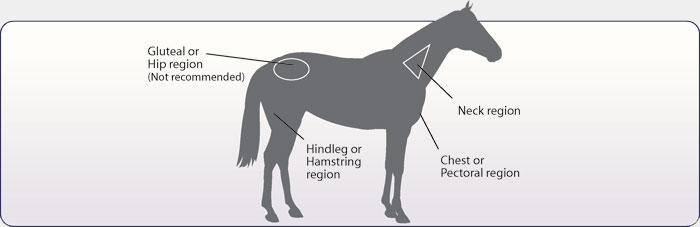
Horse Injection Guide

Neck Region: Extreme care necessary to hit safe “triangle” of muscle – neither too high in the neck into the large ligament (ligamentum nuchae), nor too low in the neck close to the cervical vertebrae (neck bones).

Though most frequently used, one must avoid the jugular area.

• Hindleg or Hamstring Region: Easy to reach and large muscle area. Be aware horse may kick.

Chest or Pectoral Region:  Easy to reach. Be aware horse may strike, or possible swelling may make walking difficult.

Gluteal or Hip Region: Easy to reach. Be aware that if a post-injection abscess forms here it is difficult to treat. Not a recommended area.

Step-by-Step Injection Guide


• 1.  Use 20-22 gauge, 1.5-inch needle.

• 2.  Use a new, sterile needle for each dose of vaccine and for each horse.

• 3.  Keep needle sheathed until immediately before use.

• 4.  Disinfect skin with alcohol. Tap skin a few times and thrust needle in quickly, deep into muscle, straight all the way to the hub.

• 5.  Carefully attach syringe to inserted needle. Pull back plunger slightly to insure you are not in blood vessel. Blood will appear if you are. If so, withdraw and try again.

• 6.  After withdrawing needle, massage site for 30 seconds after injection to distribute vaccine and help avoid soreness.

• 7.  Allow horse to rest and get free exercise for 2 to 3 days following vaccination, during which time horse may experience slight soreness and lethargy.

Can Vaccines Have Side Effects?

The short answer is yes. In very rare cases vaccines can cause a severe allergic reaction called anaphylaxis. Anaphylaxis is always very serious and can even lead to death.

Vaccines may also cause reactions at the site of injection ranging from mild stiffness, soreness, and swelling, to abscesses.

Disclaimer

As with other health information presented here. Since we are not Veterinarians, we can only hope that the user will take the information in the spirit that it is given - as informational. This information is not intended to replace information attained from a Veterinary.

If you are on a vaccination schedule, do not alter your vaccine regiment - especially if it was setup by your veterinarian or other trained animal health care professional.