Wednesday, September 25, 2013

"Red line" just one of roughly 500 Obama promises that have come and gone

by FoxNews.com

obama_presser_080913.jpg

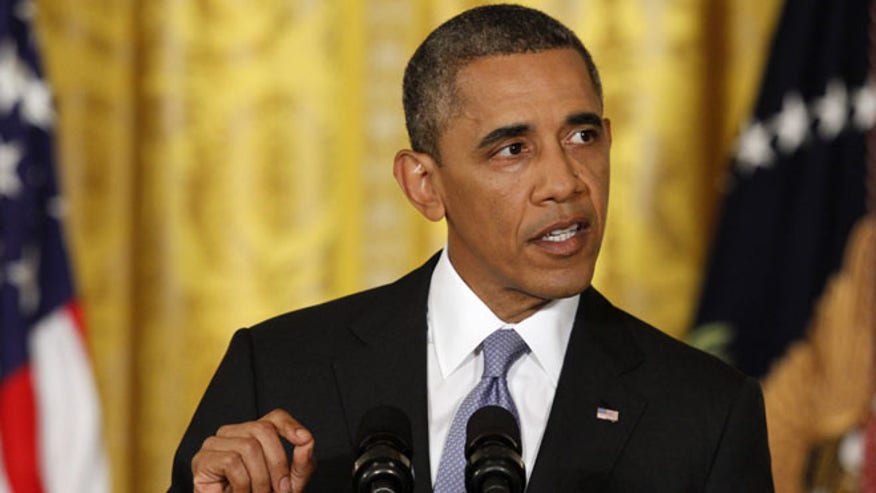
FILE: Aug. 9, 2013: President Obama speaks during a news conference in the East Room of the White House in Washington.AP

President Obama vowing that Syria would “cross a red line” by using chemical weapons is far from the only marker he’s laid down or promise he’s tried to keep since running for president in 2008.

The president has made more than 500 campaign-related promises alone. And just last week he re-drew a line in the sand for congressional Republicans flirting with shutting down the government over his Affordable Care Act and looking for spending cuts as part of a separate deal to increase the federal debt limit.

“That’s not happening,” Obama said. “I will not negotiate over the full faith and credit of the United States.”

The president has had mixed success in keeping that vow over the past few years.

He managed in January to get the debt ceiling raised without yielding to Republicans’ demand for accompanying spending cuts.

However, in 2011 he failed to reach a “grand bargain” with House Republicans over the debt ceiling, forcing both sides to eventually accept a series of drastic spending cuts known as sequester.

“The sequester is not something that I've proposed,” Obama announced in his final 2012 presidential debate. “It is something that Congress has proposed.”

PolitiFact -- the Pulitzer Prize-winning project of the Tampa Bay Times that has essentially tracked all of the president’s major promises -- ruled Obama’s argument “mostly false.”

“It was Obama’s negotiating team that came up with the idea,” wrote PolitiFact.

The project finds that Obama has kept 241, or 45 percent, of his roughly 500 campaign promises, while breaking 118, or 22 percent, and compromising on roughly 25 percent. The remaining 8 percent are essentially still to be determined.

Though tracking a president’s promises is among Washington’s favorite parlor games, Obama’s “red line” vow in August 2012 has perhaps become his most debated and closely watched -- as it plays out on an international stage.

Obama waited for months, amid reports that Syrian President Bashar al-Assad was using a chemical weapon in that country’s roughly 2-year-long civil war. However, after reviewing compelling evidence about an Aug. 21 sarin-gas attack that killed nearly 1,500 Syrians, the president said the United States must take military action.

The president appeared to try to blur the red line when he said earlier this month: "I didn’t set a red line. The world set a red line. … My credibility isn't on the line. The international community’s credibility is on the line."

The outcome remains in flux as Congress, at the president’s request, considers whether to authorize the use of limited military force and Syria moves closer to a diplomatic solution in which it would put its chemical weapons under international control.

PolitiFact has picked Obama’s top 25 promises and concluded he has kept nine, broken six and compromised on seven with three still in the works.

Among the most significant kept promises are removing U.S. combat troops from Iraq and ending the use of torture as an interrogation tactic on international prisoners.

Obama’s failure to close the Guantanamo Bay Detention Center and imposing tougher rules on the so-called “revolving door” for lobbyists and former officials are among the top broken promises for PolitiFact and others -- with a little more than three years remaining in his two-term presidency.

PolitiFact argues that Obama’ path to citizenship remains a work in progress.

To be sure, he must wait for the Republican-led House to vote now that the Democrat-controlled Senate has passed the legislation.

The project also concludes Obama’s promise to create 5 million new “green” jobs also is still in the works.

However, PolitiFact reports the federal government didn't count such jobs until this year, which make tracking the promise difficult.

And the Brookings Institution, a nonpartisan think tank, estimates the U.S. economy had 2.1 million green jobs in 2003 and 2.7 million of them in 2010, which would make the goal of 5 million hard to reach by 2016.

PolitiFact also concludes the president broke his promise to cut a typical family’s health insurance premiums by as much as $2,500 annually under ObamaCare.

However, the project didn’t address the president’s June 2009 promise that “If you like your health care plan, you’ll be able to keep your health care plan, period.”

Unions have argued that ObamaCare could make the cost of insurance for workers under multi employer plans more expensive, forcing them into the so-called government backed “exchanges.”

“The Obama administration and Congress must not allow this to happen,” the International Brotherhood of Electrical Workers said this summer.


The above article was posted on FoxNews.com

EDITOR'S NOTE:

Maybe now that big money campaign donors like the Unions are against ObamaCare, the Democrats will listen to them.

And since he has not yet anounced a run for a third term - even though it legally can't be done - Obama  may want to keep the Unions and their big money happy for as long as he can.

The Good News is, broken promises or not, Obama's Liberal Union Bosses who are going to have a real hard time telling Union memebers that they spent Millions of thier Pension fund Dollars to push ObamaCare and elect then re-elect Obama - are now against ObamaCare also and indeed might be the downfall of ObamaCare and its Socialist mandate.

It proves Good News can sometimes come in strange ways.

Tom Correa


Sunday, September 22, 2013

1875 Rules of Conversation

1. Even if convinced that your opponent is utterly wrong, yield gracefully, decline further discussion, or dexterously turn the conversation, but do not obstinately defend your own opinion until you become angry

Many there are who, giving their opinion, not as an opinion but as a law, will defend their position by such phrases, as: “Well, if I were president, or governor, I would,” — and while by the warmth of their argument they prove that they are utterly unable to govern their own temper, they will endeavor to persuade you that they are perfectly competent to take charge of the government of the nation.

2. Retain, if you will, a fixed political opinion, yet do not parade it upon all occasions, and, above all, do not endeavor to force others to agree with you.

Listen calmly to their ideas upon the same subjects, and if you cannot agree, differ politely, and while your opponent may set you down as a bad politician, let him be obliged to admit that you are a gentleman.

3. Never interrupt anyone who is speaking; it is quite rude to officiously supply a name or date about which another hesitates, unless you are asked to do so.

Another gross breach of etiquette is to anticipate the point of a story which another person is reciting, or to take it from his lips to finish it in your own language.

Some persons plead as an excuse for this breach of etiquette, that the reciter was spoiling a good story by a bad manner, but this does not mend the matter.

It is surely rude to give a man to understand that you do not consider him capable of finishing an anecdote that he has commenced.

4. It is ill-bred to put on an air of weariness during a long speech from another person, and quite as rude to look at a watch, read a letter, flirt the leaves of a book, or in any other action show that you are tired of the speaker or his subject.

5. In a general conversation, never speak when another person is speaking, and never try by raising your own voice to drown that of another.

Never assume an air of haughtiness, or speak in a dictatorial manner; let your conversation be always amiable and frank, free from every affectation.

6. Never, unless you are requested to do so, speak of your own business or profession in society; to confine your conversation entirely to the subject or pursuit which is your own specialty is low-bred and vulgar.

Make the subject for conversation suit the company in which you are placed.

Joyous, light conversation will be at times as much out of place as a sermon would be at a dancing party.

Let your conversation be grave or gay [happy] as suits the time or place.

7. In a dispute, if you cannot reconcile the parties, withdraw from them.

You will surely make one enemy, perhaps two, by taking either side, in an argument when the speakers have lost their temper.

8. Never, during a general conversation, endeavor to concentrate the attention wholly upon yourself.

It is quite as rude to enter into conversation with one of a group, and endeavor to draw him out of the circle of general conversation to talk with you alone.

9. A man of real intelligence and cultivated mind is generally modest.

He may feel when in everyday society, that in intellectual acquirements he is above those around him; but he will not seek to make his companions feel their inferiority, nor try to display this advantage over them.

He will discuss with frank simplicity the topics started by others, and endeavor to avoid starting such as they will not feel inclined to discuss.

All that he says will be marked by politeness and deference to the feelings and opinions of others.

10. It is as great an accomplishment to listen with an air of interest and attention, as it is to speak well.

To be a good listener is as indispensable as to be a good talker, and it is in the character of listener that you can most readily detect the man who is accustomed to good society.

11. Never listen to the conversation of two persons who have thus withdrawn from a group.

If they are so near you that you cannot avoid hearing them, you may, with perfect propriety, change your seat.

12. Make your own share in conversation as modest and brief as is consistent with the subject under consideration, and avoid long speeches and tedious stories.

If, however, another, particularly an old man, tells a long story, or one that is not new to you, listen respectfully until he has finished, before you speak again.

13. Speak of yourself but little.

Your friends will find out your virtues without forcing you to tell them, and you may feel confident that it is equally unnecessary to expose your faults yourself.

14. If you submit to flattery, you must also submit to the imputation of folly and self-conceit.

15. In speaking of your friends, do not compare them, one with another.

Speak of the merits of each one, but do not try to heighten the virtues of one by contrasting them with the vices of another.

16. Avoid, in conversation all subjects which can injure the absent. A gentleman will never calumniate or listen to calumny.

17. The wittiest man becomes tedious and ill-bred when he endeavors to engross entirely the attention of the company in which he should take a more modest part.

18. Avoid set phrases, and use quotations but rarely.

They sometimes make a very piquant addition to conversation, but when they become a constant habit, they are exceedingly tedious, and in bad taste.

19. Avoid pedantry; it is a mark, not of intelligence, but stupidity.

20. Speak your own language correctly; at the same time do not be too great a stickler for formal correctness of phrases.

21. Never notice it if others make mistakes in language.

To notice by word or look such errors in those around you is excessively ill-bred.

22. If you are a professional or scientific man, avoid the use of technical terms.  They are in bad taste, because many will not understand them.

If, however, you unconsciously use such a term or phrase, do not then commit the still greater error of explaining its meaning. No one will thank you for thus implying their ignorance.

23. In conversing with a foreigner who speaks imperfect English, listen with strict attention, yet do not supply a word, or phrase, if he hesitates.

Above all, do not by a word or gesture show impatience if he makes pauses or blunders.

If you understand his language, say so when you first speak to him; this is not making a display of your own knowledge, but is a kindness, as a foreigner will be pleased to hear and speak his own language when in a strange country.

24. Be careful in society never to play the part of buffoon, for you will soon become known as the “funny” man of the party, and no character is so perilous to your dignity as a gentleman.

You lay yourself open to both censure and bad ridicule, and you may feel sure that, for every person who laughs with you, two are laughing at you, and for one who admires you, two will watch your antics with secret contempt.

25. Avoid boasting. To speak of your money, connections, or the luxuries at your command is in very bad taste.

It is quite as ill-bred to boast of your intimacy with distinguished people.

If their names occur naturally in the course of conversation, it is very well; but to be constantly quoting, “my friend, Gov. C,” or, “my intimate friend, the president,” is pompous and in bad taste.

26. While refusing the part of jester yourself, do not, by stiff manners, or cold, contemptuous looks, endeavor to check the innocent mirth of others.

It is in excessively bad taste to drag in a grave subject of conversation when pleasant, bantering talk is going on around you.

Join in pleasantly and forget your graver thoughts for the time, and you will win more popularity than if you chill the merry circle or turn their innocent gayety to grave discussions.

27. When thrown into the society of literary people, do not question them about their works.

To speak in terms of admiration of any work to the author is in bad taste; but you may give pleasure, if, by a quotation from their writings, or a happy reference to them, you prove that you have read and appreciated them.

28. It is extremely rude and pedantic, when engaged in general conversation, to make quotations in a foreign language.

29. To use phrases which admit of a double meaning, is ungentlemanly.

30. If you find you are becoming angry in a conversation, either turn to another subject or keep silence.

You may utter, in the heat of passion, words which you would never use in a calmer moment, and which you would bitterly repent when they were once said.

31. “Never talk of ropes to a man whose father was hanged” is a vulgar but popular proverb.

Avoid carefully subjects which may be construed into personalities, and keep a strict reserve upon family matters.

Avoid, if you can, seeing the skeleton in your friend’s closet, but if it is paraded for your special benefit, regard it as a sacred confidence, and never betray your knowledge to a third party.

32. If you have traveled, although you will endeavor to improve your mind in such travel, do not be constantly speaking of your journeyings.

Nothing is more tiresome than a man who commences every phrase with, “When I was in Paris,” or, “In Italy I saw…”

33. When asking questions about persons who are not known to you, in a drawing-room, avoid using adjectives; or you may enquire of a mother, “Who is that awkward, ugly girl?” and be answered, “Sir, that is my daughter.”

34. Avoid gossip; in a woman it is detestable, but in a man it is utterly despicable.

35. Do not officiously offer assistance or advice in general society. Nobody will thank you for it.

36. Avoid flattery. A delicate compliment is permissible in conversation, but flattery is broad, coarse, and to sensible people, disgusting.

If you flatter your superiors, they will distrust you, thinking you have some selfish end; if you flatter ladies, they will despise you, thinking you have no other conversation.

37. A lady of sense will feel more complimented if you converse with her upon instructive, high subjects, than if you address to her only the language of compliment.

In the latter case she will conclude that you consider her incapable of discussing higher subjects, and you cannot expect her to be pleased at being considered merely a silly, vain person, who must be flattered into good humor.

Editor's Note:

The above is an excerpt from a book published in 1875: A Gentleman’s Guide to Etiquette by Cecil B. Hartley.

Mr Hartley’s rules may be over 100 years old, but they’re pretty much just as true today as they ever were.

There is a lot there that applies today, or at least should, to both men and women.


Friday, September 20, 2013

University of Kansas Hate Speech - UPDATE!


University of Kansas professor David Guth was  placed on administrative leave after he tweeted Hate Speech.

Chancellor Bernadette Gray-Little on Friday issued a statement regarding Associate Professor of Journalism David Guth.

"In order to prevent disruptions to the learning environment for students, the School of Journalism and the university, I have directed Provost Jeffrey Vitter to place Associate Professor Guth on indefinite administrative leave pending a review of the entire situation. Professor Guth’s classes will be taught by other faculty members," Gray-Little said in the statement.

Kansas State Senator Greg Smith is calling for Guth’s ouster.

Sen. Smith said University of Kansas distancing itself from Guth’s comments is not enough.

He said as long as Guth remains at Kansas University, he won’t support any budget proposals or recommendations for the university.

The controversy surrounding Guth started after he turned to Twitter to voice his "opinions about gun violence" following the Navy Yard shooting.

What David Guth essentially said was that the next time this takes place that it should be the children of NRA members who are gunned down.

Imagine that! Talk about Hate Speech coming out of one ignorant SOB!

Then to add insult to injury, Guth stood by his Hate Speech by saying in an interview, with Campus Reform, "Hell no! Hell no! I do not regret that tweet. I don’t take it back one bit!"

The Kansas State Rifle Association has called for Guth’s immediate dismissal.

"The KSRA will do everything possible to see to the removal of this man," said Kansas State Rifle Association President Patricia Stoneking.

"He should be fired immediately. His statements are outrageous!"

She then went on to say, "Is this who you want teaching your children? I certainly do not want him teaching mine."

While Guth refuses to apologize for his Hate Speech tweet, he does defend it.

This is his defense, he said, "If you look at how I structured the statement, I didn’t really bring [the NRA’s) children into it.  I carefully structured the statement to make it conditional, but apparently it was too much of a nuance for some people."

Guth went on to say, "I don’t want anybody harmed. If somebody’s going to be harmed, maybe it ought to be the people who believe that guns are so precious that it’s worth spilling blood over."

Imagine the nerve of this clown!

Kansas State Rifle Association President Patricia Stoneking maintains she will fight to have Guth removed from the classroom.

"Having such a terrible vitriolic violence contemptuous attitude is not what we want in the classroom with our kids with their young impressionable minds," she told in an interview.

"He owes the public at large an apology. I’m receiving hundreds of emails and phone calls from people who are extraordinarily upset and fearful for their children because of this man."

The University of Kansas issued the following statements in response.

Ann Brill, dean of the William Allen White School of Journalism and Mass Communications wrote:

"While the First Amendment allows anyone to express an opinion, that privilege is not absolute and must be balanced with the rights of others. That’s vital to civil discourse. Professor Guth’s views do not represent our school and we do not advocate violence directed against any group or individuals."

Timothy C. Caboni, vice chancellor for public affairs wrote:  

"The contents of Professor Guth’s tweet were repugnant and in no way represent the views or opinions of the University of Kansas. Like all Americans, he has the right under the First Amendment to express his personal views and is protected in that regard. But it is truly disgraceful that these views were expressed in such a callous and uncaring way. We expect all members of the university community to engage in civil discourse and not make inflammatory and offensive comments."  

Like it or not, when anyone says, "The blood is on the hands of the NRA. Next time, let it be YOUR sons and daughters!" - that is Hate Speech!  

Now if there are followers of David Guth who actually follow through with his desire, wouldn't Guth be culpable in that attack?   

After all, isn't inciting violence as guilty as those who carry it out on their behalf?   

Remember, David Guth is guilty of Hate Speech which is a communication that carries no meaning other than the expression of hatred for some group, especially in circumstances in which the communication is likely to provoke violence.

Hate Speech is the incitement of violence!

Yes, David Goth is guilty of inciting hate and violence against law-abiding citizens who have done him no harm.

His target are those who belong to the NRA and live within the laws of the land set forth within the Constitution of the United States.

David Guth wants violence brought to their children.

Hate Speech in any form of expression should not be tolerated, especially from a university professor who has so much influence on students taking his courses.

Story by Tom Correa

University of Kansas Hate Speech


What is Hate Speech?

Hate Speech is defined as a communication that carries no meaning other than the expression of hatred for some group, especially in circumstances in which the communication is likely to provoke violence.

It is an incitement to hatred primarily against a group of persons defined in terms of race, ethnicity, national origin, gender, religion, sexual orientation, political preference, and the like.

Hate Speech can be any form of expression regarded as offensive.

Reported by The Kansas City Star, the University of Kansas officials criticized one of their journalism professors by saying his remarks that he tweeted regarding Monday’s shootings at the Washington Navy Yard were "repugnant."

David Guth, who is a journalism professor at the University of Kansas (KU) unloaded a volley of Hate Speech in a tweet targeted at NRA members and their children.

Guth turned to Twitter on Monday to say he would like to see the murder of children of National Rifle Association (NRA) members the next time there is a deranged gunman.

Imagine that! And yes, he's still working there!

"#NavyYardShooting The blood is on the hands of the #NRA," tweeted David Guth, who is an associate professor of Journalism at the university’s William Allen White School of Journalism.

He went on to say, "Next time, let it be YOUR sons and daughters, he continued. “Shame on you. May God damn you."

On Thursday, Ann Brill, dean of the university’s journalism school, said Guth’s views "do not represent our school, and we do not advocate violence directed against any group or individuals."

While the First Amendment allows anyone to express an opinion, Brill said, "that privilege is not absolute and must be balanced with the rights of others."

Timothy C. Caboni, university vice chancellor for public affairs, called Guth’s tweet "repugnant," then added that it was "truly disgraceful that these views were expressed in such a callous and uncaring way."

"We expect all members of the university community to engage in civil discourse and not make inflammatory and offensive comments," he said.

This was more than just a poor choice of words or inflammatory comments, this fits the legal definition of Hate Speech. 

And now, many people, including KU alumni, say that Guth should be fired.

While I can't help but wonder if all of the Universities in America are filled with these sorts of horrible individuals, I also wonder if that's all the University is going to do about this.

The way I see it, if I were a student or a parent thinking of sending my kid to the University of Kansas, I'd ask myself if I'd want to attend or send my kid there?

If this is the example of the caliber of professors at the University of Kansas, and this is the sort of Hate Speech is coming out of Universtity of Kansas - then I believe both students and parents should not attend classes or send their children there.

If David Guth has proven anything, he's proven that a poor education is not worth paying for - and families should not spend hard earned dollars to send their children to the University of Kansas.

And yes, for certain not for jounalism classes where the Liberal Agenda is in full swing.
 
Story by Tom Correa