Wednesday, May 22, 2013

Muslim Terrorist Getting Military Salary?

Fort Hood's Muslim Terrorist has been paid $278,000 Salary since 2009 Terrorist Attack

So what's wrong with this picture?the Muslim terrorist who was an

The military can't take away the salary of Nidal Hasan, the Army Major turned Muslim Terrorist charged in the deadly 2009 Fort Hood attack, until he has been convicted

Because of that rule, Army Major Nidal Hasan, a soldier who renounced his oath to this nation and instead waged Islamic Jihad against unarmed people, and in the process killed 13 people and wounded 32 others during his terrorist attack at Fort Hood, has reportedly been paid more than $278,000 in salary since the 2009 attack.

Believe it or not, Department of Defense officials confirmed to NBCDFW.com that imprisoned Army Maj. Nidal Hasan’s salary cannot be suspended unless he is proven guilty in the Nov. 5, 2009, terrorist attack in Texas, citing the Uniform Code of Military Justice (UCMJ).

Jury selection in his trial is scheduled to begin May 30.

If Hasan, 42, had been a civilian Defense Department employee, Army officials could have suspended his pay after just seven days - but since he was in the Army that's not the case.

If though he yelled out "Allauh Akbar" and conducted himself as a Muslim Terrorist and subsequently an enemy combatant when he killed the unarmed and the innocent, why has the Army kept paying him?

And yes, this has been going on since 2009!

Now, a military judge has refused to another delay in Hasan’s trial. His attorneys keep seeking to postpone the court-martial, but now it will be held on September 1st.

Hasan’s attorneys claimed military jurors may be influenced by national media coverage of the Boston Marathon bombings that compared the two Muslim terrorists - Dzhokhar and Tamerlan Tsarnaev - to Hasan.

Of course Hasan's attorneys don't want military jurors to be influenced by Muslim attacks around the globe which Hasan used as an example when he planned his attack.

His pattern of behavior is that of a Muslim terrorist, a Jihadis, a enemy combatant, not just some criminal violating the UCMJ.

Nidal Hasan is no different than Dzhokhar and Tamerlan Tsarnaev.

So why hasn't he been tried years during the almost 4 years ago since he conducted his attack? That's a great question, why indeed? Could it be politics?

Nidal Hasan faces the death penalty or life in prison without parole if convicted of 13 counts of premeditated murder and 32 counts of attempted premeditated murder.

But honestly, that doesn't make sense.

Premeditated murder is the crime of wrongfully causing the death of another human being, also known as murder, after rationally considering the timing or method of doing so, in order to either increase the likelihood of success, or to evade detection or apprehension.

While Nidal Hasan did rationally consider killing people, it was a lot than than that.

Nidal Hasan rationally put together a terrorist plot to knowingly kill as many unarmed people as he could, through surprise and involving deliberate use of extreme violence, in the hope of attaining his religious aim of adhering to the murderous doctrine of Islam.

On April 15, 2013, two Muslim terrorists detonated two pressure cooker bombs in the City of Boston during the Boston Marathon.

The Fort Hood Terrorist Attack took place on November 5, 2009 at Fort Hood near Killeen, Texas. In the course of the attack, a single terrorist killed 13 people and wounded another 32 people.

It is the worst terrorist attack to take place on American soil since 9/11/2001.

Several individuals, including Senator Joe Lieberman, Army General McCaffrey, and others have called the event a terrorist attack.

Senator Joe Lieberman called the shooting "the most destructive terrorist attack on America since September 11, 2001."

Michael Scheuer, the retired former head of the Bin Laden Issue Station, and former U.S. Attorney General Michael Mukasey also described it as a terrorist attack.

The White House and Pentagon have refused to characterize Hasan's attack as terrorism, instead terming it mere "workplace violence."

It seems they were more worried about offending our enemies than looking the problem squarely in the eye and seeing it for what it is.

An example of this was the statement that came out of Homeland Security Secretary Janet Napolitano who stated "we object to - and do not believe - that anti-Muslim sentiment should emanate from this ... This was an individual who does not, obviously, represent the Muslim faith."

Yes, there's nothing like a head of a government agency who is completely out of touch. Well, maybe there is? How about the President being out of touch?

As the U.S. military and law enforcement were scrambling to save lives after the Nidal Hasan terrorist attack at Ft. Hood, Texas, President Obama, fully aware of what had taken place opened his remarks at the Tribal Nations Conference for America’s 564 federally recognized Native American tribes with a three-minute "shout out" to an audience member while stressing desire to pass ObamaCare.

"I hear that Dr. Joe Medicine Crow was around, and so I want to give a shout out to that Congressional Medal of Honor winner. It’s good to see you," he said.

Then after a few laughs and pitching his ObamaCare package, the President finally acknowledged the tragedy by saying, "I planned to make some broader remarks. But as some of you might have heard there has been a tragic shooting at the Fort Hood Army base in Texas."

The next day, Obama opened his remarks at a brief press conference in the White House Rose Garden in which he warned the American public against "jumping to conclusions" over the motives of the shooter.

Obama said. "This morning I met with FBI Director Mueller and the relevant agencies to discuss their ongoing investigation into what caused one individual to turn his gun on fellow servicemen and women. We don't know all of the answers yet, and I would caution against jumping to conclusions until we have all of the facts."

Obama was criticized by some for being "insensitive", as he addressed the shooting only three minutes into his prepared speech, and then for not giving it enough importance even the next day.

Many have criticized Obama for refusing to acknowledge the attack for what it was - Islamic Terrorism and not merely workplace violence akin to domestic violence.

The phrase "Allahu Akbar" is commonly used as a "war cry" by Jihadis. Jihad entails the act of killing the innocent and non-Muslims. It is used by Jihadis.

So imagine the scene, Nidal Hasan, acting as a Muslim terrorist screams, "Allahu Akbar!" Then starts shooting anyone he sees!

Does that sound like mere workplace violence to you? Does Hasan sound like some disgruntled employee? Was the whole attack as merely workplace violence because Hasan had a beef with his supervisor or co-workers?

No it doesn't. He is a Muslim Jihadis!

Days after the shooting, reports in the media revealed that a Joint Terrorism Task Force had been aware of e-mail communications between Hasan and the Yemen-based cleric Anwar al-Awlaki, who had been monitored by the NSA as a security threat, and that Hasan's colleagues had been aware of his increasing radicalization for several years.

When President Obama went before cameras at the White House oafter the deadly bombings in Boston, he was smart enough to call the attack an “act of terrorism.”

Obama’s decision to use that designation - which he scrupulously avoided in his first public response on a few days before - attests to his extreme sensitivity of calling an Islamic attack terrorism.

Deploring what he called a "heinous and cowardly act," Obama said that “the American people refuse to be terrorized."

Moving quickly to put Obama on the record, the White House appeared intent not to repeat the messy chain of events after the assault on the diplomatic mission last year in Benghazi, Libya, which killed four Americans, including Ambassador J. Christopher Stevens.

In that case, critics accused the White House of initially playing down the terrorism links for political reasons during a hard-fought presidential campaign.

Senator Susan Collins, Republican of Maine, echoed a sentiment voiced by many of her colleagues when she said, “I was puzzled yesterday that the president did not describe it as a terrorist attack right off the bat since it was so evidently a terror attack.”

The White House appeared to have learned from episodes like the failed plot to blow up a Northwest Airlines jetliner on Dec. 25, 2009, when the president was heavily criticized for saying nothing publicly for three days about the event.

A month before that plot, Obama was faulted for his initially subdued response to the terrorist attack at Fort Hood, Tex., in which Maj. Nidal Malik Hasan killed 13 active and retired soldiers - all unarmed and innocent.

Let's understand something here, Hasan expressed admiration for the teachings of Anwar al-Awlaki, the imam at the Dar al-Hijrah mosque in Falls Church, Virginia between 2000 and 2002.

Awlaki had been the subject of several FBI investigations, and had helped hijackers al-Hazmi and Hanjour settle, and provided spiritual guidance to them when they met him at the San Diego mosque, and after they drove to the east coast.

Hasan wrote nearly 20 emails to him between December 2008 and June 2009. In one, Hasan wrote: "I can't wait to join you" in the afterlife.

Hasan asked al-Awlaki when jihad is appropriate, and whether it is permissible if innocents are killed in a suicide attack.

So since when is the silly concept of Jihad a part of workplace violence? It is a part of Islamic Terrorism. Muslim such as the two Muslim terrorist who killed and maimed all of those people in Boston followed the teachings of Anwar al-Awlaki - the same jerkweed that Nidal Hisan followed.

So where's the difference between Hasan and those two who set of bombs in their Muslim terrorist attack in Boston? All three were schooled by the same radical Muslim nutcase. All three did this in an attempt to kill as many innocent as possible all in the name of Jihad.

The victims of the Fort Hood Terrorist Attack have been denied Purple Hearts and are suing the military because they claim the "workplace violence" designation gives them diminished access to medical care and financial benefits normally available to those whose wounds are designated as "combat related."

A group of soldiers and families have sought to have the defense secretary designate the shooting a "terrorist attack;" this would provide them with benefits equal to injuries in combat.

Nidal Hasan shed his uniform and oath to this nation when he took up the mantle of Muslim Jihadis. At that moment, he was not an Army Officer, a Major, he became an enemy combatant.

And yes, as an enemy combatant, the Army should not be paying him a salary of any sort.

But than again, don't ask the Army or the White House why Hasan is getting paid his full military salary while those he tried to kill don't get anything in the way of assistance - political correctness and pressure forbids the military from doing anything wise or noble these days.


Story by Tom Correa


Monday, May 20, 2013

Obama Admin say Scandals "Irrelevant"?

The Obama administration is now saying that facts and the law are "irrelevant"? Can it be true?

Well, the Obama administration is now trying to tell the American people that the facts pertaining to the Benghazi scandal are "irrelevant."

Yes, a top White House adviser said it was an "irrelevant fact" where President Obama was on the night of the Benghazi terror attacks.

And believe it or not, if you are looking for justice in the IRS scandal - forget about it!

You see, Obama administration's Dan Pfeiffer said the Obama administration would NOT cooperate with the investigation into the IRS because they see it as a "partisan fishing expeditions."

I know it sounds like I'm making it up, but it's true! Dan Pfeiffer went so far as to say that the law governing the targeting of conservative groups was "irrelevant."

He actually said that the law is "irrelevant!"

Obama administration's Dan Pfeiffer went on five Sunday talk shows where he supposedly tried to do damage control and reverse the damage done to the Obama administration this week by a series of scandals.

On "Fox News Sunday," Dan Pfeiffer tried to hammer home that the president "only heard" about the IRS unfairly targeting Tea Party groups "when it came out in the news."

It doesn't matter that the IRS law breaking was widely reported in the news and was a topic of concern more than a year ago; it doesn't matter that it makes President Obama look like a completely out of touch dunce; Dan Pfeiffer says President Obama only found out about it in the news when you and I found out about it just recently.

Of course, what that means is that you and I must be getting more information than the President because I wrote a blog about the IRS intimidation and targeting Tea Party folks early last year:

IRS Threats - How The IRS Wants Information From Tea Party Chapters? March 2, 2012

But wait, I heard about it on Fox News! Does this mean that President Obama should be watching Fox News?

Is his problem CNN, NBC, CBS, ABC, and MSNBC? His information and news outlets are all letting him down.

Sen. Rand Paul, R-Ky., who appeared on CNN's "State of the Union," suggested there was a written policy to target political groups opposing the president but when pressed for proof, he was unable to provide details.

On ABC, Dan Pfeiffer did his best impression of a lying Ambassador Susan E. Rice when he stuck to the White House script and said that the law governing the targeting of conservative groups was "irrelevant."

Even ultra-liberal George Stephanopoulos couldn't believe his ears and asked, "You don’t really mean the law is irrelevant do you?"

Dan Pfeiffer took his cue and attempted to tap dance an answer as he tried to clarified his statement, "What I mean is that whether it's legal, or illegal is -- is not important to the fact that it -- that, the conduct as a matter. The Department of Justice said they're looking into the legality of this. The president is not going to wait for that. We have to make sure it doesn't happen again regardless of how that turns out."

Ding, ding, ding, we have a winner! We can give this week's Foot-In-Mouth Award to Dan Pfeiffer! 

The Foot-In-Mouth Award is presented to a political hack who bravely goes forth and allows their mouths to over-run their ass! In this case, Danny boy doesn't know what he is talking about!

Earlier this week, a Treasury Department inspector general report revealed that Tea Party and other groups that had been critical of Obama received extra scrutiny when applying for a tax-exempt status from the government.

According to the report, IRS agents had not flagged similar liberal or progressive groups.

The incident was traced back to an Ohio IRS office that had singled out conservative groups and held up their applications or demanded information from them like donor information, which is illegal.

Many groups would not or could not provide the confidential information and as a result had to suspend their applications.

And how many Conservatives groups have been targeted by these Obama Nazis? Well, over 500 Conservative groups and no telling how many Conservative individuals have been singled out and targeted by the IRS tax men.

And yes, unless you have been audited - you have no idea how that Gestapo bunch works!   

Then, believe it or not, while he was defending the IRS or how the President's where-abouts during a National Security Emergency does not matter, Dan Pfeiffer took on another subject.

He demands an apology from Republicans for saying that U.N. ambassador Susan Rice was a part of the Benghazi cover-up after the Obama administration did nothing to help the four Americans who were fighting for their very lives for more than 10 hours.

That's right, no help for more than 10 hours and U.S. Marine response teams were only 2 hours away! Imagine that! Ten hours!

Dan Pfeiffer went on CBS' "Face the Nation" to say that the issue of "who" changed the initial talking points on the attack is "largely irrelevant."

Of course, what that means is that the White House doesn't think it matters "who lied" to us about what took place.

The Benghazi emails though did show top State Department officials involved in trying to water down the administration's initial storyline to remove references to prior security incidents and warnings.

So now, let's understand what Obama administration's Dan Pfeiffer is saying when he is speaking for the White House:
  • The Obama White House considers the law governing the targeting of conservative groups was "irrelevant."
  • The Obama White House does NOT consider what the IRS has done as illegal.
  • The Obama White House will NOT help find the criminals in the IRS who broke the law.
  • The Obama White House considers the Congressional investigation into the criminal acts by the IRS as "partisan fishing expeditions".
  • The Obama White House considers "the facts" pertaining to the where-abouts of the President of the United States during a National Security Emergency is "irrelevant;"
  • The Obama White House thinks "who lied" to us about what took place is "largely irrelevant."
  • That "the facts" pertaining to the series of scandals coming out of the White House are "irrelevant;"
  • That the person who man the call and refused aid or to send the Marines into Benghazi is "irrelevant."
  • That all information relating to these scandals are not pertinent to Americans being killed or targeted by an out-of-control Federal Government agency.  
What  Dan Pfeiffer said was that the law is not important; that the facts have no bearing on or connection with the subject at issue; that the actions of the White House are unconnected, unrelated, and unimportant in the managing of government agencies. And yes, that Benghazi doesn't matter.

So get ready folks!

In the next few weeks, the American people are going to be bombarded with the words "inappropriate," "peripheral," "insignificant," "negligible," "immaterial," "extraneous," "beside the point," "unrelated," "unconnected" and "neither here nor there" from the Obama administration. 

The reason is that they are circling the wagons in an attempt to spin the lie that they have nothing to do with the abuse of power and rampant law breaking by the IRS, or the horrible performance of the White House and the State Department when our people were getting killed in Libya.


Story by Tom Correa

Sunday, May 19, 2013

What Is Flag and National Anthem Etiquette?


With Memorial Day coming up here in a few days, I figure it might be time to talk about what is proper Flag and National Anthem etiquette?

First off, proper etiquette for "The Flag of the United States of America," also known as "Old Glory" and "The Star Spangled Banner", or as a matter of fact the Pledge of Allegiance, is just not that tough that everyone can't do it. Americans know that there are events that are usually opened with the formal presentation of the Flag of the United States of America followed by the national anthem. And yes, some events are opened with the Pledge of Allegiance.

The information below describes the proper way for US citizens within U.S. jurisdictions to show the due respect for these symbols of our country, as defined by the Code of Laws of the United States of America - also known as the United States Code.

Flag Etiquette

It is all about standards of respect.

When the flag of the United States of America is formally presented or paraded, the proper etiquette or respect is described below:

United States Code, Title 4 Chapter 1 — The Flag, section 9:
  • During the ceremony of hoisting or lowering the flag or when the flag is passing in a parade or in review, all persons present in uniform should render the military salute.
  • Members of the Armed Forces and veterans who are present but not in uniform may render the military salute.
  • All other persons present should face the flag and stand at attention with their right hand over the heart, or if applicable, remove their headdress with their right hand and hold it at the left shoulder, the hand being over the heart.
  • Citizens of other countries present should stand at attention.
  • All such conduct toward the flag in a moving column should be rendered at the moment the flag passes.
The Flag Code

The Flag Code, which formalizes and unifies the traditional ways in which we give respect to the flag, also contains specific instructions on how the flag is not to be used. They are: 
  • The flag should never be dipped to any person or thing.
  • It is flown upside down only as a distress signal.
  • The flag should not be used as a drapery, for covering a speaker's desk or draping a platform. Bunting of blue, white, and red stripes are available for these purposes. The blue stripe of the bunting should be on the top.
  • The flag should never be used for any advertising purpose. It should not be embroidered, printed, or otherwise impressed on such articles as cushions, handkerchiefs, napkins, boxes, or anything intended to be discarded after temporary use. Advertising signs should not be attached to the staff or halyard
  • The flag should not be used as part of a costume or athletic uniform, except that a flag patch may be used on the uniform of military personnel, fireman, policeman, and members of patriotic organizations.
  • The flag should never have been placed on it, or attached to it, any mark, insignia, letter, word, number, figure, or drawing of any kind.
  • The flag should never be used as a receptacle for receiving, holding, carrying, or delivering anything.
  • When the flag is lowered, no part of it should touch the ground or any other object; it should be received by waiting hands and arms. To store the flag it should be folded neatly and ceremoniously.
  • The flag should be cleaned and mended when necessary.
  • When a flag is so worn it is no longer fit to serve as a symbol of our country, it should be destroyed by burning in a dignified manner.
Note: Most American Legion Posts regularly conduct a dignified flag burning ceremony. Many Cub Scout Packs, Boy Scout Troops, and Girl Scout Troops retire flags regularly as well. Contact your local American Legion Hall or Scout Troop to inquire about the availability of this service.

Displaying the Flag Outdoors

When the flag is displayed from a staff projecting from a window, balcony, or building, the union should be at the peak of the staff unless the flag is at half staff.

When it is displayed from the same flagpole with another flag - of a state, community, society, or Scout unit - the flag of the United States must always be at the top except that the church pennant may be flown above the flag during church services for Navy personnel when conducted by a Naval chaplain on a ship at sea.

When the flag is displayed over a street, it should be hung vertically, with the union to the north or east. If the flag is suspended over a sidewalk, the flag's union should be farthest from the building.

When flown with flags of states, communities, or societies on separate flag poles which are of the same height and in a straight line, the flag of the United States is always placed in the position of honor - to its own right: 
  • The other flags may be smaller but none may be larger.
  • No other flag ever should be placed above it.
  • The flag of the United States is always the first flag raised and the last to be lowered.  
When flown with the national banner of other countries, each flag must be displayed from a separate pole of the same height. Each flag should be the same size. They should be raised and lowered simultaneously. The flag of one nation may not be displayed above that of another nation.

Raising and Lowering the Flag
  1. Old Glory should be raised briskly and lowered slowly and ceremoniously.
  2. Ordinarily, it should be displayed only between sunrise and sunset. It should be illuminated if displayed at night.
  3. The flag of the United States of America is saluted as it is hoisted and lowered.
  4. The salute is held until the flag is unsnapped from the halyard or through the last note of music, whichever is the longest.
Displaying the Flag Indoors

When on display, the flag is accorded the place of honor, always positioned to its own right. Place it to the right of the speaker or staging area or sanctuary. Other flags should be to the left. The flag of the United States of America should be at the center and at the highest point of the group when a number of flags of states, localities, or societies are grouped for display. When one flag is used with the flag of the United States of America and the staffs are crossed, the flag of the United States is placed on its own right with its staff in front of the other flag. When displaying the flag against a wall, vertically or horizontally, the flag's union (stars) should be at the top, to the flag's own right, and to the observer's left.

Parading and Saluting the Flag

When carried in a procession, the flag should be to the right of the marchers. When other flags are carried, the flag of the United States may be centered in front of the others or carried to their right. When the flag passes in a procession, or when it is hoisted or lowered, all should face the flag and salute.

The Salute
  1. To salute Old Glory, all persons come to attention.
  2. Those in uniform give the appropriate formal salute.
  3. Citizens not in uniform salute by placing their right hand over the heart and men with head cover should remove it and hold it to the left shoulder, hand over the heart.
  4. Members of organizations in formation salute upon command of the person in charge.
The Flag in Mourning

To place the flag at half staff, hoist it to the peak for an instant and lower it to a position halfway between the top and bottom of the staff. The flag is to be raised again to the peak for a moment before it is lowered.

On Memorial Day the flag is displayed at half staff until noon and at full staff from noon to sunset. The flag is to be flown at half-staff in mourning for designated, principal government leaders and upon presidential or gubernatorial order.

When used to cover a casket, the flag should be placed with the union at the head and over the left shoulder. It should not be lowered into the grave.

National Anthem Etiquette
During the Pledge of Allegiance and National Anthem
  1. The pledge of allegiance should be rendered by standing at attention, facing the flag, and saluting.
  2. When the national anthem is played or sung, citizens should stand at attention and salute at the first note and hold the salute through the last note.
  3. The salute is directed to the flag, if displayed, otherwise to the music. 
During the playing of the national anthem of the United States of America, the proper etiquette or respect is described below:

United States Code, Title 36, section 301:

1. Designation. — The composition consisting of the words and music known as the Star-Spangled Banner is the national anthem.

2. Conduct During Playing — During rendition of the national anthem:

When the flag is displayed individuals in uniform should give the military salute at the first note of the anthem and maintain that position until the last note; members of the Armed Forces and veterans who are present but not in uniform may render the military salute in the manner provided for individuals in uniform, and all other persons present should face the flag and stand at attention with their right hand over the heart, and men not in uniform, if applicable, should remove their headdress with their right hand and hold it at the left shoulder, the hand being over the heart; and when the flag is not displayed, all present should face toward the music and act in the same manner they would if the flag were displayed.

Keep in mind that there is no need to observe the above etiquette if you merely see the flag.

For example, at a rodeo, the flag is often carried by a mounted rider. If the rider should carry the flag into the arena during a warm-up period prior to the rodeo there is no need to stand at attention and/or salute. However, when the flag is formally introduced and passed by, rules of proper etiquette and respect apply.

Now as for Women and Hats

At a rodeo, it is not uncommon to find women wearing cowboy hats or some other type of hat. While the United States Code does describe the removal of "headdress," or hats, as proper etiquette for the formal presentation of the flag and the playing of the national anthem, this stipulation has not traditionally been applied to women.

Today, though, with the popularity of unisex hats among women such as cowboy hats or ball caps, some women voluntarily remove their hats. To the best of my knowledge though, it is nonetheless not considered disrespectful if she chooses to leave it on. But as for the guys, they should take off their hats and place them over their hearts and give due respect to the symbol of our freedom and liberty.

It is worth mentioning that during the formal presentation of the flag and the national anthem, not all "headdress" needs to be removed. For example, religious headdress such as a Jewish yamaka has always been considered an exception and may be left on.

Though most believe that there is or at least "should be" enforcement, it should be noted that while our flag and national anthem etiquette is Federal Law as defined by the United States Code - there are no provisions for enforcement.

The bottom line, showing proper etiquette or respect for Old Glory or our national anthem is voluntary.
Of course, there is the fact that not showing proper respect for Old Glory or our national anthem is a classless act. Showing disrespect for either might have someone taking the offender to task.

Then There Are The Ignorant And The Ingrate!

It's true that every now and again you find someone so self-absorbed that they are either ignorant or just plain stupid. The fact is that there are people, who in most cases were probably brought up without any guidance at all when it comes to love of our country. These people have no idea what these symbols mean, how precious they are, or that it is right to give respect to them. And yes, in most of their cases, it's a matter of us simply not being able to fix stupid!

Sadly, America has people in our country who purposely disrespect the flag in many ways.
Some say they purposely spit in the face of those who have died defending our nation, those who have become disabled serving our great country, and of course those of us who serve our nation today in some way, shape, or form. But frankly, most who knowingly disrespect our flag understand very well how their act is no different than spitting in the face of all of their fellow Americans.

As for those ingrates, they have no class and aren't worth a tinker's dam. They are completely worthless. 

Tom Correa

The Angle System For Branding

The Angle System for Branding was developed by Dr. R. Keith Farrell at Washington State University in the 1960s.

It is commonly used when freeze branding horses and is perhaps best known in the United States for being used on United States Bureau of Land Management (BLM) horses, aka "mustangs".

It offers simplicity, universal application, and the need for only two branding irons to make any number. Usually, when using this system the brand is located on the horse's neck.

A BLM brand will be located on the left side of the neck.

The Angle Brand System symbols
Here are the symbols used in the angle brand system. Only the bar and right angle symbols are used.

We have put numbers next to each symbol so you can easily see which number each symbol represents.

Typically, when using the angle system the horse's year of birth is shown first by using the last 2 digits of the year the horse was born, stacked on top of each other.

The numbers following the year of birth are a unique number series used to identify an individual horse.

For example, this brand:

An example brand

This brand would be read as:

The "02" is the year the horse was born. The "9 8 5 6 7 4" is a unique number assigned to a particular horse.


BLM Brands

The angle brand system is used to brand United States Bureau of Land Management (BLM) horses (aka "mustangs").

When the BLM uses this system, they place the brand on the left side of the horse's neck, and add an extra symbol at the beginning of the brand, in front of the year the horse was born, to indicate the brand is registered with the United States Government.

A bar is also placed under all or part of the numbers after the year. The bar underneath the numbers acts as a guideline indicating where the actual bottom of each character is.

This "true bottom" guideline can be helpful when reading brands on horses whose necks have arched or dipped due to the horse gaining weight, losing weight, aging, etc., since they were branded.

An example of a BLM brand
An example of a BLM freeze brand.

Photo of an actual BLM freeze brand. 

The last character on this brand is difficult to read. Trimming the hairs at the site of the brand can sometimes make any characters that are difficult to read clear again.


Horse Vaccines

So How Do Vaccines Work?

A horse vaccine contains a harmless form of a disease-causing organism.

When the vaccine is given to a horse it tricks the horse's immune system into believing its body is under attack by the real thing.

This causes the horse's immune system to work to identify what is attacking it, and to figure out what type of antibodies will kill it.

The horse will produce antibodies until it successfully produces the right type of antibody that kills off the "practice" disease provided by the vaccine.

Thanks to this valuable practice, if the horse should ever be exposed to the real disease it will be able to identify it quickly and begin producing large numbers of antibodies to quickly and efficiently kill it.

Do Vaccines Always Work?

Most of the time vaccines do a good job of providing immunity for our horses, but sometimes a horse can get sick anyway. No vaccine is ever a 100% guarantee your horse won't get sick.

If your horse does become ill with a disease he or she has been vaccinated for, the chances are good that the vaccine will at least reduce the symptoms and duration of the illness.

How Long Does A Vaccination Last?

Usually, horse vaccines do not provide a lifetime of immunity. You should consult with an equine veterinarian in your area to know what vaccines to give to your horse, and when or how often to repeat them.

Common Terms Associated With Horse Vaccines and Vaccinations

When talking to your veterinarian and/or buying vaccine it can be confusing to hear the proper terms sometimes used with horse vaccines, or to read them on the package label.

Below is a short list of very common terms used when talking about vaccines:

Adjuvant:  A vaccine adjuvant is something that is mixed with the vaccine to cause a better immune response by the horse's body. Not all vaccines have or need adjuvants. Common adjuvants that come with some vaccines for horses today are Havlogen and Spur.

Antigen:  An antigen is a substance that stimulates the immune system to produce antibodies.

Attenuated:  Attenuated means weakened, thinned, reduced, or diminished. Many vaccines are made from attenuated strains of disease-causing organisms.

Efficacy:  When talking about vaccines, efficacy means the ability to create or produce the desired amount of protection from disease.

Intramuscular Injection (IM):  An intramuscular injection is when medications (including vaccines) are delivered into the muscle by a needle. Many equine vaccines are given by intramuscular injection.

Killed Vaccines (also called inactivated vaccines):  This is a vaccine that contains a disease causing organism that has been killed or inactivated. Killed vaccines are frequently teamed up with an adjuvant (see "adjuvant," above) to help boost the immune response.

Modified Live Vaccines (also called modified-live vaccines or live-attenuated vaccines):  These are vaccines that contain disease producing organisms that are still alive, but they have been modified (see "attenuated," above) so that they don't cause illness.

Pathogen:  A pathogen is any organism that causes disease.

Subcutaneous Injection (SQ):  A subcutaneous injection is when medications (including vaccines) are delivered just underneath the skin by a needle. Some equine vaccines are given by subcutaneous injection.

Virulent:  Virulent means full strength, not weakened, capable of causing illness or disease.

Common Equine Diseases


Tetanus:  Often referred to as “lockjaw”, tetanus is caused by a toxin-producing bacterium that is often found in the soil. It can enter the skin through cuts, wounds or a newborn’s umbilicus.

Symptoms include muscle stiffness and rigidity, flared nostrils, prolapsed third eyelid and legs stiffly held in a sawhorse stance. As the disease progresses, muscles in the jaw and face stiffen, preventing the animal from eating or drinking. More than 80% of affected horses die.

Strangles: A highly contagious, yet rarely fatal, bacterial infection characterized by abscess of the lymphoid tissue of the upper respiratory tract.

Strangles is transmitted through contact with infectious excretions and surfaces containing the resilient bacteria.

Encephalomyelitis: More commonly known as “sleeping sickness”, this virus is transmitted to horses by mosquitoes that have acquired it from birds and rodents.

Eastern (EEE) and Western (WEE) equine encephalomyelitis have been noted in the United States.

Venezuelan (VEE) equine encephalomyelitis has not been seen in the U.S., however a recent outbreak occurred in Mexico.

Symptoms vary, but all result from degeneration of the brain. Early signs include fever, depression and loss of appetite. As it progresses, staggering gait and paralysis may develop. Depending upon the strain, between 20 and 100% of infected horses die.

West Nile Virus:  A virus transmitted by mosquitoes that have acquired it from birds or other animals. West Nile Virus infects the central nervous system, and presents with symptoms similar to Encephalomyelitis.

Although it has been responsible for equine deaths, most infected horses can achieve full or partial recovery with supportive therapy.

• Rabies: The rabies virus is most often transmitted through contact with the saliva of an infected animal.

Rabies affects the central nervous system and leads to cerebral dysfunction, including excess salivation, abnormal behavior and aggression.

Though horses are infected infrequently, it is always fatal. Rabies can be transmitted from horses to humans.

Equine Herpesvirus/Rhinopneumonitis (EHV): Two distinct viruses, equine herpesvirus type 1 (EHV-1) and equine herpesvirus type 4 (EHV-4) cause two different diseases, both of which are known as rhinopneumonitis.

Both types cause respiratory problems that may include fever, lethargy, loss of appetite, nasal discharge and coughing.

EHV-1 may also cause abortion, foal death, neurological signs and paralysis. Rhinopneumonitis is spread by aerosol or direct contact with secretions, instruments or drinking water.

The virus may not present any symptoms in carrier animals. Immune protection for pregnant mares requires vaccination with EHV-1 vaccine specifically labeled for abortion protection.

Influenza: One of the most common respiratory diseases in horses, influenza is highly contagious. The virus can be transmitted by aerosol transmission from horse to horse.

Symptoms are similar to those in a human with a cold, including dry cough, nasal discharge, fever and loss of appetite. Horses that travel or are exposed to other horses are most at risk.

Potomac Horse Fever: An acute enterocolitis caused by ingestion of bacterial spores that may be found in pastures bordering creeks and rivers. Symptoms can include mild colic, fever, diarrhea and abortion.

PHF is a seasonal problem with geographic factors.

How and Where to Inject

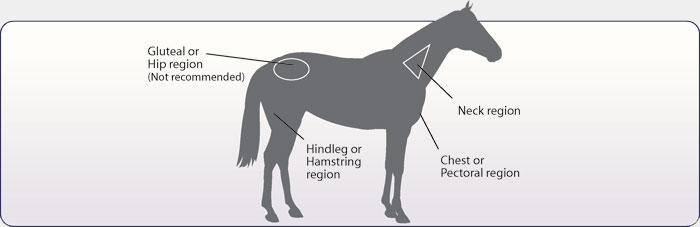
Horse Injection Guide

Neck Region: Extreme care necessary to hit safe “triangle” of muscle – neither too high in the neck into the large ligament (ligamentum nuchae), nor too low in the neck close to the cervical vertebrae (neck bones).

Though most frequently used, one must avoid the jugular area.

• Hindleg or Hamstring Region: Easy to reach and large muscle area. Be aware horse may kick.

Chest or Pectoral Region:  Easy to reach. Be aware horse may strike, or possible swelling may make walking difficult.

Gluteal or Hip Region: Easy to reach. Be aware that if a post-injection abscess forms here it is difficult to treat. Not a recommended area.

Step-by-Step Injection Guide


• 1.  Use 20-22 gauge, 1.5-inch needle.

• 2.  Use a new, sterile needle for each dose of vaccine and for each horse.

• 3.  Keep needle sheathed until immediately before use.

• 4.  Disinfect skin with alcohol. Tap skin a few times and thrust needle in quickly, deep into muscle, straight all the way to the hub.

• 5.  Carefully attach syringe to inserted needle. Pull back plunger slightly to insure you are not in blood vessel. Blood will appear if you are. If so, withdraw and try again.

• 6.  After withdrawing needle, massage site for 30 seconds after injection to distribute vaccine and help avoid soreness.

• 7.  Allow horse to rest and get free exercise for 2 to 3 days following vaccination, during which time horse may experience slight soreness and lethargy.

Can Vaccines Have Side Effects?

The short answer is yes. In very rare cases vaccines can cause a severe allergic reaction called anaphylaxis. Anaphylaxis is always very serious and can even lead to death.

Vaccines may also cause reactions at the site of injection ranging from mild stiffness, soreness, and swelling, to abscesses.

Disclaimer

As with other health information presented here. Since we are not Veterinarians, we can only hope that the user will take the information in the spirit that it is given - as informational. This information is not intended to replace information attained from a Veterinary.

If you are on a vaccination schedule, do not alter your vaccine regiment - especially if it was setup by your veterinarian or other trained animal health care professional.

Horses - First Aid Kits

Always Be Prepared!

Being prepared is important in all aspects of our life. Whether it be carrying a spare tire and an extra can of oil in your car or truck to have the right things you may need in a horse emergency, being prepared is important.

Having a well stocked Animal First Aid Kit is essential when owning livestock.

As for horses, every horse owner needs a few basic first aid essentials. A good First Aid Kit will keep you from wasting time from having to search for needed items and supplies when your horse is sick or injured.

These items will help you dress wounds, reduce swelling and inflammation, and more.
Although some say the items in your First Aid Kit should only be used for emergencies, I use my First Aid Kit regularly. I just make sure I re-stock it after I use something in it.

The other thing that I do is check the items for expiration dates and replace them as needed. For me, since I stopped traveling with my horses, I don't worry about having a duplicate First Aid Kit in my horse trailer anymore.

Since a horse injury can occur at any time, in any location, keep at least a basic first aid kit in your barn, truck or travel trailer. Especially if you travel a lot, I suggest you do just that and keep a kit in your truck or trailer where it is easily accessible.

And yes, like the kit you keep in your barn or stable - update and re-stock it as needed.

Here are some suggestions of what to have on hand in your kits:
  • Phone numbers: List your veterinarian, an emergency clinic. emergency contacts for assistance, and/or your shoer.
  • Pocket knife
  • Scissors
  • Hoof Pick  
  • Tweezers
  • Wire cutters
  • Pliers
  • Rubbing Alcohol
  • Epsom Salts
  • Disposable syringes for flushing woulds
  • Sterile non-stick gauze dressing pads
  • Sterile non-stick gauze rolls
  • Self-sticking wrap
  • Self-sticking bandage
  • Bandage pins
  • Adhesive tape
  • Duct tape
  • Vetrap
  • Antiseptic ointment
  • Iodine
  • SWAT® Fly Repellent (for use around wounds to help repel insects)
  • Bute
  • Betadine 
  • Icthmmol
  • Wound ointment
  • Wound powder  
  • Disposable shaving razors
  • Petroleum jelly
  • Clean towel
Helpful First Aid extras:

 
The best first aid kit holds a range of products to deal with a wide variety of injuries or accidents. In addition to the basics, however, having the following products accessible will help you further prepare for almost any mishap: 
  • Buckets - soak hooves and more with a few buckets kept specifically for first aid use.
  • Flashlight - view wounds and injuries in darkness or poor light conditions.
  • Ice Packs - prevent and reduce swelling with Ice Cells.
  • PVC Pipes - cut 6" diameter piping in half lengthwise and then into 1-1/2 to 2 foot sections for use as an emergency splint.
  • Sheet or Roll Cotton - help apply pressure bandages or offer support to injured muscles or bones.
  • Surgical Gloves - keep your hands clean and help prevent wound contamination.
  • Thermometer - measure your horse's temperature (normal range is 99.0°F to 101°F) with a fast and accurate digital thermometer.
  • Electrolytes - help hydrate your hard-working horse with an electrolyte paste.
  • Eye Cleanser - flush away dirt and debris from sensitive eyes with Eye Clens® or Clear Eyes.
  • Fly Mask - protect face wounds and eyes from insects.
  • Hoof Boot - treat abscesses and sore feet with a convenient boot kit, such as the HOOFix Kit or HOOFix Emergency Trail Boot, or a Bell Boot.
  • Medicated Shampoo - kill bacteria and fungi on your horse's skin and coat with a iodine-based shampoo.
  • Twitch - keep your horse's attention while wounds are tended with a twitch.
First aid tips
 
Accidents and injuries can turn even the calmest horse owner into a frazzled mess.

What your horse needs most when he suffers any injury or wound is for you to remain calm and focused on getting your horse the help he needs.

Should you ever need to use your First Aid Kit, keep the following tips in mind: 
  • Stay Calm - you can better help your horse when you're calm and collected.
  • Call for Help - an additional pair of hands will get more done faster.
  • Stay Safe - you won't be able to help your horse if you get hurt trying to help him.
  • Wash Your Hands - avoid contaminating any wound by first washing your hands and then wearing latex or rubber gloves.
When any injury occurs, the key is to act quickly and smartly.

To best ensure your horse is on the road to recovery as fast as possible, know where your First Aid Kit is at all times.

In fact, show anyone who has access to your barn, or your trailer or truck where you keep your first aid kit.

If you are using a plastic tool box as your First Aid Kit, be sure to mark your First Aid Kit with a cross fashioned out of red tape or a bright red permanent marker - signaling its contents to everyone.
 
A First Aid Kit should be considered a necessity - not a luxury. The items listed should prepare you for most emergency situations until a veterinarian arrives.     

Horse Diagrams - Markings

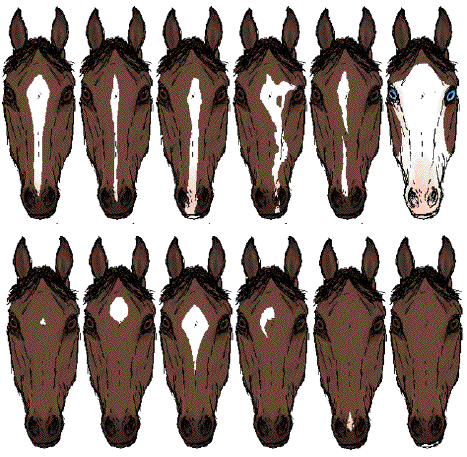
Markings on horses usually are distinctive white areas on an otherwise dark base coat color. Most horses have some markings, and they help to identify the horse.

Facial markings:

Facial markings are usually described by shape and location. There may be more than one distinct facial marking and if so, will be named separately.

Occasionally, when a white marking extends over an eye, that eye may be blue instead of brown, though this is not consistently seen in all cases.

Common facial markings are:
  • Blaze: a wide white stripe down the middle of the face.
  • Strip, stripe, or race: a narrow white stripe down the middle of the face.
  • Bald Face: a very wide blaze, extending to or past the eyes. Some, but not all, bald faced horses also have blue eyes.
  • Star: a white marking between or above the eyes. If a stripe or blaze is present, a star must be significantly wider than the vertical marking to be designated separately.
  • Snip: a white marking on the muzzle, between the nostrils.
Additional terms used to describe facial markings include the following: 
  • Faint: A small, yet permanent marking that usually consists of white hairs without any underlying pink skin.
  • Interrupted: A marking, usually a strip or blaze, that is broken and not solid for the entire length of the face.
  • Connected: Occasionally used to describe distinctively different markings that happen to be joined to one another
  • Irregular or crooked: A marking, usually a strip or blaze, that does not have a more or less straight path.
  • Lip markings: have no specialized names, usually are described by location, such as "lower lip," "chin", etc. Lip markings may indicate presence of the sabino color pattern.
 

Top row, L-R: Blaze, Stripe, Stripe (or thin blaze) and snip, Irregular blaze, Interrupted stripe, bald face. Bottom row, L-R: Faint star, Star, Star and strip, irregular star, snip, lip marking

Leg markings:

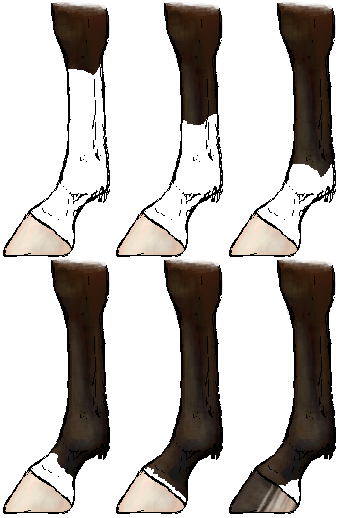
Leg markings are usually described by the highest point of the horse's leg that is covered by white.

As a general rule, the horse's hoof beneath a white marking at the coronary line will also be light-colored ("white").

If a horse has a partial marking or ermine spots at the coronary band, the hoof may be both dark and light, corresponding with the hair coat immediately above.

Where the Leopard gene is present, the hoof may be striped even if markings are not visible at the coronary band.

From tallest to shortest, common leg markings are:
  • Stocking: white marking that extends at least to the bottom of the knee or hock, sometimes higher.
  • Sock: white marking that extends higher than the fetlock but not as high as the knee or hock. This marking is sometimes called a "boot."
  • Fetlock or Sock: white marking that extends over the fetlock, occasionally called a "boot."
  • Pastern: white marking that extends above the top of the hoof, but stops below the fetlock.
  • Coronet: white just above the hoof, around coronary band, usually no more than 1 inch (2.5cm) above the hoof.
Additional terms used to describe white leg markings include: 
  • Irregular: A marking within the broad confines of a given height, but with significantly uneven edges. Indicated by the highest point of the white. Most often used to describe certain types of stockings.
  • Partial: An irregular marking that only extends up part of the leg to the height indicated, sometimes with the other side of the leg dark. Usually used to describe socks and other short markings.
  • "High White:" White stockings that extend above the knee or hock, sometimes extending past the stifle onto the flank or belly, considered characteristic of the sabino color pattern. 
  File:Horsemarkings legs.png

Top row, L-R: Stocking, Sock or Boot, Fetlock or Sock. Bottom row, L-R: Pastern, Coronet, Partial Pastern

On a gray horse, markings visible at birth may become hidden as the horse turns white with age, but markings can still be determined by trimming the horse's hair closely, then wetting down the coat to see where there is pink skin and black skin under the hair.


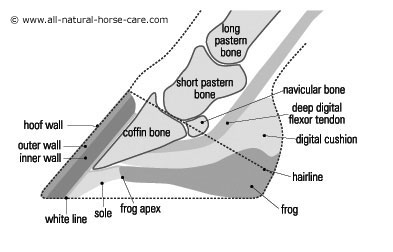
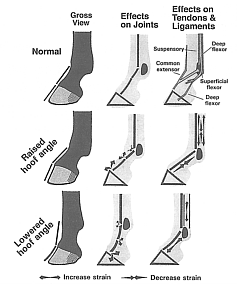
Horse Diagrams - The Hoof


horse hoof side


Horse Diagram - Parts of Their Body


Friday, May 17, 2013

Hawaii's Masters and Servants Act of 1850

A few of my readers have written to ask what I mean when I've said that my great-grandparents, or as a matter of fact my grandfather on my dad's side, arrived in Hawaii as "contract labor".

What was "contract labor," also known as "indentured servants" in Hawaii? Well, it started with legislation enacted by the Kingdom of Hawaii. It was called The Masters and Servants Act of 1850. Just two years later, in 1852, it replaced the Kingdom's "Kauwa System" of serfdom.

The word "kauwa" is Hawaiian for "slave-class." Their slave-class, called the"kauwa", were filled with those taken as prisoners of war or their children. The kauwa were identified with a tattoo mark around the eyes, or on the forehead. They were indeed slaves, but also much more than that.

You see, though the kauwa worked for the chiefs, they were often used as human sacrifices at the luakini heiau when worshipping the gods. They were not the only human sacrifices, law-breakers of all classes, or castes, and even defeated political opponents were also acceptable as human sacrifices. Yes, that's real tough politics when the loser becomes human sacrifice.

Because of their need for cheap labor, what the Kingdom of Hawaii did in adopting the Masters and Servants Act of 1850 actually had a huge affect on their legal system, their language, their integrity, and perhaps the moral fabric of Hawaii's society at large.

Was it just Hawaii's slavery in disguise? Many believe it was just that, slavery given another name.

Although Hawaii was not the only nation to use "contract labor," it was unique. You see, other than their "Kauwa System," Hawaii had no paradigm to go by when it came to slavery. That means that they did not have circumscribing laws to guide them.

While other nations used "contract labor" to replace their European style of slavery with all of its laws and methods passed down through colonization, Hawaii was free to implement its own laws regulating slavery and the treatment of immigrants.

Hawaii's Masters and Servants Act of 1850 passed by the Kingdom's Legislature codified "contract labor" and provided the legal framework within which Hawaii would receive "indentured servants." Basically, laborers in bondage to a plantation enforced by cruel punishment from the Kingdom.

Although not officially slavery, the Hawaii's Masters and Servants Act nevertheless shared the economic goal of slave-laws to harness labor. It was very much like the slave laws in the United States at the time. In fact, it is said that much of the Masters and Servants Act was taken from slave-laws in the United States.

The manner in which the Act was implemented by the Hawaii Board of Immigration and construed by the Hawaii Supreme Court illustrates Hawaii's economic compulsion for slave-labor at the time.

From June 21st, 1850, laborers were subject to a strict law known as the Masters and Servants Law.  Under the provisions of this law, enacted just a few weeks after the founding of the Royal Hawaiian Agricultural Society, two different forms of labor contracts were legalized. They were apprenticeships and indentured service.

How was Hawaii's Master and Servant Law like the slavery laws in United States at that time? 

Remember, these people were supposedly not slaves. But frankly, most say they were.

For example, under Hawaii's Masters and Servants law, absenteeism or refusal to work could cause a contract laborer to be apprehended by the district magistrate or by police officers or by agents of the Kingdom and subsequently sentenced to work for the employer an extra amount of time after the contract expired, usually double the time of the absence. For those contract laborers who found conditions unbearable and had tried to run away, again the Hawaiian law permitted their employers the use of "coercive force" such as "bounty hunters" just as they did in the U.S. at the time. All to apprehend those laborers the same way as if they were runaway slaves in the United States.

It was a lot like the Fugitive Slave Act in the United States. Like slaves, indentured servants were considered property of the plantations. If such a contract laborer refused to serve, believe it or not, he could be jailed and sentenced to hard labor in prison until he gave in. Indeed, the law was outright slavery disguised as something it was not. And rebellion was put down immediately, in fact even the mildest and most benign attempts to challenge the power of the Kingdom's authority or that of the plantations were squashed.

Take for example the brutal and shameful act that was committed against another one of the first contract laborers or "imin" who dared to remain in Hawaii after his contract and try to open a small business in Honokaa. His name was Katsu Goto. He was a Japanese merchant, interpreter, and he was lynched.

It's true, he was the leader of a fledgling Japanese community in Honokaa. One night, after riding out to help some other "imin" with an English translation, he was assaulted, beaten, and lynched.

One plantation operation was the Kohala Sugar Company, known as "The Missionary Plantation" since it was founded by Reverend Elias Bond in 1862 to support his church and schools. After witnessing the treatment of "contract labor," he protested the slave-like conditions.

Slavery is a system under which people are treated as property to be bought and sold, and are forced to work. Slaves can be held against their will from the time of their capture, purchase or birth, and deprived of the right to leave, to refuse to work, or to demand compensation. Historically, slavery was institutionally recognized by many societies. And though slavery has been outlawed in most societies, even today it continues through the practices of debt bondage and indentured servitude.

Yes, it was a form of slavery. Disguised sure, but in many ways it was no different than the American South before the Civil War.

In 1861, with the outbreak of the Civil War in the United States, most of the sugar produced in the South was gone. The North wanted sugar. Demand and the price for sugar increased dramatically. Because of the Civil War, the Hawaiian sugar industry expanded to take advantage of the need that couldn't be filled in the waring states. With the increase need, the supply of plantation laborers had to be increased as well.

The Kingdom of Hawaii set up a Bureau of Immigration to assist the planters as more and more Chinese were brought in, this time for 5 year contracts at $4 a month plus food and shelter. Even the famous American novelist Samuel Clemens, better known as Mark Twain, while visiting the islands in 1866 was taken in by the planters' logic.

Normally a foe of racism and economic servitude, Mark Twain accepted  the plantation sentiment entirely. Yes, he accepted their idea that the Chinese in Hawaii were the dregs of their society. Twain commented that, "Their Former trade of cutting throats on the China seas has made them uncommonly handy at cutting cane."

Having observed the operations of plantations throughout the south, Mark Twain knew exactly how low the "coolie" wages were by comparison to those in the American South. He expected the rest of the United States to soon follow the example of the Hawaii planters.

He wrote: "You will not always go on paying $80 and $100 a month for labor which you can hire for $5. ... It cheapens no labor of man's hands save the hardest and most excruciating drudgery ---drudgery which all white men abhor and are glad to escape from."

The planters who wanted cheap labor spoke of the Chinese as good workers. But also, as their number increased and they began to leave the plantations and enter the labor market of the towns, an outcry was raised against them. An article in All About Hawaii of 1890 warned that: "Hawaii is going to lapse into a Chinese colony without making a struggle to prevent it."

Two years later, Hawaii passed a drastic law that Chinese could only engage in agricultural field work or in work actually connected with the running and operation of rice and sugar mills. When the Chinese laborer was needed, he was praised as quiet, skillful, obedient, patient and quick to learn. When he left the plantation and entered the open labor market, or went into business, he was condemned as a murderer, cutthroat, thief, selfish and cunning. These and other racist epithets were used to deride their ethnic background. It is estimated that between 1850 and 1900 about 46,000 Chinese arrived in Hawaii.

After the American Civil War, the urgent need for Hawaiian sugar became less crucial -- so the sugar industry in Hawaii dipped sharply. But in 1876, the sugar industry was again stimulated by the Sugar Reciprocity Treaty that was signed between the Kingdom of Hawaii and the United States. The treaty permitted Hawaiian sugar to be sold in the U.S. without tariff restrictions. This gave the Kingdom of Hawaii an advantage over other sugar growing nations around the world.

Once more the plantations began looking around for more plantation labor. It was during this time that they imported Portuguese, Puerto Ricans, Koreans, Germans, Russians, Spaniards, Norwegians, and even more Chinese.

The Committee on Labor of the Planters' Labor and Supply Company wrote in 1883: "..the experience of sugar growing, the world over, goes to prove that cheap labor, which means in plain words, servile labor, must be employed in order to render this enterprise successful."

In order to keep labor servile, the characteristic of a slave, and to keep costs down, the Kingdom of Hawaii made a conscious decision to enact a policy to introduce a surplus of labor.

The surplus of labor kept the laborers servile and their cost cheap.   

The first contract laborers to arrive in the Hawaiian Islands arrived in 1851 from China aboard the Thetis, with 195 men and 20 boys on board. The Chinese workers were referred to by the derogatory term "Coolies." Plantations pay for the men was $3 a month plus room and board.

That's right, those Chinese workers were contracted for five years of labor in return for their transportation, housing, food and pay of $3 a month.  Chinese houseboys earned $2 a month. Yes, it was slave wages.

Hawaii's King David Kalakaua visited Japan in March of 1881 and asked Emperor Meiji to allow workers to come to the Hawaiian Islands where there was a shortage of laborers to work on the sugar plantations. The two leaders signed a treaty in 1885 permitting the large-scale immigration of Japanese laborers.

While the first mass emigration of Japanese workers coming to the Hawaiian Islands to work on sugar plantations included 142 men and six women who arrived aboard the Scioto in 1868, the first official Hawaiian government sponsored Japanese contract workers was 676 Japanese men and 158 Japanese women who arrived in Honolulu aboard the City of Tokio on February 8, 1885.

The initial migrants in 1868 were mostly tradesmen and craftsmen, and did not have contracts or government permission, and were called "gannenmono" (first year men), referring to the first year of Japan’s Meiji era. Between 1852 and 1896, the number of Chinese and Japanese grew from 364 to 46,023, 3 or from 4.5% to 56.5% of the total population.

In 1879, another 3,500 workers arrived from China. In 1881, Norwegian and German workers began arriving. Because of the flood of Chinese into California, which was the place in the U.S. with the most immigrant workers from China, the Chinese Exclusion Act became a United States federal law when it was signed by President Chester A. Arthur on May 6th, 1882.

It was one of the most significant restrictions on free immigration in U.S. history, as it prohibited all immigration of Chinese laborers. The act was initially intended to last for 10 years, but was renewed in 1892 and made permanent in 1902. It was finally repealed by the Magnuson Act on December 17, 1943.

By 1885, it is said that the Chinese population in Hawaii amounted to 22% of the population -- and they held 49% of the plantation field jobs. It is believed that by the 1880s, more then 20% of the Kingdom of Hawaii's entire population was actually Chinese who were working on Hawaii's sugar plantations.

And yes, like others, when their five-year labor contracts expired, they took jobs as clerks or domestic servants or to form their own businesses. And because of that, there was a growing anti-Chinese immigration movements in Hawaii. The result was that in 1886, following the example made in the United States, the importation of Chinese laborers was halted by the passage of the Hawaiian Kingdom Chinese Exclusion Act.

Laborers employed on Hawaiian plantations totaled 25,881 in 1898.

Most Portuguese came from the Madeira and Azores Islands.

According to some accounts, the first Europeans to discover the Hawaiian Islands may have actually been a sea captain from Portugal who was sailing under the flag of Spain, about 200 years before British Captain Cook did so.

Portuguese contract laborers arrived in Hawaii from the Azores and the Madeira Islands. The first Portuguese workers arrived aboard a German ship Priscilla from the Madeira Islands in 1877. That began an influx of Portuguese laborers that totaled more than 20,000 by 1913.

For my readers who have asked, yes my great-great-grandparents were from the Azores. Most of my family arrived in Hawaii after 1877.  My maternal great-great-grandfather is said to have arrived in Maui aboard a Whaling Ship, and decided to stay. That was in the late 1840s. My paternal grandfather, John Correa, my dad's dad, was born in Madeira and arrived in Hawaii in 1909 at 13 years of age. Other than the whaler, all were brought to Hawaii as "contract labor." 

Being Europeans, Portuguese men were given land. And unlike Asian workers, the Portuguese were often, but not always, hired as "lunas" (overseers). They supervised Asian workers for European (caucasian) planters, the owners.

I remember, as a boy, listening to my grandfather talk about his job with the plantation. He was a "luna", an "overseer", in charge of the mule gangs for the sugar plantation. It was well known that he carried a whip and .38 caliber pistol on the job. I remember him telling me, "the whip was used on the mules, the pistol was in case the workers acted up."

The Portuguese workers were virtually all Catholics, and this strengthened the presence of the Catholic Church in the Hawaiian Islands. And yes, the Catholic Church was something that the Protestant Missionaries had worked to keep out of Hawaii for generations.

Plantation owners worked hard to keep in place a hierarchical caste system that prevented worker organization and divided the camps based on ethnic identity. One interesting outcome of this multi-cultural workforce of plantation workers was the emergence of a common language.

It became known as Pidgin English. It became a language that was a sort of hybrid primarily of Hawaiian, English, Japanese, Chinese, and Portuguese. It allowed plantation workers to communicate effectively with one another and promoted a transfer of knowledge and traditions amongst the groups.

Was Hawaii's Masters and Servants Act ever challenged in court? Well, as a matter of fact it was.

In 1891, a Japanese contract laborer in Hilo tried to get the courts to rule that his labor contract should be illegal since he was unwilling to work for Hilo Sugar Company, and such involuntary servitude was supposed to be prohibited by the Hawaiian Constitution. The Hawaiian court upheld the "Masters and Servant's Act" and the harsh labor contracts (Hilo Sugar vs. Mioshi 1891).

In 1898, the Hawaiian Islands were annexed to the United States via the Newlands Resolution, which stated, "There shall be no further immigration of Chinese into the Hawaiian Islands, except upon such conditions as are now or may hereafter be allowed by the laws of the United States; no Chinese, by reason of anything herein contained, shall be allowed to enter the United States from the Hawaiian Islands."

On April 30, 1900, United States President McKinley signed the Organic Act establishing a Territorial government in the Hawaiian Islands. Hawaii's Masters and Servants Act made it virtually impossible for the workers to organize labor unions or to participate in strikes. Remember that while laborers were protected as property under these contracts, if they refused to work they could be put in prison at hard labor until they consented to serve and court costs would be added to their contract.

When the United States passed the Organic Act, and it went into effect, "contract labor" in Hawaii was no longer legal. And yes, it did not take long before things started changing. In fact. within a month of the Organic Act, 8,000 Japanese laborers went on strike demanding higher wages and better working conditions.

The hierarchical caste system plantation managers had worked so hard to maintain began to break down, with greater racial integrations as a result. Workers began to discover they had rights, and in 1920 they waged the first multi-cultural strike.

Though some say that Hawaii's "indentured servant" law, contract labor, was outlawed in 1900 when Hawaii became a territory of the United States. But the fact is that contract labor kept going in Hawaii for some time after that.

Between 1903 and 1910, 7,300 Koreans arrived in Hawaii on contracts. In 1906, Filipinos first arrived in Hawaii as contract labor. Between 1909 and 1930, 112,800 Filipinos arrived in Hawaii as contract labor. Hawaii's "contract labor" really didn't end until the 1930s. In fact, by 1932, the Chinese contract labor had mostly left plantation work.

So why did it stop in the late 1930s?

Well, Hawaii was not spared from feeling the effect of the Great Depression. The economy in Hawaii, like that of everywhere in the United States and the world, was in the dumps. Starting in the 1920s, many of those who landed in Hawaii from far off lands, those who worked out their contracts, left to relocate in California and the West Coast of the United States looking for work and better lives.

The Great Depression played a huge role in convincing a lot of families to relocate to the "Mainland" where there was more opportunity and land was more available to be had. Along with the Great Depression, changing global politics played a large role in the downfall of Hawaiian sugar.

With shifting political alliances and the need for cheap labor, between 1902 and into the 1930s, Cuba took more and more of a larger share of the United States sugar market. In fact, Cuba held 45% of the U.S. domestic quota, all while Hawaii, the Philippines, and Puerto Rico, and Southern sugar producing states in the U.S., shared a mere 25% among themselves.

Yes, the reason that contract labor ended was that the need for contract labor ended. Fact is within a relatively short period of time former plantation lands would be used by conglomerates to build hotels and develop Hawaii into a tourist-based economy.

Hawaii's tourist based economy has dominated Hawaiian economics for well over fifty years. And no, there is no substitute in sight to replace tourism as Hawaii's number one cash crop.

Tom Correa