Thursday, December 5, 2013

The Pawnee Massacre - Sundown of the Pawnee Indians

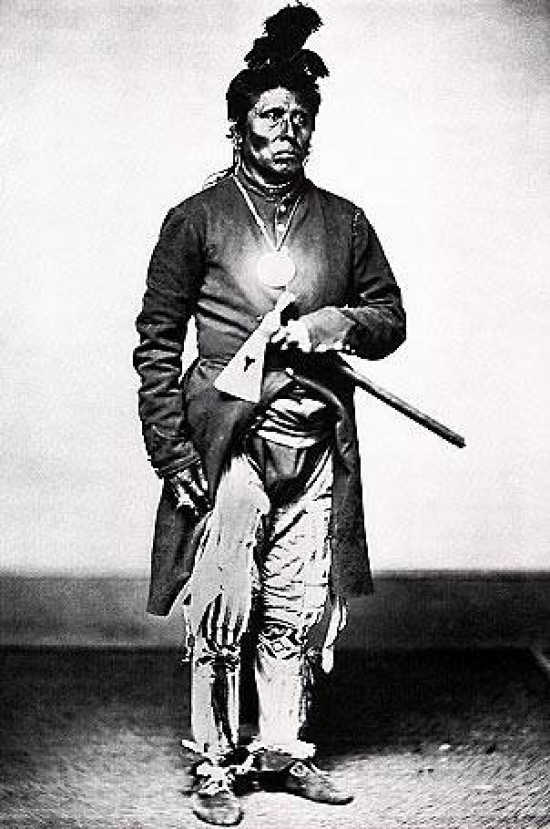
(Photo)
Sky Chief
The Pawnee Massacre took place on August 5th, 1873. It took place in what is today Hitchcock County, Nebraska.

Some have described it as the Massacre Canyon Battle, one of the last "battles" between the Pawnee and the Sioux, and the last large-scale "battle" between Native American tribes. Of course battles usually mean warriors, soldiers, clashing with one another on a battlefield. Instead, what took place on August 5th, 1873 in Nebraska was not a battle. It was a massacre. Those killed were mostly women and children.

Many hearing the words Indian Massacre would automatically assume that it was the work of the U.S. Army. That is the common narrative. What most don't realize is that Native Americans tribes waged genocidal war on each other, tribe versus tribe, since the dawn of time. Yes, long before Europeans ever set foot on North American soil. Long before Columbus found the Bahamas.

Sioux versus Pawnee: It was "Total War" between the two nations.

Historian Mark van de Logt wrote: "Although military historians tend to reserve the concept of “total war” for conflicts between modern industrial nations, the term nevertheless most closely approaches the state of affairs between the Pawnees and the Sioux and Cheyennes. Both sides directed their actions not solely against warrior-combatants but against the people as a whole. Non-combatants were legitimate targets. It is within this context that the military service of the Pawnee Scouts must be viewed."

The massacre occurred when a combined Oglala/Brule Sioux war party of over 1,500 Sioux warriors attacked a small party of Pawnee men, women and children who were on their summer buffalo hunt. They were there trying to stave off starvation.

The Platte and Republican Rivers in Nebraska was home to the Pawnee Indians. The Pawnee are said to have been a semi-nomadic people, but they maintained permanent structures such as mud-huts in villages in the Eastern part of Nebraska. On the overall, Pawnee farmed. They planted corn, beans and squash.

They were in complete contrasted to the Comanches, the Sioux, the Cheyenne, and others who ranged over vast areas of the Great Plains. They lived in tipis and relied almost entirely on the hunt for food and shelter. While they did farm, like most other Plains Indians, the Pawnee depended primarily on the buffalo for subsistence, for food, hides, and yes, even trade with whites.

Twice a year, once in the early summer and again in the fall, Pawnee men, women and children traveled from their mud-lodge villages to find the buffalo and their herds. As most know, one gift from the Europeans to the American Indian was the horse. Horses that once belonged to the Spanish became free and multiplied. Tribes gathered them, and they in turn gave the natives great mobility.
As never before, because of the horse, the American Indian could travel further in a given amount of time, pack more supplies, and return with greater amounts of meat and hides. And yes tribes honed their skills as mounted warriors, some tribes being better than others, and their ability to conduct mounted warfare became legendary.

The buffalo was important to the Pawnee, as was with other Plains Indian nations. Besides food, shelter, and trade, the buffalo had a religious significance to native Americans that actually spanned most tribes, even when they didn't have language and other customs in common. Yes, whites even today make the mistake of lumping all Native American Indian tribes in one basket because they occupied areas of the North American continent. But that's as ridiculous as saying the Germans are the same as the French because they occupy areas of Europe.  

Most of the Pawnee religious ceremonies required offerings of buffalo meat. Pawnee lodges contained altars with buffalo skulls. To the Pawnee, buffalo were nearly as important as maize which they referred to as "Mother Corn."

The Pawnee considered Southwest Nebraska as their rightful home, and the buffalo, which ranged there, as their own. For a long time, the Pawnee were able to keep their "homeland" relatively free from "foreign" intruders. The word "foreign" has an interesting connotation, fact is to the Pawnee the Sioux were considered "foreign" intruders just as the whites were.

Through a series of treaties the U.S. Government extended its influence onto the Great Plains, encroaching on the traditional Pawnee lands and their great buffalo herds. From the 1840s to the 1870s, the Pawnee people were severely weakened by famine, disease, and war with other Plains Indian tribes.

As a survival measure, many Pawnee warriors allied themselves with the U.S. Army, as Pawnee Scouts, and participated in the Army's campaigns against the Sioux who were among their traditional enemies. As I stated earlier, the Pawnee and the Sioux had been waging war for hundreds of years before Europeans, the whites, ever stepped foot on North American soil.

In the decade of the 1860s and 1870s, the railroads moved West, and they were followed by waves of American homesteaders. Then came the policy of the U.S. Army to destroy the Indian's primary food source, and thus came the wanton destruction of the buffalo by white hunters.

The buffalo hunters either provided food for the railroads, slaughtered bison for the hides, or simply were in on the extermination of the food supply of the Indians tribes. Yes, all part of the horrible policies of some U.S. Army Generals.

This, along with the hunting of the various Plains Indian tribes, severely limited the Pawnee's means of survival. Then by 1873, the Pawnee were confined to a reservation in Nance County, near Genoa. There their population had shrunk to some 2,400 people, with about 600 warriors in all.

They were on the verge of starvation, but that summer the Genoa Indian Agency Superintendent allowed a summer buffalo hunt. As it turned out, it would be their last one. A young Genoa Agency employee, J. W. Williamson, was assigned to accompany the hunt, to generally keep a tight rein on the hunting party.

He reported, "On the 2nd day of July, 1873, the Indians, to the number of 700, left Genoa for the hunting grounds. Of this number 350 were men, the balance women and children. The men carried bows and arrows, some old fashioned muzzle loading rifles, and a few Spencer Carbines. All were mounted, and in addition they took with them 800 extra ponies to pack home the meat and hides from the hunt."

The hunt had gone well, and by August 4th the expedition had reached the north bank of the Republican River, near Trenton and went into camp.

Williamson received a report that a large band of Sioux warriors were camped only 25 miles to the northwest and were awaiting an opportunity to attack the Pawnee. Williamson believed his informer, and passed the report on to Sky Chief, the senior Pawnee leader of the day. Sky Chief, having heard similar reports many times before, was adamant.

Williamson, years later, said, "On the fourth day of August we reached the north bank of the Republican River and went into camp. At 9 o'clock that evening, three white men came into camp and reported to me that a large band of Sioux warriors were camped 25 miles northwest, waiting for an opportunity to attack the Pawnees for several days, anticipating that we would move up the river where buffaloes were feeding."

"Previous to this, white men visited us and warned us to be on our guard against Sioux attacks, and I was a trifle skeptical as to the truth of the story told by our white visitors. But one of the men, a young man about my age at the time, appeared to be so sincere in his efforts to impress upon me that the warning should be heeded, that I took him to Sky Chief who was in command that day, for a conference."

"Sky Chief said the men were liars; that they wanted to scare the Pawnees away from the hunting grounds so that white men could kill buffaloes for hides. He told me I was squaw and a coward. I took exception to his remarks, and retorted: 'I will go as far as you dare go. Don't forget that.'"

Remember, Indian agent John W. Williamson, who accompanied the hunting party, reported, "On the 2nd day of July, 1873, the Indians, to the number of 700, left Genoa for the hunting grounds. Of this number 350 were men, the balance women and children."

The following morning the Pawnee hunting party broke camp and started north, up the divide between the Republican and Frenchman Rivers. Sky Chief tried to mend his friendship with John Williamson, who later reported the following:

"The following morning August 5th, we broke camp and started north, up the divide between the Republican and the Frenchman Rivers. Soon after leaving camp, Sky Chief rode up to me and extending his hand said, 'Shake, brother.' He recalled our little unpleasantness the night previous and said he did not believe there was cause for alarm, and was so impressed with the belief that he had not taken the precaution to throw out scouts in the direction the Sioux were reported to be. A few minutes later a buffalo scout signaled that buffaloes had been sighted in the distance, and Sky Chief rode off to engage in the hunt. I never saw him again."

It's true that Sky Chief did not believe that it was necessary to throw out scouts in the direction where the Sioux were reported to be. And yes, he was wrong. The Pawnee were traveling along the west bank of the canyon, which runs south to the Republican River, when the 1,500 Sioux warriors attacked.

It was not more than a mile up the canyon where the Pawnee ran into the first of some 1500 Sioux warriors, under the command of the Brule Sioux Chief, Snow Flake. Even though the Pawnee women and children had been ordered to take cover at the first sight of the enemy, the entire Pawnee party was soon overrun.

Later John Williamson reported:

"He [Sky Chief] had killed a buffalo and was skinning it when the advance guard of the Sioux shot and wounded him. The Chief attempted to reach his horse, but before he was able to mount, several of the enemy surrounded him. He died fighting. A Pawnee, who was skinning a buffalo a short distance away, but managed to escape, told me how Sky Chief died. The Pawnees were putting up a splendid fight, but the odds were against them ... The Pawnee chiefs noticed that the enemy was surrounding the head of the canyon and gave orders of retreat. Facing annihilation, the Pawnee retreated down the canyon, leaving behind their dead, their provisions, their buffalo meat. Six or seven hundred Indians, men women and children, and as many ponies, all huddled together and going down the canyon, with a thousand or more thirsty savages shooting down on them. In some places the canyon was quite narrow, and caused them to almost stop, then was when the most of the lives were lost."

File:View SW from Massacre Canyon monument.JPG
View looking southwest from Massacre Canyon monument, on south side of U.S. Highway 34 northeast of Trenton, Nebraska. The canyon runs down to the Republican River.

While many refer to the area pictured above as a "small canyon," to me looks more like an open valley or a shallow draw with no real defenses. To me it looks like a bowl to slaughter one's enemy, especially if your enemy is one foot and you are on horseback and can run them down.

Remember, on July 2nd, it was reported that 700 Pawnee left Genoa. They were made up of 350 men, and 350 women and children. In the short "battle", at the end, the wounded were numbered in the hundreds. It's said that the Sioux killed more than 80 Pawnee, mostly women and children. They lay dead among the wounded. Of those who were not dead, wounded, or who did not escape, a number of Pawnee women and children were taken captive as slaves. The slaughter was genocidal. No telling how many wounded died later after the battle.

The Sioux's massacre of the Pawnee resulted in the Pawnee Nation relocating from their Nance County Reservation to the Indian Territories in what is now Oklahoma, where they reside to this day.

Old Wounds Heal Slow

In 1923, the citizens of Trenton sought to commemorate the Massacre Canyon "battle." Supposedly, they brought in some Lakota Sioux Indians from the Pine Ridge Reservation in South Dakota to celebrate this last "fight" between the Pawnee and the Sioux, in what was to become an annual celebration, known as The Trenton Pow Wow.

It was not until 1925, two years later, that the committee was able to bring in a Pawnee for that event. At the 1925 celebration, the plan was that representatives from the Pawnee and Sioux Nations should smoke the peace pipe and formally end hostilities between the two tribes.

Even after 50 years, feelings between the two tribes ran deep. It was not until the second day of the 1925 celebration that the Pawnee could be persuaded to sit down with the Sioux and smoke the Pipe of Peace. And that, that act officially ended hostilities between those old adversaries. And in effect, it marked the end of the Indian wars in America.

Native Americans should not be lumped together

While white Americans have acknowledged a lot of what took place, when it comes to waging war, the many American Indian tribes were also incredible fighters who were extremely skilled at warfare. What they lacked in advanced technology compared to the whites, they made up for in lightning attacks, outstanding tactics, and extremely intelligent use of the terrain.

While it is true that Europeans waged war on the Indians, we should keep in mind that the multitude of tribes waged horrible brutal war almost to the point of ethnic cleansing on each other for over a thousand years before whites ever step foot on this land.

From all that I have read, what the Indians did to each other before the advent of the whites makes what the whites did to them pale in comparison. No, they were not what some think of as "close to the earth, one with nature, peace loving peoples." That is a rewrite of history that some today are painting them to be. Don't fool yourself, neighboring tribes fought each other no differently than neighboring European nations had done for a thousand years and more.

During my travels around our great nation, I've made a number of friends in many tribes. I've found that most find it absolutely insulting when people lump them together with other tribes. Trust me when I say that the Cheyenne and the Pawnee do not want to be lumped with the Sioux. And of course, the opposite is true as well.

For some odd reason, people today want to lump all of the individual American Indian tribes into this thing called "Native Americans". They forget, or simply don't realize, that tribes had separate languages, cultures, traditions, customs, laws, and even religious beliefs. Some were farmers, some truly nomads, some were hunters, and some were combinations of all of the above. Some build fortresses to keep other tribes out, and some simply moved when they were threatened. And before horses were introduced to North America by the Europeans, specifically the Spanish, they walked and were not mounted warriors.

Though neighbors, in most cases they could not even communicate with each other because their languages were so different. If you wonder how this could be, remember that Germany and France share a common border and have been neighbors forever, but they speak completely different languages and have very little in common culturally. Yes, as I stated earlier, just as the Germans and the French are distinct and different nations from each other on the continent of Europe, so were the Indian nations here distinct and different nations in North America.Like the Europeans, Indian tribes fought each other with extreme viciousness.

As for why they waged war on each other?

When I'm asked why? I always say that it's for all of the same reasons that all nations go to war. These include wealth, power, to gain land, to aid allies, to retain land, politics, and freedom. Some war for freedom's sake, some out of fear of conquest, some war out of the desire for land, wealth, and of course there were Chiefs who waged war because they sought power and dominance over others. Some wage war simply because of a tradition of hate for others.

Just like any other nationality in the world, the American Indian nations waged war for food and water, because of religious beliefs and rites within their culture, and of course because that's what they did for so many years.  

As for cultural differences, even the American Indian didn't accept all this stuff about diversity being good. Remember how the Cheyenne, the Osage, the Lenape, Shawnee, Caddo, Comanche, Kiowa, Wichita, and the Seminole joined forces to attack the Tonkawa Indians because they wanted to put an end to the Tonkawa cultural practice of cannibalism. The objective of those allied tribes was to exterminate the Tonkawa once and for all. It was the Tonkawa Massacre of 1862, and the Tonkawa tribe were almost completely wiped out. It is still the largest Indian massacre on the North American continent and it was between tribes.

While there are good reasons to go to war, such as stopping attacks and abductions by cannibals, it seems to me that there is one part of the human condition that has not evolved to the point of extinction. That condition is hate and the desire to kill just for the sake of killing another.

All the Pawnee wanted to do was hunt enough buffalo to stop from starving that winter. The Sioux saw the Pawnee hunting party, the majority being women and children. And all they saw were simply targets of opportunity, and they took it to hellish proportions. And yes, those they could not kill, they took for slaves. And yes, for a Pawnee that must have been worse than death itself.
That's just how I see it.

Tom Correa


Tuesday, December 3, 2013

Can't Sell Mistletoe, But Begging Is OK In Oregon

Dear Readers,

This last week beings Thanksgiving, I would think that we all took a moment to remind ourselves of what we have to be thankful for.

We should count our blessing, especially us who aren't doing as bad as others.

For me, I've hit bottom in my life and really didn't know what I would do if I didn't find some kind of work.

Luckily for me, my grandfather taught me that it didn't matter what kind of job you had - as long as you were working and making money honestly.  It wasn't so much the money - as it was how you came by it. 

And yes, my grandfather had a lot to do with how I see life.

Raising a family during the Great Depression taught him that pride was a luxury that didn't put food on the table - but pride was something that you held on to dearly.

For him, he would have been 100 this year, and in his early days he was a Merchant Marine out of Hawaii, and between ships he worked just about any sort of job that paid good honest money.

He worked as a bus driver, sold sewing machines, worked as a ranch butcher, worked as a doorman for two bars in Honolulu's Hotel Street when that area was known as Hell's Half Acre. And no, his pride wouldn't let him take a handout.

For me, especially when I was younger and really had no trade at the time, fresh out of the Marine Corps, no one hiring a guy who packed a rifle for a living, I always kept in mind that any kind of work was better than no work - but please let it be honest so that I can look myself in the face.

Yup, it was my grandfather who taught me the value of working hard and paying your own way in life. No handouts, means no regrets!  

mistletoe-sales-stop640.jpg
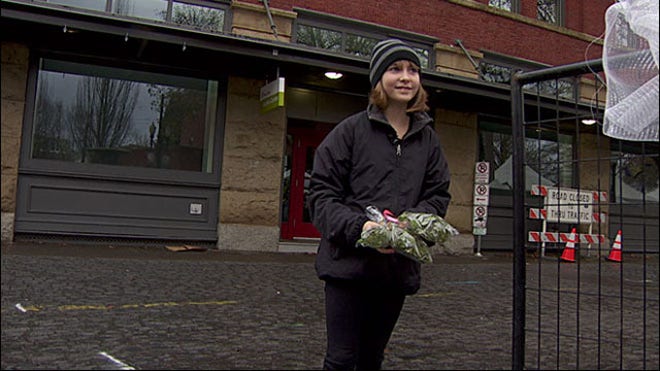
Pictured above: Madison Root, 11, holding some of the mistletoe she was told not to sell. (Courtesy KATU)

I feel as though Madison Root would have made my grandfather proud.

According to KATU-TV in Oregon, Madison Root and her father were selling bags of the hand-cut hand-wrapped Christmas favorite last Saturday morning next to the Skidmore Fountain in downtown Portland, where the city holds a weekly market.

She was trying to raise money for braces. Yes, braces for her teeth.

Everything was going well until a Security Guard told her that she had to stop selling due to a city ordinance that bans such activity in a park "except as expressly permitted under the terms of a lease, concession or permit."

That's right, she is an 11-year-old girl from Portland, Oregon, who has been told that she can't sell mistletoe to help defray the cost of braces - but there's more!

The guard then told Madison that she could sell her mistletoe outside the boundaries of the park where the fountain and the market are located, away from the crowds, or she could simply ask for donations to cover the cost of her braces.

Yes, she was told that she couldn't work for her money for her braces by selling mistletoe - but instead she can beg for the money on the city's streets.

"I don't want to beg! I would rather work for something than beg," Madison told KATU reporter Dan Cassuto.

"It's crazy. People can get money for pot. But I can't get money for braces. I'm working for this! They're just sitting down on their butts all day asking for pot."

A Portland Parks Bureau spokesman told the station that begging is a form of Free Speech and is protected by the First Amendment.

Yes, imagine that for a moment. Begging is considered a form of Free Speech in Portland Oregon!

One market vendor told the station that she wished an exception to the ordinance could be made for children.

"They should have a caveat for children trying to create options for commerce, especially this time of year," Sharon Steen, who sells ceramic bowls at the market told KATU.

"We encourage it. We want them to grow up and be entrepreneurs."

As should we all!  

This story is a prime example of what our society has become. It goes to the heart of what we teach our kids about right versus wrong, work ethics, and self-reliance.  Let me repeat that, it goes to the lessons we teach our kids - the next generation of Americans.  

It is amazing to think that an 11 year old can teach an entire city a lesson in values and standards, in what's right and what is wrong.  

The lesson from the City of Portland: Begging is good; Self-reliance and working for what you want is illegal - at least in Portland, Oregon, is not a good one.

As for Madison Root, I really believe that she'll make it in life in spite of the way things are today. Her pride won't allow her to do any different.  

And yes, that is a good thing! 

Now, my wife just finished reading this and suggested that Madison "skirt" the law by "asking for a donations" in the amount of the price of the mistletoe for her mistletoe.

While I think that this is a way "around" the city ordinance, I think it is sad that we have to do this more and more today.

Sure, on one hand she's learning that "where there's a will, there's a way" - but on the other hand, we are teaching her and others that there are ways of getting around things.

My wife says, on a positive note, that this could be a lesson in not so much "skirting" the law as it is learning how to "work with" the law.

Either way, I just find it a sad note that Portland would stop a kid from selling mistletoe so that she can raise money for her braces, yet says it's OK to panhandle for pot.

Something is wrong here, and no matter how we sugar coat it, it is just wrong that we aren't rewarding drive - but instead deterring it.


Story by Tom Correa

Monday, December 2, 2013

Some of America's Great Banned Books - Part Two


As stated in Part One, the Library of Congress created an exhibit entitled "Banned Books that Shaped America."

The exhibit explores books that "have had a profound effect on American life" yet have been banned in one way or another.

Below are some of my favorites from the list of books from that exhibit that have been banned because of subject matter - or has had its language content challenged because of "political correctness."

One of the very interesting part of this is that some of these works are considered some of America's greatest literary treasures.

These are not all of the banned books from that exhibit listed, these are just my personal favorites which I found to be great reads.

And yes, these are books that I have read. Why did I repeat that? Well, for a person who has a hard time getting through a novel because they lose my interest - my saying that is a big deal to me.

Something written really has to hold on to my interest for me to get through, that is the reason I love Short Stories instead of Novels.

As in Part One, here's a fair Warning, the titles of what has been banned might surprise you.

The Call of the Wild, Jack London, 1903

Published in 1903, The Call of the Wild is Jack London’s most-read book, and is generally considered his best, hailed as the masterpiece of his “early period.”

Critic Maxwell Geismar, in 1960, referred to The Call of the Wild as “a beautiful prose poem,” and Editor Franklin Walker said that it “belongs on a shelf with Walden and Huckleberry Finn.”

But, as one might expect, such a classic work of American literature would find itself on the American Library Association’s list of the 100 most-frequently challenged classics at #33.

Generally hailed as Jack London’s best work, The Call of the Wild is commonly challenged for its dark tone and bloody violence.

Because it is seen as a man-and-his-dog story, it is sometimes read by adolescents and subsequently challenged for age-inappropriateness.

Not only have objections been raised here, the book was banned in Italy, Yugoslavia and burned in bonfires in Nazi Germany in the late 1920s and early 30s because it was considered "too radical."

It's true, in 1929, Italy and Yugoslavia banned The Call of the Wild for being "too radical".

For Whom the Bell Tolls, Ernest Hemingway, 1940

Shortly after its publication the U.S. Post Office, which purpose was in part to monitor and censor distribution of media and texts, declared the book non-mailable.

In the 1970s, eight Turkish booksellers were tried for “spreading propaganda unfavorable to the state” because they had published and distributed the text.

This wasn’t Hemingway’s only banned book – A Farewell to Arms and Across the River and Into the Trees were also censored domestically and abroad in Ireland, South Africa, Germany and Italy.

The Grapes of Wrath, John Steinbeck, 1939

As shocking as it might seem Kern County, California, has the great honor both of being the setting of Steinbeck’s novel and being the first place where it was banned (1939).

Objections to profanity - especially "goddamn" and the like - and sexual references continued from then into the 1990s.

It is a work with international banning appeal: the book was barred in Ireland in the 1950s and a group of booksellers in Turkey were taken to court for “spreading propaganda” in 1973.

It is interesting to note that this book, which was written 10 years into the Great Depression, actually started Congressional hearings to see if this were actually the plight of the American people - and that it was taking place in our country at the time.

Politicians were so out of touch that they didn't believe things were that bad in the nation at the time.

Some even tried to cover it up saying that the New Deal policies had fixed everything by 1939, when in fact it had not.

Moby-Dick (or The Whale), Herman Melville,1851

In a real head-scratcher of a case, a Texas school district banned the book from its Advanced English class lists because it “conflicted with their community values” in 1996.

Community values are frequently cited in discussions over challenged books by those who wish to censor them.

The Red Badge of Courage, Stephen Crane, 1895

Restricting excess and refusing to allow teachers to teach books is still a form of censorship in many cases.

Crane’s book was among many on a list compiled by the Bay District School board in 1986 after parents began lodging informal complaints about books in an English classroom library.

To Kill a Mockingbird, Harper Lee, 1960

Harper Lee’s great American tome stands as proof positive that the censorious impulse is alive and well in our country, even today.

For some educators, the Pulitzer-prize winning book is one of the greatest texts teens can study in an American literature class.

Others have called it a degrading, profane and racist work that “promotes white supremacy.”

Imagine that? Makes me wonder if they ever read it?

What all of these books have in common are that they are novels depicting fictionalized people amid accurate historical events and the societal attitudes associated with that period of time in which it was written and published.

I agree with the writer who put it this way: "Today’s views of profanity may have changed, but the shame of slavery coupled with current politically-correct ignorance are once more being dealt with not by mature discussion and knowledgeable discourse, but by banning books and burying heads in the sands of time.

There continues to be this pandemic of parents and other self-righteous individuals who believe that they- and they alone- must shelter everyone from the realities of history and have the absolute authority to do so.

The most important thing about history, though, is that it is a mirror of not only our past; but of our present and our future.

We must understand the mistakes of the past if we are to have an enlightened and free society going forward.

We have a duty and a need to know that such behavior and atrocity did occur so that we can learn what we have overcome and how far we have to go.

So when people, for any reason, want to throw out books that they disagree with or are offended by it leaves me with a very annoyed and defiant disposition.

Their ignorance offends me, but that doesn’t mean I should attempt to ban their right to their opinion. I encourage them to explain in mature dialogue their reasoning."

To those who would ban the truth of what the world was like, who was in charge and who did what to who; to those who want to hide from the truth of history; to those who knowingly want to stop the free flow of thought; I feel sorry for you.

Because frankly, you are no better than the Nazi who burned books to keep them from being read in an attempt to keep their people ignorant and slaves to the state.

That's just how I see it!


Sunday, December 1, 2013

Thanksgiving: America’s Lesson on Why Socialism Doesn’t Work

Written by Matthew Givens

The story of the Mayflower, the Pilgrims, and Thanksgiving is widely taught in all our schools.

What is seldom taught, however, is what those Pilgrims learned, at great pain, about Free Enterprise versus Socialism.

That story stands as perhaps the clearest and starkest-ever comparison between those two rival systems for human interaction.

We all know how the Pilgrims landed at Plymouth Rock in November, 1620, and how they lost half their population to starvation, sickness, and exposure that first winter. 

We all know how a Native American named Squanto taught the survivors to fish, plant corn, use fertilizer, and hunt deer. 

William Bradford

And we know that following their first harvest, Governor William Bradford declared a day of Thanksgiving that we celebrate to this day.

What most of us never learned was that the original contract the Pilgrims brokered with their London sponsors required that everything the Pilgrims produced was to go into a common store, and every member was to be allotted one equal share.

Further, all the land they cleared and all the buildings they constructed were to belong the whole community.

It must have sounded like the ideal society.

Free of outside evil influences, greed and personal property were to be banished.

Everyone was to work for the common good, and altruism was to be its own reward.

How did it work out? Horribly.

In the three winters of 1621-1623, many died from starvation, pneumonia, or both.

Here is Governor Bradford’s own summary of the community’s results with what we now call Socialism:

"The experience that was had in this common course and condition, tried sundry years and that amongst godly and sober men, may well evince the vanity of that conceit of Plato’s and other ancients applauded by some of later times; that the taking away of property and bringing in community into a commonwealth would make them happy and flourishing; as if they were wiser than God.

For this community (so far as it was) was found to breed much confusion and discontent and retard much employment that would have been to their benefit and comfort.

For the young men, that were most able and fit for labour and service, did repine that they should spend their time and strength to work for other men’s wives and children without any recompense."

In other words, said the Governor, it simply didn’t work.

Wisely, in April, 1623, Bradford abruptly abandoned the idealistic [Socialist] practice of collectivism.

Instead, he assigned a plot of land to each family, permitting them to keep everything they grew or made and to market anything they didn’t consume themselves.

He actually harnessed all that awful ”greed” and put it to work in a Free Enterprise system.

Bradford had discovered that even these most idealistic of peoples had no reason to put in any extra effort without the motivation of personal incentives to do so.

So how did Capitalism work out for the same people in the same place under the same circumstances? Vunderbar!

The Pilgrims soon had more food than they could eat or trade amongst themselves. So they set up trading posts and exchanged goods with the Native Americans.

They paid off their debts to their London sponsors and soon attracted a great European migration.

As Bradford summarized the new approach:

"This had very good success, for it made all hands very industrious, so as much more corn was planted than otherwise would have been by any means the Governor or any other could use, and saved him a great deal of trouble, and gave far better content."

This was an essential and timeless lesson, learned the hard way.


So why isn’t this lesson featured in class after class straight up front in neon lights in American history classes? 

Why isn’t it the lead story of the Pilgrim experience?

Perhaps it’s because the people who write our history textbooks still don’t want to believe it.

Perhaps those authors still cling to the hope that some form of Socialism will one day triumph over Capitalism.

Unfortunately for those authors, the historical record couldn’t be clearer, and the Pilgrims’ experience is Exhibit One:

When it comes to bettering the life of the common man, Capitalism, good old fashion Free Enterprise works — and Socialism fails.

For more than 3000 years at Passover, Jews around the world have been re-telling the story of their deliverance from slavery, and for over 2000 years at Easter, Christians have been re-telling the story of their redemption.

So now, now that it’s been nearly 400 years since the Pilgrims landed in America, perhaps we could begin re-telling the real story of Thanksgiving every year.

Maybe it is about time that we headline those life-and-death lessons the Pilgrims learned about the differences between Socialism and Capitalism?

Maybe it's about time that we start talking about the benefits and advantages of the system called Capitalism which inspire people to progress and become self-reliant and self-sufficient?

Instead of praising Socialism and Communism in our schools, maybe we should be telling our children what really made America great!

And no, it was not greed and selfishness, it was hard word, drive, determination, and a will to be self-reliant and successful.


Compiled by Tom Correa


Friday, November 29, 2013

Pumpkins: A True American Wonder


Characteristics commonly used to define "pumpkin" include smooth and slightly ribbed skin, and deep yellow to orange color.

Around 2005, white pumpkins started to become increasingly popular in the United States.

Pumpkins, like other squash, are native to North America.

Pumpkins are widely grown for commercial use, and are used both in food and recreation.

While pumpkin pie is a traditional part of Thanksgiving meals in the United States, although commercially canned pumpkin puree and pumpkin pie fillings are usually made from different kinds of winter squash than the pumpkins frequently carved as Jack O'Lanterns for decoration around Halloween.

And yes, as is today, the pumpkin is a symbol of harvest time for at least 400 years in America.

Did you know that the Irish brought the tradition of carving gourds to America?

We all know of the importance of pumpkins for a Jack O'Lantern on Halloween, as Halloween has evolved from the Celtic tradition of All Hallow's Eve to what we know today.

Pumpkin carving evolved from the traditions of this annual event.

But, it wasn't pumpkins that were being carved in these ancient times. Pumpkins are native to America, and were not known to the Celtic people of Ireland. They carved turnips and rutabagas.

It's true! The tradition originally started with the carving of turnips.

When the Irish immigrated to the U.S., they found pumpkins a plenty and they were much easier to carve for their ancient holiday.

On the night which we call Halloween, glowing Jack O'Lanterns carved from turnips or gourds were set on porches and in windows to welcome deceased loved ones, but also to act as protection against malevolent spirits.

Burning lumps of coal were used inside as a source of light, later to be replaced by candles.

When European settlers, particularly the Irish, arrived in America they found the native pumpkin to be larger, easier to carve and seemed the perfect choice for jack-o-lanterns.

Halloween didn't really catch on big in this country until the late 1800's and has been celebrated in so many ways ever since!

What's in a Name?

Pumpkins are indigenous to the western hemisphere and were completely unknown in Europe before the time of Columbus.

In 1584, the French explorer Jacques Cartier reported from the St. Lawrence region that he had found "gros melons", which was translated into English as "ponpions," or pumpkins.

The name pumpkin originated from "pepon" – the Greek word for "large melon."

But, believe it or not, the term “pumpkin” has no agreed upon botanical or scientific meaning, and is used interchangeably with "squash" and "winter squash" in some areas.


Pumpkin refers to certain cultivars of squash, most commonly those of Cucurbita pepo, that are round, with smooth, slightly ribbed skin and deep yellow to orange coloration.

The thick shell contains the seeds and pulp. Some exceptionally large cultivars of squash with similar appearance have also been derived from Cucurbita maxima.

Specific cultivars of winter squash derived from other species, including C. argyrosperma, and C. moschata, are also sometimes called "pumpkin".

In New Zealand and Australian English, the term "pumpkin" generally refers to the broader category called winter squash elsewhere.

While pumpkins have been introduced to all corners of the world, pumpkins have been grown in America for over 5,000 years. Native Americans called pumpkins "isqoutm, or isquotersquash."

Native Americans used pumpkin seeds for food and medicine. American Indians used pumpkin as a staple in their diets centuries before the pilgrims landed.

When Pilgrims and other white settlers arrived, they saw the pumpkins grown by the Indians. That's when pumpkin soon became a staple in their diets as well.

Pilgrims took pumpkins, pies, and seeds back to England, and they quickly became popular.

Just as today, early settlers used pumpkins in a wide variety of recipes, from desserts to stews and soups.

And that's just some of the ways they found to eat pumpkin for themselves, they soon found out that livestock also took to pumpkins and there were others uses for pumpkins including also drying the shells and cut strips to weave into mats.

Did you know that pumpkins are not a vegetable - they are a fruit?

Pumpkins, like gourds, and other varieties of squash are all members of the Cucurbitacae family, which also includes cucumbers, gherkins, and melons - and surprisingly they are considered fruit.

The oldest evidence, pumpkin-related seeds dating between 7000 and 5500 BCE, has been found in Mexico.

Pumpkin Beer, Coffee, Ice Cream?

Yup! Several breweries produce a seasonal pumpkin ale, and the pumpkin spice latte is one of the most popular seasonal items sold during the Autumn months at Starbucks.

The largest "official" pumpkin ever grown weighed 1,340 pounds. The largest "unofficial" pumpkin ever grown weighed 1'458 pounds, but was not awarded due to damage.

The Connecticut field variety is the traditional American pumpkin.

Pumpkin Pies?

Pumpkin pie is a traditional sweet dessert, often eaten all year round.

But they are especially plentiful during the fall and early winter around Thanksgiving and Christmas in the United States and Canada.

So much so, that it is believed that has much as fifty-four percent of all Pumpkin Pie Spice sales occur in November.

Eighty percent of the pumpkin supply in the United States is available in October.

The largest pumpkin pie ever made was over five feet in diameter and weighed over 350 pounds - it used 80 pounds of cooked pumpkin, 36 pounds of sugar, 12 dozen eggs and took six hours to bake.

The first and simplest of all pumpkin puddings made by the Pilgrims, involved picking the pumpkin, washing it, hollowing it out, filling it with cream or milk, and baking it whole. This is what developed into pumpkin pie about 50 years after that first Thanksgiving.

In early colonial times, pumpkins were used as an ingredient for the crust of pies, not the filling.

Early colonists preserved pumpkins by drying them. First the skin was peeled and the insides scooped out. The pulp was sliced and placed on drying racks, or hung up to dry in the sun.

Colonists sliced off pumpkin tips; removed seeds and filled the insides with milk, spices and honey. This was baked in hot ashes and is the origin of pumpkin pie.

The pumpkin was an early export to France; from there it was introduced to Tudor England, and the flesh of the “pompion” was quickly accepted as pie filler.

During the seventeenth century, pumpkin pie recipes could be found in English cookbooks, such as Hannah Woolley's The Gentlewoman's Companion, which was published in 1675.

The recipes did not appear in American cookbooks until the early nineteenth century.
Pumpkin pie did not become a common addition to the Thanksgiving dinner until the early nineteenth century.

The Pilgrims brought the pumpkins and pumpkin pie back to New England, while the English method of cooking the pumpkin took a different course.

In the 19th century, the English pumpkin pie was prepared by stuffing the pumpkin with apples, spices, and sugar and then baking it whole.

Many companies produce seasonal pumpkin pie-flavored products such as ice cream, coffee, cheesecake, pancakes, candy, and beer.

Throughout much of the United States it is traditional to serve pumpkin pie after Thanksgiving dinner.

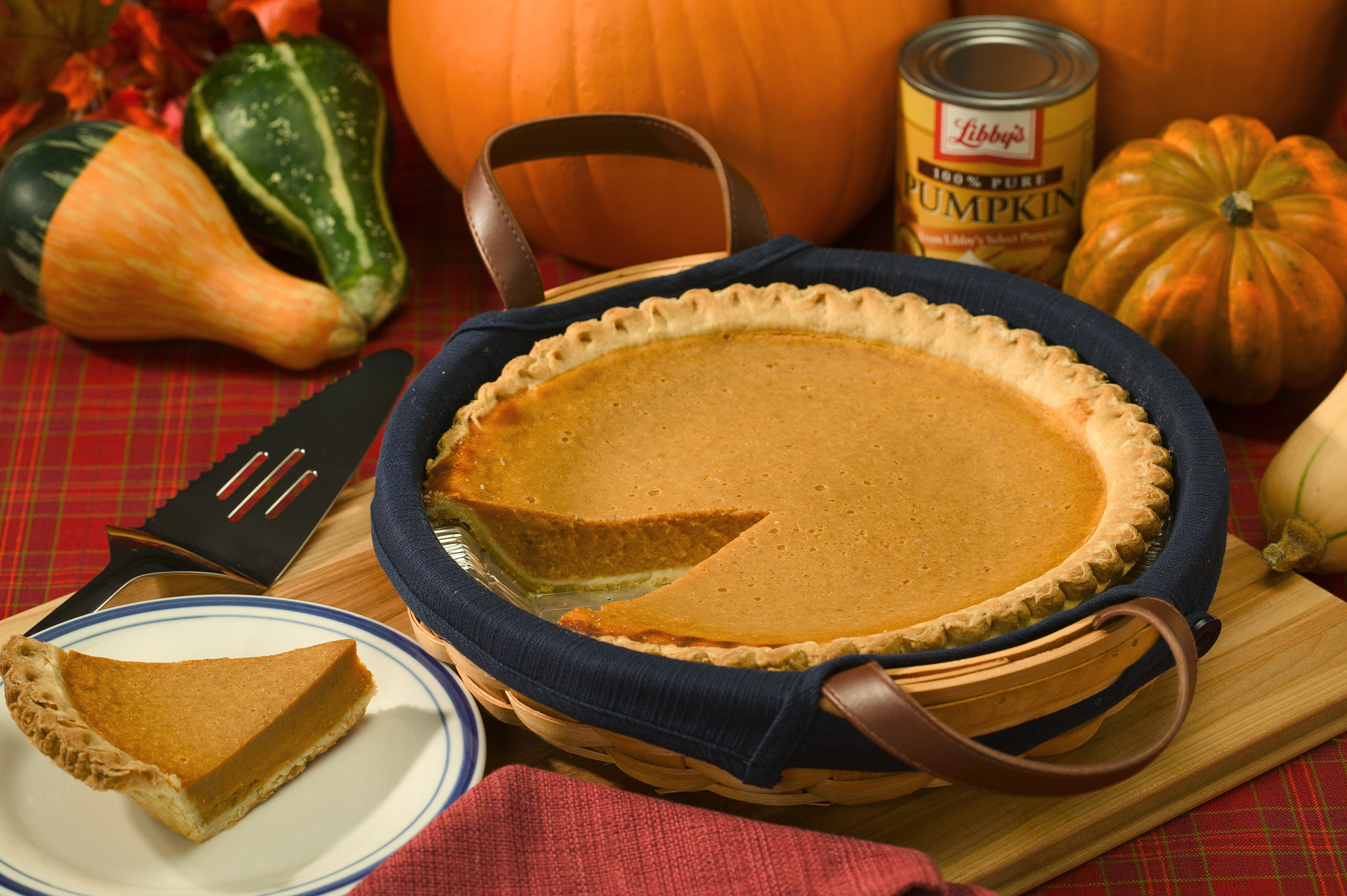
Commercially made pumpkin pie mix is made from Cucurbita pepo, Cucurbita maxima, and Cucurbita moschata. "Libbey Select" uses the Select Dickinson Pumpkin variety of C. moschata for its canned pumpkins.

Many recipes, among them Pie and Cheesecake, include eggs and whole milk or half and half. The end product is outstanding in taste!

As for pumpkins and Thanksgiving?

Well, there are reports and documentation that say pumpkins were a part of the first Thanksgiving meal of the Pilgrims and the Indians.

Pumpkins from that time forward, have been, and continue to be a tradition at the Thanksgiving feast.

Not only is it associated with the meal itself, but the pumpkin has adorned and decorated homes and communities in honor of this event for hundreds of years.

Pumpkin and your Health

Pumpkins are 90 percent water.  Pumpkins are rich in Vitamin A and potassium. And yes, they are also high in fiber.

Pumpkin, raw, Nutritional value per 100 g (3.5 oz), Energy 109 kJ (26 kcal):

Carbohydrates 6.5 g,  Sugars 2.76 g, Dietary fiber 0.5 g, Fat 0.1 g, Protein 1 g, Vitamin A equiv. 426 μg (53%), beta-carotene 3100 μg (29%), lutein and zeaxanthin 1500 μg, Thiamine (vit. B1) 0.05 mg (4%), Riboflavin (vit. B2) 0.11 mg (9%), Niacin (vit. B3) 0.6 mg (4%), Pantothenic acid (B5) 0.298 mg (6%), Vitamin B6 0.061 mg (5%), Folate (vit. B9) 16 μg (4%), Vitamin C 9 mg (11%), Vitamin E 0.44 mg (3%), Vitamin K 1.1 μg (1%), Calcium 21 mg (2%), Iron 0.8 mg (6%), Magnesium 12 mg (3%), Manganese 0.125 mg (6%), Phosphorus 44 mg (6%), Potassium 340 mg (7%), Sodium 1 mg (0%), Zinc 0.32 mg (3%)

Source: USDA Nutrient Database

The conclusion you should now be reaching is that they are therefore good for you. From a medicinal standpoint, pumpkins have been used for a variety of ailments - so go ahead and have that second piece of pumpkin pie, after all, it's good for you!.

Are Pumpkins a "Miracle Fruit"?

Pumpkins just might be a miracle fruit because researchers are working at figuring out just how good they are for us.

Preliminary research indicates that phytochemicals found in pumpkin may favorably affect insulin and glucose levels in laboratory diabetes models.

Two compounds isolated from pumpkin paste and then fed daily to diabetic rats over six weeks, trigonelline and nicotinic acid, caused significant reductions in blood glucose, cholesterol and triglycerides, indicating improvement in the diabetic condition.

And though we all know, bringing down cholesterol is combats heart disease, the benefits of pumpkins don't stop there.

As said before, pumpkins are considered fruit, but did you know that both pumpkin seeds and flowers are edible. Pumpkin seeds can be roasted as a snack and are good for your health.

The Native Americans found pumpkins to be good for us. And yes, today we are certain that pumpkin -especially the seeds - can help prevent prostate cancer in men.

Pumpkins were also once recommended for removing freckles and treating snake bites. I guess, after you're bit, just kick back and have a slice and all will be fine - or maybe not!

Other uses of pumpkins?

Well, its said that canned pumpkin is often recommended by veterinarians as a dietary supplement for dogs and cats that are experiencing certain digestive ailments such as constipation, diarrhea, and even hairballs.

As for us humans, the high fiber content helps to aid proper digestion.

Raw pumpkin can be fed to poultry, as a supplement to regular feed, during the winter to help maintain egg production, which usually drops off during the cold months.

Did you know that pumpkins are now grown all over the world?

Yes, since its discovery in America, it is a fact that six of the seven continents can grow pumpkins.

Antarctica is the only continent that they won't grow in. Pumpkins even grow in Alaska!

Did you know that the "pumpkin capital" of the world is Morton, Illinois?  Yes, this self proclaimed pumpkin capital is where you'll find the home of the Libby corporation's pumpkin industry.

As one of the most popular crops in the United States, 1.5 billion pounds (680,000,000 kilograms) of pumpkins are produced each year. The top pumpkin-producing states include Illinois, Indiana, Ohio, Pennsylvania, and California.

According to the Illinois Department of Agriculture, 95% of the U.S. crop intended for processing is grown in Illinois.

Nestlé, operating under the brand name Libby's, produces 85% of the processed pumpkin in the United States, at their plant in Morton, Illinois. In the fall of 2009, rain in Illinois devastated the Nestlé crop, resulting in a shortage affecting the entire country during the Thanksgiving holiday season.

Pumpkins are a warm-weather crop that is usually planted in early July.

And how about Pumpkin Chucking?

Yes, it is a competitive activity in which teams build various mechanical devices designed to throw a pumpkin as far as possible.

Catapults, Trebuchets, Ballistas and even Air Cannons are the most common mechanisms.

Believe it or not, there are Gamers in every sport, and in Pumpkin Chucking some pumpkin chuckers breed and grow special varieties of pumpkin under specialized conditions to improve the pumpkin's chances of surviving a throw.

So when is "pie" a bad thing? Well, in pumpkin chucking, when a pumpkin doesn't hold together on launch - that's called "pie"! For chuckers, a pumpkin coming apart and turning into pumkin haze in the air is the worse site there is.

Pumpkin Festivals? 

About 20 years ago, I waded through the mob over on the California coast at one of my favorite places on earth, Half Moon Bay, California - which on normal days is only about an hour from where I used to live in the San Francisco Bay Area.

On the weekend of the Annual Pumpkin Festival, its bumper to bumper over the hills to the tiny town, and that hour trip may take two or more. And yes, once there, it's a mad house sort of festival of fun and good foods.

Pumpkin growers in the area compete to see whose pumpkins are the most massive. And yes, the ffestival is a time for this to take place.

Half Moon Bay's annual Pumpkin Festival draws over 250,000 visitors each year and includes the World Champion Pumpkin Weigh-Off.

The Weigh-Off is where farmers from all over the US compete to determine who can grow the heaviest pumpkin. The winning pumpkin regularly tops the scale at more than 1500 pounds.

Leonardo Urena, from Napa, California, grew the winner of the 2011 Weigh-Off with a 1,704-pound Atlantic Giant, setting a new California State record.

The record for the world's heaviest pumpkin was broken on September 30, 2012, at the Topsfield Fair in Massachusetts when Ron Wallace of Greene, Rhode Island, entered a pumpkin weighing 2,009 pounds.

And yes, as expected, Guinness World Records is always recording who is the newest winner.

So besides using pumpkins to make my favorite pies, feed livestock, and cut up at Halloween, pumpkins are used to make soups, breads, beers, coffees, ice creams, and they are good for us medically.

Oh, and yes, they are also people who love to chuck them.

But for me, as much fun as pumpkin chucking looks, I take my pumpkin in pies.

The way I look at it, I'm tired of people telling me what's bad for me. Let me be an adult, and yes, trust me that I'm smart enough to know what is good for me and waht's not.

With everything being labeled as being bad for us, it seems that there really aren't that many things anymore that people will not slap a WARNING labe on. And no, I don't really know if they have gotten to pumpkin pies or not!

But I do know this, they taste great and are really good for us. Besides being nutritious, they taste wonderful and are good for the soul!

So my friends, now that we know just how wonderful and healthy pumkins are for us, this information can be used as a great excuse to our really needing that second piece!

File:Pumpkin Pie.jpg

Story by Tom Correa

Thursday, November 28, 2013

Whom To Thank When There’s No Recipient?

The Atheist’s Thanksgiving Dilemma

Written by John F. MacArthur

November 21, 2012

Thankfulness is one of the distinguishing traits of the human spirit. We sense the need to say thanks, and we realize we ought to be more grateful than we are.

We furthermore perceive that we are indebted to (and accountable to) a higher power than ourselves — the God who made us. According to Scripture, everyone has this knowledge, including those who refuse to honor God or thank Him.

Ingratitude is dishonorable by anyone’s reckoning, but to be willfully ungrateful toward the Creator is to deny an essential aspect of our own humanity.

The shame of such ingratitude is inscribed on the human conscience, and even the most dogmatic atheists are not immune from the knowledge that they ought to give thanks to God.

Try as they might to suppress or deny the impulse, “what may be known of God is manifest in them, for God has shown it to them,” according to Romans 1:19.

During a November 2009 debate in England sponsored by a rationalist group known as Intelligence Squared, Richard Dawkins admitted that when he looks at the Milky Way or the Grand Canyon, he is overcome by a profound feeling of thankfulness.

“It’s a feeling of sort of an abstract gratitude that I am alive to appreciate these wonders,” he said. “When I look down a microscope it’s the same feeling. I am grateful to be alive to appreciate these wonders.”

To whom does an atheist like Mr. Dawkins express such gratitude?

I’m by no means the first person to point out this conundrum.

In fact, the Internet is peppered with failed attempts to justify an atheistic celebration of Thanksgiving.

Atheists insist they are not ungrateful. They confess that they feel thankful, and they clearly sense a need to avoid the ignominy of brazen ingratitude on a cosmic scale — especially at Thanksgiving.

One atheist has practically made a hobby of writing articles to explain why atheists feel the need to be thankful and to answer the question of whom they might thank. His best answer?

He says atheists can be grateful to farmers for the food we eat, to doctors for the health we enjoy, to engineers for the advantages of modern technology, to city workers for keeping our environment clean and orderly — and so on.

Here’s the problem with that: Tipping the waitress or tipping one’s hat to sanitation workers doesn’t even come close to resolving the problem of whom Mr. Dawkins should thank when he looks at the stars, stands at the edge of the Grand Canyon, or studies the world of countless wonders his microscope reveals in a single drop of pond water.

Of course, we ought to be thankful on a human level to people who help make our lives better.

But if thanking people exhausts your sense of blessedness and satisfies that “sort of … abstract gratitude” you feel when pondering the vastness of the universe, you have already suppressed your own conscience to a frightening degree.

Your worldview is spiritually bankrupt.

Another atheist writer, acknowledging this problem, says the answer is easy for her: She is grateful to her lucky stars.

“What it comes down to,” she writes, “is that an atheist is generally thankful for good luck, serendipity.”

That’s an odd and ironic answer from a point of view that repudiates theism on the grounds that it is not “rational” to believe in God.

After all, the starting point for atheistic materialism is the equation nobody times nothing equals everything. What could possibly be more irrational?

Furthermore, chance (luck, fortune, happenstance, fate—whatever label you want to put on it) is not a force or intelligence.

“Chance” has to do with mathematical probability. Flip a coin and there’s a 50-50 chance it will come up tails. But “chance” has no power to flip the coin, much less design an ordered universe.

Nevertheless, that’s how atheistic materialists have trained themselves to think.

Chance is the ultimate creator. In the words of one Nobel Prize-winning atheist, “Pure chance, absolutely free but blind, is at the very root of the stupendous edifice of evolution.”

Fortune has thus been personified — imbued with the power to determine, order and cause everything that happens.

That’s mythology, not science.

At the end of the day, the atheist is no more rational and no less superstitious than the astrologist who thanks impersonal “lucky stars” for good fortune.

On some level, atheists themselves surely realize this.

Proof of their internal angst is seen in the fact that so many of them are not content merely to disbelieve.

They are militant in their opposition to God. They hate the very thought of God and would love to have every mention of Him removed from public discourse — as if that would somehow remove the burden of their own ingratitude and relieve the pangs of a guilty conscience.

But as Scripture says, it is the ultimate folly to try to suppress our own innate sense of obligation to our Maker.

“The fool says in his heart, ‘There is no God’” says Psalm 14:1. In short, to deny God is to debase one’s own mind and dehumanize the whole person.

That’s why we remind ourselves to give thanks to God — specifically, the one true God who has revealed Himself in Scripture as a God of grace and forgiveness, who so loved the world that He gave His Son as an atonement for sin, so “that we might die to sin and live to righteousness,” according to 1 Peter 2:24.

He graciously compels us to thank Him, and He himself should top the list of things we are thankful for.

-- end article.

Editor's Note:

Reprinted here on American Cowboy Chronicles unedited and with pleasure.

John F. MacArthur is president of The Master’s College and Seminary, host of internationally-syndicated radio show “Grace to You,” and author of nearly 400 books and study guides.


God Bless You and Yours!


Tuesday, November 26, 2013

South Dakota Ranchers Need Our Help

Yes, after the catastrophic October 2013 snowstorm,  South Dakota Ranchers still need our help.

100813-nws-cattle001.JPG

In early October of this year, 2013, South Dakota and its neighboring states were hit with a snow storm of historic proportions. While states were hit, South Dakota caught the full brunt of the the storm.

Four to five feet of snow fell in the Black Hills area during the storm, killing at least 100,000 head of livestock, South Dakota state officials say.

South Dakota was hit the hardest and the South Dakota Stockgrowers Association estimates that parts of the state lost at least 5 to 10 percent of its cattle.

Ranchers were encouraged to take carcasses to sites which were built to state Animal Industry Board guidelines.

At one site in western South Dakota more than two 20-foot-deep disposal pits were opened to help ranchers dispose of tens of thousands of livestock carcasses piled up since the early October blizzard decimated herds.

The already saturated by the quickly melting snow, made it difficult for ranchers to traverse the vast terrain to assess losses and tend to stressed but surviving animals.

Behind that epic blizzard another snowstorm slammed into the Black Hills. It did nothing to help the situation, bringing a foot of snow, it only complicate the mess.

Animal Industry Board rules require carcasses to be burned, buried to a depth of 4 feet or disposed of by a licensed rendering plant within 36 hours of death, though South Dakota Gov. Dennis Daugaard had waived the standard time frame, recognizing the difficulty in meeting that deadline.

Ben Kantack, a former South Dakota State University Extension entomologist, said he worries about dead cattle hidden in remote locations, saying they will create public health issues as they decompose.

He said ranchers need to make sure their surviving cattle don’t come into contact with a carcass or drink from water where one is rotting.

Kantack was concerned about water contamination.

The pits were dug specifically to avoid such health problems, as burial sites must be at least 1,000 feet from surface water, floodplains, rivers or private or public drinking water wells.

Burial is also prohibited when the primary subsurface material 20 feet below the bottom of the pit is primarily sand or gravel or when the depth to an aquifer is less than 20 feet from the bottom of the pit.

Ranchers in South Dakota were afraid they may lose everything after the freak storm - killing as many as 100,000 cattle.

Matt Kammerer, a 45-year-old rancher whose family has operated in South Dakota’s Meade County since 1882, told FoxNews.com that he lost 60 cattle in the storm, or one-third of his entire herd.

" ... It’s just dead cow after dead cow, where they’ve gotten caught in dams, streams, fences, you name it. They’re dead everywhere."- Rancher Matt Kammerer

“You’re talking about $120,000 of assets that are just gone,” Kammerer said Friday by phone. “And we still owe the banks, too. It’s like driving a brand-new pickup off a cliff and still having to make payments.”

Kammerer painted a gruesome scene north of Rapid City, where a record 23 inches of snow fell.

“It’s just unreal,” he said. “There are cattle that are 8 or 9 miles away from the pasture they were in, just lying dead. And within that whole stretch, it’s just dead cow after dead cow, where they’ve gotten caught in dams, streams, fences, you name it. They’re dead everywhere.”

Carcasses of mature cows as well as calves were floating downstream local waterways in droves, Kammerer said, stoking fears of a potential outbreak of disease.

“If you don’t get those picked up and buried, you’re looking at the possibility of disease or possibly contamination,” he said. “You’ve got to get them all picked up.”

Most ranchers in the state lost anywhere between 50 to 75 percent of their herds, according to Silvia Christen, executive director of the South Dakota Stockgrowers Association, which represents 1,500 ranching operations.

“We’re certainly looking at tens of thousands if not pushing 100,000 at this point,” she said of the dead livestock.

Aside from the economic losses, which will be severe once finally tallied, the unprecedented storm has left an “incredible emotional burden” on the state’s ranchers, Christen said.

“They know how dependent these livestock are on them and they’re absolutely emotionally devastated at the losses they’re seeing,” she said. “It’s been extremely difficult.”

In the days since the storm, Christen said ranchers are now focusing on providing medical care to the animals that did survive.

“That really has to be the priority before we start counting loss,” she said. “They need to make sure they’re safe and that they stay healthy now.”

Gary Cammack, a 60-year-old rancher near Union Center in Meade County, said he lost about 15 percent of his herd, including 70 cows and some calves, which normally sell for $1,000.

A mature cow usually brings in $1,500 or more, he said.

Livestock were initially soaked by 12 hours of rain before 48 consecutive hours or snow and winds up to 60 mph, Cammack said.

Matt Kammerer said his ranch will be able to recover, but he’s more worried about his fellow cattlemen.

“We just had one of the worst droughts ever and now we take a hit like this,” Kammerer said, his voice cracking with emotion.

“It’s just catastrophic. I’m going to be fine; it’s my counterparts … it’s my neighbors, my friends, the people you can’t even look in the face to tell them that you’re sorry.”

So how big was the snowstorm?

The unusually early and enormous snowstorm over that weekend caught South Dakota ranchers and farmers unprepared, killing tens of thousands of cattle and ravaging the state's $7 billion industry — an industry left without assistance because of the federal government shutdown.

Across the state, snow totals averaged 30 inches, with some isolated areas recording almost 5 feet, The Weather Channel reported.
The storm was accompanied by hurricane-force wind gusts, which drove some herds seeking shelter miles from their ranches.

A trail of carcasses left a gruesome sight, said Martha Wierzbicki, emergency management director for Butte County, in the northwestern corner of the state.

"They're in the fence line, laying alongside the roads," Wierzbicki told The Rapid City Journal. "It's really sickening."

Ranchers have no one to ask for help or reimbursement. That's because Congress has yet to pass a new farm bill, which subsidizes agricultural producers.

State Agriculture Secretary Lucas Lentsch called the early-season blizzard "devastating to our producers," saying his agency was trying to figure out a response.

In the meantime, he said, the best farmers and ranchers could do was to meticulously document their losses, with detailed photos, for use when and if claims can be processed.

The most immediate concern was the proper disposal of the dead livestock, which state law says must be burned, buried or rendered within 36 hours — for the health not only of surviving herds but also for people.

"That can be a significant source of disease spread, so we want to make sure those carcasses are burned, buried or rendered as quickly as possible," Dustin Oedekoven, South Dakota's state veterinarian, told the Journal.

But the South Dakota Cattlemen's Association warned that the effects would be felt for years afterward. Not only were tens of thousands of calves killed, but so were thousands more cows that would have delivered calves next year.

And the stress of the storm will leave its mark on surviving herds, the South Dakota State University Agricultural Extension Service said, leaving the remaining cattle vulnerable to ruinous diseases with names like infectious bovine rhinotracheitis, bovine respiratory syncytial virus and bovine viral diarrhea virus.

UPDATE:

Ranchers donate cattle after South Dakota blizzard kills livestock

November 25th, 2013
SDcattle661.jpg

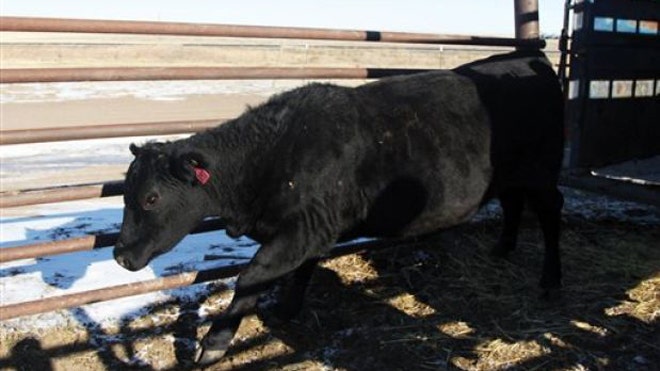
One to start a new herd. This one from Russ Allderdice runs onto the J S Livestock yard in Havre, Montana.

Russ Allderdice and other area ranchers brought cattle to the stockyard throughout the day to send to the South Dakota ranchers whose cattle was ravaged by the October blizzard.

SDcattle2_661.jpg

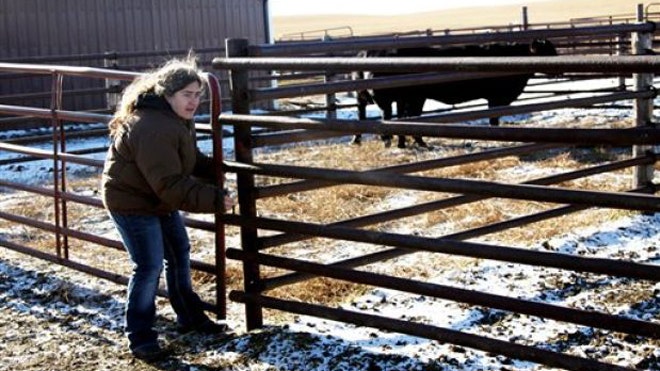
Nov. 21, 2013: Rene Brown locks up a cattle delivery at the J S Livestock yard in Havre, Montana. Brown collected cattle donations from area ranchers to send to the South Dakota Ranchers whose cattle was ravaged by the October blizzard. (AP/Havre Daily News, Lindsay Brown)

Hope on hooves is arriving in South Dakota, one heifer at a time.

A month after the freak snow storm dumped 4 to 5 feet of snow on South Dakota, 45 donated head of cattle from Montana designed to serve as breeding stock were sent to ranchers in The Mount Rushmore State.

Another 400 cattle, including yearling and bred heifers worth as much as $75,000, have also been sent to South Dakota from neighboring Montana, Wyoming and North Dakota to help the afflicted ranchers get back on their feet ahead of the looming harsh winter.

“The support from other states has been phenomenal,” Silvia Christen, executive director of the South Dakota Stockgrowers Association, told FoxNews.com early Monday, November 25th.

“We have volunteers from in the state who have helped with cleanup, we have people from surrounding states who shipped heifers and about $1.5 million has been donated to the Rancher Relief Fund.”

Christen estimated in the days after the storm that as many as 100,000 cattle would ultimately die as a result of the “devastating” storm, although state officials have said the blizzard killed roughly 14,000 cattle, more than 1,200 sheep, nearly 300 horses and 40 bison.

She still expects that number to “go up quite a bit” in coming weeks.

Part of the problem, Christen said, is that state officials have relied on self-reporting from ranchers, some of whom may be dealing with the guilt of not suffering widespread losses like their counterparts.

“They’re a very private, self-sufficient group,” Christen said of ranchers.

“The emotional flow of this whole thing has been incredible. These ranchers define themselves as caretakers of their animals and many of them feel they have failed in their role.”

Christen continued: “Many of them say, ‘Well, our neighbors had it worse,’ and some of them haven’t reported those losses due to survivor’s guilt. Many of these ranchers won’t be able to financially survive this. There’s an incredible amount of guilt among those who are going to survive. Many of them wish they can do more for others.”

Two people desperate to make a difference were Montana ranchers Rene Brown and Alisha Burcham, who began gathering cattle donations from northern Montana through Heifers for South Dakota.

The organization selected family ranches that had herds of roughly 160 cattle but lost up to 60 percent of them in the storm.

“Twelve hours this way with that storm and that could have been us,” Brown told The Associated Press.

Brown, a rancher near Chinook, Mont., could not be reached for comment early Monday. Her brother-in-law, Earl Brown, started moving the donated cattle on Friday.

“I told him I wanted to get a pot load of cattle together to send to South Dakota,” she continued.

“He told me I couldn’t do it and that if I did, he would drive them there. Well, we did and even have donations for the fuel, so he’s donating his time for the drive.”

Many small producers in South Dakota did not have insurance due to high costs, she said.

“Congress may approve some disaster aid, but that’s not a sure thing and they can’t even pass a farm bill,” Brown said.

But frankly, these people don't wait for Congress.

“This donation will make a big difference to ranchers in South Dakota. I knew the Hi-Line would come through, but it is humbling to see this come together.”

The South Dakota Rancher Relief Fund was established by a consortium of livestock organizations following the blizzard and has thus far raised $1.5 million, Christen said.

An application deadline of Dec. 31 has been set in order to assess the number of applicants and the severity of those applicants’ needs.

“The outpouring of support for the West River ranchers who lost animals during the blizzard has been overwhelming,” South Dakota cattleman Cory Eich said in a statement.

As more winter comes, Christen said colder conditions have helped the cleanup effort by drying up large mud patches created by melted snow and water runoff.

“The snow has melted and we’ve had some new snowfall, but there’s not a lot on the ground,” she said. “The ground is freezing though, which is actually helping things because it’s easier to move around these ranches and get to remote areas.”

And while the long-term financial outlook looks dicey for some ranchers, especially young breeders, Christen said livestock producers in South Dakota have plenty to be thankful for ahead of the holiday season.

“It has been incredible to see the kind of support we have gotten,” Christen told FoxNews.com. “It’s really kind of beyond words. It’s been very humbling.”

American farmers and ranchers are some of the toughest people on the face of the earth. They endure when others fail, and they don't ask help from anyone.

These great Americans who feed us and the world need our help.

If you would like to contribute to the The South Dakota Rancher Relief Fund, please do so by clicking on the links below and give what you can to help those who really need our help.

At this time, let's be the ones who showed what we are made of and help our neighbors in South Dakota!    

If one link doesn't work, please try the other.

BHACF/SD Rancher Relief Fund  

Ranchers Relief Fund   

Thank you, and God Bless you!

Tom Correa
Editor
American Cowboy Chronicles


Monday, November 25, 2013

George Zimmerman's Actions & Character

Dear Readers,

Last year, I wrote an article saying why I supported George Zimmerman in his case.

I have gotten a lot of email on this. While many are laced with profanity calling me everything in the book, and yes there have been many who have threatened me and my family, some are simply comments calling people like me who would not hesitate using a gun to protect myself  - cowards.

I usually hit delete and move on not worrying about it.

I've just received this latest comment on that post which I decided was so typical of the people who have wrote, yet was not threatening, that I wanted to share it with you:

Anonymous November 19, 2013 at 2:35 PM

"it's not hard to kick a cowards ass. Put a gun in his hand and now he is a hero. It would have never happened if the coward didn't have a gun. He even pulls guns on women. Guarantee you he would never do that that to a full grown man or anyone with a gun in their possession.. Keep supporting losers cowboys! Do you know the real origin of cowboys?"

This is my reply to that person:

While I agree that it's true that it's not hard to kick a coward's ass, what does that have to do with anything? Nothing really.

As for George Zimmerman,  I've NEVER said in any editorial that he is a hero of any sort.

I have said that he was being sat on and was having his head beaten into the concrete pavement, in what is commonly known as a "ground and pound," and to my belief of the facts given to the public -- he used his pistol as a last resort to save his own life.

I believe that you would have done the same thing if you felt that your life was in mortal danger, I know that I would.

For me, if for any other reason, simply because my training says that in a combat situation -- I should use everything in my personal arsenal to stay alive.

Now, like many of you, I have read about Zimmerman's latest problems with the law.

I've never addressed the man's "character" restricting myself to only talk about his actions against Martin.

He could be a card cheat and a woman beater, a bum and a low life, on the other hand he can be someone who volunteers his life to the sick and needy - I don't know the guy.

I only know what I would have done if I had a younger stronger assailant on top of me trying to kill me by smashing my head into the cement.

I would have used everything including shooting Martin in the case that I've described.

As for Zimmerman breaking the law himself and assaulting others, he should be prosecuted to the full extent of the law for that crime..

As for me and others supporting losers, well I would support you if you were in the same situation as he was on his back that night and you used your legally carried pistol to save your own life.

If your character as a man is a loser, that doesn't take away from the fact that you have the right to defend yourself - loser or not.

As for the origin of cowboys? Yes, I know the origin. What does that have to do with your accusing me of supporting some loser like yourself who was within the law to act as he did?

Write me, let me know why you feel it would have been OK for Martin to go ahead and kill Zimmerman, but it was not OK for a loser like Zimmerman or you to protect his or your own life?

Ask yourself this, if you were armed and on your back. And yes, you felt that you were about to die, knowing that you carried a gun for self-defense -- would you have used it? Or, and be honest, would you have really allowed Martin to kill you by smashing your head into the concrete pavement?

Write me to tell me if you would have taken what you call the coward's way out - or would you have not done everything that you could to stay alive?

If you put yourself in Zimmerman's place, are honest with yourself, and still say that you wouldn't have shot Martin - then you are a bigger coward than most.

Only a true coward, a real loser, wouldn't do everything in his or her power to stay alive when faced with the prospect of death.

Thanks for your comment,
Tom Correa
Editor

Also ...
I find that there are two camps when it come to the whole George Zimmerman / Trayvon Martin case.

The first camp is made of Conservatives who believe that we all have a right, a moral obligation, a duty, to use "every means" at our disposal to fend off danger and protect our lives.

We in that camp understand that "every means" also means using a gun if we have one.

The second camp is made up of Liberals who believe that while it is OK to kill a helpless child before birth, and forgive those on Death Row, that we are duty bound to run away if we can -- and of course, if that is useless, they feel that we should simply allow aggressors to kill us without a fight using everything at our means.

I believe that Liberals would have rather seen George Zimmerman die, be found dead after having his head caved in, than see him defend himself with a gun or a knife or a brick or whatever.

For the record ...

Since I have been asked, let me answer.

The fights that I have been in were never something called "friendly fights." I have never been in, nor ever seen, such a thing called a "friendly fight."

Each and every fight that I have ever been in, I immediately understood that the man who I was fighting wanted to hurt or kill me.

And yes, I in turn obliged them meeting force with force and moreso - all with the same intent.

I never tried to hit and run, or shake their hands afterwards. I was taught that anything short of fighting "all out" is a waste of time.

Those who have tried to hurt me in the past fully understand that I don't believe in rules when trying to preserving my life - or protecting those I hold dear.

Maybe it is my Marine training, but I truly believe that one who does not fight with every means available, to the fullest extent of his or her abilities, is the real coward!

Some call my training barbaric and vicious in a civilized world, but frankly I expect one to fight in an altercation with the same zeal and effort, wanting to use any and every means at their disposal, the same as if they were fighting cancer - with the desire to stop it or kill it.     
That's just how I see it.

Tom Correa