Monday, August 26, 2013

Firefighters Battle "The Rim Fire" Wildfire


From: Glencoe, CA To: Groveland-Big Oak Flat, CA
Glencoe to Groveland
Living in the area that we do here in Glencoe, I've always kept in mind the scary possibility of the area going up in flames. 

Yes, because this is the mountains and big tree country, fire is the scariest thing that I could ever imagine taking place here.

It is my constant concern, and the reason that I worry so much about those folks in the neighboring county who are having to fight this fire or flee their homes.

It is a real possibility that I think about each "Fire Season".

For our neighbors just South of us in the Groveland area, I can't tell you how I feel for them.

And no, not even Mother Nature is helping out.

Firefighters attempting to contain a 144,000-acre wildfire near Yosemite National Park are getting no help from the elements, which include wind gusts of up to 50 miles per hour.


The reason that this is so frightening is that it could be my property. Uncleared brush has fueled these tall trees.

On the local news, some reporter was talking about the "air quality" in Sacramento because of the fires.

While he's right in that the "air quality" has been affected, and I do understand what he is saying since the mountains up here where my wife and I live are in what looks like a state of thick fog, I would really think that there are greater concerns that a reporter can use his air time to talk about.

Today the Associated Press reported that the Yosemite wildfire "poses every challenge there can be."
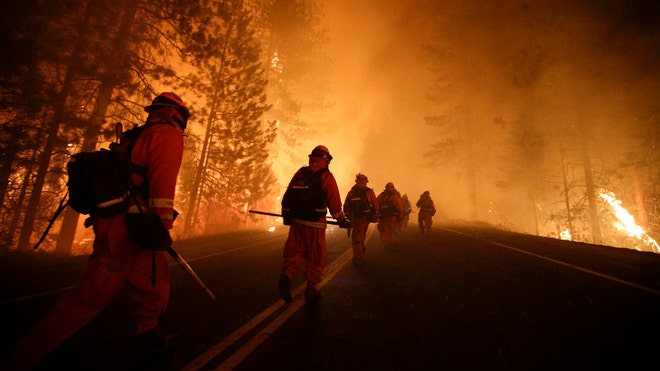
yosemite_wildfire_082513.jpg

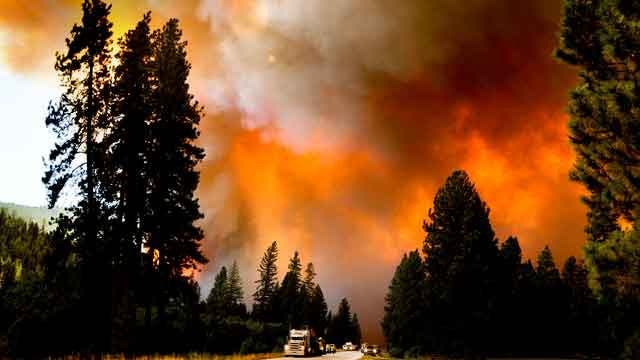
This picture from yesterday, August 25th, 2013, show Inmate firefighters walking along Highway 120 as firefighters continue to battle "The Rim Fire" near Yosemite National Park, California.

Fire crews are clearing brush and setting sprinklers to protect two groves of giant sequoias as a massive week-old wildfire rages along the remote northwest edge of Yosemite National Park. 

Firefighters battling a wildfire north of Yosemite National Park are calling it a "very difficult firefight," especially as high winds and dry conditions continue to fuel the blaze's momentum.

"This fire has continued to pose every challenge that there can be [in] a fire: inaccessible terrain, strong winds, dry conditions," Daniel Berlant of the California Department of Forestry and Fire Protection said on Sunday.

Yesterday was very windy around here, and all knew that that was not good news for the firefighters in neighboring Tuolumne County.

Firefighters were hoping to advance on the flames, but strong winds gusting up to 50 miles per hour in some places were threatening to push the blaze closer to Tuolumne City and nearby communities.


Yes, my heroes are not only Cowboys. These firefighters are some of the greatest people on earth. And yes, thank God for them!

"Winds are increasing, so it's going to be very challenging," said Bjorn Frederickson, a spokesman for the U.S. Forest Service.

Sunday evening, the Forest Service confirmed to KTVU that the fire had burned through the Berkeley Tuolumne Family Campsite, which was owned by the city of Berkeley, California, and had been in operation since 1922.

Firefighters were unable to immediately assess the damage, and it was not clear if any structures survived. The camp had been evacuated Tuesday and no injuries were reported.

The fire continues burning in the remote wilderness area of Yosemite, but park spokesman Tom Medena said it's edging closer to the Hetch Hetchy Reservoir, the source of 85 percent of San Francisco's famously pure drinking water, as well as power for a number of key buildings, including the airport.

The city has issued assurances that the water quality remains good, but the San Francisco Public Utilities Commission has shut two hydro-electric stations fed by water from the reservoir and cut power to more than 12 miles of lines.

San Francisco has been buying $600,000 worth of power on the open market to ensure San Francisco doesn't go dark.


The fire has consumed approximately 225 square miles of picturesque forests. Officials estimate containment at just 7 percent.

"It's a very difficult firefight," Berlant said. Frederickson added that the fire is slowing down a bit, but still growing.

Meanwhile, park officials are clearing brush and setting sprinklers to protect two groves of giant sequoias. The iconic trees can resist fire, but dry conditions and heavy brush are forcing extra precautions to be taken in the Tuolumne and Merced groves. About three dozen of the giant trees are affected.

"All of the plants and trees in Yosemite are important, but the giant sequoias are incredibly important both for what they are and as symbols of the National Park System," park spokesman Scott Gediman told the Associated Press on Saturday.

The trees grow naturally only on the western slopes of the Sierra Nevada and are among the largest and oldest living things on earth.

The Tuolumne and Merced groves are in the north end of the park near Crane Flat. While the Rim Fire is still some distance away, park employees and trail crews are not taking any chances.

Fire officials are using bulldozers to clear contingency lines on the Rim Fire's north side to protect the towns of Tuolumne City, Ponderosa Hills and Twain Hart.

The lines are being cut a mile ahead of the fire in locations where fire officials hope they will help protect the communities should the fire jump containment lines.
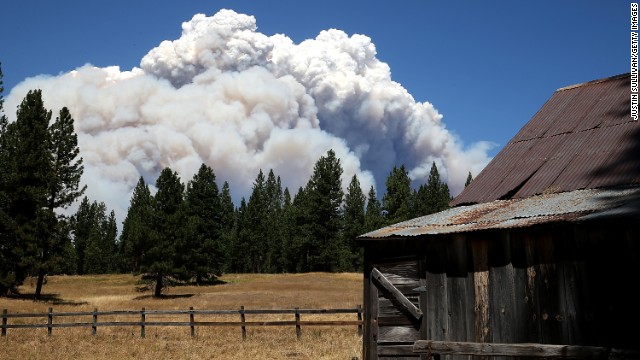


The high winds and movement of the fire from bone-dry brush on the ground to 100-foot oak and pine treetops have created dire conditions.

"A crown fire is much more difficult to fight," Berlant told The Associated Press Sunday. "Our firefighters are on the ground having to spray up."

The blaze sweeping across steep, rugged river canyons quickly has become one of the biggest in California history, thanks in part to extremely dry conditions caused by a lack of snow and rainfall this year.

Investigators are trying to determine how it started Aug. 17, days before lightning storms swept through the region and sparked other, smaller blazes.

The fire is the most critical of a dozen burning across California, officials say.

More than 12 helicopters and a half-dozen fixed wing tankers are dropping water and retardant from the air and 2,800 firefighters are on the ground.

Statewide, more than 8,300 firefighters are battling nearly 400 square miles of fires. Many air districts have issued health advisories as smoke settles over Northern California.

The Rim Fire burns close to Groveland Ranger Station near Yosemite National Park, California, August 23, 2013

The Rim Fire burns close to Groveland Ranger Station near Yosemite National Park, California, August 23, 2013. Satellite photos show giant columns of white smoke from the fire drifting North and far into the neighboring state of Nevada to the East.

On Saturday, organizers cancelled the 24th annual Lake in the Sky Air Show at Lake Tahoe because of poor visibility.

The U.S. Forest Service says about 4,500 structures are threatened by the Rim Fire.

Berlant said 23 structures were destroyed, though officials have not determined whether they were homes or rural outbuildings. Some could be barns and sheds, while others could be homes being used at the moment or seasonal cabins.

Jessica Sanderson said one of her relatives gained access to the family's property in Groveland, just 26 miles from the park's entrance, on Saturday and was able to confirm their vacation cabin had burned to the ground.

The family saw firefighters on a TV news report a day earlier defending the cabin.

"It's just mind-blowing the way the fire swept through and destroyed it so quickly," said Sanderson, who's been monitoring the fire from her home near Tampa Bay, Fla. "The only thing left standing is our barbeque pit."

At the nearby Black Oak Casino in Tuolumne City on Sunday, the slot machines were quiet as emergency workers took over nearly all of the resort's 148 hotel rooms.

"The casino is empty," said casino employee Jessie Dean. "Technically, the casino is open but there's nobody there."

As thick smoke tells everyone that the fire is getting closer, and the area has been cleared of everyone but locals and emergency workers.

Dean lives on the reservation of the Tuolumne Band of Me-Wuk Indians and left her four children at relatives' homes in the Central Valley.

But the tourist mecca of Yosemite Valley, the part of the park known around the world for such sights as the Half Dome and El Capitan rock formations and waterfalls, remained open, clear of smoke and free from other signs of the fire that remained about 20 miles away.

Range cattle and bears?
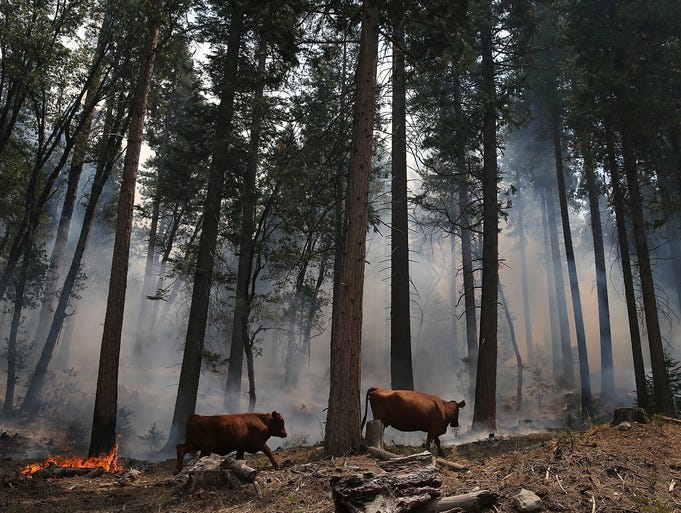


These range cows are making a run for it in any direction they can find.


Along with bears, many critters are trying to get out of the way of the fire.

Sadly many won't make it out safe.

At Ike Bunney's dude ranch near the Sierra community of Tuolumne City, all of their critters have been evacuated as firefighters brace for an intense battle to keep a wildfire raging north of Yosemite National Park out of mountain communities.

"We've already evacuated the horses," said Bunney, who was keeping an eye on his Slide Mountain Guest Ranch on Sunday. "I think they're worried about the fire sparking over these hills."

As fire leapfrogs across the vast, picturesque Sierra forests, moving from one treetop to the next, residents in the fire's path are moving animals and children to safety.

Hundreds of firefighters were deployed Sunday to protect Tuolumne City and other communities in the path of the Rim Fire.

Eight fire trucks and four bulldozers were deployed near Bunney's ranch on the west side of Mount Baldy, where two years of drought have created tinder-dry conditions.

More than 12 helicopters and a half-dozen fixed wing tankers are dropping water and retardant from the air, and 2,800 firefighters are on the ground.

Statewide, more than 8,300 firefighters are battling nearly 400 square miles of fires.

Many air districts have issued health advisories as smoke settles over Northern California.

While Yosemite Valley is clear, the Lake Tahoe basin is thick with smoke, and many outdoor activities have been canceled in Reno, Nevada.

The U.S. Forest Service says about 4,500 structures are threatened by the Rim Fire.

While the firefighters do battle there and around the West, I pray for their safety and for those who they are trying to save.


In this undated photo provided by the U.S. Forest Service, the Rim Fire burns near Yosemite National Park, Calif. The wildfire outside Yosemite National Park - one of more than 50 major brush blazes burning across the western U.S. - more than tripled in size overnight and still threatens about 2,500 homes, hotels and camp buildings. Fire officials said the blaze burning in remote, steep terrain had grown to more than 84 square miles and was only 2 percent contained on Thursday, down from 5 percent a day earlier. (AP Photo/U.S. Forest Service)

Yes, this is a horrible sight.


Sunday, August 25, 2013

Sheep - Facts & Trivia

Sheep is a term for selective grazing animals that may be domesticated (tamed) or wild.

Behaviorally, sheep are gregarious, precocial, defenseless creatures. 

Gregarious means that they flock together or like to be with a group.

Yes, it is rare to see a sheep by itself because of their gregarious nature.

Precocial means that they have a high degree of independence at birth.

This means that they can stand on their feet shortly after birth.

Sheep are defenseless for the most part against predators like coyotes and wild dogs.

Sheep are also very selective in their grazing habits.

Sheep have a split in their upper lip, with this they are able to pick the preferred leaves off of the plant.


At one time all sheep were wild. It is believed that around 12,000 BC, sheep were domesticated by the humans.

Most of the wool breeds of sheep were developed from Moulfan sheep. Most of the hair breeds are similar to the Urial sheep of ancient times.

Sheep were the third animal to be domesticated. Prior to domesticating sheep, the dog and reindeer were domesticated.

Domestication meant changes: On the outside the sheep began to develop more wool and less hair; The color of the wool and hair changed from brown and shades of brown to whites and blacks; Their ears became more of a lop ear than an erect ear; The horns that the wild sheep possessed were weakened and disappeared from many breeds.

On the inside the sheep changed as well; These internal changes happened at both ends. The tails had less vertebrates, or bones than the sheep do now. Today's sheep also have a smaller brain than the sheep 12,000 years ago.

Some sheep, including ewes, like to butt the person feeding them and the feed bucket.


Special care must be taken when children are around sheep, due to the sheep's herding and fight instincts.

Sheep theft is still legally a hangable offence in Scotland.

Sheep are usually white or black.

White sheep may appear brown, but this is just because they are dirty.

In biblical times, wool was left outside at night to absorb the dew and wrung out in the morning.

Spinning started in 3500 B.C.E.

In 1999, a French Poodle killed 20 sheep in one weekend in only one hour. It's quite a usual occurrence in North Devon (UK) for dogs to scare and kill sheep.

One pound of wool can make ten miles of spun yarn.

Sheep prefer to drink running water.

Pregnant women should avoid sheep at lambing time.

While it not their preferred recreation activity, sheep can swim when confronted with flooding or other water emergencies. Their swimming style can best be described as a doggy-paddle.

There were at least 2386 different species of sheep in Wales before it was inhabited

Sheep were first domesticated 10,000 years ago in Central Asia.

Sheep production began during biblical times.

Raising sheep is the oldest organized industry.

Man learned how to spin wool in 3,500 B.C.

There are over 40 breeds of sheep in the U.S. and approximately 900

different breeds around the world.

Sheep were smuggled into the states during the 16th and 17 centuries to develop the wool industry.

Along with goats sheep were first brought to America by Columbus in 1493.

The Navajo Churro is the oldest breed of sheep in the U.S.

By 1698, America was already exporting wool.

George Washington raised sheep on his Mount Vernon Estates.

President Woodrow Wilson grazed sheep on the White House lawn.

The female sheep is called a “ewe.”

The male sheep is called a “ram” or “buck.”

A castrated male sheep is called a “wether.”

A baby sheep is called a “lamb.”

The act of giving birth is called “lambing.”

The doe can have 1 to 3 lambs per litter.

The largest wild sheep is the Argali of central Asia. It stood 3 feet and 11 inches tall (1.2 m high) and weighed over 300 pounds (140 kg).


On the 24th of March, 1978, a sheep was found under the snow that had been there for 50 days.

The sheep’s warm breath had melted passages in the snow, so that it was able to breathe. His wool protected him from freezing.

The heaviest sheep was a ram called Stradford Whisper. In March of 1991, he weighed 247 kg and was a little over 1 metre high.

Most ewes give birth to twins.

A one-year-old sheep is called a hogget and a two-year-old is called a two-tooth. Sheep grow only eight teeth, two per year. When a ewe is a two-tooth, she is ready to breed.

Sheep eat hay and other feed. "Other feed" can mean barley and nuts, especially just prior to lambing when the ewes need extra nourishment. Hoggets can eat swedes too.

Sheep pick up ticks or lice from one another, and these parasites cause them to itch.

If sheep itch, they spend their time rubbing themselves against fences instead of eating. And yes, subsequently they lose weight and spoil their wool.

To stop this from happening, farmers dip them into a chemical dip for example Grenade, which kills the ticks or lice.

These parasites are not the only natural enemy that sheep have. They also get intestinal and lung worms, which means sheep have to be drenched on a regular basis by forcing down their gullets a chemical mixture that kills off the worms.

Sheep do not have teeth in their upper front jaw.

Sheep have 24 molars and 8 incisors.

Sheep were first used for meat, skins, milk and wool. Today they are still raised for these purposes plus many more.

One year’s growth of fleece is about 8 pounds of wool.

Wool sheep are usually shorn once a year.

Wool that comes directly from the sheep is called “raw wool.”

Raw wool may go through 70 processing steps to make sure it is the highest quality.

Depending on the market, lambs are usually sold between 90-120 pounds.

Lamb meat is an exceptional source of vitamins and minerals.

Meat from a grown sheep is called “mutton.”

A group of sheep is called a flock.

Michigan has the largest sheep packing plant east of the Mississippi River.

Sheep have a split in their upper lip which allows them to select the preferred leaves off a plant.

In sheep, the act of breeding is called “tubing.”

The act of parturition (giving birth) in sheep is called “lambing.”

The weaning age of sheep is generally between 2-3 months of age.

The pasture carrying capacity for sheep is generally 5 to 6 ewes and lambs per acre.

An immature male ram is called a “ram lamb” and the female is referred to as a “ewe lamb.”

The birth weight for lambs may range from 5 to 8 pounds.

The life expectancy for sheep is between 6 to 11 years.

The average body temperature for sheep is 102.5 F.

The average respiration rate for sheep is 16 breaths per minute.

Sheep generally consume 2 to 4.5 pounds of food daily.

Depending on the breed, the mature weight for female ewes range from 90 to 300 pounds.

Like goats, sheep are also seasonal breeders.

The best time to breed is between early fall to late winter. However, there are some breeds that can be bred year-round.

Ewes cycle every 14-19 days during the breeding season.

The average pulse rate for sheep is 75 heart beats per minute.

The duration of estrus is 24 to 36 hours.

The time of ovulation is 24-30 from the beginning of estrus.

The gestation (pregnancy length) period for ewes is 145-155 days.

Breeding per year is 1-2 per year.

Depending on the breed, puberty is between 5 to 8 months of age for ewe lambs and 6 to 8 months for ram lambs.

Depending on the breed, the minimum breeding age is between 8 to 10 months for ewes lambs.

The mature weight of a ram is between 150 to 450 lbs.

One ram can service 30 to 35 ewes during a 60 day breeding season.

Sheep are born with long tails. Some producers dock their tails shortly after they are born.

Sheep have two digits on their feet.

Sheep milk is often used to make gourmet cheese.

Sheep are animals that are over one year of age.

Lambs are less than one year of age.

A yearling is an animal between 1 to 2 years of age that may or may not have produced offsprings.

In some countries, sheep are used for fighting as part of a celebratory festival such as Eid al adha, a Muslim Festival Sacrifice. And no, that shouldn't surprise anyone - considering how violent Muslims are.

Like goats, sheep are susceptible to diseases such as parasites when they are mismanaged.

All sheep make the sound “baa” while goats make the sound “maa.”

Lambs can make a high pitched sound called “bleating.”

Milk from sheep have higher levels of fat, protein, riboflavin, calcium, zinc, niacin and thiamine than milk from goats and cows.

One pound of wool can make ten miles of yarn. Imagine that for a moment!

The small intestines of 11 sheep are needed to make 1 tennis racket.

There are 150 yards (450 feet) of wool yarn in a baseball.

Sheep have poor eyesight, but an excellent sense of hearing.

Sheep are considered grazers and goats are mostly browsers.

Sheep belong to the family Bovidae (hollowed horn), the genus Ovis and the species Ovis Aries.

Estrus (heat) is the period in which ewes are receptive to mating.

Sheep can be born with or without horns (polled).

Normally sheep have two teats and cows have four.

Signs of heat in ewes include rapid tail movement in the presence of the male, nervousness, walking the fence lines, increase vocalization for the ram, decrease appetite and milk production and redden and swollen vulua - not easy to detect.

Sheep have a four chamber stomach that contains fermenting bacteria and protozoan that assist in breaking down their food.

Rams can be quite aggressive to their handlers during the breeding season.

Sheep are very social creatures.

There are very few medications developed for used in sheep.

A ruminant is any hoofed animal that digests its food in two steps: First by eating the raw materials,  and than regurgitating a semi-digested form known as “cud” then eating the cud.

Ruminants include sheep, goats, cattle, deer, camels, llamas, giraffes, bison, buffalos etc.

The top ten states with the largest population of sheep (all sheep and lamb) are Texas (1,100,000), California (68,000), Wyoming (43,000), South Dakota (37,000), Colorado (36,000), Montana (30,000), Utah (26,500), Idaho (26,000), Iowa (25,000) and Oregon
(21,500) according to the NASS, 2005.

Healthy lambs can stand within minutes after birth and are able to move with the herd almost immediately.

Domestic sheep are extremly versitile and exist in a wide variety of habitats worldwide ranging from temperate mountain forests to desert conditions.

The skulls of domesticated sheep differ from those of wild sheep in that the eye socket and brain case are reduced.

Selection for economically important traits has produced domestic sheep with or without wool, horns, and external ears. Coloration ranges from milky white to dark brown and black.

There is considerable diversity among the over 200 distinct breeds of sheep.

Copper is regularly used in the diet in sheep at about 8-11 parts per million. It may be toxic to sheep at 15-20 parts per million.

There is a narrow difference between the amount of copper required and what will be toxic to the animal. A diet should never have copper level above 25 parts per million to be safe for most sheep.

Domestic sheep are extremely hardy animals and can survive on a diet consisting of only cellulose, starch or sugars as an energy source and a nitrogen source which need not be protein.

In general, sheep feed mainly on grasses while in pastures and can be fed a wide variety of hays and oats.

The Navajo-Churro rams can have two, four, six, or more horns. This is because they possess the polycerate gene, which is also found in old heritage breeds like the Jacob Sheep.

They also have the ability to have fused horns

The Jacob sheep is a breed of primitive multihorned sheep, patterned with black and white spots.

Jacobs are grown for their wool, their meat, and their hides, but they make good pets as well.

As of 2009, Jacobs are listed as threatened by the American Livestock Breeds Conservancy, which means the breed has "fewer than 1,000 annual registrations in the US and estimated fewer than 5,000 global population

Sheep can be milked just like cows.

Sheeps' milk is often used to make gourmet cheeses.

Mutton, or the meat of sheep, is another food product for which the animals may be raised.

The fat from sheep also known as tallow, can be used to make both candles and soap.

The tallow is cooked to purify it, and then molded into candles or further prepared into blocks of soap.

Sheep have 2 digits on each foot. The hooves grow like fingernails and need to be trimmed every few months to maintain normal conformation.

Sheep are ruminants. This means that they have four parts to their upper digestive tract (people only have one-the stomach) and they chew their cud.

Sheep can be set up on their rumps for restraint during procedures such as foot trimming and shearing.

For purpose of cleanliness, the tails are surgically shortened (docked) shortly after birth. In some parts of the world, tails are left undocked.

Short tails are less likely to become soiled with manure and are therefore, less likely to promote local infections and fly strike.

There are many different breeds of sheep. They are classified bywhat kind of wool they produce.

Merino and Rambouillet have fine wool. Some sheep have coarse or long wool like Cotswold, Romney, and the Barbados. But most breeds of sheep fall under the category of medium wool.

Examples of sheep in this category include Columbia, Suffolk, Hampshire, Dorset, Southdown, Cheviot and
Finn.

When sheep receive a haircut, it is called shearing.

The wool that is cut off is washed to get dirt, insects, and straw that may have stuck to the sheeps' fur out. The cleaned wool is then dyed to color it. The wool is combed and spun into yarn

When Woodrow Wilson was President, the First Lady had sheep graze on the White House lawn to keep it neat and well trimmed.

President James Madison wore an inaugural jacket made from the wool of sheep raised on his Virginia farm.

If you see a sheep on its back, you better help it out. A sheep can’t get up from that position. If left on its back too long, it will eventually die.

A one-year old sheep is called a hogget

A two-year old sheep is called a two-tooth.

Sheep only have lower teeth that press against an upper palette.   Some of the oldest traditional recipes come from Greece and date back several thousand years.

The worldwide population of sheep today is over 1 billion, and is considered one of the most valuable of all the domestic animals.

Wild forms of sheep are found in Europe, Asia, Africa and North America.

According to the USDA, total sheep and lamb inventory in the U.S. in July 2010 was about 6.90 million head.

There are more than 70,000 sheep farms in the U.S., and they produce over 300 million pounds of lamb each year.

In 1838, there were 1.6 million sheep in Vermont and 292,000 people.

The top 5 sheep producing states are Texas, California, Wyoming, Colorado and South Dakota.

There are more than 900 different breeds of sheep, 47 breeds and types of sheep in the U.S.
It is said that New Zealand has 3 million people and 60 million sheep.
In 2002, American meat packers produced 222 million pounds of lamb and mutton.

New Zealand has a population of about 3.3 million people and about 46 million sheep. (2000).

Top 5 Sheep Countries: (2000).

• China - 131 million
• Australia - 117 million
• India - 58 million
• Iran - 55 million
• New Zealand 45 1/2 million

In Armenia, a layer of sheep dung in a cave helped protect the world's oldest known shoe.

It's true! Buried in a pot 5,500 years ago as part of some ritual, the leather shoe was tied with laces and filled with grass that probably helped keep its shape.

The same shoe design would go on to be used across Europe for thousands of years.

Lamb is a very ancient food, archaeological evidence suggests that sheep were domesticated about 11,000 years ago.

OK, so some say 10,000 years while other say 12,000 years ago, but if either way is wrong, experts now say that there is positive evidence they were domesticated by 8900 B.C. in Iraq and Romania.

Wolves kill 176 sheep near Victor, greatest loss recorded in Idaho

On August 20th, 2013, it was reported from Idaho Falls, Idaho, that a southeastern Idaho ranch lost 176 sheep as the animals ran in fear from two wolves that chased through a herd of about 2,400 animals south of Victor, Idaho.

Sheepherders for the Siddoway Sheep Co. heard the wolves at about 1 a.m. Saturday, but didn't know the extent of the damage until they saw the sheep piled up on each other at daybreak.

J.C. Siddoway of Terreton says almost all of the sheep died from asphyxiation. About 10 died of bite wounds and one was partially consumed.

Idaho Wildlife Services State Director Todd Grimm says it's the greatest loss by wolves ever recorded in one instance in the state.

Though this is considered the greatest loss of sheep ever, wolves killed 105 sheep on one night about 9 years ago.


Horses - Eight Hoof Care Tips

These hoof care tips will help keep your horse's hooves healthy and strong.

anatomical drawing of horse leg bones
#1: Pick A Day

Yes, pick out your horse's feet.

This may sound pretty basic, but it's the single most important thing you can do for your horse's hooves.

Some folks have a herd and I certainly don't expect that anyone will be picking out every horse they have, but as for my riding horse Captain Jack - well, I try to take a few minutes to pick out my horse's hooves whenever I check him in the morning.

Hook picks are great because they are real easy to use and you get a chance to take early action on many common hoof problems.

Of course, it is very important to pick your horse before each ride, to remove any stones or small objects lodged in his feet before you add your weight to the situation.

For me, since I'm a big believer in "No Hoof, No Horse," it just gives me a minute to check on the condition of his shoes and frog.

After a ride, I have been known to check for objects in his feet before putting him up or turning him back out.

When picking out your horse, thake a few seconds and check for heat and pulse, remove manure, and check for signs of thrush.

Each time you clean your horse's hooves, remove any packed debris and gently clear the crevice of the frog, and scrape any remaining bits of matter off the sole, with the tip of the pick.

You want to be able to see the sole's entire surface. Some folks even finish the job with a stiff brush.

And yes, some hoof picks come with brush attached. If your Hoof Pick is like mine and doesn't, you can buy a brush separately and inexpensively.

#2: Establish What's Normal For Your Horse

While handling your horse's feet to pick them out, establish what is your horse's normal.

Take notice of their temperature when everything's OK and they are at ease, they'll feel very slightly warm.

Take a moment to locate the digital pulse with two fingers pressed against the back of his pastern. You should be interested not so much with the rate of the pulse, but in its strength under normal conditions.

Check the frog, which has about the texture and firmness of a new rubber eraser when it's healthy.

Don't be alarmed, though, if everything else looks OK but the frog appears to be peeling off.

I remember the first time I saw a frog come off. I was a kid and didn't know that most horses shed the frog at least twice a year. And sometimes, some horses do more often than that depending on weather and soil conditions.

Your farrier's regular trimming of the frog may have prevented you from noticing this natural process before.

#3: When picking out the feet, look for signs!

Here are some things to look for:

Thrush:

The first clue to this bacterial condition which is usually caused by prolonged standing in manure, mud, or other wet, filthy conditions, or even by prolonged use of pads, is a foul smell and dark ooze from the cleft of the frog. Later, the frog becomes cheesy in texture.

Although thrush can eventually cause lameness and significant hoof damage, its early stage is simple to treat.

Use an over-the-counter remedy recommended by your farrier or veterinarian - follow directions carefully - and make sure your horse's stall is clean and dry.

If you normally bed with straw, consider a change to much more absorbent shavings.

Some horses, especially those with upright, narrow feet with deep clefts that tend to trap more dirt, debris, and manure, are predisposed to thrush even when well cared for.

If you think your horse has an early case, ask your farrier to check during your next shoeing and ask what he recommends.

Remember, hours of standing in mud may encourage thrush or scratches which is a skin infection in the fetlock area that can cause lameness.

Mud is hard on shoes, too.

Most horse owners already know that suction of deep mud can actually pull a shoe already loosened by alternating wet and dry conditions.

Mud also makes picking up his feet a harder job. If your horse is slow about getting his front feet out of the way, he may end up pulling off the heels of his front shoes because he's stepping on them with his back toes.

Punctures:

If a nail or other object pierces your horse's sole and then falls out, the entry wound will probably be invisible by the time you pick his feet and you'll be unaware of it until it causes an abscess.

But remember, we can't always assume that the nail or whatever has fallen out, and in some cases the nail might still be in place.

If you find it, the book rule is "DON'T PULL IT OUT" - call a vet instead.

It is recommended that we put our horse in his stall, protect the punctured foot, and help the foreign object stay put, with wrapping and duct tape, or with a slip-on medication boot, and call our veterinarian right away.

The book says that an X-ray of the foot can show how far the object has penetrated and which structures are involved.

If you pick your horse's feet out regularly, you'll find the problem within a few hours of its occurrence. Then your veterinarian can remove the object and advise a course of treatment.

OK, that's what the book says. And no, I'm not advising differently to anyone.

But with that said, I've removed sharp objects from horses hooves simply because I was worried that the horse was going to put weight on that hoof and send it in deeper.

That's just me, the book says that I should have called a vet - but I just couldn't wait knowing that I can help my horse a lot sooner than the hour or so it would take for a vet to come out.

This is a real conflict with me because I cannot recommend that anyone do what I do, yet I know the worry and the chances, and that I'll most likely do exactly what the vet will do.

And no, I've never seen a vet X-ray a foot to see how far it went in before they pull a nail. They can usually determine that after the nail is out. Just my experience.

Cracks:

Cracks in the hoof wall happen. They just do. Some cracks are superficial while others can be worse involving sensitive hoof structures.

I've found that without appropriate shoeing, cracks come more often. Again, that's just my experience.

One cause of a crack is a hoof abscess. In that case, it breaks out through the coronet band at the top of the hoof creating a weak spot in the hoof wall that must be attended to as it grows out.

If you notice a crack in your horse's hoof, call your farrier and describe its location and size so he can decide whether it needs attention now or can wait until the next regular shoeing.

Abscess:

If your horse's digital pulse feels stronger than usual and/or his foot is warmer than normal to the touch, the cause could be an abscess inside the hoof from a badly placed shoeing nail, a bruise, or an overlooked sole puncture.

This is where picking comes in. Your routine check can alert you to the problem and get your veterinarian or farrier involved before your horse, which is probably in a pain from the pressure of increased blood flow to the infected area, is in even greater pain.

If you find increased heat and a stronger-than-usual digital pulse in both front feet, and if he's shifting uncomfortably from foot to foot, call your veterinarian immediately.

These are signs of laminitis, an inflammatory condition that can cause severe hoof damage if not treated promptly.

#4: Regular Shoeings

Schedule regular shoeings according to your horse's individual needs if at all possible.

Although six to eight weeks is the average, there's really no standard interval for trimming and shoeing.

If your farrier is correcting for a problem such as under-run heels, a club foot, or flare in the hoof wall, your horse may benefit from a shorter interval.

If everything looks fine but you notice that he begins forging, which is striking the back of a front hoof with the toe of a back hoof which you'll be able to tell when you hear a metallic sound, in the last few days before his next shoeing, ask your farrier whether a shorter schedule might avoid the problem.

Regualr scheduled shoeing help both horse and rider by providing protection, correction, action, and good traction.

Routine therapeutic shoeings reduce discomfort from underlying pathology of the hoof.

Horse shoes, which may be made of various materials including steel, aluminum or plastics, eliminate the contact of the hoof wall with the ground surface, thereby protecting the hoof wall from excess wear.

Horses that have developed unbalanced hooves through deferred hoof maintenance, or less than ideal conformation, can have the hooves reshaped to a certain degree, and then have shoes applied to protect the newly shaped hoof and at least partially correct problems related to poorly shaped hooves.

For my horse Murphy, before I lost him, he was eight weeks like clockwork. Captain Jack seems to grow faster so seven weeks weeks is his standard schedule.


#5: Check his shoes

If your horse is shod, than checking his shoes each time you pick out his feet is not a bad idea.

You'll need to look for:

Risen clinches: The ends of the nails your farrier trimmed and clinched are bent flush with the outer hoof wall at his last shoeing are now sticking out from the hoof.

This is a sign the shoe is loosening, probably because it's been in place for several weeks. If this is the case, your horse can injure himself if the risen clinches on one foot brush the inside of the other leg.

A sprung or shifted shoe: When, instead of sitting flat on your horse's hoof, the shoe is pulled away and perhaps even bent, it's sprung. If it's moved to one side or the other, it's shifted.

In either case, the nails in the problem shoe can press on sensitive hoof structures when he places weight on the foot.

My recommendation is to either remove the shoe, reset the shoe, or call your shoer over for coffee and hit him or her up with a "By the way, Captain jack has a sprung shoe, can you take a look?"

#6: Learn how to remove a shoe

After thinking about it, I can see where some folks wouldn't know how if they never had the need to pull a shoe. Many farriers are glad to teach clients how to do this.

Some folks like myself have my own tools, but many may even have used tools that you can buy inexpensively.

If you can remove a sprung or shifted shoe, you may save your horse unnecessary pain and hoof damage and make life easier for your farrier or veterinarian. Learning to do this is a real good idea.


#7: Help your horse grow the best possible hooves.

Some horses naturally have better hooves than others. Your horse may already be producing the best hoof he's capable of. But if not, than the following steps may enable him to do better:

Diet: It is fairly well known that adding a biotin supplement to his feed will help build stronger hoof walls.

For me, when I first got Murphy back in 1996, his hooves were ugly and cracked.

It took me between 3 to 4 months of supplements and regular trimmings before he had enough wall to hold a shoe. Then 5 to 6 months before I was at a point where I felt comfortable where his hooves were and where I'd tray to maintain them.

Biotin supplements benefited my horse Murphy in a big way when I didn't know what to try and was willing to try almost anything. And yes, even his shoer at the time was amazed at the new hoof growth in a relatively short time.
Exercise: Give him consistent and routine exercise activates the blood to pump better in the hooves. Of course, as with Murphy, working him on good surfaces and not rocky ground helped a great deal.

The object is to increase circulation to your horse's hooves, that's what helps promote growth.

#8: Trailering

Yes, trailering can be tough on a horse. Step ups, or stepping out can be a real chore for them. Because of that, try to protect your horse's hooves during hauling.

Without covering for his heels, he can easily step on the edge of a shoe and pull it partially loose. 

Once that happens, he may end up spending the remainder of the outing standing on the nails of the sprung or shifted shoe. And that's especially true, if you don't know how to pull a shoe.

Another vulnerable area is the coronet band: the rim of tissue at the top of each hoof that generates new hoof-wall growth.

Injury to this area, for instance, if he steps on himself while struggling to keep his balance in a moving trailer, can interrupt hoof growth in the area below the affected spot.

Another area is the heel of the hoof. Injury occurring for the same reason of struggling to keep his balance coming in or out of a trailer can sideline a horse. 

The solution: We can either use old-fashioned shipping bandages and bell boots large enough to cover the bulbs of your horse's heels and the backs of his shoes, or say use over-reach boots like my boy Murphy used to use so he wouldn't clip his heel, or use good quality full-coverage Velcro-fastened shipping boots to reduce the likelihood of these problems.

As said before, no hoof means no horse for us to enjoy. Besides as their owner, we took on the job of doing what we can to take care of them in every way we know how and than some.


Saturday, August 24, 2013

Little Known Old West Gunmen & Outlaws - Part One


Yes, here are the Outlaws who never made it big in the minds of the public.

The reasons are many, but basically some did the crime but didn't have the name recognition that Dime Novelists wanted.

As most know, others of course simply didn't live long enough to find their own biographer and rewrite their own history - like say how Wyatt Earp did his.   

Jim Cummings Clark

Born in Missouri, Jim Cummings Clark was christened Jim Cummings, but his name soon was changed when his widowed mother married a man named Clark. At the age of seventeen Clark stole a mule from his stepfather and fled to San Antonio, where he and a friend sold the animal, stole fourteen hundred dollars from a rancher, and then returned to Missouri.

Clark met William Quantrill, and when the Civil War broke out, he became one of the guerrilla leader's most trusted lieutenants. After the war he again turned to thievery for a time before moving to Leadville in the 1870's.

There he fought a champion prizefighter for a one-hundred-dollar fee, flirted with outlawry again, and left for Telluride in 1887. Clark worked at digging a pipeline into town, then secured an appointment as city marshal.

He enforced the law by clubbing ruffians with his fists, and he was widely rumored to have continued his criminal activities from time to time even as a law enforcement officer. He was finally fired, but then began making threats to kill members of the city council "for fifteen cents, or two for a quarter."

Clark remained in Telluride and was shot to death there in 1895.

James Copeland

James Copeland terrorized parts of Southern Mississippi during the 1830s and the 1840s. So infamous was Copeland that he became a household name from Mobile Bay to Lake Pontchatarain as a man of violence, a robber and a killer who created trouble wherever he went.

Like many of his kind, Copeland was born to respectable folk, his father a veteran of the War of 1812. He was born in the Pascagoula River Valley near the Mississippi Gulf Coast, about ten miles from the Alabama border.

Copeland began his life of crime at the tender age of twelve. Copeland claimed that his mother upheld his so-called "rascality" when he was accused of stealing pigs from a neighbor. She and a man named Gale H. Wages, a notorious character from Mobile, convinced the boy that if the local courthouse were burned down, evidence against him would no longer exist!

From then on, Copeland, aided by Gale Wages, turned to crime.

Those were the days before Colt's revolvers were readily available, and great reliance was placed upon single-shot pistols, shotguns and knives. But the lack of firepower did not impair Copeland's rise to infamy.

In 1841, accompanied by Wages and some other companions, he took a trip to Texas. From there the gang moved to Ohio, Louisiana and back to Mississippi, following a lucrative tour.

In the winter and spring of 1848, Wages and another gang member were shot by a man named James A. Harvey, who was himself murdered by Copeland.

In 1849 Copeland was arrested and charged with larceny and sentenced to four years in the Alabama penitentiary. On his release in 1853, he was promptly re-arrested by the Mississippi authorities and charged with grand larceny.

Following two years in the state pen, he was then handed over to the sheriff of Perry County, who placed him in jail to await trial for the Harvey murder.

Two years later, in 1857, he was put on trial, found guilty and sentenced to hang.

Bob Hays & Jess Williams

Bob Hays was one member of Black Jack Christian's outlaw gang which attempted to rob the International Bank of Nogales, Arizona, on August 6th, 1896.

Hays and fellow bank robber Jess Williams were inside the bank when newspaperman Frank King accosted gang members stationed outside.

When King began firing, Hays and Williams were forced to abandon their efforts and flee. Despite the failed attempt, the gang was pursued by an eight-man posse and was cornered at a hideout in San Simon Valley.

In an exchange of gunfire, Hays was shot to death by lawman Fred Higgins.

The Tom Bell Gang

Reared in Rome, Tennessee, Thomas Hodges enlisted at the outbreak of the Mexican War as a medical orderly. Following the war he moved to nearby Nashville and began practicing medicine, but within a few years he was attracted to California by the gold rush.

Prospecting proved unsuccessful, and he assumed the alias "Tom Bell" and became a thief. He was arrested in 1855 and sentenced to the state penitentiary on Angel Island at San Francisco, but he soon managed to escape.

Assisted by a notorious criminal named Bill Gristy, Hodges formed the Tom Bell gang and began to prey regularly upon gold rush area stagecoaches and teamsters.

Bill Gristy, alias "Bill White," was a notorious criminal who became the chief lieutenant in the bandit gang. A known thief and arsonist, Gristy met Hodges while awaiting trial on a murder charge. Gristy, Hodges, and several other men escaped jail, and Hodges and Gristy organized a band of thieves.

After killing a woman in an unsuccessful robbery attempt, however, the gang was tenaciously pursued. The gang was active throughout 1856, but in September, Gristy was captured, and, extracting promises of leniency, he informed on Hodges and then was imprisoned.

Before that there were violent escapes from the clutches of justice, but because of Gristy's information Hodges was finally captured by a posse near the Merced River.

Hodges wrote letters to his mother and to Elizabeth Hood, his mistress and partner in crime. Then on October 4, 1856, at around 5 pm, local vigilantes strung him up to strangle to death.

John Joel Glanton

John Joel Glanton, soldier of fortune, outlaw, and notorious bounty-hunter and murderer, was born in Edgefield County, South Carolina, in 1819. According to reports he was an outlaw in Tennessee before his arrival in Texas.

In 1835, he was living with his parents at Gonzales, Texas. His fiance may have been killed by Lipan Apaches that year. During the Mexican War, Glanton scouted as a free ranger with Colonel Hays for Gen. Zachary Taylor.

In 1849 he rode out of San Antonio for California with thirty well-armed gold-seekers, leaving his wife, Joaquina Menchaca Glanton, called "the most beautiful woman in the Republic of Texas," whom he had married in 1846, and a daughter.

His campaigns during the remainder of 1849 were widespread, successful, and financially rewarding.

By 1850, however, it became increasingly difficult for the Glanton gang to find hostile Indians, and they began to attack peaceful agricultural Indians in the vicinity of Fort El Norte.

Finally they turned to taking Mexican peon scalps for profit. As a result the Chihuahua government drove Glanton and his company into Sonora and put a bounty on his scalp.

There he contracted with the authorities to fight the Indians, traded Indian scalps for bounties, and again resorted to taking Mexican scalps to increase his profit.

He and his gang seized and operated a river ferry controlled by the Yuma Indians. While operating the ferry, they killed Mexican and American passengers alike for their money and goods.

Finally, they schemed to kill a party of Mexican miners who used the ferry, but before they carried out their plot, the Yumas attacked the ferry and killed Glanton and most of his men in mid-1850.

Glanton was scalped.

Jim Reed

Jim Reed was born eight miles from the Missouri hamlet of Rich Hill, where his father was a large landholder. When Jim was seventeen his family moved to Carthage, where he met a thirteen- year-old girl named Myra Belle Shirley, later to be known as Belle Starr.

The two adolescents courted, and after a clash with her father, Reed had a bloodless shootout with John Shirley. By this time the Civil War had broken out, and Reed joined a group of guerrilla raiders. This taste of lawless plunder set the tone for the remainder of his life.

After the war Reed became embroiled in a Missouri feud and killed two men. He fled the state and went to Texas. where he again encountered Myra Belle.

Her family had moved to Scyene, near Dallas, and she became his concubine. She already had a daughter named Pearl, whom she claimed was sired by Cole Younger.

Reed, Belle, and Pearl now migrated to Dallas, and the lovers soon produced a son they christened Eddie. After pulling a couple of holdups out of the state, Reed and his "family" returned to Texas, where he bought a farm near Scyene.

On November 30, 1873, Reed, Belle, Dan Evans, and another thief ventured into Oklahoma and went to the cabin of Watt Grayson on the North Canadian River.

Grayson was a Creek Indian chief who handled government subsidies for his tribe, and Reed's gang tortured him until he revealed where they could find thirty thousand dollars. For this and a variety of other misdeeds Reed soon was hotly pressed by the law, and he was forced to leave Belle.

On April 7, 1874, Reed and two other holdup men robbed a stagecoach near Blanco, Texas, and rewards totaling four thousand dollars were posted for him. Within a few months a close acquaintance killed him for the bounty on his head.

Judd Roberts

Judd Roberts first achieved notoriety in 1885 when he led a gang of four men in robbing and killing a rancher named Brautigen in Fredericksburg. Texas.

Texas Rangers captured Roberts and one of his confederates, and since lynching fever was high in Fredericksburg, the two outlaws were transferred to the new, "escape-proof" jail in San Antonio. 

A short time later a Fredericksburg posse captured a third member of Roberts' gang, and the local jail "immediately and mysteriously" burned down, roasting the desperado alive.

After four months Roberts and his cohort escaped from the San Antonio jail, and Roberts soon was stealing horses in the Texas Panhandle.

He periodically visited Williamson County to see relatives and friends, and Texas Ranger Ira Aten was dispatched to intercept him.

After several clashes and near misses, Aten and future Ranger John Hughes killed Roberts in the Panhandle.

John Sontag

During the 1890's John Sontag and his brother George owned a quartz mine near Visalia, California.

In 1891 they ventured east and were responsible for train holdups in Minnesota and Wisconsin. Within months they had returned to California, where they robbed a train at tiny Collis Station.

Wells, Fargo and Pinkerton detectives were hot on the trail of the Sontags, and their efforts resulted in the capture of George. For nine months there was a widespread manhunt during which John and accomplice Chris Evans wounded a total of seven posse members.

But in September there was a final confrontation which resulted in a marathon gun battle. Two deputies were killed, and both outlaws were finally shot and captured. John died of his wounds, and when his brother heard the news in Folsom Prison -- he went berserk and was killed by guards.

Burt Alvord

Burt Alvord came West with his father, a justice of the peace, at an early age. As a teenager he worked as a stable hand at Tombstone's OK Corral, where he witnessed the famous shootout and, three years later, the lynching of John Heath.

When John Slaughter was elected sheriff of Cochise County in 1886, the twenty-year-old Alvord became his deputy and right-hand man.

For the next four years Alvord helped Slaughter track down numerous thieves and rustlers, and, as an amiable frequenter of bars, he was particularly adept at ferreting out information concerning the whereabouts of various fugitives.

During the mid-1890's Alvord drifted into Mexico and rustled cattle for a time, but soon he returned to the right side of the law as constable first of Fairbank and then of Willcox, Arizona.

Although respected as a lawman, Alvord used his position to mastermind a band of train robbers. After arrests in 1900 and in 1903, Alvord and Billy Stiles, his deputy and accomplice, managed to escape.

Alvord spread a rumor that he and Stiles had been killed, and he sent two coffins to Tombstone. Though it would have been great for them if it had, their scheme didn't work. Soon Arizona peace officers continued the search for the two bandit leaders.

Alvord was recaptured in 1904, but after two years in prison at Yuma he was released and went to Latin America. He reportedly turned up in Venezuela, in Honduras, and in Panama as a canal worker. Supposedly, he died about 1910.

Reuben Houston Burrows

Born in Alabama, Reuben Houston Burrows married and moved his small family to Texas in the 1870's. He became a member of the Masonic Lodge and was noted as a cracker-barrel philosopher.

For fourteen years he lived quietly while working for the railroad, but in the late 1880's he became the leader of an outlaw band.

His wife and two children returned to Alabama, while Rube, his brother Jim, and four other hard cases began holding up trains. Jim was captured in 1888, but Rube continued to stage train robberies until he was killed a year later.

Will and Bob Christian

Will and Bob Christian were Oklahoma outlaws who broke jail in 1895 after a killing and after two months of thievery headed west.

They passed through New Mexico and stopped in Arizona's Sulphur Springs Valley, where Will, using the alias Ed Williams, broke horses and mules and later punched cows.

His friends nicknamed him "202" because of his weight and also called the swarthy cowboy "Black Jack." Soon Will returned to robbery, and his gang, the "High Fives," plundered stagecoaches, trains, and banks, throughout 1896 and 1897.

There was a series of battles and escapes from lawmen, and Will was chased down and killed by Deputy U.S. Marshal Fred Higgins.

For more information of Little Known Old West Gunmen & Outlaws, don't hesitate to visit:

Little Known Old West Gunmen & Outlaws - Part Two

Little Known Old West Gunmen & Outlaws - Part Three

This information was compiled from multiple sources.

Thanks for visiting!

Tom Correa


Thursday, August 22, 2013

Stop Obama From Giving Away $$$ BILLIONS!


If It Is Not Illegal Already, Then We Need A Law That Stops The President From Giving Away Taxpayer Money Whenever He Wants To - But Especially When It Is Needed At Home!

For example, the Federal Government is running out of money to fight wildfires.

It's true, the Feds are running out of money to fight wildfires at the peak of the season and the U.S. Forest Service is diverting $600 million from timber, recreation and other areas to fill the gap.

So as the nation burns, and runs out of needed dollars to fight the fires, America needs a new law right now to stop Obama or any other president from giving away BILLIONS of dollars whenever he gets the itch to do it!

This morning, it was reported that the nation's top wildfire-fighting agency was down to $50 million after spending $967 million so far this year on wildfires - that's according to Forest Service spokesman Larry Chambers in an email.

Chambers says the $50 million the Forest Service has left is typically enough to pay for just a few days of fighting fires when the nation is at its top wildfire preparedness level, which went into effect Tuesday.

There are 51 large uncontained fires burning across the nation, making it tough to meet demands for fire crews and equipment.

Forest Service Chief Thomas Tidwell sent a letter Aug. 16 to regional foresters and other top officials telling them to come up with the cuts by Friday.

"I recognize that this direction will have significant effects on the public whom we serve and on our many valuable partners, as well as agency operations, target accomplishments and performance," he wrote. "I regret that we have to take this action and fully understand that it only increases costs and reduces efficiency."

It was the sixth time the Forest Service has had to divert funds since 2002, Chambers said.

The step comes as the Obama administration has been cutting spending on thinning national forests to prevent wildfires, and despite Congress creating a special wildfire reserve fund in 2009, known as the FLAME Act.

Congress dedicated $413 million to the reserve in fiscal 2010, but cut it to $290 million in 2011 and raised it to $315 million in fiscal 2012, according to Forests Service documents.

This year it dropped to $299 million after sequestration.

"The Forest Service, when it lobbied for the FLAME Act, said, `Look, if you give us this reserve fund for large fires, we won't need to raid other parts of our budget,"' said Andy Stahl, director of the watchdog group Forest Service Employees for Environmental Ethics. "The Forest Service instead used up the FLAME money and is now using other parts of its budget. That is giving the agency a blank check and it just keeps putting more zeros on it."

The mandatory budget cutting measure known as sequestration reduced the Forest Service budget by 5 percent, forcing cuts of 500 firefighters and 50 engines.

Wildfire spending by other federal agencies takes the total to $1.2 billion so far this year, according to the National Interagency Fire Center in Boise, Idaho. That is more than half last year's total of $1.9 billion, and fast-approaching the 10-year average of $1.4 billion. There have been 33,000 fires that have burned more than 5,300 square miles -- an area nearly the size of Connecticut.

But wait a minute, how can we be out of money?!

The mandatory budget cuts did not stop President Obama from taking a $100 million vacation in Africa.

The "Sequestration" did not stop Obama from handing out checks to every country he's visited - especially during this last vacation.

Yes, his vacations cost the American taxpayer MILLIONS of dollars every few weeks because he takes "vacations" every few weeks.

He is the laziest President we've ever had. If he's not raising money for his political party, he's on the golf course on vacation somewhere handing out our money!

He gave $7 BILLLION dollars to Kenya. Yes, he gave $7 BILLION dollars to a country that is in the midst of a Civil War so that they can build a power plant that would be outlawed from being built here.

He gave $20 BILLION to Indonesia so students there can go to college. Imagine the gaul here!

I can't help but wonder if someone promised him a statue outside his old Mosque!

Yes, everywhere he goes, he gives away our money.

And since the Congress is the only branch of government that can legally spend our money - according to our pesty Constitution - how can the president get away with this crap when we are having money problems of our own here at home?

How can Obama get away with this?

The Hazardous Fuels Reduction Program was $500 million last year, went down to $419 million this year under the automatic budget cuts, and has been proposed to go to $292 million next year.

"The fires that are ripping through Oregon and Idaho and California and the West are just proof that the fire prevention policy is broke," Sen. Ron Wyden, D-Ore., chairman of the Senate Natural Resources Committee, said from Lincoln City.

"There are nears of neglect. The fuel load builds up and it gets hotter and hotter on the forest floor. Then you get something like a lightning strike and a big inferno. Then the bureaucracy takes money from the prevention fund to put the fires out and the problem gets worse. The cycle just repeats itself again and again."

Wyden said he and other senators would be working hard this fall to overcome pressures to cut spending in order to restore funding for wildfire prevention.

Christopher Topik, a director of Restoring America's Forests for The Nature Conservancy, said he could not fault Tidwell for diverting money to wildfires.

"We can't allow our towns and forests to all burn down," he said. "It's also irresponsible not to fund (prevention efforts) because it is an expected disaster."

You would think so!

But guess what, freak'n Obama have given all the money away!

So yes, why not pass a law that says we take from these BILLIONS of dollars, those bullshit feel-good ego boasting Obama checks that he has written, and cancel them until after we take care of our towns being burned to the ground!

Maybe it's time that he gets off his ass, as well as the golf course, and start helping Americans in need!!


Story by Tom Correa

Wolves Kill 176 Sheep - Most Ever Recorded!

Wolves killed 176 sheep near Fogg Hill - and the Forest Service says stay out of area. 

176 sheep were killed early Saturday morning near Fogg Hill in the Pole Canyon area.

It's true, a southeastern Idaho rancher lost 176 sheep as the animals ran in fear from two wolves that chased through a herd of about 2,400 animals just south of Victor.

Sheepherders for the Siddoway Sheep Company heard the wolves at about 1 a.m. Saturday, but didn't know the extent of the damage until they saw the sheep piled up on each other at daybreak.

Wolves kill 176 sheep near Victor, greatest loss recorded in Idaho

J.C. Siddoway of Terreton says almost all of the sheep died from asphyxiation. About 10 died of bite wounds and one was partially consumed.

Idaho Wildlife Services State Director Todd Grimm says it's the greatest loss by wolves ever recorded in one instance in the state. About nine years ago, wolves killed 105 sheep on one night.

Grimm says a dozen wolves have been removed from the Pine Creek area this year.

At first Wildlife officials said only one animal seems to have been eaten in the attack.

The other sheep died after it was believed the wolves had them running then they piled up on each other and died from suffocation.

Now the U.S. Forest Service officials are asking people to stay out of an area.

Jay Pence, Teton Basin District ranger, said the sheep kill could attract a lot of people hoping to see predators coming to feed on the carcasses.

Ranchers and others are trying to deal with the situation, and visitors can hamper their activities.

"There are a lot more fun things to look at than dead sheep," said Pence.

Idaho Wildlife Services confirmed they were killed during a wolf.

The animals belonged to the Siddoway Sheep Company and were grazing in the area about six miles south of Victor, according to a release from Siddoway.

The attack, they said, occurred around 1 a.m.

Todd Grimm, director of the Wildlife Services Program, said his office confirmed the depredation Sunday. Many of the animals died from suffocation, since some apparently fell in front of the rest, resulting in a large pile-up.

“This was a rather unique situation,” said Grimm. “Most of the time they don’t pile up like this, but the wolves got them running.”

Only one animal seems to have been eaten in the attack, according to the Siddoway release.

“The sheep are not fenced,” said Billie Siddoway, in an email interview. “They move every few days to a new pasture within a designated area. The sheep are herded and monitored by two full-time herders, four herding dogs and at least four guard dogs.”

Grimm said there is already a “control action” in the area. Since July 3, 12 wolves have been lethally trapped, including nine pups. The goal is to take them all, he said.

“We expect that bears and other scavengers will soon locate the kill site,” said Billie Siddoway.

From the time of the first American colonists, wolves have killed domestic livestock.

One of the first wolf bounty laws was passed in Boston in 1630, but it wasn't until the 1930s that wolves were significantly reduced in number to prevent livestock depredation in the U.S.

What used to be a very agriculture friendly nation is now changing - and some people say it's not for the good of Americans and the world constantly in need of good healthy food.

As folks wrestle with the different concepts of acceptable "change" depending on what side of politics you are on, I can't help but wonder about the problems that wolves bring to the livestock producers in those region affected.

And yes, livestock producers faced with the burdens of over-regulation and the reintroduction of predators are barely scratching out a living.

While those on the left such as Environmental extremist call for the need to reintroduce predatory species, they just might want to ask themselves where's the compassion for those who provide us food?

It appears that Environmentalists have no compassion for people other than themselves and what they want.


Story by Tom Correa

Tuesday, August 20, 2013

Teens kill Australian student in Oklahoma for "The Fun Of It"

chris_lane.jpg

Growing up in Hawaii, I remember getting beaten up by 6 guys one night simply because I was from a different part of the island. And yes, there is the fact that though I was a "local boy" - I was not real dark complected.

Later, I found out that they beat the crap out of me "just for the fun of it."

But honestly, getting your butt kicked is a far cry from getting shot dead for "the fun of it."

And no, I don't know what sort of mentality it takes to say, "We're bored, let's go out and kill someone" as has been reported.

Lack of humanity, lack of conscience, no moral compass, not accepting that there are things that are right and wrong, not accepting that there are consequences for their actions, thinking that life has no value, all play a role in this sort of horrible act.

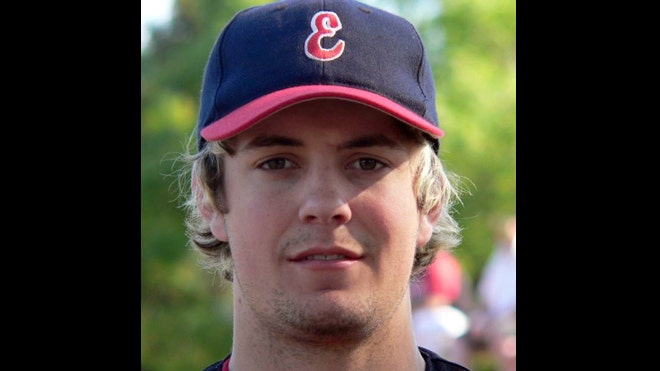
Christopher Lane, shown in an undated picture above, was attending school in Oklahoma on a baseball scholarship when he was gunned down for the "fun of it."

Three teenage suspects accused of gunning down an Australian student in Oklahoma for the "fun of it," according to police, are expected to face first-degree murder charges in court today.

Christopher Lane, 22, who was visiting the U.S. on a baseball scholarship at East Central University, was jogging along a road in Duncan, Okla., after visiting his girlfriend on Friday when he was shot in the back, allegedly by the teens.

A woman tried CPR and paramedics arrived on scene, but Lane was pronounced dead an hour later.

"He went by a residence where these three boys were, they picked him as a target, they went out and got in a vehicle and followed him," Duncan Police Department Chief Danny Ford told the Australian Broadcasting Corporation, according to AFP.

Yes, they picked him out not to threaten or to fight him - but to execute him!
"They came up from behind and basically shot him in the back with a small caliber weapon, then sped away," Ford added.

Richard Rhodes, a builder who discovered Lane lying face down, said he was targeted with a .22 caliber revolver.

Police tracked the teens down using surveillance video from a business that is near the shooting scene, KOCO reports.

If the three teenagers arrested are charged with first-degree murder and convicted, they face a maximum sentence of life in prison.

The teens, ages 15, 16 and 17, can be tried as adults, but they can't face the death penalty since they are under the age of 18, a spokesperson for District Attorney Jason Hicks told the Sydney Morning Herald.

So they would face the "possibility" of life in prison, with computers, television, medical and dental services, food, clothing, and "conjugal visits," while Christopher Lee is still dead.

But really, why can't they be hanged for what they did? Or better yet, why can't they be simply taken out and shot in the same way that they shot an innocent man just out jogging?

I know real well that someone out there is going to write and say that studies show that the death penalty does not deter crime, and that it does not stop it from happening after a prisoner (inmate) has been released.

Since my first college degree was in the Administration of Justice (Criminal Justice), I'll give those folks the same argument that I did almost 30 years ago: it does stop murders from taking place if only by a factor of one.

Statistics show, that if released, a killer or rapist or pedophile is apt to act out his crime again after his release.

So by just removing that one person who did do the crime, we save a life that will most likely be taken by that killer.

The teens in this case have not been identified by police and remain in custody at Stephens County Jail in Duncan. They are expected to appear in court Tuesday afternoon.

My belief is that teens who do adult crimes should be treated as adults in every way.

For example, Trayvon Martin was 17 years old when he attacked George Zimmerman by breaking his nose than getting on top of him and tried to beat his head into a concrete sidewalk.

If Trayvon Martin was successful in killing George Zimmerman, and if someone would have actually gave a shit that Zimmerman was killed, shouldn't Martin have been tried for murder as an adult?

Police revealed Sunday that one of the teens confessed to the crime and said he did it for the "fun of it," KOCO reports.

"The boy who has talked to us said, 'We were bored and didn't have anything to do, so we decided to kill somebody,'" Ford told the Associated Press.

After the teens were arrested, Ford said the driver, who is 17, told police they were all at the scene of the slaying and that the 16-year-old suspect pulled the trigger.

On one of the alleged killer's Facebook pages, investigators found the message: "Bang. Two drops in two hours," Sky News reports.

Yes, there was another unnamed victim.

"They wanted to be Billy Bob Badasses," said Chief Ford. "I think they were on a killing spree. We would have had more bodies that night if we didn't get them."

Ford wouldn't say how many times Christopher Lane was shot. Autopsy results are pending.

Now, here comes the parents who can't believe that there son could do such an evil act.

The mother of the 16-year-old accused in the killing said her son and his two friends were part of a “wannabe gang,” but insisted that he is not a killer, KOCO reports.

It was being reported that the teens liked to emulate the "gangsta" lifestyle. 

The father of the 15-year-old also denied his son had a role in Lane’s death, but said the boy had run-ins with the law before, News.com.au reports.

You ever notice how, even with their own confessions in hand, parents still refuse to face the facts that their kid is a killer?

In fact, no one has ever asked Trayvon Martin's parents what they thought of their poor little boy (who looked so much like president Obama if he had a son) trying to smash George Zimmerman's head into the cement pavement?

SuspectsOklaShooting.jpg

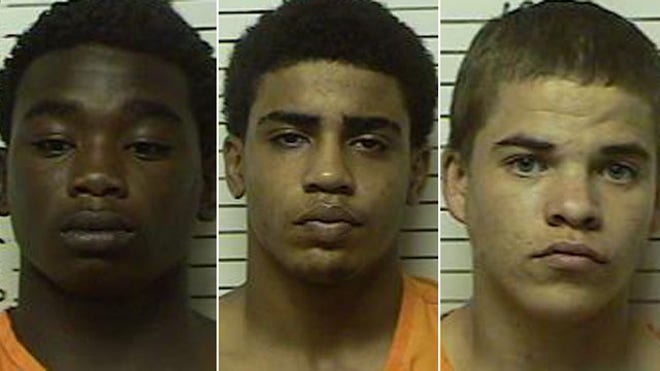
These are the "wannabe gangstas" who decided to carry out their Hate Crime and kill for fun.

And really, where is President Obama and Oprah Winfrey on this horrible act? Probably nowhere to be found.

In my opinion, racists like the president and Oprah simply don't put any importance on a young white man getting killed in an unprovoked "Hate Crime" by blacks who sought pleasure in the murder of an unarmed white guy.

No hoodie and Skettles here, no one except the killers would look like the president if he had a son, just a white guy out jogging pass a few racist killers.

The news report said that Christopher girlfriend, Sarah Harper, wrote a tribute on Facebook after he was killed.

"I love you so much babe," she said, according to Sky News. "From 2009 until forever you will always be mine and in a very special and protected place in my heart."

Christopher grew up in Oak Park in Melbourne, Australia. He was studying at East Central University (ECU), where he had won a scholarship to be the team's catcher, and had been back in the US for just three days after visiting his family in Australia, along with girlfriend Sarah Harper. The pair had been together for four years.

East Central University is setting up a fund so Lane’s parents, who are still in Australia, can come to Oklahoma.

"Chris was a well-liked young man here on campus. His teammates thought a lot of him. Seemed to be a bright, promising student," Dr. Jeff Williams, the athletic director at East Central University, told KOCO.

East Central University is in Ada, about 85 miles west of Duncan. Lane started 14 games at catcher last year and was entering his senior year.

The killing of Christopher Lane has rattled the quiet town of 24,000, where Ford said he couldn't recall the last time there was a murder.

"I don't think we average one [murder] a year," said Duncan chief of police Danny Ford. "Basically, we're a rural Oklahoma community."

Peter Lane, Christopher's dad, told the Sydney Morning Herald that his son was "a kid on the cusp of making his life."

"There's not going to be any good come out of this because it was just so senseless," Mr Lane said.

"He was an athlete going for a jog like he would do five or six days a week in terms of his training schedule," he said. "It's happened, it's wrong and we just try and deal with it the best we can."

My heart goes out to those close to Christopher. I can't imagine what they are going through, the loss, the senselessness of this.

According to the laws of the state of Oklahoma, the teenagers who did this can't be put to death.

But really, I want to know why not? Those teenagers are not human, they are worse than cold and completely numb - it made them happy. They killed for "fun". 

To me, they are worse than rabid dogs. At least a rabid dog has an excuse for doing what it does. They are not responsible for their sickness.

The animals who killed Christopher Lane saw enjoyment in killing him.

That alone should be reason enough to give them the death penalty. They knew better but did what they did for the "fun of it" - just for pleasure.


Story by Tom Correa

More Evidence of Global Warming Data Fixed?

A story on August 13, 2013, says because of distorted data, the Federal Government closed 600 weather stations.

This came amid criticism they're situated in such a way that they can only report "warming."

For example, a weather station in Hot Springs, Virginia, sits next to the wall of a steam power plant and is overgrown with weeds, yet NOAA still operates it. 

This is just one of many flawed sites, critics complain.

I've read where these "collection instruments" were placed next to extremely hot airport runways, in the heat of parking lots, next to factories, in congested areas, even along side busy urban freeways, all "to ensure" that the data they recieved shows an increase in heat.

To measure weather, volunteers take readings at different times of day, round to the nearest whole number, and mark up paper forms they mail in monthly.

Recently, data from hundreds of weather stations located around the U.S. appear to show the planet is getting warmer - but some are asking how that data is being taken?

Some critics say it's the government's books that are getting cooked -- thanks to temperature readings from sweltering parking lots, airports and other locations that distort the true state of the climate.

Now the NOAA, the National Oceanic and Atmospheric Administration, has closed some 600 out of nearly 9,000 weather stations over the past two years that it has deemed problematic or unnecessary, after taking note of the problems of using unreliable data.

Back in 2009, the Climatic Research Unit (CRU) email controversy (also known as "Climategate")began in November with the hacking of a server at the Climatic Research Unit (CRU) at the University of East Anglia (UEA) by an external attacker.

The disclosure of the email debunked the data, the data collection methods, and made public the fraud behind the whole UN Global Warming conspiracy meant to control both souvereign governments and free people.

This took place several weeks before the Copenhagen Summit on climate change, when an unknown individual or group breached CRU's server and copied thousands of emails and computer files to various locations on the Internet.


Global Warming critics, both lay people and from the scienticfic communty, deny the significance of human caused Global Warming.

They argued that the emails showed that Global Warming was a scientific conspiracy, in which Environmental Extremsts groups along with cohort scientists manipulated climate data to falsefy facts in an attempt to suppress critics.

And yes, don't kid yourself into thinking that there was not a whole lot of money atr stake if Global Warming was found to be a fraud, subsequently it was not surprise that the accusations were quickly rejected by the CRU - who said that the emails had been taken "out of context."


NOAA now says the closure of the 600 sites will help improve gathering of weather data, but critics like meterologist and blogger Anthony Watts say it is too little, too late.
"The question remains as to why they continue to use a polluted mix of well-sited and poorly-sited stations," Watts told FoxNews.com.

'They continue to use a polluted mix of well-sited and poorly-sited stations.'
- Anthony Watts

Watts has for years searched for weather stations that have flaws.

And he points to a still-open station at Yosemite park as an example of one with “heat sinks” – objects that store heat, and then release it at night.

Heat sinks can cause stations located in or near them to give off useless data - generally in the form of inflated temperatures not representative of the broader area.

“The heat sinks are a road, a building, and stacked metal pipe and beams surrounding the station,” he said.

After the heat sinks were added at Yosemite, temperature readings show a curious trend: minimum nighttime temperatures increased more than daytime temperatures.

Watts says that's because the concrete structures store heat that is released at night, and that such a trend backs up the idea that the "heat sinks" are having an effect.

But the government agency that compiles the temperature data says that such concerns are unfounded because of statistical methods used to adjust the data.

"There is no doubt that NOAA's temperature record is scientifically sound and reliable," NOAA spokesman Scott Smullen told FoxNews.com.

"To ensure accuracy of the record, scientists use peer-reviewed methods to account for all potential inaccuracies in the temperature readings such as changes in station location, instrumentation and replacement and urban heat effects."

Smullen added that the recent station closures, which were made after "an extensive six-month review by all National Weather Service forecast offices," make the system even better.

He said the agency considered several factors in shuttering stations, including whether their data was redundant, whether urban growth had rendered data invalid and if sites were transmitting reliable data.

But Watts says that the closures are something of a vindication of a years-long project to identify stations with problems.

Some of the first official notice of Watts’ findings were in the leaked “Climate-gate” emails from 2009, in which the director of the National Climatic Data Center at the NOAA appeared to take Watts’ findings seriously.

“He has a website of 40 of the USHCN [weather] stations showing less than ideal exposure. He claims he can show urban biases and exposure biases. We are writing a response for our Public Affairs. Not sure how it will play out,” Thomas Karl, the director, wrote in an internal email.

Then the Government Accountability Office -- the government agency which issues reports evaluating other agencies -- looked into the issue of inappropriately-sited stations, interviewing Watts twice.

In an August 2011 report titled “NOAA Can Improve Management of the U.S. Historical Climatology Network” the GAO concluded that “NOAA has not developed an agencywide policy… whether stations that do not adhere to siting standards should remain open… or should be moved or closed.”

NOAA spokesman Scott Smullen said that the NOAA’s recent review and closure of stations over the last two years is far more extensive than the investigation Watts conducted.

“While some of the 600 sites we targeted for closure may overlap with some sites Mr. Watts has questioned, we understand that his study looked only at siting criteria at a 1,200-site subset of our overall network, while we reviewed the entire network, and siting criteria was just one factor we considered.”

So how serious is the problem of poorly-sited stations for the overall historical climate record? And does it have implications about the extent of manmade global warming?

Watts says it does, and that if one looks only at pristine stations, they show a temperature increase of 1.1° Fahrenheit over the years 1979 to 2008. That is noticeably lower than the government estimate of 1.7° Fahrenheit, which includes readings from all stations, including those with potential problems, which it tries to adjust for statistically.

But many scientists concerned about global warming say that the statistical adjustments work, and they point out that many other measurements of temperature match closely with NOAA’s historical data.

“Watts' analysis is an outlier… Analyses by several groups using global land temps, ocean temps, and satellite-inferred temps (no thermometers there!) show very similar warming rates [to the NOAA data],” Scott Mandia, a professor of physical sciences at SUNY Suffolk, said.

Watts says he doesn’t dispute the satellite data.

“I don’t dispute the satellite measurements, but they are measuring temperature of the atmosphere above the Earth, and that includes all cities and populated areas as well as rural open space…

My premise is this: if you want to see the effect of CO2 on warming, you need to look in areas that have not been affected by urbanization to find the true signal.”

In other words, Watts says the data show that global warming is due relatively more to increased urbanization than to greenhouse gases. Such a finding would be relevant for whether government should further restrict greenhouse gasses.

“Questions should then be asked about… decisions all the way up the food chain,” Watts said.


Monday, August 19, 2013

California lawmaker pulls son from class over transgender law

A Republican state lawmaker says a new California law allowing transgender students to choose which restroom and locker room they use is part of the reason at least one of his sons will not return to his local public school this fall.

Assemblyman Tim Donnelly, who lives in the Southern California mountain community of Twin Peaks, described his family's decision in a column published on WND (World Net Daily).

He wrote that under the bill from Ultra-liberal Assemblyman Tom Ammiano, Democrat from San Francisco, the privacy rights of California students "will be replaced by the right to be ogled" and will encourage inappropriate behavior among hormone-driven teenagers.

"While trying to address a concern of less than 2 percent of the population, California is now forcibly violating the rights of the other 98 percent," Donnelly wrote.

Gov. Jerry Brown signed the bill into law Monday, making California the first state to put such transgender/gay preferences into law.

Donnelly told The Associated Press on Friday that his 13- and 16-year-old sons, who attend Rim of the World Unified School District in the San Bernardino Mountains, were "horrified" to learn they might have to share a restroom with female students.

He is pulling one son out of middle school, while another son is uncertain if he will return to his public high school.

The decision is one that his family already had been discussing before the bill was approved.

"If it doesn't change his school experience, he may still stay," Donnelly said of his high-school student. "We don't know yet how this policy is going to affect our town."

The law, which will take effect January 1st of 2014, gives students the right "to participate in sex-segregated programs, activities and facilities" based on the gender which they identify on any particular day.

As of right now only in Communist Queer California can a child who is in their forming years and unable to completely reason what is taking place - can oppose to their birth gender if they want to.

Those programs also include sports teams.

The resaon is to reduce bullying? Discrimination?

Really, you upset the whole applecart by changing how every student has to go to school because 1% of the 6.4 million students faces bullying and possible discrimination because they are queer (as in strange)?

Fact is that allowing students of one gender to use facilities intended for the other could invade the other students' privacy - and bring about serious problems for girls and boys who don't want to change in a lockerroom or use the bathroom when the opposite sex is present.

Donnelly, who is exploring a bid for governor next year, said he is hearing concerns from a growing number of parents across the state.

Some of those parents have told him they also plan to remove their students from public school, although he said the parents he has spoken with have declined to speak publicly about their decision.

Donnelly's comments Friday came as two conservative groups opposed to the law, the Sacramento-based Pacific Justice Institute and Capitol Resource Institute, filed language for a ballot referendum with the state attorney general's office seeking to repeal AB1266.

The justice institute also is distributing a form that parents can send to school districts, stating that their child's rights include the right to privacy from students of the opposite gender in situations such as changing clothes.

Brad Dacus, the institute's president, said the organization has drawn significant interest from parents who are upset by the new law.

He said the form "puts the school district on notice that students aren't surrendering their rights to privacy."

One reader sent me this cartoon, saying they think this is what will take place in our schools now that Governor Brown has lifted the protections that were in place.

I agree.

California transgender children