Monday, September 11, 2017

Wisconsin Native Americans Ate Their Enemies?


Dear Friends,

I'm sure it's obvious that I love history. More specifically I love American History. I love reading about cowboys, cattle drives, and settlers coming West. I love researching outlaws and lawmen, gold strikes, silver strikes, cattle towns, boom towns, wagon trains, and learning more about ships making the journey around the horn. I love reading about the Civil War, slavery, and I love researching Indentured Servants since my grandfather was just that. I love researching Native American tribes, especially about the way they lived pre-European contact .

I love visiting historic sites. I love visiting Civil War battlefields, ghost towns, old towns, and hardly there towns. I love whaling ships, clipper ships, and old steamboats. I love old graveyards, old gravestones out in some pasture in the middle of nowhere or in some forgotten cemetery, inscriptions about loved ones long forgotten, and I love the places that only locals know about.

I loved seeing the wagon ruts of the Oregon Trail that are still visible near a rest stop in Idaho.I loved walking on the boardwalks of Virginia City, Nevada, and touching the Red Dog Saloon doors in Juneau, Alaska. I love knowing that I'm visiting the same places where others lived and worked back when America was young and not so full of stifling rules.

Yes indeed, I love stopping at places where I've only read about, and places that I didn't know existed. I love confirming stories about the history of the Old West, but also about other eras in our history. And yes, I love being shocked by what I didn't know. Or more honestly, being surprised at what I should have been taught in school but wasn't. I love learning how truly full of shit Hollywood truly is, and wonder why can't they get it right since the real story is right there in front of them?

Yes, I'm the guy that loves reading road markers. I'm that guy who sees a sign that says to this or that point of interest and takes it. In fact, I was going through some of my old notes from my travels and found something that may interest you.

It has to do with a historic site that I found just outside of Madison, Wisconsin, if I remember right. That place is the Aztalan State Park. It is about 172 acres and is the site of an ancient Native American Indian village. An ancient village that existed before Europeans ever stepped foot on the North American continent.   

Back in 1836, an American settler came across a number of earthen mounds on the west bank of the Crawfish River. The mounds are part of what was the actual village. The village is said to have had anywhere from 500 to a thousand or more Native Americans of the Mississippian culture there. The village is believe to have flourished from around the year 900 AD to about 1300 when they just disappeared. 

Yes, their disappearance is just one of a number of mysteries related to that site. As for the people who vanished before any contact with Europeans, no one knows why they vanished suddenly. While one mystery has to do with the question as to why it's original inhabitants suddenly disappeared, another has to do with the stockade walls that they built to keep out other tribes? Was it breached somehow by enemy Native American tribes? Was it finally breached and were they slaughtered?
Of course if that were the case, then why hasn't the bones of the original inhabitants been found there?

Another mystery is why build the mounds? We do know that the people who lived there built those earthen mounds, which resemble the work of the Aztecs -- hence the name given to that area. Over time, since no one was interested in maintaining the mounds or the remnants of the stockade walls that surrounded the area, sadly it was plowed over for farming. In the process of being plowed over, a number of the mounds were actually leveled. Today, two of the three large ceremonial mounds are still intact. 

It is said that the first really formal archaeological excavation of Aztalan was in 1919. That excavation established the actual perimeter of the stockade and that it had watch towers. It was then that they also found evidence their homes, along with pottery pieces, tools, and even weapons. 

Aztalan 1850 Map
Researchers also found fire pits and what is believed to be piles of refuse. In those areas researchers found butchered and burned human bones, including the heads of men, women, and children. They ascertained that people who inhabited that area had actually eaten people.

But actually, it is said that soon after its discovery in 1836, it was already determined back then that the mounds were used for religious ceremonies which included human sacrifice. And that leads us to the final mystery of why they ate their enemies?

Those human sacrifices are said to have been part of the cannibalism of that tribe. But since food is said to have been abundant there, why resort to cannibalism? Why eat your enemies? 

Historian David Scheimann wrote, "Of all the North American Indian tribes, the seventeenth-century Iroquois are the most renowned for their cruelty towards other human beings. Scholars know that they ruthlessly tortured war prisoners and that they were cannibals; in the Algonquin tongue the word Mohawk actually means 'flesh-eater.' There is even a story that the Indians in neighboring Iroquois territory would flee their homes upon sight of just a small band of Mohawks. Ironically, the Iroquois were not alone in these practices. There is ample evidence that most, if not all, of the Indians of northeastern America engaged in cannibalism and torture -- there is documentation of the Huron, Neutral, and Algonquin tribes each exhibiting the same behavior."

Robert Birmingham, a professor of anthropology at University of Wisconsin in Waukesha, wrote a book entitled "Aztalan: Mysteries of an Ancient Indian Town", published in 2006.

He is quoted as saying, "Aztalan was the northern outpost of a great civilization comparable to other great early civilizations in the world. We call them the Mississippians; they rose after AD 1000 and had, at its center, the first city in what is now the United States – that’s Cahokia, in present-day Illinois. It was a very large city and had a society that was very complex. It was similar to Mayan cities in Mexico. They built large earthen mounds as platforms for important buildings. The major mound at Cahokia, where the ruler probably lived, is 100 feet high and greater in volume than the Great Pyramid of Egypt, though built of earth."

Birmingham said those there were a farming society. The Aztalan village is said to have lasted anywhere from 100 to 150 years. It is said that around the year 1200, the Mississippian civilization eventually collapsed in the Midwest for unknown reasons.

War with other tribes is thought to be a factor in their disappearance. Birmingham says, "The Mississippian culture was aggressive and expanding. Aztalan is one of most heavily fortified sites in the archaeological record of Eastern North America."

Since we know human remains were found at the site in 1919, what are Birmingham's thoughts about their cannibalism and if it was all about "ritual cannibalism"? Well Birmingham says those remains "Have been analyzed and don’t fit the pattern of cannibalism, at least for food." 

So I have to wonder what's it all about if not for food? Why eat your enemies if there was available sources of food and the inhabitants were not starving? Why was that a Native American trait of so many tribes?

Birmingham explained that eating others, particularly your enemies, is an ancient consequence of warfare that is certainly not restricted to Native American Indians. He said, "The taking of trophy heads, cutting up the bones of your enemies and eating them ritually -- taking the power of your enemies -- is well-documented in many cultures. In Wisconsin, the Ho-Chunks themselves recite a story in which they greeted some Illinois people who were potential enemies by killing them, putting them in a pot, then boiling and eating them. It was not for food, but to show great disdain."

He thinks that the Mississippians at Aztalan co-existed fine with some Woodland tribes, but others may have been seen as trespassing. 

While that's the reason for the walls and for the wars, I can't help but wonder if the idea of eating one's enemy to show disdain is too easy an answer and there's more to it. My skepticism comes from the fact that while I see torturing an enemy as an act of vengeance, I've read where eating of one's enemy was actually a religious ritual of many Native American tribes. 

So all in all, the tribes who practiced ritual cannibalism did not so for food. Instead it was more about their belief in the supernatural powers held within the souls of their enemies. A power that they wanted to harness by eating their enemies. Imagine that.    

Tom Correa


Sunday, September 10, 2017

How Many Slaves Landed in the U.S.?

Slave Ship
The following comes from an article entitled How Many Slaves Landed in the U.S.?

Amazing Fact About the Negro No. 1: How many Africans were taken to the United States during the entire history of the slave trade?

Perhaps you, like me, were raised essentially to think of the slave experience primarily in terms of our black ancestors here in the United States. In other words, slavery was primarily about us, right, from Crispus Attucks and Phillis Wheatley, Benjamin Banneker and Richard Allen, all the way to Harriet Tubman, Sojourner Truth and Frederick Douglass. Think of this as an instance of what we might think of as African-American exceptionalism. (In other words, if it's in "the black Experience," it's got to be about black Americans.) Well, think again.

The most comprehensive analysis of shipping records over the course of the slave trade is the Trans-Atlantic Slave Trade Database, edited by professors David Eltis and David Richardson. (While the editors are careful to say that all of their figures are estimates, I believe that they are the best estimates that we have, the proverbial "gold standard" in the field of the study of the slave trade.)

Between 1525 and 1866, in the entire history of the slave trade to the New World, according to the Trans-Atlantic Slave Trade Database, 12.5 million Africans were shipped to the New World. 10.7 million survived the dreaded Middle Passage, disembarking in North America, the Caribbean and South America.

And how many of these 10.7 million Africans were shipped directly to North America? Only about 388,000. That's right: a tiny percentage.

In fact, the overwhelming percentage of the African slaves were shipped directly to the Caribbean and South America; Brazil received 4.86 million Africans alone! Some scholars estimate that another 60,000 to 70,000 Africans ended up in the United States after touching down in the Caribbean first, so that would bring the total to approximately 450,000 Africans who arrived in the United States over the course of the slave trade.

Incredibly, most of the 42 million members of the African-American community descend from this tiny group of less than half a million Africans. And I, for one, find this amazing.

By the way, how did historian Joel A. Rogers — writer of the 1934 book 100 Amazing Facts About the Negro With Complete Proof, and to whom this series is an homage—do on this question? Well, incredibly, in his "Amazing Fact #30," Rogers says, "About 12,000,000 Negroes were brought to the New World!" Not even W.E.B. Du Bois got this close to the most accurate count of the number of Africans shipped across the Atlantic in the slave trade.

-- end of article written by Henry Louis Gates, Jr.

The above article was written for PBS. It was originally posted on The Root, a website created by Professor Gates and others. If Gates name sounds familiar, it should. In 2009, after a problem with the police at his home, the local police detained Gates.

President Obama called the police having to detain Gates, "a stupid act." The incident resulted in what the media called a "Beer Summit" between Gates, the responding police officer, and President Obama. Professor Gates is a personal friend of former president Obama.

While Gates's numbers are correct, there are a few errors regarding dates of what took place. One huge error regarding this article is its title. How Many Slaves Landed in the U.S.?

From 1655 to 1783, slaves were not brought to the United States. Fact is, during that time period, the United States did not exist. The United States only became a sovereign nation when we officially won our independence from England in 1783 with the Treaty of Paris. So in reality, slaves were legally transported to the United States for only a 25 year period. That was from 1783, when we separated from Great Britain, to 1808 when U.S. law made it illegal to import slaves into the United States.

A second error is that slavery officially ended in the United States in 1865 and not 1866. A third error is his reporting that the entire era of the African slave trade took place from 1525 and 1866. We need to make a distinction between the lawful importation of slaves versus the illegal importation of slaves from Africa. And of course, when did it really start.

The African slave trade started with African chiefs selling their own people to whites in 1516. But it should be noted that the first slave ship from Africa did not arrive in North American continent until 1655. And as for the legal importation of slaves to North America, that took place from 1655 to 1808. It was illegal to import slaves to the United States from 1808 to 1865, just as it is today.

Of the 388,000 slaves that were landed in North America between 1655 and 1865, there were 93,185 that were brought to the United States after we declared our independence from England. Those 93,185 were shipped here from 1783 to 1865.

Breaking it down further, we can see that during the 25 years from 1783 to 1808 when President Thomas Jefferson banned the import of slaves to the United States, there were 45,846 slaves brought to the United States legally. From 1808 to 1865 when the slave trade was illegal in the U.S., there were 47,339 slaves smuggled into the United States in violation of Federal law.

One other point, of the 10.7 million slaves who actually survived being shipped west across the Atlantic Ocean, only about 388,000 were off-loaded in North America. Yes, that's less than 5% of the original 12 million slaves brought from Africa to the Americas. As Gates stated in his article, "Only about 388,000. That's right: a tiny percentage." 

These numbers are not mine. I didn't pulled them out of thin air. These numbers come from Professor Gates's source, The Trans-Atlantic Slave Trade Database.

Basic math tells us that the remaining 10.3 million of those shipped west across the Atlantic Ocean, the 95% rest that didn't land in North America, were actually off-loaded in the Caribbean and South America. This proves that the great majority of African slaves were not brought to the United States of America, or the North American continent. In reality, most all were shipped to South America to sugar colonies in the Caribbean and Brazil.

What may surprised many is that slaves were in huge demand in South America and the Caribbean. In fact, much of the slave trade in the United States had to do with American slavers buying and selling slaves to ship out of the United States -- destined for Brazil and other Latin America countries.
Tom Correa


Wednesday, September 6, 2017

Liberals Have Zero Respect For Others

Dear Friends,

I was asked to pull my last post from a group that I belong to on Facebook because it's discussion was pulled off topic.

My last article was about child slave labor in the North during the Civil War. The point of my article had completely gone over the heads of some Liberals who branded it a "racist post".

The point is regarding child slave labor during the Civil War in the North. It is about the hypocrisy of those in the North who were against slavery in the South, but were OK with it taking place in the factories and the mines in the North.

Their hypocrisy is in regards to what offended them. It was selective at best. While they were rightfully offended by blacks in chains, they were hypocrites in that they should not have turned a blind eye to the child slave labor practices that were in fact taking place around them in the North at the same time.

Those labor practices, while no longer applied to blacks, were certainly applied to children until it stopped in the late 1930s. And the only reason it stopped is that adults needed jobs. Adults saw children as taking jobs away from adults during the Great Depression, and that's when it stopped.

So how is it a racist post? Well one Liberal wrote to me and put it this way, it "detracts from the suffering of blacks". Imagine just how dumb you have to be to say such a thing. Talking about child slave labor in the North, detracts from the suffering of blacks in the South? Is that dumb or what!  

Of course, from a Facebook discussion and the comments that I've recieved, it's very apparent that the name callers and the holier-than-thous on the Left refuse to allow anyone else to have an opinion of any sort. Especially an opinion that is polar opposite to their own.   

An opinion, the dictionary defines as "a view or judgment formed about something, not necessarily based on fact or knowledge." Opinion is synonymous with belief, judgment, thoughts, way of thinking, mind, point of view, viewpoint, outlook, attitude, stance, position, perspective, persuasion, standpoint.

Instead of respecting the opinions of others, Liberals always resort to name calling and threats instead of discussion. I'm not talking about Republicans or Democrats who respect each other. I'm talking about Liberals who hate for the sake of hating.

When Obama was in office, I wrote about his inept job performance, his expensive vacations, the over-regulation, the wasteful spending, the divisiveness of President Obama. And yes, I was called a racist. One person actually wrote to tell me that I can't criticize him because he is black. Another jerk actually said that it's OK to criticize a white president, but not Obama because he's black. Talk about racist.

When I wrote about my favorite quote from Rev. Martin Luther King Jr, when he said, "I have a dream that my four little children will one day live in a nation where they will not be judged by the color of their skin, but by the content of their character," I was called a racist because I said that I judged Obama by the content of his character and not the color of his skin.

Friends, I really believe that I could have written about how I like white peaches and be called a racist. No, that wouldn't have surprised me.

When I talked about the statue of Robert E. Lee and how 200 Confederate troops protected the town of Charlottesville from being burned to the ground by 1,600 Union troops under the command of General George Armstrong Custer, I was called a racist. I said that I really believe that we don't know the exact motivations of those who erected those statues after the Civil War. And because I said that, I was called a racist. I said that I believed some of those statues were put up to salute those defenders of towns and cities in the South during the Civil War. Yes, I was called a racist. 

Friends, the term racist is losing it's meaning. And no, I have no idea what they call a person who is really and truly a racist. When everything can be labeled racist, the term racist means squat.  

As for the Liberals who attack my blog, both on Facebook and here in the comment section? They don't like my research, they don't like my sources, then they resort to personal attacks after I've given them my sources or the links to some of my research material.

Of course, they don't like the fact that I have friends who work as Wikipedia contributors, friends who are historians of merit, friends who have spent their lives researching history. They don't like that I have friends who know guns even better than I do, friends who are ranchers who I've helped over the years, friends who raise and breed horses.  

They don't understand that I pick the brains of my friends for information if I need to. They do help me with finding information whether it's about cattle or horses or history.

It amazes me that Liberals don't understand that people can talk about all sorts of things and actually learn from each other. They refuse to understand that during the course of a conversation, that people can have different views than their own and actually learn from each other. Yes, I repeat myself because I'm amazed that Liberals are so narrow minded and shallow, so filled with hate for others who don't think like them.

If they believe that the cause of the Civil War was ONLY slavery, then fine. If they believe everything that Hollywood and Left has to say about how things were in the Old West, that's fine as well. So why not take their narrow minded points of view somewhere else! Why bother coming here just to put in their political spin and pick arguments is beyond me.

So now, I want to known why do they stop here? Why bother reading what I have to offer if it angers them so much? Why bother reading and writing comments filled with swearing and hate? Comments that I will not allow posted on my blog. 

Why not just start their own blogs? Why not open another Liberal blog where they can put out more hate and politically correct crap? Why not cater to fellow hate mongers on the Left?

My advice is simple, if you want to make your voice heard, check out the New York Times Facebook page. Go to some other venue with a giant readership. Go somewhere where your hate and shit disturbing is appreciated. 

I have a small blog that I use to talk about things that interest me. Things that I hope others find interesting. And since I've visited a great number of different places around the country, I want to share the true stories about the history that I find amazing. Yes, things that Liberals refuse to even consider in the slightest. 

They call themselves "progressives," but that's a joke! They are stuck looking at things in their politically correct hate filled minds. They refuse to expand their horizons and see things with fresh eyes. They have a total distaste for thinking for themselves. They accept the standard line even if it is wrong. And yes, from my experience with them, especially lately, I find they refuse to allow any other way of looking at things to enter their minds. But worse, they want us to shut up and not speak our minds.

And while this is a rant, I may as well tell you what really bothers me. It is their hate. They venomously hate others who try to look at things differently then the way they do. Because I'm not into their hate, I ask only this, if someone doesn't like what I post, instead of coming here with a political agenda, just go away. 

I would rather have readers that are open to thinking about things that they may not have considered, right or wrong, off base or not. Readers who are not tied to political correctness. Readers who want to explore history, talk about things that some people want covered up, maybe even learn something that wasn't known before. As the saying goes, the possibilities are endless. 

For the Liberals who sends me hate mail and messages about how screwed up I am, for you Democrats who don't want me to write about the Civil War for fear of "stirring the pot," go somewhere else. 

There are all sorts of Liberal blogs out there that preach nothing but hate and political correctness. If you are a Liberal, a person who hates others who do not think the way you do, you will be more at home there. Those blogs are filled with people who also can't think for themselves and simply drink the Kool-Aid. 

Tom Correa


Tuesday, September 5, 2017

The Civil War: Did The North Use Child Slave Labor?


Since I've now been forced to be blunt about the point of this article, I can tell you now that it is about child slave labor in the North during the Civil War. Because of discussions where people are trying to turn this article into something that it is not, allow me to also say that this piece is about the hypocrisy of those in the North who were against slavery in the South but were not bothered by the child slave labor going on around them.

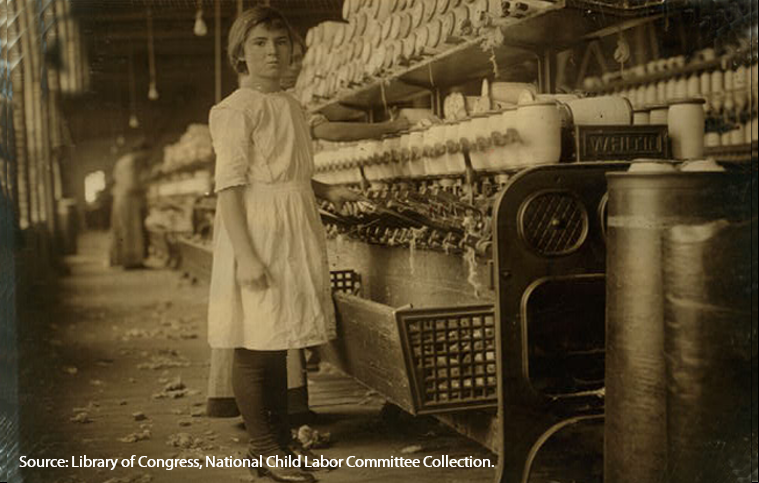
So now, let's talk about the child slave labor that took place in vast numbers in the North during the Civil War. We've all heard of the "Industrial Might" of the Northern states during the Civil War compared to the South's agricultural base. So now let's talk about the child slave labor behind that "Industrial Might" in the North. Yes, let's talk about a subject that no one seems to talk about. Let's talk about the North's use of slave labor in the form of forced child labor. Let's talk about the forced child labor that accounted for 45% to 55% of all of the labor used in the North during the Civil War.

No one talks about who worked in the factories in the North. No one talks about the huge percentage of child labor that took place in those factories. No one talks about how the North used child slave labor before, during, and after the Civil War. No one talks about how the emancipation of children did not come about until decades after slaves in the South experienced emancipation.

Let's point to the fact that young children routinely worked in the United States legally for many years before and after we became a nation. Some have indicated that black slave labor in the South does not compare to child slave labor in the North because the children were not property as the blacks were. Though that was the reality of black slaves, when looking at how children in the factories and mines were treated, one has to ask if the children were treated the same or worse than property?

Children were enslaved, they were separated from their families, they were certainly exposed to serious hazards and health risks, and they were left to fend for themselves. Child labor abuses were plentiful during the Industrial Revolution from 1820 to 1870. But it did not end in 1870. It continued for another 60 years.

Industrialization attracted workers and their families. Many relocated from farms and rural areas to cities to do factory work. In factories and mines, children were actually preferred by businesses because owners saw children as more manageable, a lot cheaper, and unwilling to strike.

Our children worked in mines, manufacturing plants, factories of all sorts, textile plants, and agriculture in various ways, including harvests and canneries all over the North. And yes, they were newsboys, peddlers, messengers, and bootblacks. The lucky ones swept the trash and filth from city streets, stood for hours on street corners pushing newspapers, and delivered messages for pennies. Others worked in the mines and coughed up coal dust all through a 10 to 12-hour shift in the heat of the dark. Others sweat to the point of passing out while tending factory furnaces. 

Overall, child laborers were the sons and daughters of poor parents, and of course, recent immigrants depended on their children’s measly wages to survive. They were the children of industry and large cities in the North during the Civil War. What black slaves were to the South, child slaves were to the North. 

The fact is forms of child labor, including indentured servitude and child slavery, have existed throughout our history. It actually predates our independence. Some were lucky and were treated easier than others. Others were treated as property.

Fact is, we can trace child slave labor back to before the United States was founded in 1776. It's true. There was child slave labor in the 18th century. From farms to factories, young children were used as laborers. 

As British colonies, long before our independence, English laws allowed children to work in everything from farms to manufacturing. By 1833, when the British outlawed black slaves, child slavery in the form of indentured servants and forced child labor was commonplace in England. 

Of course, American colonial laws modeled their laws after British laws. So yes, similarly American laws forced many children into workhouses, factories, and mines. In fact, those laws allowed for orphan boys to be placed into apprenticeships in trades. Orphan girls were sent into homes to do domestic work, work in laundries, and of course, work in sweatshops.

After we broke away from England, American industry kept up the practice and sought out children to use in all sorts of manufacturing facilities throughout the former colonies. Child labor served Alexander Hamilton's vision of America. He saw child labor as providing increased labor to support industry. 

According to his vision, when Alexander Hamilton was Secretary of the Treasury, he actually stated in a 1791 report on manufacturing that "children who would otherwise be idle could become a source of cheap labor." 

Around the same time, a national newsweekly printed their opinion stating that "factory work was not for able-bodied men, but rather better done by little girls from six to twelve years old."
  
Besides advertisements seeking children from the ages of 8 to 12 to work in a cotton mill in the North, it's said that by 1820 children made up more than 40 percent of the mill employees in at least three New England states. So while it is said that the manufacturing industry that grew following the Civil War required children as young as 8 years old, we should recognize that forced child labor in factories, in retail stores, on the streets, on farms, in mines, and elsewhere, took place long before the Civil War.

This was so much the case that in 1842, a few Northern states began to limit a child’s workday. Massachusetts lowered a child’s workday from 14 hours to 10 hours, but most laws were not enforced. And Massachusetts was not the only state to use forced child labor, child slavery in the industrial North during the Civil War.


It is a fact that women and children dominated pre-Civil War manufacturing in the North. It is a fact that the number of children used in the North actually increased during the Civil War because of the need for everything from uniforms to shoes and belts, hats, and hardware. Yes, the beans, bullets, and bandages that keep an Army functioning.

So please make no mistake about it. While the South had black slavery that they considered property, the North had child slavery that they considered property. In the North, children replaced the need for adults as many Northern men were pressed into service in the Union Army.

And while the North was afraid of the influx of freed slaves fleeing the South, Northerners, in fact, re-enslaved many freed slave children just as they did the children of immigrants during the Civil War. It's true as the children of freed slaves in the North were treated the same as other children in that they worked 10, 12, or 14 hours a day and six days a week. And while those children were, in essence, re-enslaved through forced labor and apprenticeship agreements, they were bound to companies no differently than they were to their slave masters in the South.

In 1870, the first U.S. census report on child labor numbers accounted for 750,000 workers under the age of 13. These figures came mostly from the Northern states. These numbers did not include children who worked for their families or on farms.

For many years, not much changed in the North regarding the use of forced child labor. But after the Civil War, forced child labor abuses became a routine nationwide as more cities adopted the practice. And yes, the scams to get more children increased. For example, in New York City in the 1870s, there was a scam going around that had to do with Italians who secured employment for Italian immigrants. The scam was child slavery under the guise of apprenticeship.

The people responsible for that scam deceived Italian parents still living in Italy into willingly sending their children to America to begin an apprentice program. Once agreements were signed, then the children were shipped to America. At the docks, they met and were immediately forced to work in horrible conditions. And as was the case throughout the North for many years, if the children failed to comply, they were beaten and starved.

This was happening so much so that in 1873, just eight years after the Civil War, the New York Times stated, "The world has given up on stealing men from the African coast, only to kidnap children from Italy."

While forced child labor was pretty much restricted to the Union during the Civil War, it became more and more commonplace throughout the nation after the war. Southerners followed the example set by Northerners and filled the openings left by freed black slaves with women and children. And yes, forced child labor and apprenticeship agreements extended to businesses in the South after the war. 

It is said that freed slaves willingly exchanged the labor of their children for "training" provided by their former slave owners. So yes, after the Civil War, black freed slave parents forced their own children into re-enslavement. Imagine that.

Slavery comes in several different forms. Forced Marriage, Domestic Servitude, Indentured Servants, Forced Labor, Bonded Labor, Child Labor, and Sex Trafficking are all forms of slavery. As for "chattel slavery"? Chattel slavery is the "owning" of human beings as property. They are bought, sold, given, and inherited. Since slaves in this context have no personal freedom or recognized rights to decide the direction of their own lives, isn't that comparable to what they did to children until the 1930s? 

The child slave market was filled by hiring others to find them and detain them. In some cases, it was from orphanages. Other times it was from a destitute family. They were lied to, held prisoner, and even kidnapped. They were sold into bondage and stolen. They had no personal freedom or recognized rights, were beaten and starved, had bounties put on their heads if they escaped from where they were housed or worked, and were in some cases shackled to machinery and given a coffee can to urinate in. To me, that's slavery. That is certainly not the life of a free person.

As for child labor laws, in 1904, Federal child labor reform laws began to take shape. But that didn't stop employers from putting children to work. In fact, by 1911, it is said that more than Two Million American children under the age of 14 were working 12 to 14 hours a day for six days a week. 

And yes, well into the 1900s, children worked in unhealthful and hazardous conditions and always for what was known as slave wages. As for unhealthful and hazardous conditions, even into the 1900s, young girls continued to work in mills and garment factories. They faced the danger of losing fingers or even a foot while standing on top of machines to change bobbins. They risked being scalped alive if their hair got caught in the machinery.

As for the children younger than 10 who were forced to work in the coal mines, they were known as breaker boys. They were smothered and crushed by piles of coal. They fell down shafts. Breaker boys faced the threat of cave-ins, gas leaks, explosions, and other hazards that adult miners did. But let's be honest and talk about their slave wages. They made 10 times less than the adults they worked beside. 

While black emancipation came about in 1863, it wasn't until 1938 that Federal regulations of child labor were achieved in the Fair Labor Standards Act. And, while it did not emancipate children completely, it limited the minimum ages of employment and hours of work for children through Federal law. But, unfortunately, such laws were violated all the time.

The point of my article has gone completely over the heads of some folks. I've never condoned or tried to downplay the suffering of black slaves in the South. I have never ever tried to defend slavery of any sort, nor would I ever. I certainly would not defend slavery in the South. This article is not about slavery in the South. 

The point is regarding child slave labor during the Civil War in the North. It is about the hypocrisy of those in the North who were against slavery in the South but were okay with what was happening in the factories and the mines in the North.

Their hypocrisy is in regards to what offended them. It was selective at best. While they were rightfully offended by blacks in chains, they were hypocrites in that they should not have turned a blind eye to the child slave labor practices that were taking place around them in the North at the same time.

While no longer applied to blacks after emancipation, those labor practices were certainly applied to children until they stopped in the late 1930s. And the only reason it stopped was that adults needed jobs. Adults saw children as taking jobs away from adults during the Great Depression, and that's when it stopped.

Tom Correa


Friday, September 1, 2017

The Death Of Bud Philpot 1881


Dear Friends, 

Since a reader has written to ask about him, here's what I know about the murder of stage driver Bud Philpot. I do know that his given name was Eli P. Philpott and that he as born on June 6th, 1853, in Calistoga, California. 

He was not yet 28 years of age, just a young man, when on March 15th, 1881, while working as a stage driver, he was ambushed and murdered about a mile and a half from Contention City, Arizona. The exact location of the incline where the robbers are said to have jumped out of the bushed from both sides of the road to ambush Bud Philpot is about 500 feet south of a stagecoach station that was known as Drew's Station. 

He worked for Kinnear & Company. The day that he was killed, that stagecoach carried $26,000 in Wells Fargo silver bullion. It should also be noted that besides stage driver Bud Philpot being killed, a passenger by the name of Pete Roerig was murdered during that attempted robbery. 

On March 16th, 1881, The Tombstone Epitaph reported the following:

At about 11 o'clock last night, Marshal Williams received a telegram from Benson stating that the Kinnear & Company's coach, carrying Wells Fargo & Co.'s treasure, had been stopped near Contention and "Budd Philpott, the driver, killed and one passenger mortally wounded. Almost immediately afterward A.C. Cowan, Wells Fargo & Co.'s agent at Contention City, rode into this city, bringing a portion of the details of the affair. In a few minutes after his arrival, Williams, the Earp brothers, and several other brave, determined men were in the saddle, well-armed, en route to the scene of the murderous affray.

From telegrams received from Benson at the Epitaph office, the following particulars were gathered.

As the stage was going up a small incline about 200 yards this side of Drew's Station and about a mile the other side of Contention City, a man stepped into the road from the east side and called out "Hold!" At the same moment, a number of men--believed to have been eight--made their appearance, and a shot was fired from the same side of the road, instantly followed by another. One of these shots struck "Bud" Philpott, the driver, who fell heavily forward between the wheelers, carrying the reins with him. The horses immediately sprang into a dead run. Meanwhile, Bob Paul, Wells Fargo & Co.'s messenger, one of the bravest and coolest men who ever sat on a box seat, was ready with his gun and answered back shot for shot before the frightened horses had whirled the coach out of range.

It was fully a mile before the team could be brought to a stand when it was discovered that one of the shots had mortally wounded a passenger on the coach named Peter Roerig. As soon as the coach could be stopped, Paul secured the reins and drove rapidly to Benson, and immediately started back for the scene of the murder. At Benson a telegraph was sent to the Epitaph office, stating that Roering could not possibly live. There were eight passengers on the coach, and they all united in praise of Mr. Paul's bravery and presence of mind.

At Drews Station, the firing and rapid whirling by of the coach sent the men at the station to the scene of the tragedy, when they found poor "Bud" lying in the road, and by the bright moonlight saw the murderers fleeing rapidly from the place. A messenger was at once dispatched to inform agent Cowan of the circumstances, and within twenty minutes after the news arrived Mr. Cowan had dispatched nearly thirty well-armed volunteers after the scoundrels.

He then rode rapidly into Tombstone, when the party above mentioned started out to aid in the pursuit. This, with Mr. Paul's party, makes three bodies of determined men who are in a hot chase, and Mr. Cowan stated to an Epitaph reporter that it is almost impossible for the murderous gang to escape, as the pursuers are close at their heels and have moonlight in their favor. Should the road-agents be caught they will meet with the short shift which they deserve.

"Bud", the murdered driver, whose real name is Eli P. Philpott, was one of the most widely known stage-drivers on the Coast. For years he has borne a high reputation as a skillful handler of the "ribbons," won on the principal stage lines in California, and during a year's residence in Arizona, most of the later time in the employ of Kinnears (formerly Walker & Co.'s) line.

He will be sincerely mourned, not only by hosts of personal friends but by thousands of passengers who have ridden on the box seat with him and been captivated by his simple manners and frank, manly ways. It was a rare treat to "make the trip" with him, for his memory was rich in reminiscences of the "old stage days" in California, and when he so willed he could keep a companion's attention riveted by his quaint, droll conversation.

He has a wife and young family at Calistoga, California, who had the tenderest place in his big heart. And now there is another little home in the world which has been desolated and despoiled by the ruthless bullet. There is something inexpressibly sad in the sudden death of such outwardly rough, but inwardly brave, true-hearted men, and no better representation of this class could be found than the man whom the murderers last night sent unwarned to his last home. He was proud and fond of his team and the big new coach on which he met his death as if they were human, and the horses always seemed to know when "Bud" was at the other end of the lines.

-- end of Tombstone Epitaph article.


I've read where Bud Philpot was supposed to be the shotgun messenger when the attempted robbery took place. In reality, Bob Paul was supposed to have been the driver that day. It is speculated that at some point they changed positions for some unknown reason.

If we look at stage robberies during that time, most have one thing in common, they were usually robbed slowing for a curve or slowing to make an incline. This was no different. Since the type of coach that he was on would have been pulled by six or eight horses, and its average speed was between 4 and 12 miles per hour, and on an incline, it's even slower, his making a slight incline in the road allowed the masked bandits to pop out of nowhere and surprise the almost stop coach.

Bob Paul who had switched with Philpot is said to have immediately brought his shotgun to bear on one of the robbers, but another of the bandits shot first. His shot killed Bud Philpot. And in the process, the shot that killed Philpot startled the horses and they bolted. Peter Roerig, who was a passenger, was shot when one of the bandits fired at the stagecoach as it sped away. 

The Benson stage robbery attempt and the killing of Bud Philpot are said to be one of the major factors that led to the shootout in the lot near the OK Corral on October 26th, 1881 between the Earp and the Clanton factions. The reason is that there were those in the Clanton faction that tried to tie Doc Holliday in with that robbery. The Earp faction reportedly testified the Doc Holliday went back to Georgia to visit his family at the time. The only problem with that story is that no one can prove Holiday ever went back to Georgia after leaving there.

It should be noted that while one posse was headed by Deputy U.S. Marshal Virgil Earp, another posse was headed by County Sheriff Johnny Behan. Both failed to find the perpetrators. And interestingly enough, it is said that Morgan Earp later captured Luther King in connection with information regarding the attempted robbery. Suspects Jim Crane, Harry Head, and Billy Leonard were accused of the crime but were never found. As for Luther King, he is said to have somehow escaped jail and was never heard of again.

Bud Philpott was originally buried in Tombstone. But later he was removed and re-interred at the Calistoga Pioneer Cemetery in Napa County, California, just outside of Calistoga in what is known as the "Old Pioneer Cemetery." I cannot say for certain, but I believe Pete Roerig was buried in Tombstone's Boot Hill.

The picture above is the exact stagecoach that Bud Philpot was driving. Today it can be seen at the Sharlot Hall Museum in Prescott, Arizona.

Tom Correa


Thursday, August 24, 2017

Statues, Charlottesville, Virginia, & General Custer

Confederate General Robert E. Lee Statue In Charlottesville, Virginia
Dear Friends,

The news media is full of a whole lot of hate and discontent these days. It seems that they are fueling the anger and violence going around the country. The news media's constant barrage of cruel and bitter criticisms of President Trump on a daily basis, and their rabid like hunger for more unrest, seems to be unquenchable.

The ongoing assault on our historical markers, our memorials and statues dedicated to people and events in our history, especially Confederate statues, seems to be persistently promoted by the news media. Their cameras and the promise of getting on the news is what attracts protesters with bad intentions. Yes, no different than sharks and blood in the water.

In Charlottesville, Virginia, an assorted crowd gathered to protest the removal of statues of Confederate soldiers, Confederate memorials. One group was there to protest their removal. Another group was there to protest those protesting. Then the hate groups showed up. Most were not from Charlottesville. Many were from other states. It's true, we later found out that many if not most were brought there from out of the area. And yes, the counter protest hate group that showed up with clubs and dressed for war was said to have been paid $25 an hour.

One hate group there was waving Fascist Socialist flags of those we defeated in Nazi Germany.  The other carried Communist Socialist flags of the now defunct Communist state that the world knew as the Soviet Union. Both hate groups waved the flags of those we Americans defeated at one time or another.

Of course their were good people there, yes there were. They did not associate with either hate group. They had a different agenda. Their concern was to keep the memorials in place because in many cases those memorials represented the history of their families, their town, their resilience, their history of defending the South against what was seen as invaders from the North.

I can understand how people from there are upset that the monuments dedicated to their ancestors are now seen as vile when they are not. Some say that the monuments that they want pulled down represent oppression of Black Americans, that they represent those who fought to protect the institution of slavery. But what if they they are wrong and they don't? What if the memorials stand as tributes to soldiers who stopped pillage and destruction of their town?

For me, I wanted to know why Charlottesville, Virginia, became the battleground over the removal of Confederate memorials throughout the South. Frankly, the only thing that I have ever read about Charlottesville was that Union General George Armstrong Custer once retreated from there after an hour long skirmish. Fact is, there were no big Civil War battles in Charlottesville and it wasn't very important to the North militarily, that is other than as a diversion which led to the skirmish that I mentioned.

Fact is, it's said that the folks in Charlottesville provided some materials to the Confederacy but not much. The Charlottesville Manufacturing Company operated cotton and woolen mills that made Confederate uniforms. The factory produced uniforms designed especially for the county's home guard which was known as the Albemarle Light Horse Cavalry. Their jackets cost $2.75 and a pair of trousers cost $1.50 each. The factory was burned down by the occupying Union troops in 1865. It was rebuilt and reopened in 1867 as the Charlottesville Woolen Mills. It later became Albemarle County's largest industry for many years. 

A man by the name of Marcellus McKennie opened McKennie and Company on July 1st, 1861. He was in the business of manufacturing swords for the Confederacy. His firm put out four to five swords a week. No, that was not what anyone would call record breaking production by any stretch of the imagination. To give you an idea just how slow that was, about 30 miles away, manufacturer T. D. Driscoll in the town of of Howardsville was making 28 to 30 swords a week. And yes, that was during the same time period. 

Charlottesville did preform one very essential service to the Confederacy as it had a 500 bed hospital that was used by the military. Yes, both sides at one point or another. The Confederacy first and then the Union after they occupied that town. I'm guessing that they were glad that they didn't end up burning it to the ground as planned.

As for that hospital, it actually employed hundreds of residents from Charlottesville. Yes, white and freed slaves. It's also said that it had anywhere between 15 to 50 doctors to treat its more than 22,000 patients.

Here's another bit of trivia about Charlottesville. At that hospital, Dr. J. L. Cabell who was a professor of anatomy and surgery at the University of Virginia also managed the hospital. He oversaw, among others, Marcellus McKennie the sword maker who was also a surgeon and Dr. Orianna Moon. While Marcellus McKennie was a surgeon and sword manufacturer, he was also a Colonel in the 88th Virginia which were part of the town's defenders.

As for Dr. Moon, she was the hospital's superintendent of nurses. She was an Albemarle County native who was described as being anti-Slavery. She was a graduate of the Female Medical College in Philadelphia, Pennsylvania, and she was one of only 38 women who held medical degrees in the entire United States that year.

Most of the 1,100 patients who died at the hospital during the Civil War are buried in unmarked graves in a field adjacent to the University of Virginia cemetery. And yes, I'm sort of surprised that ANTIFA hasn't demanded that those graves-stones be removed just as they're demanding that other Confederate statues be removed.

Charlottesville General Hospital cared for soldiers wounded in battle and those sick from disease. What a great number of people probably don't realize is that diarrhea, typhoid, measles, dysentery, and pneumonia were far more common ailments, then the 40% of the patients that were there being treated for gunshot wounds. And yes, amputation was the most commonly performed medical procedures when it came to gunshot wounds of limbs.

As for those amputations, Charlottesville was known to provide many of the Southern states with artificial limbs. A firm named G. W. Wells and Brothers provided artificial limbs both during and after the war. In fact, that firm supplied Confederate General John Bell Hood with an artificial leg after he lost his right leg at the Battle of Chickamauga in 1863. An interesting bit of trivia is that General Hood was recovering in Richmond when he received his artificial limb from Charlottesville. Fact is he had already ordered one and it had been sent to him from France. It's said he preferred his Charlottesville limb over the French artificial leg.

Friends, artificial limbs was a big deal since many many soldiers needed them during and after that war. If I recall, artificial limbs accounted for 20 to 30% of some state's budgets after the war. And fact is, that was for many of the states involved in the fighting.

It's said that Charlottesville had a population of about 3,000 at the beginning of the Civil War. And though it only had 3,000 residents, it was the largest town in Albemarle County. Of course with the production of clothing and swords, there were a few factories there. And of course there were also banks and hotels. Amazing to me is the fact that the town had six newspapers at the time.

As for Charlottesville, I found it interesting that the population of Charlottesville was made of mostly of Black Americans during the Civil War. In fact, before and after the Civil War, a period from 1820 to 1890, Blacks were the majority of the town and in Albemarle County as a whole. And while there were slaves there, the town of Charlottesville also had a number of freed slaves who lived there. For some, I'm sure that fact may be a little hard to believe since many folks are led to believe that all Blacks in the South were either slaves or on the run going North.

But it's true, according to the United States Census of 1860, Albemarle County was home 13,916 Black slaves, 606 freed slaves, and 12,103 Whites. I couldn't find any statistics regarding how many White slaves were in that county at that time. But rest assured, Virginia did have White slaves. And most, well most were Irish.

If you find that interesting, here's another bit of history that might amaze you. Charlottesville was partially integrated in that it had a bi-racial First Baptist Church there even before the Civil War ever started. In fact, it is said that many Black members of that congregation also went on to establish The Charlottesville African Church in 1863. Yes, imagine that for a moment. In the middle of the Civil War, in the South, in 1863, Blacks, both slaves and freed slaves, decided that they wanted their own church and simply started one. No, you don't find that sort of information in history classes.

While some people today are angry at Confederate soldiers, they actually defended Charlottesville from being looted and razed to the ground. And while many today are angry at Confederate soldiers, fact is the most prominent citizens in that town were Democrat slaveholders.

Charlottesville's wealthy civilians were the slaveholders, and they wanted to maintain the culture and racial divide of the antebellum South. Among some of the ways that they tried to maintain the statuesque was to require certain standards of behavior by everyone, including slaves and freed slaves. For example, the wealthy civilian slave-owners demanded that their slaves did not smoke in public. Those who did would get ten lashes. That was for Black and White slaves. For freed slaves, there was a $10 fine for violating such rules as not smoking in public. As for slaves or freed slaves violating the town's curfew of being out past nine o'clock at night without written permission, there were lashings and fines as well.

People today probably don't know about how the law also cracked down on the mixing of the races back then. Yes, it went on back then. For example, there was a freed slave, a Black man by the name of Jackson. He lived on University of Virginia property. In 1863, he and his wife were evicted from the University grounds and told to stay away. Yes, all because he was married a White woman. Imagine that.

Of course hypocrisy being limitless, when the Confederacy decided to draft Blacks for service in the Confederate Army and for labor to assist with the war effort, it's said that civilian slave-owners would hide or move their slaves rather than allow them to serve or work for the Confederacy. But even though that was the case, from 1862 to 1865, about 1,000 slaves, mostly Black but also some White slaves were pressed into service to fight for the Confederacy. That's the number of slaves that Charlottesville and the rest of Albemarle County had to offer. 

So now you're wondering, how about Civil War battles there? Well, Charlottesville pretty much avoided seeing fighting during the Civil War. On April 17th, 1861, when the Virginia Convention in Richmond voted to secede, as with others in the South, most Charlottesville residents were all for supporting a Confederacy.

While most today think the Civil War was all about slavery, fact is it had more to do with unfair tariffs and economic pressures being imposed on the South by the Federal government in Washington, D.C.. The economic policies of the Federal government affected the agricultural base of the South in horrible ways while not affecting the industrial North. Southern states affected by the Federal government's unfair trade and economic policies had enough of what Washington D.C. was dishing out.

I believe that the Southern states saw being part of the United States as being a part of a compact or an alliance. As with most of the other states at the time, Virginia saw itself as it's own nation allied with other nation states. They looked at their alliance with the other states that made up the United States as being voluntary.

For a modern comparison, Virginia was no different than modern day Great Britain who just exited from it's alliance with the European Union. The Brits did so because the European Union capital in Brussels Belgium was imposing unfair rules and regulations on Great Britain. The British wanted their sovereignty back and withdrew from that compact agreement. In reality, Virginia believed that they had the right to do the very same thing back in 1861 for most of the same reasons. They felt that they volunteered to join the alliance. And frankly, I truly believe that they saw it as an alliance and not as a forfeiture of their own sovereignty.

In 1861, after the vote for secession, the 19th Virginia Volunteer Infantry Regiment was raised in Virginia for service in the Confederate States Army. It fought mostly as a part of the Army of Northern Virginia.

The 19th Virginia Infantry was organized at Manassas Junction in May of 1861, and it contained men recruited at Charlottesville and in the counties of Albemarle, Nelson, and Amherst. The 19th Virginia actually served with the Army of Northern Virginia all the way through to the Appomattox Campaign when General Lee surrendered in 1865.

The 19th Virginia Infantry Regiment was commanded by U.S Army West Point graduate Philip St. George Cocke as its Colonel. Composed of ten companies, the 19th Virginia included two companies from Charlottesville. Those units were Company A of the Monticello Guard and Company B of the Albemarle Rifles.

Charlottesville also put together an 11 man regimental band which was known previously as the Charlottesville Silver Cornet Band. That band played such great music that they were actually considered the best in the Army of Northern Virginia. Sadly, the band disbanded in 1862. So the tenure of the Charlottesville Regimental Band was actually pretty short. And no, I have no idea if they went back to calling themselves The Charlottesville Silver Cornet Band.

The 19th Virginia is said to have fought at the First Battle of Manassas, also known to the Union as the First Battle of Bull Run. They served at the Battle of Williamsburg, the Seven Days' Battles, the Battle of Antietam, and were part of Pickett's Charge on the third day of the Battle of Gettysburg where lost 60 percent the regiment were either killed or wounded.
Of those lost during the course of the Civil War, it is said that of the approximately 1,600 men who served in the 19th Virginia's ranks, only 30 were left to surrender at the Battles of Sailor's Creek on April 6, 1865. Yes, just three days before Confederate General Robert E. Lee surrendered to Union General Ulysses S. Grant.

As you can see, though the men of Charlottesville and the rest of Albemarle County fought to stave off what they saw as a Northern invasion, the fighting was mostly to the East and West of Charlottesvile. That is other than the raid led by Union General George A. Custer. But frankly, the town's Confederate defenders stopped Custer just north of the town in the spring of 1864.

Most Confederate Generals were no different than the vast majority of their troops in that they did not own slaves. Most Confederate soldiers in Virginia saw their duty as protecting their homeland from invading Northerners. As for Charlottesville's Confederate defenders, it was staffed by it's residents for the most part. They organized units including a provost guard, a home guard, and the 47th and the 88th Virginia militia regiments.

In 1864, Charlottesville did become a diversionary target of a Union Army operation which later became known as the Kilpatrick-Dahlgren Raid. The raid took place when Union General Hugh Judson Kilpatrick launched a cavalry attack on Richmond itself in 1864. This was an operation meant to liberate 15,000 Union prisoners of war being held in Richmond.

General Kilpatrick's plan required two diversionary attacks to distract Confederate defenders. Union Colonel Ulric Dahlgren, yes the one-legged veteran of Gettysburg, was to strike at Richmond from the south while Union General Custer was to hit Albemarle County. Custer's attack was meant to divert Confederate troops away from Generals Kilpatrick and Dahlgren.

At Madison County, General Custer and his command of 1,500 troops set out to destroy the Lynchburg Railroad Bridge over the Rivanna River. They were then to attack and burn any factories and supplies, and even the hospital, in Charlottesville which was 40 miles away.

On February 29th, 1864, General Custer crossed the Rivanna River near the Earlysville–Charlottesville road and launched his surprise attack. He attacked the camp of Confederate General J.E.B. Stuart's Horse Artillery Battalion which was made up of about 200 men. Many of them recently wounded and convalescing.

Because of the overwhelming odds, General Custer captured the Confederate camp and burned everything there. The Confederate artillerymen briefly retreated to a nearby hill to regroup when one of their own caissons is said to have accidentally exploded. The Confederates defenders were said to be in the process of making a counterattack when that caisson blew up.

So at that very moment, Union General Custer hears the explosive and thinks that Confederate artillery is opening up. So even though he has an overwhelming force, he retreats because he though that Confederate reinforcements had arrived. And friends, even though Custer's skirmish near Charlottesville only lasted less than an hour, local residents designated it the "Battle of Rio Hill."

Custer did destroy the Confederate camp, but he failed at his primary mission of diverting Confederate troops from Richmond. To salvage some good news from what turned out to be quite a fiasco, Union General George G. Meade, who was the Commander of the Army of the Potomac, declared the Charlottesville expedition a success.

By early 1865, fearing the onslaught, the looting, pillaging, the burning of the town, by Union troops, the town's fathers sought out the Union Army to sue for peace. Yes, because of their fears, town and university officials surrendered to Union Generals Philip H. Sheridan and General George Custer on March 3rd, 1865.

It is said that the Union initially occupied Charlottesville following General Robert E. Lee's surrender a month later. The town soon came under the jurisdiction of the Union Army as an occupation force which consisted of a regiment of Pennsylvania cavalry. The city fathers surrendering Charlottesville was to prevent the town from being razed, which thankfully it wasn't.

It should be noted, since we're talking about monuments and why they are there, that the residents of Charlottesville at the time were very thankful to their Condeferate defenders for saving their town. In fact, knowing that the Confederate defenders stopped the destruction of Charlottesville by Union forces, the women of Charlottesville, both white and freed slaves, presented a $500 silk flag to the Confederate General J.E.B. Stuart's Horse Artillery Battalion. That flag read, "From The Ladies of Charlottesville To Stuart's Horse Artillery, Our Brave Defenders."

Southern towns like Charlottesville which survived the war have a debt of gratitude to the Confederate Army for saving their towns and cities. Complete and total destruction of towns and cities were common place during the Civil War. As for what those women did, it was a wonderful gesture. It was truly a wonderful gesture from the great ladies of Charlottesvilles who knew how to say thank you to those who saved their town from ruin.

I find it interesting that the statue in Charlottesville that was the center of such violence and hatred not too many days ago, was one of Confederate General Robert E. Lee.  I find it interesting that the statue was unveiled in 1924 by General Lee’s three-year-old great-granddaughter, that it was actually made in the North, and that it was designed by a New York sculptor. I also find it amazing that people would attack General Robert E. Lee who really was the great defender of Virginia. 

Friends, it is really a shame that there are too many today who have no clue why we Americans have memorials dedicated to those who we owe a debt of gratitude, to those who fought overwhelming odds to protect other Americans, to those who have been dead ages and ages ago and should still be remembered for their great deeds. Their efforts and deeds should not be forgotten. 

And by all means, their lives and purpose should not be re-written by those who with a political agenda. Those who now attempt to re-write history for their own self-interest. Their lives and accomplishes should not be lessened by those of far lesser character in this modern world.

And yes, that's just the way I see it.

Tom Correa


Sunday, August 20, 2017

Wyoming Outfitter Being Investigated For Animal Cruelty


Dear Friends,

Let's talk about a horrible act of someone abusing a horse until he kills the animal in a "training session." This is as abusive as can take place because this appears to be a totally willful act. What makes this a horrendous crime is the man doing this actually appears to have did this on purpose.

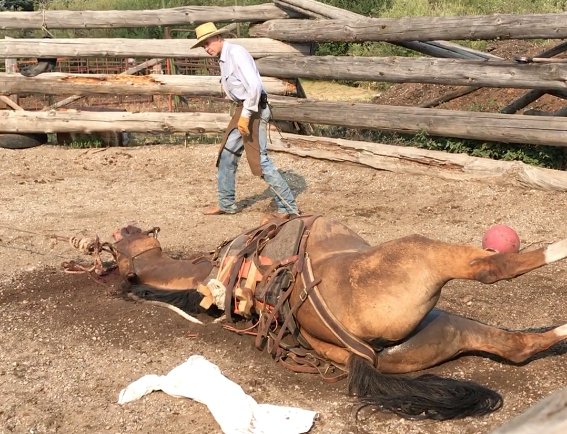
This picture above is a still from a video taken by Mary Wendell Lampton. She is the neighbor of Wyoming outfitter Forest Stearns. In her video, we can clearly see Stearns with a horse that he tied up and tortured for what is believed to be at least 6 hours.

He tied the horse's head to one end of the pen, and the horses hind legs to the other end of the pen. Then he fell the horse to the ground while the horse was wearing a pack saddle. He is reported to have told the police that he was trying to shoe the horse. After telling the police that he was trying to shoe the horse, he then changed his story to say that it was all a "training session."

Even if that were true, then why have that pack saddle on that horse while doing it. I have been around horses since I was a little kid, and frankly I've never seen this type of torture inflicted upon a horse. And to say, at first, that he was trying to shoe the horse? While I don't know the man other than what I've read about him, it seems like he was trying to cover himself with that story after the police were called.

In the video, it's clear that he was not trying to shoe that horse. It is as plain as day, and everyone watching that video can see it for themselves, that that wasn't the case at all. What is depicted in the video is a wannabe horse trainer in the midst of torturing a defenseless animal. This incident took place earlier this month in Wilson, Wyoming, in Teton County, just a fairly short distance from Jackson Hole.

As I said before, it was reported that he actually tortured that horse over a 6 horse period of time before the horse died. Yes, in my opinion, he ultimately killed the horse because the horse died after being savagely abused. Of course, not surprisingly, Stearns is said to have also claimed that the whole thing was a "training session".

Yes, imagine that, 6 horses of inflicting horrible suffering upon a horse and then call it a "training session." And friends, I'm wondering the same thing that I'm sure you're wondering about when I first read about this, was it his horse or was it a horse that he was "training" for someone else? While abusing a horse to the point of killing it is horrible in either case, imagine if Stearns had your horse to "train"? Imagine if he killed it instead of training it?

Forest Stearns is said to be 63 years old and owns Stearns Outfitters. Remember, he told the police that he was doing what he did just to be able to shoe the horse. He said his "training session," a session of torturing that horse for 6 hours before it died, was a training technique meant to stop a horse from kicking at a farrier. Imagine that.

What Stearns is said to be doing is something that some trainers think is necessary to break a horse's spirit. Some trainers believe that doing what Stearns did is the only way to truly break a horse’s spirit when getting ready to train it.

As asinine as the method is, some so-called "horse trainers" truly believe that this is helpful. The method involves tying a horse’s legs together and then forcing the horse to fall to the ground. Some of the so-called "trainers" who train this way have more incidents of creating injured horses in the process.

To me, in my experience, it's a fool's idea of training a horse in a supposed "old way" of doing things. I've often wondered if these same people believe in other things that have been found to just to scar and horrify a horse for life. Or frankly, will kill a horse.

There are horribly abusive training method that people attribute to the "old days" that should never be used. For example, one method where a horse is called "hang-tying." This is where a horse is literally handed by a halter over night away from food and water. The ignorant gunsels who do this believe that this breaks a horse's spirit and makes a horse less resistant to training.

Of course, there are those who believe that a training session means riding, or longeing, a horse to exhaustion to get the "fresh" out of a horse. The horse is put on a line, runs around like an idiot until they are worn out and winded. The idea is to get a horse in a working frame of mind. But lunging is a training method that we should use establish parameters before we step into a saddle, not exhaust the horse.

Some wannabe trainers believe in excessive spurring, especially with so-called "rock grinders" spurs with sharp rowels. Some believe in jerking on a horse's mouth used a severe bit such as a twisted-wire snaffle to causing injury to the tongue, bars, or lips. And along with that is those who like the horrible method jerking on a shank when a chain is used over the face or in the mouth. And then there's the bit method called "bitting up" where a horse is left to stand withholding water to create submissiveness. And yes, there are those who really believe that starving a horse into weakness is a way of getting a horse to "submit".

Then there are those who simply think that they can whip and beat terror into a horse to get it's cooperation. We've all heard stories of these same sorts of peole hitting a horse in the head with a can or a stick or even a board. And yes, I've personally seen some of these types of so-called trainers get so angry and frustrated with a horse that their "training session" turns into a "whoop ass session" as one trainer put told me once.

I'm old enough to have seen some great "Old School" methods that were gentle and effective ways training horses. That's why I know that a real trainer, one conscious of the horse's safety and keeping the horse's spirit in tack, doesn't use "Old School" techniques that are just plain animal cruelty. Horse "training" should not mean abusing a horse to the point were the trainer ends up having to put the horse down because their training session was so extremely severe.

And as for these people who say they have to "break a horse's spirit," I think they are wrong. Besides conformation, age, and what training a horse may or may not have had, my grandfather taught me to look for a horse with spirit and drive when buying a horse. He wanted me to look for horses that can connect with a rider and doesn't quit when needed to move cows all day.

Some of the wannabe trainers out there believe that a horse's spirit should be broken. What they don't seem to understand is that there is a difference between a horse that submits to ques and commands, and a horse which has had it's spirit broken. 

Most intelligent trainers take the good ways that took place back in the day and combine them with more modern techniques. Most real trainers understand how truly cruel this is and won't do it. Most will take from the old school and the new, and will not use such an unacceptable, unnecessary and cruel method of training. 

To me, after watching the video, Stearns may be a sadist who receives pleasure from inflicting harm on people and animals. For someone to do what he did for 6 hours is sinful, if not criminal. And no, I'm not writing his actions off to his ignorance. 

According to what I've researched, Stearns has been around horses for many years. So knowing that he is not some idiot novice who watched the movie "Horse Whisperer" one too many times and now thinks he's a horse trainer, he must have known real well that he went beyond training and was torturing the horse. 

Let's be real frank here, anyone who has spent any real time around horses knows real well that training a horse is an on-going process. Horses don't just learn in formal training sessions, they are experiencing training whenever you interact with your horse. Yes, for better or worse, every time you deal with you horse, you're doing training. And that in itself is why we all need to pay attention to what our horses are doing.

As for a gentle reprimand for misbehaving, remember that what most call "rank" horses are really just horses that have been allowed to behave badly. And no, no matter what a movie may try to depict as reality, fact is there are no quick fixes or one size fits all training. Every horse is different, and some take more training and longer training sessions for things to sink in.

Horses are all different, and most real horse trainers, reputable horse trainers, know that. So subsequently, they usually limit periods of really intense training to 20 to 30 minutes. Sometimes less depending horse the horse is responding to the what they are being taught. Believe it or not, sometimes shorter training sessions are better because it keeps a horse focused and interested in what's taking place. 

Remember, before the session starts there is a short few minute warm-up period and after the session ends there is the 10 minute or so cool down period. A session that's now very intense should be anywhere for 30 to 40 minutes or shorter. Working a horse for an hour in a training session is a very long time.

Anyone working horses, training them, knows that it is absolutely important to always end the training session on a good note. Yes, that is true even if the horse wasn't cooperating as much as you wanted that day. Another must is to finish a training session doing something that the horse does real well. Even if it is considered something minor, ending a session on a good note breeds confidence in the horse. 

As far as getting angry, my grandfather taught me that the only emotion I should ever have during a training session is "patience". So, with my knowing what I've been taught since I was old enough to walk, I'd say 6 hours of "training" a horse using cruel and inhumane treatment is a totally unacceptable. 

Forest Stearns is under investigation by the Teton County Sheriff Department for possible animal cruelty in the case. And no, this is not the first time Stearns has had problems when it comes to abusing horses. In fact, from what I've read, he has been reported regularly for abusing horses. And also, he has an police record that shows that he was arrested and booked for drunk driving three years ago. He also has been under investigation by the police for family battery.

And while some are now asking if ' idea of training techniques is legal or not, legal or not what he was doing wasn't humane in the least bit. I've watched the video a number of times to see if there was any sort of excuse for this. Frankly, his behavior is uncivilized. 

The Teton County Sheriff’s Office is investigating Forest Stearns after the video of him torturing that horse was posted on the internet. Forest Stearns, owner of Stearns Outfitters in nearby Wilson, is being investigated for cruelty to animals. Sadly, what Stearns did is only a misdemeanor in the state of Wyoming.

To view the Stearns horse abuse video, caught on tape by a neighbor, please go to Wyoming Outfitter Horse Abuse or Forest Stearns Torturing Horse to Death

After you watch it, ask yourself why he is not in jail? Maybe the Teton County Sheriff can explain why he has not done anything about this? Ask him if he's simply writing this sort of behavior off as that's how things are done in Teton County, Wyoming?

If it is, it's certainly not the Cowboy way of doing things! 

Tom Correa


Thursday, August 17, 2017

Al Swearengen & The Gem Theater

The Gem Theater

It seems that I'm being hit with a lot of questions about movie characters. One man recently wrote me to take me to task about Doc Holliday. Then after I posted a picture of the man who is mistaken for Holliday, a couple of readers wrote to ask what have I been smoking? One actually told me that I didn't know what I was talking about, he said he was never going to visit my site again because "the man mistaken for Doc Holliday is Doc Holliday."

Someone reading one of my older articles about all of the swearing in the HBO television series Deadwood and how language like that simply was not used in the Old West. You can find that article at The Old West vs HBO's Deadwood.

He wrote to inform me that his grandfather swore like that all the time and that I didn't know my "ass from a hole in the ground." I answered his letter to tell him that my grandfather swore only when he was angry. He was a Cowboy and reserved that sort of language for when he felt it was OK and when not around women and children. Either way, our grandfathers are not representative of the people of the Old West of the 1800.

Fact is swearing went on, but it was actually blasphemous in nature, unlike today's vulgar language. In fact, even the producer of the television series Deadwood admitted that very thing in an interview. His reasoning for using modern vulgarity is that what was considered vulgarity in the 1800s is too tame for today's television audiences. If someone said, "Damn you". That was considered swearing in the 1800s. He said today's television audiences would laugh at a gunfighter saying such a thing.

Producers make changes that are "historically incorrect" all the time. Take for example the movie Tombstone where the outlaw gang known as the "Cowboys" wore red sashes. The people responsible for making that movie wanted to use "gang colors" like the criminal gangs in Los Angeles, the Crips, and the Bloods. The producers of Tombstone did so even though the outlaw gang, the Cowboys, did not wear red sashes.

The HBO television series Deadwood ran from 2004 to 2006, and the producers decidedly depicted the character Al Swearengen as a politically powerful and influential individual. The show depicts him as a ruthless murderer who guides the town of Deadwood through its growth. The producers decide that Al Swearengen should be English-born and that that character should be referred to as "the slimy Limey".

As a point of interest, the term "Limey" is a derogatory term for a British person. That term is no different than calling an American black person a "Coon." Or calling a South African black person "Kaffir." Or calling a person of Mexican descent "Beaner." Or calling a white American of European descent a "Cracker."

The term "Limey" is thought to have originated in the 1850s as "lime-juicer" because of the Royal Navy's practice in the 1800s of adding lemon juice to their sailors' daily ration of watered-down rum which is known as "grog." The lime juice was believed to prevent scurvy. The British Merchant Shipping Act of 1867 required all ships of the Royal Navy and Merchant Navy to provide a daily lime ration to sailors to prevent scurvy. Since at the time, the terms "lemon" and "lime" were used interchangeably to refer to citrus fruits, ignorant people chose to call the Brits by the derogatory term "Limey."

If one reads about the Old West, the 1800s in general, one quickly realizes that scurvy was a real problem both at sea and on land. Scurvy is a disease resulting from a lack of Vitamin C. Early symptoms include weakness, feeling tired, and sore arms and legs. Without treatment, red blood cells decrease, there is noticeable tooth decay and gum disease, balding takes place, and bleeding from the skin may occur because scurvy slows wounds from healing. Scurvy is also known to create personality changes and even death from infection or bleeding.

What I find interesting is that taking their daily ration of lime, their needed Vitamin C, actually made British sailors some of the healthiest people around during that time period. Yes, all because it prevented scurvy.

Hollywood might have made Al Swearengen a British immigrant in Deadwood, in reality, he was very much an American. He was born Ellis Albert Swearengen on July 8th, 1845, to Daniel Swearengen and Keziah Swearengen, in Oskaloosa in the Iowa Territory. Yes, right here in the United States.

Al had a twin brother, Lemuel, and they were the eldest of eight children. Al Swearengen is said to have remained at home living with his parents well into adulthood. It wasn't until he was 30 years old that he left home and traveled to Deadwood in May of 1876. At that time, he was married to his first wife, Nettie Swearengen. She later divorced him on the grounds of spousal abuse. Al Swearengen married two more times after Nettie, and both of those marriages also ended in divorces.

After arriving in Deadwood, South Dakota, Al Swearengen started up a tent saloon known as the Cricket. Believe it or not, that small tent saloon is said to have offered gambling and even hosted prizefights out back. It was a success, so he expanded by closing it down and opening the much larger saloon and brothel known as the Gem Theater on April 7th, 1877.

The Gem Theater provided Deadwood with comedians, singers, dancers, and prostitutes. Swearengen called it what he did, but everyone there knew that the "theater" masqueraded as a brothel. The Gem Theater was a saloon and dance hall, but its main business was that of being a brothel.

In fact, The Gem Theater was considered a notorious brothel ripe with sexually transmitted diseases, customers getting rolled, and daily violence. Fairly quickly after opening, the Gem soon gained a reputation for its horrible treatment of the women who were forced to work there. The women who worked for Swearengen were known for looking beaten up because of their constant bruises and other injuries.

Yes, Al Swearengen was a pimp. Like Wyatt Earp, he was a pimp. Of course, Earp was arrested for being a pimp more than once. And yes, that fact in itself shoots down the argument that some have written me to say, "Being a pimp was not seen as we do today."

Al Swearengen treated his "girls" no differently than pimps do today through a combination of intimidation and physical abuse. In his case, he was well known to have beaten women. But the fact is that he also had henchmen who helped "keep the girls in line." 

While Dan Doherty acted as general manager, Johnny Burns was actually in charge of the women and several bouncers. Burns' men were said to have been as brutal to the women working there as Swearengen himself was. Yes, beating the women was said to be a common practice at Swearengen's Gem Theater.  

Besides those small details, what Hollywood didn't show its audience is how Al Swearengen lured young women who were down on their luck to Deadwood with promises of riches but then forced them into prostitution once they arrived. In fact, Al Swearengen is said to have recruited women from back East by advertising job openings in his hotel. Yes, all with the promise of making them stage performers at his theater. He would actually buy their one-way ticket. And when they arrived, the women would find themselves stranded with no other choice but to work for Swearengen.

The fact is, they either worked for him or were thrown into the street. And yes, in case you're wondering how bad was it, some of those desperate women are said to have taken their own lives rather than being forced into a position of slavery.

Was it slavery? Well, yes it was. Of course, no one talks about the slavery of women in prostitution in America. While some believe prostitution was a "chosen profession," and that being the case for some, to many it was a means to make a dollar as a last resort. Pimps are Slave Masters. And just as with other Slave Masters making a dollar off Irish and Black slaves, pimps didn't care if the women died or not. 

Al Swearengen got help from others who looked down on their luck girls for him. One such person is said to be Martha Jane Canary. Yes, the woman known as Calamity Jane was one of his first dancers at the Gem and she is known to have lured at least 10 girls from Sidney, Nebraska, to Deadwood for Al Swearengen.

Though popular among miners, the Gem quickly gained a reputation as a violent saloon where shootings were commonplace. In fact, there is a story about a Gem prostitute by the name of Tricksie who shot a man in the head after she had been beaten by him. The rest of the story goes that the man didn’t die immediately and a doctor was called in. The doctor put a probe through the man’s head. It's said that the doctor was amazed that he survived the gunshot at all. Of course, the man died about thirty minutes later. And no, Tricksie was never tried.

Swearengen wasn't ignorant of the ways of protecting his brothel from the general drive to clean up Deadwood. He made all sorts of political alliances with huge financial payoffs. This protected him from people like Seth Bullock who was Deadwood's first City Marshal.

Now if you're asking yourself where was City Marshal Seth Bullock while all this was going on at The Gem Theater, it's said that Bullock and Swearengen agreed to draw an imaginary line right down the middle of Main Street. The side with the Gem was referred to as the "Badlands". That was the side that was said to be controlled by Swearengen. Bullock controlled the other side. Imagine that.

In the summer of 1879, The Gem Theater was damaged by a fire but was quickly repaired and rebuilt. Some say that the fire was caused by one of the prostitutes who wanted to see the place burned to the ground. Then just a few months later in September of 1879, the entire town of Deadwood suffered a huge fire that is said to have destroyed about 300 buildings. That included The Gem Theater which was again rebuilt, but this time from the ground up. The new Gem was said to be bigger when it opened in December of 1879.

Swearengen left Deadwood after the Gem burned down for the last time in 1899. That was the end of that pimp's 22-year run at owning and operating his whorehouse in Deadwood, South Dakota.

The newspapers were not kind to the Gem after it burned down. One newspaper stated, "Harrowing tales of iniquity, shame and wretchedness; of lives wrecked and fortunes sacrificed; of vice unhindered and esteem forfeited, have been related of the place, and it is known of a verity that they have not all been groundless." Another newspaper wrote calling the Gem Theater, "the ever-lasting shame of Deadwood," "a vicious institution," and a "defiler of youth and a destroyer of home ties."

After the Gem Theater burned in 1899, another fire took place about six months later. That fire destroyed the adjacent buildings to where the Gem was located. In 1921, the site became the location of Deadwood's first gas station. Today, the location where the Gem Theater sat is now the site of the Mineral Palace Casino.

As for Al Swearengen, he left Deadwood right after the Gem burned to the ground in 1899. He is reported to have married Odelia Turgeon that same year. They divorced soon after. Then five years later on November 15th, 1904. at the age of 59, he was found dead near a streetcar track in Denver, Colorado. 

Around two months earlier, his twin brother Lemuel was killed when some unknown assailants shot him in the head. Some say they thought it was a robbery but he was not robbed. Others say Lemuel was shot because he was mistaken for his twin brother Al.

It is often said that Al Swearengen died destitute, penniless, and alone. There were reports that he died while trying to hop a freight train in Denver. But although recent research doesn't address his being penniless of not, it does point to evidence that indicates that he may have been murdered.

The reason for some to think this is that a rediscovered obituary and period newspaper accounts of his death show he died in the middle of a street in suburban Denver nowhere near tracks where he would hop a freight train. Dead of a massive head wound. The obituary that was found states he died of blunt-force trauma to the head. No one at the time was able to determine if it was murder or an accident of some sort.

So if you're wondering, I'm sure there are those who hoped that someone bashed his head in. After all, many would say he deserved it.

Tom Correa