Sunday, August 18, 2013

Great Country Music Voices - Jim Reeves


Jim Reeves.jpg

His full name was James Travis Reeves, but the world knows him simply as Jim Reeves.  

He was born on August 20, 1923, in Galloway, Texas, a small rural community near Carthage. 

Because he was a pretty good baseball player in High School, he won an athletic scholarship to the University of Texas - but quit after only six weeks to work in the shipyards in Houston during World War II to build Victory ships.

Victory ships were a later version of the Liberty ships.

He later resumed playing baseball and was actually in semi-professional league before being contracted with the St. Louis Cardinals "farm" team as a right-handed pitcher.

He played for the minor leagues for three years before severing his sciatic nerve while pitching, that ended his baseball career.

One biography says he tried boxing for a while, but found that there were better and smarter ways to make a living.

As a radio announcer, and had sing advertising jiggles live between songs. Yes, that's how he got his start as a singer.

During the late 1940s, he was contracted with a couple of small Texas-based recording companies, but without success.

Influenced by such Western swing-music artists as Jimmie Rodgers and Moon Mullican, as well as popular singers such as Bing Crosby, Eddy Arnold and Frank Sinatra, it was not long before he was a member of Moon Mullican's band, and made some early Mullican-style recordings like "Each Beat of my Heart" and "My Heart's Like a Welcome Mat" from the late 1940s to the early 1950s.

He eventually obtained a job as an announcer for KWKH-AM in Shreveport, Louisiana, home of the popular former radio program, the Louisiana Hayride.

Jim Reeves once said, in an interview on the RCA album Yours Sincerely, that Hank Williams (Sr.) missed a performance and Reeves was asked to substitute.

One of his breakthrough singles was "Mexican Joe" in 1953.   Accompanying Jim Reeves on "Mexican Joe" were the Circle O Ranch Boys and was Jim Reeves' debut single on the country charts. "Mexican Joe" hit number one on the country charts for six weeks with a total of twenty six weeks on the chart.

Featuring "Big" Red Hayes on the fiddle and Floyd Cramer on the piano, "Mexican Joe" was a rollicking, Western swing-influenced tale of a bandito and drifter who engages in a lifestyle of women, carousing and gambling.

Though he had released a few singles prior to "Mexican Joe," none attained the level of national success needed to reach any of Billboard's country music component charts in use at the time.

"Mexican Joe" became Reeves' first major success nationally and would eventually pave the way to super-stardom.

                                                                Mexican Joe

   
                                                                     Bimbo  

The short version of his life is that he was an American country and a popular music singer-songwriter. And yes, both here and around the world, he was also a living legend.

With records charting from the 1950s to the 1980s, his songs were a mixture of older country-style music with elements of popular music.

On July 31st, 1964, Jim Reeves died at age 40 in the crash of a private airplane.

Known as "Gentleman Jim", his songs continued to chart for years after his death.

Today, he is a member of both the Country Music and Texas Country Music Halls of Fame. But more importantly, his style of singing an beautiful voice are surely missed.

In his day, the bands would let the singer show off his or her vocal abilities and not drown out the lyrics of a song.

Because of that fact, I believe that there is not a single singer today that can hold a candle to the smooth voice of Jim Reeves.

Take a look at these videos and hear for yourself, then ask yourself "other than George Strait, why aren't there great male voices in country music today?" 


"Have I Told You Lately"


                                                             Distant Drums


      "I Love You Because"      (Oslo, Norway, 1964)


 The Blizzard
             Snowflake


                                          "Have I Told You Lately"

          He'll Have To Go

"Waltzing On Top Of The World"

            "Adios Amigo"
    (Oslo, Norway, 1964)

Songs from his appearances on
The Grand Ol' Opry


                        "Danny Boy"

"Where We'll Never Grow Old"

          Streets of Laredo

               "May The Good Lord Bless And Keep You"


And may God bless the great Jim Reeves for all he gave us.

Story by Tom Correa 


Friday, August 16, 2013

Home Defense Guns: My Choices

Dear Readers,

From your letters, it's easy to see that you have questions regarding "the best" choice for a Home Defense gun.

Ever since vice president Joe Biden said get a shotgun, I've had readers ask me about the positives and the negatives of having a shotgun versus other guns.

The email that I receive shows a split between handguns and shotguns, with a few making a pretty good argument for having an AR-15.

Maybe it was my training as a United States Marine, but my attitude on Home Defense is the same as any situation where you need to defend yourself: Any weapon is better than no weapon, and anything can be a weapon.

Most of us already know about women being told to use their car-keys against an attacker in the advent of an emergency situation on the street. That is a good example of anything can be a weapon.

For our homes, hopefully we're a little more prepared than that. But before choosing "the best" weapon for you, you have to look at your living situation.

If you have a lot of kids coming and going at all hours of the day and night like a bus terminal, than your choices are extremely limited simply because you might not know if the person coming in the door is your kid or not.

I know someone who once lost his house key and decided to climb in through a window to get in. His wife almost made herself a widow because she was ready to shoot at the very moment that he finally realized that his wife was standing there with a gun in her hand.

And of course, there is the case of the husband who likes to stay out drinking with the boys till late before coming home. If he's one of these guys who sees no reason in announcing himself as he's stumbling in the door, he could have a problem waiting for him inside. And no ladies, no matter how mad you are, you can't shoot him just because you might really want to!

Other limiting factors are things such as if you live in an apartment or have roommates who come and go for example. So before figuring out what we need, we really have to assess our needs and choices.

As for living in an apartment, I'll be real frank and say that I think a small caliber pistol is the best defensive weapon in the way of firearm. Because of the concern about a round going through a wall and entering a neighbor's apartment, I think that that concern can be minimized with a small caliber firearm such as a .38 revolver and the right kind of ammo. And yes, ammo manufacturers actually make ammo these days that are designed to reduce travel upon impact.

For example, "frangible" ammo is designed for use at close quarters to reduce the danger of ricochet.
One "frangible" ammo type is the "Glaser Safety Slug" which is designed for self defense in conditions where others might be injured by standard bullets, and they have a proven track record for safety.

The bullet design can produce large shallow wounds in flesh while failing to pass through structural barriers thicker than drywall or sheet metal. These qualities make it less likely to strike unintended targets, such as people in another room during an indoor shooting. Also, when it strikes a hard surface from which a solid bullet would glance off, it fragments into tiny, light pieces and creates much less ricochet danger.

So yes, if you want to put an assailant down with killing him in an apartment situation, it see Glaser Safety Slugs would work well in the right conditions like say an apartment.
Having said that, whether you use some sort of new "frangible" round or the standard .158 grain .38 caliber bullet, a .38 revolver is ideal for home defense.

If there is a question as to what sort of ammo to use, some police department will help you to find out what ammo is authorized for department use, and which is very defensible in court.

For a residential house, ask yourself what we have to chose from in the way of a rifle, a pistol, or a shotgun? And yes, some will ask why not a baseball bat, a kitchen knife, or simply use the telephone?

Well, I've always believed that knives are used as a last resort.

It takes a lot of nerve to slice and dice someone. While fear is a great motivator, the problem with using a knife is that it is an up close and personal weapon that will bring us eyeball to eyeball with our assailant. And in that situation, the odds are only 50/50 that we will succeed in getting out without getting injured or worse.

The reason it's only 50/50 is the same as using a baseball bat -- if your assailant is a bigger stronger younger intruder, it could end up being used on you.

The telephone is great, but contrary to what liberals are trying to tell us -- no, it's not a weapon.

If an intruder is breaking into your home, instruct your wife to dial 911 and put the phone down so that the 911 operator can automatically locate where you are calling from -- then grab a gun and get on with a defense.

While I like shooting with one hand, and have been trained to do so while holding a flashlight or a radio or whatever else, most people need to dial 911 and put the phone down so that their hands are free to hold a firearm.

Whether you're using a pistol or shotgun or rifle, its my believe that a phone in your hands is just going to get in the way. Besides, there is nothing that the 911 operator can say to you to keep you safe at that moment. It is all up to you. 

The pistols that I keep loaded are a "his and hers" situation. Yes, I really did say "his and hers!"

I keep a no frills easy to use .357 Smith & Wesson Model 64 revolver and one of my old trusty M1911A1 .45 Government Model semi-auto ready to go.

Why both? Because, while I'm comfortable with either handgun, my wife is more comfortable with the "less complicated" revolver.  Loaded with .38 caliber rounds, I'm fairly certain that she can handle using it very well. 

I also have a rifle and a shotgun that I keep in the ready. By about now, you're probably asking why so many choices?

Well, partly it's because of where my wife and I live. We live in the country. This is rural America, and not all of the intruders that I am worried about have two legs -- some definitely have four. 

You see, while a pistol and a shotgun are great for close quarters when someone is breaking in the back door -- and a shotgun will give you some range and a wider pattern -- I need to have a rifle in case a predator is after my livestock.


For that reason, I keep a either my .30-30 Marlin or my .45-70 Marlin lever-action rifle ready in case of Mountain Lions and Bears and such. Though I own a semi-auto rifle or two, I'm most comfortable with my lever-action Marlin rifles for game. And yes, a .45-70 is a big round that will certainly put down a bear if I had to.

While I don't own one, I have been trained in the use of an M16 rifle. The civilian version is the AR15 rifle. I am not against owning one, I just have others that I prefer over an AR15. And even though that's the case for me, I really believe that the AR15 can be a good home defense weapon in rural areas. But frankly, I really don't think that I'd use one in an urban setting.


The problem that I have with citizens using an AR15 in urban settings is the exact same problem that I have with law enforcement officers using an AR15 in urban settings -- bullet travel and lousy training.

In a rural area, like say the area I live in where my nearest neighbor is over 200 yards away, when taking a shot at an intruder -- if you miss, your stray rounds, those misses, go into the landscape.

In an urban setting, where your neighbor's house can be a few feet away, when taking a shot at an intruder -- your stray rounds, those misses, go through a wall and into the next home and possibly into somebody's bedroom.  

And yes, even the most well trained combat Marines miss now and then in the heat of battle. So knowing that fact, I've often worried about civilian law enforcement using AR15s. After all, there is no telling how many police officers can't hit the side of a barn. 

This is the reason that police have traditionally used shotguns. With less range, a shooter gets less bullet travel. But the trade off is public safety. Besides, even a poor marksman, as many police officers are, can be proficient with a shotgun.

And yes, the weapon that won the West was the American shotgun. That shotgun, which was handed down from generation to generation in most American families, was used for hunting small game, birds, and family defense. Back then, as is the case today, a person with a shotgun didn't need a lot of practice to learn to hit what they aimed at, and shotgun were not complicated to use.

As for my choice of home defense shotgun? While I like side-by-side double barrel shotguns, I have owned a Mossberg 500 pump action shotgun for more than 30 years.
 

Like the 911 operator, an alarm system is of absolutely no use when you have a violent criminal breaking down your door.

Shame on you if you have nothing to protect yourself or your family with. The basic solution to that problem is to get a gun. And if you're uncomfortable using a pistol, get a shotgun. The Mossberg 500 would be a good choice.

Criminals don’t like guns when they are used against them. And yes, it is absolutely true that they don't like the sound of pump shotgun chambering a round and getting ready for business. Frankly, the racking of a pump shotgun speaks an international language which can be enough to deter even the most hardened of criminals.

Mossberg 500
It happened to my father when he was living in the residential area in the San Francisco Bay Area city of Hayward. One very late night, my dad woke up after hearing noise coming from the patio door which led to my folks' backyard.

He grabbed his pump shotgun and saw the silhouette of two intruders trying to jimmy the door open.

Standing back away from the door, he racked the pump shotgun to chamber a round.

He heard one say, "that was a shotgun!" as they jumped the back fence and ran away.

If the sound of a pump shotgun being racked to chamber a round doesn't work, knowing you can pull the trigger and accurately use deadly force to take care of one or more criminals is priceless in the scheme of things when it comes to home defense protection.

And yes, Home Defense means Family Defense!

While I'm partial to pump action shotguns like the Mossberg 500 or the Remington 870, a side-by-side shotgun may be easier and less complicated for some folks.

Whatever you choose, rifle, shotgun, or pistol, training is key! Training is important to know how to use any gun. You need to know how to use it. It has to be done naturally with ease and comfort.

Fumbling with safeties or a slide release can put you in danger. For that reason, as much as I like the pump action shotgun, the old standby side-by-side shotgun may be a better choice for some folks. But, either way you go, training is important.

As for prices? I believe a Mossberg 500 pump-action shotgun can be had for under $400. Stoeger side-by-sides are about the same price.

A good quality .357 magnum revolver, such as a Ruger SP101 cost about $700 while a Smith & Wesson Model 60 will run around $800.

The .30-30 Marlin Model 336 lever-action rifle, which of course is a great deer rifle, will run you about $500. The Marlin 1895 lever-action rifle in .45-70, which is a great bear rifle, will probably set you back around $700. A basic AR15 is running between $1000 and $1200 these days.

Of course, shop around for deals just like anything else. Also, watch for when they're on sale and you can safe a lot of money!

So all in all, as you can see, if you need to have a shotgun sitting in the back of a closet or over a door, a pistol in a drawer out of the reach of children yet accessible for quick recovery, a rifle in the back of the door for that midnight prowling big cat, you have options.

It's all a matter of wanting peace of mind in the event trouble comes your way. And yes, the guns shown above would be my choices to pick from.

Good luck with making your choice.

Tom Correa


Duck Dynasty on Faith, Family & Facial Hair

Todd Starnes is the host of Fox News & Commentary – heard daily on 250+ radio stations. He’s also the author of "Dispatches From Bitter America".

In his spare time, Todd is active in his church, plays golf, follows SEC football, and eats barbecue. He lives in New York City.

Jun 14, 2013
Story by Todd Starnes

Duck Dynasty makes America happy-happy. And that’s a fact, Jack.

The reality television show following the adventures of Louisiana’s Robertson family has become one of the nation’s most-watched programs. A&E’s Duck Dynasty drew an average of 8.4 million viewers per episode last season – the second-highest-rated cable show on television.

I’m proud to say I was a Duck Dynasty fan from season one, episode one. Last Christmas, I was honored to have Phil and Kay Robertson on my Fox Radio Christmas Spectacular. And earlier this week I had a chance to catch up with their son — Jase.

“I was one of the ones who said the reality show would never work,” he told me. “We were in the hunting world. I had this perception of reality shows that you had to have all this friction and fits of rage and four-letter words.”

Think Jersey Shore and the Kardashians.

“We’re pretty calm compared to that,” he said. “We’ve got some crazy characters in our family — but I didn’t think people would want to see that.”

The nation has fallen in love with Louisiana’s favorite duck call makers – especially with Uncle Si – and his ever-present Tupperware glass filled with sweet tea.

“People just identify with our principles and values,” Jase said. “We’re all about faith, family and facial hair.”

Jase said he hasn’t seen his dad clean shaven in about 30 years.

“My wife hates the beard,” he said. “When we dated, I would grow it out during duck season. she said she could handle anything for three months — but now I have it all the time.”

But he did acknowledge the beard has its advantages.

“No one ever tries to mug us — ever,” he said. “They look at us and say, ‘No, it’s not worth it.’”

A few years ago the brothers and their dad were hunting in Idaho when a guy tried to break into their motel room. It was around 3 a.m. and Phil heard the door knob turn.

“My dad sat up with his long beard, wearing his tighty-whiteys and his gun,” he said. “He leaned over, grabbed the gun and then the guy opened the door. My dad said, ‘Wrong room!’”

Jase said the would-be robber’s hands flew up in the air.

"He turned into a crawfish and started back out,” he said. “He backed up about 250 yards into the parking lot.”

When it comes to guns – the Robertsons are “all about the Second Amendment.”

But the greatest joy in Jase’s life is not the show or the family business — it’s his family. He lives in West Monroe, La. with his wife Missy and their three children — teenage boys Reed and Cole and 10-year-old Mia.

He said keeping the kids focused has been their biggest struggle in this age of Facebook and Twitter and instant feedback.

“I’ve had to sit down with both my sons and tell them that just because 1,000 girls say you’re the best-looking thing since sliced bread – that doesn’t mean it’s true,” he said. “They’re not mature enough to deal with that.”

He said he and his wife try to keep their priorities straight.

“The best thing Missy and I can do is have a good relationship,” he said. “We have a strong, godly relationship. They see that fame and fortune is not what we are after.”

Jase believes that helps keep the kids grounded.

“We also have to take time out of almost every day and say to the kids — this is what we’re about,” he said. “I try to do something positive every day – plan a positive action every day to keep their priorities straight. That’s all you can do. It’s not going to happen by accident.”

A number of viewers have commended the family’s frank discussions about life – including lessons on the birds and the bees.

“My dad told us to wait until we got married — do it God’s way,” he said. “I like the fact that my parents are so open about sex. I waited until I got married and a lot of the reason for that is because at an early age – my parents were real open.”

He admits that some viewers have not appreciated their candor.

“Godly sex is biblical and it’s a good thing,” Jase said. “I’m glad my dad loves my mom. If he didn’t, I wouldn’t be here.”

Sure the Robertsons are a little rough around the edges but that’s their culture. That’s who they are. And that’s why American families are flocking to their show.

“The bottom line is we are trying to do what’s right,” he said. “We don’t just say we believe in God — we have active relationships with God.”

And they don’t preach at folks who may not share their Christ-centered values.

“If people want to simulate a godly lifestyle — great,” he said. “If they don’t — good luck with that.”

EDITOR'S NOTE:

I agree!  

Thursday, August 15, 2013

Attack of the Insensitive Rodeo Clowns?

Before we talk about the supposed insensitivity of Rodeo Clowns, let's talk a minute about King Obama's Dog Bo who was airlifted to the King's family vacation spot. 

King Obama commanded that his dog be airlifted via United States Marine Corps aircraft to the King's family vacation on Martha’s Vineyard - and it was promptly done!

By the way, more than Bo was airlifted to the King's family holiday on the Vineyard – also airlifted for his royal ass was his all-important "presidential basketballs".

As reported by The Telegraph, more than 70 hotel rooms, each costing up to $345 a night, have been booked for Secret Service agents.

The Obamas are staying in a $7.6 million, 5,000-square foot retreat on nine acres, which includes a basketball court, of course.

We should note that this is the first time Marine Corps aircraft, two Osprey helicopters were used to transport the King and his family.

One was for the Obamas, and one for Bo and the basketballs.

It must his way of enduring all of the cuts he's making to everyone else but himself.

But than again, it must be nice to be King!

Now as for those supposedly insensitive Rodeo Clowns?

The president of the Missouri Rodeo Cowboy Association has resigned after getting flak about a State Fair event in which a Rodeo Clown stirred up the crowd by wearing a mask of President Obama - and poking fun about the president being clown.

An attorney for rodeo announcer Mark Ficken said Tuesday that his resignation from the group is not an acknowledgment of wrongdoing on his part but rather a protest that the association has not banned the rodeo clown from its membership.

Ficken's resignation from the rodeo group comes as he tries to hold on to his job as superintendent of the Boonville School District.

The school system announced Monday that it is hiring an investigator to look into whether Ficken was involved in any "inappropriate conduct" during last Saturday's bull riding event at the Missouri State Fair in Sedalia.

Missouri's elected officials have denounced the rodeo clown act as "disrespectful" to Obama.

The event featured a clown wearing an Obama mask with an upside down broomstick attached to his backside who was positioned on the arena's dirt floor as if he were a dummy.

Another clown drew cheers from the audience as he asked if they wanted to see "Obama run down by a bull" and made comments about the bull coming to get Obama.

Ficken's attorney said a rodeo clown wearing a microphone - not Ficken - orchestrated the act and made most of the comments about a bull charging after Obama.


The Missouri State Fair said Monday that it has permanently banned the clown from performing at the fair. Imagine that!

The rodeo association, which was responsible for the event, has not publicly said what -- if any -- action it has taken against participants.

"When he found out that the association had no plans to remove the rogue clown from its membership ranks, (Ficken) felt that the better part of valor - given what was said - was to resign from the association," said his Ficken's attorney, Albert Watkins.

Neither the State Fair nor the rodeo association has identified the rodeo clown who made the comments about Obama. But a friend and relative both identified the clown as Tuffy Gessling.

"He was at our house the next day for Sunday dinner and told us that he thought people took it wrong - that it was supposed to be a joke," said his cousin, Chrissy Gessling, of Slater, Mo.

Tuffy Gessling has not responded to Associated Press requests for an interview made through Facebook, his cousin and a friend.

So where's the problem?

While there is no written law, we may have finally reached a place in America where it’s forbidden to publicly mock the king president of the United States — of course, that's assuming that the president is black (or half-white) and a Democrat.

I was angry when liberals like David Letterman attacked Sarah Palin's family. And yes, I was angry when liberals wore masks of George W. Bush in liberal sponsored protests that called for his assassination.

How about this picture of a liberal protester wearing a Bush mask with what's supposed to be blood all over his hands?


No outcry from the left? Imagine that?

But wait, Bush was white and a Republican - to the left even a lynching would have been OK!

In fact, it was reported that death threats against President George W. Bush were not even investigated as they are now since President Obama was elected.

The left's outcry over a rodeo clown putting on an Obama Halloween mask is laughable if it weren't for so many people getting their panties in a bunch over this.

Farmers and ranchers are having there private information distributed to anti-agriculture liberal environment extremist groups -- by Obama's EPA.

Conservative groups and citizens are being denied tax-exempt status by Obama supporters in the IRS.  Yes, that is an illegal act.

Over 2,217 semi-automatic AR-15 style rifles were handed over to Mexican Drug Cartels by the Obama Justice Department.  Yes, that is an illegal act.

The IRS and the GAO have spent millions of taxpayer dollars on lavish conferences.

Americans are being spied on by the NSA, the FBI, Homeland Security, and only God knows who else, all condoned by the Obama administration.

The president not refuses to even look at any favorable report about the Keystone XL Oil Pipeline because he is a slave to his liberal environmentalist donors.

Four Americans were killed in Libya while assets that could have kept them alive were told to "stand down" and no one in the Obama administration can fine the person who did that -- subsequently getting four Americans killed.

But wait, the left is not upset with any of these - yet they are about a rodeo clown wearing an Obama Halloween mask!

I ask you, is this a little insane or what?

Talk about absurdity, the man behind the mask has been permanently banned from performing at the fair ever again, as reported by the St. Louis Post-Dispatch.

Missouri State Fair officials barred the rodeo clown from ever performing at the fair again and are requiring that “all officials and subcontractors associated with the association must participate in sensitivity training,” the Post-Dispatch noted.

Why is it that Republicans and Conservatives have to attend "Sensitivity training" over something like this, yet Democrats and Liberals don't when the situation is turned around and they step way over the line.

Not just have a little fun at President Obama's unfavorable ratings, but Liberal get nasty!

As stupid as it is, liberal state lawmakers in Missouri are also demanding an investigation after threatening to cut funding for the fair, an annual event that receives state tax dollars.

Politicians and the national media jumped all over the incident, deeming it "inappropriate and disrespectful."

So where were the Democrats back in 1994 when a rodeo dummy wearing a President George H.W. Bush mask, propped up by a broomstick, was employed in the exact same was as a decoy during the bull riding at that rodeo.

Why didn't anyone demand resignations and investigation back then?

Could it have been because the left is sensitive and overly protective because President Obama is half-white/black and a Democrat?

One member of the Missouri Rodeo Cowboy Association who was at Saturday’s event told the Associated Press that there was nothing offensive or unusual about the rodeo clowns actions — he was trying to look like a dummy and that rodeo clowns have long performed such acts, often imitating sitting presidents.

“The joke is not that it was the president,” he said. “They drag out this person dressed like a dummy and all of the sudden this dummy just takes off running. That’s what’s funny.”

The only difference between then and now is the hyper-sensitivity and double standard that applies to the first black president.

Hyper-sensitivity that was on full display when the apparent Obama supporter who drew attention to the incident, Perry Beam, said "it felt like some kind of Klan rally you’d see on TV," as reported by the USA Today.

Yes, the "race card"! And no, I don't think the left has gotten the memo that the "race card" means absolutely nothing simply because it is worn out.

Like the double-standard and the denial that Democrats find themselves enjoying, all this talk about race is getting old.

Democrats on the Left cannot understand how Americans could care less what color Obama is or isn't. And frankly, since the Democrats are the only ones concerned with race at every turn - I can't help but wonder why they don't understand that race just doesn't matter?!

Fact is, Americans believe Obama's policies suck! It's just that simple, his policies are not good for Americans.

You'd think, that that is simple enough that even a Democrat would understand it.  His policies scare Americans.


Story by Tom Correa


Tuesday, August 13, 2013

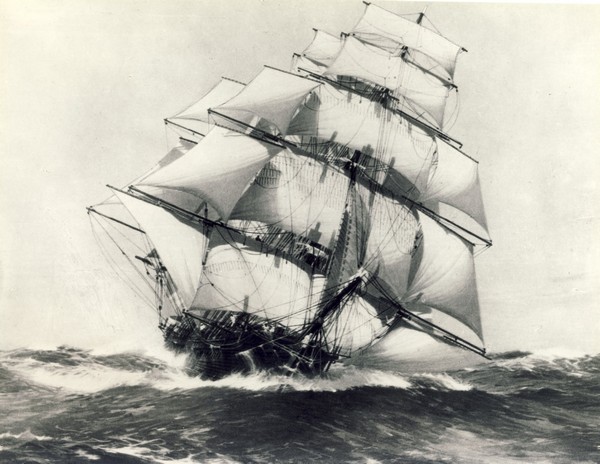
The Flying Cloud - America's Most Famous Clipper Ship


I hate it when I try rushing out an article. Sometimes, right after I click on the publish button, I  notice how the article could have been better. When gathering information about the Old West, or American History in general, I'm always taken by the small stories that were big in its day, or the small facts that have been left out of a story.

I enjoy finding out the fact that the tribe was so angry with the medicine man who instigated the Second Battle of Adobe Walls, that they renamed him "Coyote Shit" (Isa-tai) after the battle because his so-called medicine was found to be nothing but a fraud. Yes, the Indian medicine man who became known as Coyote Shit was nothing but a wannabe messiah.

I enjoy finding out that Frank and Tom McLaury were not in Tombstone on the day of the gunfight to have it out with the Earps. That story is nothing more than fiction built up by people who think the mundane is too mundane. Sure, Earp supporters like to say that the Frank and Tom McLaury were in town as part of the gang of Cowboys just there to break the law and intimidate the public.

But frankly, that's not true. Fact is, Frank and Tom McLaury were not there in Tombstone that fatal day because they belong to some gang called the "Cowboys". Unknown to the Earps, the McLaury brothers were simply in town to get cash before leaving to travel across country back to their hometown in Iowa to attend their sister's wedding, and to buy a prized bull for their herd.

And really, let's be honest when it comes to discussing what took place that day in Tombstone. Sure they were armed. But wouldn't you have stocked up on arms and ammunition as they did that day if you were about to travel across Indian country with the Apache on the prod and no one there to protect you in route to where you're going? That's what took place and that's what they were about to do, but people seem to forget that part of the story when talking about what took place before that shootout. 

Some folks think the Old West, our Western expansion, was only by horse and covered wagon, and later by trains. But friends, before trains crossed the open expanse of the West, ships traveled south around the Horn taking thousands to the gold rich California port of San Francisco.

In the early days of the California Gold Rush, it took more than 200 days for a ship to travel from New York to San Francisco. Remember those were the days before the Panama Canal. It was a long hard voyage of more than 16,000 miles.

It was a treacherous voyage that included going around Cape Horn, and subsequently some of the most dangerous waters known to mankind. Yet, in 1851, a clipper called the Flying Cloud made the same journey in only 89 days. It was a headline-grabbing world record which the Flying Cloud itself beat three years later. 

The Flying Cloud, America's most famous clipper ship, was the masterpiece of Donald McKay, the foremost marine architect and shipbuilder of his time. Most of my regular readers understand and have accepted the way I write. They know that I don't like political correctness. And yes, it would be politically correct to not refer to a ship as a lady. 

When I was a boy growing up in Hawaii, I asked my grandfather why we referred to ships and planes and cars and such as "she" or "her". My grandfather told me something that I've never forgotten. He said, "We do it because the vessel, or the thing that is getting us from one place to another, keeps us safe - just like a mother would when taking care of her child."

For that reason, I refer to the Flying Cloud as a grand lady who took care of passengers and crew as any mother would her children. She was known for her extremely close race with the Hornet in 1853; for having a woman navigator, Eleanor Creesy, wife of Josiah Perkins Creesy who skippered the Flying Cloud on two record-setting voyages from New York to San Francisco; and for sailing in Australia, and the timber trades.

She was popularly called an "extreme clipper," as are many of Donald McKay's ships, but as her dead rise was less than 40" - in reality she was not an "extreme clipper".

Donald McKay built many fast clipper ships but only one, the Stag Hound was an extreme clipper, even if others may have been advertised as such. You see, it was popular to advertise clippers as "extreme" because of the popular conception of speed. And yes, speed back then meant the same as today - getting somewhere faster!

Clipper ships were born in the shipyards of Baltimore around 1820 and represented the zenith of the age of sail. They had completely new and original naval design characteristics, still emulated today by marine designers.

These included a long and narrow hull, a narrow cutting bow, low freeboard, a streamlined stern, and a deep draft. They were especially renowned for carrying large amounts of sail relative to their displacement and were capable of remarkable speed. The Flying Cloud could be seen racing into port before the wind, her acres of sail flashing in the sun.

An ordinary sailing ship would lift her bows and plunge with the seas. But not this one, as her sleek, jet-black hull sliced through the swells, the only visible motion was the white curl at her bow and an occasional toss of spray. She seemed to skim the waves like a gigantic black and white bird.

The Flying Cloud was built in East Boston, Massachusetts, and intended for Enoch Train of Boston, who paid $50,000 for her construction.

While she was still under construction, she was purchased by Grinnell, Minturn & Co., of New York, for $90,000, which represented a huge profit for Enoch Train & Co.

She was launched in East Boston in 1851, just at the time of the California "Gold Rush", when travel and transport between East Coast ports and California was best undertaken by ship.

A reporter for the Boston Daily Atlas of April 25th, 1851 wrote:

"If great length [235 ft.], sharpness of ends, with proportionate breadth [41 ft.] and depth, conduce to speed, the Flying Cloud must be uncommonly swift, for in all these she is great. Her length on the keel is 208 feet, on deck 225, and over all, from the knightheads to the taffrail, 235— extreme breadth of beam 41 feet, depth of hold 21½, including 7 feet 8 inches height of between-decks, sea-rise at half floor 20 inches, rounding of sides 6 inches, and sheer about 3 feet."

The Flying Cloud acquired a reputation for sailing faster than any other ship of her time. Within six weeks of launch, the Flying Cloud sailed from New York and made San Francisco 'round Cape Horn in 89 days, 21 hours under the command of Captain Josiah Perkins Creesy. Then, in 1853, she beat her own record by 13 hours.

On that record breaking trip again under the command of Captain Josiah Creesy, she made the passage from New York to San Francisco in 88 days, 22½ hours, a feat never again achieved by a sail-powered tall ship.

Back in the day, clipper ships were in great demand because the California Gold Rush. In newspaper accounts of the day, the clipper Andrew Jackson was acclaimed as holding the record passage to San Francisco. After careful scrutiny of the logbooks, it has been concluded that either the Flying Cloud or Andrew Jackson can make claims to holding the record.

The Andrew Jackson holds the record for fastest passage pilot-to-pilot, arriving at the San Francisco pilot grounds in 89 days and 4 hours.

Because Andrew Jackson spent all night between the Farrallones and the Golden Gate awaiting a harbor pilot, some will consider this figure as the appropriate indicator of fastest sailing performance around Cape Horn. And though that's the case, the Flying Cloud holds the record time for a completed voyage from New York to San Francisco in 89 days 8 hours anchor-to-anchor.

Then there was the race with the Hornet. The Hornet had a two day head start on the Flying Cloud in their famous 1853 race. She left New York for San Francisco, 26 April 1853, with the Flying Cloud departing two days later.

After the roughly 16,000 mile voyage around Cape Horn, both ships arrived in San Francisco harbor 106 days later at almost the same time, with Hornet sailing in just 45 minutes ahead of the Flying Cloud. The Flying Cloud's achievement was remarkable under any terms. But there is something else she was famous for, that of having a woman navigator.

David W. Shaw wrote:

"It was all the more unusual because its navigator was a woman, Eleanor Creesy, who had been studying oceanic currents, weather phenomena, and astronomy since her girlhood in Marblehead, Massachusetts. She was one of the first navigators to exploit the insights of Matthew Fontaine Maury, most notably the course recommended in his Sailing Directions. With her husband, ship captain Josiah Perkins Cressy, she logged many thousands of miles on the ocean, traveling around the world carrying passengers and goods. In the wake of their record-setting transit from New York to California, Eleanor and Josiah became instant celebrities. But their fame was short-lived and their story quickly forgotten. Josiah died in 1871 and Eleanor lived far from the sea until her death in 1900."

In 1862, the Flying Cloud was sold to the Black Ball Line of Liverpool, England, sailing under British colors without a change of name, and was soon traveling between England and Australia and New Zealand. Her latter years were spent in the log trade between Newcastle upon Tyne, England, and Saint John, New Brunswick, Canada. During her later years, she also carried tea from China to London, making the passage from Foochow in 123 days.

Like all of the fast clipper ships, her time came to a close as steam-powered vessels took over maritime commerce. The Flying Cloud met an unfortunate end when she ran aground in 1874. She could not be rescued, so she was burned to salvage metalwork.

It's true! On June 19th, 1874, the Flying Cloud went ashore on the Beacon Island bar, Saint John, New Brunswick, and was condemned and sold. The following June she was burned for the scrap metal value of her copper and iron fastenings.

After 136 year, that record that stood the test of time was finally broken in 1989 when the breakthrough-designed sailboat Thursday's Child completed the passage in 80 days, 20 hours. The record was once again broken in 2008 by the French racing yacht Gitana 13, with a time of 43 days and 38 minutes.

But frankly, it shouldn't be considered a fair comparison. The crafts that beat the Flying Cloud's record were not ships. They were instead just small racing boats with small crews. They didn't have the tonnage, size, or number of crew to make it an equal race.

It's like comparing a Peterbilt truck and trailer's travel time with that of what it would take for formula one race car to cover the same distance. It's not a fair comparison because it there's simply no comparison between the two.

Today, the Flying Cloud can be seen on one special bottle of Old Spice after-shave. The Clipper Ship Flying Cloud appeared on a  flask decanter back in 1985.


Tom Correa


Sunday, August 11, 2013

The West - Important Events - 1860 to 1870

1860

A Homestead Bill, providing federal land grants to Western settlers, is vetoed by President Buchanan under pressure from the South.

The veto divides Buchanan's Democratic party, clearing the way for Abraham Lincoln's election in a three-way race.

In February, the Wiyot Massacre took place where up to 250 Wiyot Indians were killed on Indian Island, near Eureka, California, by recently arrived whites.

The Pony Express completes its inaugural delivery, bringing mail over the 1,966 miles from Saint Joseph, Missouri to Sacramento, California in 11 days.

Organized by William H. Russell and Alexander Majors, the service depends on a string of 119 stations, about 12 miles apart, where the young riders -- "skinny, expert . . . willing to risk death daily" -- exchange horses to keep advancing at top speed.

Severe drought leads to an exodus of 30,000 settlers from Kansas.

The Paiute War begins as Northern Paiutes raided Williams Station in Utah Territory.

The First Battle of Pyramid Lake takes place when American vigilantes seek out the Paiutes and are soundly defeated. Disorganized and outnumbered, nearly all of the vigilantes are killed or wounded.

The Second Battle of Pyramid Lake takes place, but this time a well-organized force of militia and U.S. Army soldiers seek out the Paiutes and defeat them in the final battle of the war. The Paiute War ends with an informal ceasefire.

Lincoln is elected President, pledging to pass homestead legislation and to oppose the spread of slavery.

His victory provokes the state of South Carolina to secede.

Annie Oakley was born in Ohio on August 13,1860 and her parents named her Phoebe Ann Mozee.

Texas Rangers defeat a band of Comanches at the Battle of Pease River. And yes, in the process Cynthia Ann Parker is recaptured and returned to her family after 24 years.

1861

Kansas is admitted as the 34th U.S. state. Kansas enters the Union as a free state.

Colorado and Nevada Territories are organized as Congress begins to consolidate federal control over the West, establishing strong local governments loyal to the Union across the region.

Texas joins the Confederacy, forcing its legendary Unionist governor, Sam Houston, out of office.

Florida, Alabama, Georgia, Louisiana, Arkansas, Tennessee, North Carolina and Texas secedes from the Union.

West Virginia secedes from Virginia.

President Abraham Lincoln suspends the writ of habeas corpus in the United States.

Camp Jackson Affair took place when Union military forces clashed with civilians on the streets of St. Louis, Missouri, resulting in the deaths of at least 28 people and injuries to another 100.

Kentucky proclaims its neutrality which lasts until September 3, when Confederate forces enter the state.

President Abraham Lincoln suspends the writ of habeas corpus in the United States.

Confederate forces fire on Fort Sumter in Charleston, South Carolina, unleashing the Civil War.

California declares itself for the Union when news of the Civil War reaches the far West more than a month after the attack on Fort Sumter.

Crews working to complete a coast-to-coast telegraph line meet at Fort Bridger in Utah Territory.

Western Department Union General John C. Fremont is relieved of command and replaced by David Hunter.

Battle of Belmont Missouri takes place. Union forces led by General Ulysses S. Grant overrun a Confederate camp but are forced to retreat when Confederate reinforcements arrive.

The first transcontinental telegram, transmitted from Sacramento to Washington, carries a message from the state's Chief Justice to President Lincoln.

Completion of a transcontinental telegraph line signals the end for the Pony Express.

The Kansas Jayhawkers, a supposedly pro-Union guerrilla band organized by Charles J. Jennison, begin marauding across the Missouri border.

In December, they attack and occupy Independence, Missouri, burning much of the city and killing many citizens.

1862

Congress passes the Pacific Railroad Act, which authorizes the Central Pacific and Union Pacific Companies to build a transcontinental rail line along the 42nd parallel and provides public lands and subsidies for every mile of track laid.

Congress passes the Homestead Act, which allows citizens to settle on up to 160 acres of surveyed but unclaimed public land and receive title to it after making improvements and residing there for five years.

The Homestead Act and the Pacific Railroad Act facilitate settlement of the West.

The result by 1890 was millions of new farms in the Plains states, many operated by new immigrants from Germany and Scandinavia.

General Ulysses S. Grant gives the United States its first victory of the war, by capturing Fort Henry, Tennessee.

General Ulysses S. Grant attacks Fort Donelson, Tennessee and captures it the next day.

Idaho Territory organized.

The Civil War divides the Five Civilized Tribes, who brought slaves west with them when they were forced from their homelands in the South.

Most side at once with the Confederacy, contributing a brigade to the cause.

But the Creek Nation splits into pro-Union and pro-Confederate factions, who battle against one another throughout the war.

Sibley's Brigade, an army of Texas Confederates commanded by General Henry J. Sibley, invade New Mexico, moving up the Rio Grande.

Battle of Valverde fought near Fort Craig in New Mexico Territory.

Confederates defeat a Union force at Valverde, advance through Albuquerque and Santa Fe, and then turn north toward Colorado's gold fields.

But at Apache Canyon they are ambushed by a squad of Colorado volunteers commanded by the "Fighting Parson," John M. Chivington.

Two days later they are defeated by a Union force at Glorietta Pass, where Chivington's irregulars rappel down a cliff face to destroy their supply wagons.

In what was the Battle of Glorieta Pass in New Mexico, because of Chivington's actions Union forces succeed in stopping the Confederate invasion of New Mexico territory.

The Texans retreat in disarray, their hopes of conquest shattered at what became known as "the Gettysburg of the West."

Congress passes the Morrill Anti-Bigamy Act, which targets the Mormon community by prohibiting polygamy in United States territories. The law is ignored in Utah.

Abraham Lincoln meets with a group of prominent African-Americans – the first time a President has done so.

Abraham Lincoln suggests Black people should migrate to Africa or Central America, and offers government financial assistance to do so - but this advice is rejected.

Richard Jordan Gatling patents the Gatling gun.

A smallpox epidemic breaks out in California.

The Sioux in Minnesota systematically attacked German farms in an effort to drive out the settlers.

Over a period of several days, Dakota attacks at the Lower Sioux Agency, New Ulm and Hutchinson, slaughtered 400 to 500 white settlers.

The state militia fought back and Lincoln sent in federal troops.

The ensuing battles at Fort Ridgely, Birch Coulee, Fort Abercrombie, and Wood Lake punctuated a six-week war, which ended in American victory.

The federal government tried 425 Indians for murder. Out of that 303 Sioux were convicted and sentenced to death. Lincoln pardoned the majority, but 38 Sioux leaders were hanged.

In the "far West," in the Apache Wars, Colonel Christopher "Kit" Carson forced the Mescalero Apache onto a reservation in 1862.

1863

President Lincoln issues the Emancipation Proclamation.

Back East, Union forces prevail at the Battle of Gettysburg.

Congress organizes the Arizona Territory.

Lawrence, Kansas is attacked by William Quantrill's raiders, who kill an estimated 200 men and boys.

The raid becomes notorious in the North as one of the most vicious war crime atrocities of the Civil War.

Quantrill's Raiders, a Confederate guerrilla band operating out of Missouri, terrorize much of Kansas killing the innocent and burning towns.

Among the raiders are Frank and Jesse James, and Cole and Jim Younger, who will use the hit-and-run tactics taught by their leader, William Clarke Quantrill, to create vicious outlaw gangs in the post-war West.

The first claim under the Homestead Act is made for a farm in Nebraska.

Ground is broken in Sacramento, California on the construction of the First Transcontinental Railroad in the United States.  

Frank James is identified as a member of a band of Confederate guerrillas. In May, a Union militia company raided the James-Samuel farm, looking for Frank's group.

Frank eluded capture and was believed to have joined the guerrilla organization led by William C. Quantrill. It is thought that he took part in the notorious massacre of some two hundred men and boys in Lawrence, Kansas, a center of abolitionists.

Frank James followed Quantrill to Texas over the winter of 1863–1864.

Idaho Territory is organized by the U.S. Congress.   West Virginia is admitted as the 35th U.S. state.  

Chief Pocatello of the Shoshone tribe signs the Treaty of Box Elder, promising to stop harassing the emigrant trails in southern Idaho and northern Utah.

In 1863-1864, Col. Kit Carson used a scorched earth policy in the Navajo Campaign, burning Navajo fields and homes, and capturing or killing their livestock.

He was aided by other Indian tribes with long-standing enmity toward the Navajos, chiefly the Utes. 

1864

Congress organizes the Montana Territory and admits Nevada into the Union as the 36th U.S. state, completing the political organization of the West under local governments loyal to the Union.

That spring Frank James returned in a squad commanded by Fletch Taylor. After they arrived in Clay County, 16-year-old Jesse James joined his brother in Taylor's group.

In the summer of 1864, Taylor was severely wounded, losing his right arm to a shotgun blast. The James brothers joined the bushwhacker group led by Bloody Bill Anderson.

Jesse suffered a serious wound to the chest that summer.

The Clay County provost marshal reported that both Frank and Jesse James took part in the Centralia Massacre in September, in which guerrillas killed or wounded some 22 unarmed Union troops; the guerrillas scalped and dismembered some of the dead.

The guerrillas ambushed and defeated a pursuing regiment of Major A.V.E. Johnson's Union troops, killing all of the more than 100 troops who tried to surrender . Frank later identified Jesse as a member of the band who had fatally shot Major Johnson.

A second Pacific Railroad Act is passed by Congress, one that aims to stimulate investment in the enterprise by doubling the size of the land grants and improving the subsidies offered for every mile of track laid.

Sent to punish Navajo raiding parties in northwest New Mexico, Colonel Kit Carson leads a campaign of destruction through their villages, burning crops and killing livestock.

When the Navajo surrender, Carson marches 8,000 of the tribe on a grueling "Long Walk" across New Mexico to a parched reservation near Fort Sumner on the Pecos River, where they are held as prisoners of war until 1868.

The Navajo led by the U.S. Army are relocated from their traditional lands in eastern Arizona Territory and western New Mexico Territory to Fort Sumner in the Pecos River valley.

At least 200 died along the 300-mile "Long Walk of the Navajo" that took over 18 days to travel on foot.

Sand Creek Massacre takes place when Colorado volunteers led by Colonel John Chivington massacre at least 400 Cheyenne and Arapaho men, women, and children at Sand Creek, Colorado, where they had been given permission to camp.

Meeting with army officers at Fort Weld outside Denver, the Cheyenne chief, Black Kettle, agrees to lead his people back to their Sand Creek reservation in order to restore peace after Indian raids on ranches in the area.

He is attacked there by a volunteer force led by John M. Chivington, the "Fighting Parson" of Glorietta Pass, which sweeps down on the Cheyenne encampment at dawn and massacres nearly hundreds of men, women and children.

Later Congressional and military investigations condemn the slaughter. Chivington resigns from the Army.

The U.S. Congress passes the Coinage Act of 1864 which mandates that the inscription "In God We Trust" be placed on all coins minted as United States currency.

Arlington National Cemetery is established when 200 acres of the grounds of Robert E. Lee's home Arlington House are officially set-aside as a military cemetery by U.S. Secretary of War Edwin M. Stanton.

Helena, Montana is founded after four prospectors, known as the so-called Four Georgians, discover gold at Last Chance Gulch.

It was their last and agreed final attempt at weeks of trying to find gold in the northern Rockies.

1865  

President Abraham Lincoln is shot at Ford's Theatre in Washington, D.C. by actor John Wilkes Booth.  

Union cavalry corner John Wilkes Booth in a barn, and cavalryman Boston Corbett shoots the assassin dead.  

The Confederate surrender at Appomattox Courthouse, Virginia, brings an end to the Civil War.  

The Battle of Palmito Ranch takes place in south Texas, more than a month after Confederate General Lee's surrender, the last land battle of the civil war ends with a Confederate victory.

Confederate forces west of the Mississippi under General Edmund Kirby Smith surrender at Galveston, Texas, becoming the last to do so.

Union Major General Gordon Granger lands at Galveston, Texas and informs the people of Texas of the Emancipation Proclamation. Today it is an event now celebrated each year as Juneteenth.

At Fort Towson in Oklahoma Territory, Confederate General Stand Watie, a Cherokee Indian, surrenders the last significant Rebel army.

A forest fire near Silverton, Oregon destroys about one million acres of timber.

In the market square of Springfield, Missouri, Wild Bill Hickok shoots Dave Tutt dead in what is regarded as the first true western showdown. Others call it an ambush.

The steamer Brother Jonathan sinks off the California coast, killing 225.

The Union Pacific Railroad begins moving westward, laying track at an average rate of one mile per day.

In California, Chinese laborers join the Central Pacific work gangs, providing the strength, organization and persistence needed to break through the mountains.

The Ku Klux Klan is formed by six Democrats, all Confederate Army veterans, in Pulaski, Tennessee, to resist Reconstruction and intimidate "carpetbaggers" (Republicans) and "scalawags" (Southern Unionists), as well as to repress the freed slaves.

Mark Twain publishes "The Celebrated Jumping Frog of Calaveras County," a tall tale set in a boisterous California mining camp which brings the Western experience into the mainstream of American literature.

Mark Twain becomes America's Greatest Writer.

But by the 1990s, Mark Twain's literary works will be banned in American schools for using language common to 1800s America.

Fact is, 19th Century colloquialisms like "nigger" is all it will take to ban his works.

Some propose rewriting Twain's works to make them more politically acceptable to Democrats, those in charge of the Federal Government, and teacher's unions.

1866

General Philip H. Sheridan takes command of U.S. forces in the West, proposing to bring peace to the plains by exterminating the herds of buffalo that support the Indians' way of life: "Kill the buffalo and you kill the Indians," he says.

A Lakota war party led by Chief Red Cloud attacks a wagon train bringing supplies to newly-constructed Fort Phil Kearny on the Powder River in northern Wyoming.

The Lakota see the fort, situated to protect travel to Montana mining country along the Bozeman Trail, as a threat to their territory.

When a patrol led by Captain William J. Fetterman rides out to drive off the war party, it is lured far from the fort and destroyed to the last man.

The first daylight bank robbery in United States history during peacetime takes place in Liberty, Missouri. This is considered to be the first robbery committed by Jesse James and his gang.

Charles Goodnight and Oliver Loving blaze the first cattle trail, driving a herd of 2,000 longhorns from Texas to New Mexico in what will become an annual tradition across the southern plains.

The U.S. Congress passes legislation authorizing the rank of General of the Army, which is now called a "5-star General". Lieutenant General Ulysses S. Grant becomes the first to have this rank.

Republicans pass The Civil Rights Act of 1866, overriding a presidential veto, granting further rights to freed slaves.

1867

Nebraska is admitted as the 37th U.S. state.

Alaska is purchased for $7.2 million from Alexander II of Russia, about 2 cents an acre, by United States Secretary of State William H. Seward.

The news media call this "Seward's Folly."

The Atlantic Cable Quartz Lode mine is named in Montana.

The first cattle drive from Texas up the Chisholm Trail arrives at the railyards of Abilene, Kansas.

The Kidder Massacre takes place when a Sioux and Cheyenne war party kills U.S. Second Lieutenant Lyman Kidder, along with an Indian scout and ten enlisted men in Kansas.

Manifest Destiny is the policy of the day.

The United States and representatives of the Comanche, Kiowa, Cheyenne, Arapaho and other southern Plains tribes sign the Medicine Lodge Treaty, intended to remove Indians from the path of white settlement.

The treaty marks the end of the era in which federal policymakers saw the Plains as "one big reservation" to be divided up among various tribes.

Instead, the treaty establishes reservations for each tribe in the western part of present-day Oklahoma and requires them to give up their traditional lands elsewhere.

In exchange, the government pledges to establish reservation schools and to provide resident farmers who will teach the Indians agriculture.

This same principle of restricting the Plains tribes to reservations will help shape the Fort Laramie Treaty of 1868.

In both cases, the tribes' refusal to give up their free-ranging traditions and remain confined within the territory assigned to them leads to devastating warfare.

The United States takes control of Midway Island.

Yellow fever kills 3,093 in New Orleans.

The Chisholm Trail, laid out by cattleman Joseph McCoy along an old trail marked by Jesse Chisholm, was the major artery of cattle commerce, carrying over 1.5 million head of cattle between 1867 and 1871 over the 800 miles from south Texas to Abilene, Kansas.

Between 1867 and 1873, Chinese, Scandinavian and Irish immigrants lay 30,000 miles of railroad tracks in the USA.

Former Minnesota farmer Oliver Hudson Kelley founds the Order of the Patrons of Husbandry - it better known today as The Grange.

In Virginia City, Nevada, a prostitute, Julia Bulette, was one of the few who achieved "respectable" status.

She nursed victims of an influenza epidemic, which gave her acceptance in the community and the support of the sheriff.

The townspeople were so shocked when she was murdered in 1867 that they gave her a lavish funeral and speedily tried and hanged her assailant.

1868

Congress organizes the Wyoming Territory.

The Senate approves a treaty permitting unrestricted immigration from China.

The Chinese railbuilders of the Central Pacific finally break out of the High Sierras.

In the U.S. presidential election of 1868, Ulysses S. Grant defeats Horatio Seymour in the election.

Chief Red Cloud and General William Tecumseh Sherman sign the Fort Laramie Treaty, which brings an end to war along the Bozeman Trail.

Under terms of the treaty, the United States agrees to abandon its forts along the Bozeman Trail and grant enormous parts of the Wyoming, Montana and Dakota Territories, including the Black Hills area, to the Lakota people as their exclusive territory.

General Philip Sheridan sends Colonel George Armstrong Custer against the Cheyenne, with a plan to attack them during the winter when they are most vulnerable.

Custer's troops locate a Cheyenne village on the Washita River in present-day Oklahoma.

Known as the Washita River Massacre, it takes place in the early morning of November 27th.

US Army Lieutenant Colonel George Armstrong Custer leads an attack on a band of Cheyenne living on reservation land. Yes, they were living on reservation land.

By a cruel coincidence, the village is home to Black Kettle and his people, the victims of the Sand Creek Massacre in 1864.

Custer's cavalry attacks at dawn, killing more than 100 men, women and children, including Black Kettle.

1869

Ulysses S. Grant succeeds Andrew Johnson as the 18th President of the United States of America.

John Wesley Powell, a veteran of the Civil War who lost part of his right arm at Shiloh and a self-taught expert on mountain geology, leads the first recorded voyage through the Grand Canyon of the Colorado, winning national acclaim and setting the stage for government funded scientific study of the West.

The "golden spike" is driven marking the completion of the First Transcontinental Railroad in Promontory, Utah.

The Wyoming territorial legislature gives women the right to vote, it becomes one of the first such laws in the world.

Saturday, August 10, 2013

Our Odd Addiction To Outlaws

By Mark Lee Gardner
August 06, 2013
FoxNews.com

“It is one of the characteristics of human nature to worship at the shrine of anyone who excels in any line, let it be for good or for evil.” -- Wayman Hogue, Back Yonder, 1932

On April 19, 1882, the Irish writer Oscar Wilde looked out of his hotel room window in St. Joseph, Missouri, at a large crowd of people gathered around a small house on a distant hilltop.

“It is the house of the great train-robber and murderer, Jesse James, who was killed by his pal last week,” Wilde wrote to a friend, “and the people are relic hunters.”

Wilde marveled at the prices Jesse’s possessions brought at public auction. A chromolithographic print “of the most dreadful kind” that had hung in the outlaw’s home sold for a price that “in Europe only an authentic Titian can command, or an undoubted Mantegna.”

Jesse’s celebrity status, which far outshined Wilde’s, baffled the Irishman. “The Americans are certainly great hero-worshippers,” he observed, “and always take their heroes from the criminal classes.”

The hero-worshipping Wilde encountered in St. Joseph was just the beginning. In the years to come, dozens and dozens of books, dime novels, and eventually movies, about Jesse and Frank James were produced to meet the American public’s ravenous appetite for such fare. It was the mythic Jesse that I admired, the audacious gunslinger who was more Robin Hood than ruthless killer, more Tyrone Power or Robert Wagner than Brad Pitt.

“[T]he men and kids never tire of reading about this king of outlaws,” said one newsstand proprietor in 1891, who claimed to sell three times as many Jesse James books as anything else he stocked.

Nearly seventy years later, as a child during the 1960s and early 70s, I counted Jesse James as one of my heroes, too. Of course, I grew up in northwest Missouri in the heart of Jesse James country. And it was the mythic Jesse that I admired, the audacious gunslinger who was more Robin Hood than ruthless killer, more Tyrone Power or Robert Wagner than Brad Pitt (all of whom have portrayed Jesse in film). And I admit that I still despise Jesse’s assassin, Bob Ford, even though Ford’s bullet likely prevented more deaths of innocent people at Jesse’s hands.

But while Jesse may have been the king of outlaws at one time, it did not take long for claimants to the throne to rise up in the American imagination – notorious criminals who also were rehabilitated, romanticized, and worshipped.

Born in 1859, "Billy the Kid" (real name Henry McCarty) was a personable New Mexico gunman and small time cattle thief who achieved national attention in April 1881 when he pulled off a remarkable daylight escape from the Lincoln County courthouse jail by single-handedly killing his two guards with their own guns.

There were more headlines nearly three months later when Sheriff Pat Garrett hunted Billy down and shot him dead in a darkened room at Fort Sumner, New Mexico. But it took a bestselling book published forty-five years later to send Billy into the pop culture stratosphere.

Readers of Walter Noble Burns’ "The Saga of Billy the Kid" discovered a “Robin Hood of the Mesas” who “went his way through life without remorse, unracked by nerves or memories, gay, light-hearted, fearless, always smiling.”

In late 2010, New Mexico’s governor Bill Richardson considered granting a posthumous pardon to the Kid, claiming he wanted to fulfill a promise made by his predecessor, Lew Wallace, back in 1879. Richardson announced his decision – not to issue the pardon – live on "Good Morning America" (I was actually rooting for the Kid on this one).

The following year, an authentic tintype image of the outlaw sold for $2.3 million dollars. To date, more than sixty films have featured Billy the Kid as a character, with a miniseries about Billy currently in the works at Fox.

Movies, in fact, have done much to rehabilitate the criminals of our past – or maybe Hollywood has simply given us what we wanted. Who doesn’t immediately picture handsome, devil-may-care Paul Newman and Robert Redford in their mind when western outlaws Butch Cassidy and the Sundance Kid are mentioned, or Warren Beatty and Faye Dunaway when the particularly nasty public enemies Bonnie and Clyde come up?

Indeed, the cult of outlaw celebrity Oscar Wilde witnessed in St. Joseph shows no signs of letting up, and that worries me. There’s nothing wrong with the fascination we have for these social outcasts, but when it turns to infatuation, we risk losing sight of their true – and usually awful – crimes.

What future, brooding hunks, I wonder, might eventually portray accused Boston Marathon bombers Dzhokhar and Tamerlan Tsarnaev in a TV movie? Will some governor, a hundred years from now, consider a posthumous pardon for Lee Harvey Oswald or Charles Manson?

What we need are more efforts to remember the other sides of the stories – like they do in Northfield, Minnesota.

Every September, the people of Northfield hold a graveside ceremony for the cashier who thwarted the James-Younger gangs’ attempt to rob the First National Bank back in 1876. The cashier’s name was Joseph Lee Heywood, and for his bravery, he was murdered by Frank James with a bullet to the head.

Frank James rode off into history with his brother Jesse and was never punished for his crimes. Heywood left behind a wife and two-year-old daughter.

But 137 years later, the people of Northfield have not forgotten the real hero of this outlaw tale. We shouldn’t forget who the real heroes are, either.

-- end of article.

Mark Lee Gardner is the author of "To Hell on a Fast Horse," about Billy the Kid and Sheriff Pat Garrett. His latest book is "Shot All To Hell, Jesse James, The Northfield Raid and the Wild West’s Greatest Escape" (William Morrow, August 1, 2013). He has written a broad range of books and articles focusing on the American West. He has also written a number of interpretive guides for the National Park Service on subjects ranging from George Custer to Geronimo.

Mark is also an award-winning musician who specializes in historic American folk music. He lives with his family in Cascade, Colorado. For more information please visit:   www.songofthewest.com.