Tuesday, September 3, 2013

A Call for Texas Independence in 2014


Dear Readers,

It seems that a group of Texans want their state to get the chance to vote for Independence.

The LoneStar Watchdog reported that a Pro Texas Independence Group met to discuss the matter of declaring Independence.

Will it be a tough fight? Is it a bold move? You bet on both counts!
That organization seeks Texas independence and a very orderly political divorce from Washington DC.

Right now, it was reported that those Texans have tirelessly lobbied state law makers in both houses for the cause of sovereignty and Independence.

Even though these Texan’s message has been graciously received by many state lawmakers agreeing with the need for Texas to secede.

Still there are people in leadership positions that stand in the way of allowing bills of necessary importance that passed the house overwhelmingly only to be stalled never making it to the committee in the State Senate.

But now, their bold move is to bypass Austin and those who are obstructing any legislation needed for such a move, and are going directly to the people of Texas.

The Pro Texans Independence Group started a petition drive, and Texas State law says they only need 75,000 signatures to get the measure on the state ballot in the primary election.

The petition is just saying let the people of Texas decide.

In the Texas Constitution in Article 1 section 2 states very straight forward not mincing words saying:

"All political power is inherent in the people, and all free governments are founded on their authority, and instituted for their benefit. The faith of the people of Texas stands pledged to the preservation of a republican form of government, and, subject to this limitation only, they have at all times the inalienable right to alter, reform or abolish their government in such manner as they may think expedient."

THE TEXAS CONSTITUTION

This is what the petition drive is about.

So will Texas be the first to tell the Obama administration, and those in favor of imposing more and more Federal intrusions into our lives, in a loud voice that political power is in the hands of the people and not the government?

But why the discontent?

Yes, I'm sure that someone reading this will say, "things can't be that bad that they'd want a split?"

Well, let's take a look what Obama and the federal government has done by comparing it to another document - the Declaration of Independence:

"Such has been the patient sufferance of these states; and such is now the necessity which constrains them to alter their former Systems of Government."

To paraphrase the Declaration of Independence, the history of President Obama is a history of repeated injuries and usurpations, all having in direct object the establishment of an absolute Tyranny over these States. To prove this, let Facts be submitted to a candid world.
He has refused his Assent to Laws, the most wholesome and necessary for the public good.

He has forbidden Governors to pass Laws of immediate and pressing importance, unless suspended in their operation till his Assent should be obtained; and when so suspended, he has utterly neglected to attend to them.

And yes, there is much much more.

So with the way things are right now with things taking place across most of the nation, with the exception of some hardcore Blue States who see Obama as their savior even with his demands and intrusions, can Texas exceed the number of signers willing to sign the petition who are registered voters?
This initiative is to be on the Republican Ballot in the primary election once all the signatures required is met.

Texas has open primary elections which means that Democrats who want to stop this can cross party lines and vote Republican.

But even if they try, many believe that once the initiative is on the ballot - the Democrats won't be able to rig the results because of an overwhelming landslide in favor of Texas Independence.

The Last time Texas seceded was in 1860s when the people of Texas broke away from the United States before the Civil War - or what folks down in the South call the "War of Northern Aggression."

Even though President Sam Houston opposed secession because he felt it was the wrong time, the Texas State Legislature at the time recognized the will of the people and overridden Sam Houston’s opposition.

Texas seceded from Mexico in 1836.

Secession is now talked about widely in Texas.

Will Texans make a statement that will shake the foundations of Washington DC and the corrupt power structure that seems to be entrenched and impervious to the will of the people?

Can Texas send such a message to the Obama administration and it actually be heard?

The straw that breaks the back is usually loaded on by those who think they can do whatever they want to whomever they want!

Will Texas be the first state to say "Enough Is Enough" and declare Independence?

Can this be seen as the ultimate form of displeasure with Obama's presidency?

I believe that it is.

I see this as a desire to rid itself of the shackles of over-regulation that the Federal Government is putting on our personal freedoms, just as I see this as the result of the Federal government overstepping its authority over our citizens.

The actions of the Federal Government under President Obama has been criminal because this president has used agencies and departments to attack, intimidate, and enslave citizens of the United States to the point of conducting criminal actions to accomplish their agenda.

Story by Tom Correa

Monday, September 2, 2013

The Star Spangled Banner

Although its events inspired one of the nation’s most famous patriotic songs, the War of 1812 is a relatively little-known war in American history.

The War of 1812 was between the United States and the British Empire and Britain's Indian allies.

It lasted from 1812 to 1815.

The U.S. declared war because of a series of trade restrictions introduced by Britain to impede American trade with France, a country with which Britain was at war with - the U.S. contested these restrictions as illegal under international law.

The British treated the United States as their colony instead of a sovereign nation and restricted American trade with France.

Because Great Britain still looked upon the United States as one of their colonies, the British Navy used "impressment" which was forced recruitment of U.S. seamen into the Royal Navy.

In many quarters of the British government at the time, Americans were still seen as rebellious British subjects - so pressing them into service on British ships seemed only right to the British.

The British insisted that it was their right to reclaim their deserting sailors - even if "their" sailors were now Americans.

Another reason for the War of 1812 was that the British military supported American Indians with arms and munitions.

The British saw this as a way to halt the American expansion into the American frontier of what we call today the Mid-West.

An implicit but powerful motivation for the Americans was the desire to uphold national honor in the face of what they considered to be British insults.

American expansion into Ohio, Indiana, Michigan, Illinois and Wisconsin was impeded by Indian raids - armed by the British.

The British had the long-standing goal of creating a large supposedly "neutral" Indian state that would cover much of Ohio, Indiana and Michigan.

The British made their demands known to the United States as late as 1814 at the peace conference, they felt as though they still had rights to American soil.

The War of 1812 did a few things that Americans might not be aware of:

First, it establish the credibility of the young United States among other nations; Second, it fostered a strong sense of national pride among the American people; and lastly, it seared into Americans those patriotic feelings as reflected and preserved in the song which we know today as out National Anthem.

Great Britain’s defeat at the 1781 Battle of Yorktown marked the conclusion of the American Revolution. But, it did not end Great Britain's ambitions of ownership of the America's.

Not even three decades after the signing of the Treaty of Paris, which formalized Britain’s recognition of the United States of America, our two countries were again in conflict.

Resentment for Britain’s interference with American international trade, combined with British involvement in American expansion, led Congress to declare war on Great Britain on June 18, 1812.

In the early stages of the war, the American Navy scored victories in the Atlantic and on Lake Erie while Britain concentrated its military efforts on its ongoing war with France.

But with the defeat of Emperor NapolĂ©on’s armies in April 1814, Britain turned its full attention to the war against the smaller ill-prepared United States.

Angered by British interference with American trade, the young United States was intent on reaffirming its recently won independence.

But instead, after a series of defeats, Americans became demoralized.

On August 24, 1814, British troops marched into Washington, D.C., and set the Capitol building and White House on fire in an attempt to burn them to the ground.

The city was sacked and ablaze.

"Every American heart is bursting with shame and indignation at the catastrophe."
—Baltimore resident describing the burning of Washington, 1814

America’s future seemed more uncertain than ever as the British set their sights on Baltimore, Maryland, a vital seaport.

What the British did not know was the resolve that they create by burning Washington D.C., it was the same resolve that Americans felt after 9/11 and the cowardly attack by Muslims who murdered thousands of innocent Americans.

On September 13, 1814, British warships began firing bombs and rockets on Fort McHenry, which protected the city’s harbor.

The bombardment continued for twenty-five hours while the nation awaited news of Baltimore’s fate.

In the summer of 1813, Mary Pickersgill (1776–1857) was contracted to sew two flags for Fort McHenry in Baltimore, Maryland.

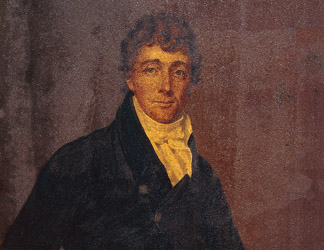
Francis Scott Key
Francis Scott Key
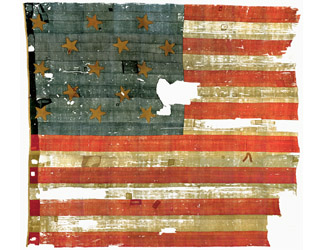
The one that became the Star-Spangled Banner was a 30 x 42–foot garrison flag; the other was a 17 x 25–foot storm flag for use in inclement weather. Pickersgill, a thirty-seven-year-old widow, was an experienced maker of ships’ colors and signal flags.

She filled orders for many of the military and merchant ships that sailed into Baltimore’s busy port.

Helping Pickersgill make the flags were her thirteen-year-old daughter Caroline; nieces Eliza Young (thirteen) and Margaret Young (fifteen); and a thirteen-year-old African American indentured servant, Grace Wisher.

Pickersgill’s elderly mother, Rebecca Young, from whom she had learned flagmaking, may have helped as well.

Pickersgill and her assistants spent about seven weeks making the two flags. They assembled the blue canton and the red and white stripes of the flag by piecing together strips of loosely woven English wool bunting that were only 12 or 18 inches wide.

On September 14, 1814, Baltimore’s Fort McHenry withstood an attack against all odds and the sight of a huge American flag celebrated a crucial victory over British forces during the War of 1812. 

The sight of those “broad stripes and bright stars” inspired Francis Scott Key to write a song that eventually became the United States national anthem.

Key’s words gave new significance to a national symbol and started a tradition through which generations of Americans have invested the flag with their own meanings and memories.

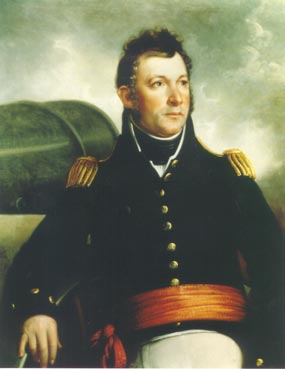
Lt. Col. George Armistead

Lieutenant Colonel George Armistead was the commander of Fort McHenry during the 1814 bombardment.

He became an instant hero after the battle.

While Francis Scott Key's song was known to most Americans by the end of the Civil War, the flag that inspired it remained was a Armistead family keepsake.

It was exhibited occasionally at patriotic gatherings in Baltimore but largely unknown outside of that city until the 1870s.

The flag remained the private property of Lieutenant Colonel Armistead's widow, Louisa Armistead, his daughter Georgiana Armistead Appleton, and his grandson Eben Appleton for 90 years.

During that time, the increasing popularity of Key's anthem and the American public's developing sense of national heritage transformed the Star-Spangled Banner from a family keepsake into a national treasure.

New York stockbroker Eben Appleton inherited the Star-Spangled Banner upon his mother's death in 1878.

The publicity that it had received in the 1870s had transformed it into a national treasure, and Appleton received many requests to lend it for patriotic occasions.

He permitted it to go to Baltimore for that city's sesquicentennial celebration in 1880. After that his concern for the flag's deteriorating condition led him to keep it in a safe-deposit vault in New York.

In 1907 he lent the Star-Spangled Banner to the Smithsonian Institution, and in 1912 he converted the loan to a gift.

Appleton donated the flag with the wish that it would always be on view to the public.

Museums constantly balance the desire to display an object with the need to protect it from the damage created by light, dust, and other environmental factors.

The Smithsonian has had to balance its effort to fulfill his wishes with the need to care for the fragile and damaged object.

As for the Star Spangled Banner?

Besides being a lawyer, Francis Scott Key was a gifted poet.

Documentation

Inspired by the sight of the American flag flying over Fort McHenry the morning after the bombardment, he scribbled the initial verse of his song on the back of a letter.

Back in Baltimore, he completed the four verses and copied them onto a sheet of paper, probably making more than one copy.

A local printer issued the new song as a broadside.

Shortly afterward, two Baltimore newspapers published it, and by mid-October it had appeared in at least seventeen other papers in cities up and down the East Coast.

The Star-Spangled Banner

O say can you see, by the dawn’s early light,
What so proudly we hail’d at the twilight’s last gleaming,
Whose broad stripes and bright stars through the perilous fight
O’er the ramparts we watch’d were so gallantly streaming?
And the rocket’s red glare, the bombs bursting in air,
Gave proof through the night that our flag was still there,
O say does that star-spangled banner yet wave
O’er the land of the free and the home of the brave?

On the shore dimly seen through the mists of the deep
Where the foe’s haughty host in dread silence reposes,
What is that which the breeze, o’er the towering steep,
As it fitfully blows, half conceals, half discloses?
Now it catches the gleam of the morning’s first beam,
In full glory reflected now shines in the stream,
’Tis the star-spangled banner - O long may it wave
O’er the land of the free and the home of the brave!

And where is that band who so vauntingly swore,
That the havoc of war and the battle’s confusion
A home and a Country should leave us no more?
Their blood has wash’d out their foul footstep’s pollution.
No refuge could save the hireling and slave
From the terror of flight or the gloom of the grave,
And the star-spangled banner in triumph doth wave
O’er the land of the free and the home of the brave.

O thus be it ever when freemen shall stand
Between their lov’d home and the war’s desolation!
Blest with vict’ry and peace may the heav’n rescued land
Praise the power that hath made and preserv’d us a nation!
Then conquer we must, when our cause it is just,
And this be our motto - “In God is our trust,”
And the star-spangled banner in triumph shall wave
O’er the land of the free and the home of the brave.

But how did it come about?

Attorney Francis Scott Key witnessed the twenty-five hour bombardment of Fort McHenry from a British troopship anchored some four miles away.  

He had boarded the ship to negotiate the release of an American civilian imprisoned by the British, and had been detained aboard as the bombardment began.  

On September 3rd, 1814, following the Burning of Washington and the Raid on Alexandria, Francis Scott Key and John Stuart Skinner set sail from Baltimore aboard the ship HMS Minden, flying a flag of truce on a mission approved by President James Madison.  

Their objective was to secure the exchange of prisoners, one of whom was Dr. William Beanes, the elderly and popular town physician of Upper Marlboro and a friend of Key's who had been captured in his home.  

Beanes was accused of aiding the arrest of British soldiers. Key and Skinner boarded the British flagship HMS Tonnant on September 7th and spoke with Major General Robert Ross and Vice Admiral Alexander Cochrane over dinner while the two officers discussed war plans.  

At first, Ross and Cochrane refused to release Beanes, but relented after Key and Skinner showed them letters written by wounded British prisoners praising Beanes and other Americans for their kind treatment.

Because Key and Skinner had heard details of the plans for the attack on Baltimore, they were held captive until after the battle, first aboard HMS Surprise and later back on HMS Minden.

At Fort McHenry, some 1,000 soldiers under the command of Major George Armistead awaited the British naval bombardment.

Their defense was augmented by the sinking of a line of American merchant ships at the adjacent entrance to Baltimore Harbor in order to further thwart the passage of British ships.

The attack began on September 13th, as the British fleet of some twenty ships began pounding the fort with Congreve rockets from rocket vessel HMS Erebus and mortar shells from bomb vessels Terror, Volcano, Meteor, Devastation, and Aetna.

After an initial exchange of fire, the British fleet withdrew to just beyond the range of Fort McHenry’s cannons and continued to bombard the American redoubts for the next 25 hours.

All the Americans had to do to stop the bombardment was to lower the fort's American flag, but they didn't.

In fact, even though the flag was battered and war torn, and the flagpole itself was hit - men from inside the fort kept it flying by sacrificing their own lives in the process.

During the bombardment, between 1,500 to 1,800 cannonballs were launched at the fort.

And in the end, the flag was still there, signaling no surrender. 

After the bombardment, certain British gunboats attempted to slip past the fort and effect a landing in a cove to the west of it, but they were turned away by fire from nearby Fort Covington, the city's last line of defense.

During the bombardment, HMS Erebus provided the "rockets' red glare". HMS Meteor provided at least some of the "bombs bursting in air".

On September 14, 1814, as the dawn’s early light revealed a flag flying over the fort, Key exultantly began jotting down the lines of the song that became our national anthem.

Key gave the poem to his brother-in-law, Judge Joseph H. Nicholson, who took the poem to a printer in Baltimore, who anonymously made the first known broadside printing on September 17th - of these, two known copies survive.

On September 20th, both the Baltimore Patriot and The American printed the song, with the note "Tune: Anacreon in Heaven".

The song quickly became popular, with seventeen newspapers from Georgia to New Hampshire printing it.

Soon after, Thomas Carr of the Carr Music Store in Baltimore published the words and music together under the title "The Star-Spangled Banner", although it was originally called "Defence of Fort McHenry".

The song's popularity increased, and its first public performance took place in October, when Baltimore actor Ferdinand Durang sang it at Captain McCauley's tavern.

Washington Irving, then editor of The Analectic Magazine in Philadelphia, reprinted the song in November 1814.

The melody Francis Scott Key used for his song was the popular English tune known as “To Anacreon in Heaven”. Anacreon was an ancient Greek poet noted for his praise of love and wine.

Written about 1775 by John Stafford Smith, the tune was originally the “constitutional song” of the Anacreontic Society, a gentlemen's music club in London. Yes, the tune comes from a drinking song.

The song became extremely popular in America, where it was used to accompany a number of verses, including the patriotic song called “Adams and Liberty,” before 1814.

Key himself used the tune for his 1805 song, “When the Warrior Returns from the Battle Afar.”

After the War of 1812, the successful defence of Baltimore and the battle of New Orleans produced a sense of euphoria over a "second war of independence" against Britain.

The war ushered in an "Era of Good Feelings," in which the partisan animosity that had once verged on treason practically vanished.

Britain is said to have been less affected by the fighting during the War of 1812, but it cannot be denied that its government and people did in fact welcome an era of peaceful relations with the United States.

As for the Star-Spangled Banner?

During the 19th century, “The Star-Spangled Banner” became one of the nation’s best-loved patriotic songs.  

It gained special significance during the Civil War, a time when many Americans turned to music to express their feelings for the flag and the ideals and values it represented.  

By the 1890s, the military had adopted the song for ceremonial purposes, requiring it to be played at the raising and lowering of the colors.

On July 27, 1889, Secretary of the Navy Benjamin F. Tracy signed General Order #374, making "The Star-Spangled Banner" the official tune to be played at the raising of the flag.

During World War I, the War Department ( now called The Department of Defense) established a standard arrangement to be used by U.S. military bands.

This arrangement is the one we have come to know and love.

Despite its widespread popularity, believe it or not, "The Star-Spangled Banner" did not become America's National Anthem until 1931.

Yes, believe it or not, on November 3rd, 1929, Robert Ripley drew a political cartoon in his syndicated cartoon, Ripley's Believe it or Not!, saying "Believe It or Not, America has no national anthem".

In 1931, America's most famous composer and conductor, John Philip Sousa published his opinion in favor, stating that "it is the spirit of the music that inspires" as much as it is Key's "soul-stirring" words.

On March 3, 1931 a law was signed by President Herbert Hoover, and "The Star-Spangled Banner" was adopted as the National Anthem of the United States of America.

Below is a copy of the original that Frances Scott Keys penned to paper.


The Texas Children's Choir performs the National Anthem at the AT&T Center, February 24th, 2010.


Story by Tom Correa

Sunday, September 1, 2013

Dallas Stoudenmire's Murder


It was the aftermath of the Four Dead in Five Seconds Gunfight. Having seen their new Marshal in action, the city of El Paso Board of Aldermen upped his salary to $100 a month. 

The Four Dead in Five Seconds Gunfight made Dallas Stoudenmire a legend in his own time, but it would also eventually have deadly consequences for him. Both dead men, former town marshal George Campbell and Johnny Hale had many friends. Many of who weren't happy with the outcome of the shootout.

Dallas Stoudenmire, on the other hand, although his reputation as a gunman would continue to grow with later gunfights, had few friends in El Paso. In such a situation, as sorry as it is to say, the fact remains that town marshal Stoudenmire would eventually stand alone in his own defense of his actions. It was something that was more the case than not, vendettas were common simply because a justified shooting meant very little in towns of the Old West.

James Manning was a friend of Hale and Campbell. James Manning owned a string of saloons with his brothers. Three days after the famous "Four Dead in Five Seconds Gunfight" on April 17, 1881, James convinced former deputy Bill Johnson to assassinate Marshal Stoudenmire. Johnson was known to have a profound hatred and grudge against Stoudenmire for publicly humiliating him a few days before. 
 
Marshal Stoudenmire started his tenure in El Paso on Monday, April 11, 1881. He was the sixth town marshal in eight months. The City Council asked him to take the city jail keys from deputy marshal and town drunkard Bill Johnson. Witnesses said that Marshal Stoudenmire approached the intoxicated Johnson asking for the jail keys. Johnson mumbled that he would go home and figure out which keys were his and which were the city's, and Stoudenmire became impatient and demanded that he hand over the keys right away. When Johnson hemmed and hawed about it, Marshal Stoudenmire physically turned Bill Johnson upside down and shook him until the keys fell to the ground. Stoudenmire then threw Johnson to the ground and grabbed up the keys. Johnson was publicly humiliated.

Now very late on the night of April 17, an intoxicated Bill Johnson was squatting down hiding behind a pillar of bricks with a double-barrel shotgun waiting to bushwhack Marshal Stoudenmire.

When Johnson heard the voices of Dallas Stoudenmire and Stoudenmire's brother-in-law, Stanley "Doc" Cummings, his legs started to wobble. He fell backward, accidentally firing both shells into the air, narrowly missed Stoudenmire. Stoudenmire immediately drew and fired his Colts. Believe it or not, of the 8 rounds that are said to have hit Johnson, it's said that Stoudenmire shot off Johnson's testicles. Imagine that! As can be expected, Johnson bled to death within a few minutes.

This started a feud between Stoudenmire and the Manning brothers. The Mannings were from Alabama, and George had studied medicine at the University of Alabama and later in Paris, France. George returned from Europe to join the Confederacy with his brother James. There were four Manning brothers, George, James, Frank, and John. For a time, the Manning brothers joined ex-Confederates in exile in Mexico. They then eventually settled in Texas. Known simply as "Doc," George Manning was hot-tempered and had even once got into a knife fight with a rival doctor.

In 1881, James and his brothers Frank and John reunited near Canutillo, Texas, and started a ranch. That ranch was really a safe house for every outlaw and rustler in the area. It's said that by 1882, James made enough money from rustling to purchase the Coliseum Variety Theatre in El Paso. George "Doc" Manning then joined them.

Dallas Stoudenmire was also from Alabama and also served in the Confederacy. He was one of the nine children of Lewis and Elizabeth Stoudenmire. Shortly after the American Civil War began, Dallas enlisted in the Army of the Confederacy, even though he was only 15 years old. And though he was six feet tall, his officers soon discovered his age and discharged him. He then re-enlisted twice more like the Civil War Soldiers and Sailors System Reports a Pvt D. Stoudenmire in Company F of the 17th Alabama Infantry, and a Pvt D. Stowdemire Company C, 6th Alabama Cavalry. Apparently, he was eventually allowed to serve as a Private in Company F, 45th Alabama Infantry Regiment. According to surviving records, by the war's end, he stood 6'4" tall and had been wounded at least twice since he carried at least two bullets in his body for the remainder of his life.

Following the war, Stoudenmire drifted to the SouthWest and served for at least three years with the Texas Rangers. He had a reputation for being handsome, a sharp dresser, and a gentleman around ladies. But when intoxicated, he could be extremely dangerous and had a quick temper. He was known for his habit of wearing two guns and being equally accurate with either hand.

He disappeared from the records between 1874 and 1878, possibly residing in Mexico for a time. He was able to speak Spanish fairly well and is known to have worked during the years immediately after the war as a sheep farmer, a wheelwright, a proprietor of a general store, a merchandiser, and even a carpenter. 

He resurfaced when he served as a Town Marshal for Socorro, New Mexico. While employed there, his brother-in-law and El Paso, Texas, resident Stanley "Doc" Cummings, convinced him to take up a job as town marshal in El Paso. The city was seeking to hire an outsider with a "rough reputation". At that time, El Paso was a remote lawless boomtown.

Stoudenmire traveled to El Paso by stagecoach and was soon hired. This was the beginning of the end of a wild and violent El Paso and the beginning of his fame. Within six days of his having started his job as town marshal, Stoudenmire had killed four men, one accidentally. Between the killing of Bill Johnson and the following February, Marshal Stoudenmire killed another six men in shootouts during arrests and the city's crime rate dropped dramatically. As for Stoudenmire's reputation as both a lawman and a gunman, both increased to legendary status.

On February 14, 1882, James Manning killed "Doc" Cummings, supposedly while acting in self-defense after an earlier argument that evening had escalated. 

Manning claimed that Cummings had pulled his pistol and verbally threatened to kill him outside the saloon when an innocent bystander walked by. Cummings whirled and growled, "Now, are you not one of his friends?"

The bystander squealed his innocence, but Cummings allowed him to go provided that he walked with his arms up in the air into the darkness of night. Cummings then turned and realized that Manning had gone back inside the saloon. Cummings entered and again verbally threatened to kill him. Manning left the bar briefly and appeared in the hallway.

This time Manning was armed with his pistols drawn on Cummings, and snapped, "We will settle this for now and all."

In an instant, gunfire erupted from both sides. Cummings was struck and staggered out across a wooden sidewalk, toppling backward onto the dusty street as he screamed in agony then died.

Manning was acquitted in a trial attended by many friends of the Mannings. This enraged Stoudenmire. And really, it's said that unfortunately for the city of El Paso, his brother-in-law Stanley "Doc" Cummings had been the only man able to confront or control Stoudenmire's fierce temper. 

It was then that Stoudenmire began to publicly confront those responsible for James Manning's acquittal and caused many to avoid coming into town or visiting saloons for fear of running into an enraged Stoudenmire. Despite his prowess and expertise with handguns and his effectiveness as a lawman, Stoudenmire was still an outsider.

He was well respected by the Texas Rangers and the U.S. Marshals. But as for locally, he had several things against him. Stoudenmire was an "outsider" and not from El Paso, had no family there other than his own family and his now deceased brother-in-law "Doc" Cummings. The Mannings, on the other hand, had been in El Paso longer and had many friends in the city government. 

Stoudenmire had only two things in his favor. First, he had dramatically lowered El Paso's violent crime rate more than any who came before him. And second, people truly feared him. In fact, it became fairly apparent fairly quickly that the more people Stoudenmire killed to clean up El Paso, the more people feared him so much that they wanted him either fired or dead.

On May 27, 1882, the town council announced the firing of Stoudenmire. He walked into the council hall, some say half-drunk, and dared them to take his guns or his job. He pulled and twirled his guns and threatened, "I can straddle every God-damned alderman on this council!"

They attempted to calm him by telling him he could keep his job. But after sobering up, Stoudenmire resigned on his own on May 29, 1882. He then became a proprietor of the Globe Restaurant, which belonged to Cummings. But no, that was not the end of his being a lawman. The fact is, Dallas Stoudenmire was then appointed Deputy U.S. Marshal for Western Texas and New Mexico Territory.

For a few short months, Stoudenmire served well as a Deputy U.S. Marshal. But however, the feud was far from over. The Mannings, mainly George "Doc," James, and Frank, were careful to never confront Stoudenmire alone. Despite their hatred of him, he had shown his skill with a gun on several occasions. And that made them weary.

Their fear did not go unnoticed by Stoudenmire, who once mocked them in public while standing outside of a saloon. Stoudenmire is said to have stood defiant in the street, daring them to come outside and fight him. They remained inside a saloon while other residents attempted to convince Stoudenmire to go away and sleep off his intoxication. Eventually, he grew tired, called the Mannings "Cowards," and left.

Drunk and resentful, Dallas Stoudenmire went to the Manning saloon on the morning of September 18, 1882. He confronted three of the Manning brothers, James, Frank, and George, aka "Doc."

Some say on September 18, 1882, Dallas Stoudenmire and Geroge "Doc" Manning met in a local saloon and bellied up to the bar to have a "peace talk" and that James and Frank left soon as Dallas arrived, leaving Doc to talk with him. Others say Dallas Stoudenmire's anger had over-ridden his sense of security, and he walked into an ambush. 

Either way, this time, Stoudenmire was at a disadvantage. It's said he was drunk when an argument started between him and "Doc" Manning. And probably unknown to Stoudenmire, his would-be killer "Doc" Manning already had his hand on a small caliber pistol in his pocket. As for James Manning, some say he was lying in wait nearby, ready to ambush Stoudenmire. Either way, the deck was stacked against Dallas Stoudenmire.

Stoudenmire started off by saying, "Doc, someone or somebody has been going about telling lies...".

George "Doc" Manning replied, "Dallas, you have not kept your word."

"Whoever says I have not tells a damn lie," Stoudenmire roared.

When Manning made a move for a second gun, Stoudenmire went for his pistol, but then George Manning fired twice from the hidden pistol inside his pocket. Stoudenmire's friend tried to push both men, causing Stoudenmire to lose his balance and Doc's bullet hit Stoundenmire in his left arm.
A second-round barely penetrated Stoudenmire's skin because of papers folded heavily in his shirt pocket.

Nevertheless, the second shot, along with being pushed, had knocked Stoudenmire down, and he stumbled through the saloon's batwing doors and into the street. As he fell outside the doorway, believe it or not, Stoudenmire was still able to pull one of his pistols with his right hand and shot "Doc" Manning in the arm.

Some say that Dallas Stoudenmire and George "Doc" Manning got into a fistfight and wrestled in the street for a while. Facts point to Stoudenmire recovering just long enough to shoot Doc Manning through the right arm. That knocked Manning's gun from his grasp.

But Doc Manning, knowing that he was a dead man if Stoudenmire let off another shot, grabbed the wounded Stoudenmire with both arms and wrestled with him. Thus, he pinned Stoudenmire's gun hand to his side. There was a reason he did so.

At that moment, James Manning came out of hiding from behind Stoudenmire. James Manning fired two quick rounds. One hit a barber's pole, and the other hit Dallas Stoudenmire in the head behind his left ear -- killing him instantly.

It was an ambush. James Manning was waiting for Stoudenmire outside and shot twice at the wonded Stoudenmire who was on the ground. It was as if he executed him. The first shot missed and hit a barber pole, and the second hitting Dallas Stoudenmire in the head. As I said before, killing him instantly.

To show you how mean and nasty George Manning was, it's said that after James had shot Stoudenmire in the head - Geroge grabbed a gun and began pistol whipping the dead Stoudenmire.


Dallas Stoudenmire had the barrel of this 1860 Colt Army revolver sawedoff so the gun could be concealed. The Colt was retrieved from the El Paso street where Stoudenmire was killed in a shootout on September 18, 1882

A funeral ceremony for Dallas Stoudenmire was held at El Paso's Masonic Lodge #130. His wife Isabella then had his body shipped to Columbus, Texas, for burial. All funeral expenses were paid for by the Masonic Lodge. According to the website Find A Grave, Stoudenmire is buried in the Alleyton Cemetery in Colorado County, Texas.

James Manning was tried for murder, but believe it or not, he was acquitted. Yes, even back then, if you had money and influence - you could get away with murder. Of course, it also helped that the whole jury was made up of Manning's friends.

The Mannings continued to live in El Paso. It is ironic that when Assistant City Marshal Thomas Moad was killed while investigating a disturbance at a local brothel on July 11, 1883, believe it or not, Frank Manning was appointed to replace him.

Frank Manning only kept the job temporarily because everyone learned that he never arrested friends and acquaintances, even if they were caught dead to rights. Frank Manning died in an insane asylum.

As for James Manning? Everyone saw him shoot Stoudenmire in the back of the head. The fallout from the killing of Dallas Stoudenmire in that manner made El Paso an uncomfortable place for James Manning, even though he had a lot of friends there. Because of that, James Manning relocated to Seattle, Washington, and bought a saloon there. When the saloon was destroyed in a fire, James Manning moved to the Los Angeles area and became an investor in mining properties near Parker, Arizona. James Manning is said to have died in Los Angeles after suffering from cancer for a very long time. James Manning was destitute, alone, and ravaged by cancer when he died.

After being shunned by locals who weren't of the criminal ilk, George "Doc" Manning resumed his medical practice near Flagstaff, Arizona. Like his brother James, he too died pennyless in 1925. He is buried in the Citizens Cemetery in Flagstaff.

While it is said that the killing of Dallas Stoudenmire was soon all but forgotten, the legend of Dallas Stoudenmire grew and lives on today. He was born on December 11, 1845, and died on September 18, 1882. He became the City Marshal of El Paso on Monday, April 11, 1881. He was the sixth town marshal in eight months. City Marshal Dallas Stoudenmire has been credited for successfully taming one of the most violent towns in the Old West. The man who tamed El Paso, Texas, gained fame for a brief gunfight that was later dubbed the "Four Dead in Five Seconds Gunfight."

Today, he is known for being an American Old West gunfighter and lawman. To their credit, the El Paso Police Department acknowledges and pays tribute to the legendary Marshal Stoudenmire for his accomplishment.

Although lesser known than many other Old West gunfighters today, unlike Wyatt Earp, Dallas Stoudenmire really was a well-known legend in his own time. He had a deadly reputation in his day and was involved in more gunfights in his time as a lawman than most of his better-known contemporaries.

As far as lawmen go, very few could match him.


In May 2001, Dallas Stoudenmire's Smith & Wesson American, serial number 7056, sold at auction for $143,000. His El Paso city marshal's badge sold for $44,000 in a separate lot.

Tom Correa


Saturday, August 31, 2013

Dallas Stoudenmire & The 4 Dead In 5 Seconds Gunfight

The Four Dead in Five Seconds Gunfight was a famous gunfight that occurred on April 14, 1881, on El Paso Street, El Paso, Texas. Just a few days earlier on April 11th, 1881, Dallas Stoudenmire became the sixth man in eight months to hold the office of El Paso City Marshal.

The 36-year-old Stoudenmire had spent the previous years using his considerable gunfighting talents on both sides of the criminal justice system. His time as the law in El Paso would be similarly checkered. The fact is only three days after he took office, he would be at the center of one of El Paso's most notorious gunfights. Most who witnessed the gunfight generally agreed that the incident lasted no more than five seconds after the first gunshot. If that sounds like a very short amount of time, it is. In fact, it's one of the very few gunfights that was shorter in time than the later famous gunfight near the O.K. Corral which took only about 30 seconds.

On the day of the "Four Dead in Five Seconds Gunfight," a posse of about 75 heavily armed Mexicans galloped into El Paso looking for two missing Vaqueros named Sanchez and Juarique. The Vaqueros had been searching for 30 head of stolen cattle when they went missing. 

Solomon Schutz, Mayor of El Paso, made an exception for the Mexicans, allowing them to enter the city limits with their firearms. Gus Krempkau, an El Paso County Constable, accompanied the posse to the ranch of Johnny Hale, a local ranch owner and suspected cattle rustler, who lived some 13 miles northwest of El Paso in the Upper Valley. The corpses of the two missing men were located near Hale's ranch and were carried back to El Paso. 

A court in El Paso held an inquest into the deaths, with Constable Krempkau, who was fluent in Spanish, acting as an interpreter. The verdict was that Sanchez and Juarique had been in the vicinity of Hale's ranch looking for the stolen cattle. The court determined that the American cattle rustlers, among them Hale, had feared that the men would discover the cattle and return with a larger force.

Two American cattle rustlers, Pervey and Fredericks, were accused of the murders of Sanchez and Juarique after they were overheard bragging about killing two cowboys when they found them trailing the herd to Hale's ranch during the night of April 13th - or in the early morning of the 14th.

Meanwhile, a large crowd had gathered in El Paso, including John Hale and his friend, former town Marshal George Campbell. There was tension between some of the Americans, concerned about the Mexicans being heavily armed within the city, and the Mexicans, who wanted justice for their two murdered comrades.

At the inquest, Pervey and Fredericks were formally charged with the murders and immediately arrested. The court was adjourned and the crowd dispersed. They were scheduled for trial at a later date. The 75 Mexicans rode quietly back to Mexico with the bodies.

Marshal Dallas Stoudenmire was present in the courtroom. Then after the court adjourned, he walked across the street for dinner. Constable Krempkau went to a saloon next door to retrieve his rifle and pistol.  There, a confrontation took place with George Campbell over remarks allegedly made by Campbell about Krempkau’s translations and his apparent friendship with the Mexicans.

John Hale, who was reportedly unarmed, was heavily intoxicated and was also upset with Krempkau’s involvement in the matter. Hale grabbed one of Campbell's two pistols and yelled, "George, I've got you covered!" He then shot Krempkau, who reeled backward.

Slumping against a saloon door, Krempkau drew his own pistol. 

Marshal Stoudenmire heard the shot, pulled his Colt 45s, and ran toward the gunfight, firing at Hale but hitting an innocent Mexican bystander. It's true, jumping up from his dining chair at the Globe Restaurant and pulling out his pistols, he ran out into the street. And while running, Marshal Stoudenmire fired once wildly. It was then that he killed Ochoa, an innocent college-educated Mexican bystander, who was running for cover.

John Hale jumped behind a thick adobe pillar, but as he peered out from behind it, Stoudenmire shot him between the eyes, killing him instantly. 

Campbell stepped from cover with his pistol drawn, saw Hale topple down, and yelled to Stoudenmire that it wasn't his fight.

Constable Krempkau, mistakenly believing that Campbell had shot him, then fired his pistol twice at Campbell before losing consciousness. The first bullet struck Campbell's gun and broke his right wrist, while the second hit him in the foot. Campbell screamed and scooped up his gun from the ground with his left hand. But, Marshal Stoudenmire whirled and fired.

Campbell dropped his gun again, grabbed his stomach, and toppled to the ground. Stoudenmire walked slowly toward Campbell and is said to have glared down at him.

In agony, former marshal Campbell yelled, "You big son of a bitch! You murdered me!"

Stoudenmire said nothing. Campbell and Krempkau both died within minutes. During the "Four Dead in Five Seconds Gunfight," Marshal Dallas Stoudenmire accounted for three of the four fatalities with his twin .44 caliber Colt revolvers. In just a few seconds, four men lay dead or dying. 

As for reports that there were three Texas Rangers standing nearby during the incident? There were, but they did not take part in the fight. In fact, they later said they felt Stoudenmire had the situation well in hand.


Tom Correa


Thursday, August 29, 2013

Newly-discovered image shows Billy the Kid, claims historian

Published August 29, 2013
FoxNews.com


TheKid.jpg
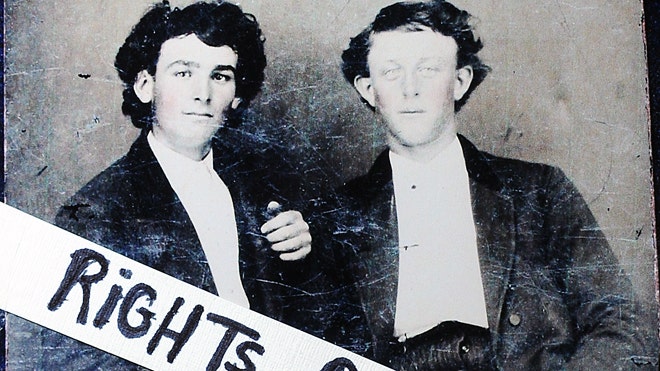
Could that be the legendary William Bonney on the right? One historian is sure it is. (Las Cruces Sun-News)

An old, but recently discovered photo shows two men standing together in what historians figure must be about 1879, and there's new evidence that the man on the right is none other than Billy the Kid..

If true, it would be only the second known image of the Wild West gunslinger. The other one has already fetched millions of dollars at auction.

"It’s finally a good image of the Kid that reveals a young man as people who remembered him described him – not as the famous bucktoothed Billy we know so well." - Historian Frank Parrish

New Mexico historian Frank Parrish, of Las Cruces, revealed the new image, made from a tintype owned by a Mesilla Valley man who wishes to remain anonymous.

And Parrish has done some extensive research to back up his claim that the man on the right is the legendary gunfighter who was also known as William Henry McCarty Jr., William Bonney and Henry Antrim.

Much of it is based on identifying the man on the left, as Dan Dedrick.

“The other individual had remained unidentified until recently when I identified him as Dan Dedrick, a very close friend of Billy’s. Identification of Dedrick is the ‘clincher’ in this image, elevating a near-certain image to a clearly and obvious picture of the Kid," Parrish told the Albuquerque Journal.

"It’s finally a good image of the Kid that reveals a young man as people who remembered him described him – not as the famous bucktoothed Billy we know so well."

Billy the Kid would have been about 20 years old when the picture was taken - with less than two years left on the planet.

The only known photo of the youthful Billy was a tintype owned by Dedrick's family for years and then sold for $2.3 million to Palm Beach, Fla., businessman William Koch in 2011 at Brian Lebel’s Annual Old West Show and Auction in Denver.

In that photo, Billy is packing a Colt revolver and trademark 1873 Winchester carbine rifle.

It's the Dedrick connection that convinced Parrish he had the second known picture of Billy, who was born Nov. 23, 1859, in New York and died July 14, 1881, in Fort Sumner.

“There are many purported photo images of Billy the Kid, but only one that is acknowledged by leading historians – until now,” Parrish told the paper.

“The famous standing bucktoothed Billy photograph was originally given to Dan Dedrick by Billy. It was not known until now that the same Dan Dedrick had his photo taken with his pal.”

The newly surfaced tintype was once part of the estate of Pat Garrett, the sheriff who shot and killed Bonney.

Parrish was asked by the current owner to authenticate it and determined the lesser-known man was definitely Dedrick.

“Identification of Dedrick is the ‘clincher’ in this image, elevating a near-certain image to a clearly and obvious picture of the Kid," he said.

"It’s finally a good image of the Kid that reveals a young man as people who remembered him described him – not as the famous bucktoothed Billy we know so well,” Parish said.

Parrish expects “there will be skeptics," but he has no doubts. “It’s Billy,” he said.


Little Known Old West Gunmen & Outlaws - Part Two


As I said in Part One, here are some gunmen and outlaws who never made it big in the minds of the public.

And yes, the reasons are many - but basically some did the crime but didn't have the name recognition that Dime Novelists wanted.

Others of course simply didn't live long enough to find their own biographer and rewrite their own history - like say how Wyatt Earp did his.

Vicente Silva

In Las Vegas, New Mexico, though it was just not so apparent to the town's citizens, they didn't notice a marked increase in cattle rustling. By the late 1880's entire herds were disappearing.

Led by a man named by Vicente Silva, a respected saloon owner of the Imperial Saloon, the group was called the Silva's White Caps, or Forty Bandits; or sometimes, the Society of Bandits.

Often meeting in Silva's saloon, the gang held the area in a virtual stranglehold until October, 1892. At that time the Las Vegas citizens hanged a fellow gang member named Pat Maes. Soon thereafter the bandit group gradually disintegrated.

Silva was eventually murdered by former members of his gang and was buried at Camp de lost Cadillos on May 19, 1895.

Juan Soto alias "The Human Wildcat"

Juan Soto, who's alias was "The Human Wildcat," was part Indian and Mexican. He was said to be a very large, ugly man, who was a notorious California thief and murderer.

In 1871 he was involved in a killing in Alameda County, and Sheriff Harry Morse made Soto the subject of one of his relentless manhunts. Morse found Soto several months later, and following a spectacular pistol duel, the fugitive was shot to death while running toward Morse's Henry rifle yelling insanely!

Some animals just need to be shot!

William Larkin "Billy" Siles

William Larkin "Billy" Stiles was a young gunman, who rumored to have killed his father at the age of twelve, who gained notoriety in the Southwest at the turn of the century. After assisting lawman Jeff Milton, he was hired by Burt Alvord, marshal of Wilcox, Arizona.

The two law officers soon organized a gang of train robbers, however, including Three-Fingered Jack Dunlap, George and Louis Owens, Bravo Juan Yoas. and Bob Brown. Stiles and Alvord eventually were exposed, and the next few years brought a series of chases, arrests, and escapes.

In 1904, Alvord was captured, but Stiles fled the country and worked his way finally to China.

He soon returned to the United States, where he was killed while working as a Nevada deputy sheriff under the alias "William Larkin." Yes, Alvord was crooked - and his deputy was as well!

William Towerly

One Sunday morning on November 29, 1887, the two deputies found Smith with his gang, Lee Dixon, his brother-in-law, Dixon's wife and William Towerly in a tent near the Arkansas River.

The outlaws had the advantage in numbers and firepower so they knew it was to their benefit to stand their ground in a gunfight.

Dalton and Cole rushed the tent knowing the outlaws had very little protection from within. The lawmen were surprised when they ran into a heavy barrage of gunfire.

Frank Dalton was the first to be hit as a slug tore into his chest driving him to the ground. Towerly, seeing the fallen officer ran directly toward Frank Dalton shooting him several times in the head as he passed over him. As the smoke cleared, Dixon also lay seriously wounded on the ground with Towerly making his escape.

Towerly made his mark as a gunman by killing two peace officers in separate shootouts, although he was himself shot to death in his last fight.

Towerly's escape was brief for the lawmen were on his trail finding him near his home at Atoka, Choctaw Nation. Towerly fought to his death for he knew killing a deputy marshal meant a trip to Judge Parker's gallows.

Joe Walker

Walker's father, a Texas rancher, died when Joe Walker was still an infant. His mother had turned their property over to her brother, a Dr. Whitmore, to manage.

About 1870 Whitmore merged the Walker herd with his own and moved to a ranch in northern Arizona, where he was soon killed in an Indian raid.

Whitmore's widow sold out and migrated with her sons, George and Tobe, to Carbon County, Utah, where they became a prominent banking and ranching family.

When Walker's mother died, he went to Utah to make a property settlement with the Whitmores.

They denied any relationship or property claims by Walker, and he found employment at local ranches and at a Huntington sawmill and began to hound the Whitmores.

After a shooting incident in 1895 Walker threw in with outlaws at nearby Robbers Roost and began to rustle cattle and horses.

He frequently stole stock from the Whitmores, but on one such raid an accomplice named C. L. ("Gunplay") Maxwell informed the authorities of Walker's whereabouts after the two outlaws quarreled.

Walker managed to escape only after a lengthy chase and siege.

A few months later, on April 21, 1897, Walker cut telegraph wires and otherwise aided Butch Cassidy's Wild Bunch in pulling off the eight-thousand-dollar Castle Gate payroll robbery.

About one year later, following another raid on Whitmore livestock, Walker was chased by a nine-man posse in Utah.

Encamped near the town of Thompson with a passing cowboy named Johnny Herring, Walker bedded down for the night with his gun in his blankets. But the posse surrounded the camp during the night, and when Walker stirred at dawn, the lawmen opened fire.

Walker and Herring, who was assumed by the posse to be Butch Cassidy, were riddled with bullets and died in their bedrolls.

Nathaniel Ellsworth Wyatt

The son of an Indiana farmer, Nathaniel Ellsworth Wyatt moved with his parents and brother to Oklahoma in 1889.

After his brother, Nim "Six-Shooter Jack", was killed in Texline, Texas, Zip turned bad. He was involved in several fatal shootings and began robbing stores, post offices, and trains.

He took refuge in Indiana, but was tracked down and arrested by Chris Madsen. He escaped from jail in Guthrie, but in 1895 a posse surprised and shot him.

Ben Gravens

Often called the last of the notorious Oklahoma outlaws, Ben Cravens was the troublesome son of farmer B. B. Cravens.

Ben ran away to the lawless Indian Territory after being jailed for tearing up the local school. He became a horse thief, whiskey runner, and train robber. Frequently arrested, he just as frequently escaped from jail.

He broke out of custody in Lineville and Corydon, Iowa, Guthrie and Tecumseh, Oklahoma, and Lansing, Kansas.

Cravens was married to a Missouri girl and worked as a farmhand for a time, but he was arrested under an alias for stealing hogs, and when his true identity was revealed, charges were brought against him.

He was given a life sentence, although he won parole as an old man.

Jack Dunlap alias "Three-Finger Jack"

Jack Dunlap, alias "Three-Fingered Jack," was a notorious Arizona outlaw about the turn of the century. Captured in 1895, he soon was loose again, and he joined the bandit gang of Black Jack Christian. Later Dunlap became involved with the Burt Alvord-Billy Stiles band of train robbers.

Burt Alvord and Billy Stiles were both lawmen who were also outlaws, Jack Dunlap joined up with them and the Owen brothers, Bravo Juan Yaos, Bob Brown.

During a train robbery in Fairbank, Texas, the train pulled into the station and as the crowd was milling about, the outlaws mingled with the crowd pretending to be drunken cowboys.

Sheriff Jeff Milton was standing in the open door of the baggage car when the outlaws opened fire with lever-action Winchesters, shattering his left arm and severing an artery.

Unable to return fire because of the innocent by-standers Milton grabbed his shotgun and waited for his chance. The outlaws took the opportunity to charge the train in all the confusion,  and instead were met with buckshot.

Three-Finger Jack caught a load of buckshot in the chest. And though he died, it was only after confessing who the gang members were.

Tranquellano Estabo

Within a few months in 1895 this notorious Mexican outlaw was involved in three gunfights. Near Phoenix, N.M., Tranquellano Estabo and some friends got into a fight with Walter Paddleford and some other men.

Three of the Mexicans were killed in the shootout, but Estabo escaped unhurt. A few months later, after mortally wounding a man during a card game in a Phoenix saloon, Estabo went into the street and began shooting his pistols.

When ordered to stop by Sheriff Dee Harkey and his assistant Cicero Stewart, Estabo replied with gunfire. When Estabo jumped on his horse and tried to escape, Harkey gave chase.

Just three miles out of town, Estabo was forced to surrender.

The frightened gunman was returned to town where he was nearly killed by Stewart. Estabo's life was spared and he was put in jail to await trial.

Chris Evans

Chris Evans was a Californian who owned a farm near the mine of George and John Sontag, a pair of train robbers. In 1892, Evans helped the Sontag brothers escape from a posse, and after George was captured, Evans teamed up with John in stopping stagecoaches.

They claimed that they were searching for lawmen to kill, but they seemed to have no compunctions against seizing whatever loot was available. The manhunt continued for nine months, and the two fugitives shot their way out of trap after trap, wounding seven deputies in the process.

When they were finally apprehended, John was killed, and Evans, once he recovered from his wounds, was sentenced to life in prison.

On December 3, 1893, he managed to escape, but he was recaptured the following February and was returned to his cell.

David Lyle Kemp

As a youth in Hamilton, Texas, David Lyle Kemp killed a man named Smith. Kemp was sentenced to be hanged, and in panic he tore away from his guards and jumped out of a second story courtroom window.

He broke both ankles in the fall, but somehow clambered onto a horse before being surrounded and recaptured. However, because of his age the governor commuted his sentence to life, then gave him a full pardon.

Kemp drifted into New Mexico, opened a butcher shop in Eddy which is present day Carlsbad, acquired an interest in a gambling casino in nearby Phoenix, and believe it or not actually became sheriff when Eddy County was organized in 1889. He conducted his office in the interests of his gambling cohorts, and the county became quite rowdy.

Dee Harkey was appointed deputy U.S. marshal to subdue the area, and Kemp and his friends threatened and on more than one occasion tried to kill the troublesome lawman. Kemp also bought a ranch in the vicinity and turned to rustling to increase his ranching and butchering profits.

He was cuaght red-handed by Harkey one night and agreed to leave the country. He stayed in Arizona for a few years, but returned when an old enemy, Les Dow, was elected sheriff of Eddy County.

Kemp killed Dow, took up rustling again, and eventually returned to Texas to a ranch near Higgins. There he was shot and killed by his sister during the 1930's. Yes, in the 1930's!

Steve Long

Steve Long, alias "Big Steve," had a background that was pretty obscure. But, at six-foot, six-inches, the northerner established himself as a vicious gunman in Laramie.

In 1867, Long obtained a postion as deputy marshal of Laramie and participated in a pair of bloody gunfights within two months.

Steve Long, was a professional gunfighter who teamed up with brothers Ace and Con Moyer establishing a saloon in Laramie City, Wyoming.

The Moyer brothers founded the town, appointing themselves as justice of the peace and marshal, respectively. Steve Long was made the deputy marshal.

With six guns, they ruled with an iron hand. The trio dished out "justice" in the backroom of the saloon, ordering ranchers to sign over deeds to their lands and miners to hand over their claims.

Those who refused were shot to death by Long on the pretense that the victim reached for a weapon. Numerous others were killed when they objected to crooked card games run at the saloon. The townsfolk began to refer to the saloon as "The Bucket of Blood."

Meanwhile, a local rancher by the name of N.K. Boswell began talk of forming a vigilante group to put the trio out of business.

Long also was in the habit of moonlighting as a thief, and on October 18th, 1868, he attempted to ambush and rob prospector Rollie "Hard Luck" Harrison. In the ensuing gunfight, Long was shot and he retreated.

Back in Laramie City, Long's fiancĂ©e treated the wound but was incensed when Long told her how he received it. She told the vigilante group about Long's attempted robbery.  Nice gal huh?

Wasting no time the group stormed into The Bucket of Blood on October 28th, 1868, seizing Long and the Moyer brothers.

Dragging them to a partially finished cabin, they began to string them up to the rafters. But before he could be strung up Long asked the vigilantes to remove his boots.

His last words were "my mother always said that I would die with my shoes on."

They promptly hanged him from a telegraph pole with his bare feet dangling, and his fiancee, that sweet gal, put up a marker to his somewhat tarnished memory.

Port Stockton

Born the son of a Texas rancher, Port Stockton and his older brother Ike early on demonstrated a leaning toward the wild side of life.

At seventeen years of age, Port assaulted a man and was charged with attempted murder - but older brother Ike helped him to escape the law.

Port drifted to Dodge City, then in 1874 he went to Lincoln County, New Mexico, where Ike had opened a saloon.

Ike was raising a family, and Port soon married a Baptist preacher's daughter named Irma. But within two years, the brothers had moved to Colorado and settled in Trinidad.

In October, 1876, Port got into a shooting scrape in Cimarron, New Mexico, and Ike had to spring him with a predawn jailbreak.

Two months later there was another gunfight in Trinidad, and the Stocktons hastily moved to Animas City, Colorado. Seems like they were running out of towns.

Port gambled for a while, then secured an appointment as city marshal. But marshal or not, he was run out of town after he angrily chased and fired his pistol at a Negro barber who had accidently nicked him with a razor during a shave.

He briefly held the marshal's job in Rico, Colorado, but he was forced to leave there, too, when his past caught up with him.

Port next moved his wife and two small daughters to a shack just outside Farmington, New Mexico.

Port teamed up with a pair of hard cases named Harge Eskridge and James Garret, and the trio was widely suspected of rustling. Then the three undesirables shot up a New Year's Eve party after being thrown out, and hard feelings grew.

Port was killed in the violence that followed, and Ike swore revenge.

There was an outbreak of rustling soon thereafter, and when certain area citizens were shot up, Ike was blamed and Governor Lew Wallace issued a reward for his arrest.

In September, 1881, Ike was shot in the leg in the streets of Durango, and he died following amputation.

Tough luck for the tough guy!

Robert T. Tucker

I just read in some maginzine dedicated to Old West History that contrary to popular belief Horse Thiefs were not really "a hanging offense."

So why do I laugh at writers who come up with stuff like that? Well, I think that bullspit opinion would have been interesting news to Robert Tucker.

Nothing is known about him other than the fact that he's proof that the 1800's were tough on bad guys and horse thieves. After being caught by vigilantes for stealing a horse, he was hung as a horse thieve.

"Alleged" or not, he was still hung for it!


For more information of Little Known Old West Gunmen & Outlaws, don't hesitate to visit:

Little Known Old West Gunmen & Outlaws - Part One

Little Known Old West Gunmen & Outlaws - Part Three

This information was compiled from multiple sources.

Thanks for visiting!

Tom Correa

Wednesday, August 28, 2013

Great Country Music Voices - Marty Robbins


Marty Robbins 1966.JPG

Born Martin David Robinson, the world knows him professionally as simply Marty Robbins.

He was born on September 26th, 1925, was born in Glendale, a suburb of Phoenix, in Maricopa County, Arizona.  

At the age of 17, he left home to serve in the United States Navy in the dangerous role of an LCT coxswain during World War II.    

He was stationed in the Solomon Islands in the Pacific Ocean. To pass the time during the war, he learned to play the guitar, started writing songs, and came to love Hawaiian music.

After his discharge from the Navy in 1947, he began to play at local venues in Phoenix before moving on to host his own show on KTYL.

After that, he then began his own television show on KPHO-TV in Phoenix. Then right after singer Little Jimmy Dickens made a guest appearance on Robbins' TV show, Dickens got Robbins a record deal with Columbia Records.

Marty Robbins became known for his appearances at the Grand Ole Opry in Nashville, Tennessee, and much more.

He was an American singer, songwriter, and multi-instrumentalist.

While some know that he was indeed one of the most popular and successful country and Western singers of all time, his Gunfighter Ballads and Trail Songs was the single most influential album of Western songs in post-World War II American music.

And yes, for most of his nearly four-decades long career, Marty Robbins was rarely far from the top of the country music charts. Several of his songs also became pop hits over the years.

On December 8th, 1982, Marty Robbins passed away because of complications following cardiac surgery.

His voice is legendary. His song will stand the test of time. And as for country music today, his voice has surely been missed.

 
   El Paso ( The Full Version)

                                              Ghost Riders In The Sky

                                 Big Iron

                                           Devil Woman


    Little Joe The Wrangler


                                      Ride Cowboy Ride


She Was Young And She Was Pretty


Yes, after listening to his music, don't you agree that rock has taken over country music - and not for the better.


Story by Tom Correa