A town rose out of Ed Schieffelin's discovery in the San Pedro Valley. It took the name of Schieffelin's first mine and called itself "Tombstone."
Of course, it's said that for more than a thousand years before Ed Schieffelin's discovery, local Indian tribes mined clay, cinnabar, copper, turquoise, and silver. Spanish conquistadors arrived in the 1500s, and they too searched for silver and gold. Spanish missions in Southern Arizona between 1687 to 1711 documented finding silver in the mountains bordering the Santa Cruz Valley, today's Santa Cruz County, Arizona. The Spanish wrote about many mining attempts, but mining was held back because Arizona was the northern fringe of the Spanish frontier and susceptible to Indian attacks. Yes, it was an area plagued by guerilla warfare with the Apaches. That problem limited the Spaniards, just as it would limit Americans from mining and prospecting that area.
American prospectors in more significant numbers started mining the silver deposits that were previously known to the Spanish and Mexicans after southern Arizona became part of the United States when the Gadsden Purchase took place in 1853. Of course, as we all know, American prospecting led to conflicts known as the Apache Wars.
While Apache raids on prospectors and mines are documented, as with life, that which we know about is not always the greatest threat to us. One American prospector who learned that lesson also discovered silver in what is known today as Cochise County, Arizona. His name was Frederick Brunckow. And yes, it's a historical fact that he hit paydirt along the San Pedro River several years before Ed Schieffelin made his discovery.
Frederick Brunckow was born in Germany sometime in 1830. The Prussian-born Brunckow came to the United States in 1850 at age 20 or 21. After attending the University of Westphalia studying to become a mining engineer, Brunckow emigrated to the United States in 1850. He was hired by the Sonora Exploring and Mining Company which took him West.
In 1858, almost 20 years before Ed Schieffelin's discovery, Frederick Brunckow discovered silver about 8-miles southwest of what would become Tombstone right there near the San Pedro River. Right after that, Brunckow left the Sonora Exploring and Mining Company to start his own San Pedro Silver Mine.
In 1858, almost 20 years before Ed Schieffelin's discovery, Frederick Brunckow discovered silver about 8-miles southwest of what would become Tombstone right there near the San Pedro River. Right after that, Brunckow left the Sonora Exploring and Mining Company to start his own San Pedro Silver Mine.
At 28 years of age, Frederick Brunckow hired William M. Williams as his mine superintendent and his cousin James Williams as his mine's machinist. John Moss (although some say his name was Morse) was educated as a chemist. Moss was hired on as the mine's assayer. Brunckow hired a German cook by the name of David Brontrager. He also hired several Mexican laborers.
Brunckow soon built a cabin as sleeping quarters and store for supplies. His mining claim along the San Pedro River was not far from the future site of Tombstone. The small but simple cabin was made of adobe and had a fireplace. It also had a tin roof. It is said that Brunkow was known to be a good employer and friend to all there.
Sadly, Frederick Brunckow was murdered on July 23, 1860. And while the story behind his death is sketchy, we know what William M. Williams reported as taking place.
Seeing what took place, he left the cabin, ran out the door, and went back to Fort Buchanan to report what he had found. Initially, the soldiers believed it was an Apache raid. But when the soldiers arrived at the cabin the next morning, they found two more bodies. John Moss was found dead just outside of the camp. His body was reported as being "ravaged" by animals. Frederick Brunckow was eventually found inside a mine shaft. He was found with a rock drill through him. Williams M. Williams and the soldiers buried Brunckow and the others at the cabin.
The German cook showed up later and surrendered to U.S. Army Captain Ewell at Fort Buchanan. He said that he fled and ran away as fast as he could when the killings started. He then went on to describe how the Mexican laborers robbed the store of supplies after killing the others. He said they found him running away and took him as their prisoner. One story says they released him later because he was a good Catholic. Another story, what seems a little more believable, is that he escaped after they made camp. He made good his escape when the Mexicans got drunk and passed out. He wandered until he found Fort Buchanan.
The murders of Frederick Brunckow, John Moss, and James Williams were never solved. Sadly, justice was never served as their killers were never apprehended.
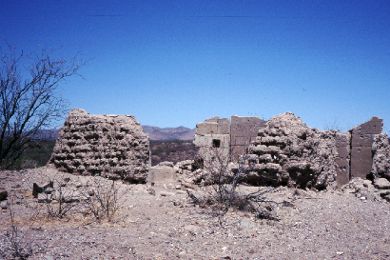
Today, Frederick Brunckow's cabin is referred to as "The Bloodiest Cabin in Arizona History." No, it's not just because Brunckow and his men were killed there. The fact is, Brunckow and his men were not the last to be killed there. In all, it's believed that at least 21 murders took place at or near that cabin between 1860 and 1890. And yes, besides Frederick Brunckow, John Moss, and James Williams, several of those killed have been buried around the cabin. A few of the graves have been identified.
A story related to Brunckow's Bloody Cabin is that of Milton B. Duffield who was the first U.S. Marshal appointed to Arizona Territory. He was born in 1810 in Wheeling, West Virginia. Frankly, from everything that I read about him, people did not like him very much at all. But, though that was the case, he had a reputation for fearlessness and for having great aim with both a rifle and pistols. He was also known to shoot first and ask questions later.
If you've ever wondered just how cautious some lawmen were in the Old West, take a look at U.S. Marshal Milton Duffield. He was known for carrying several firearms and a concealed knife. Believe it or not, one report said he carried at least 9 guns, big and small, while another said he carried 11 of them -- all at the same time. He obviously figured out how to get around reloading during a firefight, just carry more guns.
According to M.B. Duffield, a former well-known inhabitant of Tuolumne, murdered in Arizona. [History of Tuolumne County, 1888], "Duffield had a wife and four children, whom he abandoned to go out West. By 1852, Duffield was in Tuolumne County, California, working in real estate and in the gold mines. Around the same time, he came into conflict with a man named James G. Lyons. One day in 1854, while walking down the road, Lyons and two of his friends spotted Duffield and began firing on him with their sidearms. Duffield, with his 'raw nerve' immediately pulled out his revolver and shot Lyons dead while the other two ran off.
When the Civil War began, Duffield was sent on an exploratory mission to Nicaragua for the United States government. After he returned in 1863, the Lincoln administration appointed him to be the first United States Marshal for the new Territory of Arizona, a post he held from March 6, 1863, to November 25, 1865.
After spending some time working as a special postal agent, in June 1870, two Mexican men entered Duffield's home and tried to kill him with an ax and a knife as he slept. Waking up to a blow to his shoulder, Duffield fought off both attackers and forced them to flee, all after having been struck thirty-one times and losing his right thumb." per History of Tuolumne County, 1888.
A few years after Marshal Duffield retired, he bought the Brunckow cabin and its mining claim. That was in 1873. Immediately after buying the land, cabin, and mine, he found out that the ownership of the property was being disputed by a man by the name of James T. Holmes. Holmes claimed to be the owner and insisted that it was his land. Holmes occupied the cabin and wasn't about to budge. And to make matters worst, Holmes was either a former Confederate soldier or a Southern sympathizer during the Civil War.
Duffield is said to have had a deep hatred for the South and their cause during the Civil War. He hated both Southern soldiers and those who supported the Confederacy. While U.S. Marshal in Arizona during the later years of the Civil War, he helped rid the area of those who he believed were responsible for burning Union Army hay depots and bushwhacking Union soldiers. After the war, some of those Confederate soldiers and sympathizers who fled Arizona -- later returned to occupy the property that was confiscated from them during the war.
While the cabin was not in use and appeared abandoned, Holmes occupied the cabin and was insistent that it was his. Tensions between the two men peaked on June 5, 1874.
It was on that day that the 63-year-old Marshal arrived at Brunckow's Cabin with the intention of evicting Holmes. Duffield dismounted his horse and began walking up to the cabin. Holmes stated that Duffield was "waving his arms and shouting like a madman." Supposedly, that was "his usual manner." He said that because Duffield had a long-time reputation of being "armed to the teeth," and knowing his violent reputation, Holmes grabbed his double-barrelled shotgun before stepping outside to confront Duffield.
Holmes walked out the front door. But, instead of telling Duffield to stop where he was, he shot the old lawman without hesitation. Holmes stated that it was only at that point that he figured out that Marshal Duffield arrived unarmed.
Why was he unarmed? Do I find it strange that a man would go from carrying a lot of guns to carrying no gun at all? Well, we will never know why he was unarmed. And yes, I find it strange that he wasn't packing a gun. I can tell you that losing your right thumb in an era when you need it to cock a single-action pistol is something that can only be seen as a handicap in a gunfight. Of course, besides the fact that he still had his left thumb, there were pistols at the time that were known as "self-cockers" which we call "double-action" pistols. So no, before you write to ask, I really have no idea why he showed up to confront someone unarmed.
So of the 24 or so bodies buried around Brunckow's cabin, the first U.S. Marshal appointed to Arizona Territory, former U.S. Marchal Milton Duffield is buried there in an unmarked grave. As for Holmes, he was arrested. He was tried for murder. And believe it or not, he was only sentenced to 3 years in prison. So yes, this again proves that the myth about "cop killers didn't get off lightly in the Old West" is just a myth.
Here's something else, Holmes escaped before having served any of his time. What's more, it is said that the law in Arizona in 1874 did not make any sort of effort to find Holmes. While Holmes was never seen again, some say the sad reason that no one pursued him was that "no one like Duffield." And yes, if you're wondering, Duffield's murder has also helped foster the cabin's reputation for being haunted since some say the old Marshal haunts the place.
According to one source, the cabin and mine were owned by Clanton gang member Frank Stilwell until he was murdered by the Earp posse on March 20, 1882. And as for reports of other ghosts at Brunckow's cabin, it's said that by as early as the mid-1880s, Arizona newspapers published reports of ghostly apparitions refusing to rest and haunting the cabin. Of course, even back then, newspapers printed embellished tales. As for the many different murders that took place there, who knows how many killings and tragedies were said to have taken place there - but only happened in the imagination of some newspaper writer? No one will ever know.
Today, it's said that local ranchers try to keep the cabin ruins safe from souvenir hunters who want to take pieces of its walls. And no, unlike many other historical landmarks of significance, there is no sign acknowledging what took place there. And frankly, one would think there would be since Frederick Brunckow discovered silver there long before Ed Schieffelin did in 1877.
And as a last note about the Brunckow Cabin, I do find it very interesting that Ed Schieffelin gets the credit for discovering silver in that area. That's especially true when we consider that 17 years after the Brunckow cabin murders, Ed Schieffelin used the Brunckow cabin fireplace to assay samples of his mines.
Tom Correa