Saturday, December 14, 2024

The Famed XIT Ranch

XIT Ranch Divisions.

Story by: H. Allen Anderson
Published: 1976
Updated: 2020
Source: Texas State Historical Association

In 1879, the Sixteenth Texas Legislature appropriated three million acres of land to finance a new state Texas State Capitol building. and appointed a Capitol Board composed of the governor, comptroller, treasurer, attorney general, and land commissioner to sell the land and contract for the building. 

The destruction of the old capitol building by fire on November 9, 1881, made construction of the new building urgent, and early in 1882 Mathias Schnell of Rock Island, Illinois, accepted the contract in return for the land. 

In turn, Schnell transferred three-fourths interest to Taylor, Babcock, and Company of Chicago, which organized the Capitol Syndicate, in which Charles B. Farwell, John V. Farwell, Col. Amos C. Babcock, and Col. Abner Taylor of Illinois were leading investors. Several months later Schnell assigned the rest of his contract to the syndicate after rumors surfaced that he had bribed one of the capitol commissioners and had tried to bribe designing architect Elijah E. Myers. 

Since the land that the syndicate was to receive as payment was in the unsettled Panhandle area, the syndicate established the XIT Ranch to utilize the land until it could be sold. Total cost of erecting the state capitol, which was completed in April 1888, was $3,744,630.60. Of this amount, the Capitol Syndicate's expenditures were $3,224,593.45; about $500,000 was assumed by the state.

Cowboys at the XIT Ranch (1891). 

Capitol Freehold Land and Investment Company Certificate. 

Babcock went to Texas to conduct a survey of the property. He arrived at Mobeetie in March 1882 and sought transportation facilities to the tract from nearby Fort Elliott. 

On the strength of a letter he carried from Gen. Philip H. Sheridan to the post commander, he was furnished a four-mule ambulance, a wagon to haul camp equipment, and a small wall tent. William S. Mabry, surveyor from Tascosa, and C. R. Vivian, the Oldham county clerk, accompanied Babcock, along with several area cowboys and a Mexican cook. 

From Buffalo Springs, near the northern boundary, to Yellowhouse Creek in Hockley County, the odd entourage took thirty-six days to inspect the vast ranges, traveling over 950 miles in all. 

Babcock returned to Chicago to report that claims for the spread, which extended some 220 miles north to south on the New Mexico border, were accurate in regard to soil, grass, water, timber, rock, and shelter. He recommended that it be immediately stocked with cattle and fenced. 

During the inspection tour the party had discovered a mistake in earlier surveys, notably that made by John H. Clark in 1859; subsequently the syndicate took measures that eventually saved for Texas a strip of land on the New Mexico line measuring a half mile or more in width and 310 miles long. 

To secure the enormous amount of finances necessary for developing the ranch, John Farwell went to England and late in 1884 succeeded in forming the Capitol Freehold Land and Investment Company of London. By attracting wealthy British investors like the Earl of Aberdeen and Henry Seton-Karr, a member of Parliament, Farwell returned with the equivalent of roughly $5 million in American currency.

An Eclipse Windmill for Domestic Water Supply at the XIT Ranch. 

 
Texas Longhorn. 

XIT Ranch Cattle Brands. 

From the first, the Capitol Syndicate had intended to run cattle only until the land could be utilized for agriculture; long-range goals were to promote settlement, eventually subdivide the acreage, and gradually sell it off piecemeal. On the strength of Babcock's suggestions, it was decided to fence the entire range and erect windmills. 

B. H. (Barbecue) Campbell of Wichita, Kansas, was chosen by Farwell to be the XIT's first general manager. An experienced rancher and breeder and longtime friend of Taylor and the Farwells, Campbell received his nickname from the Bar BQ brand he used at his ranch on Medicine Lodge Creek in the Indian Territory. 

Under his direction, Mabry surveyed a fence line for a horse pasture at Buffalo Springs, the ranch's first designated headquarters, and late in the spring of 1885 the first pasture fence was completed. Campbell, in the meantime, set about contracting for longhorn cattle in Central and South Texas. 

On July 1, 1885, the first herd of 2,500 head arrived at Buffalo Springs. They had been driven from the Fort Concho area by Abner P. Blocker, who reportedly devised the XIT brand with his boot in the dust when Campbell sought a design that could not be changed easily. 

Although legend persists that the brand signified "ten in Texas" since the land covered all or portions of Dallam, Hartley, Oldham, Deaf Smith, Parmer, Castro, Bailey, Lamb, Cochran, and Hockley counties, that theory is doubtful; some speculate that it really meant "biggest in Texas." 

At any rate, Joe Collins, who brought in the second herd, served briefly as range foreman but was shortly afterward replaced by Berry Nations. Within the next year 781 miles of XIT range was fenced, and by November 1886 some 110,721 cattle valued at $1,322,587 had been purchased.

XIT Ranch Cowboys. 

After 1887 large-scale buying ceased, and the herd as carried averaged 150,000 head. During Campbell's tenure as general manager, contracts for water wells were made with drillers, fencing projects were continued, and the first ranch house was built in 1886. 

For convenience the ranch was cut into the southern areas reserved for cattle and steer raising, which gradually transition northward until the cattle are two years old and ready to be driven. 

The northern and southern regions consists of eight pastures or divisions known as Buffalo Springs, Middle Water, Ojo Bravo, Alamasitas, Rita Blanca, Escarbada, Spring Lake, and Yellow House. Buffalo Springs, near the Oklahoma border in Dallam County, was used as a steer pasture; Middlewater, in Hartley County twenty-one miles southwest of present Dalhart, was reserved for culls and undesirables; Ojo Bravo (Bold Spring), in Hartley County south of the Romero community and considered the prettiest part of the ranch, grazed high-grade cattle; and Rita Blanca, west and south of Channing, was utilized as a beef ranch. 

Escarbada, in the southwest corner of Deaf Smith County, ran graded cattle. Spring Lake, in northern Lamb County, was a breeding pasture, while Casas Amarillas, was a general pasture in southern Lamb County. 

Each division had a section headquarters, a foreman, its quota of employees and horses, and its specific characteristics. When the Fort Worth and Denver City Railway built through the Panhandle in 1887, the new town of Channing emerged as a major shipping point. 

As a result it became the center of ranch activities, and the main XIT headquarters, containing twenty-two rooms, was established there. The eighth division, Alamasitas, which came about with the building of the Pecos and North Texas line in 1898, was centered at Bovina. Another railroad shipping point was Perico, near the Farwell Park line camp in the Buffalo Springs division.
In 1887, reports of inconsistencies in the XIT's management, including inferior cattle and the presence of wanted outlaws on the range, led to an investigation conducted at the syndicate's request by state Senator Avery L. Matlock from Montague. 

Consequently, Campbell resigned and returned to his family and business interests in Kansas. Matlock briefly took over the management until January 1, 1888, when Albert G. Boyce came in as the new general manager. Like his predecessor, Boyce insisted on strict adherence to the ranch laws as set up by the syndicate, including prohibitions against gambling, drinking alcoholic beverages, abusing stock, and killing beef without permission. 

Even so, under his rule, the XIT reached its peak with 150 cowboys who rode 1,000 horses and branded 35,000 calves in one year. In addition to its vast Panhandle acreage, the XIT maintained maturing grounds for its cattle in the northern Plains, first in South Dakota and later, in 1889, on a range north of Miles City, Montana. 

For eleven consecutive years, 12,500 cattle were driven annually to these northern pastures and fattened for the Chicago markets. Beginning in 1889, a program of breeding and herd improvement was launched with the introduction of Hereford, shorthorn, and Aberdeen-Angus cattle to the XIT.

XIT General Office in Channing.

 
XIT General Office Plaque. 

By the turn of the century 325 windmills and 100 dams had been erected on the XIT ranges, all at a cost of around $500,000. Cross fences divided the ranch into ninety-four pastures, and 1,500 miles of fencing had been completed. Cowhands were paid from twenty-five to thirty dollars a month. 

Although dances and other social gatherings were commonplace at Channing during holidays and special occasions, other extracurricular diversions were easily attainable in the rail towns springing up outside the ranch boundaries. 

Since the XIT dominated politics in several counties, many of its employees were elected to public offices. Not always did the ranch interests win out; in 1891 "Judge" A. L. Matlock led the forces opposing the organization of Dallam and Hartley counties, fearing that friction resulting from the subsequent influx of settlers and more towns would upset the well ordered life the ranch had enjoyed. However, the "small men," including several XIT cowboys triumphed. Ruck Tanner, foreman of the Rita Blanca division, was elected Hartley County's first judge. 

The XIT did score one important victory in 1903 when the county seat was moved from Hartley to Channing.

Ira Aten. 

Certainly, the operation of such a huge spread meant coping with unceasing problems. Instances of fence cutting and cattle rustling increased as smaller ranchers moved into the Panhandle and the adjacent New Mexico Territory. 

Consequently the XIT men, along with certain "hired guns," often formed vigilante posses that struck back at known rustler abodes. Straight-shooting lawmen like Ira Aten were frequently hired as section foremen. 

Moreover, wolves and other wild animal predators, deprived of their natural prey, took a terrible annual toll among cattle, particularly during the calving season; many cowboys thus earned extra money by "wolfing" to obtain the high bounties established for wolf pelts. 

Frustrating delays in drilling wells, especially during XIT's earlier years, sometimes resulted in cattle dying from lack of sufficient water. Because of such difficulties, in addition to droughts, blizzards, prairie fires, and declining markets, the XIT operated largely without profit throughout most of its lifespan.

George W. Littlefield. 
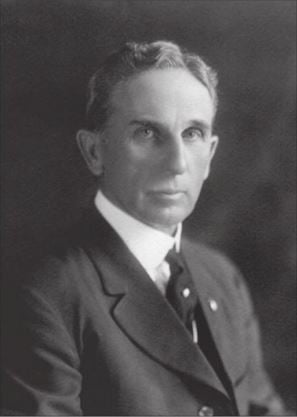
Henry S. Boice. Courtesy of Bob and Miriam Boice. 

By the late 1890s, the clamorings of British creditors were rising, and the Capitol Syndicate began the gradual process of selling out. George W. Littlefield was the first large purchaser, buying 235,858 acres.

William E. Halsell started his Mashed O Ranch out of the old Spring Lake division by buying 184,155 acres; John M. Shelton developed the Ojo Bravo division as the Bravo and JJ ranches. 

As homesteaders began pouring in, a land rush occurred during the early 1900s. To better promote its real estate, the Syndicate established the office of land commissioner in 1905, selected F. W. Wilsey for the position, and stationed James D. Hamlin at the rail town of Farwell to represent the owners.

Experimental "poor farms," as the cowboys called them, were set up, one about seven miles south of Channing and another at the short-lived townsite of Parmerton near Bovina. 

By the time Henry S. Boice succeeded A. G. Boyce as general manager in 1905, much of the XIT land was already being divided into small tracts and sold to farmers. 

In 1909, nearly all of the British bonds that had helped start the enterprise were redeemed in full, much to the satisfaction of the English investors. While the state capitol had cost more than $3,000,000 instead of the original projection of $1,500,000, the cost of the land being sold was increased, and the corporation fulfilled its contract. 

The last of the XIT cattle were sold on November 1, 1912, and land sales subsequently increased through the Capitol Reservation Lands, the new trust formed by the Farwell Estate in 1915. 

R. L. (Bob) Duke, who had served as foreman for the Buffalo Springs division and then as assistant general manager under Boice, became the last XIT cowboy to actually work for the estate when he was retained to oversee that portion of the range leased to the Shelton-Trigg partnership. 

By 1929 some 450,000 acres were still owned by XIT Ranch; by 1943 that acreage had been reduced to around 350,000. The last parcel of XIT land was sold in 1963 by Hamlin Y. Overstreet, who had succeeded his late uncle as a company representative in Farwell.
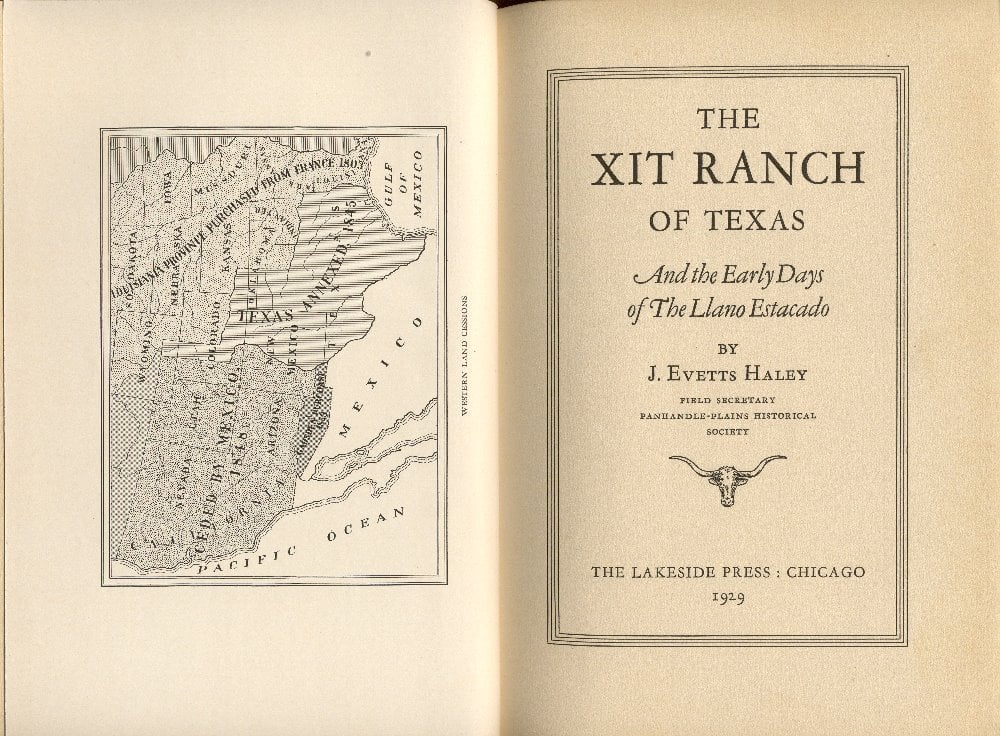
The XIT Ranch of Texas (1929) by J. Evetts Haley. 

Panhandle-Plains Historical Museum. 

The romance of the XIT Ranch, enhanced by the spread's sheer size, lives on in western lore. In the late 1920s, the Farwell Estate commissioned J. Evetts Haley to write its colorful history, The XIT Ranch of Texas (1929). 

It, along with Lewis T. Nordyke's Cattle Empire (1949), which is written more like a novel, remains the standard account. Memoirs of former XIT employees, including James D. Hamlin, Cordelia Sloan Duke, and Charles E. MacConnell, known locally as "XIT Buck," have also been published. 

The voluminous XIT Ranch records are housed in the Panhandle-Plains Historical Museum in Canyon, and the old general office building still stands in Channing. 

In Dalhart memories of the ranch are kept alive in the XIT Museum and the famous "Empty Saddles" monument, as well as the annual XIT Reunion, complete with parade and rodeo. Other West Texas towns, including Muleshoe, Farwell, and Bovina, also advertise their common heritage with the XIT. 

The old Escarbada division headquarters, where Ira Aten and his family resided during his stint as foreman, is now part of the Ranching Heritage Center in Lubbock.

Source: Texas State Historical Association


Wednesday, December 11, 2024

The Waggoner Three D Ranch

Waggoner Ranch main entrance. The entrance includes the ranch's backward three Ds brand. 

Story by: H. Allen Anderson, Published: 1952
Revised by: Judy Alter, Updated: August 28, 2023
Source: Texas State Historical Association

The Waggoner (Three D) Ranch had its beginnings in the early 1850s when Daniel Waggoner, his son W. T. (Tom), and a fifteen-year-old Black slave trailed 242 cattle and six horses into Wise County.

Waggoner left behind in East Texas the grave of his wife. He first settled on Catlett Creek near the site of present Decatur, Texas. Two years later, after buying an additional 200 head, Waggoner located his herd on a 15,000-acre tract on the West Fork of the Trinity River near Cactus Hill, in an area now under Lake Bridgeport. 

However, because of the increasing danger of American Indian raids, he was compelled to move his family east to Denton Creek temporarily. His first brand was a D61, but about 1866 he began branding with three Ds in reverse, a brand easy to recognize and difficult for rustlers to alter. He used a D71 brand on his horses until around 1881.
Daniel Waggoner

By 1869, Dan and Tom Waggoner had formed a partnership known as D. Waggoner and Son. Late that year they wintered a herd in Clay County, and in the spring of 1870 young Tom headed a drive to the Kansas market and netted a profit of $55,000, which was the basis of their ranch fortune. 

In 1871, with the westward push of the frontier, the Waggoners moved their headquarters to Clay County and settled temporarily on the Wichita River in southeastern Wichita County. From that site they moved the headquarters to the junction of China Creek and the Red River in northwestern Wichita County, just north of what is now Electra, which was later named for Tom's daughter. 

By the early 1880s their range extended thirty miles from China Creek to Pease River. 

In 1885, the need for more grassland prompted them to join other Texas ranchers leasing range land in the "Big Pasture," part of the Comanche and Kiowa reservation lands across the Red River in Indian Territory. 

With the passing of the open range, they began purchasing Texas land. Paying about $1 an acre, the Waggoners slowly built their cattle and horse empire. Between 1889 and 1903 the ranch came to cover a block running thirty miles east and west and twenty-five miles north and south, including more than a million acres. It extended into Foard, Knox, Baylor, and Archer counties but centered chiefly in Wilbarger and Wichita counties.

Among the notable employees on the Waggoner Ranch during its early years were Jimmie Roberts, E. B. Gillis, Walter Lowrance, Tony Hazelwood, and W. D. (Shinnery) McElroy. Roberts, who was a dead shot, proved an effective deterrent to rustlers. 

During the 1880s, the Waggoners sold around 40,000 cattle a year. By 1900, the ranch, well-watered and compact, held 60,000 cattle. Three railroads afforded transportation to the markets, thus eliminating the annual long drives over the Western Trail to Kansas. 

In 1900, Robert L. More, noted for his collection of bird eggs, came into the Waggoners' administrative employ. By that time, they had abandoned the Big Pasture in the wake of the federal government's allotment of reservation lands to individual settlers. 

In 1903, the China Creek headquarters was sold as farming land in a development known as the Waggoner Colony. The Wichita and Wilbarger land eventually was broken into at least four divisions with headquarters known as White Face, Four Corners, Santa Rosa, and Zacaweista (also spelled Sachueista). Subsequently Zacaweista, south of Vernon, emerged as the main headquarters.

Around 1885, the Waggoners began breeding Durham shorthorns, and Hereford cattle were introduced early in the 1890s. Since 1917, the stock has been predominantly Hereford, although experimental crossbreeding programs with Angus, Brahman, Simbrah, and Brangus bulls were tried.

Dan Waggoner died in 1904, and W. T. took over the ranch. In 1909, he divided the ranch among his three children, Paul, Guy, and Electra, as a Christmas gift mainly to give them training in ranching, and maintained a quarter section, called White Face for himself. 

The discovery of oil at Electra in 1911 caused the Waggoners to combine oil production and refining with ranching activities; the refinery cars and tanks bore the image of the Waggoner cattle brand. For years, the area around the Zacaweista headquarters contained one of the major shallow oilfields of the world, which was developed by the Texas Company which later became Texaco.

In 1923, the heirs apparently having declined to learn about ranching, W. T. consolidated the ranch under a trust with himself as the sole trustee and the only one empowered to make decisions for the property.
Waggoner Ranch became renowned for its Quarter Horses. 

The ranch specialized in fine horses as well as cattle. W.T. always had a stable of fine thoroughbreds. When Buster Wharton, Electra’s son, inherited her portion of the ranch, he raised polo ponies. But the ranch ultimately became known for Quarter Horses. 

W. T’s son, E. Paul, bought a yearling called Poco Bueno at auction in San Angelo, Texas. The horse became the ranch’s foundation sire and probably the best-known Quarter Horse of all time. He earned several championships, sired several champions, and had a distinguished career as a cutting horse after he was retired from the championship circuit.

In 1931, W. T., then living mostly in Fort Worth, bought farmland near Arlington, Texas, and developed the Waggoner Arlington Downs Stables, a $2 million racing plant that remained in operation until the repeal of the state's parimutuel betting law in 1937.

After the 1934 death of Tom Waggoner, his widow, Ella Halsell Waggoner, became the sole trustee and served in that capacity until the 1950s when she was in her nineties. She relinquished authority to her only surviving child, E. Paul. In later years the trustee position was filled by several men appointed from outside the family. Although the surviving heirs owned the land, they had no voice in its management according to the terms of the trust, and each trustee found it difficult to navigate the increasing tension between branches of the family.

When Buster Wharton died in 1967, the issue of inheritance led to one of the most contentious lawsuits seen in Texas courts. Several parties filed lawsuits claiming rights to Buster’s portion of the ranch, and the matter was in the courts for six-and-a-half years. Ultimately the Texas Supreme Court named Buster’s son, Bucky Wharton, as the legitimate heir. Bucky and E. Paul’s daughter, internationally-known sculptor Electra Waggoner Biggs, became joint owners of the property.

In 1991, the ranch consisted of more than 520,000 acres in six counties — Wilbarger, Baylor, Wichita, Archer, Knox, and Foard. The largest ranch under one fence in the nation, it was still owned by Waggoner heirs, namely the families of A. B. (Bucky) Wharton III and sculptor Electra Waggoner Biggs.

About 26,000 acres were devoted to farming grain crops. The ranching operation consisted of fifteen camps, or divisions, each with from 20,000 to 30,000 acres. A family resided at each camp to look after the livestock, fences, and water. 

Twice a year the wagon crew worked the cattle at each camp. During roundups, the ranch helicopter was used in addition to cowboys on horses. Several reservoirs on the ranch properties, including Lake Kemp, provided public recreational facilities as well as limited leased housing.

Map showing the Waggoner Ranch. 

At approximately 535,000 acres, as of the 2020s, the ranch is known as the "largest ranch in Texas under one fence" and covers parts of Wilbarger, Baylor, Wichita, Archer, Knox, and Foard counties in North Texas. 

In April 1991, Electra Biggs asked a district court to sell the ranch and distribute the proceeds to its shareholders. Bucky Wharton countered with an offer to split the ranch evenly. 

Biggs was primarily represented by her son-in-law, Gene Willingham. He and Bucky Wharton differed over how to protect the family fortune against low energy prices and land values, with Willingham contending that an even division would be too complicated given the nature of the assets. 

The ranch at the time had cattle, oil wells, mansions, aircraft hangers, and stalls and stables. The land alone was valued at $110 million (in the 1990s), and with the assets added, the estate was estimated at a value of about $330 million. It was the major employer in the area around Vernon, Texas, present-day headquarters of the ranch, and many cowboys and their families had lived their entire lives on the ranch. 

Four generations of the Waggoner family had lived on the land.

Eventually, with the two factions unable to negotiate, the case ended up in the courts, which decreed that the land must be sold. In 2016, tycoon and sports mogul Stan Kroenke, owner of the Los Angeles Rams and husband of Walton heiress Ann Walton Kroenke, bought the ranch. Kroenke not only owns the Rams but also hockey, soccer, basketball, and lacrosse teams; ranches in Arizona, Montana, Wyoming, and British Columbia; three vineyards; and a luxury resort in California especially for wine merchants. Purchase of the Waggoner (Three D) Ranch has made him the ninth largest landowner in the United States. Kroenke vowed to keep the Waggoner under one fence. 

No descendants of the Waggoner family live on the land for the first time in more than 150 years. In 2020, the only major change was that families were evicted from leased homes on the two lakes within the property, although one lake remains accessible to daytime fishermen and tourists. Surrounding towns have not seen the economic fallout that was anticipated.

Source: Texas State Historical Association


Monday, December 9, 2024

Praying For Christmas Gifts


The old Cowboy has volunteered to dress and play Santa for many groups.  In fact, looking back on his life, it's been almost 30 years since he first volunteered to do it for a friend. And yes, ever since then, he's been Santa each year for at least one group or another.  

About thirty years ago, he was asked to "Be Santa" for a Senior Care facility. Agreeing, he bought a Santa suit, a wig, a beard, "Santa boots," and jingle bells of different types. He took on the role with good-natured gusto, ringing bells, and trying to fake a sincere deep-sounding "Ho! Ho! Ho!" that he imagined would be that of the real Santa.

He went to the Senior Center and played his part to the smiles of the seniors gathered for their Christmas lunch. They were thrilled. Many tried to peer past the wig and beard and glasses to see who it was trying to bring them some small Christmas joy. Most were like that of children. Most were wide-eyed and embraced Santa grabbing his white-gloved hands and smiling broadly. Most thanked Santa. A few told Santa their age. 

One woman gripped Santa's hand and said, "I'm a hundred and three. And I remember you." 

Behind the fake wig and beard, he smiled as a tear rolled down his cheek. He knelt beside her, and whispered in her ear, "And you're still a good girl." 

With that, she smiled, her heart beaming through her eyes, nodding, she said with a sense of real pride, "I always have been."

That day started years of going to that Senior Center. It progressed to him going to one or two Convalescent Hospitals, where some of those who lived there could not speak at all. And yet, he made his rounds as Santa, shaking hands and greeting those confined to their beds. 

During one visit to the various rooms, an old man, who Santa found out later was in his late 90s, reached out and tugged on Santa's coat. The old man's eyes widened as he delicately motioned for Santa to come closer. It looked as if it took all of his strength to lift his hands, and the old gent's hands shook as he beckoned Santa to him. The old gentleman had a secret. He had a secret that he only wanted to share with Santa. 

As Santa stood there beside his bed, a nurse stepped closer and said it was the most excited that she'd ever seen him. Holding the old man's shaking hand, Santa obliged and bent over to put his ear close to the old gent. At first, he thought he heard only sounds. And for a moment, Santa really couldn't make out what the old man was saying. But then it became clear what the old man wanted, though soft as a whisper, it was clear what the secret was. 

It was a secret that Santa understood. It was a secret that Santa would remember for the rest of his life. And with that, Santa held the old man's hand. The old man looked up and soon nodded before closing his eyes. His grip on Santa's hand loosened, and soon Santa knelt beside his bed. Holding the old man's hand, Santa prayed for him.  

There were more beds to visit. There were more old men and women to see. And yes, just as when Santa found out later that the old gent had no visitors and was always alone, he found out that many there had no visitors and were always alone. They were just waiting. It was just a matter of time. 

As for the old-timer who had a secret for Santa, Santa found out later how the old gent was looking forward to his arrival. The old-timer let a nurse know that Santa had something for him. It was a Christmas gift that he wanted. It was a Christmas gift that he had hoped for. Yes, a gift that he believed only Santa could get him. 

What was it that the old man whispered, what was it that the old gent wanted? "Please pray for me, Santa," the old man asked, "Pray for me, Santa." 

Yes indeed, Santa prayed for him. And no, he didn't need to know him to pray for him. After all, it was enough that that's what the old gent wanted. The old gent got what he wanted for his last Christmas — and all he wanted was for Santa to pray for him. 

Over the years, the old Cowboy has been Santa for all sorts of various groups and events, from hospitals to Christmas fundraisers and bazaars, to Christmas parties for rodeo clubs, veterans organizations, non-profits, and big and small community gatherings. Yes, he's even been the centerpiece of many a Christmas parade. He's done a lot of events as Santa. 

For about 20 years, he has looked forward to being the Santa for one small town. That town is your typical "Small Town USA" with a Main Street that's only three blocks long and buildings built before the Civil War. It is a tiny place when compared to large cities. Yes, most cities have sections of their cities that are so much larger than that town. Of course, that small town with its few blocks-long Main Street doesn't have the hustle and bustle of cars, horns, road rage, and congestion that big cities do. In fact, that small town doesn't even have a traffic light -- never the less road rage or congestion. 

Being a Santa in such a town is a wonderful experience. That's one reason why he's done it for so many years. Making himself available for parents so that they can take pictures of their big and small children, sometimes crying babies, with Santa has been something he looks forward to each year. Unbeknownst to all, behind his fake wig and beard, he mostly enjoys watching the parents standing in line. He loves watching their efforts and the joy that comes to them while they try so hard to let their children experience some of their own fond memories. 

Parents of every sort hand their child over to Santa to live a wonderful Christmas tradition. It's a tradition that they experienced as children. And yes, it's a Christmas tradition that they want for their children. 

Yes indeed, he enjoys it all. And while he tries to make their children enjoy the moment, so the parents can get that snapshot that they'll treasure for years, Santa enjoys it because it's his way of giving back. But then again, he finds hope in what he sees while behind that wig and beard. And frankly, in a world that might seem a little off-kilter and crazy at times, finding hope is not bad.     

In small towns, most people think most people know everyone else. And yes, in some cases that's more true than not. Of course, during Christmas that changes a little because most of the parents in the long lines have no idea who that Cowboy is behind that fake beard. They don't know if it's a neighbor or not. Of course, every once in a while, someone who knows will come along. And yes, there is that wink and nod, that knowing handshake, and a sense of camaraderie and pride between those knowing that the secret of who Santa really is is safe with them. 

While there may be one or two, most in that town have yet to learn who their Santa is. And though he has been a Santa for that small town for more than 20 years, it's a bit of a mystery that he sort of gets a kick out of.  

Of course, over the years, he has heard many Christmas wishes from children. He especially remembers a little girl who wanted a "flowery hat." When her mother heard that, she just about lost it since she had spent a great deal of money on other things that, in reality, meant very little to her daughter. As for the latest and greatest electronics, many have wanted the latest and greatest toy, electronic item, and fad for their kids. And yes, over the years, the old Cowboy has wondered if the parents bought the latest and greatest more for themselves -- than for their children. 

As for helping parents fulfill their children's wishes, the old Cowboy learned fairly quickly about the secret of relaying that information to the parents on the spot so they can help Santa fulfill their son or daughter's dreams. Yes, as you can see, there are good reasons why that old Cowboy is a great Santa.  

That's not to say there are no surprises. Some surprises come in the form of letters to Santa, while every once in a great while, he'll be surprised by some of the replies to his question, "So tell me, what do you want for Christmas?" 

During the last few years, he's heard children say they didn't need much. He understood that it was a sign of the times. During hard times, especially with families struggling to afford gas and groceries, Christmas can be a very disappointing time of year. Two years ago, Santa met a teenager who asked him if he could find her father a job because he had been laid off. She said, "Mom said we're not having much for Christmas because Dad's not working." Last year, a parent asked Santa to tell her children that he could "Only bring one present this year." 

Of course, he remembers a teenager who was no longer a child but still had that innocence that we all hope children maintain for as long as possible. She answered Santa's question of what she wanted for Christmas by saying, "I wish my family would be happy."  

Last night, Santa met with a lot of children and there was a lot of laughter. Again he watched the parents as they waited their turn in line. Everything was wonderful. Everything was perfect. A couple of children dropped off letters to Santa. One teenager told Santa that she was content with everything she had and she really wanted others to have more. When he told her that it was okay to want something for Christmas, she told him that she has a lot more than most -- and she thanks God for what she has. 

Santa nodded his head, pulled her close, and said, "You've been blessed. God Bless you!" 

After being Santa last night, the old Cowboy was tired. On the way home, he and his wife stopped at a grocery store. He waited in his truck as his wife went into a store to pick up a few things. When she returned to their truck, the old Cowboy had taken off his Santa wig, beard, and coat. He sat behind the steering wheel and was surprisingly quiet. 

At first, she just wrote it off as him being tired from meeting children for almost four hours. He was 70, and his wife knew it just wasn't as easy as it once was for him. Then, on the drive home, the old Cowboy's wife asked if everything was okay. 

He said he opened one of the letters to Santa that was given to them tonight by one of the children. He handed the open letter to his wife. She turned on the truck's overhead light and read it. It read, "Dear Santa, May I please have a PS5 PlayStation and my Mom back to Life."

She shook her head, and tears welled in her eyes. She felt bad knowing there were so many people out there who were going through so much. While she knew how hard it is for people out of work and the cost of everything being so high, she also knew how Christmas is the hardest on those who have lost others. 

"Wow!" she said. "What do you think?" 

For a moment, he thought about that old man who wanted Santa to pray for him. Then the old Cowboy said, "I'm thinking about how the road seems dark and icy tonight. It makes me think I should watch out for deer and other critters on the road more than I do. But it is clear. And yes indeed, there are a lot of stars out tonight. 

I'm also thinking about an old man I met back in the late 1990s at a Convalescent Hospital. I remember how he told the staff that he had a secret that he wanted to tell Santa. But, only Santa. When I got there dressed for the part, I found out that he had a request for Santa. I was told that it was very important to him. 

When I went to his room, I found out the old gentleman was dying, and he knew it. And really, for whatever reason, he wanted Santa to pray for him. I nodded, and I did. I didn't know him, but I prayed for him. Right now, I'm thinking about that young girl who wrote to Santa, and about how different folks ask for prayers in different ways -- especially when they're down."

As for the ride home, it was dark that night, and not much more was said about the child's letter. By the time they got home, the wind picked up, and the chill was piercing as he and his wife stepped out of the warmth of their truck. As his wife made her way into their home, he said he was going out to their barn to check on their animals. 

Their barn wasn't much of a barn, but it served the purpose. Once inside, he took a flashlight off a shelf and checked their horses. He then looked at their water to see if it was ice. The horses and their water looked fine for the night. He looked over at their pigs snuggled together. Listening, he heard the wind whipping up outside, a tree branch scratching his barn's tin roof, and soon he found himself a bale of hay to sit on. It was there that he put his hands together and prayed for the child who wanted her mother "back to Life." 

Sitting there for a few minutes, in his barn among his animals, in that very humble place where he feels the closest to God, a man who plays Santa for children and parents alike, prayed to ask God for a favor. He asked God to never ever let that child forget her mother. He asked God to make it so that that child would never stop missing her mother, never stop wanting to see her, never forget her mother's smile and her mother's kind eyes, or the sound of her mother's voice. He prayed that she never ever loses her memory of her mother's loving ways, their shared laughter, their love. He prayed that one day, a day years down the road, a day when age takes over, that she would see her mother in a mirror in front of her.

The old Cowboy then took a long pause and looked around his stable. For a moment, he listened to the pigs' grunt and heard a snort or two come from his horses, almost as if giving him their approval of his prayer. Then, for a moment, he wondered if he had forgotten something in his prayer. 

For a moment, he thanked God for his memories of having coffee with his Dad, his grandma's cooking, and his grandpa's Cowboy ways. He thought about his prayers when they passed and how he asked God to help him never forget. 

He knew his request to God was huge. He knew he wanted that little girl to always have her Mom in her heart. And while he was sure her mother would stay there, he thought about how our memories fade as we get older. He wanted her to never forget. 

Of course, while he knew it was a huge request, he also knew such a prayer was not an impossible gift for God to grant a child with a broken heart. After all, God is in the business of miracles and love.  

So yes, my friends, a few days ago, though that old Cowboy was tired from a long night, though knowing he needed to go into his warm home and to bed, he again put his hands together, closed his eyes, and prayed that his prayer for that child would be heard. No, not for himself, but for a small child. Just so she gets the gift she wants. Amen.

Tom Correa 


Friday, December 6, 2024

How Much Money Do Farmers Make?

Hello Friends,

A reader sent me this video, thinking it would be informative for my readers. I watched it and believe that the average person who doesn't know how farmers make money or survive can benefit from watching it. 

This is a great video and Cole, aka Cole The Cornstar, is very articulate. 

Also, I've included all of Cole's contact information from his YouTube Channel. 

I hope you find this interesting. 

Tom Correa


Below is Cole The Cornstar's YouTube Information in his own words:

This is the first video of its kind. Finances in farming is often a subject many are not willing to talk about. In this video, I shine a light on all of our expenses for our 1,700 acre farm in Central Iowa. I cover every aspect of income and expenses and produce actual numbers. 

The goal of this video is to raise awareness and to educate. It is not designed as a pity video, so please, do not feel bad for us. The information is as personal as it gets and this video took me a long time to create. 

Sources: Yields and Prices 

Quick and dirty tax calculator: 

Thank you for watching! 

Special Thanks To Our Video Sponsor: 

► This could be you! Website: This could be your website! 
►Like My Sunglasses? 
Use code: “COLECORNSTAR” for 10% OFF. 

Cole The Cornstar, aka Cole, is a 4th generation family farmer from Central Iowa who is the life force behind his family’s 1,700 acre farm. Cole promotes agriculture by filming his day-to-day adventures with his Dad (Daddy Cornstar) and brother (Cooper) on the farm. With a lot of help from Daddy Cornstar, Cole instills humor and education into his videos fit for both young adults and adults. Despite being 22-years old, Cole has an old-fashion work ethic with an innovative approach toward agricultural technology and practices. Cole's mission is to prove the American Dream is not dead and be a megaphone for agricultural education and innovation, from technological advances in farming equipment to conservation practices. 

Want To Follow Behind The Scenes? 

►Send Me Fan Mail: 
Cole The Cornstar 
PO Box 1432 
Marshalltown, Iowa 50158 

►Support us on Patreon: Patreon.com/colethecornstar 

Watch more Videos like this: 

►WATCH NOW: SNOW-BLOWING CORN?? 

►WATCH NOW: Cole, The GRAVE DIGGER?? | 

►WATCH NOW: Convincing The Bank To Lend Me $1,000,000 | 

► Edited By Cole The Cornstar Business inquiries only: 

Thursday, November 28, 2024

The Thanksgiving Spanking of 1874


The story below comes from the Humboldt Times. It was published on February 17, 1875. 

A Discouraged Boy 

Crabapple's boy had read that touching Thanksgiving story about the chap who ran away from home when a lad and went to sea, and was not heard of for several years, and how on every Thanksgiving Day his fond mother set a plate for the wanderer and kept a seat for him at the table, and how his gray-haired father, when he asked for the blessing, prayed for his wayward son — prayed that he might return safety to his paternal roof. 

And then one Thanksgiving Day, when they had about given him up on him for dead, although the plate and the vacant chair told the story of a mother’s undying hope, just as the family had set down to the Thanksgiving dinner, there came a rap at the door. 

“Come in!” cried the father. And, at that moment, their son bounced into their home wearing a sailor’s uniform and tarpaulin hat, just home from a long whaling voyage. Such rejoicing as there was in that house. How his father shook him by both bands, how his mother wept over him and embraced him; and how all his brothers and sisters, and aunts, and cousins hung around his neck and tugged at his sailor jacket. 

It was worth the braving of the seas to meet with such a welcome on his return. He sat at the feast in the chair that a mother’s doubtless love and hope and recollection had always placed for him and never was there a happier Thanksgiving since that cherished anniversary was invented. 

Crabapple’s boy wept over that story every time he read it, and he got to wondering whether such a fuss would be made over him should he run away from home and then turn up again some Thanksgiving Day. He thought about it so much that he finally decided to test the business out.  He would see how the folks would act when he played the prodigal's return. 

So about a week before Thanksgiving, he ran away from home. He didn't go to sea, because the sea was too far off, and he couldn't make much of a voyage in a week, anyhow. He got a job in a tanyard, grinding bark, which answered all the purpose, for he could imagine his "bark was in the sea" as he rode the old horse around the circle. 

He called the mill the world and imagined himself sailing around the world every revolution. When the week was up he started for home. He fancied himself so much tanned by the occupation he had followed that his parents would hardly know him. He imagined he had picked up a good many hid ears, anyhow. 

With a beating heart, he approached the paternal mansion. He looked in at the window and saw the folks just sitting down to the Thanksgiving supper. 

A chill of disappointment crept over him as he saw there was no vacant chair, and there was no idle plate anywhere on the table. He listened at the door when the blessing was asked, but although several prophets were honored with flattering, no his name wasn't mentioned. 

This was a little hard on the boy who had run away from home and was liable to turn up on that or any succeeding Thanksgiving Day. Relations didn’t seem to cluster around the hearthstone to any great extent. 

So while repressing a chilling foreboding that arose in his breast, he flung open the door, rushed into their midst, and exclaimed: "Father! Mother! 'Tis I, Jimmy Crabapple, your son! I'm home again! I'm home! I'm home!" And with that he, threw himself into his father's breast, sobbing convulsively. 

And what did his father do? Did he cry and slobber tears over him, and call out "Oh, thank the Lord, my long lost boy is home"? 

No be didn't. He instead took his son by the collar, led him into the woodshed, and used a barrel stave on him. [A barrel stave is a narrow strip of wood that forms the sides of a barrel. Staves are placed edge to edge to create a liquid-tight seal at the stave joint. Jimmy Crabapple's father used it as a switch in place of using a wooden spoon, a belt, or a paddle to spank his son for running away.]

Young Crabapple was punished for running away while his brothers and sisters danced around on the back stoop in an ecstasy of joy. All while his mother screamed, "That’s right, Ambrose! Give it to him! Learn him better than to run away from home again and make us sick with worry." 

The boy was then sent to bed without any Thanksgiving supper at all, and threatened with being deprived of both Christmas and New Year if he ran off again. It's said he never ran away again.

The above was published in 1875, and a few things can be learned from this story.

Back in 1800s America, children running away from home was done for a few reasons. At the time, child labor laws and restrictions were so non-existent that children were basically in the same class as slaves. Yes, while some people today might think that that's not so, it is the truth. Children were people enslaved by others. 

Many children, like Black slaves, ran away from lives of bondage or abuse. While many ran away to the cities where they could blend in. Many found work as cooks and servants, newspaper boys, and factory workers getting a fraction of what adult workers would get paid. Many were injured and cast aside as there was a surplus of runaway children to be had as labor in all sorts of industries including in the mines at the time. 

Other children, especially those from large very hungry families, ran away to escape the filth, squalor, and congestion of the cities at the time. Many saw living in sewer pipes or under stairs somewhere as being a better alternative than being packed with ten others into a 12-by-12-foot room.  

And yes, many children, many like my own grandfather, ran away from abuse at home and went to sea to work aboard ships. Many made the sea their lives. As for many of the children who worked in the coal mines, in the cities, on the docks, or on ships, many went West seeking freedom and better lives. Many ended up working on cattle ranches, were part of the first cattle drives, herded livestock, tended oxen, and were indeed some of America's first "cow-boys." 

American Indian children in boarding schools were often separated from their families and communities, which led to many of them running away from those schools. Believe it or not, even though many of them had to ride trains to get to those Eastern schools, many of those children ran away and tried to walk home. Yes, all out of a basic human need to return to a life they missed and understood, a life where they were loved and people didn't treat them as lower-class citizens. 

Let's remember that many of those children tried to assimilate into White Society, including immersing themselves in learning American English while being forced not to speak their own language. Most American Indian children runaways ended up back on Reservations where they felt safer and were not looked down on. 

As for young Jimmy Crabapple, he was a teenage child who loved a sentimental story about a son who was missed for a very long time, loved, appreciated, and even honored with an empty chair. That tells a great deal about Jimmy. 

To young Jimmy, to get that sort of love he yearned for, to get that sort of wealth of being loved like that, to get that which he wanted more than anything in the world, that which he wanted to have so much that every time he heard that story read that he would cry, he knew that all he had to do was run away at Thanksgiving -- and return soon afterward. After all, that's the storyline. To his way of thinking, what not follow the storyline and he'd get the same results.

So yes, that's the story of Jimmy Crabapple. That's what he was all about. His plan was not to run away for good to seek a better life. He just wanted to stay gone long enough to be missed. And yes, in his young mind, a week would suffice to accomplish what he needed. He figured a week being gone with be enough for his parents and siblings, aunts and uncles, and everyone to miss him. All he wanted was to be loved with adulation upon his return.  

What he didn't know was that children should never run away from home. While it makes parents crazy with worry, it also doesn't serve any purpose -- especially if a child is doing it for the reasons that Jimmy Crabapple did in 1874. Though he wanted to be missed and loved, no, it's never smart to run away from home for any reason.

Of course, his young easily influenced mind told him that all he had to do was run away to be loved just like that other boy in the story. He didn't know that sometimes stories are just stories. 

While he believed in his heart that if he ran away, he would be missed -- he didn't understand what that would do to others. He believed that if he ran away, that he would be loved. After all, he heard it in a story. And as all children know, stories never lie. 

Sadly, Jimmy Crabapple learned that sometimes a story, even a story of a young man who went to sea and returned to a loving family, is just a fairy tale, a tall tale, a yarn, all fiction, and has nothing to do with real life. He learned that fact of life while peering in the window of his home and seeing there was no mournful somber air to their Thanksgiving day. He saw his brothers and sisters playing and no one seemed to be acting even close to as depicted in that story that he cried over every time he heard it. 

Besides learning that sometimes a story is just a story, he learned that being loved is not something that we can pry out of others. He learned that people either love you or they don't. And who knows if he ever recognized it or not, but he also learned something else that Thanksgiving. And yes, it was something that Jimmy Crabapple could forever be thankful for. 

He learned that though it came with a long spanking that he received from his father, he learned the hard way that he was certainly loved. 

Whether or not he realized it then is anyone's guess, but it's hoped he learned that disciplining a child for running away is an act of love. It is a way to correct behavior and protect the child's safety. It is a way for parents to demonstrate that they care enough to set boundaries and guide them toward making better choices. He learned that on that day, and would be thankful for the lesson for the rest of his life.  

While I don't know if Jimmy Crabapple considered his father using a barrel stave on his posterior as either lovingly or constructive, it was certainly a sign of love. I would certainly say it was, especially when it comes from a loving parent who feels they've lost control of their kid -- and maybe they feel helpless when their child runs away. Of course, since Jimmy is said to have never run away again -- he must have felt his father's lover pretty good.

So all in all, while Jimmy Crabapple might not have thought so that day, his parents gave him a lot of love. Yes, even if it wasn't the warm and fuzzy love that he was looking for.  He learned that love can come in different forms. And yes, that can be a tough lesson to learn. A tough lesson that he should have been thankful for learning at a young age.

For Jimmy, he learned that love can sometimes be in the form of a spanking. Of course, that was probably a tough lesson to learn on Thanksgiving back in 1874. But then again, I'm sure it would be just as hard for some children to learn today.     

Tom Correa


Saturday, November 16, 2024

A Daring Highway Robbery In Calaveras County 1874

Calaveras County Sheriff Ben Thorn

In case you haven't heard of him before, Calaveras County Sheriff Benjamin K. Thorn was the man who captured highwayman Black Bart. He was also the man who captured the bandit Joaquin Murietta. While this isn't a biography of Sheriff Thorn, below is a story of a highway robbery in Calaveras County. It took Sheriff Thorn only four days to track down and arrest the bandit. That's faster than most lawmen in the Old West. 

The Tuolumne Independent newspaper dated January 2, 1875, reported that a highway robbery took place East of Sandy Gulch near Sawyer's Bridge, on December 26, 1874. For those of you who have told me that you use maps to find the locations of the incidents that I talk about, that robbery took place about halfway between the towns of West Point and Glencoe in Calaveras County. It took place near the present-day South Fork bridge of the Mokelumne River on what is today California State Route 26.

As for the 1875 news article mentioning Claude Duval and Jack Sheppard? Claude Duval (or Du Vall) was a 17th-century French highwayman in Restoration England. Believe it or not, he robbed and killed male travelers and took the time to dance with women travelers in France during his holdups. Believe it or not, he robbed and killed on behalf of exiled English royalists who would later return to England under King Charles II. 

I guess that was one way of making money as a royal, just have others rob and kill for you. Then again, that should not surprise anyone since the British Crown also commissioned "Privateers" to rob and kill on the high seas for them. With a license and support from Elizabeth I of England to distinguish them from "Pirates," "Privateers" like Sir Francis Drake and Sir Walter Raleigh made themselves and their backers immensely rich by robbing Spanish ships.

As for Claude Duval, according to popular legend, he supposedly abhorred violence unless it was necessary. But, he is known to have killed men without provocation. He's also known to have shown polite courtesy and chivalry to women passengers. His behavior is thought to have created the myth of the "romantic highwayman." Yes, supposedly, he was the model used by many writers when describing a supposed "romantic thief" who kills men and charms women. 

As for the mention of Jack Sheppard, he was also known as "Honest Jack." He was a notorious English thief, highwayman, and prison escapee of 18th-century England. Though he was hanged on November 16, 1724, his life's story and tales of his robberies and prison escapes have been told and retold usually romanticized in books, plays, and even in movies. 

From the Tuolumne Independent newspaper:
Daring Highway Robbery

Mr. S. M. Miller, traveling for the wholesale liquor house of Starbuck & Co., of this city [Stocton, California], was robbed on one of the highways in Calaveras County last Saturday [December 26, 1874], under circumstances that invest it with the interest of a romance, and bring to mind the days of Claude Duval, or Jack Sheppard. 

As for Mr. Miller being held up, he was en route from West Point Io Mokelumne Hill and was driving a "spirited pair of horses" attached to a light buggy. At a point between Sandy Gulch and Sawyer's Bridge, he was stopped at about 3 o’clock when an unknown man stepped out from the chaparral that lined the road. The unknown highwayman is said to have presented a pistol, (a Coll’s five-shooter), and ordered Miller to halt, remarking, "Come out! Come out! We want to get rid of you!" 

To that, Mr. Miller told the robber to keep cool and that he would give up. Upon this, the robber stepped upon the wheel of the buggy, and grabbing Miller’s cap, threw it into the road. He then stepped back about six feet and deliberately discharged his pistol at Miller, the ball barely missing his head.

The shot started the team, and one of the horses ran and obliged Miller to whip the other. After traveling at this gait for a mile and a half, Millar discovered he had struck the wrong road and turned back. When he had retraced his course for a half mile he was again confronted by the highwayman, who fired at him putting a bullet through his coat, but missing his body. 

About one hundred yards from this point Mr. Miller found himself hemmed in by the chaparral and again turned back his team. The third time he was met by the robber, who told him to come out, and Miller surrendered. The robber first took the whip and threw it away. He next relieved Miller of his purse, containing $220, examined the puree for a moment, and told his victim to "go on" while refusing to give him back the whip or cap. 

Mr. Miller drove back to Sawyer’s Bridge bareheaded. The knight of the road is a tall, stout man, and he is known. He had his face covered with a piece of gunny sack which was used as a mask. Calaveras County Sheriff Ben Thorn is in pursuit of the villain and is likely to capture him. 

(This report above originated in the Stockton Independent newspaper on December 30, 1874.)

In a follow-up report of that robbery, the Tuolumne Independent newspaper stated that Mr. Shine, the stage driver, informed us that the fellow who committed the robbery was arrested last Wednesday, December 30, 1874, by Sheriff Ben Thorn of Calaveras County. Yes, Sheriff Thorn arrested the highwayman only four days after the robbery was committed. 

The Sheriff arrested him on suspicion and told him that Miller knew him. The bandit was a Cherokee and the same man whom Mr. Miller suspected. The robber confessed and told Sheriff Thorn the whole story, including how he had disposed of the money; that he had paid a grub bill of $6O, gave $40 to his mother, and gave a part of the money to his partner.

Since the above report was in type, the newspaper learned by telegraph that the robber's name was Bob Maxwell. He was arrested at West Point and also confessed to having robbed the West Point Stage two months ago. Thus ends the story of the highway robbery of Mr. Miller, and the swift capture of highwayman Bob Maxwell. 

Considering it took him only four days to identify, locate, and arrest Maxwell, it's no wonder Sheriff Ben Thorn was a legend in his own time throughout California. And really, if you don't think that's amazing, remember that Sheriffs in the 1800s were responsible for a variety of duties, including keeping the peace, collecting taxes, maintaining jails, arresting fugitives, investigating crimes, escorting prisoners, keeping a list of wanted criminals, and serving orders and writs among other things not listed here.

Who was Calaveras County Sheriff Benjamin Kent Thorn? Why haven't you ever heard of him? 

Well, he was born in New York on December 22, 1829, and grew up in Chicago. He arrived in California in the fall of 1849 during the California Gold Rush. In fact, he arrived with the first rush of argonauts seeking gold and their fortunes. Ben Thorn initially arrived in the mining camp of Volcano which was then in Calaveras County. After a short while there, he moved to San Andreas where Mexican gold miners established the camp in 1848 and named it after the Catholic parish of St. Andrew. For more than 50 years, he was a resident of Calaveras County.

He died on November 15, 1905, while visiting his daughter in San Francisco. He is buried in the San Andreas Protestant Cemetary. The Calaveras Prospect newspaper published his obituary on November 18, 1905, which read: 

"In 1867, he was elected Calaveras County Sheriff, and except for four years, he held that office continuously for 35 years. His name was associated with the capture of some of the most noted criminals of the West, among them the famous Black Bart and Joaquin Murietta." 

It's said that Ben Thorn was never discovered by Hollywood. That's the reason many have never heard of him. Of course, when you think about it, some who ended up being famous later, and weren't while they were alive, would have been completely forgotten if they hadn't self-promote themselves by finding a biographer who wrote what they told them -- or simply twisted the truth so much that the facts didn't matter. 

Take for example the case of Wyatt Earp. Today, because of History Revisionist, Fan Worship, and Fiction Writers putting out books and movies, he's seen by many as a hero and intrepid lawman. But yet, for those folks like me who have studied Wyatt Earp, and read a great deal about him to discern the truth from fiction for the better part of 50 years, we know Wyatt Earp was just a pimp, a thief, a con artist, a lawman who was fired a few times for breaking the law, a man who used a badge to commit murder, a man who was a fugitive and evaded being tried for two murders in Arizona, and "Bad Man" who associated with criminals and was as crooked as a dog's hind leg. 

In the 1890s and very early 1900s, Americans knew Wyatt Earp as being a notorious and infamous person, a villain, and "Bad Man" which was a term used a lot to describe him in the newspapers at the time. Being called a "Bad Man" was a term that he hated a great deal. Yes, Americans in the late 1890 and early 1900s knew he was not the hero that he is being portrayed as today. He was anything but that when he was alive. So what changed? He self-promoted himself in Hollywood by befriending actors, and of course, he found a biographer who wrote what he told them even if it were lies and exaggerations.
 
As for Bat Masterson, he certainly was a lawman and a Sheriff. He certainly skirted the law to do friends like Wyatt Earp favors. Of course, he is considered by some to be one of the longest-serving Sheriffs in the Old West during the 1800s. But Bat Masterson, who served as Sheriff in different counties, including Ford County, Kansas, and Dodge City, Kansas, was never a Sheriff as long as Ben Thorn was in Calaveras County. 

In the case of Ben Thorn, who served for 35 years as the Calaveras County Sheriff, it is proof that he was a County Sheriff longer than anyone I can think of who was a County Sheriff in the 19th-century Old West. And yet, he's not even noted for that because Hollywood never noticed him. And frankly, my friends, I think that's sad. 


Saturday, November 9, 2024

We The People


Story by Terry McGahey

I sometimes seem to hate California, but that is not really true. I hate the politics, lies, and regulations that California enforces upon its citizens. Here in Arizona, we now have the same problem that many Californians deal with, especially those who live in Northern California and those who live in Southern California and believe in our Constitution and our way of life, liberty, and freedom.

The problem I am referring to is the brainwashing of the majority of Democrats who truly believe in Woke, open borders, high inflation, and others. They must believe in those things because they keep voting in the same morons thinking things will change and get better, but that will never happen. Northern California’s smaller counties, for the most part, are full of patriotic Americans who believe in the same values that we have here in Arizona. The problem in Arizona is we have been invaded by Democrats from Southern California and other Left-leaning states, but mainly in California.

These folks have moved into our major cities such as Phoenix and Tucson by the hundreds of thousands over the past twenty years or so and now we are also being outvoted by the far left just as you all in Northern California have been dealing with for many years now. I have never understood why these people move to another state to get away from the high taxes and cost of living but when they move elsewhere they want it to be just like it was in the place "they ran away from." 

Just like buffalo being chased off a cliff, these people will go like lambs to the slaughter because all they do is follow the crowd without thinking for themselves.

This isn’t just an Arizona problem, it is also taking place in Montana, Idaho, and other states where these cancerous far-Left voting individuals move too. And yes, I just call the far-Left Democrats a cancerous disease with these individuals spreading throughout our nation to destroy it, just as cancer destroys cells within human beings. 

If you don't like it here, and you want it to be the same as where you came from, then go back to where you came from because we don't want you! I truly feel for the folks in the smaller counties of Northern California because they have been dealing with this cancer for many years now.

You far-left voters who voted for Harris and Tampon Tim need to wake up and understand this point. You need to know your Rights that the Constitution affords us as Americans. But the sad truth is, most of them have no idea what our Constitutional Rights actually are and don’t understand that the Constitution is actually the law of the land, not our pitiful politicians who want to be all-powerful and who now hold the White House. 

Look at it this way, just like an HOA which disallows you to even paint your door a different color, that type of government will do the same thing if you step out of line and take away your Rights and even your property. Leftists need to read our great document and also understand what our Bill of Rights says.

I doubt that most far-Left voters even know what the First Amendment, Second Amendment, Fourth Amendment, and others say, truly stand for, or how they are written. They are about our freedom and liberties. But then again, maybe they can't read?

You know what's really sad? Should the time ever come that the far-Left criminals ever succeed in turning this country into a Socialist/Communist society, which is what they truly want, the same people who vote far-left will be the first ones to cry and ask, what happened? 

Remember this, we do have some socialist programs but we are not a socialist-run government. If you far-leftists want what's called Democratic Socialism you need to understand one thing, once socialism gets a small hold it will continually grow and grow. 

Also, understand this, Socialism is just one very tiny step from Communism. All I ask is to stand up against this cancer because as the old western song lyrics state, "If you don’t stand for something, you will fall for anything." Quit falling for the lies of the far-left Socialists and stand up for our constitution, not politicians!

Before I close this out I want to thank Tom Correa for allowing me this platform. Tom and I have actually never met in person but I am proud to call him my friend.

About the Author

Terry McGahey
Associate Writer/ Old West Historian

Terry has been a working cowboy, a writer, and an Old West historian. He is best known for his fight against the City of Tombstone and its historic City Ordinance Number 9.

He was instrumental in getting the famous Tombstone City Ordinance Number 9 repealed while at the same time forcing the City of Tombstone to fall in line and comply with the laws of the State of Arizona.

If you care to read how he fought Tombstone's City Hall and won, check out:


Sunday, November 3, 2024

2024 Election Proves Over 65 MILLION Democrats Are "Sheeple"

Democrat voters have proven themselves to be "Sheeple" of the worst sort. Not only are they compliant, so easily influenced, and so much like sheep, but yesterday when voting in the Presidential Election, over 65 Million of them proved they would vote for the person who would have led them to slaughter. 

And that's the thing about sheep, they will blindly follow a Judas Goat even if the Judas Goat is a smiling, constantly cackling Vice President Harris who appears so stupid that she can answer a question directly without help from her staff and the media. 

If you're unfamiliar with what a "Judas Goat" is, allow me to help you understand where I'm going with this. Judas Iscariot was the disciple who betrayed Jesus in exchange for thirty pieces of silver. I see Kamala Harris as nothing less than a Judas Goat.

There was a time in American meat processing plants when sheep destined for slaughter didn't follow humans to slaughter -- but they were willing to trail behind goats trained to "betray" other livestock by leading them to slaughter. They were commonly known as "Judas goats." And yes, even today, a Judas Goat is defined as "an animal, especially a sheep or a goat, used to lead others to slaughter." The term also defines "any person or thing used to lure people in a direction that's unhealthy for them." 

So why is it that I see Kamala Harris as a Judas Goat? Or more precisely, why do I see the people in charge of the Democrat Party as Judas Goats? Well, I believe Kamala Harris is a person who would have betrayed her supporters after being elected. 

Even if she were used unwittingly as the tool of the Democrat Party's agenda to destroy America as we know it, all to make our country into what the Left considers a model of a Communist nation, I really believe that she was a Judas Goat. 

Granted, Kamala Harris was a Judas Goat with multiple accents and personalities and laughed nervously a lot, but that's the role she volunteered to play in the recent election. 

Please understand where I'm coming from. During the Trump presidency, Americans were bombarded with lies about Donald Trump being criminally involved in collusion with Russia. While President Trump went about imposing higher tariffs on goods coming from nations like China and Mexico who were stealing our manufacturing base, the Democrats in Congress fought him. While Trump was busy trying to create good jobs for American skilled labor, the Democrats were obstructionists. 

When Trump was going about shattering the myth of the Obama Administration that a low GDP was something that we would have to accept as the "new normal," the Democrats attacked him saying he was "Hitler." 

When Trump was trying to roll back the job-killing government rules and regulations that were also putting big and small companies out of business, Democrats said Trump was a threat to the environment. When Trump cut taxes for hard-working Americans and created urban business incentives to inspire business investments in American cities hit hard by poverty and lack of opportunity, Democrats called Trump a "racist" even though Trump's policies were trying to help the Black community in those cities. 

While President Trump was trying to build security barriers, the Border Wall, and close the drug trafficking and sex trafficking routes into the United States at the Mexican Border, the Democrat Party fought him at every turn and called him a "Xenophobe" even though he wanted to keep out criminals. 

In fact, to scuttle President Trump's policies altogether, Democrats formulated a clandestine plot, sponsored and carried out by high-ranking members of the Democrat Party including former Secretary of State Hillary Clinton and other former members of the Federal Government, to unseat a sitting President of the United States -- Donald Trump. 

That plot was all-consuming by the Democrat-controlled Mainstream Media. Americans were inundated with talk of Russia, Russia, Russia, allegation after allegation, and it was all part of a criminal conspiracy to remove President Trump from office. Their plot resulted in President Trump's Impeachment trial while in office, and an Impeachment trial after he left office. All orchestrated by the Democrat Party, Hillary Clinton, the FBI, the CIA, the NSA, and other nefarious Deep State individuals working to remove President Trump from office.

It was an attempted coup. And no, even after we all found out that it was all fabricated, made-up, lies with the intent to harm a sitting President, not one Democrat operative involved with the Russia Collusion Coup was ever brought to trial for conspiracy to defraud the American people -- or anything else. 

So, did the Democrats join in the fight to make the lives of Americans better when President Trump was hard at work trying to get it done, when it was trying to secure the border, or when he was trying to let us keep more of our money? No. They attacked him and were obstructionists who worked to destroy all of his efforts to make our lives better. 

Why would they do that to the American people? It's because they didn't want President Donald Trump to be a success in his first term in office. No matter how it hurt the country or adversely affected Americans, Democrats wanted him to fail as a president and the Democrats were willing to do anything to sabotage his efforts. How did they sabotage him, through malicious prosecution, false accusations, lie after lie after lie, and relentless defamation while he was in office. 

The non-famous "Russia Collusion" charge that was promoted by the Democrats for 4 years of President Trump's time in office, with investigation after investigation being held found President Trump innocent of all allegations and charges. And by the way, it takes a special kind of liar, it takes a truly heartless Judas-type to convince over 65 MILLION brainwashed supporters that what the Democrat Party did to President Trump was somehow okay.

So what does this have to do with over 65 Million "Sheeple" voting Democrat in an attempt to elect Kamala Harris as President? And really, what does what the Democrats did by attacking Trump while he was in office and attacking him since he'd left office have to do with Kamala Harris being a Judas Goat?
 
Under the Democrat Party's agenda to destroy and remake America, Joe Biden and Kamala Harris have attacked Americans on multiple fronts. To me, their worst attack was after immediately taking office in 2021 when they attacked American Oil Production. That single move instantly made Americans again dependent on Foreign Oil and again made Foreign nations wealthier. And yes, that did more harm to working Americans than any other thing they purposely did upon entering office.   

When the Biden-Harris administration attacked American Oil, Americans were hit with an immediate backlash of skyrocketing gas and food prices and high energy bills. Friends, we're talking about the highest fuel prices in American history. And no, Biden and Harris and the other Millionaire politicians in the Democrat Party didn't feel the pinch like we have -- just like the Hollywood celebrities who came out to support Harris, they're all rich and money means nothing to them.  

High fuel prices have hurt our food chain, our truckers, our airline industry, shipping, manufacturing, especially any firm that makes any of the over 6,000 oil-based products that we use daily, and much more because of our dependence on oil-based products. The high fuel prices have hurt our farmers, ranchers, and all of our agricultural producers by making feeding cattle more expensive, making growing crops more expensive, making machinery and other equipment priced out of reach, and making shipping costs too high to stay in business. 

Just their attacks on our American Oil Producers alone have created more problems than the Democrats can fathom, and they don't care because their attacks on American Oil along with imposing more and more government regulation are what their big Climate Change donors wanted. 

It takes a special sort of Judas Goat to convince people that not being able to afford groceries, or afford gas, or buy medicine, or anything else you need, should be considered "Joy." Yes, that special sort of Judas is Kamala Harris. 

It takes a special sort of Judas Goat to make you think that too many taxes on everything, higher taxes, taxes, taxes, and more taxes, along with intrusive government regulations on what's in your house, and a government that tells you how to live, dress, work, talk, feel, and how to think are somehow good things to happen to us. 

It takes a special sort of Judas Goat to convince over 65 Million of your sheeple to vote for them when in fact they don't care if you are threatened by Illegal Alien Gangs, murderers, rapists, child sex traffickers, drug cartels, and an overall increase in crime never seen in our history. 

Kamala Harris is the sort of Judas Goat who tells her followers that crime is too high and she's the only person running for president who ever tried criminals -- while at the same time conveniently not acknowledging that she set up funds to assist criminals. She didn't bother telling people how she was for "Defunding the Police" and is responsible for the increase in crime -- but then again, Judas-type folks don't admit to that sort of thing. 

Yes, it takes a very special sort of Judas Goat who can convince over 65 Million of their supporters that it's okay that Americans are out of work and having to work two jobs just to try to make ends meet -- while she and the Democrat Party are responsible for giving Illegal Aliens are getting free money and receiving more benefits than American Citizens. It takes a special kind of Judas to look directly into a television camera and tell the American people that there is nothing she would change from the disastrous Biden-Harris policies of the last 4 years. And yes, that's what Harris did. 

Unwittingly or not, whether she knew what she said or is indeed the puppet that many of us think she is, she admitted that she saw nothing wrong with the Biden-Harris policies that have given us so much misery and despair. And yes, she said there was nothing she would change and her intent was to stay the course and give America more of the same thing.

Yes, indeed, Kamala Harris was a Judas Goat who lied and smeared her opponent, all to get to the White House. She convinced over 65 Million voters who like being screwed with out-of-control crime, high cost of food, high rents, high gas prices, and high everything else. She convinced her followers that being miserable and enduring hard times is "joy" and that wanting to be prosperous and happy is being a "fascist." And it worked, she proved that by the fact that over 65 MILLION voters voted for her. 

Of course, where Judas Iscariot was the disciple who betrayed Jesus in exchange for thirty pieces of silver -- Kamala Harris was going to betray 65 MILLION of her followers for the White House.

My friends, there is no way that I would have guessed that America has over 65 MILLION voters who like being screwed by the Democrat Party. I figured there were a few million, but never in my wildest imagination did I think that over 65 MILLION voters would be fine with what the Democrats have done to America over the last 4 years or more. But I really underestimated how many sheeple vote in line with the Democrat Party.  I just didn't realize that so many people would be so easily used. 

To my way of thinking, there are over 65 MILLION Democrat voters out there who should thank the over 70 MILLION Republican voters who did not accept the lies and fought to stop Kamala Harris and the Democrat Party. But most likely, they won't because Democrats have a hard time believing that they've been used. 


Tom Correa


Farmland Costs Rise, Pricing Young Farmers Out of the Market as Age of Farmers Increase


The USDA data shows the average price of farmland rose nearly 8% in 2023 compared to last year

Story by Mills Hayes 
FOX Business

There's plenty of young people interested in starting a career in farming. A farmer needs land, but buying land is more expensive than ever.

The cost of farmland rose over 7% this year, pricing many farmers out of the market. This comes as the U.S. deals with an aging farmer population, causing many to wonder who will grow the next generation’s food supply.

In Iowa, the Shivers Farm has been producing beef and pork for six decades.

"The corn that we grow, this corn, will go right back into the cattle along with the hay," Emily Shivers said. "It's hard work. But we feed you. We feed America."

Midwest farmers have been dealing with a severe drought in Spring and Summer and now costs are adding pressure. They’d love to buy more land, but the prices are becoming unaffordable, and developers are turning farmland into neighborhoods.

"There’s some ground just right over here, behind our farm, that butts up to our farm that sold for 25-$30,000 an acre. Just last year. It's hard. We can't compete with that. Developers can compete with that, but we as farmers can't," Shivers said.

"I want them to know where their food comes from, which is grown on the land. It's grown, you know on family farms like this," Shivers said. In 2020, she started posting on social media when they had meat to sale. Since then she's been trying to prom (Mills Hayes/Fox News / Fox News)

USDA data shows the average price of farmland in the US is $4,080 dollars per acre. In Iowa? $9,930. In California, it’s $12,400. And in New Jersey, an acre of land goes for about $17,700.

More than 80% of the worlds corn and soybeans comes from Midwest farms. Prices for corn and soybeans surged in 2021 and 2022. Farmers made more money, invested in land, and drove up the cost of it.

"Increasing costs are certainly making it harder and harder for any beginning farmer to get started," Martha McFarland, with Practical Farmers of Iowa, said.

McFarland connects farmers looking to retire with beginner farmers looking for land. She said there is land in northwestern Iowa going for $12,000 to $14,000 an acre.

"There is no way that I ever would have been able to do that without family land to get started," McFarland said about her 260-acre farm raising bison and cattle.

Farmers say they can't compete with developers who can buy farmland for more money. "Once it's gone, you never get it back. Once it has houses on it, you never get it back. And we we feed the world like this is that's what we do," Emily Shivers, with (Mills Hayes/Fox News / Fox News)

Will Cannon, a third-generation farmer but a first-generation full-time farmer and a director for the Iowa Corn Growers Association, says farms are getting larger, and it takes about 1,000 acres to have a decent standard of living.

"Farmers just keep getting older and older, because they're the ones that can afford to own the land and operate the land right now," Cannon said. "In Iowa, the average age of the farmer right now is 60 years old."

Cannon partnered with an older farmer and when the farmer decided to retire he was able to buy out his equipment and rent his land. Not all beginner farmers are that lucky and he says it’s challenging to find enough older farmers to mentor the new generation.
 
"When we're looking at farmland, maybe 1.5% to 2% of all farmland changes hands within a year. So, actually the supply of land is relatively small," Chad Hart, a crop market specialist and economics professor at Iowa State University, said. 

"It's almost like a marriage where you really have to work together to be able to make that work. And anyone who has a business that has a business partner understands that. It's no different here in farming in agriculture, but it's finding out how to get those people to jive together," Cannon said.

Cannon says some absentee landowners will rent the land to the highest bidder, sometimes switching renters every year. When farmers know they only have the land for a year, they may cut corners to save money. This can cause long-term damage to the land and prevent future farmers from growing on it.

"There’s not a lack of people who are interested in being able to farm. It's a lack of opportunity," Cannon said.

Iowa Congressman Zach Nunn and Texas Congresswoman Jasmine Crockett introduced legislation this week that would simplify requirements for USDA loans for beginning farmers and expand support for new farmers.