Wednesday, July 4, 2012

We Hold These Truths To Be Self-evident

"We hold these truths to be self-evident, that all men are created equal, that they are endowed by their Creator with certain unalienable Rights, that among these are Life, Liberty and the pursuit of Happiness."

Those words are the preamble to the Declaration of Independence. No greater words have been written.

But how did such an amazing document come about? Well, this is the story of the birth of the Declaration of Independence!  Its birth is the birth of a nation.

Someone once wrote, "Nations come into being in many ways. Military rebellion, civil strife, acts of heroism, acts of treachery, a thousand greater and lesser clashes between defenders of the old order and supporters of the new - all these occurrences and more have marked the emergence of new nations, large and small."

The birth of our own nation included them all.

The birth of the United States of America was unique, not only in the immensity of our later impact on the course of world history and the growth of democracy, but also because so many of the threads in our national history run back through time to come together in one place, in one time, and in one document: the Declaration of Independence.

It all started with 13 British Colonies and their slow but fateful move toward independence. Something that, up to that point in the history of mankind, had never taken place before.

The American Revolution (1775-83) is also known as the American Revolutionary War and the U.S. War of Independence. The conflict arose out of a desire for individual liberty.

It was the direct result of tyranny being imposed upon British subjects in Great Britain's 13 North American colonies by their own British government and King George III.

For more than a decade before the outbreak of the American Revolution in 1775, tensions had been building between colonists and the British authorities.

Attempts by the British government to raise more and more revenue by taxing the colonies through the the Stamp Act of 1765, the Townshend Revenue Act of 1767, and the Tea Act of 1773, all met with angry protest among many colonists - who in fact resented their lack of representation in the English Parliament in London.

They demanded the same individual rights as other British subjects.

The first major American opposition to British policy came in 1765 after Parliament passed the Stamp Act, a taxation measure designed to raise revenues for a standing British Army in America.

Under the banner of "no taxation without representation," colonists convened the Stamp Act Congress in October 1765 to vocalize their opposition to the tax and the economic burden put upon them by their government.

With its enactment in November, most colonists called for a boycott of British goods, and some organized attacks on customhouses and homes of tax collectors.

After months of protest in the colonies, the Parliament in London finally voted to repeal the Stamp Act in March 1766.

The Townshend Revenue Act of 1767 established taxes on glass, paint, oil, lead, paper, and tea, all to raise £40,000 a year for the administration of the colonies.

The result was the resurrection of colonial hostilities created by the Stamp Act.

Reaction assumed revolutionary proportions in Boston, in the summer of 1768, when customs officials impounded a sloop owned by John Hancock, for violations of the trade regulations.

Crowds mobbed the customs office, forcing the officials to seek shelter on a British warship in the Harbor.

Troops from England and Nova Scotia marched in to occupy Boston on October 1, 1768.

Bostonians offered no resistance. Instead, they changed their tactics and they established "non-importation" agreements that quickly spread throughout the colonies.

British trade soon dried up and the powerful merchants in Britain once again interceded on behalf of the colonies.

To add fuel to the fire, the Boston Massacre took place on March 5th, 1770.

British troops had been stationed in Boston, capital of the Province of Massachusetts Bay, since 1768 in order to protect and support crown-appointed colonial officials attempting to enforce unpopular Parliamentary legislation.


Amid ongoing tense relations between the population and the soldiers, a mob formed around a British sentry, who was subjected to verbal abuse and harassment.

He was eventually supported by eight additional soldiers, who were subjected to a verbal assault and "snowballs".
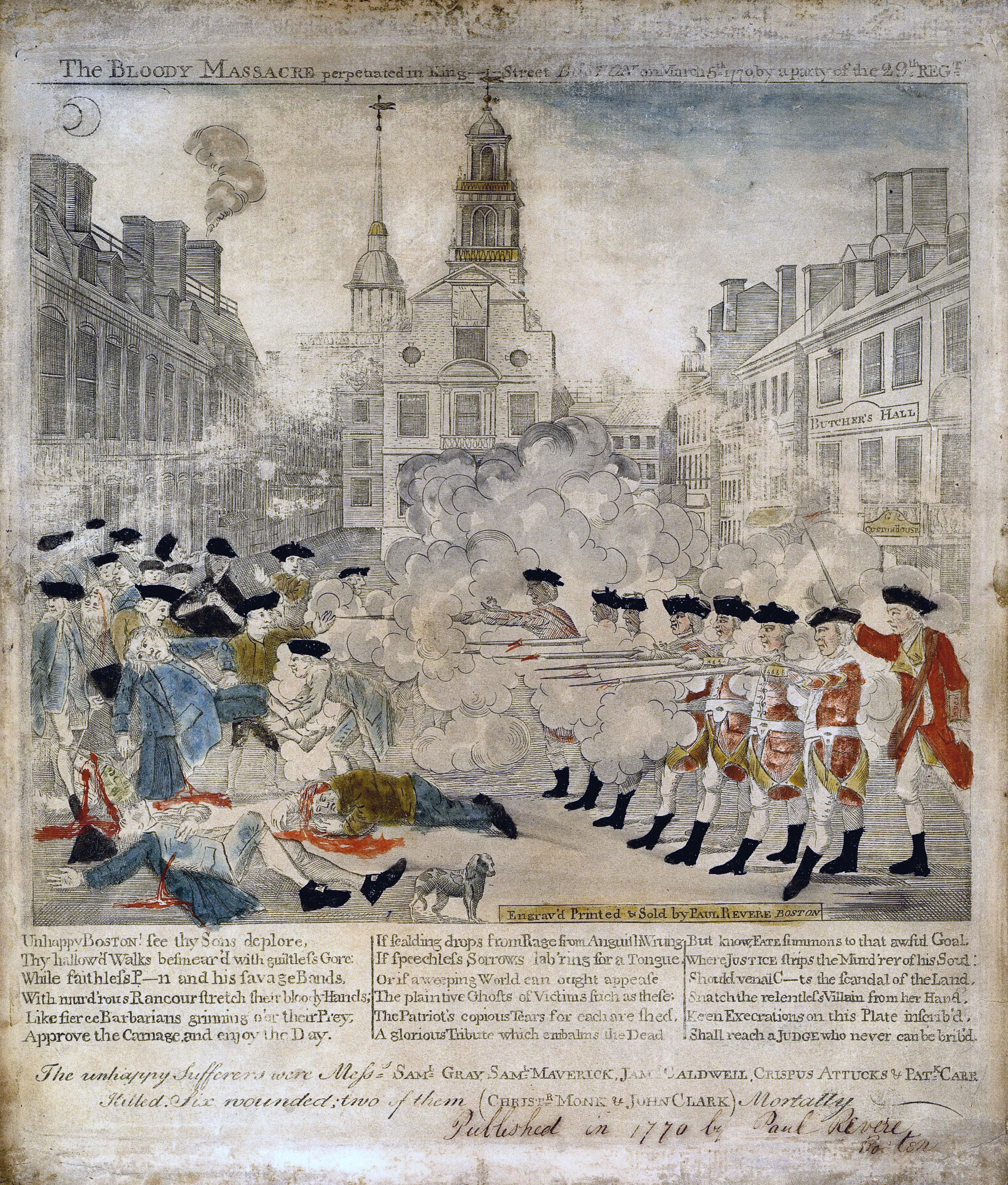
File:Boston Massacre high-res.jpg

Yes, the Boston Massacre took place when a squad of British soldiers, came to support a sentry who was being heckled and hit with "snowballs."
Their idea of support was not to scatter the crowd, but instead to let loose with a volley of musket shots at point blank range into the crowd.

Three people were killed immediately and two died later of their wounds; among the victims was Crispus Attucks, a man of black or Indian parentage.

The British officer in charge, Capt. Thomas Preston, along with eight of his men was later arrested for manslaughter.
The killings of March 5th, was promptly termed a "massacre" by Patriot leaders and commemorated in a widely circulated engraving by Paul Revere, which aroused intense public protests and threats of violent retaliation.

Depictions, reports, and propaganda about the event, notably the colored engraving produced by Paul Revere, further heightened tensions throughout the Thirteen Colonies.

The event is widely viewed as foreshadowing the outbreak of the American Revolutionary War five years later.

This pressure caused Lieutenant Governor Thomas Hutchinson to withdraw the British troops billeted in Boston to to Castle Island in the harbor.

In an effort to demonstrate the impartiality of colonial courts, two Patriot leaders, John Adams and Josiah Quincy, volunteered to defend Captain Preston and his men.

The prosecution produced little to no evidence, and Preston and six of the soldiers were acquitted. Two others were found guilty of manslaughter, branded on the hand with a hot iron, and released.

Although many Patriots criticized the verdicts and the anniversary of the Boston Massacre became a patriotic holiday, the removal of troops from Boston and the repeal of all but one of the contested import duties resulted in a lowering of tension in the years following the incident.

Though individual liberty was being trampled, most colonists continued to accept British rule. At least they did until Parliament's enactment of the Tea Act of 1773.

The Tea Act of 1773 was a bill passed by the English Parliment designed to save the faltering British East India Company by greatly lowering its tea tax and granting it a monopoly on the American tea trade.

The low tax allowed the company to undercut even tea smuggled into America by Dutch traders, and many colonists viewed the act as another example of taxation and tyranny. It was the straw that broke that broke the backs of British subjects. It turned angry subjects into freedom fighters.

In response, militant colonists in Massachusetts organized a band of Bostonians known as the Sons of Liberty.

The Sons of Liberty, all dressed as Mohawk Indians boarded British ships. Once there they dumped 342 chests of tea into Boston Harbor.

What become instantly known as the "Boston Tea Party" saw British tea valued at some £18,000 dumped into Boston Harbor.

Parliament was absolutely outraged at what took place in Boston.

The Boston Tea Party finally led the English Parliament to enact the Coercive Acts, called the Intolerable Acts by the colonists, in 1774.

The Coercive Acts closed Boston to merchant shipping, established formal British military rule in Massachusetts, made British officials immune to criminal prosecution in America and required colonists to quarter British troops - something that British subjects had long resisted.

The Coercive Acts was blatantly designed to re-assert Imperial authority in Massachusetts.

In response, the colonists called the first Continental Congress to consider united American resistance to the British.

In response, a group of colonial delegates which included George Washington of Virginia, John and Samuel Adams of Massachusetts, Patrick Henry of Virginia and John Jay of New York met in Philadelphia in September of 1774 to give voice to their grievances against the British crown.

Massachusetts led the resistance to the British by forming a revolutionary government and establishing militias to resist the increasing British military presence across the colony.

The First Continental Congress did not go so far as to demand independence from Britain, but it denounced taxation without representation, as well as the maintenance of the British army in the colonies without their consent.

The First Continental Congress issued a declaration of the rights due every citizen, including life, liberty, property, right of ssembly, and trial by jury.

The rights of good and honest men and women were under assault. Their individual liberty was being dismantled.

The Continental Congress voted to meet again in May of 1775 to consider further action, but by that time war had already broken out.

In early April of 1775, Thomas Gage, the British governor of Massachusetts, ordered British troops to march to Concord, Massachusetts, where a Patriot arsenal was known to be located.

On April 19, 1775, British soldiers encountered a group of local American militiamen at Lexington, and the first shots of the American Revolution were fired.

The local militiamen clash with British soldiers in Lexington and Concord, Massachusetts, marked the first shots fired in the Revolutionary War.

To King George III, it was a Colonial Rebellion.

To Americans, a call for "independence" was sweeping the land.

In June of 1775, the Congress established the Continental Army, issued paper money for the support of the troops, and formed a committee to negotiate with foreign countries. By the end of July of that year, it created a post office for the "United Colonies."

In August of 1775, a royal proclamation declared that the King's American subjects were "engaged in open and avowed rebellion."

Later that year, Parliament passed the American Prohibitory Act, which made all American vessels and cargoes forfeit to the Crown.

And in May of 1776, the Congress learned that the King had negotiated treaties with German states to hire mercenaries to fight in America.

Parliament remained unwilling to negotiate with "American rebels" and instead hired German mercenaries, called Hessians, to help the British Army crush the American rebellion.

As British subjects in North American, many saw it as a struggle for their rights as British citizens.

But more and more all of the actions of the crown combined - was too much to deny. It had become a fact that their mother country, Great Britain, was now treating her colonies as a foreign enemy.

On June 17th, 1775, in the Revolution's first major battle, Colonial forces inflicted heavy casualties on the British regiment of General William Howe at Breed's Hill in Boston.

The engagement, known as the Battle of Bunker Hill, ended in British victory - but it gave encouragement to the revolutionary cause.

By the autumn of 1775, the British North American colonies from Maine to Georgia were in open rebellion.

Throughout that fall and winter, Washington's forces struggled to keep the British contained in Boston, but artillery captured at Fort Ticonderoga in New York helped shift the balance of that struggle in late winter. The British evacuated the city in March 1776, with Howe and his men retreating

Government officials representing the crown had been ran out of many colonial capitals and revolutionary governments put in their places.

The Continental Congress had assumed the responsibilities of a central government for the colonies.

One by one, the Continental Congress continued to cut the colonies' ties to Britain.

The Privateering Resolution, passed in March 1776, allowed the colonists "to fit out armed vessels to cruise on the enemies of these United Colonies."

On April 6th, 1776, American ports were opened to commerce with other nations, an action that severed the economic ties fostered by the Navigation Acts. A "Resolution for the Formation of Local Governments" was passed on May 10, 1776.

At the same time, more of the colonists themselves were becoming convinced of the inevitability of independence.

Thomas Paine's Common Sense, published in January 1776, was sold by the thousands. By the middle of May 1776, eight colonies had decided that they would support independence.

On May 15, 1776, the Virginia Convention passed a resolution that "the delegates appointed to represent this colony in General Congress be instructed to propose to that respectable body to declare the United Colonies free and independent states."

By June 1776, with the Revolutionary War in full swing, a growing majority of the colonists had come to favor independence from Britain.

Then, on June 7th, 1776, in a session in the Pennsylvania State House - later known as Independence Hall - the Continental Congress heard Richard Henry Lee of Virginia read his resolution. It began:

"Resolved: That these United Colonies are, and of right ought to be, free and independent States, that they are absolved from all allegiance to the British Crown, and that all political connection between them and the State of Great Britain is, and ought to be, totally dissolved."

The Lee Resolution was an expression of what was already beginning to happen throughout the colonies.

When the Second Continental Congress, which was essentially the government of the United States from 1775 to 1788, first met in May 1775, King George III had not replied to the petition for redress of grievances that he had been sent by the First Continental Congress.

And yes, even though fighting was taking place throughout the colonies, even though the iron glove of oppression had descended on the 13 Colonies, believe it or not, even with what was right in front of their face -  still some delegates wanted to put aside Independence, and instead pursue the path of reconciliation with Britain.

In keeping with these instructions that Richard Henry Lee, on June 7th, 1776, presented in his resolution, on June 11th, consideration of the Lee Resolution was postponed by a vote of seven colonies to five, with New York abstaining.

Congress then recessed for 3 weeks. The tone of the debate indicated that at the end of that time the Lee Resolution would be adopted.

Before Congress recessed, therefore, a Committee of Five was appointed to draft a statement presenting to the world the colonies' case for independence.

The Committee of Five consisted of two New England men, John Adams of Massachusetts and Roger Sherman of Connecticut; two men from the Middle Colonies, Benjamin Franklin of Pennsylvania and Robert R. Livingston of New York; and one southerner, Thomas Jefferson of Virginia.

Later in 1823, Jefferson would write that the other members of the committee "unanimously pressed on myself alone to undertake the draft. I consented; I drew it; but before I reported it to the committee I communicated it separately to Dr. Franklin and Mr. Adams requesting their corrections. . . I then wrote a fair copy, reported it to the committee, and from them, unaltered to the Congress."

If Thomas Jefferson did make a "fair copy," incorporating the changes made by Franklin and Adams, it has not been preserved.

It may have been the copy that was amended by the Congress and used for printing, but in any case, it has not survived.

Jefferson's rough draft, however, with changes made by Franklin and Adams, as well as Jefferson's own notes of changes by the Congress, is housed at the Library of Congress.

Jefferson's account really does reflect the three stages in the life of the Declaration of Independence: the document originally written by Jefferson; the changes to that document made by Franklin and Adams, resulting in the version that was submitted by the Committee of Five to the Congress; and the version that was eventually adopted.

On July 1, 1776, the Continental Congress reconvened.

The following day, the Lee Resolution for independence was adopted by 12 of the 13 colonies, New York not voting.

Immediately afterward, the Congress began to consider the Declaration of Independence.

John Adams and Benjamin Franklin had made only a few changes before the committee submitted the document.

The discussion in Congress resulted in some alterations and deletions, but the basic document remained Jefferson's.

It should be understood that the political philosophy of the Declaration was not new. Fact is, its ideals of individual liberty had already been expressed by John Locke and other Continental philosophers.

What Jefferson did was to summarize this philosophy in "self-evident truths" and set forth a list of grievances against the King in order to justify before the world the breaking of ties between the colonies and the mother country - the crown.

Though thought completed, the process of revision continued through all of July 3rd and into the late morning of July 4th. Then, at last, church bells rang out over Philadelphia; a Declaration of Independence had been officially adopted.

That, my friends, is how the Declaration of Independence came to be.
And yes, since today is July 4th, here's just a little about our amazing document itself.

The Declaration of Independence is made up of five distinct parts: The introduction; the preamble; the body, which can be divided into two sections; and a conclusion.

The introduction states that this document will "declare" the "causes" that have made it necessary for the American colonies to leave the British Empire.

Having stated in the introduction that independence is unavoidable, even necessary, the preamble sets out principles that were already recognized to be "self-evident" by most 18th- century Englishmen, closing with the statement that "a long train of abuses and usurpations . . . evinces a design to reduce [a people] under absolute Despotism, it is their right, it is their duty, to throw off such Government, and to provide new Guards for their future security."

The first section of the body of the Declaration gives evidence of the "long train of abuses and usurpations" heaped upon the American people by King George III.

The second section of the body states that the colonists had appealed in vain to their "British brethren" for a redress of their grievances.

Having stated the conditions that made independence necessary and having shown that those conditions existed in British North America, the Declaration of Independence concludes that "these United Colonies are, and of Right ought to be Free and Independent States; that they are Absolved from all Allegiance to the British Crown, and that all political connection between them and the State of Great Britain, is and ought to be totally dissolved."

Congress adopts the Declaration of Independence in the morning of a bright, sunny, but cool Philadelphia day on July 4th, 1776. All 56 members of Congress affix their signatures to an enlarged copy of the Declaration of Independence.

Fifty-six congressional delegates in total signed the document, including some who were not present at the vote approving the declaration. The delegates signed by state from North to South, beginning with Josiah Bartlett of New Hampshire and ending with George Walton of Georgia. John Dickinson of Pennsylvania and James Duane, Robert Livingston and John Jay of New York refused to sign. Carter Braxton of Virginia; Robert Morris of Pennsylvania; George Reed of Delaware; and Edward Rutledge of South Carolina opposed the document but signed in order to give the impression of a unanimous Congress. Five delegates were absent: Generals George Washington, John Sullivan, James Clinton and Christopher Gadsden and Virginia Governor Patrick Henry.

The first, largest, and most famous signature is that of John Hancock, President of the Continental Congress. The youngest signer was Edward Rutledge (age 26). Benjamin Franklin (age 70) was the oldest. Two future presidents signed as well, John Adams (second President) and Thomas Jefferson (third President).

It was exactly one month before the signing of the document, that Congress had accepted a resolution put forward by Richard Henry Lee that stated "Resolved: That these United Colonies are, and of right ought to be, free and independent States, that they are absolved from all allegiance to the British Crown, and that all political connection between them and the State of Great Britain is, and ought to be, totally dissolved."

One of the things that I find so interesting is that the dramatic words of the Lee resolution were actually added to the closing of the Declaration of Independence.

As a final thought, on August 2, the declaration was completely signed by everyone.

The names of the signers of the Declaration of Independence were withheld from the public for more than six months to protect the signers.

If independence had not been achieved, the treasonable act of the signers would have, by law, resulted in their deaths.

The American War for Independence would last for eight years.

Still to come was the Patriot triumph at Saratoga, the bitter winter at Valley Forge, battle upon battle, the intervention of the French, and the final victory at Yorktown in 1781.

In 1783, with the signing of the Treaty of Paris with Britain, the United States formally became a free and independent nation.

I find it an interesting bit of trivia that Independence Day, the Fourth of July, was not made a National Holiday until 1941. 

I guess it just proves that sometimes priorities elude those responsible with carrying the torch of freedom - us!

I believe today, July 4th, is a day of celebration and renewal.

And yes, let's all take a moment to give thanks to those who gave all so some may live free.

Let's marvel at the wonder that was won against all odds!

Let's renew our sacred vow as Americans to do as our Founding Fathers said, and "Stay Free By Staying Vigilant."

Many have given so much to preserve our individual liberty, we should stand as sentries guarding what has been handed down to us.

Besides guardians, we are the stewards of our freedoms.

Our freedoms that so many have fought and died for, our freedoms that has been tested by way of politics and the courts, that so many have labored so hard to preserve, our freedoms  are not a gift by any means.

Yes, there are those who would take our freedoms for granted.

Sadly, there are those who see no reason to stand in defense of our freedoms. Sadly, there are those who see no reason to fight for America and our first principles.

They don't understand that our freedom is a sacred trust.

Our freedom, our liberty, is a jewel among those things handed down to us by God.

Our individual liberty, our freedom, is prized as more precious and more valuable than life itself - especially by those who have lived under the yoke of tyranny.

Let's celebrate the birth of our great nation. Let's ignore the Nay Sayers, ignore those pitiful individuals who have no respect for our accomplishments or strengths as a nation.

After all, those who've never prized our independence have always been on the wrong side of history.

Let's wave the colors and have pride in the fact that our nation is still free. Let's praise our founders, their brilliance, and their understanding of the rights of man.

Let us hold our flag and our country in high esteem. Let's rejoice knowing that we have helped more, fed more, and protected more people than any other nation in the history of the world.

Let's feel good about being Americans!

Happy 4th of July!

The original!

The original Declaration of Independence document measures 29-3/4 inches by 24-1/2 inches, and is now exhibited in the Rotunda for the Charters of Freedom in Washington, DC. It has faded badly, largely because of poor preservation techniques during the 19th century.


Story by Tom Correa

Saturday, June 30, 2012

RANDOM SHOTS - Black Racist Hate Crime, Homeland Security Instructions Border Patrol To "Run Away" And "Hide", and Much More!


FIRST SHOT!

Homeland Security Instructions Border Patrol To "Run Away" And "Hide" From Gunmen

That's right! On June 29, 2012, it was reported that our Border Patrol is now being issued instructions to "run away" and "hide".


As insane as it sounds, it's true! A pocket card handed out to Homeland Security employees in April detailing how they should handle an "active shooter" situation.

Border Patrol agents in Arizona are blasting their bosses for telling them, along with all other Department of Homeland Security employees, to run and hide if they encounter an "active shooter."

It's one thing to tell civilian employees to cower under a desk if a gunman starts spraying fire in a confined area, say members of Tucson Local 2544/National Border Patrol Council, but to give armed law enforcement professionals the same advice is downright insulting. The instructions from DHS come in the form of pamphlets and a mandatory computer tutorial.

“We are now taught in an ‘Active Shooter’ course that if we encounter a shooter in a public place we are to ‘run away’ and ‘hide’" union leader Brandon Judd wrote on the website of 3,300-member union local. “If we are cornered by such a shooter we are to (only as a last resort) become ‘aggressive’ and ‘throw things’ at him or her. We are then advised to ‘call law enforcement’ and wait for their arrival (presumably, while more innocent victims are slaughtered)."

The FEMA-administered computer course, entitled “IS-907- Active Shooter: What You Can Do,” is a 45-minute tutorial that provides guidance to all employees on how to recognize indicators of possible workplace violence and what to do should their office be invaded by gunmen and focuses around three main options; either evacuate, hide out, or in dire circumstances, take action.

Main Points of the "Active Shooter" training course -

Evacuate: If there is an accessible escape path, attempt to evacuate the premises.

Hide out: If evacuation is not possible, find a place to hide where the active shooter is less likely to find you.

Take action: As a last resort, and only when your life is in imminent danger, attempt to disrupt and/or incapacitate the active shooter.

Once the course is completed, employees are urged to download additional materials including a summary booklet and pocket-sized card outlining protocol, which was also handed out to employees two months ago.

One DHS employee told FoxNews.com the instruction cards were handed out to employees six weeks ago. At the time, he assumed they were only for civilian employees, not armed law enforcement officers within the department, which oversees the U.S. Customs and Border Protection.

"Requiring BP agents to follow the same steps is egregious,” he said.

DHS officials maintain that the Active Shooter course was designed for all employees—civilian and law-enforcement officers-- and no one should rush into a situation where they, or others around them, could get hurt.

“The Department of Homeland Security takes very seriously its responsibility to protect all of its employees from threats that may surface in the workplace,” U.S. Customs and Border Protection spokesman Michael Friel said in a written statement to Fox News.

“CBP workforce training is designed to prepare all employees, including leaders, managers, supervisors, law enforcement personnel and non-law enforcement personnel, to understand their own roles and the roles of their fellow employees in responding to threats. In an active shooter scenario, employees are taught to take actions that keep them alive.”

But members of Local 2544 say they are obligated to protect the public in such a situation, whether they are on duty or not. Given the instructions, some wonder if they would be disciplined for taking down a gunman in a situation like the Fort Hood shooting or the January, 2011 case in Casa Adobes, in which a deranged gunmen shot 19 people, including Democratic Rep. Gabrielle Giffords. Six people were killed.

“It is always comforting to know that for those of us who carry a weapon when we are off-duty, if we should encounter such a situation, stop a shooter and save countless lives, we can look forward to being disciplined or fired by the Border Patrol because we should have run away to hide and then maybe thrown objects at the deranged killer instead of taking action and stopping him with a firearm,” the union local's website says.

So now, if an Illegal Alien is crossing into the Untied States with guns and actually uses one - our security folks, our Border Patrol, is not to apprehend but instead are now being instructed to leave them alone, run the other way, and hide.

This is the backbone of what we get from Democrats, who are nothing be devious cowards, in charge of our safety and security along the border. This is a horrible situation that can only be remedied in the November Election.

The head of Homeland Security, Janet "I know nothing about security" Napolitano is as inept as they come when it comes to national security. She's a typical liberal politician.

Early in her term as head of Homeland Security, she paid dues to the liberal establishment by "warning" America about Veterans returning from Iraq and Afghanistan. 

In April of 2009, this was the headline in the news:

Janet Napolitano's Homeland Security Classifies Returning US Veterans as Potential Terrorist Threat

It was in April of 2009 that Homeland Security Chief, Janet Napolitano, had the gaul to "warn" Americans about "right wing extremists" and "the threat" that they pose to the United States.

Her policy basically lumped in people who are either pro-Second Amendment, anti-Abortion, anti-Illegal Aliens, or pro-smaller government, with White Supremacists and Domestic Terrorists. As crazy as that sounds, as absolutely egregious as that is - she wasn't finished.

Janet Napolitano also affirmed her belief that the men and women in our military, those overseas fighting on our behalf, are a bigger threat to America than Al Queada.

This is what Janet Napolitano thinks about our military men and women who are overseas fighting on our behalf:

"the return of military veterans facing significant challenges reintegrating into their communities could lead to the potential emergence of terrorist groups or lone wolf extremists capable of carrying out violent attacks"

That is was unforgivable at the time. And yes, its something that I won't forgive or forget.


To suggest that some of our troops will come home and form or join terrorist groups is beyond reprehensible. I question her sanity!

Her Homeland Security Report read:

"Returning veterans possess combat skills and experience that are attractive to right-wing extremists. DHS/I&A is concerned that right-wing extremists will attempt to recruit and radicalize veterans in order to boost their violent capacities."

Yes, believe it or not, she said that our men and women coming home from doing battle for America was indeed America's biggest threat - bigger than Al Queda!

And now, from this "active shooter" situation card, it is very apparent that her total lack of understanding of security is not limited to her complete lack of sane judgement.

She is as worthless as tits on a boar, and the faster we get her out of that position and put a non-political knowledgeable security person in her place the better off America will be.

This is what we get when we have a Communist form of government in the White House, Stalinist political appointees who don't know their ass from a hole in the ground.

SECOND SHOT!

Pentagon crackdown on free guns riles some Police

In June, it was reported that the Defense Department fired off a round of letters warning State Law Enforcement Officials to track down every gun, helicopter, and Humvee that the military had given them under a $2.6 billion surplus program, or have their access to the handouts cut off.

The problem, according to the states: At least some of them had already turned over that information.

All the same, officials at the Defense Logistics Agency have stopped issuing weapons to thousands of police departments until they're satisfied they've had a full accounting of where all the giveaways have landed.

While some of the state liaisons said they don't expect major hassles complying with the broad review, others said Friday that the letters show the Defense Department's own troubles keeping abreast of paperwork and add another layer to an overly bureaucratic process that, on its face, is fairly straightforward.

The defense agency's Law Enforcement Support Office provides police and sheriffs' departments with equipment ranging from guns and helicopters to computers and air conditioners and even toilet paper. The goods are cheap or free to acquire, but much of them come with strict rules that prohibit them from being sold and dictate how they must be tracked.

Associated Press inquiries into how the program is administered in all 50 states and several U.S. territories, however, show that most of them only keep paper records, and the few states that keep electronic records only recently made the switch from paper.

"That's the problem with the entire program is it's paper-based when it should be automated," said Michigan National Guard Master Sgt. David Sass.
Sass, who has been the state's coordinator for just four months, said he already feels like he's dealing with a broken system.

"The current program they have is inefficient and ineffective and truly not of the quality and value we need to accomplish our ultimate goal of property accountability," Sass said.

What worries Sass the most is being asked to certify, under the penalty of perjury, what law enforcement agencies tell him about the weapons they got from the Pentagon. The letters the Defense Department sent out late last month demand "a complete (100 percent) weapons physical inventory," in accordance with the program's rules.

Sass said there are more law enforcement agencies in his state than there are work days in the year and it would be impossible for him to personally check the inventory of each one.

"I'm quite concerned," he said. "Realistically, how can we be expected to verify that they have all their weapons without them being honest?"

The military decided to conduct a "one-time, clean sweep" of all state inventories instead of reviewing them piecemeal, said Kenneth MacNevin, a spokesman for the federal agency. While some gear, including guns, has been stolen or otherwise gone missing over the years, MacNevin said the reporting requirements themselves aren't new and that the review wasn't prompted by anything specific.

"Leadership decided to make sure we have a good, full accounting for all of this," he said. "We're not doing this based on any thought there's a problem. We're doing it because accountability is accountability."

However, MacNevin said the AP's ongoing inquiries and a pair of media reports were factors in the decision to send the letters. Only New Hampshire didn't get a letter; State Police Major Russ Conte, the state's liaison for the surplus program, said his office already had completed a full accounting.

The Arizona Republic reported last month that the Pinal County Sheriff's Office has stockpiled millions of dollars' worth of equipment through the program, distributing some of the gear to non-police agencies, and intended to sell other property, which would violate the program's rules.

"The Pinal County Sheriff's Office was audited seven months ago by the Department of Defense and were found to be in full compliance and today we are still in full compliance ...," sheriff's spokesman Tim Gaffney told the AP and the newspaper in an email Friday. "This decision to temporarily suspend the issuance of weapons has nothing to do with us."

A report in March by California Watch, which was founded by the Center for Investigative Reporting, found that California police accumulated more equipment during 2011 than any other year in the program's two-decade history. That follows the overall trend in the program, which last year doled out almost $500 million in gear, up by more than double from the year before.

Tim Hoyle, another spokesman for the Battle Creek, Mich.-based Defense Logistics Agency, said all weapons will be withheld until the accounting is completed.

In a letter dated May 24, the military notified Florida that it had failed to certify that it had finished its annual physical inventory of weapons, aircraft, Humvees and armored personnel carriers. The agency said it intended to suspend Florida from participating in the program if the certifications weren't received by June 22.

But Mike McClure, who supervises the state coordinator for the program, said the letter was sent in error, because the state had, in fact, completed its required audit.

"We should be receiving a letter from LESO in the coming days formally rescinding their earlier memo," the official, Mike McClure, wrote in a June 1 email to several colleagues.

Louisiana received an identical letter, but a state official said Friday it already had provided the right documents to Defense officials.

"They assured us that we should not have gotten the letter," said Michael DiResto, a spokesman for the state Division of Administration.

Defense Logistics spokeswoman Michelle McCaskill said the agency was standing by its decision to send the letters.

"There were some states where inventories have been completed but the certification paperwork has not been received and is still required," she said in an email Friday. "We have not rescinded any letters. The letters were tailored for each state to reflect what was needed from that state."

The surplus program has grown exponentially in recent years, with a record $498 million worth of property distributed in fiscal year 2011. That includes $191 million in aircraft alone and more than 15,000 weapons worth nearly $4.8 million. Military officials said the program has become more popular as law enforcement agencies sustain deep budget cuts.

Conte, the New Hampshire coordinator, said some of the other equipment law enforcement agencies receive through the program is more needed at times. "The weapons part of it is a small part compared to everything else, but it's an important part," he said.

THIRD SHOT!

Black man invades home, rapes and murders White woman age 85, and puts her husband, age 90, in hospital


Surprisingly, President Obama, Al Sharpton, and the rest of the other Black champions for racism and social injustice, didn't take to a moment or a microphone to denounce the hate filled racist actions taken by a 20 year old black man who broke into a home and utterly terrorized the elderly white family there.

This took place in March when they were so wrapped  up in the case of 17 year old black boy Trayvon Martin attack on George Zimmerman which resulted in Zimmerman having to shot Martin, so they obviously didn't hear about a real racial hate crime taking place.

And sorry to have to be the one to educate the President, but yes, racism has not color. Racist can be found in all colors. Black people can be racist just as anyone else can.

A black man, Tyrone Dale David Woodfork, age 20, proves with absolute certainty that Black people can be racist and commit Racist Hate Crimes. 

Tyrone Dale David Woodfork raped and murdered - he beat to death a nearly blind white woman -  Nancy Strait, age 85, as well as tried to kill her husband, Bob, age 90. He ended up in the hospital serious condition.
I know that some folks out there will write me to tell me that this 20 year old black man, Tyrone Dale David Woodfork, is misunderstood because of years of slavery and injustice. Please don't bother. The only slavery blacks have had to endure since 1865 is that of being slaves to the Democrat Party in the form of government programs to keep them subservient to them.

And as for injustice, black Americans constitute about 17% of the general population - yet according to the Justice Department blacks represent 45% of drug offenders in prison - and blacks commit 52% of the murders in this country.

A great reason to bring back hangings!
It all took place on March 20th, 2012. Of course you probably didn't hear about it because since the Zimmerman case the liberal news media has been awful busy telling America about the horrible effects that racism has on black people.

Nancy and Bob Strait, who had celebrated their 65th wedding anniversary in December, were discovered by their daughter at their home in Tulsa, Oklahoma. Both the pensioners were rushed to hospital where Mrs Strait, who was nearly blind, died from her rape and injuries.

Home invasion? Or just another Black Racist Hate Crime? Oops, I'm sorry, I forgot that black people can't be charged with Racial Hate Crimes because black people can't be racist.

You bet! And if you believe that, then I've got some swamp land to sell you!

Someone should tell that to Bob and Nancy Strait when were both attacked when black burglars broke into their home in Tulsa to rape and kill 85 year old Nancy Strait.

Bob Strait, who served with honor in the 101st Airborne Division during World War II, suffered a broken jaw, broken ribs, severe bleeding, and a concussion.

Police have arrested black 20 year old Tyrone Dale David Woodfork in connection with the case. Besides Woodfork, there might be at least one more son-of-a bitch out there living with what he did. I can only hope karma comes around and gets him or them as well  - in spades.

The Straits' distraught family paid tribute to the pair, who grew up in poverty in rural Oklahoma during the Great Depression.

They met each other on a blind date on Thanksgiving in 1946, then married a month later and went on to have six children, 18 grandchildren and about 50 great and great-great grandchildren. They had recently welcomed a great-great-great grandchild.

Their daughters Lanora and Andra told Tulsa World that the couple were loving and generous people who would do anything for anyone.

"Dad never talked, and Mama never quit talking," Lanora said.

"Whatever she did, it came from the heart," Andra added.

The pair could be found sitting on their porch singing and playing the guitar during warmer summer evenings.

Bob Strait, who had worked for the oil derrick supply company Lee C. Moore before retirement, enjoyed woodwork while his wife loved making quilts and baking.

I'm sure President Obama would say, if he had a son that he would look a lot like Tyrone Dale David Woodfork, age 20. The scumbag was arrested a day after the attack on complaints of first-degree murder, burglary, assault with a dangerous weapon and two complaints of armed robbery.

The Straits both had been struggling with health problems before the attack. Bob Strait had been diagnosed with a terminal kidney illness but had outlived the doctor's prognosis.

"He was living because Mother was alive," Andra told Tulsa World.

The couple had had food poisoning the week before the attack.

"There is no one else who has been through what he's been through who is still alive," Lanora said of her father. "We pray he doesn't remember."

Tulsa police say the home invaders made off with their Dodge Neon, a television and $200.

Woodfork was later found hiding in a nearby house after a witness spotted the stolen vehicle being driven down the road. He is being held at Tulsa Jail without bail accused of first-degree murder, burglary, assault with a dangerous weapon and two counts of armed robbery.

Why no rape charges?

"This investigation is far from over," Officer Jason Willingham of the Tulsa police department told Tulsa World. "We've still got a lot of questions that we still need answered."

Nancy Mrs Strait's funeral was held on the following Friday. The family has set up a fund called the Nancy Strait and Bob Strait Support Trust to help pay for the service and her husband's medical care.

It's hard for me to imagine how wonderful people like the Straits can live such a full, raised during the Great Depression, go off to fight in World War II, raise six children, have 18 grandchildren and about 50 great and great-great grandchildren -  all after marrying a month after meeting - then this horrible thing happens.

If a court of sane people convicts the young black man, 20 year old Tyrone Dale David Woodfork, for the rape and murder of an 85 year old white woman, and the beating of her 90 year old husband, then I hope they put him to death.

He is one of the lowest of the human race. He's one of the lowest that I've ever heard of. I know they won't, but I really wish they'd use a little Western Justice and hang him slow. Honestly, I don't think any punishment can be harsh enough for such an criminal act against humanity.

FOURTH SHOT!

Long Island New York Policemen demoted for being Republicans

On June 2nd it was reported that six Long Island cops claim their Commissioner is putting politics before the badge.
The Long Beach policemen say they’ve been targeted by the Long Island Democratic political machine for supporting Republican candidates in local elections last year.
Long Beach Police Commissioner Michael Tangney, a longtime Democrat, demoted the Officers, cut their overtime, switched them to midnight shifts, and even filed false internal charges against them for "political payback," the veteran officers claim in a $39 Million lawsuit.

"It's just the way politics work in this town," Tangney allegedly told one of the officers while demoting him.

Officers John Radin, 53; Benjamin Tayne, 47; James McCormack, 55; James Canner, 44; Karl Hayes, 42; and Jose Miguez, 39, claim they turned to their Union for help, but that then-president Stefan Chernaski, another Democrat, ignored them completely.
Chernaski filed his own $27.5 million claim last year against a then-Republican administration, claiming harassment. He settled for $25,000, and got two promotions and a $20,000 pay hike when the Democrats swooped into power.

Chernaski had never worked as a detective, yet was put in charge of the detective division, bumping aside Canner, a decorated officer who supported the Republican opponent of Tangney’s wife, Darlene, in her Nassau County Legislative race last year.

When Hayes learned of his January demotion from supervisor of investigators to sergeant, he “began crying hysterically for three to five minutes,” according to Brooklyn federal court papers. The stress of the demotions and suddenly being put on the midnight shift caused McCormack, a lieutenant who headed the traffic division, to retire, the suit alleges.

Radin, demoted from inspector to lieutenant, saw his monthly pay slashed from $18,000 to about $10,000, and he was moved to a small cubicle and referred to as “Jack in the Box,” according to court papers.

All of the officers involved, including Tangney and Chernaski, earned well over $130,000 salaries last year, according to See Through NY.

The town’s Democratic Party boss Michael Zapson sneered, “The fact that the gravy train is over for them, I’m not surprised they’re upset.”

Eric Rothstein, lawyer for the six officers, said the raises Tangney and Chernaski received offset any saving the city got by slashing his clients’ pay. “Politics doesn’t belong in the police department,” he said.

Former City Council President Jim Hennessy, a critic of City Manager Jack Schnirman’s government, slammed the Democrats as power mad.

“Everything is politics. It’s not about government,” he said. “It’s about getting power, holding power, keeping power, and going to town against anyone who threatens that power.”

The Democrat controlled city and the PBA have denied the allegations as "false" and "frivolous," and said they would aggressively defend themselves against the lawsuit.

For me, I've had to belong to a few different Unions in my time. And yes, I've seen this before. It was a situation where I went to my Union Rep for help in a bad situation. He refused me. Later I found out that he was getting money under the table by the very people who I worked for to keep me quiet.

So no, it doesn't surprise me that these Officers are not getting help from their Union because they are Republicans. Unions in America are controlled by Democrats and Organised Crime.

Besides the Union end of this, this makes me angry because in the case of this sort of thing is happening in a Police Department.  And yes, in this case it is a kin to graft and corruption. There is a theme of blatant corruption and payoffs at the highest levels in that Police Department.

But what can those six officers do? Crooked Democrats have an ally in the Justice Department, they can most likely buy there way around a Federal or State investigation. All they really have to do is be a contributor to Obama 2012 re-election campaign.

FIFTH SHOT!

Christian Student Expelled Over Her Views on Homosexuality Loses Her Lawsuit Against Georgia’s Augusta State University

Yesterday, June 29, 2012, it was reported that Jennifer Keeton was expelled over her personal views pertaining to homosexuality.

So let's cut to it here, it is becoming more and more a part of life in America to punish people who have views on things that do not meet the liberal Political Correctness standards that have taken over the country.

Yes, there is a tricky and potentially-troubling situation going on when it comes to individuals who are studying counseling in college these day. If they happen to oppose homosexuality, or anything else not Politically Correct, then they may be expelled.

Jennifer Keeton, who is a Christian, learned this the hard way after she was expelled from the graduate program at Georgia’s Augusta State University in 2010 for expressing her disagreement with the same-sex lifestyle.

Now, two years later, she has lost a subsequent court case defending herself against the school’s decision.

Here’s what took place.

Georgia’s Augusta State University‘s program apparently stressed that students couldn’t "discriminate" against others based on any indicators, including sexual orientation.

But Keeton, citing her religious views, refused to alter her engagement with gay students and clients. It’s not clear exactly what Keeting said inside or outside of the classroom that created such a stir, but this is certainly an interesting First Amendment case.

While the school argues that Keeton deserved to be dismissed, the former student says that she, in fact, was the victim of discrimination herself - especially considering the fact that she was kicked out of the program explicitly over her personal beliefs.

She was initially put on probation and was told that she would need to follow a “remediation plan” to remain in good standing with the university. This plan, though, included sensitivity training, writing papers about tolerance and the lessons she had learned and attendance at gay pride events. Naturally, Keeton refused to comply and she was removed from the program.

“The case hinged on whether the policies governing the counseling program were neutral and generally applicable to all students, regardless of their religious beliefs,” World on Campus explains. “Judge J. Randall Hall, of the Southern District of Georgia, determined that they were.”

“Keeton’s speech and conduct were evidently impelled by the absolutist philosophical character of her beliefs, but that character does not entitle her to university accommodation and it is irrelevant to the court’s analysis,” Hall wrote, clearly showing favor for Augusta State. “Neutrality as a legal standard is immutable, it does not bend to the strength or tenor of personal conviction.”

Currently, the Alliance Defense Fund (ADF), a conservative legal group representing Keeton in the case, is looking at options following the district court’s opinion and will soon make a decision about next steps.

I don't like the idea that any student can get expelled from an American university for having different views. Whether she was a counseling student or a business major this shouldn't take place.

There used to be a Conservative saying in the 1960s when the liberals first started taking control of America, "I might not believe in what you say, but I'll fight for your right to say it."

It's apparent that that is not how Georgia’s Augusta State University feels about their student's right to free speech or their right to think as they may.

I find it absolutely criminal that a school can demand the students to shut up about how they feel on any issue that may be Conservative or Christian in nature.

Our Founding Father were condemned for writing and talking about something called Freedom of Speech. I think they would have been fairly proud of Jennifer Keeton for standing up for what she believes in.

SIXTH SHOT!

Discrimination Is Not A Bad Word

OK, so here comes another of my ramblings!

One thing that I find interesting about cases like the one with Jennifer Keeton standing up for what she believes in - is the way people today use the word "discriminate."

When I was growing up, I remember hearing a man talk about a friend of my grandfather's who was a great judge of horses. He was said to have "Discriminating Taste."

I found that sort of interesting because I'd never heard the term before. It actual means "to note or observe a difference; distinguish accurately" such as when judging the conformation of a horse, or having to pick out clothing, or better made cars. Yes, it goes on. We do it everyday. Conscious or unconscious, we do. It's called being human.

We discriminate between things, good and bad, ugly or pretty, right and wrong, legal and not, safe and unsafe, moral and amoral. To discriminate between things that I admire and things that I find offensive is a very human trait.

We do it right and wrong. We all make distinctions in favor or against people and things everyday. I hate, yes I said hate, rapists and murderers and child molesters, people who use others, people who like to control others, cowards, mean drunks, racists of any color, drug users, people who harm animals, Communist because I've seen first hand what they do, and yes, the homosexual lifestyle being passed off as something more than simply just a lifestyle of choice.

And sorry to those out there who find my statement offensive, but the fact is that they have never found such a thing as a Gay Gene!

And contrary to popular belief, I don't hate Democrats. Some of my best friends are Democrats. I don't hate Liberals, I just hate what some of the radical bastards do! It's called having the ability to discriminate between actions that I don't like and those I do.

I love and respect our troops who are willing to fight and die for us, and prefer their company over come to find out wealthy Occupy Protesters. I love most horses but mostly Quarter horses with nice hind quarters. I like Hereford cattle over sheep, guns but not modern black guns so much, Old Cowboy Music and not today's excuse for Country Music where you can't even hear the words.

I like steak and eggs over salads, target shooting over cleaning my garage, Cowboy hats over any other, short rowel Roping spurs over Knob spurs, batwing chaps over shotgun style chaps, hunting and fishing over watching television, the smell of fresh cut lumber over smelly perfumes. That, my friends, is discrimination.

I love my nieces and nephews, grand nieces and nephews, whatever color or ethnic background they happen to be.

Do I favor one niece and nephew over another because one might be part black and another part Italian, or one is part Mexican and another is part Hawaiian? Of course not, I love them all.

Would I like it, if one were not being a good parent or practicing a dangerous life style like doing drugs? I would not like it at all. That's called discrimination. And it's because I discriminate and understand what I like and don't like, that I have the ability to make sound judgements. It also enables me to say that it's my choice not to like certain things in life.

I discriminate daily on things I see on a menu, what I buy for myself to wear, and what people I associate with. We all do!

It is a human trait that I have no problem with. We all discriminate in one way or another so that we can see and mark a difference in the world around us. Sometimes it is simply discerning in matters of taste, and other times it may be something in depth that may have us researching to find out where we stand on the matter.

Today, the word discriminate has become a very bad word. The reason for that is the Political Correct slant that has been placed on the word to define the word to mean something conspicuously bad, offensive, and nasty. 

The lie Liberals are trying to perpetuate is to say that discrimination is to make a distinction in favor of or against a person or thing on the basis of the group, class, or category to which the person or thing belongs rather than according to actual merit.

When they say "a new law discriminates against foreigners," they are trying to slant your way of thinking to the negative. They would not like it if the same statement read, "a new favors citizens over foreigners." No, they wouldn't - and that's why they have turned an innocent word into something bad.

No, discrimination is not a bad word. If you're smart, you discriminate to live better and wiser.

LAST SHOT!

Did One City Really Ban People From Putting Flags Near the Graves of Vets?

It's strange how some stories are just too close to home.

Just last night, I was asked to look into a problem with the cemetary in Angels Camp here in California about a 40 minutes from here.

Angels Camp has a small population of 3,835 according to the 2010 census. Mark Twain based his short story "The Celebrated Jumping Frog of Calaveras County" on a story he claimed he heard at the Angels Hotel in 1865.

Now I find out that the Angels Camp Cemetery is not allowing American Flags on the graves of veterans there. I'll be looking into this.

Mineral Wells, Texas, is a town of about 17,000 residents located 50 miles east of Fort Worth in Parker County.

Yesterday, June 29, 2012, it was reported that "The Mineral Wells City Council is reconsidering an ordinance that bans flags from being displayed at the graves of veterans at any time other than two weeks around Memorial Day and Veterans Day," CBS DFW reported.

The CBS DFW report went on to say, "The ordinance, which was passed last week, includes a host of regulations concerning what can be placed around city graves. Teddy bears and statues must be removed 21 days after the funeral. Mourners cannot place flowers near a grave site unless they’re in a vase."

So what made council members think this was a good idea? And yes, I'm sure many are wondering how they intended to enforce it?

The volunteer-staffed Cemetery Board pitched the idea to the City Council last week and, apparently, nobody thought that regulating the small comfort of putting flowers or a flag on a grave would, you know, really, really upset some people.

Of course, there was a backlash! People were very upset about this. City Manager Lance Howerton maintains the council didn’t mean any disrespect. Some find that hard to believe when considering the city supported the proposal.

"When a veteran tells you they love the flag more than life itself, they mean it,” said Robert Veach, an Army veteran whose father’s grave is located at Woodland Park Cemetery in Mineral Wells.

Veach was among a group of veterans who were unhappy with the ordinance and took their complaint to the city council.

“Maybe we have to raise the flag a little so it would be easier to weed-eat and mow,” Veach said. “It’s a symbol of the country; we can’t let it go without a fight. We can’t.”

I agree!

Story by Tom Correa

Friday, June 29, 2012

Bear Attacks - Part One


California Camper Killed In Bear Attack At Yellowstone National Park

Bear attacks are usually completely unexpected, an example of this is on July 6th, 2011, Brian Matayoshi, a 57-year-old Gardena pharmacist who lived in North Torrance, California in the Los Angeles South Bay has been identified as the victim of the fatal bear attack that took place in the 2.1 million acre Yellowstone National Park.

Brian, a Recreational Vehicle (RV) owner, was camping in the park with his wife Marylyn.

This is the first time a human has been killed by a bear within park boundaries since 1986, though one camper was killed and two injured in a horrific bear attack at the Soda Butte Campground, Montana at the north-eastern corner of Yellowstone National Park in July, 2010.

On Wednesday morning, at approximately 11:00am, Brian and his wife were hiking on the popular Wapiti Lake Trail - located off the South Rim Drive - at a point about a mile and a half from the trailhead when they spotted a bear approximately 100 yards away prompting them to immediately turn and walk away.

The bear that was 100 yards away was there in seconds as the female grizzly ran down the trail and attacked Mr. Matayoshi who received multiple bite and clawing injuries.

The bear then went after attacked Marylyn, who had fallen to the ground nearby. The bear bit her daypack, lifting her from the ground and then dropping her. She played dead, and the bear left the area. She was not injured.

The bear then left the area and Brian was pronounced dead at the scene when rangers arrived at approximately 11:30 a.m.

"It is extremely unfortunate that this couple’s trip into the Yellowstone backcountry has ended in tragedy," said Dan Wenk, Superintendent of Yellowstone National Park. "Our heart goes out to the family and friends of the victim as they work to cope with their loss."

The initial National Park Service (NPS) investigation suggests that the sow grizzly acted in a purely defensive nature to protect her cubs.

"It was not predatory and so we see no reason to take action against the bear," said Kerry Gunther, bear management biologist for Yellowstone National Park, in a statement to the Associated Press.

For me, when I hear the facts of what took place with the bear being at least 100 yards away when they first saw the bear and decided to walk away from the bear - I don't see how they could have been a threat to the bear. When I read statements from the NPS that says their investigation "suggests" that the sow grizzly acted in a "purely" defensive nature to protect her cubs - I can't help but wonder if they're protecting the park from future litigation.

This particular female bear is not tagged or collared, and does not apparently have a history of aggression or human interaction. Typically, the National Park Service does not trap, relocate, or kill a bear under those circumstances. A Board of Review which will include inter-agency experts will be convened to review the incident.

The NPS has reminded Park visitors that they should stay on designated trails, hike in groups of three or more people, and be alert for bears and make noise in blind spots.

Then again, since I have been to Yellowstone many times, I know real well that the majority of visitors there do stay on the designated trails and boardwalks.

I also know for fact that staying on the designated trails and boardwalks does not prevent you from being charged by a bear or a buffalo.

NPS recommends that visitors should also carry bear pepper spray, which has been shown to be highly successful in stopping aggressive behavior in bears:

•The spray should be carried in a hip or chest holster to ensure easy access.
•You should carry more than one can of bear pepper spray so that you have additional spray time should it take more than one burst to stop a bear, or if you encounter more than one bear.

The Matayoshis were not carrying pepper spray. I never carried pepper spray there because I was told I didn't need it in the camp areas and on designated trails.

Because of my experience at Yellowstone, I don't think the Matayoshis were carrying pepper spray because they weren't expecting to be attacked by a bear - especially one from the length of a football field away.

Bear Drags Teen Camper Out Of His Tent Near Fairbanks, Alaska

On August 21st, 2011, it was reported that an 18-year-old camper had a rough encounter with a black bear near Fairbanks, Alaska.

Thomas Gilligan was awakened by the bear, which dragged him partially out of his tent in the Angel Rocks area.

The Fairbanks Daily News-Miner said that Gilligan sustained scratches on his back, but no serious injuries because his friends scared the bear away.

"I was sleeping, and I heard it, but I thought it was my friends messing around," Gilligan said.

He was sharing a tent with two friends. Another friend stayed in a tent alone nearby.

Gilligan said he was sleeping in jeans and a sweatshirt, but no sleeping bag, when he heard the bear outside "pushing rocks around and stuff." He figures the animal was looking for food.

The bear reached inside the tent's flap, which was unzipped at the bottom. Gilligan said the bear grabbed him.

"I didn't get a good look at it," he said.

The attack was over quickly. And after the bear took off, the campers packed up and left, reporting the encounter to a park ranger.

Gilligan, who received a tetanus shot, said that his experience won't keep him from camping again.

Juneau, Alaska, Woman Saves Dog From Bear With Well-Aimed Punch

This is not the recommended course of action, but it did work!

On September 1st, 2011, it was reported that black bears in residential neighborhoods aren't exactly unheard of in Juneau. While many people stay inside when bears are about, one local woman says she had a different instinct when she saw her dog was in trouble.

It started out as a typical evening for 22 year old Brooke Collins. She let her dogs out as usual - but this time, she said there was a black bear outside who took hold of her dachshund Fudge.
Collins said she didn't see the bear outside when she let the dogs out around 7:30 p.m. Sunday. She said Fudge just darted out and the barking could be heard almost instantly. She said that barking was "the most horrible sound in the world."

Collins said when she looked outside she saw a bear was crouching down with Fudge in its paws and was biting the back of the dog's neck.

"That bear was carrying her like a salmon," she said.

She said she feared for her pet's life and, and in an instant, she ran over and punched the bear right in the face to make it let go.

"It was all so fast. All I could think about was my dog was going to die," said Brooke. "It was a stupid thing, but I couldn't help it. I know you're not supposed to do that, but I didn't want my dog to be killed."

She said she almost instinctively went up and did the first thing she thought of. It all happened too fast to really think about but she had flashes of hearing about how some animals will back off from a punch to the nose, she said.

She said her boyfriend Regan O'Toole came out upon hearing the screaming. O'Toole said the bear already looked startled from being punched at that point. He said the animal went down the driveway and into the bushes to the mountain as he ran toward it.

Her dog suffered some claw and bite marks but they weren't deep so she said she decided not to take Fudge to the vet. She said the dog appeared to be more shocked than injured. She said she will get Fudge checked out if they appear infected.

Collins said she's very close to her dogs, which is why she reacted this way. She said after this experience, however, she'll keep a closer eye on them outside, as she fears an encounter with her other canine, a Pomeranian named Toki.

Collins lives in a neighborhood tucked up against Mount Juneau. She said black bear sightings are a regular occurrence there. She believes this same one has been around her house many times and is not afraid of people.

She said if this is that bear, it's definitely used to people and keeps coming back and may even know what days the trash will be out. She said she's even followed it to take pictures before.

O'Toole said he's seen five bears in the area this year, including a sow with two cubs. "We haven't had any attacks over the years and they're around all the time," he said.

Collins said one scary thing in hindsight was the bear's size, which she said was very large even when it was crouching. O'Toole said it was definitely a large one.

Collins said the whole experience of a physical encounter shook her up, calling the whole thing an eye-opener. She said she'll be taking a lot more caution from now on and definitely won't be approaching neighborhood bears.

"It's definitely changed my opinion because I never thought one would attack my dog," she said. "I wasn't in my right mind at the moment but I would never think of doing it again."

Bear Saves Man From Mountain Lion Attack In California

On March 29th, 2012, it was reported that when Robert Biggs finished gazing at a cute, cuddly family of black bears and turned to continue on his day-hike in northern California on Monday, he thought he was safe.

The 69-year-old man from the town of Paradise was anything but.

He'd been watching a mother bear, her yearling and a newborn from about 40 feet away, but he had no idea that he was being stalked by a ferocious mountain lion. As he turned to leave, the cat pounced on his backpack with all four paws.

"He grabbed me from behind and knocked me to the ground," Biggs said. "I was on my knees. I had my rock pick out because i was on a steep incline, and I smashed the cat in the head with it. He screamed, but he didn't let go."

His backpack and rock pick were the only things standing between him and certain death, Biggs said. He raised his weapon again for another swing at the hulking feline.

"That's when a blur on my left side grabbed the lion by its throat - turns out it was the momma bear," he said. "I heard a tremendous screeching, some growling noises."

Biggs said that the bear ripped the cat's grip from his backpack, and the two clashed for another 15 seconds. The bear won the battle, probably because it "outweighed the big cat 400 pounds to 100 pounds."

The mountain lion ran away, and the bear went back down on all fours. according to Biggs, the bear made eye contact with Biggs before regrouping with her young.

Biggs - who had been hiking the same two-mile trail in the Bean Soup Flat area for years -- left with a few scratches and bruises on his arm. Being a mountain man, he refused his wife's pleas that he go to the hospital, and instead put some peroxide on his wounds.

Biggs doesn't hesitate to say that he owes everything to that mama bear.

"I'm 100-percent sure it did want to save my life," he said. "We made eye contact. I'd seen the bears before and I know she knew who I was."

Fairbanks, Alaska, hunter recalls weekend mauling in Kodiak

On May 7th, 2012, there was a report out of Fairbanks that man and his son brought home two bears - and 50 stitches


One minute, Rodd Moretz was high-fiving his 13-year-old son, Caleb, after shooting the biggest brown bear of his life. The next minute, he was tumbling down the hillside with another giant brown bear, wondering if he was going to die and how things could have gone from so good to so bad so quickly.


The father and son from Fairbanks had lucked out and each drawn permits to hunt the world's largest brown bears on Kodiak Island.


Just five days earlier, Caleb had shot a massive trophy brown bear. On the next-to-last day of their hunt, Rodd Moretz had shot an even bigger brownie. Things couldn't have gone much better.


At least until another bear showed up. That's when everything changed.
"I remember looking right down at the bear, she was falling downhill away from me, and I was thinking, 'I'm going to land right on top of her,' " Rodd said.

His son Caleb, meanwhile, was watching the whole thing play out from above. He too was trying to fathom what had just happened.

He and his father had been walking up a trail toward the brown bear that Rodd shot and killed near Sulua Bay on the southern end of Kodiak Island last weekend when they approached what looked to be a bear den cut into the bank.

They had noticed fresh bear tracks on the trail and figured the tracks and the den belonged to the bear that Moretz had just shot. It had disappeared over a nearby ridge. Rodd Moretz is an experienced hunter and knew he had killed the bear.

"We thought the den was his," said Rodd, a 48-year-old civil engineer at the Bureau of Land Management in Fairbanks. "I was so sure I didn't even take my rifle off my pack."

He did, however, tell Caleb to get his gun ready "just in case." They had taken only a couple more steps down the trail and were about 10 feet from the den when they heard a bear inside.

"She was woofing and grunting," Rodd said. "I said, 'Get ready Caleb, there's a bear coming out!' "

His adrenaline pumping, Caleb readied his .300-caliber Weatherby. A second later, the bear exploded from the den.

Even though they knew it was coming, the sight and speed of the bear startled both father and son which caused both of them to instinctively step back. Caleb tripped on an alder and fell backward just as his father yelled, "Shoot!"

When no shot came, Rodd turned to see his son Caleb on the ground next to him. With the bear almost on him, Rodd took a step toward his son, grabbed the rifle from his hands and turned to shoot the bear.

But it was too late for that. He didn't have time to get a shot off because the bear was just too close. Rodd then ducked his head just as the bear was about to hit him.

"She went right over me and bit me right on top of the head," said Rodd, "I think she only caught me with one tooth because I've only got one big cut from the back of my hair to the front."

He said it felt like the bear hit him "like a freight train" then flipped him in the air. Both man and bear rolled down the steep hillside. It was at that point that Rodd thought that he was going to land on top of the bear. Imagine that!

"She must have slammed on the brakes or something," he said. "I went over her and landed flat on my back."

He came to a stop in a thick patch of alders and rolled over in time to see the bear above him, heading back up the hill toward where Caleb, who now had no rifle, was standing on the hillside.

Caleb Moretz, an eighth-grader at Randy Smith Middle School, is an experienced hunter in his own right even at the age of 13. He has killed seven bears, including two brown bears.

Still, he didn't know what to think as he watched his father and the bear tumble about 50 feet down the hillside.

As the bear turned and headed back up the hill toward Caleb, he could hear his father yelling, "It's coming back up." Making a split-second decision, Caleb took a few steps to his left and jumped down the steep hillside to where his father was crouching.

It was only then that Rodd realized his scalp had been ripped open. His head and face were covered with blood, making the injury look a lot worse than it was.

"It happened so fast I didn't even know for sure I was bit in the head," Rodd said.

Seeing all the blood, Caleb immediately wanted to go back to camp and call for help, but his father convinced him otherwise. "He said, 'We're going to go get my bear, go back to camp and call some people and ask them what to do,' " Caleb said.

Doing so, however, required walking back up the hill and past the den where the bear that had just charged him had retreated. They also had to find Rodd's .378 caliber Weatherby rifle.

They found the rifle about halfway up the slope and then side-hilled their way around the den to the ravine where the bear he had shot was lying.

With the dead bear only about 100 yards from the den, Caleb nervously stood watch as his father skinned it as quickly as possible.

"We had the guns really close," Caleb said. "I was freaking out."

What usually is about a three-hour job took Rodd Moretz only about 30 minutes. Rather than skin out the feet and head as he normally would, Rodd Moretz simply cut them off in the skin and stuffed them all in his pack. "I did a horrible job," he said.

After they climbed down the hillside, Rodd Moretz skinned out the feet and head of the bear before continuing to their camp, which was about a mile away.

Back in camp, Caleb bandaged his father's head and they used a satellite phone to call Rodd Moretz's wife, Kristy, in Fairbanks at around 11:30 p.m.

After he told Kristy what happened, she called family friend and veterinarian Scott Flamme for advice on how to treat Rodd's head wound. She also called the air service in Kodiak that had flown the Moretzes to camp and requested an early pick-up.

A plane landed at around noon on Sunday.

When they arrived in Kodiak, Rodd Moretz went to the Alaska Department of Fish and Game to have the two bear hides sealed before going to the hospital to get stitched up.

On Tuesday, just three days after the attack, there was hardly any sign that Rodd had been bitten by a bear. You couldn't tell he had 50 stitches in his head. That's right, 50 stitches in his head!

Doctors didn't need to shave his head or cut his hair to stitch him up, and he had no bandage covering the wound. You had to look closely at his scalp to even see the stitches.

Rodd believes, and state wildlife biologist Larry Van Daele in Kodiak agrees, that the bear who charged him was probably defending cubs in her den.

Larry Van Daele told the Anchorage Daily News that mating season for bears on Kodiak Island is approaching and the bear that attacked the Moretz was most likely a sow. She may have confused Rodd Moretz with a hungry male brown bear that could prey on her cubs.

"The way she exploded out of the den, the way (Rodd Moretz) described it, suggests she was feeling very defensive," Van Daele said.

Rodd said he and Caleb watched the male bear on the hillside for three hours before shooting it, and it wasn't far from the den.

"I assume he was there waiting to breed her or eat her cubs when they came out," Rodd said. "She was definitely on alert. When we got too close, she came out. We just happened to be in the wrong spot."

Eagle River, Alaska, Bear Mauling Survivor Surprised To Be Alive
 
On May 15th, 2012, it was reported that 57 year old Howard Meyer was attacked by a brown bear. Down on all fours in the woods, it looked like it could stand 7 or 8 feet tall, he said.

It was too close for comfort as it was only about 30 yards away, the distance between bases in a baseball diamond.

Then, he said, the bear huffed and charged at him. Biologist says the bruin's actions have had the look of a defensive attack.

It was around 6 pm on Saturday afternoon, on a raw spring day in the high reaches of the Eagle River Valley. Meyer, who is an attorney, was walking around his 66-acre property on Mariah Drive, which borders the wilderness of the Chugach State Park.

He said he had gone out at around 4 pm in moccasins, jeans, a flannel shirt and a nylon jacket, not hoping for a hike in particular but looking for marks that denoted his property lines. It was a good time of year for such an expedition, Meyer said, because the leaves were not yet out, making it easier to see. He was maybe a half-mile away from his house.

Meyer said he was aware of the bears and moose that frequent the land, so he broke pieces of dead wood and hit trees with a stick to make noise.

He was traversing the side of a slope - one foot down, one foot up - when he spotted the brown bear.

Meyer said he shouted and swore and turned away to run - even though he knew that experts advise holding your ground. The sight of the giant bear coming at him simply propelled him away, he said.

But luck wasn't with him as he tripped in a tangle of roots and brush. And suddenly the weight of the huge bear was on top of him. The bear clawing at his back through his flannel shirt and nylon jacket.

Meyer said death seemed certain. "I just curled in and said, 'This is the end,' " he said.

As Meyer was accepting that his life was going to end in this particular brushy thicket on this Saturday evening in early May, the bear abruptly relented and ran off.

He believes the attack lasted only seconds. And with the bear out of sight, Meyer said he tried not to panic but he was in a sort of haze.

He lost a shoe in the attack, plus his glasses. He said he didn't know exactly where he was anymore. But he still had his cell phone.

The 911 operator tried to keep him calm.

He knew he was bleeding but decided not to survey his wounds. "I didn't want to freak out," he said.

The operator told him to stay where he was at, he said. That was not advice that Meyer was prepared to take. He really wanted to get off that hillside, so he left.

Police and paramedics met him near his house.

At the hospital he learned that he had puncture wounds in his back from the bear's claws, along with some scalp injuries. He also has scrapes from rolling around in the brush. He said he was told he didn't need a rabies shot.

The mauling - the first reported in 2012 in the Anchorage area - was a classic example of a defensive attack by a brown bear, said Alaska Department of Fish and Game area wildlife biologist Jessy Coltrane.

The bear was likely startled, she said. When black bears are startled they usually run away. When brown bears are startled, they sometimes charge.

Standing your ground is the best way to respond to a charging brown bear, though some people find they just can't do it, Coltrane said. Most charges stop short or end with a single swat.

"Once that bear knocks you down and knocks you around, typically the bear walks away," she said. "Just like what happened with Mr. Meyer."

Meyer and Coltrane gave a different account of the circumstances of the mauling than a police spokesman initially did Sunday. Meyer and Coltrane said the attack happened in a brushy section of Meyer's private property rather than on a hiking trail.

Biologists have no reason to believe this bear will cause more problems, Coltrane said. "This was a surprise encounter in the woods in the wilderness in thick brush," she said.

It is a reminder that bears are now awake, she said. There have been several reports of black bears in residential areas of Anchorage in recent days. Most of those sightings are caused by unsecured garbage, chickens or other bear attractants, Coltrane said.

Two days after the attack, Meyer was fielding phone calls from business associates and his daughter in his room at Providence Alaska Medical Center.

"I'm not going to make the meeting on Wednesday," he told one person who called his cell phone. "I was mauled by a bear."

Though groggy from painkillers, Meyer had begun to ruminate on his mauling. His thoughts are unprintable. "Unprintable," he said two days later from a hospital bed. "I thought that it was the end of my life."

In the 21 years that the Harley-riding personal injury attorney has lived on Mariah Drive, Meyer said he has embraced the wild that surrounds his home.

"I'm the visitor," he said. He has encountered bears before, hunting in Prince William Sound and on Kodiak Island. He said he'll do things differently in the future, such as carrying pepper spray.

He thinks he may have crossed paths with the bear while it was feeding on something dead left over from winter.

That's possible, Coltrane said.

The bear encounter leaves Meyer considering other things, too. He told the 911 operator that this was the end of his Alaska adventure, which began 25 years ago when he moved north from Minnesota.

"At that moment I was not real thrilled," he said.

The bear attack won't drive him out of Alaska, he said. But it does make him think about his own mortality. He's wondering why things turned out the way they did? "It could have torn me to shreds," he said. "It didn't."

Grabbed While On The "Throne" - Man Survives Outhouse Bear Attack In Canada

I could start this one as "No shit this really happened" but Gord Shurvell might not find that very funny.

The reason is that on May 23rd, 2012, 65-year-old Canadian Gord Shurvell of Winnipeg made a trip to the outhouse that he’ll never forget.

Shurvell says he was doing his business when a black bear barged in and attacked him, leaving him with scratches and a head puncture wound, before his friend shot the animal.
Shurvell recounted his tale of survival to CBC News.

He said he and his friend, 63-year-old Daniel Alexander, were on a camping and fishing trip near Dunbar Lake, about 37 miles north of Sioux Lookout, Ontario, when the attack happened early Saturday.

He told CBC he went to use the bathroom, leaving the door open so he could enjoy the morning view, when the bear barged in.

"I'm sitting on the throne, and my feet are sort of up on the 'poopstool,' we call it," he told CBC. "So I'm kicking at him to get away, but he grabbed my pants that were down around my ankles. And that was the start of it, and he just kept coming."

He said the bear got a hold of him by the right shoulder and dragged him out of the outhouse toward the bush.

“I’m screaming for my buddy to come with a gun,” he said.

Alexander was in the cabin when he heard the commotion. "I started out of the cabin and something clicked in, and I thought 'bear.' I turned around, went back into the cabin and got the gun," Alexander told CBC.

Alexander said the bear dropped his friend and turned toward him. That’s when he took aim and shot the bear in the head, killing it.

Shurvell was treated at a hospital for scratches on his head, neck and arms, as well as a puncture in the back of his head. Shitty deal all the way around.

Brown Bear Mauls Hiker Near Bird Creek, Alaska


On June 15th, 2012, it was reported that a brown bear mauled a hiker near Bird Creek. The good news is that his wounds are considered minimal due to backpack and adrenaline rush.

The brown bear sank its teeth into Ben Radakovich's back, at one point lifting him from the ground and shaking him hard as it mauled him on a trail southeast of Anchorage.

The attack took place on the Bird Creek Trail south of Anchorage early Sunday, and the man escaped by scrambling up a tree, Alaska State Troopers said.

Ben Radakovich, 30 of Eagle River, was about three miles from the trail head hiking alone when he rounded a curve and met up with a bear cub.

"(The encounter) scared the cub and the cub turned around and high-tailed it out of there," said Beth Ipsen, trooper spokeswoman.

Then the sow attacked. And yes, it was as sudden as that.

Ben was wearing a backpack, which provided some protection, and carrying ski poles, which he used to fight the bear.

Ipsen said it wasn't clear whether he had time to drop and tuck his body into a ball or whether the bear first bluff-charged. But the bear attack went on for a while, she said.

During a lull, Radakovich managed to break away and climbed a nearby tree. He told troopers a rush of adrenaline propelled him to the top, maybe 30 feet up.

From the tree, he called 911 on his cellphone at 7:42 a.m. He could hear the sow grunting in the brush at first. Then it grew quiet.

Rescuers got to his spot on the Penguin Creek Trail, off the main trail, just after 9:20 a.m.. One trooper based in Girdwood was off duty and another hadn't yet started his shift, so both had to drive in from South Anchorage, Ipsen said. They met up with park rangers and hiked in together.

The trail head is off a road at about Mile 101 of the Seward Highway.

Cellphone coverage is spotty in the area so Ben and the 911 dispatcher kept getting disconnected, but one or the other always called back, Ipsen said.

Ben stayed calm and Ipsen said he gave great directions about how to get to the Penguin Creek Trail. But he didn't feel able to hike back alone.

Medics from Girdwood Fire and Rescue hauled a wheeled stretcher behind an ATV and treated his wounds. By 10:49 a.m., Ben was in Helo-1, the trooper helicopter, which deposited him at Providence Alaska Medical Center minutes later.

He suffered a big wound on his lower back and many puncture wounds as well as scrapes and bruises to his head, neck and back, Ipsen said. A Providence spokeswoman said he was treated and released.

"The trooper acknowledged he was lucky he had that backpack on, or it could have been worse," Ipsen said.

Ben was carrying pepper spray, but everything happened too fast for him to use it, Ipsen said.

State Department of Fish and Game officials plan to close the Bird Creek Trail for a few days and the Penguin Creek Trail for perhaps a week, Ipsen said. Troopers spotted a bear on the trail but don't think it was the same one.

Wildlife officials looked for the sow but didn't find it, Ipsen said.

Days later, the 30-year-old man recalled that as the enraged bear with a young cub pounced, he had no time to fear death, just a split second to yell and step back.

"I didn't really think anything," he said after last Sunday's attack during a solo hike along the Penguin Creek Trail south of Anchorage. "I was just reacting instinctively."

It was only later that Ben contemplated all the what-ifs: What if the grizzly had bitten him a little harder on the neck or gotten an artery or his spinal cord? What if Radakovich hadn't been wearing a backpack that held the hard hiking helmet the bear dug into first?

He was left with wounds in his lower back and a lacerated neck, requiring multiple stitches to close. He feels stiff, bruised and sore.

"I'm just thankful that it didn't turn out worse," he said Thursday by telephone from his home in suburban Anchorage. "If that bear wanted to kill me, it easily could have."

Originally from Moscow, Idaho, Ben moved with his family from to Alaska, where he and his wife, Tami, work as public school psychologists in Anchorage. They love the outdoors and like to go camping and hiking with their three children.

Ben Radakovich was eyeing the Penguin Creek Trail because he wanted to hike up its peaks.

He was an hour into the hike where the trail is narrow and winding, closed in by thick foliage. Bears were uppermost in his mind, so he kept calling out "hey, bear" and "out of my way, bear" to warn any of his presence.

But the mother grizzly was just around a bend in the trail, poised to attack. Ben dropped one of his hiking poles and reached for his bear-repellent spray on his belt. The bear jumped on him, knocking the spray out of his hand and going for his backpack.

Ben said that he curled up in the fetal position. The bear lifted him with its teeth and shook him. He clearly remembers also being bitten in the neck. He doesn't know what happened for several seconds, and wonders if he passed out.

"I just remember sitting and realizing the bear was gone," he said.

He called 911 on his cellphone but hung up when he saw the bear coming back. He quickly climbed the tree and called again.

For nearly a half hour, he could hear the bear grunting below him.

Rescuers reached him after nearly two hours and he was flown by helicopter to an Anchorage hospital, where he was treated and released that evening.

Ben says he and his wife won't be making any more solo treks in certain places. But he knows that even people in groups can be vulnerable: A group of seven teenage wilderness survival students was attacked by a grizzly in Alaska's Talkeetna Mountains last year; four were badly injured, but survived.

"There are things you can do to make yourself safer, but bears are unpredictable," he said. "You can never be 100 percent certain that you'll have the time to fend off a bear."


Arizona Bear Attacks Up To Three In A Month
 
On Jun 25th, 2012, it was reported that a Tempe, Arizona, man was injured during a bear attack in the Tonto National Forest - and is in critical condition after the state’s third such incident in a month.

Peter Baca, age 30, was airlifted Sunday morning to a Scottsdale hospital after the bear smashed his forehead and left large lacerations and bite wounds on the man’s legs and arm, officials said.

"He had a large spot on the right side of his head that was just a mess, but he was alert and talking, which was amazing," said Carly Stoltenberg, who was camping nearby when the bear attack happened.

The attack at the Ponderosa Campground was the third bear attack within the past month, according to the Arizona Fish and Game Department, which explained that the bears are most likely drawn to garbage and the scent of food.

The first attack was May 31st, that was when a bear entered a woman's tent - also at Ponderosa Campground - and clawed her.

A bear also entered an unfinished cabin, on June 21st, near Tonto Village which is about 2.5 miles away from Ponderosa Campground. There the bear actually bit a man on his leg while he was asleep.

Neither of the attacks ended with life-threatening injuries, but Baca, the victim of Sunday’s attack, wasn’t nearly as fortunate. The man’s fiancée and a 1-year-old child were able to escape unharmed and warn other campers in the area.

"It was completely surreal. I was never scared. It just seemed like I was dreaming," camper Stoltenberg said. "It looked like it was a baby bear, he was so skinny. I think he was starving."

Stoltenberg said she heard screams and thought people were messing around at another campsite, but she quickly realized that something was wrong.

"We saw our friends’ tent start shaking and heard someone yell, 'Bear, bear.' We then saw the bear walking behind our tent and we quickly ran out and tried to scare it away," Stoltenberg said.

Stoltenberg said her husband and another man grabbed their guns and tried luring the bear away from the campsite. They didn’t want to fire at the bear because the area was so crowded and they feared that shooting would only anger the bear.

The men led the bear away, but it started walking toward them and they fired several shots. But they don’t think any of the shots hit the bear.

Kim Bress, who was camping with the Stoltenbergs, told ABC 15 that she woke up to the bear ripping through her tent.

"I didn’t hear him, I didn’t hear him at all, but I remember the rip definitely," Bress said. "I grabbed my son and my husband stood up yelling at the bear and it was like the bear just kind of looked at us, stood up, then others managed to chase him away."

After being chased away, the bear walked to the campground where it attacked the Tempe man, which was about 50 feet away.

Baca’s life was possibly saved by an off-duty EMT who just happened to be camping nearby. The EMT had a bag full of medical supplies and was able to wrap Baca’s wounds and give him an IV.

"There was blood everywhere and the campsite was a mess, but that man saved his [Baca's] life. I definitely don’t think he would still be alive if he wasn’t there," Stoltenberg said.

Tim Holt of the Arizona Game and Fish Department said bear attacks in Arizona are rare and usually caused by extreme environmental conditions.

"There have only been 10 bear attacks in Arizona since 1990," Holt said. "The last three attacks have come in the last month, so they are extremely rare. I believe the number of attacks is primarily based on harsh drought conditions which have forced the bears into areas with humans because their natural food sources are gone."

Although two bears were tracked and killed by rangers today, state officials are still unsure whether either of the bears was responsible for Sunday’s incident.

"We won’t know if these were the same bears until lab results come back," Holt said. "At this time, we are not willing to speculate on that."

Grizzly Bear Kills 70 Sheep In Montana

Just yesterday, June 28th, 2012, it was reported that a female grizzly bear was captured after going on a predatory killing spree - slaughtering more than 70 sheep around Montana in a two week period.

The sow slaughtered sheep throughout ranches within a 20-mile radius of Great Falls, Mont. None of the sheep appeared to have been killed by the cub travelling with her, and only two sheep appear to have actually been eaten.

"Sometimes the predatory instinct of grizzly bears just kicks in and they go to killing livestock," Carol Bannerman, public affairs specialist with the U.S.D.A.'s Wildlife Services told Fox News. She explained that it isn't clear why the bear went on the rampage.

"The problem is, once they discover how easy it is to kill sheep in particular, they seldom stop killing [them]."

The depredations occurred at three ranches within eight days. Between June 16 and June 22, some 72 sheep were killed and at least four more were injured. At one site, 50 sheep were killed in two nights.

"She wouldn't go back. Some animals will go back to the location where they have depredated and eat. That did not happen," Bannerman said.

At one point, wildlife services were able to capture the grizzly cub, place a GPS tracker on it, and released it in the hopes that it would return with its mother.

There was an initial struggle to locate the cub once it had reunited with the sow, however -- so much so, that they had to start a helicopter search.

On June 24th, the two were finally tranquilized.

"The sow wasn't in very good shape," Mike Madel, grizzly bear management specialist at Montana Fish, Wildlife, and Parks, told Fox News.

"It was the youngest mother and the smallest cub I had ever found," he continued. "She was four and a half years old and the cub was 32 pounds. Usually at that age they weigh around 50."

When the bears were recovered, researchers saw that the sow had ear tags from 2010, when she was captured by Madel. Grizzly bears can be euthanized if they have previously been captured for depredating. Luckily, the sow had been captured for research purposes, so the team of biologists opted to relocate the two.

The four year old sow and her cub were placed 160 miles from the incident, around Frozen Lake, near British Columbia.

The tracking and relocation of the animals was a collaborative effort between the U. S. Forest Services, Montana Fish, Wildlife, and Parks, U.S. Fish and Wildlife Services, and U.S.D.A. Wildlife Services.

Even though in a recent depredation incident, a male the bear was euthanized, Madel said that wildlife departments handle incidents on a case by case basis.

"We've moved towards fast recovery because we've protected the female grizzly population that grows over time," Madel remarked.

Grizzly bears are currently listed as threatened on U.S. Fish and Wildlife Service's Threatened and Endangered Species List, but Madel says that at a growth rate of three percent, they could soon be removed from the list.

"Going through that capture event usually makes them wary of other people. She's less likely to do this again."


Tom Correa