
 |
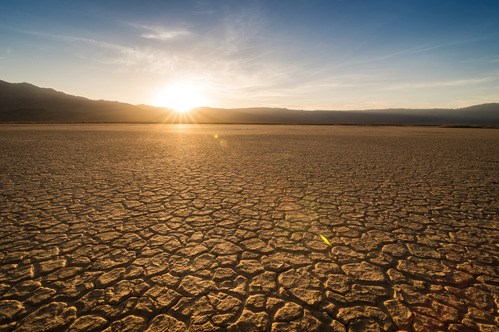
| Panamint Valley NPS Photo/Death Valley |
Most emigrants reached the end of their long overland journey weeks or months before December 25 rolled around. A few, though, stranded or lost along the way, spent their first Christmas in the West in winter camps many miles from the settlements. Here’s how they observed the holiday.
The Rev. Brier, his wife, Juliet, and their three little sons, ages 9, 6, and 4, reached Salt Lake City via the California Trail in October 1849. Fearing they were too late in the season to cross the Sierra Nevada safely on the Truckee Route—the Donner disaster had made national news just three years earlier—the family and other ‘49ers joined a hundred-wagon train heading south to intercept the Old Spanish Trail in the vicinity of present-day Parowan, Utah. The Old Spanish Trail, a well-worn trade route used by mule-packers traveling between Santa Fe and Los Angeles, passed south of the Sierra Nevada, avoiding the danger of mountain blizzards.
But along the way, a stranger showed the emigrants a curious, hand-sketched “trapper’s map” leading directly to the gold diggings and purporting to shave about 500 miles off the overland trip. The captain of the Briers’ wagon train, a Mormon frontiersman named Jefferson Hunt, tried to dissuade them from trying the mysterious route. ‘49er William Manly reported years later that Hunt “very much doubted if a white man ever went over it, and that he did not consider it at all safe for those who had wives and children in their company to take the unknown road.”
“Gentlemen!” Captain Hunt—a man of few words—supposedly exclaimed, “All I have to say is that if you take that route, you will all be landed in Hell!”
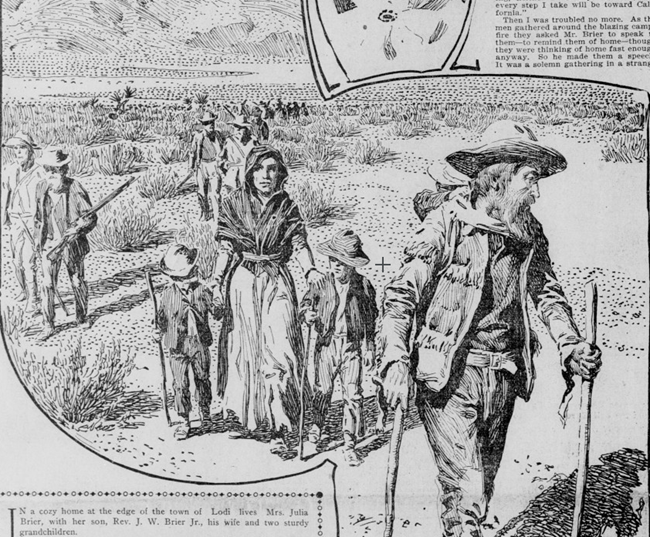 |
| The San Francisco Call article, “Our Christmas Amid the Terrors of Death Valley.” Dec. 25, 1889. |
Starvation, desperate thirst, and exhaustion plagued the emigrants as they struggled and straggled through the barren wastelands of southern Nevada. They splintered into at least six groups to try different directions, parting and sometimes re-merging and parting again along the way. Some slaughtered some of their oxen, burned their wagons in the cook-fires, abandoned their belongings, and continued on foot. The youngest Brier child, barely out of toddlerhood, had to be carried. The middle son, John, remembered, “After many days of bitter travel we reached the Armargosa [an intermittent stream] and camped in the dry channel, counting ourselves fortunate to find a muddy pool of water. The end of the next day (Dec. 23) found us, with our canteens empty, at the summit of a pass where there was no water, no grass, no fuel….”
The following morning, Christmas Eve, the Rev. Brier spotted a green oasis in the distance. All day the little party hurried toward it, desperate for water. They finally reached the springs—one hot, one cold—around 3 o’clock on Christmas morning. Today that spot in Death Valley National Park, located at the mouth of Furnace Creek Canyon, is known as Travertine Spring.
In an article published by the San Francisco Call newspaper on Christmas Day 1898, when Juliet Brier was in her eighties, the preacher’s wife remarked, “This was a Christmas none could forget.”
My little ones had no thoughts of Santa Claus that year. The men killed an oxen for our Christmas, but its flesh was more like poisonous slime than meat. There was not a particle of fat on the bones, but we boiled the hide and hoofs for what nutriment they might contain. We also cooked and ate the little blood there was in the carcass. I had one small biscuit, but we had plenty of coffee, and I think it was that which kept us alive.
Music and singing? My, no! We were too far gone for that. Nobody spoke very much, but I knew we were all thinking of home back east and all the cheer and good things there.
To add a bit of cheer to the occasion, the Rev. Brier delivered to his boys a Christmas lecture on the importance of education. John remembered it as amusing. One of the single ‘49ers, William Manly, reached their camp in time to hear the speech, too.
“It seemed very strange to me to hear a solemn discourse on the benefits of early education when, it seemed to me, starvation was staring us all in the face,” Manly wrote in his popular published account, Death Valley in ’49. “None of us knew exactly where we were, nor when the journey would be ended, nor when substantial relief would come.”
In a separate camp, Louis Nusbaumer’s party of ‘49ers and families despaired over the condition of a failing ox: without it, they would have to abandon their wagon and carry their remaining supplies. In his journal, Nusbaumer wrote:
December 24…. Our prospects again look dismal. One of our oxen is about to die but we will not despair on the eve of the day when our Savior was born. We came about fifteen miles today through abominable alkali swamps and were compelled to camp without water and grass. In fact, we had to go back quite a distance to get water for our supper.
December 25. Christmas day in the mountains of California [actually Nevada] …. This is a day of sorrow for us as the ox, before mentioned, is not able to go further and it is necessary for us to throw out a great deal of our goods in order to lighten the load…There is quite a difference between Christmas days in different states. In some of them you receive presents, in others you must throw things away. I hope my dear wife is having a happier Christmas day than I am. May God keep her in good health. Should I never return to her and should chance deliver this journal into her hands, she will glean from these pages that she was never far from my thoughts and that my heart beat for her to the last.
Ahead lay the salt flats of a great sink, where the Lost ‘49ers would wander from seep to seep for about two months. Survivors would name that desert Death Valley.
At least 13 emigrants lost their lives on this detour. William Manly and a companion eventually emerged from Death Valley and made their way to a Spanish rancho. Being given provisions, they headed back to help others waiting in the desert and led them to safety.
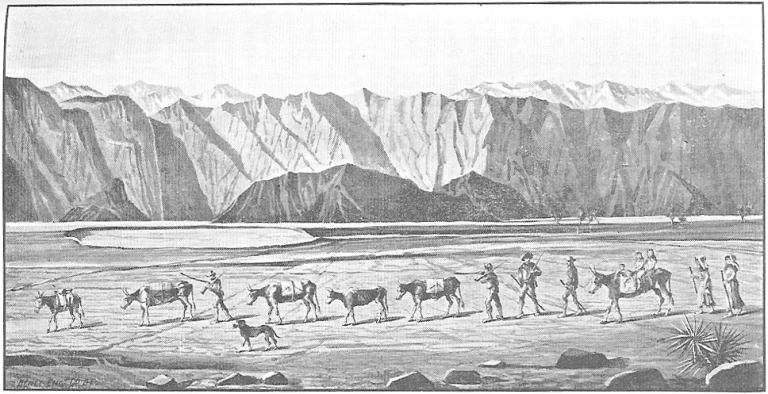 |
| Lost ‘49ers leaving Death Valley. The story above comes from the National Park Service, Christmas on the Emigrant Trails: Christmas 1849 at Death Valley, California, California National Historic Trail, Death Valley National Park |


No comments:
Post a Comment
Thank you for your comment.