Thursday, September 24, 2026

American Can-Do Optimism Beats Defeatism Every Time


Don't Accept The Defeatist Lie That Poverty And Social Circumstance Holds People Back. 

Today, there are people who have never accomplished a thing in their entire lives -- but they'll try with all their influence to tell others that passion to pursue a goal and having true individual grit is somehow bad. 

In fact, I've read where some teachers are against telling students to "work harder" to get their grades up because those teachers didn't believe that hard work accomplishes anything. They validate the belief of some folks like me who believe that some folks live to make excuses for people who lack any sort of grit.

For folks who might not know what having "grit" is all about, they need to understand that grit is the passion and long-term perseverance that you put out to stick to your goals, those difficult goals in life that only you fight to achieve.

Grit is an American trait that should be celebrated because it is at the core of the American spirit and the pursuit of the American Dream. 

You can tell if someone has true grit. They have grit if they have courage and are not afraid to fail, instead of not trying. They are people who learn from setbacks. And yes, they are conscientious, reliable, hardworking, and pretty disciplined. They usually have long-term goals and stay focused on what they are striving for. Of course, they are resilient. In fact, their attitude is one of maintaining confidence and optimism during hard times.

Sadly, there are nay-sayer people in our midst who tell others that having grit, passion, and the ability to stick to goals doesn't matter. Those nay-sayers relish telling others that those attributes don't matter because they came from poverty, or they lacked "stable housing," or were "victims" of some imaginary thing the Left calls an "unfair social structure."

Those nay-sayers work at convincing Americans that giving a project all you have is just too hard -- unless you get support from others. They are defeatist who will tell you that you're stuck where you're at in life no matter how hard you work to better yourself. For me, I feel sort of sorry for people with such "defeatist" attitudes. Really though, I feel bad for those who agree with their defeatist attitude.

In reality, American history has all sort of stories of self-made individuals, immigrants, and workers who faced steep odds, but still prevailed in the end. Most came from poverty. Most lacked "stable housing." 

None of the stories that I've ever read described men and women with grit, as "victims" of some imaginary thing the Left calls an "unfair social structure." The fact is, most would tell you that it was their lousy circumstance growing up that made them push themselves. It's true, poverty, or fear of poverty, can be a great motivator for people to work harder to excel in life.

Many bootstrap entrepreneurs of 1800s America rose from humble beginnings to become influential figures in the industrial landscape. These individuals exemplified the spirit of the American Dream. They did so by leveraging hard work and innovation to achieve success. 

As an example, let's look at the famous John D. Rockefeller who started from very modest beginnings. Born in Richford, New York, in 1839, he grew up in a family that moved a lot and lived from hand to mouth. His family finally settled in Strongsville, Ohio, in 1853. It's a suburb of Cleveland.

At age 16, he took a bookkeeping course. Some say he completed it, but some say he didn't. Either way, he spent weeks walking Cleveland's streets in search of work which was hard to find. He finally landed a job as an assistant bookkeeper for a produce firm called Hewitt & Tuttle. He began working for them on September 26, 1855. And yes, he earned .50 cents a day, which was $3.50 for a 7 day work week. And believe it or not, he also "tithed" 10% of his earnings to charity.
 
By age 20, John D. Rockefeller had enough personal savings to start his own produce-shipping business. Even making that sort of money, and working at other jobs, he was able to save $1,000. 

He combined his savings with a small loan from his father to build capital. In the end, he founded Standard Oil, which dominated the oil industry and made him one of the richest men in history. In fact, John D. Rockefeller rose from modest beginnings to become the world's first billionaire.

Let's look at Andrew Carnegie who was born into a poor family in Scotland. It's true, Andrew Carnegie was born into poverty in a one-room weaver's cottage in Scotland. His family immigrated to America in 1848. At age 13, he started working as a "bobbin boy" in a Pennsylvania cotton mill. He earned just $1.20 per week at that job.

Andrew Carnegie didn't let his poor start in life stop him, the same as how he didn't let making $1.20 a week stop him, from pursuing bigger and better things. He had the personal drive to teach himself to use the telegraph. And with that, he caught the attention of railroad executives who made him a telegrapher.
 
By the 1860s, he had investments in railroads, railroad sleeping cars, bridges, and oil derricks. He built Pittsburgh's Carnegie Steel Company. He sold his Carnegie Steel Company to J. P. Morgan in 1901 for $303,450,000. 

Carnegie Steel Company was the basis of U.S. Steel Corporation. After selling Carnegie Steel, he surpassed John D. Rockefeller as the richest American of the time. It's said that his passion to never be poor again, drove him to work tirelessly. In the end, the poor uneducated boy grew into one of the wealthiest men of his time.

Cornelius Vanderbilt started out as a poor farmer. In fact, he was born to a poor, illiterate family on Staten Island, New York. He had to quit school at age 11 to go to work to help feed his family. He gave his wages to his mother.

At age 16, he "borrowed" $100 from his mother to buy a small perch boat. After that, he spent his teenage years ferrying passengers and cargo across New York Harbor. He worked relentlessly through brutal conditions until he amassed enough capital to buy more boats. In the end, Cornelius Vanderbilt build a global shipping and railroad network. He made his fortune in shipping and railroads. It's said he transformed American transportation.

From America's early frontier pioneers to modern entrepreneurs, we rightfully credit individual determination for overcoming major economic and social hurdles.

Messaging to say otherwise is a lie told by those without the sand to get off their collective asses and follow their passion. For those nay-sayers who don't try, they will never know the sacrifice and hard work that it takes to fight the good fight. 

The spirit of Americans with grit is at the foundation of our country's success.

Frankly speaking, my belief that a defeatist attitude is un-American is a sentiment deeply rooted in traditional concepts of American identity, culture, and history. I'm not the only person who believes that. It's connected to several of our core beliefs as Americans.

For example, America's "Frontier Spirit" is about early Americans who emphasized overcoming harsh conditions, exploring the unknown, and persevering through grit and determination. Early Americans relied heavily on the idea of overcoming seemingly insurmountable geographic and environmental obstacles. This goes to the heart of our American cultural expectation of perseverance, ingenuity, and a refusal to give up when facing hardship.

"American Exceptionalism" is the belief that the United States has a unique mission and destiny in the world. Within this framework, failing or adopting a defeatist attitude is often viewed as a rejection of one's higher purpose or potential.

The "American Dream" is the foundational belief that anyone, regardless of their background, or their start in life, can achieve success through hard work and optimism. The traditional idea of the American Dream says that anyone can succeed through hard work and determination. These ideals inherently reject defeatism. And frankly, defeatism can be seen as a personal flaw in one's character.

American culture has historically prized practical action and problem-solving. We admire people with a "can-do attitude." It reflects on our cultural preference to focus on solutions rather than dwelling on limitations.

America's cultural identity traditionally rejects defeatism. Our mindset instead to practice resilience and hard work. Look at our history, the Revolutionary War, the Civil War, the Great Depression, World War I, and World War II are rightfully thought of as victories achieved by refusing to give up in the face of overwhelming odds.

As motivation, our strengths to prevail through challenges has been used as a rallying cry in politics, sports, and business to inspire resilience, unity, and a proactive approach to solving major national or personal challenges. Folks like me who label pessimism and defeatism as "un-American," truly believe that hard work produces rewards that only others with a positive attitude can understand. And yes, in case you're wondering, I really believe that skeptics who see America in a negative light truly lack patriotism.

Growing up poor and wanting more in life should motivate us to work harder and pursue our dreams even harder than ever. People will never achieve success with a defeatist attitude. A person who tends to expect bad things to happen and focuses on the negative parts of a situation usually get exactly what he or she focused on -- failure.

Let's remember, big and small bootstrap entrepreneurs built America. It was the individual determination of self-reliant settlers, merchants, railroad men, saloon owners, the man or woman who started a laundry, the guy who had a single wagon who started a freight company, the woman who started a diner in a tent in a mining camp, the lone prospector who followed his dream of striking it rich, the cattlemen who started with nothing other than a desire to round up viral cattle and feed them to hungry miners, and yes, the cowboy who saved his money instead of drinking and gambling it away because he hoped to one day have his own spread, they build America.

All of those who built businesses from scratch using minimal personal resources, a whole lot of grit, and a total willingness to give an extreme amount of hard work to their business, in fact built America. They had the determination to stick to it, ride it out, and start over again if that's what's needed.

Bootstrap entrepreneurs in the Old West were no different than today's bootstrap entrepreneurs in that they built businesses from scratch using personal grit, minimal capital, and local opportunities rather than large outside capital. Those folks were self-reliant. They pushed themselves to build businesses from scratch using minimal personal resources, a whole lot of grit, a total willingness to give an extreme amount of hard work to their business, and the determination to stick to it, ride it out, and start over again if that's what's needed.

Most operated on shoestring budgets, reinvesting early profits directly into supplies, livestock, or storefront expansions. They were frugal and repurposed everyday materials and solved immediate regional shortages, such as tools, flour, and clothing, while tailoring goods to local frontier demands.

While I believe the best example of bootstrap entrepreneurs in the Old West is the American cattle rancher of the 1800s, the men who went to Texas with the dream of rounding up viral Longhorn cattle and getting them to market took a lot of guts, there were a lot of tough Americans in the 1800s that followed their dream of freedom and independence by being their own boss.

General Store owners in some towns across the West often started with a single wagon of dry goods, trading directly with miners, trappers, cattlemen, cowboys, and incoming homesteaders before building permanent timber storefronts. Traders often bartered goods for labor, pelts, or future harvest shares when hard currency was scarce.

As for Outfitters and Blacksmiths, it is a fact that skilled tradesmen utilized basic hand tools to service wagon trains, build towns, repair mining equipment, dig wells, all the while keeping their business alive with whatever they made a day.

As for trailblazing merchants, like Levi Strauss who started with modest dry goods wholesale before identifying and funding specific frontier clothing needs like durable riveted pants made out of tent canvas for miners.

John W. Mackay was known as "The Miner Turned Silver King." He arrived in Virginia City, Nevada, as a penniless Irish immigrant. He began working as a common, manual laborer in the silver mines. Instead of spending his wages in the saloons and gambling halls, Mackay worked double shifts and used every spare dollar to buy up tiny, fractional shares of unproven mining claims from discouraged miners.

He pooled his bootstrapped equity with three partners in order to form the Bonanza Firm. In 1873, they hit the "Big Bonanza." It was the richest concentration of silver and gold ore ever discovered. That event made John W. Mackay one of the wealthiest men in the world. He later used his fortune to build a global communications network that challenged the Western Union monopoly.

Another example is Biddy Mason who was born a slave. It's true. She was born into slavery, and arrived in California in 1851 after walking 2,000 miles behind a pioneer wagon train. After legally winning her freedom in a landmark 1856 court case, she found herself in Los Angeles with no money, assets, or property.

She didn't simply give up. Instead, she took up being a Midwife and nurse. She saved her money and over time she reinvested her cash into low-cost downtown Los Angeles piece of property that no one else wanted. That led to her creating a Real Estate empire. Before she passed, she was known for her philanthropy.

Fred Harvey was known as "The Civilizer" of the West. He was a British immigrant who worked his way up from working as a dishwasher in New York City to becoming a railroad clerk. He noticed that the food options for railroad travelers were consistently pretty poor. He took note of the fact that the men's meals often consisting of rancid meat and stale beans served in dirty shacks.

He partnered with the Santa Fe Railway to build the first restaurant chain in the West. His sweat equity and railroad partnership paid off. He reinvested his restaurant cash flow into a standardized chain called Harvey Houses which was the first restaurant chain in the United States. He transformed roadside hospitality through disciplined low-cost expansion.

Robert Massie became known as "The Sheep King." In 1883, 16-year-old Robert Massie arrived in West Texas completely broke and signed on as a lowly hand herding sheep. Taking payment in livestock. He bred his own flock. He ended up owning thousands of acres of Texas cattle ranching, and got into banking.

Seth Bullock and Sol Star were known for hardware and hospitality. They were merchants, partners, in Montana. They recognized a massive cash-flow opportunity during the 1876 Black Hills Gold Rush in Deadwood, South Dakota. With one wagon of hardware, and a quick inventory turnover, they funded a permanent storefront. They built the Bullock Hotel and were in cattle ranching.

What made America's 19th-Century Bootstrap Entrepreneurs successful was self-reliance, passion, and determination to better themselves and their families through hard work. We know that being born to poverty didn't stop them. Instead of stopping them, in many cases, they packed up whatever they had and migrated West.

Settlers coming West started businesses, farms, took up trades, created stores and services all with little money and little to no outside funding. They relied entirely on sweat equity, and maybe used trade credit. Early ventures focused on immediate survival needs like general stores, blacksmithing, freight hauling, saloons, and a lot more businesses.

Owners who survived and prospered are the ones who learned to pivot quickly when mines closed and people started leaving, when booms went bust, when railroads changed routes and towns died because of it, when cattle drives ended and that well went dry for cattle towns that depended on the money that those drives brought in.

The core reality of economic survival in the American frontier was adaptability. The historical boom-and-bust cycles forced business owners and communities to constantly evolve. Towns built around gold, silver, or copper, like Tombstone, Arizona, and Bodie, California, could turn into ghost towns overnight once the veins ran dry. Surviving businesses had to move or shift to supplying agriculture instead of mining.

The railroad was the lifeblood of 19th-century commerce. If a railroad bypassed a town, that town often withered and died. Prosperous owners literally packed up their buildings and moved them closer to the new tracks.

The end of cattle drives and open-range cattle drives, like the Chisholm Trail, ended in the late 1880s due to barbed wire, expanding railroads, and harsh winters. Cattle towns like Abilene and Dodge City had to pivot from wild transit hubs to settled farming and ranching communities to survive.

The lesson was hard for some to learn: those who cling to a dying industry perish, while those who pivot survive. It's ultimately a lesson that still applies today.

The 19th-century Old West was a prime landscape for bootstrap entrepreneurship, where individuals with zero funding relied entirely on personal hard work, sweat equity, and cash flow to build commercial empires in some cases. Without venture capitalists or traditional banking networks, these founders utilized creative funding, resourcefulness, shear determination, and a lot of guts to make their businesses a success.

That's why we can say without hesitation that America's 19th-Century Bootstrap Entrepreneurs built America. That's why we should remember and admire those men and women. Their grit should influence others to never give up.

Tom Correa


Saturday, September 19, 2026

World War One Was A Huge Consumer of Horses -- A 1914 Perspective


Did World War I need horses? Absolutely. World War I urgently needed horses because early mechanized transport like trucks and tractors could not handle the deep mud, ruined roads, and vast supply needs of the front lines. Horses were vital for both logistics and transportation needs. 

That's why millions of horses and mules were used in World War I to carry food, water, mail, the wounded, ammunition, and medical supplies to the trenches. Heavy field guns alone required teams of six to twelve horses just to move a single piece through the mud. 

The nations involved in the war deployed millions of animals. The British Army alone utilized over one million horses and mules during the conflict. In fact, Britain shipped more hay and oats by weight to the Western Front than it did ammunition.

The cavalry quickly found out that there were limitations to fighting a modern war. In fact, while mounted troops remained vital in open terrains like the Middle East., cavalry officers soon found out that traditional cavalry charges quickly became obsolete on the muddy machine-gun-defended Western Front.

Great Britain and the British Empire entered World War I on August 4, 1914. King George V declared war on Germany at 11:00 PM on August 4, 1914, after an ultimatum sent to the German Empire expired. Britain used the Treaty of London from 1839 as its legal justification, stating it had a duty to defend Belgium as a perpetually neutral state after German troops invaded. 

Britain also entered the war because it wanted to stop a total French defeat and prevent an aggressive Germany from taking complete control of Western Europe. When Britain entered the conflict, the rest of the British Empire, including nations like Australia, Canada, India, and New Zealand were automatically brought into the war as well. 

Though the United States officially entered World War I on April 6, 1917, after nearly three years of staying neutral because President Woodrow Wilson wanted to avoid the conflict. Britain bought hundreds of thousands of horses and mules from the United States during major global conflicts, specifically World War I. 

In fact, before entering the war, America supplied the British and Allied armies with more than one million horses and mules. Massive depots, such as one in Lathrop, Missouri, collected the animals before shipping them through ports like Newport News, Virginia, to Britain and the Western Front. 

Below is a news article from Morning Press, Volume 43, Number 38, October 9, 1914. It talks about the need for America to supply horses for what would later become known as World War I. I think you may find it interesting.

War Expected to Bring Increased Demand for American Horses

WASHINGTON. Oct. 8. During the next decade there will probably be an increased demand for American horses in the countries now engaged in the European war.

The demand may even continue much longer, according to investigators of the United States department of agriculture, as not only will horses be needed for armies, but when peace is restored, more will be needed for agriculture. 

Already European agents are said to be endeavoring to purchase horses in this country' and Canada, and there is an increased interest in many sections in horse breeding. To meet this Increased European demand American farmers may well endeavor to raise well bred horses, although the department of agriculture does not advise them to purchase a surplus of homes merely for breeding purposes. 

It merely advises that ordinary farm work should be done whenever possible by good mares which should be bred to good stallions. It also desires to emphasize, the fact that only horses of high quality may be profitably raised today. Inferior horses are a drug on the market, and their production is to be discouraged as mud as the production of good horses should be encouraged. 

U. S. Previously Drawn On 

The United States has previously been drawn on to supply European countries at war. In the Boer War over 100,000 horses were bought here by the British government. It may be doubted whether a foreign government could now obtain a similar supply in this country, except at excessive cost. 

However, if farmers take pains to utilize their good mares during this winter to breed them to good stallions, in the course of several years (time enough for the foals to develop), America will be better able to meet the European demand. 

It is natural that European countries should look to the United States for horses, as next to Russia it has more of these animals than . any other country - In the world! 

The United States and Russia possess 58 per cent of the world supply. Strange to say. however there were no horses originally on our continent and the present supply comes from stock brought over from Europe, Canada's supply is small compared to our own. 

War As Consumer of Horses. 

The German army requires for a complete mobilization 770,000 horses, and the French army is said to require 2 50,000, which figure, however, probably includes only those for the cavalry. It is conservatively estimated on good authority that 1,000,000 horses are now engaged in the European war. 

As the great majority of these horses are not included in the permanent military organization, but are used for farm work and are requisitioned by governments only when needed for military purposes, the countries of continental Europe will certainly face an acute shortage of farm horses before the next planting season which will seriously affect the price of horses the world over, as soon as peace is declared. 

According to the best information horses in the countries of Europe now at war number as follows; Great Britain 2.231,000 France 3,222.000 Belgium 363,000 Germany 4,323,000 Austria-Hungary 4,374,000 Russia 24,632,000 Total 39,263,000 In addition England has a supply of about 6,000,000 to draw on in her various dependencies. 

Russia has about 10,000,000 in Asia and France probably 300.000 to 1,000,000 in her colonies. The rapacious consumption of horses in war is illustrated by figures from our own civil conflict. 

During his Shenandoah valley campaign, Sherman was supplied with fresh horses at the rate of 150 per day. In his report for the year 1863, the quartermaster general of the United States army slated: "The service of a cavalry horse under an enterprising commander has averaged only four months.” 

During 1864 there were 300 horses consumed per day in the northern army, without considering those captured and not reported. During eight months of that year, the cavalry of the army of the Potomac was remounted twice, nearly 40,000 horses In all being required. 

Our Own Army Desirable Market. 

Our own army furnishes a desirable market for well-bred horses, there being under the remount system at least 3,000 horses required annually to supply both the army and the national guard. 

There are now about 20,000 horses in our regular army on a peace basis. In war, many more would be required before the first engagement. There is, therefore, a steady market for good horses independent of the European demand. 

Even the invasion of motor power which has reduced the number of horses on our streets, has not influenced this demand. In fact, the price of horses has advanced along with other commodities during recent years. 

The bureau of animal industry of the United States department of agriculture, Washington, stands ready to aid any farmer desiring to breed high class horses. 

As the day of the large horse ranch is practically gone, any increased demand will have to be met by the farmer. There are certain localities more suited to horse breeding than others and places where certain breeds do better. 

Such details may be obtained for the asking. Even in the south, where mules are bred in preference to horses, an increased production of first class animals should find it , ready market abroad, although the mule is not used on the continent to the extent that it is used here. 

-- end of news story as it appeared in 1914. 

For nearly three years, America stayed neutral because President Woodrow Wilson wanted to avoid the conflict. But, three main events changed the minds of Americans and pushed our nation into that fight: 

First, a German submarine attack sank neutral American merchant ships. In fact, in January of 1917, Germany broke its promise and announced it would sink any ship heading toward Britain. Second, Britain intercepted a secret message from Germany proposing a military alliance with Mexico against the United States. Known as the "Zimmermann Telegram," it asked Mexico to invade the United States and join the war against America from the South. And third, after German U-boats sank several American merchant ships, there was a threat to trade in that German actions made the Atlantic Ocean unsafe for American travel and commerce.

It was because of these things, and the fact that Americans were in support of the war, that made President Wilson ask Congress to declare war. Congress voted to approve the war on April 6, 1917. 

As for the cost in casualties of how many horses were killed during that war? An estimated 8 million horses died from shellfire, disease, exhaustion, and starvation across all nations during World War I. That's a lot of horses killed.

Tom Correa

Wednesday, September 16, 2026

American Ranchers Define Bootstrap Entrepreneurs


Bootstrapping means launching and growing a business using existing resources and minimal outside capital. The term "bootstrap entrepreneur" perfectly describes the modern American rancher. After all, the reality of running a successful ranch, as with any successful agricultural operation, requires attention, intense innovation, self-reliance, personal grit and determination, and a lot of hard work. 

Today's Ranchers

Ranchers today must master a wide range of practical, financial, and technological subjects to run a successful cattle operation. As for their sweat equity, most of America's ranchers operate as the CEO, veterinarian, mechanic, laborer, and accountant all at once to keep their overhead low. And yes, since it is said that "true entrepreneurs find opportunity where others see waste," American ranchers are masters of optimizing thin margins through creative problem-solving.

As for pastures and grazing, pasture cycles and rotational grazing maximizes the efficiency of the land to reduce the need for expensive commercial feed. Rotational grazing methods keep pastures healthy and reduces expensive feed costs. And let's not forget feed and supplements, today's ranchers know how to balance rations, provide necessary mineral supplements (like copper, selenium, and salt), and source backup hay or silage which is essential during droughts.

Today, veterinary care and preventive medicine is vital to sustaining a herd. To do it right, today's ranchers establish vaccination schedules, parasite control programs, and biosecurity measures prevents costly disease outbreaks. And yes, most ranchers today have Calving Programs for managing breeding seasons, performing pregnancy checks, choosing between natural service or artificial insemination. And let's keep in mind that handling difficult births can dictate one's herd productivity.

As for infrastructure and equipment, fencing and water, reliable perimeter and cross-fencing alongside dependable, freeze-protected watering systems prevents escapes and dehydration. Of course, that takes constant maintenance.

As for today's rancher having business savvy? Today, they track and monitor daily expenses, feed price fluctuations, profit margins, labor costs, and every dime they can't afford to spend. There is a reason for their vigilance, they practice maximizing the lifespans of their asset. In fact, from fixing decades-old tractors, welding broken gates, and repurposing materials, they repair instead of simply replacing by buying new equipment. Why? To save money and stay afloat.

Silicon Valley startups face market uncertainty, but ranchers face market uncertainty plus how unpredictable Mother Nature can be. Yet, they manage cash flow through severe weather events like blizzards, droughts, and floods that can wipe out their inventory overnight.

And here's something else to think about, instead of taking massive payouts like other business owners do, ranchers define what it is to be bootstrap entrepreneurs by pouring their profits straight back into their business. 

For today's ranchers, every successful season means investing in long-term infrastructure of their operation. Whether it's building better genetics to improve their herd, or fixing fencing, repairing barns, or maintaining their tractors, or maybe improving their water systems, it's all done to ensure the operation survives for the next generation.
Old West Ranchers

Old West ranchers were the definition of bootstrap entrepreneurs. They operated in a high-risk capital-intensive industry with zero safety nets. And while pop culture often paints them as simple, rugged cowboys, successful Old West ranchers were actually shrewd business strategists who managed complex supply chains and volatile markets. Please don't make the mistake of thinking ranchers lack knowledge.

To successfully raise cattle and run a cattle operation in the Old West, a rancher needed to be a master of survival, business, and animal husbandry. The frontier lacked modern technology, fencing until the late 1870s, and there was no easy access to veterinarians. This means that a rancher's knowledge had to be incredibly broad.

Of course, besides protecting their primary assets which were their livestock from theft, predators, injury, and environmental hazards, ranchers had to recruit, pay, and manage a highly specialized workforce of cowboys. With no access to easy credit, keeping overhead low was a matter of survival. In most cases, there ranchers and their small crews built their own homesteads, dug their own wells, and broke their own horses.

Old West ranchers needed to know about cattle management and husbandry, breed selection and traits. Ranchers understood that they needed to fund a year's worth of supplies before to make a cattle drive -- and that was before the cattle were sold.

They also had to understand how to handle Texas Longhorns, the dominant breed of the era. Longhorns were chosen because they were hardy, immune to certain tick fevers, and though they were wild and dangerous to handle, they could walk thousands of miles. Herds traveled about 10 to 12 miles per day to keep the cattle fed and watered.

Operating on the literal frontier, ranchers in the Old West utilized "Open Range" tactics, which essentially meant they leveraged their use of public land before investing heavily in private land ownership and barbed wire. Open Range branding was going on and ranchers had to know how to design, register, and apply a unique brand and earmark to identify ownership of their cattle. Because cattle roamed free on the open range, branding during the spring roundup was the only way to prove property ownership and deter thieves.

As for range and resource management, and water rights? Ranchers had to also know how to evaluate the prairie grass (like buffalo grass or grama grass) to know how many acres of land were required to feed a single cow without overgrazing. Ranchers back then also had to locate and secure access to natural water sources like rivers, creeks, and springs. In the more arid parts of the West, controlling the water meant controlling thousands of acres of surrounding public grazing land.

As for basic veterinary medicine at the time, treating common ailments without a vet was an art form to ranchers and cowboys during that period. Ranchers had to treat screw-worms, blowflies, lameness, and injuries from predators, as well as handle difficult births in the field.

So yes, ranchers in the Old West had to solve massive logistical challenges. Of course, before railroads expanded, ranchers had to organize long-distance cattle drives which moved thousands of head of cattle across hundreds of miles of hostile territory to railheads in places like Abilene or Dodge City.

As for the logistics of a Cattle Drive? Trail drives were all about navigating the famous cattle trails like the Chisholm Trail or the Goodnight-Loving Trail to move thousands of cattle from Texas to railheads in Kansas, Colorado, or Wyoming. Moving thousands of head of cattle and remuda of horses 12 to 15 miles per day over several months while balancing grazing needs, water access, and strict crew organization was a huge task.

Daily pace and route planning was important. Herds moving too fast caused cattle to lose weight, and that lowered their value at the market. So no, no one want that. Crews navigated dangerous river crossings, dry stretches of land, and the constant threat of stampedes. At night, the crew would rotate shifts and stand "night watches" around the clock to calm nervous animals, prevent stampedes, and be on the lookout for rustlers.

The "Trail Boss" was the boss. He managed the entire operation, chose campsites, and handled negotiations when needed. Trail Bosses scouted ahead of time to ensure adequate grass and a reliable water source. The "Point Men" rode at the front of the herd to control speed and set direction. The "Swing Riders" and "Flank Riders" kept the middle and sides of the herd bunched together to prevent strays. 

The "Drag Riders" stayed at the very rear to push slower cattle along. That was an exhausting dusty job. It was the position for newer crew members. The "Wranglers" cared for the remuda which was their spare horses. The Cook traveled ahead using the Chuckwagon to prepare three hot meals a day and act as the trail drives medic.

Imagine putting that together, and logistically moving thousands of head of cattle through terrain that may be hostile both from Indians, outlaws, and Mother Nature. 

As for dangers on the way, stampedes in the dark also vied for the title of a cowboy's worst fear, a sudden noise or crack of lightning would trigger a runaway herd in seconds. Second to stampedes at night were river crossings. They were among the most perilous challenges on cattle drives. They were extremely dangerous. Crossing swollen rivers like the Red or Brazos required strategic timing to protect livestock and crew.

It's true. Swift currents and swollen waters could quickly sweep away both men and cattle at any given moment. The steep banks, muddy, with sharp drop-offs made it hard for cattle to enter or exit the water safely. These were horrible situations where thousands of uneasy Longhorns could panic in the water -- which led to mass drownings or crushing each other.

The Red River marked the boundary between Texas and Indian Territory, which is modern-day Oklahoma. That river was feared for its sudden rises and treacherous bottoms. Old-timers noted that more trail men drowned in the Red River than on all other western rivers combined. 

 As for the Horsehead Crossing, the Pecos River, thirsty herds crossing that stretch often rushed wildly into the water. As you can imagine, that caused congestion, pile-ups, lost equipment, crushing, and drowning losses exceeding a hundred head at a time.

Of course, Mother Nature can be tough. On cattle drives the weather could change in a minute. And, because droughts forced long dry spells for the land and detours for whatever water there was, prairie fires threatened entire herds.

Large-scale cattle drives came to a virtual halt when the Civil War began in 1861. That's why there were so many massive herds roaming and multiplying untended in Texas until the famous post-Civil War cattle drives began. That's also what in the post-Civil War American West, trail drives were massive.

Ranchers moved millions of cattle from Texas to northern railheads between the 1860s and 1880s. As for the Chisholm Trail, it ran roughly 800 miles from San Antonio, Texas, through Oklahoma (Indian Territory) to Kansas railheads like Abilene and Dodge City. It was the busiest and most famous route. The Western Trail later replaced the Chisholm Trail, running north from South Texas through Dodge City all the way to Nebraska, Wyoming, Montana, and Canada.

As for the Goodnight-Loving Trail, blazed by Charles Goodnight and Oliver Loving, it headed West from Texas along the Pecos River through New Mexico before turning north into Colorado and Wyoming.

The Shawnee Trail was an earlier eastern route used before the Civil War that led herds into Missouri and Illinois until "Texas fever" quarantines shut it down. The Shawnee Trail was actually the main pre-Civil War route running from Texas through eastern Oklahoma into Missouri, Illinois, and Ohio. Of course, during the California Gold Rush in the early 1850s, cattle drovers herded cattle across deserts and mountains to supply high-priced beef to West Coast mining camps.

And yes, to supply local and military contracts, ranchers also trailed cattle to supply frontier forts and Indian reservations in Texas and neighboring territories. This was done to supply cattle to hungry Americans. It was also to make money and stay afloat.

Let's remember, Old West ranchers faced constant threats of total business failure. True entrepreneurs adapt when their initial market shifts. For ranchers back in the day, they faced constant volatility from weather, disease, and fluctuating market prices. 

If ranchers in the Old West were hit with a single harsh winter, like the devastating "Big Die-Up" of the Winter of 1886–1887, or disease outbreaks like Texas Fever, or a sudden market crash, their entire operation could be wiped out overnight. This all meant that ranching was a huge gamble back in the day.

As for insurance? Ranchers in the Old West generally did not buy formal commercial insurance for their herds. Instead, they relied on mutual associations formed starting in the 1870s to combat cattle rustling and recover stolen property.

In 1877, forty Texas cattlemen formed the group that became the Texas and Southwestern Cattle Raisers Association to hire special rangers, track stolen livestock, and protect assets. From the 1880s to the 1890s, similar regional Stockgrower Associations popped up across the Great Plains and the West. These groups acted as a functional safety net rather than traditional insurance companies.

As for losing cattle, like what happened in the "Big Die-Up" of the Winter of 1886–1887, a lot of ranches went under because there was no such thing as insurance for a herd at the time.

So, as for actual insurance on their herds, commercial livestock mortality policies existed in the Eastern United States, such as the horse and cattle associations in Pennsylvania and New York, but they were rare and extremely expensive. Also, insurance companies who may have been willing to provide coverage for a small "cattle farm" in New York or Pennsylvania, would refuse to cover a rancher's operation in the West because traditional corporate insurers considered open-range cattle operations too high-risk and difficult to monitor.

As for modern coverage, federal multi-peril crop insurance did not arrive until 1938, and federally supported livestock risk programs did not begin until 1999.

British and Scottish Investors

When the original venture Capitalists invaded the Old West, it didn't take long for independent ranchers to sell out. That happened when the cattle industry grew and attracted the attention of global investors from Great Britain and Scotland. 

Those investors were fueled by popular books like The Beef Bonanza, or How to Get Rich on the Plains. That's what pushed syndicates from London, Edinburgh, and Dundee poured an estimated $30 million into western ranges by 1882. So yes, by the early 1800s, British and Scottish investors poured millions of dollars into American ranching to create conglomerates. 

They made offers for ranches that seemed too good to pass up. And yes, those investors turned local bootstrap ranching operations into some of the earliest multinational agricultural corporations. As for the original owners and local ranch managers, after they cashed in their interests, it's said they frequently reinvested their newfound fortunes into smaller regional ranches, expanding local infrastructure, or backing emerging western boomtowns like Cheyenne, Wyoming.

Let's keep in mind that during the 1870s and 1880s cattle boom, many Old West ranchers sold their extremely profitable spreads to British and Scottish investors for millions of dollars. Then, they often used that capital to launch new livestock operations. Although, some invested in railroads. Of course, others simply retired extremely wealthy.

That era marked a massive turning point in the history of the Old West by transforming traditional open-range ranching into a highly commercialized global business. So while those folks who actually defined what "American Bootstrap Entrepreneurship" is all about built the American cattle industry, the "Beef Bonanza" of the 1870s and 1880s, drove European investors and investor syndicates to invade the American West.

They saw huge profit potential in the grasslands of the Great Plains, and they wanted in on that. When they arrived, they had the funds to buy ranches, cattle, crews, and form politically powerful land and cattle companies. Some of those companies were the famous the Matador Land and Cattle Company, the Swan Land and Cattle Company, and the Prairie Cattle Company.

Founders Henry Campbell and Alfred Britton sold the Matador Ranch to investors in Dundee, Scotland, for $1.25 million in 1882, transforming it into the Matador Land and Cattle Company, Ltd.  That company acquired the Matador Ranch in Texas. It grew into a massive multinational corporation, expanding its holdings across several states and Canada, and operated continuously until its lands were sold in 1951.

The Swan Land and Cattle Company was organized in Edinburgh, Scotland, in 1883. That mega-corporation controlled millions of acres across Wyoming. It was one of the largest foreign-owned ranching outfits in American history.

The Prairie Cattle Company was called the "Mother of the British Companies." It was established in 1880 in Edinburgh, Scotland, and managed colossal tracts of land stretching from Colorado and New Mexico to Texas.

Many of the physical ranches established or expanded during this corporate boom, such as the historic XIT Ranch or portions of the Matador Ranch, laid the structural groundwork for modern American corporate agribusiness. And, believe it or not, some of those historic tracts are still operated by large agricultural firms today.

Of course, though those foreign-backed conglomerates bought up millions of acres, introduced fencing, industrialized meat production, and connected remote American rangelands directly to British dinner tables. 

Mother Nature changed everything when she burst their speculative bubble following the devastating "Big Die-Up" of the Winter of 1886–1887. That event wiped out massive herds and forced many of these early multinational corporations to restructure or collapse altogether.

The legacy of the Old West rancher is carried on by ranchers today. They prove that successful entrepreneurship isn't about having the most funding. It is about managing scarcity, managing risk, having pride in what you do, being determined to succeed, not being afraid of hard work, being responsible, and wanting to create value out of a rugged landscape that many would never be able to handle.

Tom Correa

Friday, September 11, 2026

Let's Talk About 9/11

It 's said that people never forget where they were when big events in history happen. For me, on September 11, 2001, I was called at home that morning by my brother-in-law who was exciting about a jet hitting a building in New York City. 

When I turned on my television, I found that almost all of the television stations were reporting that a passenger plane, a huge Boeing 767 jetliner, had slammed into a building in New York City. It was commercial airline wide-body jetliner, specifically a Boeing 767, that hit the North Tower of the twin towers. 

At first, I thought they were talking about a small jet plane. Then I found out it was a jetliner. A jet is any aircraft powered by a jet engine. A jetliner is specifically a large commercial passenger or cargo airplane. A jetliner is a specific type of jet built strictly to carry large groups of passengers or cargo commercially. Jet planes include military fighter planes and private business jets, those are usually small jet aircraft. Jetliners are very large wide-body aircraft designed to hold hundreds of people. Jetliners are huge in comparison to tiny one-seat military jets.

Jetliners serve scheduled public airline routes and global mass transit. At 8:46 am, a large jetliner, an American Airlines Boeing 767, its Flight 11 in route from Boston to Los Angeles, slammed into the North Tower, 1 World Trade Center, that morning on September 11, 2001. 

For Flight 11, it was only 47 minutes between leaving Boston and smashing into the North Tower in New York City. The timeline of American Airlines Flight 11 on the morning of September 11, 2001, details the events from its departure to the moment of impact: 

5:45am – Muslim terrorists Mohamed Atta and Abdul Aziz al-Omari clear security at Portland International Jetport in Maine to catch a connecting flight to Boston. 

7:59am – Flight 11 takes off from Boston Logan International Airport, bound for Los Angeles. 

8:14am – The Muslims begin their attack on the plane. The aircraft fails to respond to instructions from air traffic control. 

8:19am – Flight attendant Betty Ann Ong alerts American Airlines ground personnel via an inflight phone. She reported that the cockpit is unreachable, that a passenger had been stabbed, and that Muslim terrorists were hijacking Flight 11.

8:24am – Muslim terrorist Mohamed Atta mistakenly transmits a message to air traffic control while trying to address the passengers, stating: "We have some planes. Just stay quiet, and you'll be okay."

8:32am – Flight attendant Madeline Amy Sweeney reaches a flight services manager at Boston Logan to provide critical details about the Muslim attackers, the hijacking, and the emergency on board.

8:37am – Boston Air Traffic Control alerts Northeast Air Defense Sector, (NEADS). And in five minutes, Air National Guard jets are in the air heading to intercept Flight 11. 

8:46am – The Muslim terrorists were on a suicide mission and force Flight 11 into the North Tower of the World Trade Center. The huge jetliner slammed into floors 93 through 99. Yes, instantly killing everyone on board. 

All 92 people on board were killed when American Airlines Flight 11 crashed into the North Tower of the World Trade Center that morning. Of those aboard, there were 81 passengers, including the 5 Muslim attackers who hijacked the jetliner to use it as a weapon of war, and 11 crew members. As I'm sure everyone can understand, when the airliner slammed into the building, it instantly killed hundreds of innocent people inside the North Tower.

Television stations broadcasting what happened initially reported that it must have been some sort of an accident. Then, a few minutes later, at 9:03am, 17 minutes after Flight 11 hit the North Tower, America and the world watched on television as United Airlines Flight 175 was purposely piloted into the South Tower of the World Trade Center. 

United Airlines Flight 175 was the second jetliner used as a weapon of war on September 11, 2001. 

Flight 175 Morning Timeline

7:15am – The five Muslim terrorists, led by Marwan al-Shehhi, clear security at Boston Logan International Airport.

8:14am – Flight 175 takes off from Boston, bound for Los Angeles, roughly 15 minutes after Flight 11.

8:42am – Flight 175 makes its final routine radio transmission after flight controllers report hearing a suspicious, heavily breathing voice on the frequency.

8:42am – 8:46am – The Muslims onboard start their attack. They breach the cockpit, stab the pilots, and force passengers to the back of the jetliner.

8:47am – The plane's transponder code changes twice, and the aircraft begins deviating from its assigned altitude and flight path.

8:52am – Passenger Brian David Sweeney calls his wife, Julie, leaving a final voicemail, and then calls his mother to report what's taking place. About that same time, passenger Peter Hanson calls his father and describes the chaos and stating that the Muslim attackers stabbed a flight attendant.

8:55am – It was at that time that a New York Air Traffic Control Center controller notes: "We may have a hijack or problems over there with another aircraft."

9:03am – Flight 175 is purposely piloted into the South Tower of the World Trade Center. It slams into floors 77 through 85. All 65 people on board, including 51 passengers, 9 crew members, the 5 Muslim suicide attackers, and hundreds of Americans in the South Tower are killed instantly. 

The impact was broadcast live on television. It's true. The impact of the second jetliners slamming into the South Tower of the World Trade Center was broadcast live on television for everyone to see firsthand. And yes, it was then and there, at 9:03am on September 11, 2001, that Americans and the rest of the world realized that the United States was at war with Islam. The attack by Muslims that morning showed the world how ruthless and truly barbaric Islamic radical are. It was then that the civilized world would have to step forward and meet the evil of Islam head on.

Minutes later at 9:37 a.m. on that same day, September 11, 2001, American Airlines Flight 77, Muslim terrorists intentionally piloted that Boeing 757 into the Pentagon. American Airlines Flight 77 was scheduled to fly from Washington Dulles International Airport to Los Angeles International Airport. On board that Boeing 757 was 53 passengers, 6 crew members, and 5 Muslim terrorists. 

The target of the Muslims was the western facade of the Pentagon in Arlington, Virginia. The impact caused structural damage and a massive fire broke out. The fire burned for hours. Besides the 59 passengers and crew, and the 5 Muslim suicide attackers, 125 military and civilian personnel inside the building were killed instantly.

On that same day, at 10:03am, United Airlines Flight 93 went down in a field near Shanksville, Pennsylvania. That happened after passengers and crew fought back against the Muslim terrorists who were trying to hijack that flight. 

The flight was supposed to fly from Newark International Airport in New Jersey to San Francisco International Airport in California. On board were 40 passengers and crew members, plus 4 Muslim terrorists. The Muslims wanted to target either the United States Capitol or the White House in Washington, D.C.

Four of the Muslim terrorists took control of the plane about 40 minutes after takeoff. But, because the flight was delayed leaving the gate, passengers learned via phone calls about the other attacks in New York and Washington. Because of that, passengers and crew took action and rushed the cockpit to stop the Muslims attackers from reaching their target.

It is believed that the struggle in the cockpit forced the plane down into an empty field in Somerset County, Pennsylvania. While it killed everyone on board, those heroes prevented those Muslims from accomplishing their mission. Thankfully, their bravery stopped any further loss of life on the ground. 

By the way, while United Airlines Flight 93 went down and crashed in that field near Shanksville, Pennsylvania, the jetliners that slammed into the World Trade Center Towers or the Pentagon, did not "crash" in those places as if by accident.

The word "crash" carries a heavily negative, sudden, and destructive connotation in almost all contexts. While that's true, and the word "crash" does imply a violent, uncontrolled, and chaotic event rather than a gradual or planned transition, let's not mistake what happened that morning with planes that crash. What happened that morning was violent, but it was completely controlled. It was a planned attack against us. 

Those Muslim attackers purposely and deliberately piloted those Boeing 767 jetliners full of people on board into the Twin Towers and the Pentagon, and tried to do the same with Flight 93. They used those huge jetliners full of fuel for their long trips as weapons of mass destruction. 

And yes, it upsets me to no end when people say those jetliners "crashed" into the World Trade Center Towers and the Pentagon as if by accident. It was as far from accidental as one can get. Those Islamic attackers used those huge planes in the exact same way as someone uses any weapon to purposely kill their enemy. 

And as for Islam, after 25 years of everyone in the world seeing all of the death and destruction that the followers of Islam have committed, from the mutilation of women to their rape of children as child brides, to the stoning of women and the slaughter of gay people, to the beheadings of Christians and how we've all witness them burning people alive, to the support of terrorists attacks and killing of innocents around the world, to all of the casualties of wars that Muslims have started over the last 25 years, there should be no question in the minds of any rational person that Islam sees the rest of the world as their enemy.    
 
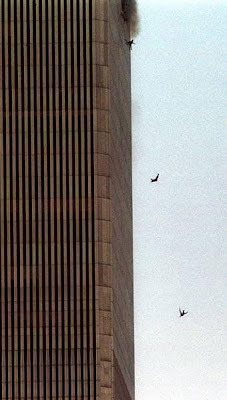
For me, I will never forgive Islam for its attack on America on 9/11, for creating such homicidal maniacs, for those people on those planes, for the thousands who were killed in the towers, and especially for the hundreds of Americans forced to  jump to their death instead of being burned alive. The horror caused by that Muslim attack is something that I will never forgive. 

According to information later, about 200 people jumped from the upper floors of the World Trade Center towers during the September 11 attacks.

An exact official count does not exist. The chaos, smoke, and destruction made precise tracking of what was taking place completely impossible. While early reports from news outlets that tried to play it down, outlets like The New York Times, tried to say there were about 50 people who jumped rather than be burned alive, subsequent forensic investigations place the figure closer to 200. 

Americans decided that they rather jump to their death and escape the intense heat, thick smoke, and suffocating flames as high as 2,000°F after the planes struck the towers. And frankly, I don't see any reason to forgive Muslims for causing that.


In all, a total of almost 3,000 victims and 19 Muslim suicide terrorists died on September 11, 2001. In New York City, at the World Trade Center, 2,753 people died at the Twin Towers and surrounding area. At the Pentagon, 184 people died, that includes passengers and crew on American Airlines Flight 77 and people inside the building. In a field near Shanksville, Pennsylvania, 40 passengers and crew died after United Airlines Flight 93 went down. In total aboard all four jetliners, all 246 passengers and crew died. 

As for our First Responders? In total, 441 first responders lost their lives, including 343 firefighters from the FDNY, 37 officers from the Port Authority Police Department, and 23 officers from the NYPD. 

While those are statistic that no one expects anyone to remember from that day, there is at least thing that I hope people haven't forgotten. It's how Muslims here and overseas rejoiced and celebrated at our loss. Yes, that in itself is something that Americans should never forget.  

Tom Correa


Thursday, September 10, 2026

Democrat Policies Are Why We Have A Beef Shortage

Whether some folks want to admit it or not, policy decisions under Democrat administrations, notably the Biden-Harris administration (2021–2025), contributed to the financial strain on ranchers -- which resulted in the reduction of American's cattle herd to a 75-year low by the end of the Biden presidency.

Several policy initiatives from Democrat administrations created burdensome economic and regulatory environments for livestock producers. Chief among them is the Democrats use of the federal government to attack American agriculture with "Climate and Environmental Regulations." The implementation of stringent environmental oversight, including their tighter restrictions on public land grazing, water use regulations, and aggressive climate initiatives created tremendous hardship for ranchers and farmers.

Ranchers were forced to either comply or be taken to court and forced to comply, or be jailed, and possibly lose their property, if they didn't comply with Democrat policies and regulations that were trying to destroy their livelihood. The cost to comply with those policies, and the reduction of available grazing acreage all in the name of Climate Change, was a financial burden that put some farms and ranches out of business. Frankly, that seemed like the ultimate goal of those policies which were designed to appease Climate Change fanatics who are huge Democrat Party donors.

Of course, there were huge costs accrued by American ranchers and farmers involved in fighting the Biden administration's government overreach and their authoritarian policies. And let's be even more honest, from forcing Americans to take a trial COVID vaccine, to telling Americans what household appliances that Americans were "authorized" to have, and their attacks on anyone supporting their political opponents, the Biden administration acted more like a totalitarian dictatorship than a representative democracy. 

While we can all guess who was in charge in the White House making decisions and signing laws and pardons since Joe Biden was incapacitated during his presidency, his administration was out of control. Those folks in the White House who were running his administration used the power of the federal government, a power that our Founding Fathers warned us about, to heavy-handedly to force Americans to comply with their Leftist Socialist vision of America. That alone violates the government's Constitutional duty to promote the general welfare.

But really, that didn't matter to the folks running the Biden administration. Their overreach by using the awesome power of the federal government to advance a Leftist agenda is why many of us push for prosecution of the people who were in the Biden administration. Our Founding Fathers designed a system of checks and balances, and federalism, specifically to prevent the centralization of power as what took place when Biden was in office.

His administration's heavy-handed environmental rules from the EPA and Biden's workplace mandates, all enacted by him, or someone in his administration. His administration's implementation of vaccine mandates for federal workers, contractors, and large businesses during the pandemic was an unprecedented infringement on individual liberty. It was something that dictators do. 

As for his administration's huge federal spending, such as the American Rescue Plan and the Inflation Reduction Act, which did nothing for working Americans while making Democrat Climate Change donors even wealthier. It only contributed to the high inflation that we felt at the time. 

The Biden administrations Leftist Socialist policies of Open Borders, of them actually flying Illegals into the United States from other countries, allowing millions of Illegals to enter without care of the consequences to Americans, was all at a huge cost on American taxpayers. That and other huge federal spending to finance Illegal Aliens and other social programs such as furthering the Leftist Gay Agenda worldwide by spending billions of American tax dollars overseas through USAID to further their social science agenda, all increased inflation here at home.

Add to that how the Biden administration tried to kill American Oil Production as another element in appeasing their wealthy Climate Change donors, and there are the reasons why under the Democrat administration, there was accelerated inflation which lead to historically high input costs for fuel, fertilizer, and equipment. 

The lie coming out of the Biden administration at the time was that "U.S. crude oil production reached historic record highs during the Biden administration." Of course, if that were true, than why were we paying so much for a gallon of gas at the time? If that were true, than why did America's agricultural producers have to endure substantial financial strain from high fuel, energy, and fertilizer expenses?

And no, it wasn't as with what's going on now with the Iran War where America is trying to stop Muslim lunatics from having Nuclear Weapons. Nuclear Weapons that would have certainly trigged a Nuclear War if they were not stopped. 

We went through a lot of hardship and high gas prices because the Biden administration tried to kill American Oil production. In fact, Biden killed oil drilling leases on federal lands and the cancelled oil production projects like the Keystone XL pipeline on his first day in office to the celebration of the Leftwing News who were still promoting the Climate Change hoax. Biden did what he did to pay back his Climate Change donors who want an "anti-fossil-fuel environment". 

Biden's attacks on American Oil contributed to a Global energy price spike. And no, it wasn't because of Putin as Joe Biden claimed. In fact, we learned that gas prices were on the immediate rise when Biden took office and immediately administration cancelled the Keystone XL pipeline. 

Biden later lied to the American public about the price of gas being because of Putin, when in fact it was his administration's war on American oil production that drove up gas prices. Biden didn't think Americans were smart enough to see that gas prices and overall inflation were already climbing steadily for months prior to Putin's invasion of Ukraine.

Americans food production felt the impact when farmers and ranchers saw major jumps in production expenses, notably for diesel, propane, and natural gas, which are vital for running machinery, heating facilities, and transporting livestock. 

The elevated overhead costs for American ranchers cut profit margins and forced ranchers to liquidate sections of their herds to remain solvent. The bottom line is that the Biden administration's policies forced ranchers to sell their herds to stay in business. That's why we're talking longer to rebuild herds now.

As for other Democrat policies designed to purposely put American ranchers out of business?

Democrat administrations regard the protection of endangered species, such as the management of gray wolves on grazing lands, more important than our ranchers. Yes, so much so that they restricted the ability of ranchers to protect their livestock from natural predators. This also resulted in direct herd losses and increased management costs for producers.

As for the Meat Packing problem? Ranchers have argued for a very long time that the federal government's policies regarding this issue has failed to adequately police the heavily consolidated meatpacking sector. Ranchers contend that corporate consolidation left independent cow-calf operators with reduced bargaining power and lower returns. The fact that it is not profitable discourages herd expansion.

While the impact of Democrat inspired regulations and overreach are bad enough to kill herds, the shrinkage of the U.S. cattle herd to roughly 86.2 million head is also driven by a combination of compounding factors such as  pastureland destroyed by fire and limited forage availability across major cattle-producing regions; natural multi-year biological and market cycles where periods of high liquidation are followed by slow, cautious herd rebuilding; then there are trade dynamics and the availability of cheaper imported beef from foreign markets that squeeze domestic producer values. 

Of course, there's America's long-term problem that American ranchers are aging and no one knows who will take their place when they ride out their string. For me, I believe another huge problem is agricultural lands being converted into commercial developments and residential sprawl. This is all forcing American ranchers to sell of their herds.

So yes, Democrats have created environmental regulations that are so strict, especially those regulations under laws like the Clean Water Act (such as definitions of "Waters of the United States") or the Endangered Species Act, that they place uncalled for restrictions on our private property land use. This has only increased the burdensome operational costs that American ranchers already endure.

As for public land management? Democrats have hurt ranchers by limiting grazing on federal government lands, increasing grazing fees, refusing permit renewals, and increasing land-use restrictions. Democrat administrations, who have sold their collective souls to their wealthy Leftist Climate Change donors, have used federal government agencies like the Bureau of Land Management (BLM) to destroy American ranchers. 
 
Democrat administration policies have been aimed at "reducing cow farts," the supposed methane emissions from livestock, and have tried to get ranchers to move away from producing beef. Their policies have been a direct threat to America's ranching industry.

Democrat policy makers are ignorant of the fact that American ranchers and framers are better Stewards of the land than they are. American ranchers and farmers don't need more burdensome regulations from what seems like a hundred different federal agencies that seem more interested in stopping American beef and food production, than feeding our nation. 

Democrats argue that they need to regulate land and water use to prevent overgrazing, protect wildlife habitats, and preserve public lands. But for what if their policies have create starvation for future generations.

Democrats refuse to understand that livestock have been on this earth for a very long time. They refuse to understand that agriculture and livestock production does not contribute to greenhouse gas emissions or hurt the planet. They refuse to accept the truth and instead accept what even the United Nations as now said is unacceptable bogus climate information. 

The "Livestock's Long Shadow" Controversy has to do with a 2006 United Nations Food and Agriculture Organization (FAO) report that falsely claimed that livestock was responsible for 20% of global emissions -- stating that livestock emission, cow farts, were higher than the transportation and manufacturing industries worldwide.
While that report was shot down and acknowledged as a lie to create a sense of doom, people on the Left still believe the lie. 

In fact, in the United States, the EPA estimates that the entire agriculture sector, cow farts and equipment use, only accounts for less than 6% of total U.S. greenhouse gas emissions, which is lower than the transportation, electricity generation, and industrial sectors. 

But no, that hasn't stopped Democrats from creating more federal rules and regulations to kill American ranching and farming. Instead of helping to promote sustainable farming practices and reducing the industry's burden on trying to adhere to unreasonable government regulations, and instead subsidize crop insurance, disaster relief funds, provide agricultural conservation grants, and provide critical financial safety nets to American farmers and ranchers, Democrats aim is to prosecute ranchers and famers through legal actions that in many cases have put American ranchers and farmers out of business. 

I really believe that today's Democrat policies, and their use of government agencies to attack and strongarm American industries like agriculture, have put small businesses and family farms and ranches, in many cases some that have been in families for generations, out of business completely.  

For me, I believe that attacks on American ranchers is part of the Left's concerted effort to wage a war to destroy America from within. The same Democrats who have attacked America's Oil and Manufacturing Industries have attacked American ranchers and farmers.

As for the Left targeting American beef producers? I believe it's all a part of the Left's Green New Deal and the Climate Change extremist's war on beef. 

President Trump is fighting to undo the damage done by Democrat administrations. To do that, he has enacted several policies aimed at supporting American ranchers. In fact, he has just rolled out his Rancher's First Initiative to the angst of Democrats who put Climate Change and appeasing European Global Warming groups ahead of American food production.

As with many Americans today, President Trump recognizes that America's cattle herds are at a 75-year low. And as with many Americans, he rightfully blames burdensome government regulations imposed by past-Democrat administrations. Heavy-handed authoritarian policies from Democrat administrations have proven to be heavy burdens for American food and energy production to endure. 

President Trump is working for American ranchers and farmers to change things for the better, And really, his policies allow common sense to take over where the Leftist ideology has screwed things up. 

Tom Correa

Saturday, September 5, 2026

Franklin D. Roosevelt's War Against Government Handouts And Socialism


Franklin D. Roosevelt was commonly referred to by his initials FDR. He was a Democrat president who rejected the idea of government handouts and fought against allowing Socialism to get a foothold in America. Yes, he was just the opposite of today's Democratic Party politicians.

FDR was against free government handouts so much so that he openly criticized "the dole," a term used at the time that means direct welfare payments without working for it. He believed getting money for nothing destroyed a person's work ethic and pride. He believed in "Work over Welfare." 

Instead of handing out free government cash to Americans, FDR created massive work programs like the Works Progress Administration (WPA) and the Civilian Conservation Corps (CCC). He wanted people to earn a paycheck. FDR saw direct relief as a temporary last resort during the Great Depression, not a permanent way of life.

FDR believed in the "Dignity of Work." In fact, President Franklin D. Roosevelt championed the idea that there is a dignity of work that people can't find when they're simply getting handouts from the government. That's the number one reason that he favored job creation over direct welfare handouts during the Great Depression.

It's true. That's why FDR chose "Work Relief" over simple cash handouts because he believed labor preserved personal self-respect and individual worth. He absolutely rejected being on the "Dole" because he feared that pure welfare handouts would act like a narcotic and destroy a person's initiative. He felt that a person's pride much be preserved.

That's exactly why he argued that letting people earn a living through physical labor or creative effort meant allowing Americans to keep their self-respect intact instead of forcing them to rely on charity.

In fact, Franklin D. Roosevelt felt so strongly about rejecting "the dole," which was a term used back then to describe direct unearned cash handouts from the government, that he said he believed that it destroyed human dignity and created a cycle of permanent dependency. Roosevelt argued that direct cash handouts fractured the American work ethic. In a famous 1935 address to Congress, he outlined his moral opposition to unearned "income":

He said, "Continued dependence upon relief induces a spiritual and moral disintegration fundamentally destructive to the national fiber. To dole out relief in this way is to administer a narcotic, a subtle destroyer of the human spirit."

Instead, FDR championed work relief, ensuring that citizens earned their state assistance through public labor. To help bypass the dole, FDR created specialized New Deal agencies designed to provide temporary employment on public works projects. It was all in an effort to get the economy started again.

To do that, FDR created the Federal Emergency Relief Administration (FERA) in 1933. FERA initially distributed state grants. FDR quickly shifted its focus away from direct cash toward creating unskilled local government jobs because work was "psychologically more beneficial to the unemployed"

FDR then created the Civilian Conservation Corps (CCC) which replaced FERA in 1935. The CCC employed young men in environmental conservation, forestry, and park maintenance.

FDR also created the Works Progress Administration (WPA). This program built massive infrastructure projects including roads, bridges, and schools. The WPA employed millions of Americans without relying on direct cash handouts. In fact, the WPA was such a massive agency, that it employed more than 8.5 million Americans. 

Of course, while most Americans of that time knew that WPA workers built public infrastructure like schools, roads, and bridges, some folks may not have known that the WPA also funded work for writers, historians, and artists. In fact, some monuments around the nation were build by the WPA during the Great Depression.

President Franklin D. Roosevelt also applied his anti-dole, anti-handouts, philosophy to Social Security when he designed the Social Security Act of 1935. This is seen by the way he insisted that retirement benefits be funded via worker payroll taxes rather than the general treasury.

According to historical records, FDR rejected a "pay-as-you-go" system because he felt unearned federal pensions would turn Social Security into an unsustainable government dole. He wanted workers to earn their retirement so that no future politician could legally strip away their benefits.

His belief that pure welfare handouts would act like a narcotic and destroy a person's initiative paid off as it benefited the worker and their community. In fact, paying wages put real money back into local communities and stimulated local economies and the broader market. To him, and many Americans, that was preferable than simply receiving handouts from the government.

So yes, FDR believed in the dignity of work. In fact, FDR expressed strong reservations about people being on welfare permanently. He believed that able-bodied Americans preferred earning their livelihood through productive labor.

FDR contended in the depths of the Great Depression that "The Federal Government must and shall quit this business of relief."

As for Socialism? Contrary to what Democrats today say, Social Security is not a Socialist program. In fact, FDR was against Socialism. FDR did not want Socialism in America. When he created the Social Security, he famously stated that his goal was to save the American Capitalist system -- not destroy it with a Socialist program.

Franklin D. Roosevelt viewed Social Security as a way to protect free-market Capitalism by easing economic insecurity. He did not see it as a step toward Socialism. In fact, FDR believed the Great Depression threatened the survival of American Capitalism. He saw extreme poverty among older adults as a major flaw in our free-market system. He designed the Social Security Act of 1935 to provide a safety net so free-market American Capitalism could survive.

FDR stated that government relief programs like Welfare, his recovery programs like the CCC and WPA, and his reform programs were tools to preserve the profit system -- not to replace it. 

He wanted to give workers basic protection against unemployment and old-age destitution. He believed that working class Americans would never surrender their personal freedoms to Socialism and Communism. He believe that working and earning a living, and not being in a position to take temporary handouts from the government, would protect the United States and ultimately prevent radical Leftist political movements from taking hold in America.

He actually viewed his New Deal as a practical path to get American back to work and combat state sponsored Socialism and Communism, and the unrest that comes with both of those evils. He viewed Socialism and Communism as authoritarian threats that stripped individual liberty. His aim was to neutralize them by eliminating the poverty that fueled their growth.

So don't let Socialists today attempt to re-write history. Don't let them tell you the opposite of what President Franklin D. Roosevelt tried to do by putting Americans back to work.

FDR's New Deal was a deeply practical Capitalistic reform program designed to save the American economic system from collapsing into the extremism of Socialism and Communism. During the height of the Great Depression, with unemployment soaring past 20%. And yes, FDR recognized that widespread economic desperation was a breeding ground for social unrest.

He feared that if the federal government did not act decisively to get Americans back to work, citizens might turn to radical political alternatives like state-sponsored Socialism or Communism. So, instead of seeking to destroy American Capitalism, FDR argued that his New Deal was its savior.

By introducing federal jobs programs, stabilizing the banking sector, and establishing a social safety net, his administration aimed to fix the structural flaws of the free market so that authoritarian ideologies would lose their appeal. He did that because he knew that Socialism and Communism, and their totalitarian state control on the lives of those under such systems, would mean the end of our freedoms and nation as we know it.

Too bad Democrats today aren't more like FDR.

Tom Correa