Saturday, November 18, 2023

The History of Jesus Maria -- Written by Judith Marvin

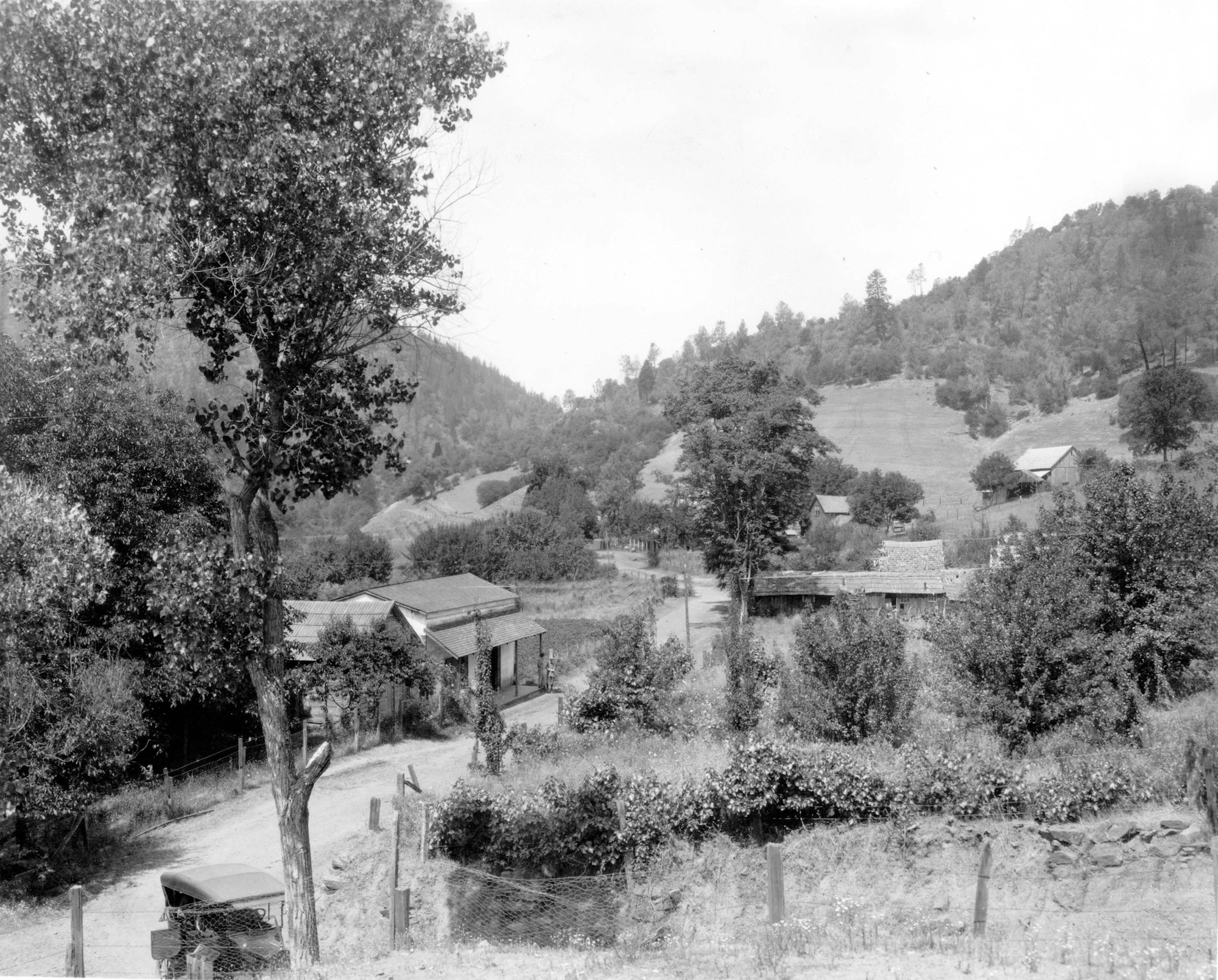
May contain: nature, outdoors, and countrysideView north down the main street of Jesus Maria, ca. 1900 (Courtesy Calaveras County Historical Society).

An overview history of Jesus Maria is accompanied by more specific histories of: the Milk Ranch owned by Hughes, Beffa, Dotta, Jelmini, and Gnecco families; the town’s stone and adobe stores owned by the Ratto, Lagomarsino, Molle, Gayon, Gnecco, and Cavanna families; the Gregoire Vineyard and Ranch; and the Plumb Ranch.

Overview History

Gold was discovered along the banks of Jesus Maria Creek, a tributary of the Calaveras River, in the earliest days of the Gold Rush.  Jesus Maria, like many other Gold Rush era camps, soon had a reputation for lawlessness and was considered one of the area’s wildest, with fandango houses, saloons, and gambling establishments catering to the miners.  Numerous accounts of violence, robbery, fighting, and murders were recounted. 

By the summer of 1852 the community had settled into a more peaceful existence, as a correspondent for the San Francisco Alta commented:

Jesus Maria – This place, which a short time ago was but an inconsiderable camp, consisting of a few scattered tents, presents now the appearance of a fine and flourishing village.  Large numbers of miners are daily arriving, and houses are springing up with surprising rapidity.  Hill diggings have been struck, and tunneling is carried on to a large extent.  We know of scarcely a single instance of a tunnel in operation there which is not paying something, while some are said to be remarkably rich. Very little is doing on the river, as the water is exceedingly high at present (San Francisco Alta, June 7, 1852).  

The name was derived from a Mexican vegetable peddler who sold to miners in the early 1850s (Gudde 1975:177).  Although Jesus Maria had been living in the town since its establishment, very little is known about him other than assessments for property from 1856-1860, and the 1860 census when he was listed as a miner, from Mexico, aged 53.  

In addition to a large population of Mexicans, the community included Chileans, French, Italians, Americans, and Chinese.  The other prominent name in town, Negro (Nigger) Gulch, was named for two black men who operated a saloon in Mokelumne Hill and mined in the gulch (Matzek 1987).  It refers to the gulch which courses uphill northeasterly from Jesus Maria to Whiskey Slide, a hard rock mining community about a mile away.

As was common in these early placer mining communities, once the easy gold was depleted, the population moved on to richer strikes elsewhere, often just walking away from their properties.  Most of the names in the earliest records were Hispanic, either Mexican or Chilean, but by 1854, many had departed without leaving any record of land transactions.   The community stabilized, however, as stores, butcher shops, saloons, liveries, blacksmiths, dairies, winery, hotels, restaurants, gardens, and farms were established.  The town cast 213 votes in the election of 1854.

Sixteen men were assessed for property in 1854, including French, Mexicans, Italians, Chileans, and Americans.  Identifiable were Ratto & Co’s. Italian Store, John Garnier’s Hotel de France, Francis Dauphine’s Vineyard, Joseph Gayon’s store, John Mandis’ Saloon, Mathews & Holmes Livery Stable, John Solari’s Store (with Molle), and the Boston Flat Ranch (BF-7), about a mile east of town.  

Numerous miners were undoubtedly residing locally, living in tents and cabins, but not assessed for property.  Two years later Louis Dulac opened his French Restaurant, and in 1857 Catherine Fischer operated a butcher shop in her own name, Thomas Phillips had a livery and trading post, and Harry Sing had a wash house (Calaveras County Assessment Rolls, various).
May contain: nature, rural, building, countryside, shelter, outdoors, advertisement, poster, and housing
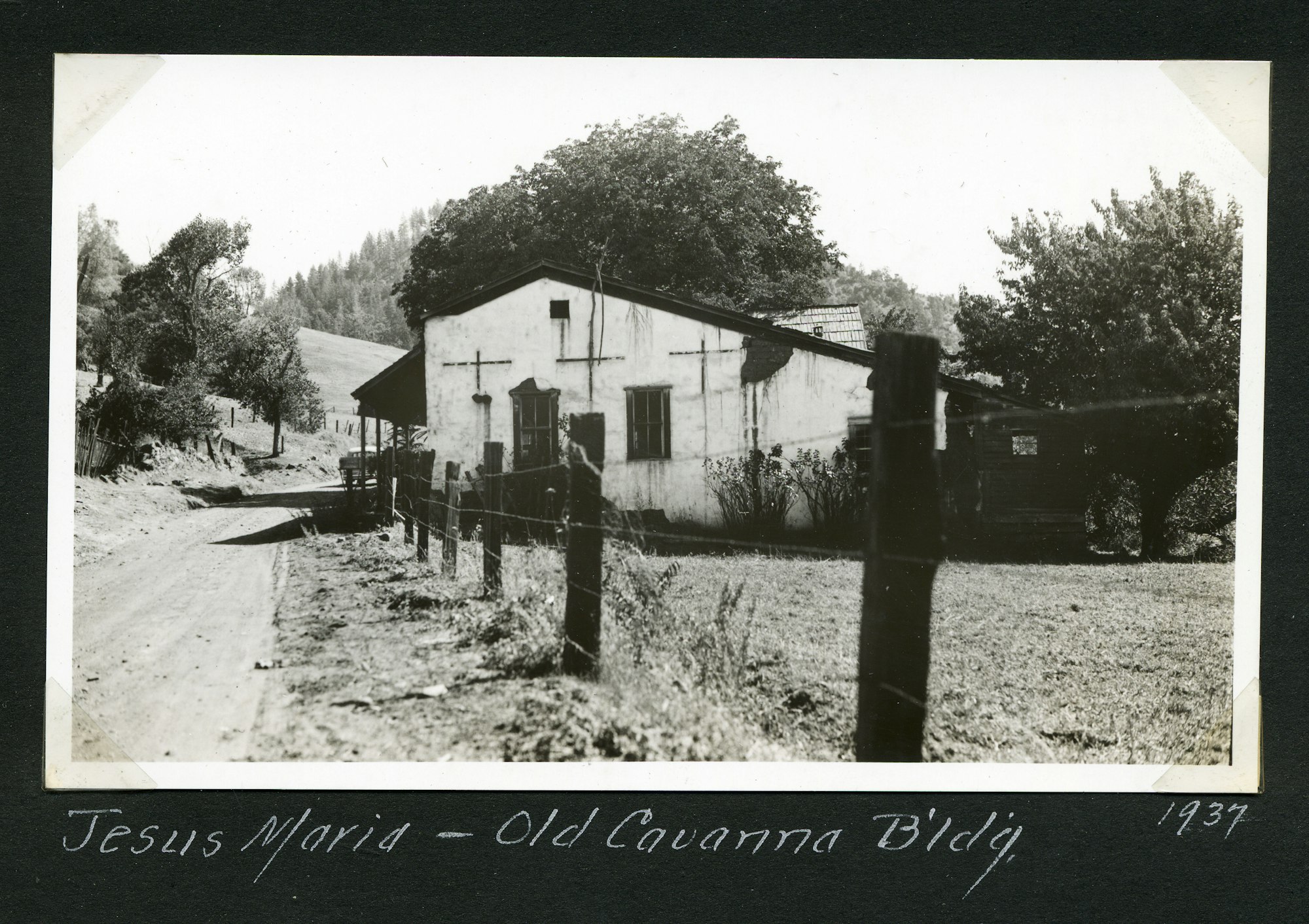
Adobe home and store of the Cavanna family, 1936 (Courtesy Judge Smith Collection).

By 1858-9, the population in the village peaked with 26 men assessed for businesses or houses in town and the Nigger Gulch School (soon changed to Negro Gulch School) had been established.  

In addition to the businesses mentioned above, a “Milk Ranch” was operating, providing milk to Jesus Maria and vicinity, first by Christopher Hughes, and then by the Swiss Alexander Beffa and Giobatta Dotta; Elias Craig had opened a blacksmith shop; Bartolomeo Ruizzo was operating a confectionary, Eugene Jacob a butcher shop; James Carr a billiard saloon; Louis Rieffel a French bakery; Joseph Michel a butcher shop and clothing store; and four stores were selling groceries and dry goods:  Ratto & Lagomarsino’s Italian Store, Paulo Molle’s Italian Store, Juan Falco’s Store, and David Phillips Store.  

Two Chinese were also assessed: Ah Chin for a Spanish horse and John Sing for a house and lot.  Most of the Chinese, however, resided in a community up a gulch southwest of town, along the road to the Fischer Ranch in Oak Flat (Hughes 2015). 

Other assessed properties were not identified by use and could have simply been the homes of miners (Calaveras County Assessment Rolls, 1858, 1859).  Up Negro Gulch near town, Giobatta Falco was mining on the Mauna Ranch with water from his Falco Ditch.  Mining continued in Jesus Maria Creek and on its banks for several years, however, including Ratto and Lagomarsino and others.  East of town, Bartolomeo Ratto and Giovanni Batista (George) Lagomarsino purchased the Boston Flat Ranch (BF-7). 

These enterprises continued in operation through February 1861, when a fire decimated most of the community.  The fire burned westward on both sides of the street, finally stopping at Falco’s stone store (the later Gnecco home).  With the easy gold recovered, many of the townspeople moved on to more successful diggings, including virtually all of the Mexican population.  Only one Chilean family, that of Manuel and Carmen Mauna, remained. 

After the fire, only 14 properties were assessed; one was Alfred Norton’s Saloon, occupied by Hooper as a billiard saloon.  A New Yorker, Norton was serving as Justice of the Peace, law and order having come to Jesus Maria.  Thomas Tanner had taken over the Hotel de France, but there was no longer an assessment for it after 1865.  

Elias Craig was blacksmithing (southeast of Ctx. 214); Mandis was operating his saloon, selling it to Gayon by 1865; the Falco, Gayon, Molle, and Ratto stores were operating; Beffa was dairying at the Milk Ranch; and Manuel Mauna mining and residing on a ranch on Negro Gulch.  Martin and Catherine Fischer had moved their butchering operation to Oak Flat, about a mile south of Jesus Maria.

As the 1860s wore on, more and more gardeners and farmers settled in the community, taking over the mining ditches from Jesus Maria Creek, Esperanza Creek, and Wet Gulch to irrigate their lands.  Among those who arrived in those years were Joseph and Catherine Costa who had a ranch on the south side of Jesus Maria Creek below town; Stefano and Maria Cavanna, also across the creek below town; J.S. Stevens and Olivia Jacinto who had small farms on the creek one-quarter mile above town; miner Orrin Plumb  who farmed in the creek below his house and barn on the north side of Jesus Maria Road on the east end of town; and several folk who were noted as having small gardens, including Elias Craig, John Estuela, Manuel Mauna, and Francisco Gnecco.  Several ranchers also settled at Whiskey Slide about this time. 

Farmers grew vegetables, potatoes, fruit, and raised livestock, including cattle, hogs, and sheep, while others grew grapes and made wine and brandy.  The most long lasting agricultural enterprise in town was the vineyard and winery of Dauphine/Gregoire/Gnecco.  The vineyard was located near Jesus Maria, running northerly “along the Jesus Maria to Whiskey Slide Road about one mile to a post marked D.F., east about 100 rods, bounded south by Plumb’s fence, about 100 rods to Boston Flat Road, along Boston Flat Road to beginning” (Deed Book B:409). 

In April 1857 Dauphine sold half of his land to Francois Fouroche, who sold to James Gregoire in 1862, and in June 1871, Gregoire advertised “Ranch For Sale Cheap,” located at Jesus Maria, with an enclosed pasture of 400 acres, securely fenced with rails, and a ranch of 40 acres fenced with pickets; containing 6,000 grape vines, all in full bearing; a shed, 40 x 20 feet, three stables, each 40 feet in length, built in 1870, costing $600 when built, with the entire property offered for $500” (Calaveras Prospect, July 1871).  Gregoire’s house, barn, and sheds were recorded as BF-4 CTX 230)

John Gnecco
John Gnecco

Two years later James and Elisa Lancell Gregoire deeded the property to Eugene Jacob, acting in company with John Deforse, for $200.  The deed included a ditch conveying water from Jesus Maria Creek to a garden on the south bank of the creek, and a house, barn, and fence.  

In 1873-4, Francisco Gnecco was assessed for Gregoire’s Vineyard, located back of Gregoire’s house.  By 1876 he was also assessed for 1000 gallons of wine and 50 gallons of brandy, evidently continuing the French winemaking tradition.  

From 1875 thereon, Gregoire’s Vineyard was assessed to John Gnecco, who had taken over his father’s properties.  Over the ensuing years the vineyard was noted as 10 acres, 18 acres, and eventually three acres by the 1930s. 

Whatever the size of the vineyard, John Gnecco had the most enduring and successful business in Jesus Maria.  His wife Louisa (Lagomarsino) was known for her hospitality, serving teamsters and travelers from their home on the north side of Main Street in the west end of town.  She also grew melons, alfalfa, sugar beets for cattle, and made cheese from milk.  In addition, the family raised cattle, taking them to Jelmini Basin and Bear Trap in Alpine County during the summer months after they acquired the Jelmini properties in 1910.  John grew vegetables, distilled grappa, made wine and brandy, and, during the Depression, his son Frank was recalled as having “made whiskey and made money” (Hughes 2015). 

As was common in areas in Calaveras County that were distant from established townsites, once the government surveys were completed in the early 1870s, all claimants in town allowed a prominent landowner, usually a merchant, to patent the land, then deed the properties back to them, thus providing legal title. This occurred in Jesus Maria with merchant Francisco Gnecco.  

On April 10, 1875, Gnecco patented the lands within the townsite, deeding individual properties back to the original owners.  In 1877, Francisco moved back to Italy and deeded his Jesus Maria properties to his son Giovanni Batista (John), who continued the tradition.  When people moved away, many of them sold their properties to the Gneccos as well. 
historic photo of JM Gnecco house
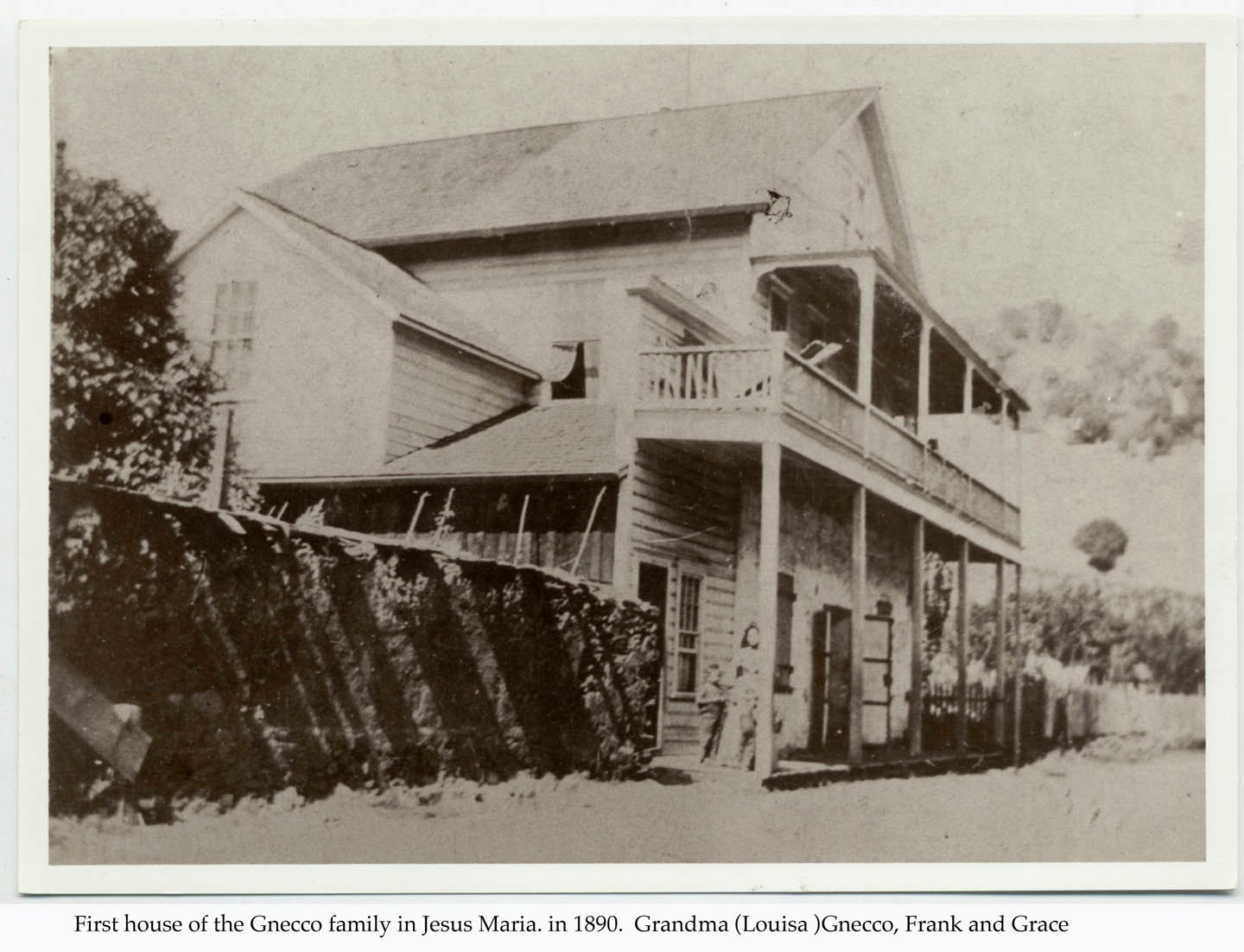
Gnecco house in Jesus Maria in 1890, with Louisa Lagomarsino Gnecco and children Frank and Grace on the porch.  It burned in 1898.

A few stores, a butcher shop, dairy, saloon, blacksmith, vineyard, farms and ranches survived into the mid-1870s, but by the 1880s only a handful of properties in the village were extant.  

By that time, Joseph Gayon was still selling wine and groceries, Stefano Cavanna and family were farming, Gnecco was making wine and brandy, Paul Lancell was operating the old Jacob butcher shop in Falco’s old store, the Maunas were operating a saloon in town, and Jelmini was running cows and cattle.  

Up at Camp Whiskey Slide, the Phillips family had settled near the Hughes, Moffitt, and Wilhelm ranching families, where the Negro Gulch School was established in 1858.

By 1894, the only folk in town were John and Louisa Gnecco residing in the old Falco store, adapted into a fine two-story house ner  the center of town. Also in residence were Gaetano and Johanna Jelmini on the west end of town; Bartolo Cavanna owning the old Ratto Italian Store, and residing with his mother Mary in Gayon’s old adobe store; Manuel and Carmen Mauna on the north side of Main Street; and Orrin Plumb’s sons on his ranch.  

Agostino Lagomarsino had taken over his brother’s ranch at Boston Flat and was residing there with his daughter, Celestina Giuffra, and her family.
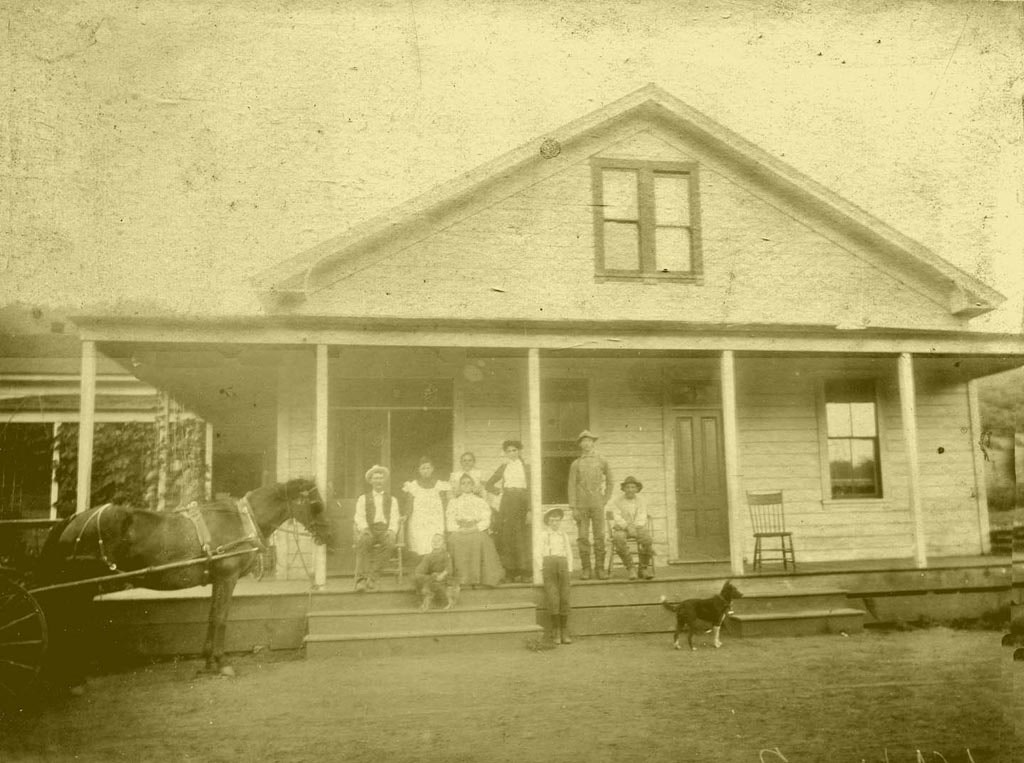
May contain: human, person, animal, mammal, horse, dog, canine, pet, building, housing, and furniture
John and Louisa Gnecco's new home in Jesus Maria`; it burned in 1936.

The Gneco home burned in 1898, but they soon built a new one-story house a bit west, south of Molle’s old adobe store (Ctx. 207) .  

In 1907, only the Cavannas, Maunas, Gneccos, and Johanna Jelmini were assessed in town.  

The widowed Celestina Giuffra had purchased the Plumb ranch, but was residing in her Boston Flat Ranch.  

By 1918, only the Cavanna stone and adobe buildings and Gnecco home were assessed.  The second Gnecco home burned in 1936, and a newspaper reporter commented, “since this latest fire, there remains on the historical old townsite of Jesus Maria only one building to attest to the affluence of the town in the boon ‘50s, a stone and adobe structure (actually two structures), known as the old Cavanna house” (Calaveras Prospect, January 18, 1936.  

In 1947 Willard Hughes, whose ancestors had once owned the first livery and dairy ranch in town, purchased the townsite from Frank Gnecco.

Of the 1850s’ buildings, only three were to last until the 20th century:  Ratto & Co. stone store, Joseph Gayon’s adobe store, and Paulo Molle’s adobe store; the stone store of Giovanni Falco -- subsumed into the Gnecco home by the 1880s -- was demolished when it burned in 1898.  The other early buildings in town were of frame construction, and either burned, were torn down, or collapsed over the ensuing years.  

The only remaining standing building, Molle’s ca.1854 adobe– later known as the Gnecco Winery – was destroyed in the 2015 Butte Fire.

Story by Judith Marvin, 2016, Calaveras County Historical Society

Thursday, November 9, 2023

Jewish Americans Buy Guns For Protection Against The Left


There is a part of me that feels sorry for Jewish Americans who have solidly supported their Leftist friends but now find themselves in a position of being threatened by their so-called friends. Imagine the awakening they must be going through. One day they find themselves supporting Democrats and so-called Progressives, and the next day they find themselves having to buy guns to protect themselves and their family from being harmed by the very people that they were allied with. It happens. It's sad. But yes, it happens.

So how does that work exactly for those on the Left?

Well, for years, Jewish Americans on the Left protested with those whom they thought were their friends. They marched together against American oil companies and were too dumb to understand that they were supporting Foreign oil companies that sponsor terrorist groups. They chanted together with other Liberals for the right to kill babies and saw nothing wrong with killing a child at birth. Of course, it never dawned on them that anyone who would find it so easy to kill a child would also find it very easy to kill them and their family.

They attended the same universities where extremely well-paid professors condemned America and brainwashed them into thinking that slavery to a Communist government was better than freedom in a representative democracy. They didn't care to ask why Communism has never been successful, why people flee Communist states, or how it is to live under Communism. Like good Leftists, they simply drank the Kool-Aid and accepted everything they were told. Of course, they were too busy condemning America to even understand that in a dictatorial Communist state -- they wouldn't have been allowed to condemn the state. 

Of course, they and their Leftist pals attended the same classes that told them why they should question their gender even though a trip to the restroom confirms what sex they are. And yes, they even sat together and commiserated about how those nasty Conservatives are so narrow-minded when it comes to their not wanting to limit our 2nd Amendment Rights. They could never see the reason why anyone would need a firearm of any sort -- they and their vegan buddies even wanted to take the guns away from hunters. And now, they are actually thinking differently about owning large-capacity magazines and a rifle that could be used for defensive purposes.

So, what changed? Why the turn around on seeing guns as "useful tools" rather than "instruments of death"? What made the Jewish American who has been on the Left suspect that his or her Leftist friends are full-of-shit and worse -- they want to hurt you and your family.

Well, that awakening came about after October 7th of this year. This year, 2023, is a year that has opened the eyes of millions of Americans and not only Jewish Americans. After years of Democrats and the Left telling America that MAGA Americans, those White Americans, Asian Americans, Hispanic Americans, and Black Americans who are Conservative, are America's Public Enemy number one, Jewish Americans on the Left now realize that that's all been a lie.

They have found out that it's their pals, the Democrats, and so-called Progressives that they've identified with, those on the Left who have all sorts of ideas of how the world would be perfect if we all simply allowed the government to "rule us," that now want them dead because they are Jews.

It's their pals who are marching in the streets and in universities by the hundreds of thousands. It's their pals who have now shown themselves to be the real enemies of America. It's their pals who have turned on them. It's the Left that's been chanting "Gas the Jews!" "Kill the Jews!" "Wipe Out Israel!" "From the River to the Sea!" Those pals of theirs now want them, their families, their race, exterminated.

They can't believe their fair-weather friends would be so hateful, have such bloodlust, be such Racists, be the Fascists that they were told were the Conservatives. Jewish Americans across the board, from the young in colleges to the old who supported Biden, are finding out the truth about who they've been running with. 

And yes, my friends, as hard as it is for them to believe, it's their friends, their fellow travelers, and their Communist comrades, who are now openly supporting the Hamas terrorists. And really, it must be a bit of a shock to see their pals support the evil who decapitated babies, raped the young and the old before slaughtering them, and burned others alive on October 7th in Israel.

The awakening of Jewish Americans to the truth of who the Left really is is something that no one thought we'd see in our lifetime. Like other Leftists, Liberal Jews believed with all their hearts that the hoax called "Climate Change" was going to destroy the earth. 

But now, Jewish Americans are watching the Left protesting and their huge rallies are calling for their death. And really, it must be tough for them to find out they don't need to worry about Climate Change or the supposed threat from MAGA Americans --  when in fact they are learning that the real threat to all of humanity and the Jewish race specifically comes from their Liberal friends.   

Their friends are the real Racists and fascists in America. Their friends support Hamas and other Muslim terrorists. It's their friends who want the Jewish race exterminated. Because Jewish Americans wake to see another day, they are the enemy of those who support groups like Hamas. And as shocking as it is to Jewish Americans, they now see that it's their friends who are acting no differently than the Nazis of the 1930s and 1940s Germany who slaughtered 6,000,000 Jews during the Holocaust.

It's a hard lesson to find out that you've been friends with people who side with the terrorists and who want to kill you, people like you, and other Jews. And yes, that's why like so many other Jewish Americans since October 7th, many have decided that they need to buy a gun to protect themself against those on the Left. They have learned that those so-called friends of theirs see Jews as people who should be exterminated.

Frankly, that's a hard way to learn that you need to buy a gun to protect yourself. Fear of being killed is a great motivator to fight to stay alive. And to stay alive, high numbers of Jewish Americans, those who have acknowledged the threat coming from Democrats and so-called Progressives for what it is, are now buying guns at record numbers.

They are smart to do so since the government can’t protect them. And since history looks like it is repeating itself,  and the times look a lot like what took place in Nazi Germany in the 1930s and 1940s, purchasing weapons out of fear for the safety of themselves, their communities, and their families is smart. 

Of course, when the Left comes to get them, the only hope for defenseless Jewish Americans will be the protection they get from MAGA Americans. Ironically, the people who will fight to protect Jewish Americans are those very people whom the Left has told the Jews to hate.

That's how I see it.

Tom Correa 

Sunday, November 5, 2023

The Benson Stage Debacle -- by Joyce Aros


by Joyce Aros

From the June 2006 issue of Tombstone Times

The story has been told and retold. In fact, one could not relate the build-up to the gunfight on Fremont Street without including the account about the Benson stage robbery attempt and the shooting of Bud Philpot. It is one of the major peripheral factors in the events of October 26, 1881.

As it turns out, it may be even more important than that! It has been one of the enduring mysteries of old Tombstone... did Doc Holliday really have anything to do with that attempted robbery and did he actually shoot Bud Philpot?

For me the story was a paradox. On the one hand, though I believed Doc Holliday to be capable of almost anything to do with money, I really had a hard time seeing him as a highwayman. After all, wasn't he a smartly dressed urban man who loved the atmosphere of saloons, cigar smoke and playing cards? Yes, indeed, so what would entice him to be out on a dusty desert road with a bunch of rough cowboy types holding up a stage? It just didn't fit my image.

But then there was the other side of the coin. Kate Elder, his common-law wife. Now, Kate and Doc had a very volatile relationship as was well known at the time. There is some indication that it occasionally came to blows. And these kinds of fights often result in a temporary loss of loyalty by one party or the other. Perhaps this happened in Kate's case, for she did indeed turn on Doc in a way she had not done before. She accused him of murder!

But let me give you the background knowledge you need to understand this whole story. On March 15th, 1881, the Sandy Bob stage out from Tombstone and on its way to Benson was robbed. Actually, it was an attempted robbery. 

The driver, Bud Philpot, was in reality to be the shotgun messenger at the time, and Bob Paul was to have been the driver. But at some point and for some reason, they changed positions, perhaps to give the driver a chance to warm his hands, as March can be chilly in this desert. 

As the stage slowed for a small incline in the road, a masked bandit appeared in the path of the coach and demanded that the driver pull up. Bob Paul immediately raised his shotgun to resist the attempt, but the gunman fired first, killing Philpot. The startled horses bolted and the highwaymen took off, losing out on the desired Wells Fargo booty of twenty-six thousand dollars in pure silver. I cannot tell you how much that would be in today's money, but the general consensus seems to be to multiply by ten.

The driver was able to get the team under control and drove it into Benson where he quickly sent a telegram to Tombstone with the necessary information regarding the attempted hold-up and the subsequent murders of Philpot and Peter Roerig, the hapless passenger who had been shot at as the horses sped away. 

A large posse was gathered and took off after the robbers in a cloud of dust and excitement. This would seem to be some time after ten o'clock at night when the news arrived and was probably closer to midnight by the time men and horses were choking the road with heel dust. 

There were two posses, one led by Virgil Earp. With him were Wyatt, Morgan, Bat Masterson, Doc Holliday and Marshall Williams. A formidable bunch to be sure. The other group was led by Johnny Behan and did not include such notable names.

Jim Crane, Harry Head, and Billy Leonard were accused of the crime but were never located. One man who was with them, Luther King, was found and brought back to the sheriff's jail, but miraculously escaped shortly thereafter and was never heard from again.

I am not going to ramble on with the continuing details of posse accounts and resulting disappointments for all. The case was never really solved. The outlaws that were believed to be involved met various violent ends in a short time. All except one. It seems there was another man with Leonard, Head and Crane. We are not talking about the in and out escapee. He just held the horses and seemed to have little stomach for the rough stuff; but there was someone else who disappeared into the night right after the attempted hold-up.

At this point I am going to quote an item from a Tucson newspaper, The Arizona Daily Star, dated March 26th, 1882. The article is titled "The Vendetti," and was written after the so-called vendetta ride of the Earp gang after the brothers were attacked. The news piece attempts to review the events leading up to and after the Fremont Street murders.

"...The trouble between the Earps and the Clanton and McLowry boys grew out of the robbery of the Benson stage. On March 15th1881, the stage with Wells, Fargo & Co.'s express left Tombstone for Benson with a large treasure, 'Bud' Philpot driving and Bob Paul as Wells, Fargo & Co.'s messenger. The coach left at 6:00pm and at 7:30pm, while only 200 yards out from the first station, the order to halt was given. Simultaneously with it two shots were fired, one of which killed the driver and the other perforated the cushion upon which Paul was setting. 

The driver fell off, carrying the lines with him, and the horses ran away. Paul emptied his gun, returning shot for shot, but without effect. The horses kept running, and the robbers kept shooting, and in all fired some twenty shots at the retreating stage with its load of ten passengers. 

They succeeded in killing one man who was on top. Paul managed to stop the team, gathered up the lines and drove rapidly to Benson, where he telegraphed the news to Tombstone. Immediately all was excitement. Agent Williams of Wells, Fargo & Co. and the Earp brothers were rushing around, preparing to hunt the robbers. 

At 8:30 that same evening Doc Holliday rode up to a saloon in Charleston, ten miles from the scene of the attempted robbery and inquired of Billy Clanton. On being told that he was not there, started in the direction of Tombstone, which was nine miles distant, and about 10:00 o'clock rode up to a saloon on a back street in Tombstone and called for a big drink of whiskey, which he drank at a gulp, without dismounting. His horse at the time was covered with foam. 

This all happened before the news of the murder reached Tombstone. At midnight the agent and the Earp brothers, with Holliday, left town to meet Paul. It was too dark to follow a trail when they arrived on the ground, so they camped until morning. 

They found three masks made of hay rope and about twenty large-size rifle cartridges. They then took the trail and followed it for about three weeks without catching any one but a supposed accomplice, and he was assisted by some unknown person to escape from the custody of the sheriff while consulting with his lawyer...."

So now you have been over the account twice and it sounds like a pretty routine stick-'em-up for the time period. But wait... it gets better.

Let's take the notorious Ike Clanton and try to flesh him out a bit. He is always spoken of as that miserable loud-mouthed coward that got his kid brother killed and then ran away, groveling somewhere under somebody's back stoop. The movies show him off even worse, almost licking Wyatt Earp's boots as he begs for his life. 

Wow! If that were really so, I don't think Ike Clanton could have spent another 24 hour period in the whole of Cochise county. Cowards were not suffered gracefully by the cowboy crowd and Ike's existence would have been too miserable to bear. Actually, reminiscing old timers around Charleston recall that it was Billy Claiborne and Johnny Behan that were censured by the folks around for not helping the McLaurys and Billy Clanton. There was no bad feeling about Ike Clanton. There has got to be more to the story.

To quote the succeeding paragraph... "The news of Holliday's ride becoming known, coupled with the facts that he was seen mounted and armed in the early part of the afternoon, ostensibly to go to Mexico, caused many surmises, and not a few made the remark that the 'robbers were hunting themselves.' Before the return of the agent's posse it became known that Billy Leonard, Jim Crane and Harry Head were interested in the murder, and it was their trail that Paul was following. Wells, Fargo & Co. offered a large reward for them, but it was of no use...."

Our interest in these lengthy quotes is in regard to John Henry Holliday and his late night ride to... Mexico?... then Charleston... then to a back street saloon in Tombstone... and then to join the midnight ride of the posses. 

If we go back to the middle of the account, we see that about 8:30 pm, an hour after the attempted hold-up and only nine miles away, Doc Holliday turns up in a saloon in Charleston, of all places, when he has been reported to be on his way to Mexico for an extended period of time. 

In Charleston he is asking for Billy Clanton! He has never met the nineteen year old cowboy and logically, should have no interest in him whatsoever, yet here he is well off his supposed path to Mexico to seek this very person. Why? What reason could he have to make such an effort?

Possibly the answer might be found in the correspondence of Will McLaury, the older brother of Frank and Tom McLaury. Will had come to Tombstone just a few days after he received word of the deaths of his two brothers. 

The older McLaury was a lawyer and joined the prosecution team at the Hearing proceedings against the Earps and Doc Holliday regarding the gunfight known as the O.K. Corral showdown. He wrote to his brother-in-law, D.D. Applegate in Toledo, Ohio, a letter wherein he describes what he understands to be the cause of the gunfight. 

I'll quote the pertinent portion ... "The cause of it was this; some time ago, Holliday, one of the murderers, attempted to rob the express of Wells-Fargo & Co. and in so doing killed a stage driver and a passenger and the other parties involved with him the Earp brothers were interested in the attempted express robbery and young Clanton, who was killed, a boy 18 years old, knew the facts about the attempted robbery and had told his brother, J.I. Clanton, Thos. and Robt. And they had got up facts intending to prosecute him Holliday and the Earp brothers and Holliday had information of it. It is now known that the other two men who knew of the murder in the attempted robbery have since then been killed in Mexico, the report was by 'greasers' but at the time they were killed, Holliday was out of town 'said to be visiting relatives in Georgia.'"

It is fair to say that Will McLaury's view of the tragic consequence to his brothers is biased. But the opposing viewpoints are also. However, it still gets better...because we have the action of Big Nose Kate, Doc's girlfriend!

Though most women in that day and age probably knew very little about what their men were doing, Kate was in a unique position. Wives and sweethearts of the menfolk of that day would be more submissive and less likely to make inroads into a mans' world. But Kate, ever plying her trade in the saloons, would not only be less submissive but also able to pick up on a lot of talk and action in the environment she breathed in. And as Doc likely treated her more as a concubine than a wife, he probably talked pretty freely around her as well. She would not be as sheltered from language and back-street talk as would the more respected wife. And so it is reasonable to assume that Kate knew what was going on with the Benson stage robbery and Doc's involvement with it, and by extension, the Earps' activity as well. Her association with the group via Doc had to have allowed her to be privy to some things she had best not share with the general public.

Kate was a drinker. And she started drinking heavily after some sort of argument with Doc that may or may not have gotten physical. She no doubt complained about her treatment to anyone in the saloon who would listen to her, as drunken women are reputed to do. Johnny Behan listened and got an earful. Talk about a happy man! 

At the time, there was a great deal of suspicion that Doc had been involved in the hold-up and was indeed the triggerman. Therefore, when Kate began to complain about Doc's abuse, which she often claimed came from his association with the much-disliked Earps; she also voiced her belief about Doc's contribution to the tragic bloodletting. Could this actually be the chance to incarcerate the unpopular Holliday... maybe even hang him? Behan had to be beside himself with joy.

Never one to miss such an opportunity, Behan likely bought a few more rounds for Kate before giving her pen and paper. Just a little insurance! 

Only a woman scorned and mistreated and tending toward drowning her sorrows would take such a risk. Kate was indeed a sad creature. Angry and hurt, the alcohol caused her to throw caution to the winds and lose sight of any immediate consequences. She signed a complaint against Doc.

The Nugget of July 6th, 1881, reported that Holliday was arrested on July 5th; charged with complicity in the Benson stage hold-up on the complaint of Kate Elder. But, he was freed on a $5000 bail that was put up by Wyatt Earp and friends.

Then Kate was arrested the following day by Virgil Earp. She was arrested for drunk and disorderly conduct in one of the town's saloons. For some reason, Virgil did not feel compelled to arrest all the other likely drunken patrons of the saloon. No cell room, I guess.

Kate was held for several days without any formal charges. The Earps were not above 'framing mischief by law,' so to speak, and though this seems like a relatively small but uncomfortable situation, it was a frightening one for Kate. 

It would be naïve to think that the jail time did not include some sage advice about travel arrangements and even some threats from the Earp faction. Kate knew these men and she didn't like them. She complied and recanted for her release. Doc's appearance in court was short as Kate now refused to testify. The case was thrown out, but we get a good look at the way the Earps operate. It should not be forgotten.

Now I want to get back to Doc's hasty ride into Charleston right after the stage was attacked. I am very concerned about his desire to find Billy Clanton. And from what Will McLaury had to say in his letter to his brother-in-law about the whole episode, there's good reason to be. Doc hated the cowboys and just did not associate with them at all. 

Why go looking for a young cowboy late at night, lathering up his horse to do it, when he had never met the boy? In my mind... why else but to threaten or kill him! Either Doc or someone of his group saw the young man in the vicinity of the hold-up. One of the group recognized him. They knew he had seen them commit the crime, just as Will McLaury wrote in his letter. 

Billy Clanton had been working cattle in the area all day. He was heading home to the ranch and was either on the Charleston road or cutting across it. He may even have come close to the group in the dark after they took off their hemp rope masks, for that evening there was a bright moon. At any rate, he knew who pulled off the attempt and he told his brother and the McLaurys. And possibly sealed his fate!

That is how the circumstantial evidence stacks up. Billy's witnessing what happened and then Kate backing it up. Witnesses saw Doc in Charleston right after the stick-up and others saw him race into town to a back-street saloon he likely never frequented, his horse totally winded and lathered when he had said he was off for a few days to Mexico! And, interestingly, Doc was spotted on the road from Charleston that evening by another almost unimpeachable witness, John Slaughter, who was driving with his wife in a buggy. Slaughter said there was no doubt in his mind it was Doc Holliday he saw in the moonlight. Slaughter is a tough one to deny!

But there is yet another suspicious act on the part of the not-too-clever Holliday. On October 26th, 1881, as Billy Clanton and Frank McLaury were leaving the Grand Hotel to go hunt up their brothers, Doc Holliday approached Billy, introduced himself and shook hands with the puzzled boy, saying that he was "glad to meet him". 

He didn't approach Frank McLaury or Billy Allen or Major Frink, those who were with Billy. Just Billy Clanton. Billy rarely came into town, so it seems obvious to me, at any rate, after his seeking the young cowboy in Charleston that night unsuccessfully, that Doc wanted to identify the boy... make sure he shot the right one... the eye witness. He did! Billy Clanton was mortally wounded at the onset of the fight on Fremont Street in another hour or so. 

Many witnesses testified that Doc and Morgan Earp shot first, and one of the first ones shot was Billy Clanton, despite his hands raised and his statement that he did not want to fight.

One other little thing of note to throw in the pot; Holliday was a close personal friend of Billy Leonard, one of the robbers. They had known each other before either one came to Tombstone, and the story goes that Doc was known to go and visit Leonard out of town several times before the robbery took place. Though Leonard was a friend of Doc's, he didn't hesitate to describe him as a "shiftless, bagged-legged character; a killer and professional cut-throat and not a wit too refined to rob stages or even steal sheep..."

So what do we make of all this? Did the Earps know what Doc had done? Almost surely! Were they in on it? That's up for debate but it seems possible. For sure they wanted to protect Doc from his own folly and protect themselves from the damning fallout. 

Wyatt had a burning ambition to be the next sheriff of Cochise County, a real money-maker of a job. The kickback from collecting taxes and other fees was considerable, to say the least. But this stuff with Doc Holliday and murder! That could really kill his chances if Doc couldn't be cleared in some way. Wyatt's brain was buzzing!

And of course, the crafty Wyatt came up with a plan. His posse had chased the outlaws all over creation for more than three weeks trying to catch them. It was important that they be apprehended, and in the course of their capture, likely be shot for resisting arrest. That way they would never spill the beans about Doc's (or the Earps) complicity in the botched hold-up. 

Why would I think that? Well, I am going to rely on the newspaper account in the Star again. The 'Vendetti' article explains it.

"...So matters rested for some time, until, as Ike Clanton swears, Wyatt Earp called him aside and told him that he would guarantee him (Ike) all of the Wells, Fargo & Co.'s reward and one thousand dollars more on top of it, if he would induce Leonard and Head to come to some ranch in the neighborhood of Tombstone so that he (Wyatt) could surprise and kill them. 

He gave as his reasons that they had failed to realize anything from the attempted robbery and they might squeal sometime. Crane had been killed by the Mexicans with 'Old Man Clanton,' so there was nothing to fear from him. To satisfy Clanton that he meant business, Earp had Wells Fargo's agent telegraph to San Francisco asking whether the reward would be paid dead. The answer came back yes. But while negotiations were pending Leonard and Crane were both killed in New Mexico for cattle stealing..."

This is really interesting and falls right in line with Earp's ambitions. He'll deal with anyone to attain his ends. At the time, it would seem he was on some sort of friendly terms with Ike Clanton or he wouldn't have approached him. Ike was the man in the valleys who had his finger on the pulse. He was well connected and well informed about everything going on in the surrounding environment of the outlaws. If anyone could help with the capture certainly Ike could... but would he?

There is not one writer I have read that didn't think Ike greedily jumped at the chance and even dragged in his equally greedy companions, the McLaurys. I just don't buy it. It doesn't fit. Ike was a wheeler-dealer of sorts, a businessman more than anything else, though a rough-edged cowboy for sure. But it seems he was a broker for the ranchers and butchers and even the army in dealing with the stolen cattle market. He had a strong business relationship with the rustlers who supplied a very demanding meat market. Ike was the go-between, the buffer. 

Would he jeopardize that for a deal that would benefit no one but Wyatt Earp? I don't think so. Ike was not short of cash. He handled huge amounts for the people he did business with and made a fat profit or he wouldn't be doing it. $6000 split three ways (Earp says the McLaurys were in on it) was not enough for any of them to take the risk of being found out. There's no doubt they would be killed. 

It has become apparent in different accounts that Frank McLaury was very cautious in crossing some of those men as he helped out Billy Breakenridge with one or two problems. Such a treacherous act as setting up some 'friends' of his would definitely be disastrous for any of them as it would be sure to leak out eventually. No, I don't believe Ike went for it at all.

But many people do because that's the way Wyatt Earp tells it. It seems that Ike told of the proposition that Earp made him, and when Earp heard about it, it made bad blood between them. Couple that with Doc's finding out that the Clantons and McLaurys knew of his involvement in the Benson stage hold-up and you can see where this is going. Those cowboys were ruining everything for the Earps and their plans to become rich and powerful in Tombstone. Something had to be done!

It was. The chips all fell into place for the Earps when all the parties came together on October 26th, 1881 in the vacant lot off Fremont Street. But it was no real benefit to the Earps after all. As usual, they made the wrong play and shortsightedly botched their long term plans to be big players in the territory.

--- The above article is by Joyce Aros 

I'm always a little fascinated by articles like this. The writer took a look at an event and gives her analysis of what took place -- as well as her take on some of the characters involved. And just so you know, I've read where some people who claim to be Earp Experts don't like what she wrote in her books. And as you've heard me say over the years, I have very little respect for many of those so-called "Experts." When it comes to the Earps, I've found them to be more like infatuated adolescent fans rather than objective researchers. 

So what do you think? For me, this is one of those article that I have to read and re-read a few times to see what might go against what I already know about what took place during that stage robbery and killing. I do have to say that I respect her analysis and I'll really give it some thought. 

So why do I like articles like this, especially since I know it goes against the "accepted story" of what took place? Well, while her view of things is in contrast to what the "accepted story" of what took place, she really makes a lot of litgitimate points. 

That's not a bad thing at all. In fact, since I've come to the conclusion that the Earp family as a whole were no where near being honorable people, certainly not choir boys, I really believe that sometimes the "accepted story" is just not true. 

Maybe after some digging, I'll be able to report back to you to say whether she was right or not. After all, she might be. 

Tom Correa


Tuesday, October 31, 2023

An 1874 Ghost Story -- Taking A Shot Or Two At A 'Woman in White"

This is an interesting ghost story because one of the witnesses goes Western in a big way by drawing a pistol and taking a couple of shots at the ghost. For me, this is the first time that I've seen a newspaper report of a ghost encounter where someone decided to shoot at a spirit. 

The news story below is from the Omaha Daily Bee, Omaha, Nebraska, July 18, 1874, Page 4:
 
A Ghost Story 

A Mysterious ''Woman in White" Flitting Around In Prospect Hill Cemetery.

It was not long since that the report that the house standing at the northwest corner of Thirteenth Street and Capitol Avenue was haunted, excited considerable curiosity among the superstitious. This morning, however, we were told a reliable story that puts the haunted house way in the shade.

The scene of this strange and true narrative is Prospect Hill Cemetery, adjoining which Mr. H. P. Stanwood, the well-known sculptor, has a small dwelling and a marble-cutting shop, in which several hands are employed.

On Tuesday night, shortly after dark,' one of two brothers, who sleep in the shop, happened to step out of doors before retiring, and looking out over the silent city of the dead, a vision of -- a ghost -- a "woman in white" -- the invariable costume of ghosts met his astonished gaze.

The mysterious being was slowly flitting towards the building, when he ran in and brought his brother out to view the strange sight.

Both became scared, and hastening out of the back door, just as the ghost came in the front door and blew out the light, they ran over to Mr. Stanwood's residence to inform him of what had happened.

Mr. Stanwood and the men went out to see what was the matter, and sure enough they saw before them the ghost, who hit Mr. Stamw0od on the back, and asked where her children was -- if they were buried in that tomb.

The ghost then flitted into the house, blew out the light, and entering a bedroom, so scared the occupant that he jumped out of the window and ran away. One of the two brothers mentioned above, having pulled out his revolver, deliberately took aim and fired twice at the ghost, but without effect.

She then took her departure into the cemetery, followed by the men to a certain grave, where she vanished.

On Wednesday night the mysterious ghost again made her appearance, and so frightened the two brothers that they came down town to sleep during that night, and the next night.

The above is a true statement of the facts, as related to us by a gentleman of veracity. Mr, Stanwood himself is not a superstitious man, and has no faith in ghosts, but our informant assures us that he substantiates the above statement.

-- end of news story Omaha Daily Bee, Omaha, Nebraska, July 18, 1874, Page 4


Saturday, October 28, 2023

Slavery in California -- By Delilah L. Beasley (1918)


Delilah Leontium Beasley, (September 9, 1867 – August 18, 1934), was a historian and newspaper columnist for the Oakland Tribune in Oakland, California. She was the first African-American woman to be published regularly in a major metropolitan newspaper.
Slavery in California
By Delilah L. Beasley (1918)

Slavery in California prior to the Mexican War was slavery in the Spanish possessions. The Spaniards began with the enslavement of Indians and later at the advice of De las Casas changed to that of Negroes. This system was first used in the West Indies and later extended to other colonies. 

It is said that about the year 1537, Cortes fitted out at the port of Tehuantepec, several small vessels, provided with everything required for planting a colony and sailed north to the head of the Gulf of California, transporting four hundred Spaniards and three hundred Negro slaves, that he had assembled for that purpose. This is the first mention of Negro slavery in California. After the founding of the Mission of San Carlos by the president, Father Junipero Serra, with a community of twenty-three friars, we read that the first interment in the cemetery was that of Ignacio Ramirez, a former mulatto slave from San Antonio, who had money to purchase his, freedom.  

There were too a number of Negro slaves brought to California between these periods. They came on trading ships and with various expeditions, which they usually deserted after reaching the State. Hittell [known for his work History of California] is wrong, therefore, in saying that the first slave in California was brought there in 1825 when the wife of Antonio Jose de Cot, a Spaniard, brought with her a slave girl named Juana, fourteen years of age, from Lima to San Francisco. He doubted even that this was the first slave in California for the lady expressed her intention to avail herself of the first opportunity to leave.

Spain did not especially bother about Negro slavery in her Pacific coast territory for nearly two hundred years before the coming of the Americans. She promised by the treaty of September 30, 1817, to abolish the slave trade on October 31, 1820, in all Spanish territory. 

In 1821, however, certain of the northern colonies of Spain in America established their independence as the United States of Mexico. Three years later the importation of slaves from foreign countries was prohibited and children of slave parents were declared free. Notwithstanding this there set in considerable emigration from the Southern States followed by an agitation for the acquisition of Texas.

In 1827, therefore, Coahuila and Texas were organized as a State with a law prohibiting slavery. As, this, however, did not check the immigration, President Guerro issued a decree in 1829 abolishing slavery in Mexico on the occasion of the celebration of the independence of Mexico and in 1830 ordered a military occupation of the State to enforce the anti-slavery measure. But the aggressive southerner ever endeavoring to extend the territory of slavery had all but won the day in Texas. 

In 1836 Texas declared itself a republic with a constitution permitting the introduction of slavery and forbidding the residence of free Negroes without the consent of its Congress. Then came the Mexican War resulting in the defeat of Mexico and the cession to the United States of a vast territory of which California was the most valuable part. It is clear, therefore, that at the time the United States government acquired the territory of California from Mexico, slavery had been abolished there for nearly twenty years. The pro-slavery party, however, did not consider this action of Mexico a finality in the settlement of the slavery question in the new possessions. 

When a bill providing for the purchase of this territory was laid before the house, David Wilmot, of Pennsylvania, after consultation with other northern democrats, offered the following amendment:

"Provided that an express and fundamental condition to the acquisition of any territory from the republic of Mexico by the United States, by virtue of any treaty which may be negotiated between them, and to the use by the executive of the moneys herein appropriated, neither slavery nor involuntary servitude shall ever exist in any part of said territory, except for crime whereof the party shall first be duly convicted."

This proviso was adopted by a vote of 83 to 64. The bill carrying this proviso was then reported to the Senate where followed a heated debate which lasted until adjournment, the proviso being killed in the midst of stormy scenes in Congress.

This discussion showed that few statesmen believed that slavery would be profitable in California. They were not unlike Daniel Webster who, while speaking on the admission of the State of Texas, said that slavery was effectually excluded from California and New Mexico by a law even superior to that which admits and sanctions it in Texas. He meant the law of nature. The physiographic conditions of the country would forever exclude African slavery there; and it needed not the application of a proviso. If the question was then before the Senate he would not vote "to add a prohibition-to reaffirm an ordinance of nature, nor reenact the will of God. "'

The coming and going of the Negro in California did not especially interest any one until the beginning of the immigration of the forties. The subject of slavery in California was officially called to the attention of the inhabitants through the issuance of a proclamation by the Commander in Chief of the District in regard to the unlawful enslaving of the Indians. He was endeavoring to protect them, but they were enslaved in spite of his efforts. 

PROCLAMATION TO THE INHABITANTS OF CALIFORNIA.

"It having come to the knowledge of the Commander in Chief of the District that certain persons have been and still are imprisoning and holding to service Indians against their will and without any legal contract for service. It is thereby ordered that all persons so holding or detaining Indians shall release them, and permit them to return to their own homes. Unless they can make a contract with them which shall be binding upon both parties. The Indian population must not be regarded in the light of slaves, but it is deemed necessary that the Indians within the settlement shall have employment, with the right of choosing their own master and employment. Having made such a choice they must abide by it, unless they can obtain permission in writing to leave, or the Justice in their complaint shall consider they have just cause to annull the contract and permit them to obtain another employee. All Indians must be required to obtain service and not be permitted to wander about the country in idleness in a dissolute manner. If found doing so they will be liable to arrest and punishment by labor on the public works at the direction of the Magistrate. All officers, Civil or Military under my command are required to execute the terms of this order and take notice of every violation thereof.

- Given at headquarters in Yerba Buena.
- Signed, John Montgomery. Sept. 15, 1846. 
- Published for the Government of all concerned. Washington A. Bartlett, Magistrate of San Francisco, Sept. 15, 1846.
- California StarSept. 15, 1846

The Legislature undertook to perpetuate this system by enacting a law permitting the enslavement of Indians, the only condition upon the master being a bond of a small sum, that he would not abuse or cruelly treat the slaves. Under the provision of the same law, Indians could be arrested as vagrants and sold to the highest bidder within twenty-four hours after the arrest, and the buyer had the privilege of the labor for a period not exceeding four months. An Indian arrested for a violation of a law could demand a jury trial, but could not testify in his own behalf against a white person. If found guilty of any crime, he could either be imprisoned or whipped, the whipping not to exceed twenty-four lashes.

Later there was a steady influx of Southerners and their Negro slaves into the territory of California after the country was taken over by the United States. Then came the question as to the enslavement of the Negro. The situation became serious after the Congress of the United States appropriated three million dollars for the purchase of the new territory, and still more so after gold was discovered there. 

Mexican rule ended with the cession of the territory to the United States; and yet session after session of Congress adjourned without giving California a territorial form of government. The question of slavery in the newly acquired territory divided Congress so that they could not decide the issue. 

Southern newspapers were advertising for slave-owners to send names and the number of slaves they were taking to California to found a New Colony. The settlers were divided. Some came because they either disliked slavery or were too poor to own slaves. They recognized the possibilities for making California a free State and did not care to be designated Poor White Trash by masters who were being allowed to fill the State with Negro slaves to constitute the basis of an aristocracy like that in the South. 

There were other inhabitants in California at the time who, being slave-owners, were Southern sympathizers. They were determined either to have slavery in California or make a desperate effort before seeing the territory given up as a free State. It did not require very much investigation, however, to show that the pro-slavery party was in the minority. 

The editor of The Californian said in May 1848, that he voiced the sentiments of the people in California in saying that slavery was neither needed nor desired there. A correspondent of this paper hoping to hold that section for free labor said: "If white labor is too high for agriculture, laborers on contract maybe brought from China." 

Referring to the proposal to make the commonwealth a slave State, Buckelew said: "We have not heard one of our acquaintance in this country advocate this measure and we are almost certain that 97-100 of the present population are opposed to it." 

Again it is remarked in this paper: "We left the slave states because we did not like to bring up a family in a miserable, can't-help-one's-self condition," and dearly as he loved the union, he would prefer California independent to seeing her a slave State.

The lack of law and order and fear of the southern slaveowners with their herds of Negro slaves finally led to the call of the Constitutional Convention. The question of slavery there was not so much debated in that body as was expected. Some excited pro-slavery leaders were talking of an independent Pacific Republic. The southern faction in the convention was led by a Mr. Gwyn, who afterward became a United States Senator from California, and the northern element was ably represented by a Mr. Broderick, who later was chosen State Senator. 

The convention finally drafted its constitution with a section that provided that "neither slavery nor involuntary servitude unless for the punishment of crime shall ever be tolerated in this state."

The pro-slavery faction in the convention was determined to have slavery somewhere and had managed to have the eastern boundary of California so designated that it extended as far as the Rocky Mountains. This would have resulted in rejection by Congress, or a division of the territory into a Northern and a Southern California, giving the pro-slavery element a new State. 

The unwieldy boundary, however, was discovered in time to have it changed, but not until after much debate, which almost wrecked the constitution. The California representatives elected by the convention left for Washington, where they presented to Congress the Constitution and the petition of the California settlers asking for admission as a State. There had never been a precedent for their act. Yet the settlers in California felt perfectly justified since it was their only safeguard against the pro-slavery leaders who were bringing their slaves into the territory.

Leaders at the national capital naturally hesitated, not knowing whether or not the admission of California under the conditions thus obtaining would aggravate or improve the national situation. California, however, cared little about the national situation, as is attested by the resolutions of 1850 to the effect: "That any attempts by Congress to interfere with the institution of slavery in any of the territories of the United States would create just grounds of alarm in many of the States of the union; and that such interference is unnecessary, inexpedient, and in violation of good faith; since, when any such territory applies for admission into the union as a state, the people thereof alone have the right, and should be left free and unrestrained, to decide such question for themselves." 

Broderick moved the insertion of the following: "That opposition to the admission of a state into the union with a constitution prohibiting slavery, on account of such prohibition, is a policy wholly unjustifiable and unstatesmanlike, and in violation of that spirit of concession and compromise by which alone the federal constitution was adopted, and by which alone it can be perpetuated." This amendment was adopted.

After a debate of four months, Congress admitted California as a Free State as one of five compromises. Jefferson Davis, however, repudiated the idea of advantage to his section. He said: "Where is the concession to the South? Is it in the admission, as a state, of California, from which we have been excluded by congressional agitation? Is it in the announcement that slavery does not and is not to exist in the remaining territories of New Mexico and California? Is it in denying the title of Texas to one-half of her territory? " He [Jefferson Davis] held that gold washing and mining was particularly adapted to slave labor, as was agriculture that depended on irrigation.

The day after the admission certain Southern senators sent to that body a Protest against the injustice of the act of Congress, admitting California as a Free State. The Senate refused the clerk permission either to read or record it. Whereupon the newspapers began publishing articles of severe criticism and talked of dividing the Union. Jefferson Davis went before the United States Senate and, addressing it, called attention to these comments, adding that so much outside criticism was doing more to divide the Union than the Protest would possibly do. Congress finally voted that the Protest be recorded.

Was this to be a Free State in every sense of the word? This was the day when the slave power "was covertly grasping at the Spanish-speaking countries beyond the Rio Grande, as it had at the lands beyond the Sabine." At first, it was not, for a good many slaves were brought into the State. 

On April 1, 1850, an advertisement appeared in the Jackson Mississippian referring to California, the Southern Slave Colony and inviting citizens of slave-holding States, wishing to go to California, to send their names, number of slaves, time of contemplated departure, etc., to the Southern Slave Colony, of Jackson, Mississippi. The design was to settle in the richest parts of the State and to secure an uninterrupted enjoyment of slave property. The colony was to comprise about 5,000 white persons and 10,000 slaves.

Another effort to extend slavery in this section came in the unsuccessful filibustering expedition of the Tennessee lawyer, William Walker, who undertook to establish to the south in Sonora, a State with a constitution like that of Louisiana, basing his advocacy of slavery on the lofty grounds of civilizing the blacks and liberating the whites from manual labor. 

To explain the meaning of this expedition Bancroft considers it sufficient to point out that Jefferson Davis was Secretary of War at that time and that the Gadsden purchase was then under consideration. 

In 1852, Peachy of San Joaquin introduced a resolution to allow fifty southern families to immigrate into California with their slaves. Some of them came without permission but on finding that they could not legally hold their slaves, they sent a part of them back while others became free.

In 1852 the Legislature passed a rigid Fugitive Slave Law intending to bar slavery from the State. The mischievous clause of this measure was that all slaves who had escaped into or were brought to California previous to the admission of the State to the Union were held to be fugitives, and were liable to arrest under the law, although many of them had been in the State several years, during which they had accumulated considerable property. The pro-slavery element not only profited by this, but the interpretation of this law by many of the Judges enabled them to bring their slaves into the State, work them in the mines, and return to the South and back to slavery with their Negroes. 

If they did not wish the trouble of their return passage they auctioned them off to the highest bidder. It also enabled them to make fortunes by selling to the slaves their freedom, charging them twice and often thrice the price he could have possibly brought on the other side of the Rocky Mountains. 

Many Negroes were returned to slavery by the Courts. An owner of slaves in Mississippi brought them voluntarily into California before the adoption of the Constitution by the State. The slaves asserted their freedom and for some months were engaged in business for themselves. The owner under the provision of the Fugitive Slave Act of 1852 brought them before the Justice of Peace, who allowed the claim of the owners and ordered them into his custody. The slaves then petitioned for a writ of habeas corpus which came before the Supreme Court and after hearing the case the Court ordered that the writ be dismissed and the slaves remanded to their owners. - California Reports 

The case of Alvin Coffey is equally as interesting. This account was given by a lifelong friend of the subject. Alvin Coffey was born in 1822, in Saint Louis, Missouri. He came to California with his sick master, a Mr. Duvall, who landed in San Francisco, September 1, 1849.  
They went to Sacramento, October 13, 1849. During the next eight months the slave earned for his master $5,000, working in the mines, and by washing for the miners and mining for himself after night, he earned $700 of his own. As the master continued in poor health he decided to return with Alvin to Missouri at the expiration of two years. When they reached Kansas City, Missouri, the master sold Alvin to Nelson Tindle, first taking from him the $5,000, earned for the master, and also the $700 earned for himself. Nelson Tindle took a great liking to Alvin and in a short time made him overseer over a number of slaves. Alvin, however, longed to return to California and, in order to earn his freedom, bought his time from his master and took contracts to build railroads. One day Nelson Tindle said to Alvin that he was too smart a man to be a slave and ought to try and purchase his freedom. Whereupon Alvin told him if he would let him return to California, he could easily earn enough money to effect the purchase. Alvin was permitted to return to California, and in a short time sent his master the $1,500 to pay for his freedom. Alvin then undertook to earn the money to pay for the freedom of his wife and daughters, who were slaves of Doctor Bassett, of Missouri. He earned the required sum and returned for his family. After paying for their freedom, he went with them to Canada, where he left his daughters to be educated. He and his wife Mahalia came to California. It cost him for the freedom of himself and family together with the trips to and from California about $7000. California Reports 

In certain Southern counties of the State it was unpopular to speak on behalf of the slaves. In 1855, Chase and Day, two Abolitionists of Alameda County, were ridden on a rail, ducked and otherwise maltreated.

That same year expired the Fugitive Slave Law which had been renewed from year to year to enable slave-owners to reclaim fugitives who had sought refuge in that State prior to its admission to the Union. Fearing that this might be followed by other legislation hostile to their class, the Negros held a convention in San Francisco that year to discuss their rights, their treatment by the white people, politics, principles and necessity of education. The Fugitive Slave Law was not reenacted.

Some of these eases are more than interesting. 

Daniel Rodgers came across the plains with his master from Little Rock, Arkansas, worked in the mines in Sonora, California, during the day for his master and at night for himself, earning and paying his master $1,100 for his freedom. Soon afterward the master returned with him to Little Rock and sold him. A number of the leading white gentlemen of Little Rock raised a sum of money, paid for his freedom and set him free. California Reports 

William Pollock and wife from North Carolina came to California with their master who located at Cold Springs, Coloma, California. He paid $1,000 for himself and $800 for his wife. The money was earned by washing for the miners at night and making doughnuts. They removed to Placerville, California, and afterward earned their living as caterers. California Reports 

In 1849,  a slaveholder brought his slave to California. Not wishing to take the Negro back to his native State, Alabama, he concluded to sell him by auction. An advertisement was put in the papers, the boy was purchased for $1,000, by Caleb T. Fay, a strong abolitionist, who gave the boy his freedom. California Reports 

A Mississippi slaveholder brought several slaves from that State and promised to give them their freedom in two years. They all ran away save one, Charles Bates, when they learned that they were already free. The owner, finding mining did not pay, started east, taking Charles with him. On the Isthmus of Panama, Charles was persuaded to leave his master. He returned to California and to Stockton with his true friend. On the street one day he was recognized by a party who had lent money to Charles's master. The debtor got out an attachment for the former slave as chattel property, and according to the State law, the Negro was put up and sold at auction. A number of anti-slavery men bought the boy for $750 and gave him his freedom. 
- California Reports

The tendency to free the Negroes brought there, checked the importation of that class. The rights of the master to his slave, however, were not easily relinquished and the institution of slavery in California did not come to an end until 1872. Freedom, however, had to win and the pro-slavery element had to change its policy. In 1856 and 1857, efforts were made to call a convention to change the constitution so as to permit the importation of slaves, for with the expiration of the Fugitive Slave Law in 1855, slave-owners who held minors had to return them to slave States or let them go free. Since the Negroes brought into the State could in most cases become free, the pro-slavery [Democrat] party then sought to get rid of the free Negro.

In his message to the legislature in 1850, Governor Burnett recommended the exclusion of free Negroes. This was always Burnett's hobby. He incorporated this into the laws of Oregon when he revised them in 1844. Burnett had been brought up in the South and although he had ceased to be a slaveholder, he could not think of living with Negroes as freemen. The exclusion of the blacks too had a sort of popular appeal in it. The legislature, however, was divided on the question as to what should be done with the free Negro. A bill in compliance with the wishes of the Governor was introduced but defeated.

Undaunted by this, however, the enemy of the free Negroes won a victory in another quarter in enacting a law that no black or mulatto person or Indian should be permitted to give evidence in any action to which a white person was a party. The leaders of the Negroes held another convention in 1856 to protest against this law. Another bill providing for the prohibition of the immigration of free persons of color into the State was introduced in 1858 and after much debate put through both houses, but it never became a law. The black code, of course, was abrogated after the Civil War.

DELILAH L. BEASLEY

-- the above is reprinted from The Journal of Negro History, Vol. 3, No. 1 (Jan., 1918), pp. 33-44, Slavery in California, by author Delilah L. Beasley. 

Editor's Note: 

As for slavery in California, or more correctly the efforts made by pro-slavery Democrats to establish slavery in California? As you can see, there was a concerted effort by the pro-slavery Democratic Party to establish slavery in California. When that failed, pro-slavery Democrats tried to split California into two States, one free and one slave. In the end, they went so far as to break the law by attempting to keep their slaves in bondage -- slaves that they knew would be free in California. 

California became a territory of the United States in 1848. A Constitutional Convention was held in Monterey in August of 1849. Among the issues addressed, the convention prohibited slavery, gave the right to vote to every male citizen, and made both English and Spanish the official languages. 

Now before I go on, let me just say that I've read period newspaper accounts of slave auctions being held in California in spite of the fact that slavery was never legal in California. And in fact, California joined the Union as a "Free State." So, before you write to tell me that there was slavery going on in California, please understand that I fully understand that it was taking place -- but it was not legal in California. Yes, just as there are those who buy and sell meth and other illegal drugs today, there were those who bought and sold slaves in California. It was done. But those doing it were in reality breaking the law. 

At California's Constitutional Convention, there were Democratic Party members who came to California with the mission of getting the new state of California to officially sanction slavery. While most of them were Southerner slave owners, they were outnumbered by Northern abolitionists. As for the opposition to slavery by White-American miners, it's said that they didn't like the idea of having to compete with slave owners who wanted to flood the gold fields with slaves. 

What I found especially interesting about this piece is that in 1852, when a resolution was introduced to allow fifty Southern families to immigrate into California with their slaves -- some of them came without permission but left after learning that they could not legally own slaves in California. 

It's interesting to me that slave owners would do anything to keep their slaves, even to the extent of trying to send them back to where they knew it was legal to keep people in chains. It's a "Slave-Owner Mentality" that I'm thankful not many have today. 

Tom Correa


Tuesday, October 17, 2023

Don't Tell Me Cows Can't Fly


I was working for one of the local outfits about 15 miles or so from Tombstone, Arizona, and during roundup another one of the local ranches brought a few of their hands over to help which is something neighboring outfits will do giving each other a hand when needed. After we finished and loaded up the cattle in the large cattle trucks you see traveling the highways heading to the feed lots, we all hung out a while and had a few beers and talked about the day and other Bull crap.

Sometimes, more than not, the story’s led into wild bull crap stories seeing who could come up with the best story topping all others. Of course, we all knew it was nothing more than bull crap but the fun was trying to top the other guys' wild stories, then we’d all have a good laugh.

Two days later it was time for the other outfit to work their roundup so at daybreak on that morning we were there preparing to head out and milling around shaking hands, visiting, and waiting for the owner to give us his plan on rounding up his herd. These were red Brangus cattle which are a mix of Brahman and Angus breeds.

These cows were pretty onery and the minute they would spot you on horseback they would take off in the opposite and different directions and would hide out in the brush, ravines, or just run from you. Yes, these cows were onery as heck but still not as flat-out mean like the longhorns I had worked.

While working the pens on foot some of these cows would try to freight train you, meaning they would try to run you over and anyone who has ever been freight-trained knows the pain and or possible injuries which can occur.

As we rode out and reached the top of a small knoll the majority of the herd was down in the lower part of the pasture, when they spotted us they took off like a shot so we divided up heading in their different directions. I had rode out and around their last spotted position to the back end of the pasture which was probably 240 acres or so and came up behind them. I caught up about 15 head and was slowly pushing them back down into the lower pasture. This is where the title of this article relates.

As I was moving them down a fairly steep hill towards a somewhat deep wash one old cow who was very good at hiding out, reached the bottom and jumped clear across that wash and landed into a small mesquite tree and then sulled up being completely still as though I couldn’t see her. Funny though, all I could see of her was her rump and tail. I couldn’t help but laugh at that and still do to this day now and again.

In order not to lose the others I just left her there and kept pushing the others and would go back later the next day and gather up the ones we missed hiding out, these cows were professionals at hiding.

Once we had all met up in the lower pasture we began pushing them up to the pens and locking them down I told the story of that old cow and we all had a laugh about flying cows. The next day we all headed out and picked up the rest of the strays pushing them into the pens with the rest.

We finished the roundup the following day and headed to town partying and just having a good time which pretty much cleared out the bar, so we mostly had it to ourselves. I guess the locals were afraid of what could take place and didn’t want to get involved. So the next time someone uses the old expression, "When cows fly," I’ve seen it happen.

Story By Terry McGahey
Associate Writer/ Old West Historian 

Terry is a working cowboy, writer, and historian best known for the fight that he waged against the City of Tombstone and their historic City Ordinance Number 9. He was instrumental in getting the famous Tombstone City Ordinance Number 9 repealed while at the same time forcing the City of Tombstone to fall in line and comply with the laws of the State of Arizona.

If you care to read how he fought Tombstone's City Hall and won, check out:

Sunday, October 1, 2023

Fred White, Tombstone Marshal

Tombstone City Marshal Fred White

Over the years since the gunfight at the O.K. Corral, much has been written about the Earps', Clanton's, and others involved in that famous feud. Not nearly as much has been written about Marshal Fred White who was killed by Curly Bill in the empty lot where the Bird Cage Theater was later built.

Not much is known about Fred White between the time of his birth in 1849 in New York City according to the 1880 census and his arrival in the Arizona Territory. Most everything I could dig up was during his time spent in Tombstone as the town’s first City Marshal but nothing before that period.

As with most movies made in Hollywood, reality is not the norm. In many of the movies about Tombstone and the gunfight at the O.K. Corral the actors portraying the actual participants are much older. Fred White was only between 31 and 32 years of age depending on his actual birth date. 

For example, in the movie Tombstone, his part was played by the much older actor Harry Carey Jr. While Harry Carey Jr. was always regarded as a great actor, it did surprise a lot of folks when the then 60-year-old actor was chosen to play Marshal Fred White who was in his early 30s when he was killed.

Known as a likable and professional lawman Marshal White was well respected by all of the different elements in Tombstone as well as by the cowboy element, including Curly Bill Brocius. In fact, it was known that Curly Bill would joke around with Marshal White from time to time and the two actually got along well together. Marshal White had arrested a few of the cowboys now and again but still had no problem with them.

What this tells me is that Marshal White did not involve himself with the cowboys' rustling operation because he was only the Tombstone Marshal, so his jurisdiction only fell within the town limits. So as far as the cowboys' dealings went, that was the responsibility of the Pima County Sherriff. Unlike the Earps, he had no vested interest in businesses in town and distanced himself from the political rivalries that involved many of Tombstone’s population and was known to treat everyone fairly settling for only his income as town marshal.

On Thursday, October 28, 1880, several of the cowboy element were in town drinking heavily and began shooting at the moon. Marshal White confronted the cowboys and without incident, they handed over their guns voluntarily. When he encountered Curly Bill, who was very intoxicated, he asked Bill for his gun and Bill handed it to White barrel first on half cock. Half cock on the old six-shooters was basically a safety but when Marshal White pulled on the barrel the gun went off shooting him near the groin area.

Afterward, Curley Bill was said to terribly regret the incident because he liked Marshal White. Marshal White lingered for two days before passing away on Saturday. October 30th, 1880. Prior to the Marshal's demise, he cleared Curly Bill of the incident stating that it was an accident. It's true. Curley Bill was acquitted of Marshal White's murder after Marshal White provided deathbed testimony that the shooting was an accident.

Later in the Tucson Court, it was proven that Bill's gun could go off while on half cock so Judge Neugass dismissed the charges making this a horrible accident. Marshal White is buried in the old Tombstone Cemetery later to become known as Boothill.

Marshal White had served in law enforcement for five years. From all I could find with research about Marshal White, it seems to me that he was one of the most fair and decent men in the old west to ever wear the badge instead of like many who were of both sides of the law when it became convenient to do so.

Story By Terry McGahey
Associate Writer/ Historian 

This once-working cowboy is best known for his fight against the City of Tombstone and their historic City Ordinance Number 9, America's most famous gun-control law. He was instrumental in finally getting the famous Tombstone City Ordinance Number 9 repealed, and having Tombstone fall in line with the State of Arizona. 

If you care to read how he fought Tombstone's City Hall and won, please check out: 


Sunday, September 24, 2023

Thomas Arthur Prickett -- Also Known As "Nickel Jim"


Tom Prickett
aka "Nickel Jim"
July 19, 1942 - September 6, 2023

Tom was born in Kenosha, WI on July 19, 1942. He grew up in Waukegan, IL with his father, a
chemist, mother, a homemaker, and 2 younger siblings, Jerry and Pam. As a boy, he enjoyed the outdoors and was a keen hunter, even running a trap line. At a young age, Tom showed a huge interest in machinery and engines. His interest in engines would follow him into the US Air Force in 1959 where he would work on America’s fighter planes. While in the Air Force stationed in Madrid, Spain, he met and married Frances White in 1962. She was the daughter of Senior Master Sergeant Stanley White who was also stationed in Madrid. Their marriage would last 60 years until his passing.

After receiving an honorable discharge, the young couple returned to the States where their daughter, Deanna was born in 1964. In 1967, Tom, Fran and Deanna moved West to California, and in 1969, the young family bought a new home in the small town of Livermore. Their son, Adam was born that same year.

A creative man, he could build or fix anything. He enjoyed building engines, working on hot rods and race cars, owning and running a specialty race & speed shop in Livermore, and operating one of the premier engine balancing companies in the Western United States, Balance Technology.

Tom enjoyed a game of pool and bowling, he fished, was into archery, and several shooting sports. He was an excellent marksman and participated in many competitions. He lent his shooting skills and organizational knowledge to the Livermore Pleasanton Rod and Gun Club, becoming a range master. 

Nickel Jim and his Son-In-Law Tom Correa

In 2007, he took the alias “Nickel Jim” when he joined the Single Action Shooting Society (SASS) and participated in 3 different clubs. As a natural shooter, Tom excelled at SASS matches while also enjoying the camaraderie of the sport.

A man of many talents, Tom served and loved his country, created a loving family, made many friends, and gave back to his community in countless ways, including dressing as one of Santa’s helpers every Christmas just for the enjoyment of children. 

He leaves his loving wife of 60 years, Fran, beloved children and their spouses, Deanna & Tom and Adam & Amanda, adored grandchildren Gabriel, Lucas, and Ginger, friends, colleagues, and his trusty dog Axel.

Services will be held Friday, October 20 at 1:00 p.m. with military honors at the San Joaquin National Cemetery located in Santa Nella, California, off Interstate 5 South. 

Tom was a generous man with a quirky sense of humor and cared deeply for animals. He loved his family and friends and will be greatly missed and forever in our hearts. Thank you, Tom, for sharing your life with us. 

We will miss you.