Saturday, January 28, 2023

William Morris, alias Tipperary Bill, Hanged June 1859


William Morris is said to have been from Tipperary, Ireland. He supposedly arrived in San Francisco by way of Ireland, but some claim he was one of the last of the ex-convicts that Australia dumped on America's doorstep back in 1849. 

Of course, such tales being what they are, no one really knows if Morris did in fact belong to an Irish Gang in Boston before coming West, or if he arrived in California while running from the law for a murder that he committed in New York City. What people knew for sure is that William Morris, alias Tipperary Bill, was a man who found it easier to steal and rob, and kills, than to work for what he wanted. 

What sort of character was he? Some say he was flamboyant, someone who enjoyed playing the part of an Irish nobleman or poet. While he might have seen himself as being some sort of Irish nobility, most saw the ex-con and a con artist, as a petty thief, a known highwayman, and a murderer who took the lives of others without hesitation. Most knew he was of the lowest character. 

The San Francisco Evening Bulletin newspaper is said to have described him best when they wrote, "Morris is one of the most hardened wretches possible to conceive. He is one of the most desperate and apparently incorrigible criminals ever seen."

Even before Morris committed the murder that finally got him hanged, there was at least one story about William Morris published on September 27, 1858. That was when the Sacramento Daily Union newspaper ran the following story:

Murder -- 
On September 13th, a man named John Collins from Iowa Hill, Placer County, was killed by a man named William Morris, alias Tipperary Bill, who was recently pardoned out of the State Prison of California. It appears that the two had a quarrel which ended in an impromptu street "duel" when Collins fell mortally wounded. Five shots were interchanged between the parties.

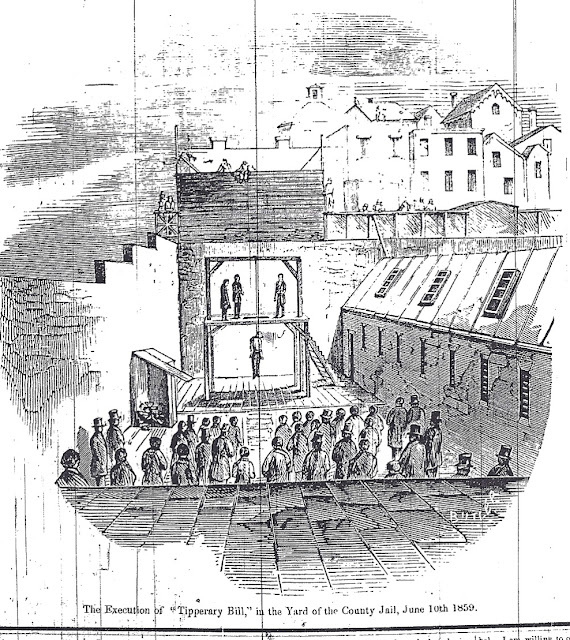
Later, when Morris was finally hanged on June 10th, 1859, the newspapers reported that there were about one hundred observers in attendance, including reporters from several newspapers, all there to witness the execution of career criminal and murderer William Morris, alias Tipperary Bill. 

The following was reported by the Weekly Stockton Democrat newspaper a few days after his hanging:

HANGING of WM. MORRIS, alias TIPPERARY BILL -- William MORRIS was hung in San Francisco on Saturday, 10th inst., convicted of the murder of W.M. DOAKE.  The housetops surrounding the jail were covered with men, women, and children, to witness the execution. The officers cleared the housetops, but the heights overlooking the scene were covered with people. The last words he uttered, after kissing the crucifix, before the fatal noose was adjusted, were: "For all the sins I have ever committed, I pray God to forgive me; I forgive all who has wronged me; God be with you all, and pray God bless you all; good-bye."

While it is amazing how it didn't take long for William Morris to find religion while waiting for his appointment with the hangman, and yes that's exactly what did indeed happen, the story above was sent by telegraph to newspapers across the country. The following report also went out by telegraph to syndicated news agencies: 

San Francisco News — Execution of William Morris, alias Tlpperary Bill.  San Francisco, June 10th., About five hundred people congregated in and about the County Jail, today, to see the execution of William Morris, alias Tipperary Bill. There was very little excitement. At the appointed hour, 12 o'clock, the door which opens from the north side of the Jail gallery into the yard was opened, and the officers, with the criminal, accompanied by two Father Confessors, made their appearance and ascended the gallows. Officer Ellis read the warrant for the execution. After the reading was concluded, the prisoner, with a crucifix in hand, stepped forward, and, in a firm but mild voice, said: 

"Gentlemen: I wish it to be understood that I leave behind me no verbal or written statement of any part of my career. I am willing to offer my life to God, as a sacrifice for the part, and hope that it may be accepted. God be with you all and bless you. I forgive and desire to be forgiven by every person, and I ask your prayers for my forgiveness for all that is past."

Morris then stepped back, upon the drop, and, kneeling down, he repeated, with Father Peter, the Apostles' Creed, as received by the Roman Catholic Church. At the conclusion of this devotional exercise, he arose, shook hands with his spiritual advisers, and signified his readiness for death. He ascended the steps with no signs of trepidation. His was the firmest tread of the entire ascending company. 

When he arrived upon the platform, the Deputy Sheriff pinioned his arms, and the black cup was drawn over his eyes. At twenty minutes to one, Sheriff Doane unlatched the spring in the slide, and William Morris was hanging by the neck. The descent of the body was followed by a nervous straightening or stretch of the legs and a slight movement of the fingers. In less than one minute all perceptible movement, even of the slightest degree, had passed forever. 

At the expiration of twelve minutes, Dr. Ayers felt the pulse beating, but in three minutes more the blood had ceased to stir. At the end of half an hour, a plain cherry coffin was brought up the yard, and placed under the drop. In it was placed the body of the criminal. The cap was taken from his face when it was plainly discoverable that death had been caused instantly by the breaking of the neck and not by strangulation. The corpse had every appearance of that of a man who had died a natural death.

So what did William Morris, alias Tipperary Bill, finally do to reap the hangman's noose in San Francisco in June of 1859? Who did he murder in cold blood?

Well, on the 19th of November, 1858, a very angry William Morris walked into a saloon located on the Barbary Coast on Pacific Avenue between Kearny and Dupont. Two friends, Richard H. Doake (one source of five spelled his name Doak) and John Evans, had just walked into the same seedy saloon just moments before Morris. 

Both Doake and Evans watched as Morris walked in angry as all get out while looking for a certain woman. Morris is believed to have been looking for the woman who supposedly owned the place. It was almost midnight, and a saloon gal working there told Morris that the woman that he was looking for had left for the night. This made him even angrier and he became vulgar when talking to the saloon gal. 

That's when Richard Doake told Morris, "that's no way to talk to a woman." Doake was a sailor off of the three-masted bark Success. It's said the 23-year-old Doake was not a very big man, especially when compared to Morris who was described as being very tall and muscular -- an all-around big man. 

Evans saw an angry Morris turn toward Doake. Evans knew Morris was a dangerous man. And yes, it was then that Evans realizing the threat warned his friend Doake that Morris was carrying a pistol under his coat. Morris hearing Evans warning to his friend Doake didn't stop the 32-year-old Morris from challenging Doake to meet him outside in the street. With the challenge given, Morris is said to have calmly walked out of the saloon doors. Once outside, Morris called out that he was waiting. 

Evans and the saloon gal tried to convince Doake not to go outside, but he didn't listen to their good advice. It was when Doake went to the door to see if Morris was waiting as he said he would, that Morris stepped close and shot Doake in the neck -- right there at the door. 

Morris shot Doake before the young sailor ever passed through the doors and made it outside. The shot fired did not kill Richard Doake instantly. Doake staggered back, grabbed his neck, and fell. He actually lingered for a while before dying. Some say Morris held a gun on the people in the saloon to stop them from helping the dying young sailor. Once Doake was dead, Morris fled into the night -- leaving the Barbary Coast, San Francisco, and the man he murdered behind him. 

Alerted, the San Francisco Sheriff's deputies responded and started their hunt for Morris. A deputy's posse did not give up and after a few weeks, Morris was found and arrested across San Francisco Bay near the town of Benecia. Of course, as soon as he was arrested, he was put in chains and carted back to San Francisco. 

Once they were in the city, he was immediately taken to stand trial. Though he had been there before for other acts where no one stepped forward, this time witnesses came forth to say what they say when Morris murdered Richard Doake. The trial was short and the jury's decision was quick. And when the judge pronounced the sentence, that he would hang, it was reported that Morris jumped to his feet and angrily said, "Let it be soon!" 

Some say he may have regretted his request since the Sheriff put carpenters to work immediately to build a gallows to accommodate Morris's request. After that, it said Morris had a few weeks to listen to carpenters hammer and saw away while building the gallows erected right there on the grounds of the county jail. 

It was reported that he may have found religion and asked for a Catholic priest. Some said that he made his amends with God while waiting for the hangman. Of course, there were those who said that his making amends with God was just an act. They point to how he supposedly rehearsed his last words before he was hanged. Supposedly he practiced his last words as if they were the end of a stage performance and he was the star actor.

So, while Richard Doake had the misfortune of having words with a killer in a saloon on Pacific Avenue on the Barbary Coast, William Morris, alias Tipperary Bill, was convicted of murder in March of 1859 and ended up walking to the gallows in June of that same year. Believe it or not, it was a mere 90 days from the time Morris was captured to his meeting with the hangman. 

To many, it was justice served.

Tom Correa


Tuesday, January 24, 2023

Crime & Craziness In The News -- Part One

With rioters burning police patrol cars in Atlanta, and a series of mass shootings taking place around the country, including some in California by shooters who do not meet the profile of mass shooters, there's a silly notion going around these days that says our world has never seen such craziness as we are today.
 
Well, read some of the following news clippings. The news clippings below may assure you that crime and insane acts of people have always been with us.
_______________________________
QUARREL LEADS TO KILLING
New Era, Humeston, Iowa, March 17, 1887

In a quarrel in Lawrence County, Ky., on March 9th, Samuel Smith, aged sixteen years, shot and killed Stephen Hammond and his wife and wounded their two small children. 
_______________________________
LYING IN WAIT
Perry Chief, Perry, Iowa, Friday, September 30, 1887

William Thompson concealed himself near the house of A. J. Thompson and shot three members of the family, one of them fatally. The murderer also shot a school teacher. His victims were his own cousins. He has not been captured.
_______________________________
DEMENTED WOMAN'S DEED
Newark Daily Advocate, Newark, Ohio, May 8, 1891

She Puts Arsenic in the Coffee Pot and Poisons the Entire Family 

Catlettsburg, Ky., May 8. - Mrs. George Carter, who resides with her husband, made a deseprate but unsuccessful attempt to poison her entire family with arsenic Monday night. For some time the woman has been in a very despondent mood, and her friends fear she is insane.

On the day mentioned she placed a quantity of arsenic in the coffee pot. After the family had partaken of the evening meal, all became seriously ill; medical assistance was summoned, and the woman told what she had done, adding she wanted to die but did not wish to leave her husband and two children. One of the children is expected to die.
_______________________________
LYNCHED FOR THEIR CRIME
New Oxford Item, New Oxford, PA, Friday, May 20, 1892

Two colored men, named Finkley and Smith, who killed a boy without provocation, were captured and lynched.
_______________________________
INSULTS HAVE CONSEQUENCES
Landmark, Statesville, N.C., Thursday, June 9, 1892

N. H. Matofsky, a traveling occultist, and J. Will Harman, a Cincinnati drummer, charged with making insulting remarks on the street to women of Louisa, Ky., were placed on a raft last week by the citizens of the town and sent adrift down the Ohio river. They were rotten-egged before they started.
_______________________________
MOTHER ARRESTED FOR KILLING HER CHILD
Daily Herald, Delphos, Ohio, Saturday, April 18, 1896

The body of an infant was found in a spring near Louisa, Ky., yesterday with a rock tied around its neck. The verdict of the coroner's jury was that it was killed and placed there by its mother, Orpha Stanley, a widow with nine other children, who came here three weeks ago from Johnson county. Mrs. Stanley is in jail.
_______________________________
A SAD GOODBYE
Freeborn County Standard, Albert Lea, Minnesota, August 31, 1898

Mrs. Nancy Wellman, who died at her home at the age of 95 years, was the mother of 16 children, 11 of whom were married. She had 88 grandchildren, 192 great-grandchildren, and 31 great-great-grandchildren. She also raised nine orphan children.
_______________________________
EX-SOLDIER SHOT
Marion Daily Star, Marion, OH, March 3, 1899

Harry Price, a young lawyer of Catlettsburg, fatally shot Jerry Moningham, this morning, while on the steamer, Argand, seven miles below here. Moningham was the member of the First Kentucky volunteers who shot his captain R. S. Carr, at Ashland last week.
_______________________________
RENEWED AN OLD QUARREL
Sandusky Daily Star, Ohio, Monday, February 25, 1901

Dick Vinson shot and killed William Thompson. On meeting, they renewed an old quarrel and Vinson opened the firing.
_______________________________
SLEW THE MARSHAL
Mansfield News, Mansfield, Ohio, April 10, 1902

At Fallsburg, in this county, Ralph Marcum, Marshal of Fallsburg, was shot and instantly killed by George Cooksey, whom he was trying to arrest for some minor offense. After Cooksey shot Marcum, he was wounded by a man named Edward Webb, but it is not known how serious his wounds are. Cooksey returned from the Philippines War recently.
_______________________________
BYSTANDER MORTALLY WOUNDED
Washington Post, Tuesday, April 30, 1907

Huntington, W.VA., April 28.- George Washabaugh, of Mount Pleasant, Pa., was shot and mortally wounded in Central City, a suburb, late this afternoon, by Edward Adkins, of Louisa, Ky. Adkins was intoxicated, and in being ejected from a saloon opened fire with a pistol at random on a crowd of bystanders, shooting Washabaugh. Adkins was arrested.
_______________________________
TO PREVENT MOB VIOLENCE
Decatur Daily Review, Decatur, Illinois, Monday, August 31, 1908

Kentuckian, Who Caused Death of Two, Spirited Away

John Sprouse was brought here yesterday from near Cherokee to escape violence. He is accused of having set fire to the residence of Charles Cooper on Saturday, resulting in the destruction of property and the lives of two of the Cooper children. Cooper's wife and two children were seriously burned. Sprouse and Cooper had been engaged in a lawsuit over lumber.
_______________________________
ROBBER ARRESTED
Washington Post, Washington, DC, Friday, December 31, 1909

Sam Crabtree was arrested at Kenova yesterday and charged with waylaying, assaulting, and robbing Charles Skiba, general manager of the Charleston sheet steel works at Huntington Tuesday night.
_______________________________
SAFE ESCORT FOR WITNESS
Washington Post, Washington, D.C., June 12, 1910

Court Fears For Constable Who Appeared Against Vinson Gang

Charleston, W. Va., June 11. - The jury in the Federal court in the case of the Vinson gang of mountaineers, charged with conspiracy to prevent Federal Officers from making arrests, reported a failure to agree. The jury was discharged until Monday when they will again be sent back to consider the case. 

Judge Keller detailed a deputy marshal to accompany Constable Rowland Salmons, who was a government witness, back to the State line for fear that friends of the Vinson might attack him.
_______________________________
BRIDE DRINKS ACID
Altoona Mirror, Altoona, PA, August 8, 1918

Honeymoon of Three Weeks Ended by Pathetic Suicide

Circleville, Ohio, Aug. 28. - Mrs. Mary Burton, while her husband was in Columbus, took a dose of carbolic acid and her body was found in the morning. She had hung a white card on the front door and left a long letter, the contents of which has not been given out. Mrs. Burton was married three weeks ago and was homesick and had no money. 
_______________________________
GUN BATTLE FATAL
Kingsport Times, Tennessee, Tuesday, June 14, 1921

Huntington, W. VA., June 14 - Millard Meeks was killed and his brother Garfield and Deputy Don Cheek were seriously wounded in a gun battle at White House, Ky, today during a circus performance. Three men were wounded slightly. The fight started when the deputy sheriff attempted to place Meeks brothers under arrest on charges of disturbing the peace.
_______________________________
DOG FINDS CAN OF GOLD
Washington Post, Washington, D.C., February 26, 1910

Following Whining, Digging Dog, to Find Can with $482 in Gold

Huntington, W. Va., Feb. 25. - A can containing $482 in gold was found by boys on their way home from school across the river from Huntington, in Lawrence County, Ky. The boys saw a dog digging away and whining at a hole under a deserted log cabin. They went over and found an old tin canister. It was full of gold coins, which it is believed had been there for more than 25 years.
_______________________________


Friday, January 20, 2023

Miniature Hereford Cattle's Growing Popularity


About 10 years or so ago, I was contacted by a few readers who asked if I would research and write an article about Hereford cattle. I was told that it would be a help to some of their children who were in the 4H and FFA. It was then that I decided to do a few articles intended to be used mainly by youngsters involved in 4H and FFA. Frankly, I really liked the idea of researching different breeds of cattle to help 4H and FFA kids. The fact is that I love it when I see kids involved in that sort of thing. After all, being responsible and having to raise a critter builds responsibility, good self-esteem, and good character traits in youngsters. 

It's probably why youngsters living in rural America are brought up with a lot more respect for others and a better work ethic. They simply don't have the same problems as youngsters who live in urban areas. While that's a subject for an article all in itself, it's safe to brag and say that about ranch and farm kids without feeling like that's stretching the truth.

As for writing about Hereford Cattle, after I put out an article on the breed, I found myself writing, for all the same reasons, about different cattle breeds, breeds of horses, goats, sheep, and even pigs. And to be honest, when I first took on the task of writing an article on Hereford Cattle, the breed, I didn't think it would be that tough. Boy was I wrong! 

I figured to do the article on Herefords with the help of the various Cattle Industry and Agriculture University websites out there. I figured I'd use those websites as source material to supplement and support what I thought I already knew about the breed. Well, what I found out was that even after me helping move and work a lot of white face cattle during a lot of gatherings and brandings, I still found that there was a lot that I simply didn't know. 

Of course, my friends, as always, just proved that we can always learn something about what we thought we knew about. In that case, I learned a lot about the Hereford breed that I simply didn't know. And yes, as far as I'm concerned, that's the biggest benefit of doing research. Whether it's doing research about cattle, horses, firearms, or about moments and events in our history, there are things that I find that I didn't know -- and find fascinating. And that, well that makes the time and effort worth it. 

As for the bottom line of the article Hereford Cattle - The Icon of the Cattle Industry, I still believe that what I wrote back in 2013 remains true today. "Herefords have demonstrated they are high-quality beef cattle in every aspect. Most ranchers will agree that Herefords are tough as nails and can almost subsist on twigs and rocks because they are excellent foragers, while also being excellent mothers, and providing a consistently excellent eating experience for consumers." 

The full article can be found here: Hereford Cattle - The Icon of the Cattle Industry

Well, it wasn't too long ago that I was contacted by a reader from the Miniature Hereford Cattle of Illinois which is an organization that was created so that owners of Miniature Hereford Cattle in that state and other interested people would "have a central location to connect." 

Their website states, "The Miniature Hereford breed was developed by Rust and Roy Largent of Fort Davis, Texas in 1970. The Largents were going against the industry trend at the time for larger, taller cattle. Their goal was to develop an efficient, smaller beef cow through selective breeding.

Difficulties plagued their early attempts but in 1981 the first true Miniature Hereford bull was born. His name was LS REAL MT 3, and he is present in the genealogy of almost every Miniature Hereford alive today."

After exchanging emails, and doing my own research, I found that the interest in Miniature Hereford Cattle is growing in popularity all across America. This new information enabled me to edit my 2013 article on Hereford Cattle to include information about Miniature Herefords. While I did include that information in that article when I rewrote the article, I'm bringing this to your attention today because a few of you have written to say that they didn't realize that the original 2013 article on Herefords now includes information about Miniature Herefords. So, if you have not read it lately, here is the additional information on Miniature Hereford Cattle:

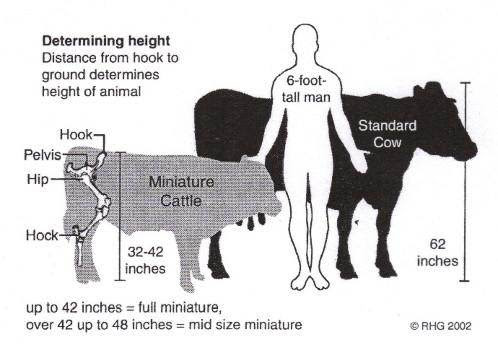
So now, here is something more about this breed. There are Miniature Herefords. To the uninformed, those who know very little about Miniature Herefords may see them as “great pets” that are somehow genetically defective or not equal to full-size Herefords. Well, they are wrong. A Miniature Hereford is a full-blood Hereford.

The distinction between the full-size Hereford and the Miniature Hereford cattle breed is that the Miniature Hereford is simply not as tall as the normal full-size Hereford that we find throughout our country. 


While ordinary Herefords are outstanding, Miniature Herefords have their advantages.

I’ve read that the “Purebred Miniature Herefords” are free of the dwarf gene and subsequently that’s why they are registered with the American Hereford Association (AHA). Yes, just the same as their larger counterparts. As for their bloodlines, their pedigrees within the American Hereford Association can be traced all the way back to when Hereford cattle first arrived in America.

Herefords have proven their hardiness time and time again, their incredible ability to adapt to any environment, and their ease of gaining weight to produce high-quality beef. Because of these superb traits, Herefords are treasured by cattle producers. Miniature Herefords are no different.

Because of their smaller size, Miniature Herefords are much easier to handle compared to large cattle. They require less space and Miniature Herefords are excellent for children because of their docile nature. And yes, this makes Miniature Herefords the perfect 4-H or FFA animal. And really, as most of us who have been involved with 4-H and FFA projects for children, we all know very well how such projects help instill a sense of responsibility, pride, and accomplishment in youngsters.

There are many reasons to choose a Miniature Hereford. They are small and compact. They mature quicker than their full-size counterparts. They eat 30-40% less than their full-size counterparts. They adapt to a variety of environments with varying conditions and temperatures. They really have a gentle disposition. Their dispositions make them easy to handle, especially for children taking part in 4-H and FFA. In reality, Miniature Herefords make great 4-H or FFA projects.

All of these are winning factors, especially since Miniature Herefords require less acreage and cost less to raise. The advantages of Miniature Herefords for more Americans today make them the perfect cost-efficient beef cattle to raise on smaller farms. And because more and more families on small family farms today are raising beef for themselves, Miniature Herefords sound like the perfect choice for American families with limited acreage.

As with the original article, the above information has been compiled from many sources. I hope you found it interesting and useful. And please, don't forget to visit Miniature Hereford Cattle of Illinois.

Tom Correa


Wednesday, January 11, 2023

The Cardinal Virtues — Courage 1902


Article below from The Cardinal Virtues1902
By William De Witt Hyde

Courage

If man were merely a mind, wisdom to see particular desires in the light of their permanent consequences to self, and justice to weigh the interests of self to the impartial scales of a due regard for the interests of others, would together sum up all virtue. Knowledge, in these two forms, would be virtue, as Socrates taught.

We feel, however, as well as know. Nature, for purposes of her own, has placed the premium of pleasure on the exercise of function, and attached the penalty of pain to both privation of such exercise on the one hand, and over-exertion on the other. Nature, too, has adjusted the scale of intensity of pleasures and pains to her own ends; placing the keenest rewards and the severest penalties on those appetites which, like nutrition and reproduction, are most essential to the survival of the individual and the race; thus enforcing by her rough process of natural selection a crude wisdom and justice of her own. 

Moreover, these premiums and penalties were adjusted to the needs of the race at a stage of evolution when scanty and precarious food supply and a high death rate, due to the combined inroads of war, famine, and pestilence, rendered nutrition and reproduction of vastly more relative urgency, in comparison with other interests, than they are to-day.

Pleasure and pain, therefore, though reliable guides in the life of an animal struggling for existence, are not reliable guides for men in times of artificial plenty and elaborate civilization. To follow the strongest appetites, to seek the intensest pleasures and shun the sharpest pains, is simply to revert to a lower stage of evolution, and live the life of a beast. Hence that combat of the moral nature with the cosmic process to which Mr. Huxley recently recalled our attention; or rather, that combat of man with himself which Paul and Augustine, Plato and Hegel, have more profoundly expressed. 

This fact that Nature’s premiums and penalties are distributed on an entirely different principle from that which wisdom and justice mark out for the civilized man renders it necessary for wisdom and justice to summon to their aid two subordinate virtues — courage and temperance: courage to endure the pains which the pursuit of wisdom and justice involves; temperance to cut off the pleasures which are inconsistent with the ends which wisdom and justice set before us.

The wide, permanent ends at which justice and wisdom aim often involve what is in itself, and for the present, disagreeable and painful. The acquisition of a competence involves hard work, when Nature calls for rest; the solution of a problem requires us to be wide awake, when Nature urges sleep; the advocacy of a reform involves unpopularity, when Nature suggests the advantages of having the good opinion of our fellows; the life of the country calls for the death of the soldier, when Nature bids him cling to life by running away.

Now, since we are not ascetics, we must admit that per se pleasure is preferable to pain. If it were a question between rest and work when weary, between sleep and waking when tired out, between popularity and unpopularity, between life and death, every sensible man would choose the first alternatives as a matter of course. Wisdom and justice, however, see the present and partial pain as part of a wider personal and social good, and order that the pain be endured. True courage, therefore, is simply the executor of the orders of wisdom and justice. 

The wise and just man, who knows what he wants, and is bound to get it at all costs, is the only man who can be truly brave. For the strength of one’s courage is simply the strength of the wise and just aims which he holds. All bravery not thus rooted and grounded in the vision of some larger end to be gained is mere bravado and bluster.

Of the many applications of courage, two of the simplest will suffice for illustration: the courage of space, to take the pains to keep things in order; and the courage of time, to be punctual, or even ahead of the hour, when a hard task has to be done.

Even if our life is a small, sheltered one, even if we have only our house or rooms to look after, things tend to get out of order, to pile themselves up in heaps, to get out of our reach and into each other’s way. To leave things in this chaos is both unwise and unjust; for it will trouble us in the future, and trouble the people who have to live with us. Yet it costs pain and effort to attack this chaos and subject it to order. 

Endurance of pain, in the name of wisdom and justice, to secure order for our own future comfort and the comfort of our family and friends, is courage. On the other hand, to leave things lying in confusion around us; to let alien forces come into our domain and encamp there in insolent defiance of ourselves and our friends, is a shameful confession that things are stronger than we. To be thus conquered by dead material things is as ignominious a defeat as can come to a man. 

The man who can be conquered by things is a coward in the strict ethical sense of the term; that is, he lacks the strength of will to bear the incidental pains which his personal and social interests put upon him.

The courage of time is punctuality. When there is a hard piece of work to be done, it is pleasanter far to sit at ease for the present, and put off the work. “The thousand nothings of the hour” claim our attention. The coward yields to “their stupefying power,” and the great task remains forever undone. 

The brave man brushes these conflicting claims into the background, stops his ears until the sirens’ voices are silent, stamps on his feelings as though they were snakes in his path, and does the thing now which ever after he will rejoice to have done. 

In these crowded modern days, the only man who “finds time” for great things is the man who takes it by violence from the thousands of petty, local temporary claims, and makes it serve the ends of wisdom and justice.

There are three places where one may draw the line for getting a piece of work done. One man draws it habitually a few minutes or hours or days after it is due. He is always in distress, and a nuisance to everybody else. There is no dignity in a life that is as perpetually behind its appointments as a tail is in the rear of a dog.

It is very risky — ethically speaking, it is cowardly — to draw the line at the exact date when the work is due; for then one is at the mercy of any accident or interruption that may overtake him at the end of his allotted time. If he is sick or a friend dies, or unforeseen complications arise, he is as bad off as the man who deliberately planned to be late, and almost as much to blame. 

For a man who leaves the possibility of accident and interruption out of account, and stakes the welfare of himself and of others on such miscalculation, is neither wise nor just; he is reckless rather than brave. Even if accidents do not come, he is walking on the perilous edge all the time; his work is done in a fever of haste and anxiety, injurious alike to the quality of the work and the health of the worker.

The man who puts the courage of punctuality into his work will draw the line for finishing a piece of work a safe period inside the time when it is actually due. If one forms the habit and sticks to it, it is no harder to have work done ten days, or at least one day, ahead of time than to finish it at the last allowable minute. Then, if anything happens, it does no harm. 

This habit will save literary workers an incalculable amount of anxiety and worry. And it is the wear and tear of worry and hurry, not the amount of calm, quiet work, that kills such men before their time.

I am aware that orderliness and punctuality are not usually regarded as forms of courage. But the essential element of all courage is in them — the power to face a disagreeable present in the interest of desirable permanent ends. They are far more important in modern life than the courage to face bears or bullets. They underlie the more spectacular forms of courage. 

The man who cannot reduce to order the things that are lying passively about him, and endure the petty pains incidental to doing hard things before the sheer lapse of time forces him to action, is not the man who will be calm and composed when angry mobs are howling about him, or who will go steadily on his way when greed and corruption, hypocrisy and hate, are arrayed to resist him. 

For, whether in the quiet of a study and the routine of an office or in the turmoil of a riot or a strike, true courage is the ready and steadfast acceptance of whatever pains are incidental to securing the personal and public ends that are at stake.

___________________________


About the Author: 

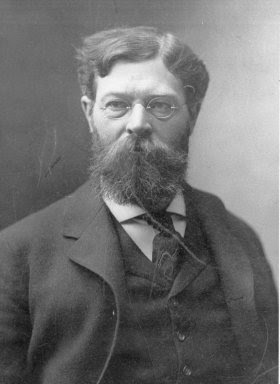
William De Witt Hyde was an American educator and academic administrator who served as the president of Bowdoin College in Brunswick, Maine, for thirty-two years, from 1885 to his death in 1917.

Born in Winchendon, Massachusetts, on September 23, 1858. Hyde graduated from Phillips Exeter Academy in 1874, from Harvard University in 1879, and from Andover Theological Seminary in 1882. Ordained to the Congregational ministry in 1883, he was a pastor in Paterson, New Jersey, from then until 1885. Thereafter, he became president of Bowdoin College, also holding the position of chair of mental and moral philosophy at the College.


Sunday, January 1, 2023

Americans Should Know Where Our Food Comes From

What I want for us in 2023 is not that much different than what I've wanted for years.

For many years, I've wanted our American agriculture industry to be free to grow and produce what we need without government interference. I grew up understanding that American farmers and ranchers fed the world with reliable, safe, sanitary, healthy food. We did so because our methods of ranching and farming reflected our concern with quality assurance. 

Of course, while quality assurance has meant safety controls and inspections which are the primary tools for American ranchers and farmers, Foreign Ag Importers don't have to adhere to such quality control guidelines or regulatory laws. In fact, according to the FDA, "the FDA is not authorized under the law to approve, certify, license, or otherwise sanction individual food importers, products, labels, or shipments." 

Please understand. According to the FDA, "Today more than 200 countries or territories and roughly 125,000 food facilities plus farms supply approximately 32 percent of the fresh vegetables, 55 percent of the fresh fruit, and 94 percent of the seafood that Americans consume annually." 

Yet, today, we import foods from other nations that have zero methods of inspection, and the risks of Americans becoming ill by way of consuming produce, meats, and seafood from other countries is a bigger problem than ever before. Actually, from what I've been told by friends in the medical field, more Americans than ever are experiencing illnesses caused by eating contaminated food imported from other countries. 

Foreign Importers "can import foods into the United States without prior sanction by FDA, as long as the facilities that produce, store, or otherwise handle the products are registered with FDA, and prior notice of incoming shipments is provided to FDA." Also, Foreign Imported "food products are subject to FDA inspection only when offered for import at U.S. ports of entry." 

In fact, while provisions of U.S. law say "importers of food products intended for introduction into U.S. interstate commerce are responsible for ensuring that the products are safe, sanitary, and labeled according to U.S. requirements, and all imported food is considered to be interstate commerce," none of the FDA inspection processes apply to imported agricultural products. 

The problem that I have with this is that the Federal Government is all for allowing uninspected, possibly unsanitary, and subsequently unsafe agricultural products into the United States from foreign countries. But to make matters worse, the FDA says that private American family farms and ranches are types of establishments that are considered "unapproved food sources." 

So while the FDA states "American consumers seek a safe, diverse, and abundant food supply that is simultaneously affordable and available throughout the year. To help meet these consumer demands, the United States imports about 15 percent of its overall food supply," the FDA also suggests food establishments should reject food from private American family farms and ranches. 

The FDA does that while acknowledging that Foreign Agriculture Importers don't have to adhere to U.S. laws regarding agricultural production, inspections, safety regulations, and sanitary requirements. The Federal Government does not, and cannot, hold Foreign Agriculture Importers to the same standards as American Agricultural Produces. 

This is spelled out by the FDA when they say, "importers of food products intended for introduction into U.S. interstate commerce are responsible for ensuring that the products are safe and sanitary." Reading this statement by the FDA, we can see that the Federal Government is "trusting" the unregulated agriculture producers in foreign countries to not do what American ag producers are forbidden from doing by law. And by the way, that trust is broken daily since we know that Foreign Ag Producers are not concerned with American laws -- including our laws forbidding the use of know carcinogens as pest control. 

The bottom line is that allowing the importation of unsafe and unsanitary foods into the United States is an example of Globalists trying to further globalize the agriculture marketplace -- even if it means placing Americans at great risk of illness and death. This is especially true in regard to the detriment of our children and our seniors because of sacrifices in food safety measures in most foreign countries. 

It is said that for American consumers, the primary advantages of imported agricultural products are the cheaper prices, availability, and of course variety. But, since millions of Americans get sick each year from non-existent food-safety standards and shabby at-best inspection regimes, the number one reason that we Americans should know where our food comes from is that foreign agriculture producers and those importers who deal with all sorts of countries, especially those unfriendly to the United States, simply don't have our safety in mind.

Tom Correa


Friday, December 30, 2022

Archeologists Discover Who the ORIGINAL Americans Were


This might change the way you see who the First Americans were and their downfall.

I hope you find this as interesting as I did.

Tom 


Sunday, December 25, 2022

America's Christmas 2022


Merry Christmas my friends!

While we all know full well that Americans in the Old West of the 1800s lived day-to-day lives that were completely different than ours today, our Christmas traditions, customs, and festivities are a lot alike. 

Believe it or not, the Old West was not very different than what takes place today. In fact, many of our Christmas traditions and customs started with the flood of different people from around the world with almost everyone adding a little something that was unique to their place of origin. Over the years, during every phase of our history, especially after the Civil War, the vast majority of Americans have indeed created a specialness to how we Americans celebrate the birth of Jesus Christ.

Over the years, Americans took to celebrating the birth of our Lord and Savior as Americans do most things. We gave Christmas our own touch of American customs. One thing that made us different is that Americans over the years refused to observe Christmas as some ultra-solemn act that should only be observed by requiring formality and carried out according to certain pre-established rules -- all respecting strict protocol. Rules? Really, rules? Americans traditionally hate rules. That's part of who we are as a people.

So yes, we can all be extremely thankful that America's Christmas traditions and customs did not follow the English Puritan view of Christmas. To the English Puritans who established New England, Christmas was seen as being a "pagan ritual," a "corrupt religious ritual." They did not celebrate December 25th because they saw it as just another work day -- unless it fell on the Sabbath.

Americans instead viewed Christmas as a birthday party meant to celebrate the birth of Jesus. We have traditionally accepted Christmas with open hearts. And from this, even in the Old West, Christmas trees were decorated, gift-giving was already an old American custom, and Christmas stockings waited to be filled with goodies. There were dances, feasts, parties, and even plays to reenact the birth of Christ.

From sending Christmas cards, and enjoying family-oriented days of fun, games, reminiscing, and feasting, while celebrating the birth of Jesus, to noting the appearance of Santa Claus, Americans in the Old West were a lot like us. At the time, Americans also went to church and parents read the Bible to their children on Christmas Eve as many do today. Many read the story of the birth of Jesus Christ, just as many do today.

While in those days, it wasn't unusual to read a recent letter from a relative far away or share good tidings with everyone there, today we do email or maybe this thing called "face time." Yes, all for the same for all the same reasons, to share the joy and be close to those we love. Like us, Christmas was a day to live the closeness that comes with being with family and dear friends.

Now, before someone writes to tell me that we can't compare the comfort and gift buying of today with the mostly meager, humble, homemade Christmases of long ago, those who lived in harsh environments of years ago, I assure you that I'm not doing that. I'm talking about how we today, even after being slammed with terrible blizzards and savage frigid cold winds which are extremely similar to the Tragic Winter of 1886 that killed hundreds of thousands of cattle in the Great Plains, will still celebrate Christmas.

Today, thousands are fighting the elements and the frigid cold temperatures. In America, over 100,000 Americans die each year from the cold -- whereas, usually less than 3,000 Americans die from the heat per year.

Winter kills. And yes, while Christmas for many in the Old West was a difficult time, today we have millions of Americans stranded and spending their entire Christmas without heat to stay warm or power to cook. Like those in the Old West though, my bet is that Americans who are determined to keep the spirit of Christmas alive will do so.

That's what Americans do. For those without utilities and in need of help, I know that their Christmas may be meager and humble, a little more homemade, and maybe improvised. But, it will be Christmas. And to that spirit, that of the Holy Spirit, I believe that power outages and "once in a generation" blizzards can't stop even those Americans from feeling the Holy Spirit this Christmas.

And while my prayers are with those fighting the cold, I wish them and you all a very Merry Christmas and a Happy New Year.

Especially you, Benny! Merry Christmas!

Tom Correa

Monday, December 19, 2022

We Need To Be More Like Santa


I refuse to let Atheists dampen my celebration of the birth of Jesus Christ. I won't let the Leftists who take every opportunity to attack Christians this time of year stop me from singing what's in my heart. I refuse to let the vocal few who want to spew their hate for my Christian beliefs get their way. I will not let anyone suck the joy out of my Christmas.

I refuse to let it happen. I simply won't allow it. No, just as I won't allow anyone to diminish the importance of the birth of Christ. I won't in the same way that I will defend his teachings against those who want to remove love and kindness for our fellow man and woman from the world around us.

I can do this as I have over the years through discourse with those who want widespread hate and discontent to reign supreme in the world. I can do this by explaining how Jesus Christ brings hope and makes us better people through caring for others.

Study after study, even those studies which are conducted to the dread of Leftists, all show that Christians are much more likely to donate to charities than non-Christians. Let me put it another way, those who accept Christ as our savior and believe his teachings are more apt to help others than those who don't believe in Christ -- we are more giving and a lot more caring than those who talk about helping others, but don't.

If you tell this to an Atheist, and he or she, or them or they, or it or shim, still doesn't understand it, tell them this: Followers of Jesus Christ demonstrate love and caring for others more than non-followers.

And really, why is the Left so obsessed with attacking Santa Claus? What is so wrong with some people that they cannot find goodness in a great example of someone who followed Christ with all of his heart and soul? What's wrong with anyone wanting to give gifts, being generous and charitable? Why is it that a man who lived almost 1700 years ago, a man who gave to the needy and rewarded the good, bother so many people on the Left today? Frankly, I can't understand the malice that the Left has for Christians or Santa Claus.

Santa Claus was a follower of Christ. Everything about Santa Claus is about being a follower of Jesus Christ. According to historians, the name Santa Claus is the English translation of the Dutch name for Sinterklaas. We know that the historical St. Nicholas Sinterklaas existed and that he was a godly man who was known for his generosity and charitable ways.

Nicholas Sinterklaas was born around 280 AD in the city of Patara (Turkey) in Asia Minor. He was the only child of parents who were wealthy Christians. They were devout believers. Because he arrived late in life, his parents saw him as a gift from God. And because of that, they devoted him to God and the teachings of Jesus Christ.

After he lost his parents to a plague, to his credit, he found himself drawn closer to God. And more so, instead of wallowing in self-pity at his loss, the death of his parents actually made him more aware of the sufferings of others. He became so much aware of the plight of others that he was known to use his substantial inheritance to honor his parents and further follow Christ's teachings by helping those in need around him.

He was chosen as Archbishop of Myra, a harbor city to the southeast of Patara in what is modern-day Turkey. Of course, that was about the time when extremely violent persecution of Christians began. Though serving as Archbishop, he was arrested, imprisoned, and he was tortured for his faith in Christ. The persecution that began during the reign of the Roman Emperor Diocletian was carried on by his successor, Galerius, for eight long years.

Following Emperor Galerius, Emperor Constantine who was the first Christian Emperor became the undisputed leader of the West. By 324 A.D., Emperor Constantine claimed leadership of the entire Roman empire and declared Christianity a legal religion. At one point, Constantine recognized the need for unity among Christians, so in 325 A.D. he summoned bishops from all over the empire to meet in Nicea and discuss doctrinal issues. Nicholas of Myra (Nicholas Sinterklaas) is listed among the bishops in attendance at that gathering of bishops.

During his life, Nicholas Sinterklaas was a devout follower of Jesus Christ. And because of the stories and legends of several miracles attributed to him, he became known as "Nicholas the Wonderworker." Yes, long before he was canonized and became Saint Nicholas, his reputation for his legendary secret gift-giving was widespread.

So why does the Left pursue attacking Nicholas Sinterklaas who was a Christian bishop who lived in the 4th Century? Through all sorts of trials and hardships, he was still known as never wavering in his belief in Christ. He did not stray from his belief that living by the wishes of God was beneficial for all of us.

Nicholas Sinterklaas is said to have died when he was 63 years of age in about 343 AD. It's believed that he died either on or near December 6 of that year. After his death, the legend of his gift-giving grew. He became Saint Nicholas after being canonized. This all gave rise to the traditional model of Santa Claus through Sinterklaas. Saint Nicholas was transformed into the legendary character called Santa Claus, who brings Christmas presents to good children around the world.

Today, St. Nicholas Day is still observed on December 6 in many countries. Here in America, the practice of gift-giving associated with St. Nicholas was combined with our celebrating the birth of Christ which we know as "Christmas." Frankly, it's a no-brainer to Christians that a holiday celebrating gift-giving would merge with the birth of Christ.

Let's face facts, Jesus Christ is the greatest gift ever given to the world. And before someone decides to write to tell me that "presents" are not a part of Christianity, please remember that presents were brought to Jesus on the night of his birth by the three Wise men. But more than that, allow me to repeat myself, the greatest gift to all of mankind was given to us in the form of Jesus. The Christ child whose birthday we celebrate this time of year.


I know I'm repeating myself, but why do people on the Left see it wrong for someone to be generous and charitable, and kind? What's wrong with living the most fundamental of Christ’s teachings, "The first of all the commandments is to "Love the Lord your God with all your heart, and with all your soul, and with all your mind, and with all your strength: this is the first commandment." Mark 12:30

And as Christ goes on to teach, "And the second is like, namely this, Thou shalt love your neighbor as yourself. There is none other commandment greater than these." Mark 12:31

Christians are not perfect all the time, but Christians do their best to be the best person they could possibly be with the help of the Holy Spirit. Being a faithful follower of Jesus is not about living your life perfectly. It's about trying to abide by the teachings of Christ.

How do we do this? By doing as God has instructed us. The Holy Bible tells us that God does not care if we come to him with burnt offerings, yearling calves, thousands of rams, ten thousand rivers of olive oil, or offering our firstborn for our transgressions. No, money, gifts, or sacrificing our firstborn on some sort of pagan altar is not what God wants.

It's not that complicated. In the Holy Bible, Micah 6:8 helps us to tie our following of Christ's teachings with our daily actions and our care for those in need. It simply states, "You have been told, O mortal, what is good, and what the Lord requires of you: Only to do justice, to love goodness, and to walk humbly with your God."

So what's wrong with anyone wanting to give gifts, be generous, be charitable, spread hope and love, and show our love of God? What's wrong with any one of us trying to live a life based on acting justly, practicing goodness, having the strength to do what's right, and walking humbly with God?

I believe that there isn't a thing wrong with us trying to live such a life. In fact, I wish more people did. I wish more people were like St. Nicholas. I really truly believe that we all need to be more like Santa by following the teachings of Christ, having hope, showing kindness, remembering those who have less, helping those in need, and giving of ourselves without wanting to be acknowledged for doing any of it.

So now, here's my prayer for you. I want you to be more like Santa and get your friends to be more like him too. Let's all try to act justly, and remember who is good and who is bad. Let's all use the Common Sense that God gave most of us and not reward bad people for doing bad things. The fact is, they don't deserve it. And please understand, "turning the other cheek" is more a guideline than a rule. Being a Christian doesn't mean that we have to forgive, reward, or condone behavior that is considered morally wrong or offensive. We should never reward the naughty and only reward the nice.

So yes, while keeping in mind who deserves our friendship and love, and who doesn't, let's all practice goodness, and have love and hope and joy. Let's support our troops, support the police, and try to walk a little more humbly with God this coming year.

God Bless you all! From my family to yours, may you and yours have a very Merry Christmas.

Tom Correa


Saturday, December 10, 2022

The Story Of The Christmas Nugget


So here it is. The Story Of The Christmas Nugget.

As short a tale as it is, believe it or not, this is one of your most requested Christmas stories. So yes, I'm reprinting The Story Of The Christmas Nugget below because you've said you haven't been able to find it. I hope you enjoy it.

The story below talks about how Christmas was a huge celebration that was always looked forward to during the years of the California Gold Rush. And yes, as with other Christmas celebrations all having their own customs taking place in different regions of the nation, Christmas in the California Far West had its own customs.

Because the California Gold Rush was such an extraordinary event that brought people from all corners of the earth, many who participated in the Gold Rush were young and far from home. Many were from foreign lands, many religions, and many cultural customs. All were factors that added to the intense revelry, fun, and sense of fellowship during Christmas.

In its earliest days, the Gold Rush was almost exclusively male and the sentiment was usually a mixture of homesickness, horseplay, and revelry. Yes, Christmas celebrations in the mining camps were typical for the 19th-century American West.

A Gold Rush Christmas was usually an unassuming, often spontaneous affair that consisted primarily of eating, drinking, companionship and entertainment. Although in the mid-19th century, gift-giving was becoming fashionable, if there were presents in the gold fields they were practical in nature.

For example, clothing, hats, gloves, knitted socks, scarves, and mittens were always prized. In the towns where there were children, little girls received homemade rag dolls and miniature quilts while little boys received tops or other wooden toys.

Alfred Doten, who is well known to have chronicled the Gold Rush, was also a friend of Mark Twain during Twain's extremely brief stay in the California Gold Country. Doten was widely renowned as a leading "reveler," and he described Christmas in Amador County in 1853. In his account, Doten talked about how he threw a "Christmas Spree" which featured "a glorious game supper of fried deer tongue, liver, quails, and hares, washed down with barrels of cognac and accompanied by fiddle, flute, banjo, clarinet, and accordion music."

Andrew Hall Gilmore wrote about his California Christmas Day experience in 1851 in a letter to his brother in Indiana:

Thursday night - 25th

Dear Brother,

"Christmas Gift to You." Oh, I wish that I could be at home today. I think we would have a Christmas party. We would have the old gobbler roasted with a score of fat hens, pound cakes, pies, and lots of other good things. But the best of all would be the pleasure of seeing you all. Probably if we live we may be with you next Christmas.

I will tell you what kind of a day it has been and what we have been doing. It has been the most rainy day I believe that I have ever seen in this country. …

As we had no invitations to any Christmas parties: and feeling no inclination to go on a "bust", we thought we might spend the day as profitably by going down to our diggings and working like fine fellows, even if it was Christmas and awful rainy at that. So Aaron and I encased ourselves in our waterproof suits and went to work ….

We made $11.25 each, which was a tolerably good rainy day's work.


Just so my readers know, $11.25 in 1851 is equivalent in purchasing power to about $435.41 today (2022).

An elaborate California Christmas during the Gold Rush was described by Louise Amelia Knapp Smith Clappe in 1851. Better known as Dame Shirley, Ms Clappe wrote a series of letters describing her life in the Gold Rush community of Rich Bar on the Feather River.

These letters are considered one of the best eyewitness accounts of the California Gold Rush. Here, Dame Shirley recalls the "Saturnalia" of Christmas 1851:

The saturnalia commenced on Christmas evening, at the Humboldt [Saloon], which, on that very day, had passed into the hands of new proprietors. The most gorgeous preparations were made for celebrating the two events. The bar was retrimmed with red calico, the bowling-alley had a new lining of the coarsest and whitest cotton cloth, and the broken lamp-shades were replaced by whole ones. 

All day long, patient mules could be seen descending the hill, bending beneath casks of brandy and baskets of champagne, and, for the first time in the history of that celebrated building, the floor (wonderful to relate, it has a floor) was washed.

At nine o'clock in the evening they had an oyster-and-champagne supper in the Humboldt, which was very gay with toasts, songs, speeches, etc. I believe that the company danced all night. At any rate, they were dancing when I went to sleep, and they were dancing when I woke the next morning. The revel was kept up in this mad way for three days, growing wilder every hour.

So now, as you can see, Christmas often represented the only time when some people, both adults, and children, received presents. As a result, Christmas held an important place in the hearts, minds, and memories of 19th-century Californians. There are many accounts of homemade Christmas gifts and celebration festivities in the gold fields. While most were modest, some were complicated, some planned, and some spontaneous, but all were heartfelt. Such a heartfelt account is that of the Christmas Nugget, a Christmas gift treasured by all.

The Story Of The Christmas Nugget

Yes, there is the California Gold Rush Christmas story of the "Christmas Nugget" which was recounted in William P. Bennett’s 1893 memoir of the California Gold Rush entitled The First Baby in Camp.

On Christmas Day in 1849, Mrs. William George Wilson delivered a healthy 12-pound baby boy at Canyon Creek, near Georgetown up near Hangtown which is modern-day Placerville.

Soon the news spread to a neighboring claim. Then before you knew it, the gold field grapevine had spread the news that Bill Wilson had struck it rich with a 12-pound nugget.

"News of the big find spread like wildfire up and down the canyon where hundreds of men were at work," wrote Bennett, "At once, there was a grand rush to Bill Wilson's cabin. Every miner was anxious to see the 12-pound lump."

Seeing that most took the news literally, the Wilsons thoroughly enjoyed the moment as the men lined up at the cabin door to get a look at the large nugget.

"Then a few were let in at a time to view the Christmas nugget." Bennett wrote. "Each of the miners loved being had."

For three more days, the joke continued throughout the area. Bennett wrote of miners who came from more than ten miles away to see the giant "Christmas Nugget."

For all, it turned out to be a very Merry Christmas. One that many talked about for months to come. One that few forgot. After all, it was a Christmas gift that spoke to their struggle and sacrifice, their hard work and search, the elusive prize they all sought, and their belief that it was something that they too would find. Such a nugget was a reminder that it was within their grasp to have those things that mean more than gold. 

For as Bennett recalled, "As each squad came out of the cabin, the men solemnly asserted that the Wilson nugget was the finest ever seen."

Yes, it was a very Merry Christmas indeed.

Merry Christmas!
Tom Correa

Monday, December 5, 2022

The Rockefeller Center Christmas Tree Gave Many Hope In A Time Of Despair


Back in the 1990s, I was in New York City on a job. It was close to Christmas, and I made my way to Rockefeller Center to check out the famed Christmas Tree. Since it was something that I had only seen on television, I wanted to see it for myself.

For some reason, I've been thinking about what I learned that day. Talking with some folks in charge, I found out that the Rockefeller Center Christmas Tree is usually a Norway Spruce anywhere from 65 to 110 feet tall. The large tree is placed annually in the famed Rockefeller Center in Manhattan in the heart of New York City in late November, right after Thanksgiving or early December. And believe it or not, many Rockefeller Center Christmas Trees are given to Rockefeller Center by many donors.

For many years, the story goes that the late David Murbach, who was the manager of the Gardens Division of the Center, scouted the Northeast United States in a helicopter for the right tree. Fact is, Mr. Murbach would search the Northeast forests of Connecticut, Vermont, Ohio, upper state New York, New Jersey, and even into Ottawa, Canada looking for the right tree. Today, the Rockefeller Center's Head Gardner does the search.

It's said that once a tree is found, a crane is brought in to support the tree while it is being cut. Once free, it is moved by trailer transport to New York City. Besides beauty and shape, the only limiting factor to what tree is chosen by width because of the New York City streets heading to Rockefeller Center limit the height of the tree to 110 feet.

Once at the Rockefeller Center, the tree is supported by four guide wires attached at its midpoint and by a steel spike at its base. Scaffolding is put up all around the tree to allow workers access to the tree so that they can put up over 30,000 lights attached to 5 miles of wiring.

From 1942 to 1944, the tree was left unlit during World War II because of the need to blackout cities to avoid attacks and bombings. In 1967, the tree was an opportunity for Canada and the U.S. to demonstrate goodwill. It was Canada’s 100th birthday and, in honor of the milestone, the Canadians donated a tree. In 1971, Rockefeller Center bowed to the environmental movement and agreed to recycle the tree. Yes, the crazies have been around for a long time.

The tallest Christmas tree at Rockefeller Center was a 100 feet spruce that was put up on Veterans Day, November 11, 1999. In 2007, the tree was lit with LED lights instead of incandescent bulbs to save energy. NBC covered the story very favorably, attracting criticism given that it was NBC’s parent company, General Electric, who manufactured and sold the bulbs.

In 2008, signifying its commercialization, a 10-foot tall, 550-pound star made with 25,000 Swarovski crystals topped the tree. It is called the "Swarovski Star" and was created by German artist Michael Hammers, who in 2009 additionally designed his own star lighting production. Rumor is that the Swarovski Star cost $1.5 million. A pop singer by the name of Fergie had the honor of helping unveil the tree topper.

Today the decorated Christmas tree remains lit at Rockefeller Center through January 6, the Christian feast of The Epiphany. Nowadays, once it's removed from the premises - it is recycled for a variety of uses.

Unlike these days, with anti-Christians running rampant in government and an Atheist minority telling the rest of the nation that "they" do not want to see any form of Christian tradition, the first Christmas tree in Rockefeller Center was put up for a bunch of workers to celebrate Christmas.

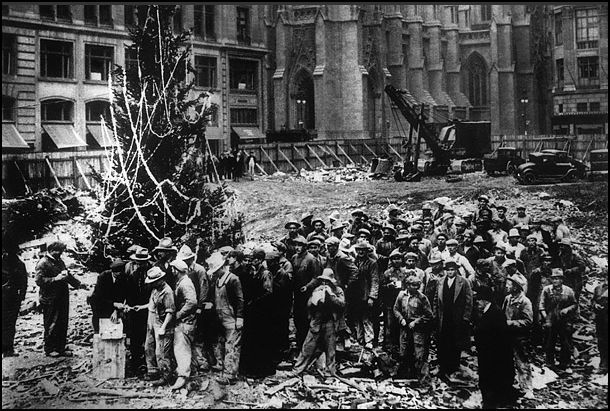
Although the official Christmas tree tradition at Rockefeller Center began in 1933, which was the year that 30 Rockefeller Plaza opened, the unofficial tradition began during the construction of Rockefeller Center during the Great Depression. They showed that even in the midst of the Great Depression, they did not lose faith.

Yes, during the Great Depression, when having a job and putting food on the table was considered a blessing; when families were going hungry and losing homes as never before; a small Christmas tree gave much hope in a time of despair. It took place when workers took it upon themselves to bring in and decorated a small 20 feet fir tree.

The story goes that they used strings of cranberries, garlands made out of old newspapers, and a few tin cans. Some say that the workers used the tin foil ends of blasting caps as well. That was on Christmas Eve, December 24, 1931, and yes, they were inspired because of the season. They simply wanted to celebrate the birth of Jesus Christ.

We sometimes forget how grateful those men were to be working at all. They had jobs, and they knew they were the lucky ones. Low wages, no money, living was expensive, and times were tougher than the world has seen since. But even then, then in the midst of the worse Economic Depression ever to befall this nation, with more than a quarter of all Americans out of work, in an era of great despair, the workers there put up that tree as a sign of hope and a belief that their faith was important.

We should take a lesson from those men. Though we are today being attacked by anti-Christians in government, in the Mainstream Media, in Hollywood, and yes, even in our schools today, we can still take comfort in knowing that those who attack us are a very tiny fraction. We need to remember that America is still the largest Christian nation in the world. We are a nation where over 75% of us still affirm that we are indeed Christians.

Today, we Americans see our government attacking our rights of freedom of religion and free speech. The government is even attacking our right to arm ourselves in self-defense of our own lives. And yes, many of us see America as divided as never before. Sadly, our division plays into the hands of our enemies. What's sadder than that is how many of America's enemies are now deeply rooted within our own government. 

During these times when we have a corrupt and abusive federal government, a time when the law applies to some all depending on one's wealth and political affiliation, a time when more and more jobs are being lost to government over-regulation and over-taxation, American families are having it tough to make ends meet. 

Every day food prices, rents, and the costs of merely surviving are through the roof. While this is going on, our government wants more taxes while giving billions of American taxpayer dollars to foreign governments. Private businesses are now seen as an enemy instead of providers of employment, and the divide between the rich and the poor is becoming wider. Add to this despair and we have a nation looking at a bleak future. 

Of course, as during the Great Depression, with great despair comes great challenges. One challenge for all of us is how we remain hopeful. For me, I focus on those things in life that matter to me. I focus on the love of my family, the closeness of a few special friends, my faith in God, and my responsibilities.

By holding such things dear to me, I find myself stronger and more hopeful. I find myself more willing to fight and overcome those adversities that seem to pop up these days. And yes, just as others have done before during other tough times, I know that Americans have to stay strong, have hope, and believe with all of our hearts that Christmas will be wonderful -- no matter what happens.

Tom Correa

Thursday, November 24, 2022

Let's Put Thanks Back In Thanksgiving


We've made it. Today is Thanksgiving Day 2022. Today is the one day a year that Americans officially set aside to give thanks for what we have. Later on, I will tell you why we should be thankful every day, for now, I need to answer your concerns. 

As for my readers who have written to say they have "nothing to be thankful for," some of you have sent me quite a list to think about. And frankly, you are right that we should be concerned about many of the issues that plague us today. 

Rising crime and the people who want to defund the police are a problem. We should ask why our border is not secure. This is especially true knowing that huge numbers of those coming across our border are drug cartel members, violent criminals, and carriers of Fentanyl. We should stop children from being smuggled across the border for horrible reasons. And yes, it is a fact that known terrorists are coming into our country.  

I agree that parents attending school board meetings are right in demanding that public schools stop teaching Critical Race Theory which is designed to specifically instill division and create hate for others. I hate that parents are now being painted as "America's Enemies." I hate that half the population today is frightened of our own government and that we have a president in the White House who actively works to divide our nation to the point of calling the millions of Americans who voted for his political opponent "Enemies of Democracy." 

I understand how hard it is to make ends meet today. I understand how tough it is to make the hard choices of either buying gas or food or putting off paying a bill. Like every other working family, my family is also faced with paying $5 for a head of lettuce, $6 for a gallon of gas, soaring electricity bills, higher taxes, 40-year high Inflation, and all of the other pain that Biden is responsible for creating. 

No, I have no idea why he doesn't realize that petroleum is what it takes to manufacture thousands of everyday products that we use. I have no idea who is advising him to intentionally shut down America's oil, natural gas, and coal producers. 

It's as if Democrats are too stupid to realize that the oil industry is vital to us. Even if we somehow miraculously figured out how to eliminate the use of oil in the energy sector, we will still require oil to manufacture goods. Yes, you would think the President of the United States would have advisors who are smart enough to understand that we need oil to make computers, cell phones, clothing, and thousands of other products. 

Yes, just as you would think that a President would understand that coal is vital to making steel. Among other things, we cannot build buildings, ships, and bridges without coal. My friends, I really don't think the President of the United States or his advisors know that synthetic graphite is made out of oil and coal. Yes, the main ingredient in the batteries that supply power for Electric Vehicles and the grid battery storage for "clean" electricity is made out of fossil fuels. And yes, I understand that Biden and the Democrats want to shut down America's oil and coal industries. Biden has said so. I get it. Yes, I get it.

And yes, I know really well that we have a lot of other problems including private businesses that now have to compete with states and the federal government for workers. And no, it's not that more people are working for states and the federal government. The problem is that the government is paying people not to work, not to try to hold a job, and not to seek employment. 

Back in the 1970s, someone out of work was eligible for 12 weeks of unemployment benefits. They also had to prove that they were actively trying to find a job. After 12 weeks, benefits were done. 

Now, in California for example, a person can receive State Unemployment Insurance benefits for up to 26 weeks. And when that's done, when a person runs out of available weeks of benefits, that person is eligible for to up 53 weeks under the Pandemic Emergency Unemployment Compensation (PEUC) program. If you think that's something, guess again. Today, the government makes it so that someone not wanting to work may qualify for Pandemic Unemployment Assistance (PUA) if they were impacted by the COVID-19 pandemic. If eligible, that person can receive up to 86 weeks of PUA benefits. So really, how does a private business compete with the government when the government is handing out that sort of money?

So yes, my friends, for those of you who are writing to tell me that there is very little to be thankful for during these hard times, I get it. I really do understand that your farm equipment can't harvest a crop if you can't afford fuel. I understand that your trucks can't get to market to keep the supply chain intact for the same reason. 

And yes, since I'm paying the highest prices in feed costs for my rescue horses that I ever have, I know really well that ranchers are having a horrible time affording to feed their herds. And of course, I know that if cattle producers are having a hard time feeding their herds, then pig and poultry producers must be having it just as tough. The public should understand that that's why the price of food is through the roof these days. 

So, with all of our concerns, our worries, our problems, why do I believe that we still need to put the "Thanks" back into Thanksgiving?

Well, it has to do with freedom and family. 

During this last election, the Mainstream Media projected that there would be a "Red Wave" and we should consider ourselves failures if we Conservatives didn't produce anything short of a Tsunami. Since a lot of our nation's problems, as the list above that my readers have provided to me illustrates, are politically created, we should be thankful that we have the freedom to try to improve things. 

And while we certainly did not create a "Red Wave," although more than 6 Million more Republican voters voted in 2022, and not all of the nation went "Red," we should be thankful that we got rid of Nancy Pelosi. In fact, while our political adversaries in the Mainstream Media play it down in an effort to reassure their Leftist Base that America wants to be a Socialist/Communist nation, we have proven them wrong by retaking the House of Representatives. And yes, that's another big thing to be thankful for. 

How does that help us? If for any other reason, our retaking the House of Representatives means that Americans are now in a position to stop the attacks on working-class Americans. We can be thankful that now we have more of a "checks and balance" system of government -- rather than an oligarchy government run by a small group of Leftist Democrats having total control of our country. And yes, my friends, that in itself is something that should give us hope for a better future. It's definitely something that we can now be thankful for. 

There is something else. With all of the rampant voter fraud and overt criminal acts pertaining to our elections these days, a sight that frankly makes us look terrible in the eyes of the free world, we can be thankful that our system still works at all. If anything, the last two elections have shown us that computer technology is the real enemy of our Republic -- because it's now been proven that such technology can be manipulated to benefit the criminal and his or her forces who want to cheat to win.  
Of course, our knowledge of this being the case is also something that we can be thankful for. We can now fix it -- if we want to.

So, over the last few paragraphs, I've voiced your concerns. In reality, they are our concerns. Of course, some of you said that I wouldn't. Some of you have written to say that I only write about fluff these days, that I was afraid to write about what is on the minds of all of us these days, and that I was somehow avoiding the problems that we face today. 

Well, that's not true. We all face the ills of our world in different ways. We all face our day-to-day problems differently. I try to remain optimistic. I try to remain hopeful. And yes, to do so, I try to remember what is personal and close to my heart. I try to remember what I am thankful for. 

I keep in mind that I have a loving wife who I'm extremely thankful for having in my life. I remember that my Mom, at 88 years of age, is still doing okay. Sure she's had some ups and downs lately, but she's a fighter who is not giving up. And yes, I'm very thankful for that. 

Lately, I've been stricken with a horrible case of "writer's block." Besides that taking place lately, I have become very disappointed by a few people who I thought were my friends. As funny as it sounds, their attacks on me are something that I'm now very thankful for. Think about it, they revealed their shady and immoral character. They have shown themselves to be the lowlifes that they truly are.  And yes, as strange as it might sound, as disgusted and disappointed in them as I have been lately, I'm very thankful. In fact, I feel blessed that I now see them for who they really are. They are just scum that I'm now blessed to not have to work with any longer.  

Maybe that's why I believe we can find thanks in our smallest blessing. Americans need to be thankful every day and not simply one day a year. We can start by putting the "Thanks" back into Thanksgiving. 

Among that which we can be thankful for is that we have the ability to hold on, persevere, accomplish great things, be resilient, and conquer our ills. While some in other nations have these traits, we can be thankful that Conservative Americans do it best.

And yes, my friends, there are honest differences between Conservative and Liberal Americans. Yes, just as there's a real difference between Red and Blue Americans in Red and Blue States.  

Conservative Americans don't give a damn for weak-kneed individuals who surrender to the political whims of a few who want to control us. We refuse to encourage those who want to make something as silly as pronouns a problem. We reject the idiotic notion of rewriting history to fit the grievances of a few who want to capitalize on the ills of the past -- ills that they themselves never experienced. Americans don't need to be told that making us pay off the loans taken out by the ignorant is not right.

Conservative Americans don't need to be convinced of the sheer lunacy on the part of the Left who are trying to spread the crazy idea that inanimate objects such as roads and bridges can be racist. We know that trying to convince the world that there are more than just two genders is insanity. We fully understand that trying to change what we all know as scientific fact is dumb. We get it. We really get it because we all know that some things are indisputable. And yes, Conservative Americans truly understand that trying to create genders that don't exist, and actually using children as human lab rats, all just to support an immoral political agenda, is morally repugnant. It is wrong.

And yes, it's all about control. And yes indeed, I know full well that Conservative Americans will not accept being controlled by others. Liberals, those who are Artificial Americans, don't mind it because they don't understand that about us. We can all thank God that Authentic Americans are Conservative Americans.

America is based on the idea that we aren’t subservient to the edicts of Kings or Presidential mandates. While we can also thank God for giving us the strength to rebel against oppression and those who demand that we be submissive, being submissive does not feel comfortable for Conservative Americans. And yes, defying tyranny is as American as Apple Pie.

While Democrats seem to be fine with being on their knees, Conservative Americans understand the concept of defying servitude very very well. Maybe that's why I believe that God has blessed us. Yes, even with all of the problems that we face today, I really believe that God has blessed us immensely.

Because we can all be thankful that God has given us the ability to reason, to be fair and honest, truthful and trustworthy, reliable and respectful, as well as being kind and considerate, we can also be thankful that we are not blind nor ungrateful for those things which we have been blessed with. Among our blessings is that of living in a free country where defying oppression is an instinctive part of our very character. Of course, Liberals don't seem to mind being on their knees. 

My friends, Americans, in general, don't have to like not having political representation. We don't have to accept increased unfair taxation, overbearing rules, or burdensome regulations. We don't have to like amoral or abhorrent social changes. We can decide for ourselves whether such issues are acceptable or not. This is part of an inherent quality that is ingrained in us. It is part of the American character. Sadly, it is not a part of the subservient Liberal mindset where submissiveness to the government is admired and encouraged. Of course, the question as to why Liberals want masters and disdain freedom is beyond all reasoning.

A disdain for freedom goes against the heart of being a Conservative American. I believe the love of freedom goes to the heart of most Americans. And really, I really believe that Liberals, those who want to treat themselves, their wishes, or their beliefs as being less important than the demands of the government, are a relatively small but vocal minority. 

Of course, when it comes to fighting maliciousness or unjust treatment, or an abuse of power, be it big or small, this is an indispensable part of who we are. I believe it is rooted in our concern with the rightness or wrongness of things. And yes, it is rooted in our love of freedom. 

I believe it's one of the many intrinsic virtues that God has blessed us with. And while I just wish the love for freedom was a bigger part of the Liberalism belief system that exalts what they see as the benefits of being slaves to the government, our love for freedom is among God's blessings that we should be thankful for. 

It's one of the many reasons that I can honestly say, "Happy Thanksgiving!"

May God Bless you and yours!

Tom Correa