Monday, February 12, 2024

The Death of George Leihy & Henry Everts 1866

It might sound strange, but there were people in the Old West who didn't feel they needed to carry a gun. As strange as that sounds, there were those back in the day who were against carrying a gun for one reason or another. It's true, there were. In fact, an example of such an individual was Deputy U.S. Marshal George W. Leihy. 

As odd as it sounds for a lawman, especially for one in the 1800s, he felt that he didn't need a gun way back in 1866. And for unknown reasons, he didn't carry a gun.

Can anyone imagine a law enforcement officer of any sort going unarmed today? I can't. But that's what Marshal Leihy did in 1866. For reasons that I'm sure wouldn't make much sense for a person in his position, George Leihy was unarmed and vulnerable while working as a Deputy U.S. Marshal and Superintendent (Indian Agent) in La Paz, Arizona. As unbelievable as that sounds, it's a true story.

George W. Leihy was born in New York. Before arriving in Arizona, he was in Petaluma, California. In 1863, he left his wife and children to go to Arizona for mining opportunities. By 1865, he become the Superintendent of Indian Affairs (Indian Agent) at the La Paz, Arizona, reservation. I read that he took the position of Deputy U.S. Marshal to supplement his pay as Indian Agent. As for wearing a badge but not carrying a gun as a Deputy U.S. Marshal and Indian Agent, the reason that he didn't carry a gun may have had something to do with his religious beliefs. 

Quakers, also called "Friends," are a Christian denomination known formally as the "Religious Society of Friends" or "Friends Church." In 1851, Congress passed the Indian Appropriations Act which authorized the creation of Indian reservations. In 1868, President Ulysses S. Grant reorganized the Indian Service. Part of that reorganization called for the replacement of government officials by religious men, nominated by churches. Religious groups were to oversee the Indian agencies on reservations and teach Christianity to the native tribes. This was all about the assimilation of the Indian tribes into the world of American whites.

Quakers had already been involved in that effort on reservations for a couple of years prior to the 1868 reorganization. In fact, in the mid-1860s Quakers and other Christian groups were being put in charge of many of the agencies in an effort to introduce some honesty into the Indian service. Let's be honest here, many of the government officials who were Indian agents were as crooked as a dog's hind leg.

Many agents were also said to be also cruel as the day is long. This was probably due to the fact that many were military officers who were appointed as agents on reservations after they left the Army. It's said that some agents took out their personal hatred for Indians while in their official capacity as Indian agents. In many cases, it was a situation of having put people in place to care for those they hate.

I read that Indian Agent and Deputy U.S. Marshal George W. Leihy was a Quaker who didn't believe in carrying a gun for self-protection. While I hate to speculate simply because I don't like to speculate as to why someone did something way back when, and yes I really like only going with facts, there is speculation that he didn't want shooting another person on his conscience if it came to that. Of course, the hard truth is that you have to be alive to have your conscience bother you. 

Sources say he was advised on several occasions that he should arm himself since he was the Indian Agent in La Paz. When he volunteered to become a Deputy U.S. Marshal, he was told by local military commanders that he should be armed because he needed to escort prisoners. Some of those prisoners were bad hombres who would do anything to get loose and disappear.

The first U.S. Marshal ever killed in the line of duty was on January 11, 1794. The fact is only five Deputy U.S. Marshals had been killed in the line of duty up to 1860. Knowing those facts, one can only wonder if he felt a sense of complacency. No one will ever really know if he felt the odds were in his favor, and being unarmed was a safe bet.

We know he was told to be on guard before his last assignment, simply because it was well-known that there were Indians in his charge at La Paz who were not happy with him. Even after being told that, he is said to have disregarded the wise advice of others and still went about unarmed. This would catch up to him during a return trip from Prescott when he was escorting a killer.

On that trip from Prescott, Deputy US Marshal Leihy had with him a La Paz Indian who was captured in the Skull Valley fight and was being held as a prisoner at Fort Whipple. Skull Valley was known for ages of troubles and death. Among those age-old wars was that between the Pima and Yavapai Indians.

The commanding officer of Fort Whipple, Col. Lovell, released the La Paz Indian to Leihy on his authority as the Indian Agent. As the Indian Agent, Leighy superseded Col. Lovell's authority over the Indians. Even though that was the case, at one point Lovell out and out refused to release the La Paz Indian to Leihy until he called in a second marshal for that assignment. While Col. Lovell was said to be extremely reluctant to release him because Leihy was unarmed, he had no choice.

The reason for Col. Lovell's reluctance had to do with the local reputation of that prisoner, and the fact that Lovell saw that Marshal Leihy was at a disadvantage against that killer. Col. Lovell is said to have made it very clear to Leihy that the La Paz Indian in his custody was a known killer. None of that mattered to Deputy US Marshal Leihy.

Newspapers later reported that George Leihy and two Indians arrived at Eble's Station in Skull Valley on their way to the Bell Ranch where they were to be joined by the Indian agency clerk. He was listed in the papers only as "Mr. Evarts" who reportedly arrived at the Bell Ranch in a buggy pulled by two horses. He met Leihy there and traveled with Leihy who was in charge of the detail.

As for his clerk, Henry Everts? He was born in 1832 in Indiana. That means that he was either 33 or 34 years of age when he was killed. Other than knowing that Henry was one of eleven children of Timothy Chittenden Everts and Maria L Everts, I haven't been able to find out if he too was a Quaker, if he was "deputized" by Leihy to help him transport the prisoners, or if Everts was armed in any way. 

Deputy U.S. Marshal George W. Leihy disregarded great advice and went about the country alone and unarmed. During his return trip from Prescott, about ten miles below Skull Valley where the road passes through Bell's Canyon, Marshal Leihy and his agency clerk were waylaid and killed. Actually, they weren't just killed. 

The Weekly Journal-Miner, Prescott, Arizona, on Friday, November 30, 1866, reported what they believed happened. According to that newspaper, it was only an hour after they left Bell Canyon that the mule that Everts had with him trailing behind his buggy had returned to Bell's Ranch with arrows in it. With that, soldiers were notified and soon they were on their way to search for Leihy and his companion Everts. The newspaper mistakenly misspelled Everts name as "Evarts" in the article.

As stated in the article, when the soldiers found their bodies, both had been tortured alive. Henry Everts was "beheaded and filled with arrows." Near him was the body of George Leihy. He had been beaten in the head with a rock to the point that his head was "flattened," his arms and legs were broken in many places, and his heart was cut out. Yes, he was found without a heart. The report said that a "pair of bullet molds were found in its place." 

As for Everts' buggy, it was burned save for a wheel. One of his horses was killed and cooked and partially eaten. The other horse and the Indians that Leihy was escorting were gone. It is believed that the Indians that he was escorting must have been joined by a war party of anywhere between 40 to 70 warriors. Both Leihy and Everts were killed, dismembered, and mutilated. 

As for the Indians with Leihy, most believe they simply joined the party that killed Leihy and Everts. Both Leihy and Everts were buried where they were killed. 

We have the freedom to decide for ourselves whether to arm ourselves or not. Not carrying a gun is a personal choice, no different than carrying one is. Yes, there have always been folks who simply don't believe a gun of any sort is needed. And, contrary to what we are told by Hollywood and fiction writers, people were able to make that same choice back in the Old West. 

In reality, there have always been folks who refuse to believe the real-world wisdom that says, "It's better to have a gun and not need it -- than to need a gun and not have it." While we don't know all of the circumstances of his death, many believe that on that Sunday, November 18, 1866, Deputy U.S. Marshal George W. Leihy learned one of life's lessons the hard way. A gun would have come in handy. 

George W. Leihy was said to be 49 years old when he was killed in 1866. And while there will never be a way of knowing how much difference being armed would have made when he and Everts were attacked by a war party of 40 to 70 warriors, I believe that he should have been armed. 

For what, you ask. What difference would a single gun or even two guns have made against 40 to 70 warriors? Well, it could have been used, as guns had been used in many similar cases when people were in such dire straits so that he and his companion wouldn't have had to live through being tortured alive.

Tom Correa


Wednesday, February 7, 2024

Charlie Bowdre & His Pals by Terry McGahey


Charlie Bowdre who was well known as one of Billy the Kid's friends during the Lincoln County War and part of the group known as the Regulators was born in Wilkes County Georgia in 1848. His family moved to Mississippi in 1854 where Charlie worked on his dad's farm. After approximately 1873, in my opinion, Charlie became known as what we call today, a saddle tramp, ending up in Lincoln County, New Mexico in 1874. 

For anyone who doesn’t know the term "saddle tramp," it refers to a man who travels a lot picking up part-time jobs along the way but not staying long in any one place always on the move.

Once in Lincoln County Charlie hooked up with a man by the name of Doc Scurlock and the two opened a cheese plant along the Gila River. During this time Charlie got involved with Doc serving on posses chasing down cattle rustlers and the two were also involved in the lynchings of the ones they captured. 

Once, Charlie was involved with three others storming the Lincoln jail and taking a man by the name of Jesus Largo, a cattle rustler, to the outside of town and hung him. Even though they stormed the jail and forcibly abducted Largo no files were charged.

When the Lincoln County War began in 1878 Charlie sided with the Tunstall-McSween faction where at that time he met Billy The Kid, Jose Chavez, Richard Brewer, Jim French, George Coe, and Frank Coe. Charlie was also present when the regulators killed William Morton, Frank Baker, and William McCloskey along Blackwater Creek. 

Charlie was shot by Buckshot Roberts at Blazers Mill on April 4th, 1878, he returned fire killing Roberts and later he would be charged with Robert's death.

Later, Charlie was also involved in the July 15th-19th 1878 Battle of Lincoln. While still being involved with Billy the Kid and the regulators Charlie worked as a cowhand for Tom Yerby and Pete Maxwell. The same Pete Maxwell where Billy the Kid was killed by Pat Garrett at Maxwell's home in Fort Sumner. Charlie married Maria Antonia Herrera only a short time before his death at Stinking Springs, New Mexico.

While some of the Regulators along with Billy the Kid were holed up in a rock house at Stinking Springs, Pat Garrett and his posse had surrounded the small house earlier that night. The next morning Charlie walked out of the small house to feed the horses when Garrett’s posse opened up on Charlie riddling him with bullets. Billy told Charlie, take a few with you, but Charlie was too weak to even pull his pistol and died on the spot.

Charlie Bowdre is buried in the old Fort Sumner Cemetary next to Tom O’Folliard, another of the Regulators. Both Tom and Charlie were later joined by Billy the Kid in 1881. They always called themselves, "Pals."

Terry McGahey
Associate Writer/ Old West Historian

Terry has been a working cowboy, writer, and historian. He is best known for the fight that he waged against the City of Tombstone and their historic City Ordinance Number 9. He was instrumental in getting the famous Tombstone City Ordinance Number 9 repealed while at the same time forcing the City of Tombstone to fall in line and comply with the laws of the State of Arizona.

If you care to read how he fought Tombstone's City Hall and won, check out:

The Last Gun Fight -- The Death of Ordinance Number 9 (Chapter One)

Tuesday, February 6, 2024

Horse Thieves -- Yesterday & Today

Horse thieves lived dangerously in the Old West. While stealing a horse in the East was considered a misdemeanor, the opposite was the case in the American West where a horse theft was considered a serious crime worthy of a rope and a short drop. 

The fact is that there's no telling just how many horse thieves got a taste of Frontier Justice hanging from a tree limb after the law or the real owner caught up with them. 

Of course there was, more likely than not, the local vigilance committee. Let's not forget that law was not very common back then. To have some law and order, many towns formed vigilante groups.

These "vigilance committees," better known as vigilante groups, were made up of the local citizens when no law was available and criminals preyed upon the citizenry. Some think of vigilante groups as masked men who hide their identities.

That may have gone on in some parts of the country, but it was not the norm and certainly not everywhere. The fact is that most folks knew exactly who was on the vigilance committee of their town. Small towns are like that. Folks usually have an idea of what's going on around them. That's just the way it is in the country.

Also, there was another part of belonging to the local vigilance group, the same men that belonged to that group were most likely the same ones in the volunteer fire department and the ones who helped build their town.  Besides, most vigilance groups provided their towns and the areas they lived in with a sense of security and an immediate response to crime.

Some people don't understand that vigilance groups in the Old West were just an organized "hue and cry." In common law, a "hue and cry," which I believe is Latin for "a horn and shouting," is the process used when citizens are summoned to assist in the apprehension of a criminal.

The "hue and cry" is what came before organized law enforcement was ever established. Citizens who witnessed a crime would call out for help, and other citizens would quickly respond. And in fact, in Old English law, it was a crime if you didn't respond. 

The "hue and cry" was the law that meant that anyone who witnessed a crime could make a "hue and cry," and that the "hue and cry" must be kept up against the fleeing criminal until the felon is apprehended. It meant that all able-bodied men, upon hearing the shouts and calls for help, were obliged to assist in the pursuit of the criminal.

This is where we get the tradition of forming Posses to pursue outlaws and bandits, rustlers and horse thieves. The "hue and cry" is comparable to the Posse Comitatus law which says that all able-bodied men when asked will assist.

In mining towns and camps like this part of the Mother Lode Country here in California, miners set up Miner's Courts to establish laws. And yes, miners set up vigilante groups to protect claims, settle claim disputes, and even protect miners and newcomers.  During the 1850s, thousands of San Francisco residents openly formed the Vigilance Committees to take back control of the city government from crooked city officials who they saw as being corrupt.


Vigilance groups are also said to have mediated land disputes during range wars, ruling on ranching areas and ranch boundaries. They also registered cattle brands, and yes, they also protected cattle and horses from rustlers and thieves. Folks understood that people would steal horses, and the horses needed to be protected.

"There ain't nothing lower than a horse thief!"

To me, one of the lowest life forms on earth is a horse thief! And I'm not alone in thinking that way these days, but it's nothing new. Many folks in the Old West thought so, after all being afoot in the West meant ruin or death. Back then a horse was not a pet, he was a tool and just maybe a companion -- but a horse could definitely be a part of your livelihood. 


To many, a horse not only meant transportation but more importantly something you had to have to work and make a living. If you were a farmer or a rancher and your horses were stolen, then that criminal act could mean the end of your farm or problems herding cattle and working the range. If you were a traveler atop your horse and stopped by a Highwayman, who then robbed you and stole your horse leaving you afoot, it could mean your death.

Yes, a death brought on either at the hands of Indians or death at the hands of the elements. That, my friends, is why they hanged horse thieves in the Old West. Few things matched how people looked at horse thieves back then. Horse thieves were considered lower than snakes and vermin, as no good and dirty rotten as one can get in life.

Even the term "Horse Thief" was an insult back then, and still is in some places today. The term is plain English for someone lacking any shred of moral decency. These days, they might not be hung for stealing horses. But the fact is, today there are still horse thieves who are no good dirty rotten scoundrels who should face the full measure of the law. 

Today most stolen horses end up in horse auctions or slaughterhouses. And whatever you do, please don't think that it can't happen to you. I read that horse thieves are a very real law enforcement problem throughout rural America today.

Fact is, one estimate puts the figure at as many as 40,000 to 55,000 horses stolen each year.

Today stealing a horse is still grand theft under California law. That California statute went into effect on January 1st, 1997. It was amended in 2008, but this statute can be traced back to the 1800s.

California consolidated a variety of common law crimes into theft in 1927. Horse theft has always been what is considered an elevated class of "grand theft". The larceny of a horse was grand larceny as late as 1882, even though its value was less than $50.  (People v. Salorse (1882) 62 Cal 139, 1882 Cal LEXIS 709).

It just shows how serious of a crime it was, and really still is. Granted no one's going to legally hang a man for stealing a horse today. That's not to say that some wouldn't want to, but these days it is a felony, and prison will be there for a horse thief. There is a problem today in that many states do not require that a person who is in possession of a horse show proof of ownership of the horse.

This means that horse thieves today can sell stolen horses at horse auctions, slaughterhouses, or privately with very little fear of the law looking into where the horse came from. This allows horse thieves to relax and not worry about criminal prosecution. Why, well all because this is the way the law works in many states.

The fact is that in many states today, even if your horse is properly identified, there are many auction houses and slaughterhouses that are not forced by law into making any sort of inspection of these markings. Cattle rustlers have a harder time stealing cattle these days because of Brand Inspectors, but the odds are still in their favor of not getting caught. The reason, people will try to get away with stealing and there simply isn't enough law enforcement to go around to stop it. And yes, like stealing cattle, stealing horses goes unpunished in many cases.  


Tom Correa

Sunday, February 4, 2024

The Brave Man Wins Respect - A Sermon Everyone Needs Today

It's not every day that I feel like writing about a church service that I've attended. But frankly, that's partly what this is about. On October 22nd, 2023, my wife, myself, and other family members attended a Sunday church service at the Celebration Church located in Livermore, California.

It was a service filled with song, prayer, and energy. Yes, a lot of energy. The folks there were not short on volume when making their connection with Christ. And yes, if one wasn't caught up in the spirit then they had to be asleep. Then again, there's no way for anyone to fall asleep. No, no one was sleeping there. No, not there.

It was not the reverent soft voices mumbling prayers that I grew up knowing. But no, it wasn't snake handlers either. All in all, it was the sort of energy that I needed from a morning at church. Especially lately, I needed the energy of Christian song and praise. But even more, I needed to hear a sermon that I could connect with. I needed something that was being said aimed at me. And yes, I found it there.

The following is part of the sermon that was given by visiting Pastor Eddie Staton Jr.:

"The brave man wins respect. This is sure to be the case in the long run. He may be accused of rashness, want of judgment, intemperance of language or of purpose; but in the end he secures the confidence and attachment of all.

The lesson is especially needed in the present age. One of [the days] most marked characteristics is moral cowardice. Men are incapable, for the most part, of incurring the disapproval of the set in which they live. Politicians vote with their party for measures of which they disapprove.

People in society dare not raise their voices against what passes current in their own coterie; they yield to practices, admit persons to their intimacy of which and whom, in their own better judgment, they disapprove. They dare not brave the unfavorable verdict of their acquaintance. Yet if they did they would lose nothing by it.

Even the careless and thoughtless respect fearlessness, and delight to honor the man who dares to say what he thinks. They may condemn at first, but in the end they come round to a sounder judgment. History continually repeats itself.

The history of Caleb is the history of every man who is honest in setting himself above the prevailing opinions of the day. His report was unpopular at first. The people sympathized with the cowardly ten (Numbers 13:30). But events demonstrated the correctness of his view, and he became a popular hero. His tribe came with him to support his request [and he took the city of Hebron. He took into his possession his inheritance.]"

— The Pulpit Commentary, Published 1899.

Pastor Eddie Staton Jr. is with the Landmark Church in the state of Washington. A description of his church reads as follows, "Landmark has a contemporary worship style, using a full band and worship team. We love what we do and love to use our skills as singers and musicians to honor our King! Our typical service will have current worship music and, at times, some time-tested favorites and beautiful hymns. We appreciate many styles and genres of music, but what we appreciate most, is the opportunity we have to worship our God and Creator. Our hope is that, together with you, we will bring Him glory and honor through our worship and praise."

The Landmark Church sounds like a wonderful house of worship. And for me, I needed to hear what Pastor Staton had to say. He hit the mark. He gave at least one person there that day a needed reminder -- "The brave man wins respect."

Of course, his sermon reminded me of what President Theodore Roosevelt said about striving valiantly and daring greatly despite our critics:

"It is not the critic who counts: not the man who points out how the strong man stumbles or where the doer of deeds could have done better. The credit belongs to the man who is actually in the arena, whose face is marred by dust and sweat and blood, who strives valiantly, who errs and comes up short again and again, because there is no effort without error or shortcoming, but who knows the great enthusiasms, the great devotions, who spends himself in a worthy cause; who, at the best, knows, in the end, the triumph of high achievement, and who, at the worst, if he fails, at least he fails while daring greatly so that his place shall never be with those cold and timid souls who knew neither victory nor defeat.”

— Theodore Roosevelt, April 23, 1910

These quotes, one small snippet from The Pulpit Commentary (1899), which has 23 volumes and 22,000 pages of commentary on The Holy Bible, was created during the 19th Century over a 30-year period using over 100 contributors, and that of President Theodore Roosevelt, are great examples of how lessons of the past certainly apply to the events taking place today.

Tom Correa


Sunday, January 28, 2024

Cowboy Pranks


Story by Terry McGahey

Sometimes funny things happen when just going to town or running errands. One example of this is when two young fellows had moved to town from New York City (get a rope). These two brothers had moved to Tombstone. Why, I never knew. While they were actually very nice guys, they're babes in the woods knowing nothing at all about Western life. Both liked to play funny pranks on people once they had been there awhile and got to know you well enough. Of course all in fun.

One evening, while I was having a few beers, they told this older half-crazy woman that I didn’t like Arabian horses. This old woman came over, sat next to me, and started going off on me about it because she had an Arab. Being as polite as I could be, I told her, "Lady I don’t even know you."

I looked over and these two city boys were looking at me and laughing. So I thought, ok, I’ll just wait for my time.

Well, about two weeks later I got my chance. I had to run over to Sierra Vista, Arizona, to pick up a ton of hay and they asked if they could go along. While on our way I pulled over at one particular cattle guard, got out of the truck, and held my hand over my eyes as though I was looking for something. They thought it was odd but never asked why.

On the way back, I did the same thing at the same cattle guard and they finally had to ask, "What are you doing?"

I then began to tell them, you see that sign that says cattle guard, well I am looking for that fellow and he is not here doing his job keeping the cattle from crossing over on the road. I then began telling them that I heard that the cattle guard positions were going to be opening up soon. I told them how good the pay and benefits were. And I told them how when we get back to Tombstone, if I were them, I would hot foot it over to City Hall and fill out an application because even though it’s a state job the city has the applications and would forward them on.

Pretty much, all the way back to town I pumped those two boys up about the job. And when we pulled into town, I parked in front of the bar, they got out and walked over to City Hall to apply while all the time I was chuckling all to myself.

I then went into the bar. And of course, I knew everyone in the place and told them the story, and the whole place busted up laughing.

About five minutes or so later those two walked in and the whole place erupted in laughter and those two boys' faces turned beet red. I then looked at them, laughed, and said, "Well boys, did you get the job?"

With that, the whole place erupted in laughter again. I then said, "Maybe that will teach you boys not to pull pranks on someone when you are in their back yard" and chuckled some more.

They sat down near me. And taking it all in good stride, they said, "We won’t prank you again that’s for sure."

I then asked them, "How did they react at City Hall?"

The older of the brothers said he asked for the application for the cattle guard position and everyone in City Hall began laughing so they knew they had been had.

The following Sunday, we headed to the bar, and a friend of mine by the name of Ron had taken a large piece of cardboard, cut it into the shape of a star, covered it with aluminum foil, and wrote in big letters, "Cattle Guards!" and hung it on the wall. To say the least, those two boys didn’t live that one down for several months, which goes to show you, that when you are in someone else’s back yard you should watch what you do. Because it could very well come back to bite ya on the butt.

Terry McGahey
Associate Writer/ Old West Historian

Terry has been a working cowboy, writer, and historian. He is best known for the fight that he waged against the City of Tombstone and their historic City Ordinance Number 9. He was instrumental in getting the famous Tombstone City Ordinance Number 9 repealed while at the same time forcing the City of Tombstone to fall in line and comply with the laws of the State of Arizona.

If you care to read how he fought Tombstone's City Hall and won, check out:

The Last Gun Fight -- The Death of Ordinance Number 9 (Chapter One)

Friday, January 26, 2024

The Civil War -- A Few Interesting Facts -- Part One

Confederate General Thomas Jonathan "Stonewall" Jackson

The Civil War started in 1861 and lasted until 1865. How awful was the Civil War? Well, believe it or not, there were more than 620,000 casualties. Let's put it this way, to understand the toll it took on the nation as a whole, we need to understand that two percent of the entire population of the United States died in the American Civil War.

During the Civil War, the Union Army needed a place to bury their dead soldiers. The Quarter Master of the Army confiscated Confederate General Robert E. Lee's home and turned his entire estate into a cemetery. It was done so that General Robert E. Lee would be reminded of the carnage he caused. Lee's estate later became Arlington National Cemetery.

The South did not expect to lose the war. Because Southerners figured that Northerners were mostly from cities and had to learn how to shoot and ride, Southerners figured they'd have it better since they were mostly farmers who were already skilled marksmen, hunters, woodsmen, and horsemen.

Most Southerners were not slaveholders. Less than a tenth of all White Southerners had any direct connection to slavery. In fact, the number of White Southerner slave owners is believed to be less than 6% of the entire White population in the South. Of the slave owners in the South, there were Black Southerners who owned slaves.

Northerners expected to win because they had more men and their Army was much larger and better equipped. Northerners believed the South could not compete with the output of Northern factories that produced 100 times more government supplies than that of the South. And yes, along with the huge manufacturing and railroads for transporting guns and supplies, there was 100 times the corruption from government contractors who profited from the war.

It is said that during the Battle of Chancellorsville, a Union soldier discovered that he and many in his unit were swindled by corrupt government contractors in the North. It happened when his rifle misfired. When the Union soldier checked, he found that his rifle cartridges were filled with dirt rather than gunpowder.

On the dark night of May 2nd, 1863, right after the Battle of Chancellorsville, Confederate General Thomas Jonathan "Stonewall" Jackson and his staff were returning to camp. His staff's arrival was mistaken for a Union Army cavalry unit. The Confederate sentries immediately fired a volley at the approaching men. When the General's staff identified themselves, Confederate Major John D. Barry didn't believe them and shouted "It's a damned Yankee trick! Fire!"

With that, a second volley was let go. Of the rounds fired in the second volley, General Jackson was struck by three rounds. Some of his staff were killed. Yes, along with their horses. It was quite the massacre. It was also total mayhem.

After the confusion settled down, General Jackson waited to be cared for. Then, once medical assistance arrived, Jackson was actually dropped from his stretcher while he was being evacuated from that position. Some say he was evacuated because of incoming artillery while others say he was simply being relocated when his unit was moved.

After General Jackson's left arm was amputated, he was actually thought to be recovering. But then, on May 10, 1863, eight days after being shot, General Jackson died of complications from pneumonia. Stonewall Jackson received chloroform for the removal of his left arm. On his deathbed, he described being anesthetized as the "most delightful physical sensation I ever experienced."

He was 39 years of age. And with his death, it's said that General Robert E. Lee felt that the Confederacy had lost one of its best Generals. No, not as a result of a Yankee sniper. But sadly, as a result of his own Confederate troops mistaking him and his staff for Union troops.

For the record, Confederate General Thomas J. "Stonewall" Jackson got his nickname during the first Battle of Bull Run. During the battle, his men noted that he stood "like a stone wall" while leading them on.

As far as having a very strange of thinking, to call Stonewall Jackson quirky would be pretty much an understatement. First, he was a hypochondriac who thought that he was "out of balance" at times. As strange as it sounds, even in the heat of battle, he would raise an arm so the blood would flow down into his body because he felt that that helped him re-establish equilibrium. And yes, believe it or not, he was shot in the hand during the First Battle of Bull Run because he was doing that.

He absolutely refused to eat pepper. He said the spice made his left leg weak. He sucked lemons because he believed that lemons helped his "dyspepsia." As for medical remedies that he believed in, he used to dunk his head into a basin of cold water with his eyes open. He did that because he believed it was good for his poor eyesight. He also believed that he needed to stand upright so that all of his organs were "naturally aligned." As for feeling invincible, it's said that he once told an aide that he felt "as safe in battle as in bed."

On May 10th, 1865, Union troops ambushed and captured Confederate guerrilla William Quantrill at Wakefield Farm, Kentucky. Quantrill was considered a mad dog killer. It seems fitting that he was shot in the back while trying to escape and lingered in pain while paralyzed from the chest down. He was taken to a military prison hospital in Louisville, Kentucky, where he died of his wounds on June 6th. He was 27 years of age.

And by the way, some reports say the Union doctors refused to give him any sort of pain medicine for the whole time that he suffered because he refused to admit who he was. Yes, even though he was identified by those who knew him. That includes men in his band.

It's believed that he refused to admit who he was because he feared he would be hanged for the Lawrence Kansas Massacre if he recovered from his wounds. He was right as it was Quantrill who ordered his more than 450 Confederate guerrilla fighters to kill around 150 unarmed men and boys -- and then burn Lawrence, Kansas, to the ground.

On that same day, on May 10th, 1865, near Irwinville, Georgia, Confederate President Jefferson Davis was captured by Union troops. It's said that he was dressed in women's clothing to escape detection. Later, he tried to say that he was only wearing his wife's shawl because he was cold.

One bit of trivia that I found hard to believe had to do with two brothers. Chang and Eng Bunker are best known as "the original Siamese Twins." Natives of Siam, present-day Thailand, the brothers were joined at the sternum. As a curiosity, they became a popular attraction in a traveling circus.

By 1839, they purchased 110 acres in the Blue Ridge Mountains in North Carolina. They married sisters and settled down there. And yes, they were slave owners. With a handful of slaves, they built a successful farm. The brothers also became naturalized citizens devoted to the Confederacy.

In 1865, Union General George Stoneman raided North Carolina and decided to draft some of the locals into service. General Stoneman did not care where their loyalties lay, he wanted troops to work in support roles. To find those troops, Gen. Stoneman set up a draft by selecting the names of local men over 18. Their names were put into a lottery wheel.

Believe it or not, Eng Bunker's name was drawn. No, his joined brother Chang was not. After some fuss about how such a mistake could happen, neither was forced to serve in the war. But of course, that didn't stop their eldest sons who enlisted to fight for the Confederacy.

There is a lot of talk these days about why the United States government put "In God We Trust" on money. On July 30, 1956, the 84th Congress passed a joint resolution "declaring 'IN GOD WE TRUST' the national motto of the United States."

Of course, there's that "In God We Trust" became the official motto of the United States in 1956 because atheistic-Communism was on the rise in the 1950s. Well, while the 84th Congress may have passed their joint resolution to show the Communists that America believes in God, the words "In God We Trust" first appeared on a U.S. coin in 1864.

In fact, "In God We Trust" first appeared on the obverse side of the Two-cent piece in 1864. It was done to boost morale during a time when war had ravaged America, and many started to question if God had abandoned us. 

Lastly, some Native American tribes were slaveholders who found a political and economic kinship with the pro-slavery Democratic Party. It is said that when Confederate Brigadier General Albert Pike authorized the raising of Native American regiments during the fall of 1860, the Creek, Choctaw, and Cherokee tribes allied with the Confederacy. It's said they felt a sense of kinship with the Confederacy. 

How anyone can have a sense of kinship with people who would fight to enslave others is beyond me. No, I don't understand the whole "Slave Owner Mentality." But, it just shows that it also took place back then.

Tom Correa


Thursday, January 25, 2024

Child Slave Labor Is Still Around Today


This post is about two things that my readers have asked me to answer. First, I've been asked if I think "reparations" for the ancestors of black slaves would be "the right thing to do." 

Let me answer it this way, there were a lot of things that took place in history that may have been wrong according to how we see the world today. It seems to me that while many people today focus on the bad, people conveniently forget that many of the ills of what took place were remedied over time. From the end of slavery and segregation to the once completely unimaginable reality of our nation electing a Black President, nothing is as it once was. This is evidence that we have moved forward in many positive aspects. 

Americans of all races have learned to be Americans. Sure some refuse to as if carrying dual citizenship with some other place, and still call themselves by nationalities and ancestries that they themselves and their families have not been a part of in more than a century or two. But overall, I believe most people who can trace their ancestry back to some nation in Africa consider themselves Americans today. 

As for "reparations"? Where do we start? Do we give reparations to everyone for some ill that beset their ancestors? Do we give reparations to the Italians and Irish for the racism and hatred that they were exposed to or for living in the squaller conditions that they were forced to endure? How about reparations to the settlers who were brought to America and died trying to fulfill the Homestead requirements? How about those who failed because the deck was stacked against them and all they experienced was ruin and heartache?

Think about it? Where do we start when trying to pay people for what happened to their ancestors who were people a hundred years before most of us were born? How about the Chinese you were paid half as much as what whites and blacks were paid to do the same jobs on the railroads? How about how they were rounded up and killed? How about how Americans turned a blind eye as they were being shipped into America as slave labor, as indentured servants, and into prostitution? How about the fact that they are the only racial group that the United States actually passed a law forbidding their entry into this country? 

And really, how about the Native American tribes that were relocated to Oklahoma, who died along the way? And how about the Native American lands that we took after they took it from someone else? Which group do you want to compensate? Do you want to go with the tribe that one tribe tried to kill off or the tribe that massacred the other? 

And please, don't make the mistake of feeling like all Native Americans are the same. I've said it before and I'll say it again, I was taught by a Cheyenne friend that the tribes in America spoke different languages, had separate customs, and hated each other for centuries no differently than the Germans and French have. Being neighbors for centuries didn't make them friends. Should we the American taxpayer in the 21st Century now start paying tribes that waged war upon each other, or just the ones that we waged war upon? And really, how far do you want to go back? 

Should Americans be responsible for paying reparations to people over incidents that took place before we were ever a nation? Should we pay for what the French, English, Spanish, Russians, and Mexicans did? Some narrow-minded people think all Europeans are the same. Some think we all came to America speaking the same "White Language." What most don't realize is that the Old West was a hodgepodge of people from all sorts of foreign lands, should American taxpayers pay for their conduct?

Of course, there's the issue of the Hawaiians who hate Whites in Hawaii but love the financial benefits that America provides. I'm sure they want reparations even though the Hawaiian Monarchy forbade them from owning land, voting, having a say in how they lived, or having any rights. 

I'm sure there are Hawaiians today who don't even know that the United States didn't even want Hawaii. In fact, I'm pretty sure that there are people in Hawaii who don't know that the United States didn't authorize the coup to take the islands, or that the United States threatened the people who did with war, or that two Presidents passed the issue of annexing Hawaii to others simply because they didn't want to deal with it. President Grover Cleveland was adamant about not allowing Hawaii into the Union. President Cleveland advocated for the restoration of the Queen but the Hawaiian Provisional Government rejected the idea. But then again, I'm sure those facts won't stop some people from still saying that Hawaiians need reparation from the United States.

Everyone alive in America today has never had to toil and live the lives that their ancestors did. No one alive today has experienced any of the grievances that their ancestors did over a hundred years ago. And though I think that providing reparations to people who are alive today is just a con game, if Americans want to give the ancestors of African slaves reparations then we must in all fairness also give the ancestors of European slaves reparations. 

Whether people like it or not, European slavery in the form of "child slavery" was more widespread because it lasted much longer than black slavery did in the United States. In fact, by 1906, it was estimated that almost Two Million white children were still in bondage working in factories, mines, fields, and wherever else cheap slave labor was needed. It is also a fact that White children of European ancestry were rounded up and used in every sort of business imaginable, all creating productive output using only their rudimentary skills far into the early 1940s.

The second thing that I've been asked for is the article below which I first published here in 2017. In the article below I talk about child slavery in the North during the Civil War. Since I've been asked to reprint the article, I hope you find this research interesting.

By the way, before getting into it, I want you to know that I wrote this article in response to a discussion on a thread about slavery in the 1800s, specifically the 1850s and 1860s. It seemed that some very narrow-minded people think the word "slavery" only applies to African people who were brought to the United States.

That sort of narrow-minded way of thinking disregards the fact that we now know that the vast majority of African slaves sold into slavery by their families in Africa were actually shipped to the Caribbean and South America. It also disregards the fact that in 1807, a mere 24 years after the end of America's Revolutionary War, America made the importation of African slaves into the United States illegal. Lastly, and most surprising, that way of thinking also neglects the fact, like it or not, that many other races have been slaves at one time or another.  

My blog post that seemed to upset a lot of people was about child slave labor in the North during the Civil War. Because of discussions where people are trying to turn that article into something that it was not, allow me to also say that this piece is about the hypocrisy of those in the North who were against slavery in the South -- but were not bothered by the child slave labor going on an equally large scale around them since the First Industrial Revolution in America.


So now, let's talk about the slave labor that took place in vast numbers in the North during the Civil War. We've all heard of the "Industrial Might" of the Northern states during the Civil War compared to the South's agricultural base. Let's keep in mind that the Civil War was the first truly "Industrial War" where the urbanized and factory-based Northern manufacturing took on the agriculture-focused South.

So now let's talk about the child slave labor behind that "Industrial Might" in the North. Yes, let's talk about a subject that no one seems to talk about. Let's talk about the North's use of slave labor in the form of forced child labor. Let's talk about the forced child labor that accounted for 45% to 55% of all of the labor used in the North during the Civil War. Let's talk about how almost all of the children who were used as slave labor in the Northern states were "white children" of European ancestry.

No one talks about who worked in the factories in the North. No one talks about the huge percentage of child labor that took place in those factories. No one talks about how the North used child slave labor before, during, and after the Civil War. No one talks about how the emancipation of children did not come about until decades after slaves in the South experienced emancipation.


Let's point to the fact that young children routinely worked in the United States legally for many years before and after we became a nation. Some have indicated that black slave labor in the South does not compare to child slave labor in the North because the children were not property as the blacks were. Though that was the reality of black slaves, when looking at how children in the factories and mines were treated, one has to ask if the children were treated the same or worse than property?

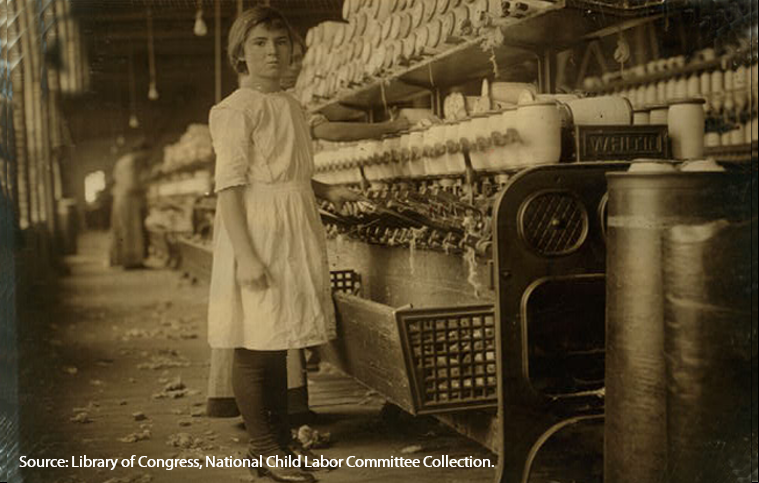
Children were enslaved, they were separated from their families, they were certainly exposed to serious hazards and health risks, and they were left to fend for themselves. Child labor abuses were plentiful during the Industrial Revolution from 1820 to 1870. But it did not end in 1870. It continued for another 60 years.

Industrialization attracted workers and their families. Many relocated from farms and rural areas to cities to do factory work. In factories and mines, children were actually preferred by businesses because owners saw children as more manageable, a lot cheaper, and unwilling to strike.

Our children worked in mines, manufacturing plants, factories of all sorts, textile plants, and agriculture in various ways, including harvests and canneries all over the North. And yes, they were newsboys, peddlers, messengers, and bootblacks. The lucky ones swept the trash and filth from city streets, stood for hours on street corners pushing newspapers, and delivered messages for pennies. Others worked in the mines and coughed up coal dust all through a 10 to 12-hour shift in the heat of the dark. Others sweat to the point of passing out while tending factory furnaces.


Overall, child laborers were the sons and daughters of poor parents, and of course, recent immigrants depended on their children’s measly wages to survive. They were the children of industry and large cities in the North during the Civil War. What black slaves were to the South, child slaves were to the North.

The fact is forms of child labor, including indentured servitude and child slavery, have existed throughout our history. It actually predates our independence. Some were lucky and were treated easier than others. Others were treated as property.

Fact is, we can trace child slave labor back to before the United States was founded in 1776. It's true. There was child slave labor in the 18th century. From farms to factories, young children were used as laborers.

As British colonies, long before our independence, English laws allowed children to work in everything from farms to manufacturing. By 1833, when the British outlawed black slaves, child slavery in the form of indentured servants and forced child labor was commonplace in England.

Of course, American colonial laws modeled their laws after British laws. So yes, similarly American laws forced many children into workhouses, factories, and mines. In fact, those laws allowed for orphan boys to be placed into apprenticeships in trades. Orphan girls were sent into homes to do domestic work, work in laundries, and of course, work in sweatshops.


After we broke away from England, American industry kept up the practice and sought out children to use in all sorts of manufacturing facilities throughout the former colonies. Child labor served Alexander Hamilton's vision of America. He saw child labor as providing increased labor to support industry.

According to his vision, when Alexander Hamilton was Secretary of the Treasury, he actually stated in a 1791 report on manufacturing that "children who would otherwise be idle could become a source of cheap labor."

Around the same time, a national newsweekly printed their opinion stating that "factory work was not for able-bodied men, but rather better done by little girls from six to twelve years old."

Besides advertisements seeking children from the ages of 8 to 12 to work in a cotton mill in the North, it's said that by 1820 children made up more than 40 percent of the mill employees in at least three New England states. So while it is said that the manufacturing industry that grew following the Civil War required children as young as 8 years old, we should recognize that forced child labor in factories, retail stores, on the streets, on farms, in mines, and elsewhere, took place long before the Civil War.

This was so much the case that in 1842, a few Northern states began to limit a child’s workday. Massachusetts lowered a child’s workday from 14 hours to 10 hours, but most laws were not enforced. And Massachusetts was not the only state to use forced child labor, child slavery in the industrial North during the Civil War.


It is a fact that women and children dominated pre-Civil War manufacturing in the North. It is a fact that the number of children used in the North actually increased during the Civil War because of the need for everything from uniforms to shoes and belts, hats, and hardware. Yes, the beans, bullets, and bandages that keep an Army functioning.

So please make no mistake about it. While the South had black slavery that they considered property, the North had child slavery that they considered property. In the North, children replaced the need for adults as many Northern men were pressed into service in the Union Army.

And while the North was afraid of the influx of freed slaves fleeing the South, Northerners, in fact, re-enslaved many freed slave children just as they did the children of immigrants during the Civil War. It's true as the children of freed slaves in the North were treated the same as other children in that they worked 10, 12, or 14 hours a day and six days a week. And while those children were, in essence, re-enslaved through forced labor and apprenticeship agreements, they were bound to companies no differently than they were to their slave masters in the South.

In 1870, the first U.S. census report on child labor numbers accounted for 750,000 workers under the age of 13. These figures came mostly from the Northern states. These numbers did not include children who worked for their families or on farms.

For many years, not much changed in the North regarding the use of forced child labor. But after the Civil War, forced child labor abuses became a routine nationwide as more cities adopted the practice. And yes, the scams to get more children increased. For example, in New York City in the 1870s, there was a scam going around that had to do with Italians who secured employment for Italian immigrants. The scam was child slavery under the guise of apprenticeship.

The people responsible for that scam deceived Italian parents still living in Italy into willingly sending their children to America to begin an apprenticeship program. Once agreements were signed, then the children were shipped to America. At the docks, they met and were immediately forced to work in horrible conditions. As was the case throughout the North for many years, if the children failed to comply, they were beaten and starved.

This was happening so much so that in 1873, just eight years after the Civil War, the New York Times stated, "The world has given up on stealing men from the African coast, only to kidnap children from Italy."

While forced child labor was pretty much restricted to the Union during the Civil War, it became more and more commonplace throughout the nation after the war. Southerners followed the example set by Northerners and filled the openings left by freed black slaves with women and children. And yes, forced child labor and apprenticeship agreements extended to businesses in the South after the war.

It is said that freed slaves willingly exchanged the labor of their children for "training" provided by their former slave owners. So yes, after the Civil War, former black slaves, those who were freed and had children, actually forced their own children into re-enslavement. Imagine that.

Slavery comes in several different forms. Forced Marriage, Domestic Servitude, Indentured Servants, Forced Labor, Bonded Labor, Child Labor, and Sex Trafficking are all forms of slavery. As for "chattel slavery"? Chattel slavery is the "owning" of human beings as property. They are bought, sold, given, and inherited. Since slaves in this context have no personal freedom or recognized rights to decide the direction of their own lives, isn't that comparable to what they did to children until the 1930s?

The child slave market was filled by hiring others to find them and detain them. In some cases, it was from orphanages. Other times it was from a destitute family. They were lied to, held prisoner, and even kidnapped. They were sold into bondage and stolen. They had no personal freedom or recognized rights, were beaten and starved, had bounties put on their heads if they escaped from where they were housed or worked, and were in some cases shackled to machinery and given a coffee can to urinate in. To me, that's slavery. That is certainly not the life of a free person.

As for child labor laws, in 1904, Federal child labor reform laws began to take shape. But that didn't stop employers from putting children to work. In fact, by 1911, it is said that more than Two Million American children under the age of 14 were working 12 to 14 hours a day for six days a week.

And yes, well into the 1900s, children worked in unhealthful and hazardous conditions and always for what was known as slave wages. As for unhealthful and hazardous conditions, even into the 1900s, young girls continued to work in mills and garment factories. They faced the danger of losing fingers or even a foot while standing on top of machines to change bobbins. They risked being scalped alive if their hair got caught in the machinery.


As for the children younger than 10 who were forced to work in the coal mines, they were known as breaker boys. They were smothered and crushed by piles of coal. They fell down shafts. Breaker boys faced the threat of cave-ins, gas leaks, explosions, and other hazards that adult miners did. But let's be honest and talk about their slave wages. They made 10 times less than the adults they worked beside.

While black emancipation came about in 1863, it wasn't until 1938 that Federal regulations of child labor were achieved in the Fair Labor Standards Act. While it did not emancipate children completely, it limited the minimum ages of employment and hours of work for children through Federal law. But, unfortunately, such laws were violated all the time.

The point of my article had gone completely over the heads of some folks. I've never condoned or tried to downplay the suffering of black slaves in the South. I have never ever tried to defend slavery of any sort, nor would I ever. I certainly would not defend slavery anywhere. The article above is not about slavery in the South. It is about child slavery as what took place in the Industrial North during the Civil War.

Their hypocrisy is in regards to what offended them. It was selective at best. While they were rightfully offended by blacks in chains, they were hypocrites in that they should not have turned a blind eye to the child slave labor practices that were taking place around them in the North at the same time.

While no longer applied to blacks after emancipation, those labor practices were certainly applied to children until they stopped in the late 1930s and early 1940s. And the only reason it stopped was that adults needed jobs. Adults saw children as taking jobs away from adults during the Great Depression, and that's when it stopped.

As for today? Sadly, there are many types of slavery and some still taking place today are in the form of involuntary servitude, debt bondage, forced labor, and child slavery. Yes, believe it or not, though not as blatant as it once was, child slave labor is still around. 

Today, the number one source of child slave labor comes from the South of our border with Mexico. Human traffickers are running children into the United States at an alarming rate. And yes, besides being brought here as child slave labor, some of the children being smuggled into our country are being sold to sick people on this side of the border as child sex slaves. 

As horrible a fact as that is, it's a fact of life today. And frankly speaking, it should disgust any normal person. But sadly, it's not enough to disgust the Biden Administration and the Democrat Party which sees the flood of illegals coming into the United States these days as a new source of cheap labor and votes. 

If politicians in Washington D.C. had any sense of honor and dignity, any sense of wanting to make something truly better, then they'd stop children from being smuggled in. They would do something to stop it now. 

Tom Correa


Monday, January 22, 2024

Introducing Terry McGahey


I have never truly introduced myself to the readers of The American Cowboy Chronicles, so at this time I thought I should do so. Number one, if anyone looking to read my articles and looking for some kind of flowering or perfect writing skills you are in the wrong place, I write just as I speak and will not be politically correct at any time. Tom and I came together as like-minded people who are sick and tired of watching our beloved country being torn apart by the radical left. 

As an American Patriot who believes in our constitution which is the law of the land, the far left has been working tirelessly at bastardizing our constitution and our way of life through lies and disinformation. I will always remember what Nancy Pelosi said before the 2020 election, not in her exact words but close enough. I remember when she stated, "We will stop Trump from becoming president by any means!" Yes, "By any means!" Doesn’t this tell you how rotten and crooked these people are?

Anyway, I was raised in an area close to a little town called Glen Avon, in believe it or not, Southern California during the fifties and sixties when the Bravo Cattle Ranch was still in operation and when California was still a good place to live. So I've always been around the cowboy-type lifestyle, I always wanted to be one. 

Back in the 1970s and through the mid-80s, I was an Ironworker building high-rise buildings and others out of Las Vegas Nevada and California. I was injured on the job pretty badly around 1986 or so. I just don't remember the exact year anymore because it no longer matters.

After being medically retired by 1988 a year and a half later I began to realize just how bad California was getting with regulations on business and with the average people being over-taxed. In 1990 I had enough of California’s bullshit. I moved on to Tombstone, Arizona, looking for a more relaxed and better way of life without the traffic and hoards of people as well as most everything else that was going wrong in that state in my opinion.

Funny, only after a year of enjoying that more relaxed style of life I ended up in a battle with Tombstone over their old Earp Ordinance disallowing the carry of firearms within the city limits. I won’t go any further with this because the whole story is on Tom’s blog. 


By the time this battle had taken place, I had met the local cowhands. And, being the same type of people I was used to as an Ironworker, I naturally fell in with them and began working cows by 1991 at forty years old. I rode my first bull at 42. I figured my body was already tore-up, so what the hell. 

Yes, cowboying is hard work but it was not quite as demanding on the body as wearing a 35 to 40-pound tool belt and climbing steel columns for much of the day.

Again, this is who I am and I won’t skirt my feelings or beliefs for anyone. We have been under attack by the far left for many years now and I want to thank Tom Correa for giving me the chance to express my feelings, thoughts, and hatred for what the Left is doing to our great nation. If we have any chance to save our country in the future I believe that Trump is the man to lead us back to our American way of life, liberty, and the pursuit of happiness. 

Just my opinion. Trump 2024


Saturday, January 20, 2024

Crooked Elections Are A Part Of Our History


The Mainstream Media and its people responsible for disseminating the news on television and in newspapers these days have lost the trust of the American people. One reason is they give folks today the impression that they've never heard of crooked elections, ballot stuffing, voter fraud, or anything dealing with election tampering. 

Of course, while the use of trickery and intimidation to achieve a political win is usually focused on a Presidential Election, there have been many smaller local and state elections where the vote was anything but honest. And while the folks in the news business make me wonder about just how uneducated they are, contrary to what the Mainstream Media is feeding the public today, crooked elections have been around since the beginning of the founding of our republic. It's true. And yes I know it's sad, but it's true. 

Simply put, electoral fraud is illegal interference with the process of an election. Electoral fraud has many different forms. Here are the most common types of election fraud: there is ballot stuffing, mail-in ballot fraud, absentee ballot voter fraud, felon vote fraud, casting votes in the name of dead people, voter impersonation, fraudulent signatures, voter registration fraud, voter intimidation, voter suppression, voter "caging and purging." 

Voter "Caging and Puging" is a conscious act to deny someone the right to vote. It takes place when a political party or a partisan organization sends registered mail to addresses of registered voters that they already know are not going to vote for their candidate. 

Why bother doing that if they already know are not going to vote for their candidate? Well, there's a reason for that. All of the mail that's returned as "undeliverable" is placed on what is called a "caging list." 

How is that list used? The political party or partisan organization that sent the mail knows they can challenge the right to vote for anyone on the list. That means they can "purge" voters' names from the voting rolls. They can get away with this because election rules say that if voters are unreachable at the address listed on their voter registration, then they are not eligible to vote in that area. It's a pretty devious way of eliminating registered voters for your opponent. Crooked as hell, but the political groups do it. Yes, especially when you know that your opponent is leading in the polls and you want to stop your opponent's supporters from voting. 

Voter Suppression describes policies and tactics that place an undue limitation on the ability of citizens to cast countable ballots in an election. To me, doing something like Voter "Caging and Puging" is a form of Voter Suppression because they are limiting someone's ability to vote for the candidate of their choice. It's all about tactics used to suppress the number of voters who might otherwise vote in a particular election.

Voter Registration Fraud is a form of vote fraud in which someone registers to vote or registers someone else to vote using a fictional name or without that person's consent. The worst case of Voter Registration Fraud that comes to my mind deals with a Democrat-controlled political organization known as ACORN. 

ACORN worked to elect the 2008 Democratic Presidential nominee Barack Obama. While it was said at the time that ACORN was responsible for "massive voter fraud," we do know that ACORN workers in Seattle, Washington, committed what the Washington Secretary of State called, "the worst case of voter registration fraud in the history of the state of Washington." The group’s leader was convicted of false voter registrations and served nearly three months in jail. Four other ACORN workers on his team also received jail time.

Voter Impersonation is a type of vote fraud in which a person claims to be someone else when casting a vote. In 1982, an estimated 100,000 fraudulent ballots were cast in a 1982 Chicago election. After a Justice Department investigation, 63 individuals were convicted of voter fraud, including vote buying, impersonation fraud, fictitious voter registrations, phony absentee ballots, and voting by non-citizens.

Of course, one type of Voter Impersonation is voting in the name of a deceased person. Voting in the name of a deceased person is vote fraud because someone is casting a vote under the name of someone dead. The way that people get away with that is because the dead person's name is still on the state's list of registered voters. Believe it or not, there are political groups that are taking some states to court over the state's desire to clean the voting rolls of dead people. Some of these political groups argue that the Constitutional Rights of those dead people are being violated -- so their names must stay on the rolls. Yes, they are doing that even those the people are dead and obviously can't vote. 

Absentee Ballot Vote Fraud is when a person attempts to fill out and turn in an absentee ballot containing false information. For example, this can occur when a person attempts to fill out and turn in an absentee ballot with the name of a false or non-existent voter. The term can extend to manipulation, deception, or intimidation of absentee voters.

Felon Vote Fraud is when a person convicted of a felony, someone who is by law not eligible to vote as a result of the conviction, attempts to cast a ballot. Voting rights for convicted felons vary by state. But overall, Felons lose the right to vote when they are convicted of a crime. The interesting thing behind this is that Voter Fraud in most states is a Felony. So yes, the people in the political party and political groups that are doing any of this are felons.

And no, they are not above "suddenly finding uncounted votes" for their candidate. For example, in the 1948 United States Senate election held in Texas. Lyndon B. Johnson won the Democrat primary over his opponent Coke R. Stevenson by only 87 votes. Of course, Lyndon Johnson was accused of voter fraud in Duval County because it had initially appeared Stevenson had won the election. And really, Stevenson would have won if it weren't for the fact that a box of 200 votes was suddenly found out of nowhere for Johnson just when he needed them.

If you're thinking that that same thing happened to Joe Biden. History agrees with you. Suddenly, out of nowhere, thousands of votes were found for Biden when he was losing the election. While many believe that Mail-In Ballot Fraud had something to do with it, some say that Mail-In Ballot Fraud is merely a product of someone's imagination. They say that knowing it's a real modern-day problem.

Mail-In Ballot Fraud is another way to stuff ballot boxes. And yes, the 2020 Presidential Election relied heavily on mail-in ballots due to the COVID-19 pandemic. Of course, even with evidence such as videos showing that people dumped questionable amounts of Mail-In Ballots into the Post Office boxes to sway the 2020 election -- some people say that Mail-In Ballot Fraud played no part in the Election of Joe Biden. Those folks insist that Mail-In Ballot Fraud is a product of our imaginations.

Of course, Mail-In Ballot Fraud is not an imaginary problem. To prove that point, all one has to do is look at what took place in September of 2023 in Bridgeport, Connecticut. A judge there found evidence of mishandled Mail-In Ballots in the Democratic primary for mayor. That judge ordered a revote. 

It's true. Surveillance videos caught people stuffing Mail-In Ballot drop boxes in Bridgeport, Connecticut, during the Democratic primary there. In his ruling, Superior Court Judge William Clark addressed the inconsistency by saying he lacked the authority to postpone or cancel the general election. However, he said he had seen enough evidence of malfeasance to order a rerun of a September 12 primary in which incumbent Mayor Joe Ganim defeated challenger John Gomes by 251 votes out of 8,173 cast.

"The volume of ballots so mishandled is such that it calls the result of the primary election into serious doubt and leaves the court unable to determine the legitimate result of the primary," Clark wrote in his ruling. 

Judge Clark cited surveillance video that showed significant Mail-In Ballot stuffing. That's exactly what he saw after watching surveillance videos showing people stuffing multiple absentee ballots into outdoor collection boxes. Yes, something that some say can never happen to any degree.

And really, I hate hearing the line, "There's no such thing as widespread Voter Fraud." The 2003 mayoral primary in East Chicago, Indiana, was overturned by the Illinois State Supreme Court after evidence of widespread fraud was revealed. It's true. A political operative for the East Chicago, Indiana, Mayor's campaign is said to have persuaded voters to let him "fill out their absentee ballots in exchange for jobs." He pleaded guilty and was sentenced to three years of probation and 100 hours of community service. 

Fraud in the 2003 East Chicago Mayoral Primary was so widespread that the Indiana Supreme Court ultimately overturned the election results and ordered a special mayoral election that resulted in a different winner.

Of course, while Mail-In Ballot Fraud is all about "Ballot Stuffing or "Ballot Box Stuffing." Ballot Box Stuff is nothing new. It is all about casting illegal votes or submitting more than one ballot per voter. It's simply a form of electoral fraud in which a greater number of ballots are cast than the number of people who legitimately voted. The term refers generally to the act of casting illegal votes or submitting more than one ballot per voter when only one ballot per voter is permitted.

In 1844 during the New York City Election, New York City’s infamous Tammany Hall which was synonymous with political corruption and election fraud showed everyone what Ballot Box Stuffing is all about when it's done on a big scale for the times. In that election, there were 55,000 votes recorded even though there were only 41,000 eligible voters in the city.

In Kansas and Missouri, in 1855, Democrats wanted political power so they could make Kansas a "Slave State." They started secret societies called "Blue Lodges" with the sole purpose of gathering enough support to make Kansas a "Slave State" instead of a "Free State". Those secret societies were all about organizing to rig that election. The Democrats had a tried and true plan. They would stuff the ballot box on the day of the election to gain control of the legislature. 

How did they do it? Well, just before the election, a census was taken. Through the census, folks there found out that Kansas had a population of 8,601. And of them, 2,905 were voters. In Lawrence, Kansas, the whole town only had 369 voters.

But on election day, which was on March 30, 1855, it is said that about 1,000 armed pro-slavery Democrats rode into Kansas from Missouri to vote at the election. According to eyewitnesses, the Democrats arrived in over 100 wagons, all armed with guns, rifles, pistols, and Bowie knives. Believe it or not, it's said that they also brought with them two small pieces of field artillery. That's one way of making sure no one would contest their voting. 

Those pro-Slavery Democrats from Missouri stuffed the local ballots with over 800 votes. Being non-residents didn't matter, they intimidated the local folks there in Lawrence who were legal voters, they shot at one voter because he was a Republican and "an obnoxious free-state man." After they terrorized the town of Lawrence all night, they left the next day. 

The Democrats' plan of ballot stuffing worked in other locations in Kansas besides the town of Lawrence on that day in 1855. In fact, even though the recent census stated that there were only 2,905 legal residents registered to vote in Kansas, believe it or not over 6,300 votes were cast. 

As far as what happened once the authorities learned of what took place? The Territorial Governor Andrew Reeder, who was threatened by the pro-slavery Democrats, ordered another election to be held -- but another vote did not take place out of fear of what the Democrats would do to their towns. 

Imagine that. People got away with fixing an election because people were afraid of what the criminals would do in reprisal. 

Tom Correa


Thursday, January 11, 2024

Americans Need To Wake Up

Story by Terry McGahey

Opinions are like fingers and toes, we all have them. So, I have decided to give mine on what I believe the Democrats objective for this country is all about. In the first place lets just call them what they truly are, Socialists and Communists. 

I will not deny that we had a problem with the Covid strain a short time ago, but this strain of flu like symptom was no different in ways than in the past with the bird flu, swine flu and others. Yes, people perished during this time period of Covid, but people also perished during the bird flu and swine flu. Odd, I don’t remember those two being labeled as a pandemic. People die every year from the flu or flu like symptoms.

It’s just my opinion that Covid was a test ran by the Democrats to see just how far they could go in an experiment of population control. And in my opinion, the major herd of sheep believed the lies and disinformation the government put out. Now I understand, if people wanted to wear masks and if businesses asked their customers to wear masks then that’s their choice and I have no problem with that.

The problem I have is that the feds and state governments began forcing people to wear masks. As I stated, that’s control people, WAKE UP! 

I know several people including myself who picked up the Covid strain, was sick with flu like symptoms for about three to five days and recovered from it, no different than most any other flu unless their immune systems were weakened for the most part. People die of the flu every year and if you noticed, no one died from the regular flu that year, it was always Covid. 

Control, control, control. If these Democrat Communists find the want or need to control the population again, now they have the perfect play book on how to get it done.

Again, these are only my opinions and with our open border policies I believe the Democrat Communists are all in with the New World Order. And in order to complete this agenda, they must completely disrupt our way of life, which they are doing. 

Think about it, some states like California and others are issuing drivers licenses to illegals, and the feds are actually giving them money, our money!

Maybe the Democrat Communists are looking down the road at getting these illegals a citizenship status believing that the millions of now illegals will eventually get to vote and will vote for them which could turn the tide completely their way in the future. Ten to twenty million votes or more could easily turn the tide in their direction to complete their agenda of control.

Nikita Khrushchev, the leader of the Soviet Communist Party from 1953 to 1964 once stated that the United States will fall from within. Doesn’t this statement seem to go along with what is happening right now in our country? 

Tie the hands of the police, allow for open borders, ruin the economy by breaking the middle class, making it so the older retirees have to decide between medication or food, try to delete or teach disinformation of our history in schools and colleges, This only mentions a few of the problems we as Americans are facing today. 

What about the global warming movement? Now the government is trying to force us into electric vehicles. Think about it, in California the illustrious governor, Gruesome Newsom had already asked people who own electric vehicles not to charge these vehicles during the peak of electric usage. 

So, how do they gain more control? They gain more control by forcing us into electric cars then declaring an electric grid emergency disallowing the people from charging their cars which restricts the movement of the American people. If you can restrict the movement of people you now have even more control which I believe is their goal in the future using the electrical grid as their hammer.

I only hope the American people will wake up to this Communist movement before it’s to late and we the people become helpless through the loss of power by the people to the Communist Democrats who want total control of our country, our people, and the death of our Constitution.

Just my opinion. 

Terry McGahey
Associate Writer/ Old West Historian
 

Terry has been a working cowboy, writer, and historian. He is best known for the fight that he waged against the City of Tombstone and their historic City Ordinance Number 9. He was instrumental in getting the famous Tombstone City Ordinance Number 9 repealed while at the same time forcing the City of Tombstone to fall in line and comply with the laws of the State of Arizona.

If you care to read how he fought Tombstone's City Hall and won, check out:

The Last Gun Fight -- The Death of Ordinance Number 9 (Chapter One)