Thursday, November 4, 2021

The Girandoni Air Rifle -- Something From The Gods


I was very surprised when I was handed an air rifle that a friend showed me the other day. Besides showing me how out of the loop I've become when it comes to modern technology and guns, especially air guns, I was extremely impressed by what I saw.

My friend showed me his .50 caliber Umarex Hammer air rifle. And no, the Umarex Hammer is not just another air rifle. It is high-tech, ingenious, and has a very large .510 caliber barrel. But, unlike firearms that use gunpowder, its use of compressed air puts out 3,000 psi behind its projectiles. This innovative, patent-pending system has the capability to propel a .510 caliber 550-grain lead slug at a muzzle velocity of 760 feet per second and a 250-grain slug at over 1,000 feet per second. 
While I did not fire it, I was told that its recoil is more like a strong push instead of a kick as would be expected from a long bore rifle. And really, for a "big-bore air rifle designed for hunting big game," that's all very impressive. Of course, the very modern Umarex Hammer air rifle isn't the same as the Benjamin air rifle that my grandpa gave me when I was a kid. And no, it's surely not the .46 caliber Girandoni air rifle. 
The 1780 Girandoni Air Rifle
So what was the Girandoni air rifle? 

Using fairly large calibers, pneumatic weapons are said to have been used in Europe by the very wealthy to hunt large game such as wild boar, deer, and even bear back in the 1700s. By 1780, an Austrian gunsmith named Bartolomeo Girandoni developed a revolutionary air rifle in .46 caliber. 

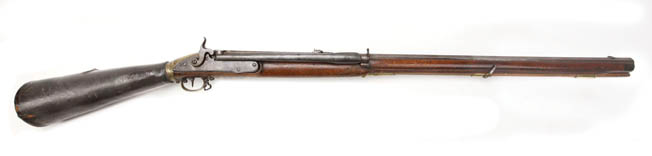
The butt of the Girandoni air rifle was an iron flask that could be detached, pumped full of air, and then reattached to the weapon. Each rifle was issued three air reservoirs, was four feet long and weighed 10 pounds. That meant the Girandoni air rifle was about the same length and weight as a musket of the times. Of course, unlike a conventional musket, the Girandoni air rifle had advanced features that muskets and rifles would not see for decades. 

Those features were why the Girandoni air rifle was adopted by the Austrian military. One feature is the use of a tubular magazine. In fact, it was one of the first rifles to use a tubular magazine. And with that, it was able to be loaded with 22 lead rifle balls that were propelled out of the weapon individually by controlling each burst of compressed air. 

So yes, believe it or not, the Girandoni air rifle is considered one of the first "repeating rifles" invented. It was used in the Austrian military from the 1780s to 1810. And that makes it the first "repeating rifle" used in military service. With the 22 lead rifle balls fed into a tubular magazine built alongside the barrel of the weapon, these rifle balls were loaded into the weapon individually by a simple steel block. The block slid back and forth at the base of the breach. As a shooter held the muzzle of the weapon upright as the bullets rolled down toward the breach, the rifle balls were fed into the breach using gravity. This also meant that a shooter could actually lie on the ground and simply hold the weapon up vertically to reload. No, he didn't have to stand. 

And think about this, during a period when a contemporary musket was considered accurate to only about 50 yards, the Girandoni air rifle and its muzzle velocity of 1,000 feet per second could put a lead ball through a one-inch pine board at 100 yards. And remember, since it was a "repeater," its full tubular magazine could be completely fired in less than 30 seconds. 

There is something else. Unlike muskets that produced a great deal of smoke, the Girandoni air rifle shots produced no dense smoke. That means the rifle used on the battlefield would not lend to the gunpowder fog that obscured battlefields of the time. And also, since it was an air rifle and did not have the explosive report of a musket, the position of a soldier using the Girandoni air rifle was not exposed to enemy fire. Of course, one of the features that endeared the rifle to shooters was the fact that the rifle was also limited by rain. After all, let's remember that rain makes gunpowder ineffective when using a musket.

Sounds great? Well, even with all of those positives, believe it or not, it was not the perfect weapon because of what it took to operate. Let's remember, those were the days when it took about 1,500 strokes of a hand-operated air pump to fill each air canister. As for its military use, this meant that wheeled air pump carts were placed behind the lines. Along with this, specially trained gunsmiths were a necessity. In fact, I read where the military needed one gunsmith for every 100 riflemen equipped with the Girandoni air rifle just to keep those rifles in operation. And since they needed specialized spare parts such as mainsprings, replacement seals, and extra air flasks, they became a pain to maintain. 

Think about this. In a time with soldiers were mostly uneducated peasants who couldn't read nevertheless have an understanding of technology, they were responsible for keeping the Girandoni air rifles in working order. And yes, it's said they were very difficult to keep in operation. Mechanical problems and seal leaks plagued the air rifles and the troops at the time were not capable of fixing them. So all in all, it is said that despite the deadly accuracy and firepower provided by the Girandoni air rifle, it proved to be technological that was too far ahead of its time. Because of problems pertaining to maintaining them, by 1810, the Girandoni air rifle had been entirely phased out of the Austrian military. 

What did the Austrian military do with all of their surplus Girandoni air rifles? Well, it is said that a few were saved as museum pieces. Many were sold to civilians by the Austrian government. The military gave some to militias. Many were lost or destroyed. And then there is that one that history tells us made it across the Atlantic Ocean to a brand new country known as the United States of America. 

Of course, when most of us think about Mountain Men and expeditions to explore America, we don't usually think of air rifles. We might think about Kentucky and Pennsylvania long rifles, but the Girandoni air rifle is not what usually comes to mind. And no, it's surely not the .46 caliber Girandoni air rifle that Lewis and Clark took along with them on their 1803 expedition. Yes, even if most believe that it was in effect the secret weapon that enabled the Lewis and Clark expedition to accomplish its mission. 

As most know, the Lewis and Clark Expedition took place from 1804 to 1806. It was the first overland expedition from the East of the United States to the Pacific coast and back. President Thomas Jefferson commissioned the expedition shortly after the Louisiana Purchase in 1803. Its official mission, the expedition was to explore and to map the newly acquired territory, to find a practical route across the western half of the continent, and to establish an American presence in this territory before European powers attempted to establish claims in the region. 

It did in fact have a secondary objective which was both scientific and economic. That meant that the expedition was to study the area's plants, animal life, geography, natural resources, and to establish trade with local Indian tribes. Initiated by President Thomas Jefferson, he hand-picked U.S. Army Capt. Meriwether Lewis to lead the expedition. Captain Lewis picked Second Lieutenant William Clark as his second in command. 

The Lewis and Clark Expedition had about 40 soldiers who were all skilled in various trades. The unit was designated a Corps of Discovery and all were volunteers. They left St. Louis in 1804 and traveled up the Missouri River into present-day North Dakota. From there they sketched and documented everything imaginable about what took place and who they came in contact with during their exploration through the new Louisiana Purchase. 

After wintering in present-day North Dakota, they left the next spring. To assist them, they hired Toussaint Charbonneau and his Indian wife, Sacagawea, who served as guide and interpreter. It is said that they "traveled through Montana and by horse over the Continental Divide to the headwaters of the Clearwater River. They built canoes to carry them to the Snake River and then to the mouth of the Columbia River, where they built Fort Clatsop (later Astoria, Ore.) and spent the winter. On the journey back the group divided, then reunited to canoe down the Missouri River to St. Louis." 

They returned to a great celebration in September 1806. All but one member of the expedition survived. The journals kept by Lewis and others documented Indian tribes, wildlife, and geography and did much to dispel the myth of an easy water route to the Pacific.

Before leaving, it is believed that Captain Meriwether Lewis obtained his Girandoni air rifle between May and June of 1803 at a supply house outside of Philadelphia. The story goes that Capt. Lewis was headed to Pittsburgh when he found the air rifle in a shop. As for how it arrived there, no one knows for sure. It is possible that it was one of the surplus rifles that had been phased out of the Austrian military. But really, no one knows for sure. 

We do know that on the very first page of Capt. Lewis' personal journal, he recounts how he took every opportunity to demonstrate his Girandoni air rifle's capabilities to the Indians that he encountered. He wrote, "The Indians considered the rifle something from the gods."

For that Girandoni air rifle, it came into its own whenever a new tribe was encountered. In fact, it's said that Lewis and Clark would stage an extravagant entrance all meant to impress the local tribe. And if you don't think it was extravagant, think again. All of the party were said to have "donned their most colorful military uniforms." With their frock coats, shined swords, formal headgear, polished muskets, and gleaming bayonets, all with flags blowing in the wind while fifes played, they would march boldly into each meeting with a new tribe. The explorers greeted the assembled tribesmen with formal gravity and then proceeded to hand out gifts such as bolts of colored cloth, beads, and commemorative medallions. 

If you think that such pomp and ceremony would help to dissuade potentially hostile actions by a tribe, that was what they were betting on while trying to do their utmost to impress the tribesmen. Of course, it was during this time that Capt. Lewis would produce and confidently demonstrate the remarkable power of his Girandoni air rifle. 

One member of the Lewis and Clark party was Private Joseph Whitehouse. In his journal, the Private described how Capt. Lewis demonstrated his rifle. That took place on August 30, 1803, at a Yankton Sioux village located along the Calumet Bluffs of the Missouri River. 

Pvt. Whitehouse wrote, "Captain Lewis took his Air Gun and shot her off, and by the Interpreter, told them that there was medicine in her, and that she could do very great execution. They all stood amazed at this curiosity; Captain Lewis discharged was done the Air Gun several times, and the Indians ran hastily to see the holes that the Balls had made which was discharged from it. At finding the Balls had entered the Tree, they shouted aloud at the sight and the Execution that surprised them exceedingly.”

During the expedition, Capt. Lewis repeated this demonstration for every tribe the group encountered. And yes, there are 39 separate entries in the expedition's journals noting the Girandoni air rifle leaving all there amazed at the power that those men possessed. 

Capt. Lewis' Girandoni air rifle played a major role in what can be considered a pivotal period of American history. And while that rifle was initially thought lost to history, it was discovered and today is on display at the Pentagon.

Tom Correa

Saturday, October 30, 2021

The Tell-Tale Heart by Edgar Allan Poe

First, I want to wish you a Happy Halloween! 

The story below is The Tell-Tale Heart. It is a short story by writer Edgar Allan Poe. In it, an unnamed narrator tries to convince readers of the narrator's sanity while at the same time describing a murder that the narrator committed. The victim was an old man, and the narrator emphasizes the careful calculation of the murder. 


True! — nervous — very, very dreadfully nervous I had been and am; but why will you say that I am mad? The disease had sharpened my senses — not destroyed — not dulled them. Above all was the sense of hearing acute. I heard all things in the heaven and in the earth. I heard many things in hell. How, then, am I mad? Hearken! and observe how healthily — how calmly I can tell you the whole story.

It is impossible to say how first the idea entered my brain; but once conceived, it haunted me day and night. Object there was none. Passion there was none. I loved the old man. He had never wronged me. He had never given me insult. For his gold I had no desire. I think it was his eye! yes, it was this! One of his eyes resembled that of a vulture — a pale blue eye, with a film over it. Whenever it fell upon me, my blood ran cold; and so by degrees — very gradually — I made up my mind to take the life of the old man, and thus rid myself of the eye forever.

Now this is the point. You fancy me mad. Madmen know nothing. But you should have seen me. You should have seen how wisely I proceeded — with what caution — with what foresight — with what dissimulation I went to work! I was never kinder to the old man than during the whole week before I killed him. And every night, about midnight, I turned the latch of his door and opened it — oh, so gently! And then, when I had made an opening sufficient for my head, I put in a dark lantern, all closed, closed, so that no light shone out, and then I thrust in my head. 

Oh, you would have laughed to see how cunningly I thrust it in! I moved it slowly — very, very slowly, so that I might not disturb the old man’s sleep. It took me an hour to place my whole head within the opening so far that I could see him as he lay upon his bed. Ha! — would a madman have been so wise as this? And then, when my head was well in the room, I undid the lantern cautiously — oh, so cautiously — cautiously (for the hinges creaked) — I undid it just so much that a single thin ray fell upon the vulture eye. 

And this I did for seven long nights — every night just at midnight — but I found the eye always closed; and so it was impossible to do the work; for it was not the old man who vexed me, but his Evil Eye. And every morning, when the day broke, I went boldly into the chamber, and spoke courageously to him, calling him by name in a hearty tone, and inquiring how he had passed the night. So you see he would have been a very profound old man, indeed, to suspect that every night, just at twelve, I looked in upon him while he slept.

Upon the eighth night I was more than usually cautious in opening the door. A watch’s minute hand moves more quickly than did mine. Never before that night had I felt the extent of my own powers — of my sagacity. I could scarcely contain my feelings of triumph. To think that there I was, opening the door, little by little, and he not even to dream of my secret deeds or thoughts. I fairly chuckled at the idea; and perhaps he heard me; for he moved on the bed suddenly, as if startled. Now you may think that I drew back — but no. His room was as black as pitch with the thick darkness, (for the shutters were close fastened, through fear of robbers,) and so I knew that he could not see the opening of the door, and I kept pushing it on steadily, steadily.

I had my head in, and was about to open the lantern, when my thumb slipped upon the tin fastening, and the old man sprang up in the bed, crying out — “Who’s there?”

I kept quite still and said nothing. For a whole hour I did not move a muscle, and in the meantime I did not hear him lie down. He was still sitting up in the bed listening; — just as I have done, night after night, hearkening to the death watches in the wall.

Presently I heard a slight groan, and I knew it was the groan of mortal terror. It was not a groan of pain or of grief — oh, no! — it was the low stifled sound that arises from the bottom of the soul when overcharged with awe. I knew the sound well. Many a night, just at midnight, when all the world slept, it has welled up from my own bosom, deepening, with its dreadful echo, the terrors that distracted me. I say I knew it well. I knew what the old man felt, and pitied him, although I chuckled at heart. 

I knew that he had been lying awake ever since the first slight noise, when he had turned in the bed. His fears had been ever since growing upon him. He had been trying to fancy them causeless, but could not. He had been saying to himself — “It is nothing but the wind in the chimney — it is only a mouse crossing the floor,” or “it is merely a cricket which has made a single chirp.” Yes, he has been trying to comfort himself with these suppositions: but he had found all in vain. All in vain; because Death, in approaching him had stalked with his black shadow before him, and enveloped the victim. And it was the mournful influence of the unperceived shadow that caused him to feel — although he neither saw nor heard — to feel the presence of my head within the room.

When I had waited a long time, very patiently, without hearing him lie down, I resolved to open a little — a very, very little crevice in the lantern. So I opened it — you cannot imagine how stealthily, stealthily — until, at length a single dim ray, like the thread of the spider, shot from out the crevice and fell upon the vulture eye.

It was open — wide, wide open — and I grew furious as I gazed upon it. I saw it with perfect distinctness — all a dull blue, with a hideous veil over it that chilled the very marrow in my bones; but I could see nothing else of the old man’s face or person: for I had directed the ray as if by instinct, precisely upon the damned spot.

And now have I not told you that what you mistake for madness is but over acuteness of the senses? — now, I say, there came to my ears a low, dull, quick sound, such as a watch makes when enveloped in cotton. I knew that sound well, too. It was the beating of the old man’s heart. It increased my fury, as the beating of a drum stimulates the soldier into courage.

But even yet I refrained and kept still. I scarcely breathed. I held the lantern motionless. I tried how steadily I could maintain the ray upon the eye. Meantime the hellish tattoo of the heart increased. It grew quicker and quicker, and louder and louder every instant. The old man’s terror must have been extreme! It grew louder, I say, louder every moment! — do you mark me well? 

I have told you that I am nervous: so I am. And now at the dead hour of the night, amid the dreadful silence of that old house, so strange a noise as this excited me to uncontrollable terror. Yet, for some minutes longer I refrained and stood still. But the beating grew louder, louder! I thought the heart must burst. 

And now a new anxiety seized me — the sound would be heard by a neighbor! The old man’s hour had come! With a loud yell, I threw open the lantern and leaped into the room. He shrieked once — once only. In an instant I dragged him to the floor, and pulled the heavy bed over him. I then smiled gaily, to find the deed so far done. But, for many minutes, the heart beat on with a muffled sound. This, however, did not vex me; it would not be heard through the wall. At length it ceased. The old man was dead. I removed the bed and examined the corpse. Yes, he was stone, stone dead. I placed my hand upon the heart and held it there many minutes. There was no pulsation. He was stone dead. His eye would trouble me no more.

If still you think me mad, you will think so no longer when I describe the wise precautions I took for the concealment of the body. The night waned, and I worked hastily, but in silence. First of all I dismembered the corpse. I cut off the head and the arms and the legs.

I then took up three planks from the flooring of the chamber, and deposited all between the scantlings. I then replaced the boards so cleverly, so cunningly, that no human eye — not even his — could have detected any thing wrong. There was nothing to wash out — no stain of any kind — no blood-spot whatever. I had been too wary for that. A tub had caught all — ha! ha!

When I had made an end of these labors, it was four o ‘clock — still dark as midnight. As the bell sounded the hour, there came a knocking at the street door. I went down to open it with a light heart, — for what had I now to fear? There entered three men, who introduced themselves, with perfect suavity, as officers of the police. A shriek had been heard by a neighbor during the night; suspicion of foul play had been aroused; information had been lodged at the police office, and they (the officers) had been deputed to search the premises.

I smiled, — for what had I to fear? I bade the gentlemen welcome. The shriek, I said, was my own in a dream. The old man, I mentioned, was absent in the country. I took my visitors all over the house. I bade them search — search well. I led them, at length, to his chamber. I showed them his treasures, secure, undisturbed. In the enthusiasm of my confidence, I brought chairs into the room, and desired them here to rest from their fatigues, while I myself, in the wild audacity of my perfect triumph, placed my own seat upon the very spot beneath which reposed the corpse of the victim.

The officers were satisfied. My manner had convinced them. I was singularly at ease. They sat, and while I answered cheerily, they chatted of familiar things. But, ere long, I felt myself getting pale and wished them gone. My head ached, and I fancied a ringing in my ears: but still they sat and still chatted. The ringing became more distinct: — it continued and became more distinct: I talked more freely to get rid of the feeling: but it continued and gained definitiveness — until, at length, I found that the noise was not within my ears.

No doubt I now grew very pale; — but I talked more fluently, and with a heightened voice. Yet the sound increased — and what could I do? It was a low, dull, quick sound — much such a sound as a watch makes when enveloped in cotton. I gasped for breath — and yet the officers heard it not. I talked more quickly — more vehemently; but the noise steadily increased. I arose and argued about trifles, in a high key and with violent gesticulations; but the noise steadily increased. Why would they not be gone? I paced the floor to and fro with heavy strides, as if excited to fury by the observations of the men — but the noise steadily increased. 

Oh God! what could I do? I foamed — I raved — I swore! I swung the chair upon which I had been sitting, and grated it upon the boards, but the noise arose over all and continually increased. It grew louder — louder — louder! And still the men chatted pleasantly, and smiled. Was it possible they heard not? Almighty God! — no, no! They heard! — they suspected! — they knew! — they were making a mockery of my horror! — this I thought, and this I think. But anything was better than this agony! Anything was more tolerable than this derision! I could bear those hypocritical smiles no longer! I felt that I must scream or die! — and now — again! — hark! louder! louder! louder! louder! —

“Villains!” I shrieked, “dissemble no more! I admit the deed! — tear up the planks! — here, here! — it is the beating of his hideous heart!”

Written by Edgar Allan Poe
January 1843

"The Tell-Tale Heart" is considered a classic of the Gothic fiction genre, also called the Gothic horror genre. The story was first published in James Russell Lowell's literary magazine The Pioneer in January 1843. It is probably Edgar Allan Poe's best-known short story. It became very famous in its time. 

The story is one of the first attempts in American literature to describe what the writer believes is the "perfect murder." Something that we all know does not exist. 


Monday, October 25, 2021

A Winter Horse Care Plan Would Be Nice

My Barn

I want to answer a letter that I received from a reader regarding caring for horses in the winter. She wrote asking me why I don't write more articles about ranching, guns, and horses. But also wrote, "Even though you would be late doing so, an article on Winter horse care would be nice." 

She then went on to tell me about her plan. All in all, she was asking my opinion of her Winter horse care plan. She also wanted to know if I can suggest other things to do for her horse? 

She wrote to say her plan at the moment includes the following: 
  • Make sure my horse has shelter to get out of the weather. 
  • Give her a little additional hay during times of extreme cold.
  • Keep her water clean and fresh
  • Make sure she is in good condition.
So, as she said, even though I'm late doing so, an article on a Winter horse care plan would be nice. And with that, I first want to say that I think her short to-the-point to-do list for a Winter Plan is on the right track.

The fact is, from what I've learned about Winter horse care, it's a two-part proposition. First, we have what needs to be done to get ready for Winter. The second is what we have to do as routine maintenance during Winter.

Allow me to explain what I'm talking about. Starting in the Spring, I begin preparing for the next Winter. What that means is that I get motivated to remedy all of the problems that seemed to pop up during the last Winter. Let me say that again, I get motivated to get ready for next Winter. The reason that I'm repeating myself is that I've found that I start out with a bang but then fizzle out. 

What really happens is that "Life 101" gets in the way and I postpone things. If you're a regular reader, then you know that I usually get more research and subsequently more of my writing accomplished when I'm not so bogged down with other aspects of my life. Such is life. 

What do I do with my time some of you have asked? Well, I do a lot of research. Yes, especially researching old notes for articles that I want to write. I have this blog to write. I'm also finishing my second book which I'm trying to make bigger and better than the first. Along with that, I also have our local American Legion post to manage. I'm a member of a Marine Corps League detachment. I put in as many hours that I can as a Calaveras County Sheriff's volunteer. And yes, I really do try to make time for my family. 

In fact, my wife and I go to lunch or dinner with my mom every week. After lunch, we take a ride and go sightseeing with no destination in mind -- or we return to her house and play cards. Frankly, I always accuse my mom of cheating at cards just to get her going. I know she doesn't, but that hasn't stopped me from pulling her leg. My friends, my wonderful mom will be 87 on November 6th. She is still going strong, but I've been around long enough to know that that can change in a blink of an eye. Because of that, I make sure that we get together as often as we can. That is if her schedule can fit me in.  

Of course, besides all of that, I try to spend time with our horses and keep up with the chores that need to be done on our small piece of property. And yes indeed, folks with small acreage like mine will certainly agree with me when I say that it feels like chores seem to never end. And no, I can't imagine being so wealthy as to hire hands to maintain large properties. 

That's why my Springtime plans fall apart and I usually find myself, as I did again this year, prepping for Winter during late Summer and Fall. That's also why I've been so busy cleaning and prepping for Winter up to a week or so ago. 

Before I retired from my first job and traveled around the country working, I used to see horses out in the snow in places like Utah, Wyoming, South Dakota, and Minnesota for example. I found out over the years that while some horses are better acclimated to cold temperatures and actually do better outdoors when the temps drop, that's not the horse that my wife and I own at all. While they do grow out their Winter coats faster than horses that are in lower elevations, our horses seem to get cold easily and seek out shelter pretty quick. 

That's why over the last few months, I've cleaned stall mats, repaired waterers and feeders, tried to store more hay, I've gotten my turn-out area ready, and much more. I try not to wait until Winter to clean and replace stall mats, so I try to get that done early. As for cleaning feeders, water troughs, and my hay storage area, I hate waiting until I need to put a horse in my barn before I get busy fixing or cleaning something that I could have done weeks ago. 

This year, I purposely made the time to fix two broken water troughs, re-do some pipes, and repair a feeder that needed it. And, I've even made sure to replace the extra floats that I used two years ago. Yes, those floats that I needed on the spare of the moment and used that were never replaced to keep on-hand for emergencies are now back on the shelf.  

Since I live in California, most folks think I live near the ocean or a big city. Well, that's not the case at all. As you've heard me talk about before, where I live here in the Sierra Nevada Mountains is what is commonly known as the California Gold Country. This is where the 1849 Gold Rush took place. And while some folks reading this might find it strange, we get snow here. Granted, it's not a large amount of snow like folks who live further up the mountain -- but we do get snow. 

So, with that, I have to prepare water troughs and pipes for freezing temperatures. That means that besides fixing broken water troughs, I've also been able to wrap pipes so they don't freeze and break. And by the way, since clean and fresh water is always a priority for horse care, I do make sure that I'm ready for the colder weather. While some people think horses can lick the ice or eat snow, that's just not the case. And of course, my knowing that our horses can get colic if they don't get enough water, I've placed their water troughs in spots where they won't freeze. 

As I said before, from what I've learned about Winter horse care, it's a two-part proposition. First, we have what needs to be done to get ready for Winter. The second is the maintenance during Winter.

If you're wondering if I have ever used electric waterers during Winter, I haven't needed to and still don't because their water troughs are located in areas where they can't freeze. And by the way, I've heard stories about horses that have gotten shocked from poorly ground electric de-icers. Frankly, I've never faced that problem. But, if you are in that situation, it's recommended that you test the water troughs out yourself so that your horse won't get shocked. I've been told that horses that are shocked will not use that waterer and refuse to take in water. And of course, that's not good.

Also, maintenance during Winter means we have to check our horse stalls, waterers, and horses more often. As for having horses confined to stalls and using waterers, it's important to check the waterers periodically and remove any old hay that's in those waterers. Old hay in a water tank will build up and can make your horse sick. So yes, it's very important to check it now and then. Believe it or not, it is said that horses need more water in the Winter in a barn than they do in a pasture during the Summer.

According to experts, "an adult horse that weighs a thousand pounds needs at least 10 to 12 gallons of water a day. If they get that, then that will help prevent dehydration and colic. During the Summer, pastures contain 60 to 80 percent moisture. This contributes to a horse's water intake requirement. In contrast to that, it's said that dried Winter feed such as hay and grain contains less than 15 percent moisture. So if our horses don’t drink enough water during cold weather, they may eat less and be more prone to impaction colic."

Again, according to experts, "even if we provide quality feed, horses will consume less if not drinking enough water. If horses eat less feed, they might not have enough energy to tolerate the cold. Also, water intake maintains a horse's fecal moisture level. If fecal material becomes too dry, intestinal blockage or impaction may occur. While a horse won't develop impaction in one day, they can over several days to several weeks of poor water intake." That's why our horses require more water in the Winter.

As for their turn-out areas, I am very happy to report that I remembered to fix areas where drainage needed to be addressed in their turn-out areas. Some of their turn-out areas ended up with a lot of standing water a few years ago. Last year, because we didn't get much rain, it wasn't that big a problem. But this year, I'm praying for more rain. And because I did address the drainage problem early this year, I think I'm ready. 

Because we've seen some high winds that have brought down a lot of branches, it's something that has to be addressed around here. If there is one thing that we have here in Glencoe, we have a lot of trees. Yes, a number of different sorts of oak, pine, cedar, and more. Because of the high winds, a lot of the loose debris that I have to deal with around here has to do with loose tree branches and that sort of thing that tends to get scattered about.  

This year, I re-did my main corral, re-built a turn-out pen, and replaced a lot of old fencing that wasn't doing the job. It was one of those things that simply needed fixing but I just never get around to it. Well, this year I did. I also put in a few new gates that I wanted to replace. I was also able to get some things done to practice what most call "good barn management."

What that means is that I got rid of what ended up being a lot of junk like old pallets, stacks of boards, old tin sheeting, and even some fencing wire that I haven't needed for the last 15 years or more. And because I used my breezeway for a few construction projects this year, I took a very large magnet and scanned the whole area where I was working in an effort to look for dropped nails, fence staples, screws, and so on. I was surprised by what I found. In reality, I hate to admit that there was more on the ground than I thought I had dropped.

As for shavings, I store bags of shavings to try to get a head start on Winter. But frankly, I never get enough for the whole Winter. So really, I just try to keep enough on hand to get me through a storm or two until I can get more. And here's a tip that has always worked for me, I never let my supply of shavings get so low that I don't have any on hand. I hate running out of shavings. 

This brings me to doing regular hoof care. Being out in the mud and possibly standing in wet pens can bring on thrush. As most horse people already know, in some cases sadly too well, thrush is an infection of the central and lateral sulcus of the frog of the horse's foot. It is most often a bacterial or fungal infection. Thrush is a huge problem this time of year. 

Good stall management is one of the best ways to prevent thrush. It is also a great way to treat thrush. Horses that are affected by thrush should be moved and kept in clean and dry stall conditions so that the frog can be cleaned and treated regularly until the infection is controlled and the tissues heal.

Good stall management, and regular foot care and inspection are what's needed as part of any Winter care plan. Horses in clean dry conditions will help keep the frog healthy. And from everything that I've experienced over the years, with early treatment and good stall management, complete recovery for cases of thrush is real good. 

Checking your horses' feet, maintaining good hoof care, goes along with the maintenance during Winter. We have to assess our horse's condition on a regular basis. So besides making sure that your barn or stable has adequate ventilation, that the waterers work well, and things stay dry, we have to assess how our horses are doing. For me, I watch their weight a lot this time of year. If they are not getting enough water or are too cold, they will lose weight. Because of that, I make sure that their waterers are going well. That's also the reason that I feed our horses some grain and additional hay during extreme cold.

I give them a little more hay and grain to keep their weight on. A healthy layer of fat provides insulation against the cold. Cold temperatures will in general increase the number of calories horses need to maintain body weight and function. I don't feed corn to them to stay warm because I learned a long time ago that corn does not cause a horse to become warmer. Instead, a little grain with hay releases more heat for them to maintain their heat and body weight. 

Experts say, "feeding high-quality hay and an additional one-quarter pound of grain per 100 pounds of body weight daily to non-working horses can provide adequate calories during cold weather. Working horses may require up to an additional one-half pound per 100 pounds of body weight per day, depending on workload, to maintain weight during cold weather."

So as you can see, even after all of the planning and preparing, it all comes down to having them inside instead of out -- and us keeping an eye on them. When that happens, the biggest thing that we can do for Winter is to check our horses every day. For me, that means rotating them to dry stalls. It also means that I spend a little more time with them to check their condition. 

So now, how about what's good for me? For you, you ask? Yes, for me. You see while I know that it gets cold in my barn, I actually enjoy putting on layers of clothing, my big winter coat, and going out to my barn to check on our horses. Frankly, it's as good for me as it is for our horses. 

I look forward to Winter because it's a time for me to take my coffee out to the barn and spend some time enjoying them while I'm checking on them. And while I check each one, one at a time, it's my time to bond a little more with them. It's also time for me to enjoy my little barn. You see I love the sound of rain hitting its tin roof because it reminds me of being a youngster on my grandfather's ranch. And as for my taking in the snow outside, it is something that I have come to enjoy. 

So yes, for me, Winter is a time for me to enjoy my time alone with my horses. Ornery, stubborn, jealous, cantankerous as they can be at times, they are among the greatest souls that God has gifted to us. And yes indeed, I really enjoy their company.

Tom Correa


Friday, October 15, 2021

Give Christopher Columbus The Credit He Deserves


If there is one sure thing that someone can say about history, something which is pure speculation but almost a sure bet, it is that someone would have sooner or later found the Western Hemisphere. Could it have been someone other than Christopher Columbus? Absolutely. And really, could it have been over something other than Spain's desire to find a shortcut to Asia? Yes, it could have been.

On October 15, 2021, vice president Kamala Harris gave a speech a day after Columbus Day, which some now recognize as "Indigenous Peoples' Day." During her speech, Harris said, "Since 1934, every October, the United States has recognized the voyage of the European explorers who first landed on the shores of the Americas. ... But that is not the whole story. That has never been the whole story. ... Those explorers ushered in a wave of devastation for tribal nations — perpetrating violence, stealing land, and spreading disease."

Not once in her speech did she mention the fact that Columbus was not looking for America, for peoples of another land, for land, or wanted to "spread disease." Not once did she say the truth is that Christopher Columbus did not travel west because he was attempting to discover a new land or was looking for slaves. It didn't matter to Harris that Africans had been selling their people into slavery to Muslims for over a thousand years by the time Columbus set sail. It didn't matter to her that tribes in the Americas had slaughtered each other for a few millennia before Columbus landed in the Bahamas, or that tribes waged genocidal war on each other longer than we know, or that tribes stole each others' lands, or that they made slaves of those who they did not butcher. She, as the Left does, conveniently neglected to talk about the horrors of war and human sacrifice that took place in the Americas for centuries before Europeans ever arrived. 

To Harris and her ilk on the political Left, Christopher Columbus has become a symbol of mass slaughter that has been idolized by White Europeans for centuries. To her and the Left, Columbus set out to intentionally do harm to others. Of course, as with most of the uneducated on the political Left whose agenda is to divide and create animosity amongst Americans, it does not matter to Harris that she misrepresented the basic reason why Columbus arrived in the Americas in the first place. 

Spain's arrival in the Caribbean and subsequently the Americas, and later in California, was all about looking for a shorter route to Asia. That's what their arrival was all about. They were trying to get to Asia. In fact, a route to the riches of Asia kept the Spanish looking for well over 200 years.  

What was Christopher Columbus looking for when he reached the Caribbean? Asia. Some folks simply don't understand that Columbus was not looking for a new continent. The "known world" did not know the Western Hemisphere, the geographical term for the half of Earth, actually sat between Europe and Asia. Map makers and scholars did not know that landmass was there. Columbus was simply trying to find a shortcut to Asia so that Spain would be able to better cash in on the wealth that Asia held.

Did Christopher Columbus fail in his quest to find that route? Yes, because he never did find what he sought -- and what Spain needed. While he, like many explorers of that age were truly fascinated by the works of Marco Polo and believed the earth is round, it is a fact that Columbus stumbled into the Bahamas purely by accident. It's true. Christopher Columbus, the man who was the son of an Italian wool maker, a man who went to sea and later ended up studying navigation and mathematics in Portugal, found the Caribbean island that he named Hispaniola by accident.

The Spanish monarchy provided him with crews for three ships -- the Niña, the Pinta and the Santa Maria. On August 3, 1492, he set sail from Spain. On October 12th of that same year, his ships found land. But it was not the East Indies, which is the lands of South and Southeast Asia.

When Columbus made landfall, he really believed that he had reached India. In fact, that's the reason why he called the natives who he encountered "Indians." He believed he had found the land that he was looking for. In reality, it was not the land of spices and riches that he had hoped for. But that didn't stop him from believing that he found Asia. He really believed that he found Asia and no idea where he was or what he stumbled upon.

Columbus sailed from island to island for months in what we now know as the Caribbean, all the while looking for friendly trading ports that he knew were already established in Asia. What was he in search of? He searched for "pearls, precious stones, gold, silver, spices, and other objects and merchandise whatsoever" found in the East Indies to take back to his Spanish benefactors.

Disappointed, by January of 1493, he returned to Spain after leaving dozens of men behind in a small settlement on an island which they named Hispaniola. That island is present-day Haiti/Dominican Republic. He returned to Spain after failing to find riches or Asia. He would sail west again later in 1493, 1498, and in 1502. Again and again with a determination to find a direct ocean route west from Europe to Asia. He died never knowing that he had discovered two continents which were to be called the "New World." He died believing he found Asia.

For some reason, people have this idea that Columbus thought he found a New World and that was the prize. That wasn't the case. Asia was the prize because of the riches that Asia held. In the 1400s, reaching Asia from Europe was considered nearly impossible. The land route was not only long, but it was also seen as filled with all sorts of danger including all sorts of hostile bands and rogue armies.

Portugal was an empire at sea and had solved the land route problem by sailing south along the West African coast and around the Cape of Good Hope. Portuguese conquistadors colonized the African coast and would later meet African Chiefs wanting to sell their own people into slavery. African Chiefs sold their people to Muslims as slaves for centuries before meeting Europeans. Muslim armies having black and white slaves was not unknown to the Portuguese and the Spanish. After centuries of war with the Muslim Moors starting in the 8th century, the Moors were finally expelled from the Iberian peninsula in January of 1492. That was when the Catholic Monarchs defeated the last Moor stronghold of the Kingdom of Granada.

The war with the Moors was costly to all, but especially for Spain in its last ten years in the war for Granada. Because of that, Spain wanted its explorers to find riches to rebuild their coffers. Portugal was seen as a power from the early 1400's and had already established a sea route around the Horn of Africa by the late 1400s. To say the Portuguese explorers didn't get around would be a real understatement since it's believed that a Portuguese explorer arrived in Newfoundland in North America in 1472. Yes, twenty years before Columbus arrived in the Bahamas.

When Columbus presented his plan of sailing west instead of south and around Africa to reach Asia, both Portugal and England were not interested in bankrolling his expedition. That wasn't the case with Spanish monarchs Ferdinand of Aragon and Isabella of Castile who were sympathetic to his idea. To them, Columbus' plan made sense considering the world was believed to be smaller at the time. To the known world, if the earth is indeed round, then Asia lay to the west.

Why not sail west across the Atlantic instead of heading south and around Africa to go east to get to Asia? His logic was sound, even if his math wasn't. Remember, he incorrectly argued that the circumference of the Earth was much smaller than it is in reality. He believed that a journey to Asia would be possible by going west. All he needed to do was prove it. Needless to say, that didn't happen even though Spain backed his efforts for four attempts. And no, Spanish monarchs Ferdinand and Isabella did not get any of the riches that were promised them by Columbus.

After Columbus failed to find his new trade route to Asia in 1492, and instead landed in the Caribbean, there was all of a sudden a whole new set of continents that were completely unknown to every mapmaker in the known world. 

So frankly, I say let's give Christopher Columbus the credit that he deserves for changing the world. Whether Columbus knew it or not, he did in fact make every map of the known world completely obsolete, completely wrong, in 1492. While he didn't know that he didn't get to Asia, his accidental find of the Western Hemisphere changed the way every power in Europe and Asia viewed the world. 

Think that's some small feat? Can any of you imagine a map without the Western Hemisphere on it? Imagine all of the mapmakers throughout the "known world" of Europe, Asia, and Africa needing a name for lands that no one ever knew about. No one even knew what it looked like, nevertheless what to name it. Remember, what would later become North and South America was completely uncharted. No one knew how big it was, if it was simply a small chain of islands near Asia, if it was a part of Asia, or if it were islands near a landmass as big as Europe and Asia and Africa, or all combined. No one knew.

All they knew at the time was that an Italian explorer commissioned by Spain to find a shortcut to Asia accidentally found lands where they should not have been. They were lands that no one thought existed. And by finding them, even though by accident, Christopher Columbus changed the world.  

Tom Correa


Friday, October 8, 2021

The Union Pacific Big Springs Robbery


During the late-night of September 18, 1877, Union Pacific express train No. 4 was made to stop at a remote water station in what is today Big Springs, Nebraska. It was carrying passengers and cargo from San Francisco. Among its cargo was a shipment of gold pieces straight out of the San Francisco Mint. 

In the darkness, an outlaw gang which was known as the "Black Hills Bandits" boarded the train at 10:48 pm. They had captured the station master and smashed the telegraph. The leader of the gang was none other than outlaw Sam Bass. He along with members Jim Berry, Joel Collins, Jack Davis, Bill Heffridge, and Tom Nixon reportedly stole $60,000 in freshly minted $20 gold pieces.

In reality, the gang had no idea that such a haul was to be had on that train. In fact, it's said that the outlaws lifted the cash and valuables off of the passengers and found $450 in a small "way safe" -- and were about to leave the scene when they stumbled on the $60,000 in gold. 

It's true, they were frustrated after pistol-whipping an attendant and were ready to leave. The attendant wasn't very cooperative when it came to helping to open the main safe. The attendant tried to thwart the robbery by telling the outlaws that the safe was on a time-lock when in fact it wasn't.

Then it happened. As a gang member was walking toward the door, he spotted three wooden boxes stacked by the main safe. Something must have told him to check those boxes because when he did -- he opened one to discover neatly packed $20 gold pieces. Soon, the gang realized they had found a fortune in $20 gold pieces shipped out from the San Francisco Mint.

While $60,000 might not sound like a lot of money today, $60,000 in 1877 is the equivalent of purchasing power to about $1,563,240.00 in 2021. So yes, between the $60,000 in newly minted $20 gold pieces, the money from the way safe, and about $1,200 and four gold watches talked from the passengers, that was quite a haul. How much so? Well, it is still considered the largest single robbery in the history of the Union Pacific Railroad. It is certainly the greatest robbery of a Union Pacific train in its history. 

Legend says the outlaws fled and later divided their loot in six ways. Supposedly, they split their stolen bounty evenly "under an old cottonwood tree near the town." Of course, thanks to press coverage at the time, newspaper stories sensationalized the heist and made Sam Bass and his gang instantly famous. Part of the sensationalism came from the fact that the robbery went off without a single fatality. And while that was well and fine on that Tuesday night, it wasn't the way things played out for the gang.

Within a week of the robbery, traveling in pairs, the first two to run into trouble was gang member Joel Collins and Bill Heffridge. It's said that they were shot dead by a Sheriff's posse which was supposedly also made up of a small group of Army Soldiers. 

Jim Berry and Tom Nixon headed out together. They were headed to Missouri when Berry decided to deposit part of his share and trade the rest for cash. When asked about the enormous amount of money, Berry supposedly gave folks a story about selling a mine in the Black Hills before returning home. His story didn't wash and a local Sheriff checked with the bank about what sort of deposit was made. 

When the Sheriff verified that it was newly minted $20 gold pieces, he formed a posse to bring Berry in. After an exchange of gunfire, Berry lay wounded and told the authorities that Tom Nixon was there but headed back to Canada. It is said that when Jim Berry died, lawmen found almost $3,000 in cash on him. As such is an outlaw's fate, Berry died a short distance from his home in Missouri.

Allan Pinkerton's Detectives were called in to try to find the three remaining gang members. Using wanted posters advertising a $1,000 Reward for their capture, the Pinkertons sought Sam Bass, Jack Davis, and Tom Nixon. While it is believed that Nixon did in fact return to his native Canada and was never heard of again, Sam Bass and Jack Davis fled South to Texas. 

The Union Pacific Big Springs Robbery was a very big deal. It propelled a small gang of unknowns into newspapers from coast to coast. Of course, it was the event that gave Sam Bass fame. Before that robbery, Sam Bass was a drifter, a cheap crook, and a petty criminal. He turned to law-breaking after working as a teamster on a freight line. It's said that he tried his hand at being a farmer, a hired hand on a trail drive, a bartender, and even a miner. 

When he was flush, as was the case after the Union Pacific Big Springs Robbery, he was a gambler known for betting on the ponies and playing faro. It's said that a mere four months after the Big Springs robbery, Bass was looking for his next big score. And while he formed another gang, and they too robbed trains, there was never another fluke like that that happened in Big Springs on a dark Tuesday night when by accident his gang stumbled on a fortune. 

Tom Correa


Thursday, September 30, 2021

Was Josefa "Chipita" Rodriguez A Patsy?


Josefa "Chipita" Rodriguez was legally hanged in Texas in 1863 for the murder of John Savage.

Josefa "Chipita" Rodriguez's life story is a bit of a mystery since very little is known about her. Today, depending on what sources you read, it seems the story of her life is one that's hard to separate fact from fiction. 

For example, there is a question about her name because some say Josefa "Chipita" Rodriguez might not have been her real name. To add to that, some question her reported date of birth of December 30, 1799, in Mexico. So besides her name, her age when the state of Texas hanged her might be in question. 

Most do agree that she was the daughter of a Mexican soldier by the name of Pedro Rodríguez. He deserted from General Santa Anna's army when Texas was fighting for its independence. Interestingly, her father, Pedro Rodriguez, supposedly fled Santa Anna's army and brought his wife and daughter to Texas. It's interesting because it's not every day that we hear about a deserter who took his whole family with him. Usually, deserters are trying to get away with as little a trail as possible. In his case, he took his entire family to San Patricio de Hibernia, Texas. 

From there, he left them to join the Texas forces to fight against Santa Anna. Yes, to fight against the army, he just deserted. Pedro Rodríguez was supposedly killed in one of the battles, but I haven't determined which one. 

The settlement that became San Patricio, Texas, started attracting settlers in 1829. The small settlement was created by the Mexican government as a place for 200 Irish-American Catholic families. Those families were migrating to Texas, which was part of Mexico at the time. Since Mexico was a Catholic country, the Mexican government required everyone migrating to Mexico to either be Catholic or become Catholic. Sadly for San Patricio, the conflict between Texas and Mexico was brewing. 

Because of the Texas war for independence, by 1836, most there had fled to safety elsewhere. The town was almost abandoned until 1845. That was when U.S. Army General Zachary Taylor and his troops arrived. General Taylor was commander of the force ordered to Texas after annexation. He was ordered to Texas because of the invasion of Texas by Mexico in 1842 when they attempted to take Texas back as their own. 

Gen. Taylor was ordered to establish his base camp at Corpus Christi. Because of the threat from Mexico, it's said that by the spring of 1846, that base housed nearly half of the United States Army. So imagine the economic boom that took place there due to all of those troops needing places to spend their money. While that was big enough to create and sustain many towns for years, more settlers also came to the area. So with them and having the soldiers and fort personnel nearby, soon the town of San Patricio began to thrive. 

The town became a stopping place and supply station for travelers along what later became known as the "Cotton Road." The area was not on the front lines of the Civil War but was critical to the "Cotton Road," a smuggling route used by the Confederacy to trade with Mexico. 

Of course, the outlaws, saloons, gamblers, leaches, and traders of various sorts but legitimate and shady also came with newfound prosperity. Along with these groups, we find the population of San Patricio trying to scratch out a living from these assorted people just passing through.

There is a story about how Josefa "Chipita" Rodriguez took up with a drifter and had a son by him. The rest of that story simply says he was not anchored to San Patricio and left. The unbelievable part of that story is that the drifter took his son with him. Yes, supposedly leaving Chipita to fend for herself. 

Before someone writes to ask if I believe that story, let me say that it would have been out of character for a drifter to take an offspring with him. Reality and human nature being what it is, the world is full of stories of those drifting along, leaving a trail of un-wed mothers in their wake. Even today, some seem to think their mission on earth is to plant seeds wherever they've been. Yes, the modern-day version of Johnny Appleseed -- who is said to have traveled across the country planting apple trees wherever he went. 

Did that happen to Chipita? Did she meet and fall in with a drifter? Did she bear a son, and did he leave with that son? Actually, the problem is that no one knows for sure if it's true or not. As I said earlier, as for Josefa "Chipita" Rodriguez, her life story is a bit of a mystery since very little is known about her. 

What we do know is that by the time she was either 60 years of age or about that age, Chipita furnished travelers with meals and a cot on the porch of her lean-to shack on the Nueces River. That's what we know for sure. She provided food and a place to sleep for travelers. Most likely, it was maybe one or two at a time. 

One traveler was John Savage. In August of 1863, he was found murdered with an ax floating in the Nueces River. Supposedly, he was carrying $600 in gold. The people of San Patricio immediately assumed that Chipita murdered and robbed him. 

Believe it or not, even after the gold was recovered when it was found in a burlap bag in the Nueces River north of San Patricio, she was still believed to have murdered him. A shadow of doubt was present, but that didn't matter. 

Josefa "Chipita" Rodríguez and Juan Silvera, a young man who some sources say was actually her illegitimate son, were indicted for murder and robbery. Was Josefa "Chipita" Rodríguez the mother of Juan Silvera? Who knows. As for the evidence, there was very little, and it was circumstantial at best. But that didn't matter. They went before Fourteenth District Court Judge Benjamin F. Neal at San Patricio, and they were found guilty. 

Chipita begged for her life and that of Juan Silvera. She pleaded not guilty, and believe it or not, the jury recommended mercy in the case. Fourteenth District Court judge Benjamin F. Neal didn't care what the jury recommended and ordered her executed on November 13, 1863. 

As with many court records in various towns that were lost to fires, almost everything about her trial was lost to a fire. The few transcripts that survived have discrepancies, which would have been grounds for a new trial in today's world. Some of the discrepancies had to do with the sheriff acting as a jury member and the jury foreman. And as for a lawyer to defend her, she didn't have one. What was her defense? Her only defense was her words, "I'm not guilty." 

She didn't stand a chance. And as for an appeal? There was no appeal or motion for a retrial. She was carted off in the back of a wagon to a hanging tree. And there, she was hanged before being placed in an unmarked grave.

Okay, as for all of the conspiracy folks who wrote to ask if I think she was killed to keep her quiet "since she had evidence of wrongdoings by politicians"? No, I don't. Besides, why would anyone believe that nonsense? 

Let's remember that she was illiterate, uneducated, poor, spoke limited English, and was killed because someone said she committed murder and robbery. Yes, even though there were no witnesses, nothing to substantiate those charges, and the money had been found elsewhere -- money not connected to her or Juan Silvera -- she was hanged. Doesn't there seem like something is wrong with that? Keep in mind that the only evidence used to say that Josefa "Chipita" Rodríguez killed John Savage was that he ate and slept at her home the night before he was killed with an ax and thrown in the river. 

So now, John Savage was found dead in mid-August, and by early November, Chipita and Juan were to be hanged. While that might sound like some speedy justice to take care of a bad hombre? Some still thought that was too long to wait. In fact, it is said that while she was being held at County Sheriff William Means's home, that there were two attempts to lynch her. The attempts were supposedly thwarted by the sheriff. Wanting to lynch an old woman already destined to hang in a few days makes me wonder if there were other reasons for wanting her dead? 

Of course, while part of the Texas legend about her says that she was kept in leg irons and chained up, I can't help but feel that she was just an old Mexican woman who may have been an easy patsy. After all, why else was there such a rush to execute her? Did the real killers want her dead so they could move on? Did the real killer or killers of John Savage also get away with murdering Josefa "Chipita" Rodríguez?

Tom Correa


Thursday, September 23, 2021

Elmer J. McCurdy -- Outlaw & Freak Show Corpse


Elmer J. McCurdy was born on January 1, 1880. He was 31-year-old when he was killed in a shoot-out with police after robbing a Katy Train in Oklahoma on October 7, 1911. 

According to some sources, Elmer McCurdy was born illegitimate. As a young man he left Maine to come West. He learned how to use explosives while in the U.S. Army at the age of 26. While he later became a down-on-your-luck drunk, many believe his drinking was because he suffered from tuberculosis. It is believed his trade was working with explosives. He worked with nitroglycerin in the mines. It was in the mines where he contracted tuberculosis. He later used nitroglycerin to try to make a fast buck. But frankly, he wasn't very good at it.

We know McCurdy was a petty thief, a small-time bank robber, a wannabe train robber who failed at everything he tried. And while some say McCurdy was just a criminal who was lousy at his trade, we know that he turned to stealing and robbing as part of a small gang at some point late in his short life.

The year 1911 would be a horrible year for the wannabe outlaw. While in Kansas in March of that year, McCurdy and three cohorts tried to rob the Mountain-Missouri Pacific because it was said its safe held $4,000. The four stopped the train. After finding the safe, McCurdy put nitroglycerin in the safe door. As was his luck in life, he used too much and completely destroyed the safe and most of its contents. 

In September of that same year, the four set out to rob The Citizens Bank in Chautauqua, Kansas. It sounds like a comedy as the four spent hours breaking into the bank through a brick wall. Once inside, McCurdy placed nitroglycerin around the outer vault door. Of course, the hapless robber again used too much and blew the vault door and the bank's interior to smithereens. That is, without ever damaging the cash safe that sat inside the vault. 

One would think that McCurdy and the others would be running for their lives by then, but that wasn't the case. Instead, he tried to blow the smaller safe door open. Again using nitroglycerin, the men hunkered down in safety, waiting for it to ignite -- but it didn't. It was at that point that they decided to get out as fast as they could. All they got from their attempt was $100 or so dollars that they found in a cashier tray.

The ill-fated McCurdy and his associates attempted to rob a Katy Train near Okesa, Oklahoma, on October 4, 1911. The gang had heard that its safe was carrying $400,000 in cash intended as payments to the Osage Nation. Image that for a moment. If they had actually got away with that, they would have been more significant than any other train robbers in our entire history. 

Of course, instead of the train with all of that money, McCurdy and his pals mistakenly stopped a passenger train instead. Yes, they stopped the wrong train. Their train robbery netted them $46 and a few items of their liking, including a few gallons of whiskey and the train conductor's watch. A local newspaper called the robbery "One of the smallest in the history of train robberies."

Even though the gang had split up, a sheriff's posse tracked down McCurdy, a small robbery or not. Using bloodhounds, the posse found McCurdy. It said that he was drunk by then and made the mistake of opening fire on the posse. The posse returned fire. He was killed almost instantly when two rounds struck him in the chest. 

Thus ended the life of hapless Oklahoma outlaw Elmer McCurdy. But, his strange story is that of a failed end-of-the-Old West outlaw whose corpse ended up in a carnival and then finally as a funhouse prop for a television show. That's where in the late 1970s it was discovered that he wasn't merely a paper-mache prop.    

How did he end up there? After he was killed by being shot to the chest after robbing a Katy Train in Oklahoma on October 7, 1911. He was embalmed with an arsenic preparation and put on display at a Pawhuska, Oklahoma funeral home. He ended up on display for almost 5 years. 

It's true, believe it or not, since months went by without McCurdy's body being claimed, the undertaker dressed McCurdy's corpse in clothes that he had on hand, placed a broken rifle in the hands, and stood McCurdy in the corner of the funeral home. As ghoulish as it sounds, at the mortuary, visitors could view him. But only after placing a nickel in the corpse's mouth. 

Imagine that, the undertaker charged visitors a nickel to view McCurdy who he dubbed "The Bandit Who Wouldn't Give Up". For five years, the undertaken displayed Elmer McCurdy's unclaimed body. And yes, the undertaker is said to have made a fortune doing it.

Supposedly, a man showed up after 5 years to claim McCurdy's body. His name was James Patterson, and he claimed to be Elmer's brother from California. He took McCurdy's body with him. Of course, he was not Elmer's brother. And while I don't know if he got the idea from the undertaker or not, he saw having McCurdy's mummified corpse as a way of making money. 

James Patterson was in fact the owner of the Great Patterson Traveling Circus. Patterson put McCurdy’s corpse on display labeled his corpse as "The Outlaw Who Would Never Be Captured Alive." It's said McCurdy became a very popular exhibit in his freak show until Patterson sold out in 1922. 

McCurdy's mummified corpse was bought by other Freak Shows, a director to promote his film, Hollywood film studios as a prop, and even bought by the famed Hollywood Wax Museum for $10,000. It was while at the Hollywood Wax Museum that McCurdy's corpse suffered the most. It was there that McCurdy corpse had its the tips of his ears along with fingers and toes broken off. And believe it or not, there is a story that says the wax museum purposely damaged his corpse to make him look more appealing to the public. 

After the Hollywood Wax Museum got rid of his body, McCurdy found his way to The Pike Amusement Zone, an amusement park, in Long Beach, California. Ironicly, outlaw Elmer McCurdy's remains was hanging from a gallows in the "Laff In the Dark" funhouse when he was used in a 1976 television episode of "The Six Million Dollar Man." One scene in the episode entitled "Carnival of Spies" was set in the "Laff in the Dark" funhouse. 

While shooting the episode, a prop man is said to have tried to move McCurdy to a better position. Remember, by then, McCurdy was hanging from a gallows in the funhouse. The prop man thought McCurdy was another paper-mache mannequin, just a prop. When the prop man tried to pull McCurdy down from the gallows, Elmer's arm was ripped right off. It's said the prop man and his crew laughed at first. That is until they looked closer and saw that the arm had a human bone. 

It was then that they realized that the man hanging from the gallows was a real man and not just a carnival prop. When the arm broke off, a human bone and muscle tissue were visible. They immediately called the police. 

In December of 1976, an autopsy by the Los Angeles County coroner's office determined that the body was that of a human male who had died of a gunshot wound to the chest more than 60 years previously. Because McCurdy's body was completely petrified and covered in wax by then, his mummified body only weighed about 50 pounds. Later, it was discovered that the body was that of outlaw Elmer McCurdy who was shot and killed by two bullets to the chest in October of 1911. 

What evidence did they have that it was McCurdy? Well, it's said that the Los Angeles County coroner's office attempted to pin down exactly who this man was through a combination of things such as old records related to the turn of the century and the what they found. They narrowed their search down to the turn of the century and pre-War War I because the coroner found two bullets in his chest. The bullets were from the turn of the century and at the location of the gunshot wounds in the body. Also, they found a coin in the McCurdy's mouth. The coin was dated 1924. 

Along with that coin, the coroner also found several ticket stubs of different venues. For some unknown reason they had been slipped into his mouth. As strange as that sounds, and really no one could answer why that was done, that evidence helped trace the corpse's journey from carnival to freak show to museum to funhouse. That evidence later helped to identify the corpse as that of Elmer McCurdy.

In April of 1977, Elmer McCurdy's body was finally buried. It's true, after more than 60 years on the move, Elmer McCurdy was buried in the Boot Hill section of the Summit View Cemetery in Guthrie, Oklahoma, on April 22, 1977. Many felt that since Guthrie, Oklahoma, was the place of his death, that he should be buried there. It is said that his graveside service was attended by about 300 interested citizens and Old West history buffs. Incidentally, he was buried next to fellow outlaw, Bill Doolin. 

And by the way, it is said that the folks in Guthrie wanted to ensure that McCurdy's body would rest in permanent peace. To make sure that happened, McCurdy's casket was encased in concrete. His grave is marked by a marble gravestone that was donated. The inscription on his stone doesn't mention his adventures while getting there. 

It simply says Elmer McCurdy. Shot by Sheriff’s posse in Osage Hils on Oct. 7, 1911. Returned to Guthrie, Okla. From Los Angeles County, Calif. for burial April 22, 1977.

Imagine that.

Tom Correa

Tuesday, September 21, 2021

Breakaway Roping 101

Since I have been asked about this sport, I thought I'd bring you an article that is concise and well-written by someone who writes for The Breakaway Roping Journal. Writer Chelsea Shaffer is the Western editorial director for The Breakaway Roping Journal, The Team Roping Journal, and Horse&Rider magazine. 

The Pendleton Round-Up added breakaway roping to its PRCA rodeo in 2017. Hubbell Rodeo Photos

Breakaway Roping 101
The most commonly asked questions about breakaway roping, answered.
by writer Chelsea Shaffer
August 31, 2020

What is Breakaway Roping?

Breakaway roping is an equine sport developed in the Western United States in which a person horseback ropes a calf around the neck, with the roper’s rope “breaking away” from the saddle once the calf is far enough away from the horse.

How Does Breakaway Roping Work?

In breakaway roping, a calf is loaded into the roping chute and the roper enters the box on the right side (heeler’s side) of the roping chute. The breakaway roper waits in the corner of the box, with the calf in the chute, until his or her horse is standing squarely looking ahead. Then, the roper nods his or her head, and a chute operator opens the gate, allowing the calf to enter the arena.

In most competitions, a small rope is looped around the calf’s neck, connected to the rope barrier in front of the roper and his or her horse. That rope barrier breaks when the calf runs far enough from the chute, insuring he has a head start on the horse and roper. When the force of the calf leaving the chute releases the neck rope, the roper may leave the box. Leaving the box early and “breaking the barrier” generally results in a 10-second penalty.

Once leaving the box, the roper’s horse runs after the calf from behind, putting the roper in position to rope the calf around the neck in a bell-collar catch. When the calf is caught, the roper stops his or her horse abruptly, pulling the rope tight and breaking the small string that ties it to the saddle horn—marking the end of the run and stopping the clock. In most associations and competitions, ropers are required to have a flag—usually made from a bandana or white cloth—at the end of their rope to make the break easier for a judge (often called a flagger) to see. The fastest time wins.

What Are the Rules of Breakaway Roping and What Penalties Can Breakaway Ropers incur?

The most common penalty in breakaway roping is the 10 seconds added when a roper breaks the barrier, failing to give the calf the appropriate head start. Breakaway ropes may also be flagged out (disqualified) for any catch other than a bell-collar catch—that is, a clean catch around the calf's neck.

Who Can Compete in Breakaway Roping?

Breakaway roping is primarily a women’s event, but it is also a stepping-stone event for young boys to help them learn to calf rope in the National Little Britches Rodeo Association and other similar organizations. In American Quarter Horse Association competitions, both men and women can compete in the breakaway roping. But in the Women’s Professional Rodeo Association—the largest sanctioning body at the professional level of the sport—only women can compete.

What Types of Ropes do Breakaway Ropers use?

Breakaway ropes — generally shorter than any other ropes on the market, at 24 feet to 29 feet—are quickly evolving as the demand for them grows. Breakaway ropers often cut their ropes shorter to customize their feel.

Breakaway ropes are made from either a nylon/poly blend or pure poly, and are twisted and designed specifically for maximizing tip control to rope the calf around the neck.

Breakaway ropers are also designed to be more durable than team ropes, because the calf drags the rope out of the arena after each competition run. 

BRJ

The above article was written by Chelsea Shaffer for The Breakaway Roping Journal

She is described as "a long-time advocate of women's roping, Chelsea Shaffer won the 2017 WPRA Media Award for the promotion of the sport. She is a graduate of Ohio University's Honor's Tutorial College and prioritizes solid news reporting and storytelling in her writing."

I hope you enjoyed this very well-written article on a sport that's enjoyed by many across the country.

Tom Correa 


Friday, September 17, 2021

The Sydney Ducks

The San Francisco Committee of Vigilance of 1851 was organized because of the lawlessness taking place in San Francisco at the time. To legitimize their formation, they published a constitution on June 9th, 1851, which was in effect a mission statement. Yes, sort of the same thing as our Declaration of Independence. It was meant to advise the world of why we were seeking independence. 

The constitution of the San Francisco Committee of Vigilance of 1851 advised all that they were there "to do and perform every lawful act for the maintenance of law and order." And that they "determined that no thief, burglar, incendiary or assassin shall escape punishment, either by the quibbles of the law, the insecurity of prisons, the carelessness or corruption of the police, or a laxity of those who pretend to administer justice."

Two days later, the Committee of Vigilance apprehended and hanged a former Australian convict by the name of John Jenkins for stealing a safe. A month later, the San Francisco Vigilantes lynched James Stuart, who was also a deported criminal from Sydney, Australia.

It is said that between April 1849 and May 1850, about 11,000 Australians arrived in California. Of those new arrivals, about 7,500 were from Sydney. Of those, many were families. But also, there was the criminal element that arrived as well. The vigilantes' primary target was that criminal element known as the Sydney Ducks. 

As I've said in other articles on this, during the California Gold Rush, not everyone coming to California came to dig for gold. Yes, there were those who saw miners and others as easy pickings. Criminal types, no matter if they were shifty gamblers, con artists, swindlers, and other lowlifes, saw hard-working people as suckers to be fleeced or worse.

Since San Francisco was the primary destination inside the Golden Gate for all coming by sea, that city had a boom in population like no other. But, along with the good came the bad apples. Among those who wanted to prey on others were Samuel Whittaker and Robert McKenzie, who had also arrived from Australia.

Starting in 1788, Australia was a British penal colony that would see over 160,000 prisoners being sent there from England and Ireland over the years. In 1849, with the influx of people coming to California, the Australian authorities saw a way of unloading part of their prison population in San Francisco. Their deported convicts were known as Sydney Ducks. Known for running protection rackets targeting businesses who were made to pay up if they don't want to be firebombed, it is believed that they were responsible for committing devastating fires starting in 1849. And besides their committing arson, the Sydney Ducks were known, killers and thieves.

Mistakenly thinking he was going to save his own neck, Stuart informed on a number of his Sydney Duck cohorts. Of course, he was hanged and never saw Whittaker and McKenzie apprehended on his information. Stuart also never saw the Vigilance Committee rid San Francisco of his cohort pals.

The Sydney Ducks were the reason for the formation of the first San Francisco Committee of Vigilance of 1851. At that time, vigilantes conducted unlawful apprehensions of Sydney Ducks, beat confessions out of them, held secret trials, deportations, and at least four lynchings while bypassing those in political power. While that's true, it might interest folks in knowing that they did hold their own investigations of those they apprehended, and in fact, held their own secret trials before determining sentences.

Before it was known as the "Barbary Coast," San Francisco's waterfront was known as "Sydney Town." The reason it was called "Sydney Town" had to do with the Sydney Ducks. The "Sydney Ducks" was not a political terrorist group like the Democratic Party created Klan. The Ducks were a gang of criminals from Australia.

They arrived in San Francisco because the British penal colonies in Australia thought it a good idea to ship their convicts to California when people worldwide arrived in California during the 1849 Gold Rush. It's said Australia ordered ship Captains to throw convicts overboard if they acted up in any way. And when they were dropped off in California, the convicts quickly took to mugging, murder, and extortion instead of doing the more challenging work of finding a job or digging for gold.

While the Sydney Ducks were not a political terrorist group like the Klan, they had something in common with the Klan -- they used arson to get what they wanted. But unlike the Klan that set fire to homes and businesses to intimidate Blacks and Republican administrators in the South on behalf of the Democratic Party, the Sydney Ducks used arson and the threat of fires to criminally extort money from their victims.

The Ducks were known to extort money from merchants, saloons, and any other business they believed could meet their demands. Of course, they beat the owners, threatened families, and set fire to their business if they refused. Their intimidation worked, and people paid because everyone saw that the Ducks meant business. After all, no one wanted to see their business burned to the ground. It was common knowledge in San Francisco that the Sydney Ducks used arson to get what they wanted. Yes, very much like ANTIFA arsonists today.

People today might not know how much people in the Old West feared fires. It was actually a town's number one concern even before setting up organized law enforcement. As for the Ducks, arson was their weapon of choice for extortion. Arson was what they used to prove they were serious. In fact, the Ducks are believed responsible for the 1849 fire that devastated San Francisco.

They set fires, and no one really knows how many died in those fires as they spread through the city. They did so without thought or care for human life. Sound familiar, it should. Of course, there was a reason that the Ducks were blamed for the fires. That's what they did. Like ANTIFA today, everyone knew arson was their weapon of terror. And just as we know why there is an increase in crime because of ANTIFA and BLM groups' rampage for months in places like Minneapolis, Minnesota, and Portland, Oregon in 2020, the rampant crime in San Francisco from 1849 to 1851 had to do with the criminal behavior of the Sydney Ducks and their reign of terror and extortion. 

Many arrived chasing the dream of getting rich during the California Gold Rush, yet only to reap failure. Many craftsmen who wanted to quit their trade in favor of going after gold soon found themselves working their trade to keep themselves fed. Indeed, many a ship in San Francisco Bay arrived to lose its crew to the goldfields. Of course, the other part of that story is that many a sailor returned to the sea. Many a seeker of gold and fortune found only despair and disappointment when learning gold wasn't just lying around for the taking.

It's said the Sydney Ducks were criminals who took up to the criminal ways without finding such despair of the slim picking in the gold camps. It's believed the Ducks saw it easier to get rich through intimidation, violence, murder, and extortion. While some opened businesses to get the gold out of hard-working miners' pockets, the Ducks saw that as unnecessary. Instead, they robbed, killed, and burned down the city for gold.

As for following through on their threats to burn down the city? It is believed they started at least a half-dozen major downtown fires that leveled thousands of buildings between 1849 and 1851. All started by the Sydney Ducks as a way to get their victims to meet their demands.

If that does not sound like what is going on today, here's this. It is said that the Ducks lit a fire, especially picking those days when the wind blew downwind of Sydney Town, then they would loot the warehouses and businesses while others were busy fighting the fires.

The threat was real, and people knew it. They understood the ruthlessness, the fact that the Ducks didn't care who died in the fires. They intimidated business owners and city officials. Both paid the Ducks to ensure that their city wouldn't burn. Their lawlessness reached such a level that robbery, arson, and killings in San Francisco took place daily.

As for the law, they were simply too under-manned to search them out. Part of the problem with apprehending the Ducks is that they were part of a large proportion of foreign-born immigrants who had a history of looking at law enforcement and the authorities as oppressors. Though that was the case, the Sydney Ducks were criminals. Those Australian criminals were the dregs of society.

People came to believe that it would take a large force to deal with the Ducks. Certainly a party more extensive than what the county sheriff had on hand. Though brave and resourceful, the county sheriff was too limited to cure the situation.

But because the citizens had enough of what they saw as weak-kneed responses, political promises, and a corrupt city government either too afraid to take strong measures or seen as being run by incompetent officials, the citizens banded. Of course, some of the city fathers wanted to declare Martial Law and alert the militia to deal with the ongoing threat.

Using members from dozens of independent militia groups in San Francisco county, more than 700 citizens formed the San Francisco Committee of Vigilance of 1851. Among them were sailors, longshoremen, teamsters, wheelwrights, shipwrights, domestic servants, store owners, merchants, bartenders, saloon keepers, former soldiers, laborers of all types, and others.

The Sydney Ducks were the reason for the formation of the Committee of Vigilance of 1851. After a few years, and the burning of their city more than a half-dozen times, the death and the destruction, San Francisco citizens were fed up with the promises to stop the chaos. The citizens acted and formed their vigilante committee.

While some think of vigilante groups as merely "a mob," that wasn't the case. Working parallel with the local law, the San Francisco Vigilance Committee turned over some of those they caught to the local authorities. Others were not so lucky. For example, there's a story about when a Sydney Duck was caught stealing a safe. It's said a dozen members of the newly formed Committee on Vigilance chased the Duck on foot and then by rowboats as the crook tried to row away.

The criminal was not merely taken to a tree and hanged, as would have happened in many gold camps and California's ranchlands where other Vigilance Committees were not so inclined to work within the law's confines. While most such groups were not unruly mobs but instead were organized and used such things as Miners Courts as the basis for their judicial system, not all Vigilance Groups were the same. One such group in Northern California tried a rustler on their way to a hanging tree. Another is known to have pronounced judgment fifteen minutes after catching a sluice box thief in the act. He was caught, tried, and tarred, and feathered within an hour.

The Sydney Duck caught stealing the safe in San Francisco was accused and tried in a vigilante court where evidence was provided. He was actually afforded a defense lawyer who was a member of the vigilantes. His trial lasted five hours. He was hanged from the Mexican customs house in front of 1,000 citizens in Portsmouth Square. It's said that after the third hanging of Sydney Ducks, Australia looked like a much safer place for Ducks to apply their criminal ways. With that, Ducks were put on ships and shipped out of town. They left being warned that they would be shot on sight if found anywhere in California.

So how long did the Committee of Vigilance conduct their trials and hangings and conduct forced deportations of Ducks who, in many cases, were beaten before being taken aboard out-going ships? The citizens of San Francisco formed their Vigilance Committee, decimated the Sydney Ducks, and then disbanded in just 100 days.

That's the reason some of the Sydney Ducks were banished by putting them on ships leaving San Francisco while others like Whittaker and McKenzie were hanged.

There is something to be said about Whittaker and McKenzie that can't be said about too many men who were hanged by vigilantes. They were stolen twice. It's true. After being apprehended by the vigilantes and kept at their headquarters, a few days later, the Mayor and County Sheriff John Coffee Hays, along with some deputies, made a surprise raid on the Committee of Vigilance headquarters. They stole Whittaker and McKenzie from the vigilantes and put them in the county jail. That was on August 20th, 1851.

The first San Francisco Committee of Vigilance of 1851 had over 700 members. Just four days later, after reconsidering the loss of their prisoners, 36 Vigilance Committee members barged into the jail and overpowered the few deputies on duty. The vigilantes stole them back. That was August 24th. While the Sheriff was miles away when that took place, it's said that when the Sheriff found out what took place, he rode back to town immediately. By the time he returned, Whittaker and McKenzie had already been hanged.

A few weeks after the hanging, the first San Francisco Committee of Vigilance of 1851 disbanded itself. In the end, the vigilantes got what they wanted and effectively wiped out the Sydney Ducks. Because they accomplished what they set out to do, and rid the city of the Sydney Ducks, they saw themselves as not being needed. Besides, it's said that they made their point about being present if things got out of hand again. Sadly, it did and they rose up again in 1856. That next time, they were 6,000 strong. 

Yes indeed, the largest vigilante force in the history of the United States.

Tom Correa


Tuesday, September 14, 2021

Sunday, September 12, 2021

Welles Crowther -- The Man in the Red Bandana

If people want to know if there are real heroes, look to Welles Crowther. 

He led people to safety after terrorists struck the World Trade Center on September 11, 2001.