Sunday, July 24, 2022

America's Greatest Presidential Cover-Up 1919

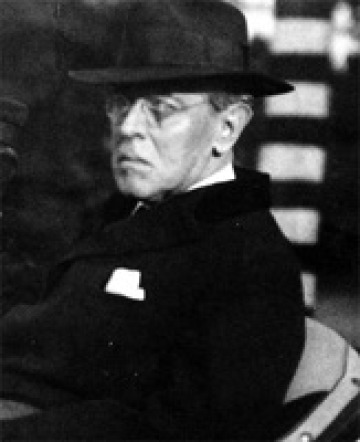
President Woodrow Wilson

Since some of you have written to ask if it is possible that President Joe Biden could be a lot more ill than we are being led to believe, let's talk about America's greatest presidential cover-up and President Woodrow Wilson in 1919. Wilson suffered a couple of severe strokes while in office. And no, instead of turning over control of the presidency to the Vice President, his handlers and his second wife refused to do that. In fact, President Wilson remained in office, even though he was at one point considered completely incapacitated.

How long did he remain in the White House after his strokes? His first stroke was not that long after taking office. His last stroke, the one that put him out of commission, took place in 1919. He was kept in the Oval Office, even though he was incapacitated for over a year. Yes, all the way up until the end of his presidency in 1921.

Historians note that Wilson had a history of cerebrovascular disorders before entering the White House.
In fact, unknown to the public at the time, Wilson was a professor at Princeton when he suffered his first stroke in 1896. Wilson's first stroke created lasting medical problems, which included ongoing numbness in his fingers, a great deal of weakness and loss of dexterity in his right hand, and off-and-on pain down his right arm. That was 16 years before entering the White House.

When Wilson had his strokes while president, he was still relatively functional for a while. Of course, because of his problems with his right hand from his previous stroke, and then his left arm, Wilson was limited as far as writing was concerned. 

In 1910, Wilson was elected Governor of New Jersey. Then in 1912, Wilson was elected President of the United States. The president's physician was Dr. Cary Grayson. He was recommended for the position by President William Taft since Grayson served as a part of Taft's White House medical staff.

Researchers report that Woodrow Wilson had his first stroke in 1896, another stroke in 1902, again in 1906, again in 1913, in 1915, and two in 1919. In fact, Wilson was only in office less than a year before he had his first stroke while in office. Woodrow Wilson's first wife Ellen reportedly took charge of his care. She reportedly consulted with several experts at the time. 

In August of 1914, Ellen Wilson died of Bright's Disease, which is a kidney ailment. While President Wilson is said to have become depressed and despondent over his first wife's death, I find it interesting that just five months later, he remarried his second wife Edith. Some say she was his mistress before Ellen died.

During the summer of 1915, Wilson became ill and was found to have the "warning signs of an impending stroke." Most believe that he had a stroke at that time. Some say Wilson was in a state of denial, while others say he was covering up his condition. 

Then right after World War I, Wilson was on a public speaking tour when he collapsed. That was at 10pm on September 25, 1919. He had earlier that night given a speech pushing for the creation of the League of Nations in Pueblo, Colorado. We know that his staff rushed him to Washington D.C. the next day. The day they were traveling back to Washington, his private secretary Joseph Tumulty put out a statement cancelling the remainder of the President's speaking tour because the President was "suffering from a nervous reaction in his digestive organs."

As the president's train sped back to Washington, all aboard knew that Presiden Wilson had suffered another stroke. While he could still walk and was even seen tipping his hat while making his way through Washington's Union Station, it was at this point that Wilson's true condition was covered-up.

Now enters America's First Woman President and the Great Cover-Up of 1919

According to the White House website on First Families, "Edith Bolling Galt Wilson was the second wife of the 28th President, Woodrow Wilson. She served as First Lady from 1915 to 1921. After the President suffered a severe stroke, she pre-screened all matters of state, functionally running the Executive branch of government for the remainder of Wilson's second term."

So how did that take place? Well, with the help of the President's private physician, Dr. Grayson, who by then was elevated to the post of Surgeon General, First Lady Edith Wilson took control of the White House. That was the case from September 28th when they returned to Washington after that speaking engagement in Colorado. Then, on the morning of October 2nd, 1919, Edith woke to find her husband, the President, unconscious.

During the night, President Woodrow Wilson suffered a massive stroke that left him blind in his left eye and his left side completely paralyzed. After being examined by Dr. Grayson, the doctor is said to have emerged from the president's bedroom with a horrible diagnosis. An extremely shocked Grayson reported, "My God, the president is paralyzed."

The First Lady and Dr. Grayson actually briefed the entire Cabinet and the president's political advisors together. During their discussion, it is said that the question of succession came up. Some say Edith had instructed Grayson not to sign an official notice of what took place. According to that story, when asked later to sign an official notice of disability, Grayson refused to sign anything that would effectively end the Wilson administration.

So, while there is disagreement about whose idea it was to withhold that information from the public, some say it was the First Lady, and others say it was Dr. Grayson and the president's senior political advisors, we do know that both they and the rest of the Wilson Cabinet worked in concert to deceive the American public regarding the extent of the President's actual medical incapacitation.

As for President Wilson, he finished his term in office through the actions of a cabal of actors all united with the intent of deceiving the public. Edith Wilson published her memoirs in 1939, and she called her actions after her husband became completely incapacitated "her stewardship." In her memoir, she stated emphatically that her husband's doctors, senior political advisors, and his entire Cabinet supported the cover-up. She supposedly just went along with the deception.

In 1921, both the President and First Lady left the White House and retired to a comfortable home in Washington. President Woodrow Wilson died there three years later. His second wife Edith died in 1961.

When asked my opinion about this by readers who want to know if this could ever happen again? My answer is simply this, probably. But really, I think it all depends on the amount of cooperation that the culprits get from the news media and inside the administration. I really believe that that's the only way such a cover-up would be perpetrated today. 

That's just how I see it.

Tom Correa


Tuesday, July 19, 2022

The U.S. Constitution Is Always Under Attack

We must all beware of a Federal Government that has zero respect for the Constitution of the United States. We live in an age when we are being bombarded with outright lies and misleading information.

Sadly though, there are hidden threats found among those lies. For example, we are lied to by our government to such an extent that they have lost almost all credibility. Part and parcel of their lies is to vilify our Constitution by making it the cause of our problems -- as well as making it the item that's presenting us with limitations to finding working solutions to some of our problems today. 

That has taken place when politicians attack the Constitution itself, attack and demean its framers, and accuse the Bill of Rights of being antiquated and useless today. By making claims that are not true, some in Congress hope to fuel a desire of some on the Left to repeal the 2nd Amendment altogether. Those enemies of America repeat their claim that we would all have a safer America if we would only repeal the 2nd Amendment. They shout their hatred for gun rights and our need for self-protection while pushing the lie that there would be no school shootings or any other mass killings if the 2nd Amendment was repealed. 

Let's remember that attacks on our Constitution began even before it was ratified. Read some of "The Federalist Papers," and you'll see how much opposition there was to the adoption of the Bill of Rights.

While I'd like to say that the attacks on our Constitution have been solely political by power-hungry politicians, they haven't been. The federal government and the fights between the three branches of our government have sometimes acted out in ways that can only be called assaults on our Constitution.

The concept of our Constitution goes beyond a written formula for a fledgling nation to use while attempting to form a government. For most of us, those of us who are proud to be Americans, we believe that the Constitution of the United States encompasses our fundamental principles. It contains instructions to the government, warnings to the government, and of course, it contains limitations to the federal government. But, it also tells the government, that we, the citizens of the United States of America, have a right to live life as we please. Our Constitution tells the government how Americans see our freedoms. As for its "spirit," the Supreme Court has upheld several statutes stating that the Constitution enables laws to be "in accordance with the spirit of the Constitution."

Friends, we have a Constitution that has been attacked at tested many times over our history as a nation. For example, the Alien and Sedition Acts of 1798 provided our nation with our first real tests of the limits of freedom of speech and the press. The Sedition Act was a set of four laws that made it a crime for American citizens to "print, utter, or publish...any false, scandalous, and malicious writing" about the federal government. Thankfully, it was repealed. It was not in the spirit of our Constitution. 

As for presidents testing their ability to violate our Constitution? It is still believed by some Constitutional scholars that President Thomas Jefferson violated the Constitution when he authorized the Louisiana Purchase in 1803. And during the Civil War, President Abe Lincoln was accused of violating our Constitution when he took it upon himself to call for enlistments without seeking Congressional authority. And no, that wasn't the only time that he was accused of infringing on the rights of Americans. 

Joe Biden has said, "The Constitution is not absolute" and "the 2nd Amendment has always limited what Americans can own in the way of guns." We should be concerned when politicians, especially a president, fail to see the importance of our Constitution as an "absolute." Yes, especially since politicians have tried attacking our Constitution for their own gains over the years. 

Take into consideration, for example, President Lincoln's suspension of habeas corpus during the Civil War. Called the "Great Writ" in law, habeas corpus is a fundamental right in the Constitution that protects all of us against unlawful and indefinite imprisonment. Habeas corpus has historically been vital to safeguarding American and preserving our individual freedom against arbitrary executive power.

President Lincoln suspended the "writ of habeas corpus" to give military authorities the necessary power to silence dissenters and rebels. His action was declared "un-Constitutional." He did so without the authority to do so. That was seen as a clear-cut case of violating the Constitution to fit his needs. And no, he wasn't the last president to violate the Constitution to meet his own agenda.

Of course, sometimes we, the citizens of the United States of America, forget the basic reason for creating our Constitution. We also forget the fact that the same reason why our Constitution exists is also the very same reason why politicians have relentlessly attacked it from its creation. That reason is simply that our Constitution is an operating manual for the federal government that limits government powers to stop the abuse of power of those in office. The Constitution is all about limiting government overreach. 

So no, no one should be surprised if Joe Biden sees the Constitution as an impediment to his governing. Frankly, no one should be surprised that a career politician like Joe Biden would say something totally un-American as "The Constitution is not absolute." After all, the Constitution limits what he can get away with.

And as for his statement, "the Second Amendment was never absolute." Biden should remember the words of the Second Amendment, as it states, "A well regulated Militia, being necessary to the security of a free State, the right of the people to keep and bear Arms, shall not be infringed." This is important since the 2nd Amendment is the only Amendment that uses such language as "shall not be infringed." 

And by the way, what we, the citizens of the United States of America, sometimes forget is that the language in the 2nd Amendment is not directed at us. It is directed directly at the federal government as a warning. It tells Joe Biden and politicians like him who want to infringe on our right to bear arms, don't. 

Americans don't have to justify why we need whatever firearm we want to own. That's our private business. The government has no right according to the Constitution to ask why we want to own a gun, or what we are going to use it for. The right of the people to keep and bear arms shall not be infringed, which means "shall not be violated by the government." 

Beware of a federal government that has zero respect for the Constitution. If for some reason, out of some ill-advised notion, those in power feel they can violate and possibly repeal the 2nd Amendment of our Bill of Rights, then they will try it. And if they are actually successful, then they will not see anything stopping them from violating and possibly repealing any of our other rights as spelled out in our Bill of Rights. 

This is why citizens must be vigilant of what those in power are doing. 

Tom Correa

Saturday, July 16, 2022

1895 -- 8th Grade Final Exam & Answers -- Subject: Biology

A Completed 8th Grade Final Exam 
Salina, Kansas, 1895

Here is a completed 8th Grade Final Exam -- Subject: Biology 

Biology (Time, 45 minutes) 

1. Where are the saliva, gastric juice, and bile secreted? What is the use of each in digestion? 

a.) Saliva is secreted in the mouth by the salivary glands. Saliva is a somewhat alkaline fluid that moistens the mouth, softens food, and aids in digestion. The submaxillary glands are located around the mouth under the lower jaw, the sublingual glands are located beneath the tongue, and the parotid glands are found in front of each ear. The buccal glands, in the cheeks near the front of the mouth, also secrete saliva. 

b.) Gastric juice is a thin, strongly acidic (pH varying from 1 to 3), almost colorless liquid secreted by the glands in the lining of the stomach. Its essential constituents are the digestive enzymes pepsin and rennin, hydrochloric acid, and mucus. 

Pepsin converts proteins into simpler, more easily absorbed substances; it is aided in this by hydrochloric acid, which provides the acid environment in which pepsin is most effective. Rennin aids the digestion of milk proteins. The mucus secreted by the gastric glands helps protect the stomach lining from the action of gastric juice. Gastric secretion is stimulated by several hormones and chemical substances, by the presence of food in the stomach, and by several psychological factors, such as the smell of a favorite food. 

c.) Bile is a yellowish-brown or green fluid secreted by the liver in the bile duct. This liquid carries away waste from the processes of the liver and helps in the digestive process. 

2. How does nutrition reach the circulation? 

Nutrients reach the circulation by absorption through the intestinal walls. The main purpose of the intestines is to take the partially digested food from the stomach and convert it into energy. 

The small intestine is about 20 feet long. The small intestine is divided into three sections, the duodenum, the jejunum, and the ileum. The small intestinal glands secrete intestinal juices that help with the digestive process. 

The liver dumps bile into the small intestine through the bile duct. The pancreas secretes pancreatic enzymes into the small intestine. Bile and the pancreatic enzymes break down fats, proteins, and carbohydrates. This partially digested mixture empties into the large intestine through an opening of the ileocecal valve. 

The large intestine is about 4 1/2 feet long. The large intestine is divided into six parts. They are the cecum, ascending colon, transverse colon, descending colon, sigmoid colon, and rectum. The large intestines' main purpose is to further digest the food, releasing nutrients into the blood and absorbing fluids. 

3. What is the function of the liver? Of the kidneys? 

a.) The liver is the center for the storage of vitamins and nutrients which are disolved and digested in the intestines. The nutrients are carried to the liver by two large veins. Blood passes through the liver at a rate of about 1 1/2 quarts per minute. At any given time the liver contains about 10% of all the blood in your body. The liver is divided into two main parts called lobes. The liver is protected by the bottom part of the ribs on the right side of your chest and the liver weighs between 3 and 4 pounds. 

The liver also works to make bile. Bile is used to break down fats in the small intestine. The bile is stored in the gall bladder until it is needed to help digest the food you eat. If you eat a real fatty food your body will need more bile to help digest those fats than it would need in comparison to a salad or some fruit. 

b.) The kidneys are bean-shaped organs, each about the size of a fist. They are located near the middle of the lower back, just below the rib cage. The kidneys are sophisticated trash collectors. Every day, the kidneys process about 200 quarts of blood to sift out about 2 quarts of waste products and extra water. 

The waste and extra water become urine, which flows to the bladder through tubes called ureters. The bladder stores urine until you go to the bathroom. The wastes in the blood come from the normal breakdown of active muscle and from the food we eat. Our body uses the food for energy and self-repair. After our body has taken what it needs from the food, waste is sent to the blood. If our kidneys do not remove these wastes, the wastes will build up in the blood and damage our body.

4. How would you stop the flow of blood from an artery in the case of laceration? 

If the laceration is in an arm or a leg, I would apply a tourniquet around the limb between the laceration and the heart, tightening it until the flow was stopped, loosening the tourniquet every 10 minutes to let blood pass to nourish the cells beyond the tourniquet, at the same time applying pressure over the laceration with a cloth pad to staunch the loss of blood. 

A laceration of the arteries of the neck obviously cannot be tourniqueted, so the only thing that can be done is to apply pressure with a cloth pad. Loss of blood and oxygen to the brain can quickly lead to death.

5. Give some general directions that you think would be beneficial to preserve the human body in a state of health.
 
a.) Regular meals of a variety of foods, both animal and vegetable. I like a lot of vegetables and fruits.

b.) Regular Exercise, which I get a lot of on the farm every day. Regular exercise keeps the muscles, heart, and lungs in good tone. 

c.) Regular Rest of from 7 to 8 hours sleep a night.
 
d.) Regular personal hygiene, brushing teeth, washing skin and hair with good soap, etc. every day. We usually get one good bath a week at home, heating well water on the stove, but in summer we swim in the river every day and wash there. 

Some good advice was provided to us along with the answers above. It's as follows: 

Make regular times of ease, prayer, and meditation each day. They help us think about and solve the problems of the day. God sometimes gives us answers to problems that we can't solve by ourselves and teaches us to ask for help with things we don't know, from our parents, teachers, and others that do know. It is great fun learning things that we don't know!

--- end of 1895 8th Grade Final Exam and Answers 

Time to take this exam: 45 Minutes

Editor's Note:

While I've tried to find out who took the time to answer the exam but haven't been able to, you should know that the answers are correct.

I've made the same comment and asked the same questions after each section in this series on the 8th Grade Final Exam given in Salina, Kansas, in 1895. First, after reading these questions and answers, I realize how dumbed down our society has become. Second, there are a lot of questions that we should be asking.

For example, here are a few questions to think about. How well do you think you would have done taking this 1895 8th Grade Final Exam? Do you think 4-year college students today can pass this exam? How about Teachers today, how would they do taking this exam? Would they be able to pass this test?

Lastly, I have to wonder why 8th Grade children in 1895 were able to pass this test versus 8th Graders today? Have we allowed things to change for the worse? Is it because the government had no input in the education system in 1895 versus their control over what children are learning today?

Just some things to think about.

Tom Correa


Sunday, July 10, 2022

Democrats, $6 Gas & $25 Alfalfa In 2022


It is getting harder and harder to put up with the stupidity of Democrats in an era when we have President Biden who can only read a teleprompter, not think for himself, and not see the harm that he is doing to our nation. 

We live in an era when Democrats want to eliminate the word "Mother" and substitute it with the phrase "Birthing Person." This is a time when Democrats see nothing wrong with allowing Drag Queens in elementary schools, allowing doctors to kill babies at birth, and allowing teachers to indoctrinate very young children in ways that are directly against the wishes of parents. It is an era when lunatic Democrats have found a way to get the President of the United States to halt domestic drilling for oil. 

To Democrats, those are all positives that our nation should embrace. And as ludicrous as it sounds, Democrats cannot fathom why Americans see them as out of touch, perverted and dangerous to our society.

Democrats don't see America as a land of good people. They see America as a land of slavery, racism, and lack of opportunity. They see America as a nation that needs a totalitarian Centralized Government in the form of an all-powerful federal government. They see Americans as children who need to be regulated and cared for. They refuse to see the goodness of individual liberty, the need for our assurances to safeguard us against government tyranny as stipulated in the Bill of Rights, or the greatness of our founding principles.

Democrats want to destroy America. That is not a secret as more and more Democrat politicians and their supporters have come forward to say that we need to dissolve our Constitution and deny basic freedoms to those who oppose them. In the same way that the Nazis destroyed the independence of the press in Germany with a series of draconian laws, Democrats are using draconian Environmental protection policies to limit our output of domestic oil. They understand that oil is the life-blood of our nation, and that's why they are attacking America's oil industry.  

It does not matter to Democrats that our oil industry provides 2.5 million high-paying American jobs, that the oil industry supports 11.3 million other American jobs, or that our oil industry accounts for about 8% of the American economy. In fact, on February 8th, 2020, Biden told a rally that he wanted to "get rid of fossil fuels." Before that, in 2020 during a Democrat debate, Biden emphatically promised his supporters that he would wage war on American energy dominance. In fact, he said, "No more subsidies for fossil fuel energy, no more drilling on federal lands, no more drilling, including offshore. No ability for the oil industry to continue to drill. Period." To give his Democrat supporters what they want, during Biden's first few days in office, he signed executive orders to shut down our oil industry. 

Because we are under attack, America has gone from a self-reliant oil producer with energy independence to now being forced to rely on other nations for our energy needs. And more so, by stopping the production of American oil, we are now facing shortages in raw materials that enable American manufacturing to produce the thousands of petroleum products that we use every day.

What have Democrats accomplished? Nothing good for America! 

Their domestic policies are responsible for Americans paying an average of $6 a gallon of gasoline and almost $7 a gallon of diesel fuel. This has increased the price of goods and food, and placed a hardship on blue-collar Americans. No, wealthy celebrities don't feel the pain that we do. They don't see anything wrong with the Democrat policies that have us paying so much at the pump. Wealthy Democrats can afford to pay more. 

Of course, Democrats can't see the big picture. They mostly live in cities and mainly see Americans as being urban people. Democrats don't understand what it takes for a farmer to grow food. In fact, I believe most Democrats have no idea of the hardship that they are placing on our agriculture producers because of their Environmental policies. I really believe they don't care what hardship others face. 

Democrat policies are the reason that people are having to plant their own gardens and work harder than before. Their policies are the reason that people are now having to sacrifice and go with less. Democrat policies are the reason that I paid $25 for a bale of alfalfa today. And while the Rescue Horses that I have are not even the slightest concern of wealthy Democrats who are always professing to be so caring, I blame Democrats for my having to look at the possibility of getting rid of the few Rescue Horses that I care for. Because of Democrats, I can't afford to feed the few Rescue Horses that I have. No, not at $25 a bale because fuel prices are so high. 

Am I angry about this? You damn right I am. I am very angry about that. I'm angry because this does not need to happen to us. We are a nation that sits on some of the world's largest oil reserves. And now, because of Biden and his Democrat friends, because of their insane Environmental policies, American agriculture can't afford to produce our food. 

Biden and his Democrat friends think this is not serious. Some of them even laugh about it while lying about who is responsible for this disaster. Well, I hope they pay in November. As for me, I will vote for any Republican who is against their policies. 

Tom Correa

Saturday, June 25, 2022

The Last of the California Rangers Tells Story of Stirring Times

William James Howard on his 97th Birthday
Washington Post
April 28, 1907

Syndicated story from The San Francisco Chronicle (1907):
 
Despite the fact that more than eighty years measure his age, Capt. W. J Howard recently made the long trip from Mariposa County to Berkeley alone in a covered wagon. He left his large holding in Mariposa to make an extended visit with son, Royal T Howard, of South Berkeley. The Captain has an extremely interesting history that should appeal to every resident of California, because of the fact that he is the sole survivor of the California Rangers, the famous troop which in the early days succeeded in bringing peace to the newly discovered gold county and law to the new State. With the years all the members of the Rangers have passed away and Capt. Howard has reached his twilight days.

The captain is enjoying a peaceful old age. He tells his children and his children's children of the many adventures he has met, but has given up looking for them. He has adapted himself to most of the modern appliances, but there are several things he finds it difficult to take up. One of them is the railroad. As long as he can make his way on horseback or in a wagon, he will have nothing to do with the steam cars.

THE CALIFORNIA RANGERS

Howard was breveted captain in the Mexican war. He was one of the twenty men appointed in 1853 by Gov. Bigler to suppress the lawlessness then rife. These men, later known as the California Rangers, were selected by a special act of the legislature empowering the governor to appoint this civil guard. It was at this time that the famous bandit, Joaquin Murietta, was terrorizing the southern part of the State, and things had come to such a pass that it became absolutely necessary that Murietta be captured. A reward of $3,00 was offered for the body of the Mexican desperado.

Murietta, as Capt. Howard tells the story, had become the leader of a band which stopped at nothing. Several murders were charged again him; he was accused of horse stealing and other serious offenses in the category of crime were chalked up against him. Of the twenty men who were appointed to hunt down the outlaw, Harry Love was chosen as Captain.

At the time of the gold excitement the Mexicans, who had flocked in large numbers, worked with a small bowl. The Americans came with their cradles and later with their sluice boxes, and long toms and commenced hydraulicing. 

 When the Mexican saw that they were being beaten in the race for wealth, they became jealous and envious and finally showed their displeasure with murder. It became so serious that it was unsafe for Americans to leave their tents and cabins. Out of this friction emerged Murietta, the greatest bandit of early California days. His depredations became such that it was necessary to organize a well-armed and brave body of men to hunt him down.

LOOKING FOR TWO DESPERATE MEN

All this the captain tells in a hearty, pioneer fashion. "The rangers started out in May 1853," to quote Howard. "We had orders to ransack every nook from Marysville to Los Angeles to find Murietta. At the same time, we were to look for two other men, Joaquin Corillo and Joaquin Vallanzuela. These were also desperate men, and we were taking no chances with any of them.

"On July 1 we received word that Murietta had stolen horses in Los Angeles. A plan was formed whereby the company was divided, one section shirting the coast and the other going through Fort Tejon. When we arrived a Los Angeles we found that Murietta had left. We also received definite information that he had fifteen men in his band. Stocked with his knowledge, we started back through Fort Tejon. We ascertained from the Indians, who had sold them food and buckskins, what route they had taken, and two days later we came upon the outlaw's camp.

"The camp was situated in a little cup of a valley, and we had the desperadoes surrounded before they were aware of their danger. A battle took place, which resulted in the total rout of the bandits, thirteen being killed and two taken prisoners. You see, we had this bad gang on the hip, and, although they put up a good fight, we put up a better one and came out ahead.

DEATH OF MURIETTA, THE BANDIT

"The fierce Murietta himself was killed. When the fighting was at its height , Murietta jumped upon his horse and attempted to escape. One of the rangers, John White by name, and fine, brave fellow, gave chase and opened fire upon the bandit, wounding him and bringing him to bay. He then commenced parleying with him, and it was at this juncture that the rest of us approached. We saw the two men in consultation, and, fearing that Joaquin would do White an injury, we opened fire and killed the bandit. It would have been avoided, but there are men who are too eager and will make trouble.

"It was finally decided that in order to show the government that the notorious robber was dead it would be necessary to have proof of his identity. In order to do this Murietta's head was cut off. One of the prisoners was asked who his companion had been, and he refused to answer. One of the rangers, I don't remember which, held the head before the captured bandit and threatened to decapitate him if he would not tell. 

The Mexican made a proud gesture, threw up his head, and informed him he could cut away. The threat was not carried out, however, and the prisoner was tied to a horse and we started on our return journey with him. We also made fast our other prisoner. One of these, the one who had so boldly defied us, we were destined to lose. 

Just before we come to a slough where passing was dangerous, we loosened the thongs which held him, and when we came to a place in the slough a little deeper than in the other portions he threw himself from the horse. He plunged into the water and sank rapidly to the bottom, not more than six feet deep, where he clung to the tulle's. George Chase was an expert swimmer, and tried to save the man, but the Mexican held fast and met his death in this manner. We voted him a brave man.

JUSTICE SWIFT IN THOSE DAYS

The other prisoner we took to Fresno, which in the early days was known as Millerton. Two weeks later he was hanged. For all this time he was handcuffed to me. He told me that he was not a bandit, but had been captured by Murietta. I believed he told the truth, but justice was swift in those days, and the Mexican's story was not generally believed. When we came to Millerton we had the head of Murietta placed in alcohol by Dr. Leach. Later it was identified, and we received our reward. 

We also brought back with us the hand of the infamous desperado, Three-fingered Jack, which was also put in alcohol. Three-fingered Jack put up a great fight, and was shot three times, at least twice fatally, before he finally succumbed. He fired his gun after he ahd been shot through the heart.

"Some time later the head of Murietta was taken to San Francisco, where it was placed on exhibition. It cost the curious twenty-five cents apiece to see the sight. Afterward it was taken to New York City, where it was again exhibited. In later years it was in Robinson's Museum, in San Francisco. At the time of the late fire it was lost and it is not known now what has become of it."

"Although our band had several close calls, there were not fatalities. We were in organization three months after this, at the end of which time peace was restored. We received $150 a month for our services. Never since did the Mexicans resort to any desperate acts of violence. We had succeeded in bringing them within the pale of the law.

WAGER WITH WIFE OF MURIETTA

"I would like to say a word concerning the wife of Murietta. It has been said that she was mistreated by the Americans, and that it was for this reason that Murietta became a bandit. I know that these stories are false. I had the best of opportunities for knowing the woman because for a considerable time she lived near me when I was camped down close to Hornitos. 

She was an extremely beautiful woman and was known as "Queen:" on account of her beauty and regal ways. At one time she bet me ten bottles of champagne, which was then extremely dear, that she was a better marksman than I. A soda water bottle was placed at sixty yards. I had no trouble in winning the wager, having always been proficient with a riffle. Not being a drinking man, I thanked her and refused the wine.

"There have also been a great number of stories told of Murietta which are not true. For example, he was never tied to a tree and whipped by the miners. Bancroft's history covering this period is in error. I would like to show up these errors, but I'm getting on in years now and don't think I will ever put the true facts in print. I am a much better man with a rifle that I am with a pen."

The captain has completed most of the manuscript of a book dealing with the stirring times in which he had taken part, but in a recent fire this labor of a long period was destroyed. He believes he will not rewrite it.

[Transcribers note: In 1928, Jill Crosely-Batts did complete a book on The Last of the California Rangers]

HAS ALWAYS LIVED AN OUT-DOOR LIVE

Capt. Howard was born in Virginia on August 26, 1826. In spite of his extreme age, he is hale and hearty. He has lived an outdoor life always. Since 1849 he has lived in California. Before he became a Ranger he fought the Indians and met with many adventures while thus employed. He has served several terms in the State legislature, has held county offices, and for years has been successfully a farmer.

Capt. Howard's life has been a series of adventures. In the many years that he has been a resident of California he has met with his fill of happenings, and if he should put the thrilling chain of events in which he played a part in their order in a book he would supply the reading public not only with an interesting volume, but of historical and instructive value. Conditions have changed since Capt. Howard helped to subdue the lawlessness of the early 1850s in this State. 

Today there is a new order of things, and a change which leaves no room for the rejuvenation of the old days when a gun was law and a rope in the willing hands of the vigilantes was used to enforce order. It was in these days that Capt. Howard was a competent actor, and was recognized as such by the men of his time. He was entrusted with many dangerous missions, often held the life of a man in his hand, and never took advantage of an unequal combat.

It was while Capt. Howard was holding the position of Sheriff at different times in Mariposa County that he showed anew what he could do as a peace officer. He was responsible for the deserts of many criminals and cleared up more than one mystery of murder and robbery. And all the time he held that office he never mistreated a prisoner. Kindness was his principle and with this, he did more than has ever been done by force.

FIRST ADVENTURE WITH THE INDIANS

Captain Howard has the following to say concerning his first adventure with the Indians: "in the year 1859 I owned the Buena Vista ranch, about four miles southwest of the town of Hornitos, on Burn's Creek, and in December of that year I had a large number of horses and mules stolen by the Indians. As soon as I discovered my loss I organized a party of twenty men and, after striking a trail of the desperados, we followed it as far as the Mormon Bar, where we met Maj. James Burney, who, in command of a body of volunteers, was out after the Indians also.

"We at once joined forces, and with Maj. Burney in command our force of over sixty men with James D. Savage as guide resumed the trail. On the Second day out, Savage made a report that the village was not very far off as he had heard the Indians singing.

"When we received the order to charge the enemy, we did so with a rush, scattering the Indians in all directions, but they soon rallied and as many of them were armed with old Spanish riles, they commenced to make warm work for us. Suddenly it occurred to me that I could charge to better advantage from behind a tree, and acting on this impulse I sought the shelter of a large pine. Evidently, the same thought had occurred to the others, as I found that Maj. Burney and John Sylvester were already in possession. However, the tree was large and we made it a point to stay close together.

"The first of our men to fall was Lieut. E. Skeqane, then Bill Little, who was shot in three different places. A little later Charles Houston got a bullet through his neck and Dick Tilasan had his nose shot away.

THOUGHT HIS FACE WAS SHOT AWAY

"Then to make matters worse (for me) I met with what I felt sure was a mortal wound. I exposed myself a little too much, and an Indian took a pot shot at me, which tore away the whole side of my face (at least I thought so), and toppled me over. Burney and Sylvester quickly pulled me back behind our friendly shelter where with hands pressed tightly over my mutilated face, I told them of the serious nature of the wound and called attention to the blood that was trickling through my fingers.

"They pulled my hands down to see how badly I was hurt, and then they burst into a hearty laugh. 'Why', they said 'you are not hurt at all, you are only crying,' and to my intense relief I found this to be true. The heavy ball from the Indian's gun had scaled off a large piece of bark from our tree, and this had struck me in the face with such force that it stunned me, and brought the tears to my eyes."

PERSONNEL OF THE CALIFORNIA RANGERS:

The following list was the personnel of the Rangers, as given by Capt. Howard: Harry Love, captain, was killed in Santa Cruz in a feud; Gen. B. Edward Conner died in San Francisco; William Burns, died in Stockton; Charles Bludworth, killed Snelling, Merced County, Thomas T Howard, died in Galveston; W. J. Henderson, died in Fresno; John White, killed at Fort Tejon; William Campbell, died at Kings River; Edward Campbell, died at Kings River; Augusta Black, killed in the civil war; Dr. Hollister, died in San Jose; Robert McMasters, died in Sacramento; George Evans, died in Santa Cruz; John Nutall, killed at Nicaragua; Geogre Nutall, died in Stockton; Nicholas Ashmore, killed at Salt Lake; James Norton, killed at Salt Lake; Ned Van Buren, killed in Contra Costa County, George Chase, drowned in the Fresno River, and Capt. W. J. Howard, living.

Editors Note: 

First, this syndicated news article appears here just as it did in The Washington Post in 1907. Second, the above story was transcribed by Carolyn Feroben for the Mariposa County Family Chronicles article, "THE CALIFORNIA RANGERS as told by Capt. W. J. Howard."

Lastly, I hope you enjoyed this look into our past through the eyes of an old lawman who was there. Reading his story of how things were supports my belief that history is something that we should observe and learn from. 

We should examine history to try to understand what was done and use it as a training aid so that we don't make the same mistakes again. Of course, the flip side of that is that we should also learn from our history so that we can recognize what works and subsequently repeat the successes of our past. Whether it's our love of country, our endeavor to preserve our history for future generations, our efforts to feed a hungry world, the alliances we've taken to stop genocide, our desire to free enslaved peoples, vanquish the evils of human traffickers, or our bringing justice to lawless lands, we should recognize that sound actions deserve repeating. 

While naysayers will undoubtedly point out where some have errored and stumbled, our history is replete with examples of altruism, heroism, selflessness, and self-sacrifice. That needs emulating. 

And that's just how I see things.

Tom Correa


Tuesday, June 21, 2022

Working hard: Cowboy poet tells it like it is


Story by Matt Meyers
April 12, 2022

Dave Knight of Keith County, Neb., is one of 11 inductees into the Sandhills Cowboy Hall of Fame this year.

Dave Knight represents the fourth generation of the H.H. Knight family who homesteaded and Kinkaided land in the North Platte River Valley, starting in 1886. Through the guidance of his father, Fred H. Knight, and mentoring from Bus Wendt, his life’s course was directed toward ranching.

At the age of 37, when his father unexpectedly passed away, he assumed the responsibility of managing the Red Rose and Red Cedar Ranches, located in Keith and Lincoln counties.

Today, looking back, his entire life has been devoted to ranching, stewardship of the land, and preservation of its history. He has become a dedicated cattleman, a reluctant mechanic of hay equipment, a former bull rider, a writer of cowboy poetry and music, and a community and church leader.

Dave is sometimes described as the Knight family curmudgeon. However, it’s known that his exterior covers an awfully soft heart that comes out in the care he provides for his mother, siblings, wife and family, neighbors, a herd of Red Angus/Hereford cows and calves, and his well-loved border collies.

His heart is reflected in the poetry and music he writes of the cowboy life.

Nebraska Sandhills Cowboy Hall of Fame chooses 2022 inductees Editor’s Note: The Sandhills Cowboy Hall of Fame is inducting 11 new honorees with a ceremony June 11 in Valentine, Nebraska. Each week through mid-June, we’ll meet the inductees.

Dave Knight was born in Keith County, on July 7, 1953, to Fred and Gertrude Knight. He was raised on the Red Rose Ranch established by his great-grandfather, where his mother still resides. In addition to his parents, Bus Wendt, who worked on the Red Rose for over 22 years, played an important role in Dave’s upbringing by teaching him about horses, horsemanship, fixing windmills, and how to fence your land properly. According to Bus, the objective of fencing was not only to keep your cattle in but, of maintaining goodwill with your neighbors – keep it straight and keep it tight! A good fence makes good neighbors.

To this day, according to his sister, Rita, “whatever Dave does, it is done the hard way, but it is done right!”


Another way of stating that fact is a Sally Haythorn reflection, who truthfully noted, “If there’s a hard way to do it, that’s how the Knights will proceed.” If truth is to be told, stubbornness may be a family characteristic Dave Knight has inherited.

In 1974, Knight married the love of his life, Deborah Huebner, and established a home on the Red Cedar Ranch, north of Keystone and part of the Red Rose. This is where they raised their two sons, Josh and Elijah, and now, with the addition of five grandchildren all under the age of 8, they continue to raise little cowboys and cowgirls. In addition, over the years, many young folks interested in the cowboy life have worked with Knight on the ranch and continue to return as members of his “extended” family.

The middle child of seven Knights – and being the first son with three older sisters – put him in an unenviable position where he learned he had to get along and be responsible. His siblings include Freida Lange of Lincoln, Valarie Olson of Brule, Bonnie Mueller of Ogallala, Rita Glenn (his sidekick in the hayfield) and also living on the Red Rose, Russell Knight of Lewellen, and Paul Knight, who has left the hayfield for New York City.

Dave Knight attended Ogallala High School where he excelled in football, wrestling, and track. Upon graduation, he studied at Winfield, Kansas to become a member of the Lutheran clergy, but left to join his father in running the ranches at Keystone. However, many will attest to the fact that he can still deliver some pretty eloquent sermons, generally delivered in the form of poetry and song which he has been writing, reciting, and singing for over 30 years.

He captures the life of a ranch in the words he puts together while waiting – waiting for that calve to be born, waiting to get into a wet hayfield, waiting for parts to come in, or waiting for his wife (captured in his poem, “Oregon or Bust”).

His venues of delivery vary from the family’s front porch, church and community gatherings, schools, meetings, reunions, and cowboy poetry gatherings across Nebraska, the Midwest, and Elko, Nevada.

His rodeo career was short-lived, but while active, it involved bulls and a father who didn’t share the same enthusiasm Dave had for the 8-second endeavor.

There was always the chance of injury and if injured, “You can’t do the work that needs to be done,” quoting his father.

Well, Dave actually stuck on pretty good, even winning a few belt buckles. But, sure enough, he did get hurt. However, by golly, he showed up for work!

So, while this was not a career that led to fame and glory, it certainly provided excellent fodder for cowboy poetry.

The same can be said for his work at the Ogallala Sale Barn, where he helped occasionally on sale days and ultimately gained profound inspiration regarding the idiosyncrasies of cattle and horses stimulated by his own personal broken leg, wrist, and finger (captured in a poem called, “The Bet”).

Throughout Dave Knight’s life, his love for family, friends, and western values has endured him to many. He’s ready to help anyone in need and his word is bond. He’s a man of integrity with deep appreciation for life lived simply. At the top of his commitments is his faith, undoubtedly instilled by his mother.

All of these attributes come out in his book of poetry, “Wrecks, Rhymes, and Ranchin’” poems that range from love of his wife to his intense dislike of the snow – with Noah’s Ark, vegetarians, and the U.W. Mail somewhere in between.


For a number of years in the 1980s he was part of the Front Street show in Ogallala, adding his talents to “The Old Time Gang,” that entertained the local citizens as well as tourists going through the area.

He serves on the board of directors that preserves the world-famous Little Church at Keystone, thus helping to support the history of his community. In addition, Knight volunteered many years to service to the Keystone/Lemoyne Volunteer Fire Department (KLVFD) contributing to the efforts of the dedicated individuals who continue to be on call to help maintain this Sandhills land and its communities.

For years he has been part of the election board for Whitetail Voting District where you could count on him to good-naturedly tease any incoming voter. He has served his home church in a variety of capacities including Sunday school superintendent and he continues to serve his church as an elder.

At this point in life, he is trying to retire but it is hard to let go. He was born to the ranch life, wakes in the morning to the needs of the cattle, and continues to look out onto the valley that has nurtured six generations of Knights. Nebraska and its Sandhills are home and Knight definitely has sand in his boots.

The Sandhills Cowboy Hall of Fame inducted 11 new 2022 honorees at a ceremony on June 11 in Valentine, Nebraska. 

Editor's Note:

This article was sent to me by a friend, Tom Graves, who knows Dave Knight. After reading the article above about Mr. Knight, I totally agree with Tom when he wrote to say, "Good guys like Dave rarely get the attention they deserve. Seven days a week in the Nebraska heat, cold, and wind deserves a medal."

Yes, Tom's right. And sadly, the public doesn't know or understand what it takes to provide our nation with food. Most don't realize what ranchers and farmers have to do. And frankly, I truly believe that most people today don't appreciate the personal commitment, the physical toll, the toil, and dedication that that way of life requires. 

And no, it's not just a job. It's a way of life. It's a way of life that takes rising early every day, swallowing any gripes about how early one's days start, the poor pay, the lousy benefits, the changing conditions, the cold, the snow, the wind, the dust, and of course the sweltering heat. While it sounds like a life not worth living, it is to those who live it. And while the hardships are all parts of a way of life, it is a way of life unknown to most who have never or will never live that life. Of course, that's the life that Dave Knight knows so well because that's the life of a true American Cowboy. Yes, Dave Knight is a true American Cowboy. 

I am very grateful and flattered that my friend Tom Graves suggested that I post Dave's story here. Of course, this story is being reprinted here on The American Cowboy Chronicles with the permission of its author Matt Meyers. My thanks go out to Mr. Meyers for allowing me to post this story here. 

Thank you so much.
Tom Correa


Tuesday, June 14, 2022

Biden loses control of inflation, and the trust of the American people


By Liz Peek 
Fox News
June 14, 2022

Americans have lost faith in government leading to "The Great Distrust"

Remember how President Joe Biden wanted to be an historic president — pointedly hanging FDR’s portrait over the fireplace in the Oval Office?

Turns out, as we now officially fall into bear market territory and Americans are getting poorer by the minute, Biden’s dreams are coming true.

Already, Biden has notched some historical firsts.

For example, consumer sentiment plummeted in June to the lowest level ever recorded in the 70-year history of the University of Michigan index. It is a stunning collapse, not seen even during the darkest days of the COVID-19 scare. The index fell to 50.2 from 58.4 in May – already a recession-level reading – and was far below the 58.1 projected by economists.

Stock Market Data, Stock Market and Exchange, Stock Market Crash, Dollar Sign, Moving Down

Meanwhile, the New York Federal Reserve just reported that consumer expectations for inflation hit a record level in May, as did pessimism about the stock market.

It seems the country has never been so gloomy. Way to go, Joe!

These are remarkable achievements, considering that most people who want a job can get one. Almost half the respondents to the Michigan survey noted gasoline prices or inflation generally as a reason for their pessimism, but clearly there is something else going on.

I call it The Great Distrust. Simply stated, Americans have lost their confidence in our leaders, our institutions (think FBI, Congress, public education, CDC etc.) and, most especially, our president. We are trying to keep our balance on an ever-shakier foundation, trying to move forward as the pillars of our country are eaten away by a rising tide of political discord and dishonesty.

At the heart of that corrosion: President Joe Biden.

Consider Biden’s recent speech at the Port of Los Angeles, where he addressed inflation which he alternately called his "top economic priority" and "Putin’s tax on both food and gas."

Biden’s speech went way beyond his usual misleading blather about "creating" 8.7 million new jobs since he took office and "cutting the federal deficit by $1.7 trillion."

It wasn’t the only time: "Millions of Americans are moving up to better jobs and better pay." Actually, real wages tumbled three percent over the past year.

"And since I took office, families are carrying less debt on average in America. They have more savings than they’ve had." Reality: debt is rising and personal savings are falling.
 
"What economists call ‘core inflation’ — moderated the last two months." Reality: core inflation of 0.6 percent in June remained at the highest level recorded over the past six months.

Things are far gloomier for Americans than the White House pretends.

These are little lies, but Biden’s White House indulges in Big Lies, too. Lies about voting rights and border security and the imminent danger posed by climate change.

But it is lies about the economy that are convulsing our markets and that could well lead us into recession.

First up, is not admitting that spending $1.9 trillion from the Democrat-only American Rescue Plan ignited inflation.

When Biden signed that bill, spewing hundreds of billions of dollars to Americans sitting on $2.5 trillion in excess savings, the country was growing at six percent and recovering rapidly from the COVID-19-induced downturn. Biden claims the economy was on the brink of recession when he took office and required the lavish handouts; that is not true.

Biden is not honest!

Not being honest about the source of inflation — excess spending — means Biden can continue to pretend that his Build Back Better program, realistically estimated to cost $3-$5 trillion, would reduce inflation. Nobody believes that, including those 17 Nobel laureates the president often cites as having endorsed the giant bill.

The Washington Post did a survey of those academics and, no surprise, many backtracked from the assertion that BBB would lower prices.

Americans no longer believe in Biden. When Biden was inaugurated, 47 percent of Americans considered him honest, while 36 percent did not; today, he is underwater by roughly six points.

The turn came when he misled Americans about the disastrous pull-out from Afghanistan, which left 13 service members dead. He said he hadn’t been warned about the risks of a hasty departure; in an extraordinary breach of decorum, his most senior military officials, including Defense Secretary Lloyd Austin and Chairman of the Joint Chiefs Mark Milley disputed that claim.

U.S. Treasure Secretary Janet Yellen makes a speech at the COP26 U.N. Climate Summit in Glasgow, Scotland, Wednesday, Nov. 3, 2021. (AP Photo/Alberto Pezzali)

A president who loses the trust of his country will pay a hefty price, but so do his constituents. We are witnessing that today, as stock prices crash.

Investors are not just responding to lower earnings estimates and higher interest rates; they are also selling assets because they have zero confidence that this White House and this president have any idea how to put our economy back on a sounder path.

After dismissing rising alarms about inflation, and then fabricating endless excuses as to why they were not responsible, the people in charge have ceded their credibility.

His advisors, including Treasury Secretary Janet Yellen, have shown themselves to be shills for Democrats’ big spending agenda, not thoughtful stewards of our economy.

Biden and his team advocate for proposals that are an unwelcome reversion to Obama-era anti-business policies, which caused the slowest-ever recovery from a recession.

They argue it wasn’t higher taxes and increased regulation that sapped business confidence and stalled investment after the Great Recession, but rather that the amount of stimulus money shelled out to stimulate the economy was too small. After spending more in the past three years than was sent went to wage World War II, we are seeing the danger of such an approach.

Most crazily, Biden continues to plug for the Green New Deal and renewable energy, refusing to unleash the greatest of all American comparative advantages — our huge oil and gas reserves. This, even as polling shows Americans frantic about the soaring price of gas at the pump and blaming Joe Biden for the increase.

Can anything turn around Joe Biden’s sinking fortunes and revive America’s innate optimism? He could start by being honest — about our problems and about possible solutions.

That seems a long shot.

Liz Peek is a Fox News contributor and former partner of major bracket Wall Street firm Wertheim & Company. A former columnist for the Fiscal Times, she writes for The Hill and contributes frequently to Fox News, the New York Sun, and other publications. 

For more visit LizPeek.com. Follow her on Twitter @LizPeek.

Editor's Note:

If you think this doesn't have anything to do with Cowboys, Ranchers, and Farmers, that this is somehow "just politics" and has very little to do with us who live in rural America, please click on the following link: 

Tom Correa

Sunday, June 12, 2022

Marines Identified In MV-22B Mishap


Article by Maj. Mason Englehart
3rd Marine Aircraft Wing
11 JUN 2022 |
 

MARINE CORPS AIR STATION MIRAMAR, Calif. --

The five deceased Marines from the MV-22B Osprey mishap on June 8, 2022 have been identified. All were assigned to Marine Medium Tiltrotor (VMM) Squadron 364, Marine Aircraft Group (MAG) 39, 3rd Marine Aircraft Wing (MAW) and were based at Marine Corps Air Station Camp Pendleton, CA. The identities of the Marines are below.

Cpl. Nathan E. Carlson, 21, of Winnebago, Illinois, a Tiltrotor Crew Chief.

Capt. Nicholas P. Losapio, 31, of Rockingham, New Hampshire, an MV-22B Pilot.

Cpl. Seth D. Rasmuson, 21, of Johnson, Wyoming, a Tiltrotor Crew Chief.

Capt. John J. Sax, 33, of Placer, California, an MV-22B Pilot.

Lance Cpl. Evan A. Strickland, 19, of Valencia, New Mexico, a Tiltrotor Crew Chief.

"It is with heavy hearts that we mourn the loss of five Marines from the Purple Fox family," said Lt. Col. John C. Miller, Commanding Officer of VMM-364. 

"This is an extremely difficult time for VMM-364 and it is hard to express the impact that this loss has had on our squadron and its families. Our primary mission now is taking care of the family members of our fallen Marines and we respectfully request privacy for their families as they navigate this difficult time. We appreciate all the prayers and support from the strong extended Purple Fox family and want them to know that more information will be forthcoming on how to help."

At the time of the mishap, the MV-22B Osprey and crew were conducting routine flight training. The mishap is currently under investigation.

Out of respect for the friends and families of the deceased and the Marines and Sailors of VMM-364, please direct all questions to the 3rd MAW Communication Strategy and Operations office at 3rdmawmedia@usmc.mil.

Editor's Note:

"The Bell Boeing V-22 Osprey is a multi-mission, tiltrotor military aircraft with both vertical takeoff and landing (VTOL) and short takeoff and landing (STOL) capabilities. It is designed to combine the functionality of a conventional helicopter with the long-range, high-speed cruise performance of a turboprop aircraft. ... The United States Marine Corps (USMC) began crew training for the MV-22B Osprey in 2000 and fielded it in 2007. It supplemented and then replaced their Boeing Vertol CH-46 Sea Knights helicopters," per Wikipedia. 

My prayers are with the families of those Marines. God Bless them all.

Tom Correa

1895 -- 8th Grade Final Exam & Answers -- Subject: U.S. History

A Completed 8th Grade Final Exam 
Salina, Kansas, 1895

Here is a completed 8th Grade Final Exam -- Subject: U.S. History 

1. Give the epochs into which U.S. History is divided 
2. Give an account of the discovery of America by Columbus 
3. Relate the causes and results of the Revolutionary War. 
4. Show the territorial growth of the United States 
5. Tell what you can of the history of Arizona 
6. Describe three of the most prominent battles of the Rebellion. 
7. Who were the following: Morse, Whitney, Fulton, Bell, Lincoln, Penn, and Howe? 
8. Name events connected with the following dates: 1607, 1620, 1800, 1849, and 1865.

1. Give the epochs into which U.S. History is divided.

The History of the United States of America is divided into several epochs:
  1. Period of Discovery and Settlement (1492 - 1690)
  2. Expansion of the Colonies (1690 - 1763) 
  3. Securing Independence (1763 - 1774) 
  4. The Critical Period (1774 - 1780) 
  5. Testing Self-Government and the Constitution (1780 - 1840) 
  6. Straining the Constitution (1840 - 1876) 
  7. The United States - A Greater Nation (to present) 
2. Give an account of the discovery of America by Columbus. 

Although Leif the Lucky, known to history as Leif Ericson, a hardy Norseman from Greenland, discovered and established outposts along the northern coasts of America fully 500 years before Columbus, Christopher Columbus, a Genoese Italian mariner, is generally accredited with the modern discovery of America, although he never set foot on the mainland. 

In his boyhood, Columbus had studied drawing, geography, and astronomy. He had been a sailor on the Mediterranean. He made his way to Lisbon, Spain, where he became a mapmaker, under the tutelage of a mariner whose patron was Prince Henry the Navigator. Becoming convinced that the world was a sphere, he sought to prove that the shortest distance to the East Indies was by sailing westward. He had the map of Toscanelli and believed it was correct. 

Probably about 1474 he began to seek the means to furnish a fleet, seeking aid from Genoa, Portugal, Venice, France, and England. The King of Portugal sent a secret expedition westward to test the idea of Columbus, but they returned without sighting land. For ten long years, Columbus endured these rebuffs, and secretly left Portugal for Spain toward the end of 1484. 

Queen Isabella finally gave her approval and remained his best friend for the rest of her life. She furnished fully half the money needed for the voyage. The fleet consisted of three vessels, small caravels furnished by the town of Palos. The largest, the Santa Maria was only sixty-three feet long and twenty feet in breadth. She had a small cabin, while the other two, the Pinta and the Nina were open boats with high bows and sterns, the better to ride the waves. Columbus commanded the Santa Maria as well as the fleet. The captains of the other two boats were the brothers Pinzon. 

They sailed from Palos on August 3, 1492, and headed into unknown waters. It was not long before the crews wanted to turn back, threatening mutiny, as all kinds of fears and superstitions troubled them. The courage and determination of Columbus was equal to every occasion, holding the crews to their work. Early on the morning of October 12, 1492, they sighted one of the Bahama Islands. They had found a new world. Columbus thought he had found a part of India, and so he called the natives there Indians. They have been called Indians ever since. But we know they are not, they are the native Americans. We celebrate October 12 as a school holiday, Columbus Day. 

3. Relate the causes and results of the Revolutionary War. 

The causes of the War for Independence from Great Britain were many. The colonies had by 1763 already shown independence by quarreling with the royal governors, insisting on ever-greater measures of self-government. In 1763, after the Treaty of Paris, France created New France, the province of Quebec. A line was drawn along the mountain sources of the rivers flowing into the Atlantic, and the colonies were forbidden to plant settlements beyond that line. 

In 1760 George III had become king and his attempts at arbitrary rule made the Englishmen at home fear for their liberties and finally helped drive the colonials into a rebellion. 

George tried to enforce Cromwell's old Navigation Act of 1651 to stop smuggling which was the life-blood of the colonials. To do this a mean measure was adopted. This was the issuing of Writs of Assistance. These were search warrants in blank. Any officer of the crown could write anybody's name in the blank line and proceed to search on the suspicion of there being smuggled goods in his home or store. Boston merchants resisted, engaging a lawyer James Otis to take the case to court. 

The case was lost, but Otis made the most eloquent speech that echoed through all the colonies. Among other things, he claimed that "a man's home was his castle." When the case was lost, John Adams and the others left the crowded room ready to take up arms against the Writs of Assistance. "Then and there," wrote Adams, "the child, independence, was born." 

The wrangle over taxation culminated with the Stamp Act of 1765. The colonials did not object to taxes, they knew that government costs money and that it was the duty of every citizen to pay his just share of the tax. But they objected mightily to the method of levying and collecting taxes. In Great Britain, no tax could be levied without the consent of Parliament. In the colonies, no tax could be levied without the consent of the legislatures. The colonials shouted: "Taxation without representation is tyranny!" 

King George and his ministers paid no attention to the legal rights of the colonials. Seeing that the Navigation Acts were not defeating smuggling, they adopted a new tax scheme, the Stamp Act, whereby every legal document, every newspaper, every bill of merchandise, and almost every form of paper had to bear an official stamp. Benjamin Franklin was in London as an agent for Pennsylvania and tried to prevent the enactment of the law, but he said he might as well have tried to prevent the sun from setting. 

From then on, throughout the larger cities, the colonists organized a secret society, "The Sons of Liberty." They opposed the Stamp Act in every possible way and were by no means gentle in their methods. The Stamp Act was repealed in 1766, but replaced by the even more onerous Townshend Acts of 1767. Samuel Adams, the "Father of the Revolution" started a new and effective kind of resistance, drawing up a circular letter, which was adopted by the Massachusetts legislature and sent to the other colonies. This produced a united action of protest against the new acts. 

General Gage arrived with four regiments as the new military governor of Massachusetts to enforce the acts. On June 17, 1774, Samuel Adams introduced a resolution to the legislature calling for a Colonial Congress to combat these oppressive measures and acts. Gage heard about the resolution and hurriedly sent a messenger to deliver a proclamation dissolving the assembly. The messenger found the door locked and was not opened until the resolution was adopted. From then on the rest is history. 

The First Continental Congress met on September 5, 1774. From that moment it was clear the colonies were ready to lay aside all their differences in the presence of threatened attacks upon their liberties. 

4. Show the territorial growth of the United States. 

After the War for Independence, the acknowledged boundaries of the United States in 1783 were: On the north the St. Lawrence River and the Great Lakes, on the west the Mississippi River, and on the south, the northern border of the Floridas extending eastward from the mouth of the Mississippi, and of course, on the east the Atlantic Ocean. 

In 1803, President Thomas Jefferson acquired the ownership of the French province of Louisiana, a vast tract extending from the Gulf of Mexico at New Orleans west to the mountain sources of the Mississippi tributaries, more than doubling the size of the United States. He purchased the territory for $15,000,000 from Napoleon, then at war with Britain. He had rather see it in the hands of the Americans than see it captured by the ancient enemy of France. The invention of the steamboat quickly opened up the settlement of the territory. 

In 1819 the Floridas were purchased from Spain, after a treaty framed by John Quincy Adams, for $5,000,000, securing the southern border and the whole of the Atlantic seaboard. General Andrew Jackson, sent to stop Indian troubles along the Florida border with Georgia had, for all intents and purposes, already militarily secured the area. 

By 1843 the northern border between Canada and the US west of the Great Lakes was fixed along the 49th parallel and included all of the Oregon country below that line to the Pacific Ocean. 

In 1835 Texas seceded from Mexico, and at once asked for admission to the Union. President Van Buren refused his assent, fearing war with Mexico. Texas then became the "Lone Star Republic." Northern opposition to annexation weakened by 1845 and the Polk administration and Texas was admitted as a slave state. 

Due to the dispute over the southern boundary of Texas, when Mexicans crossed the Rio Grande on April 23, 1846, and killed every man of a small army scouting party, war was declared with Mexico, on May 13, 1846. General Zachary Taylor, immediately after the ambush of the scouting party, began to prosecute the war and routed the Mexicans. 

Subsequently, much of Mexico was conquered including Mexico City, which practically ended the war. With the treaty of peace of 1848, in which we annexed all of California and New Mexico, we paid Mexico $15,000,000 "in consideration of the extension acquired by the boundaries of the United States," as the words of the treaty put it. 

It was thought that the boundary dispute was now settled, but another arose over the boundary of what is now Arizona and New Mexico. This was settled by acquiring more land in 1853 and paying an additional $10,000,000. Such now are the boundary extents of the United States of America. 

5. Tell what you can of the history of Kansas. 

Kansas has had a dramatic history, even before it became the 34th state in 1861. Historians have reported that Native Americans were living in Kansas as early as 12,000 B.C. They were followed for centuries by many different tribes making the history of Kansas entwined with the first Americans. 

Between 1541 and 1739 explorers from Spain and France came to the area in search of gold, knowledge, and trade with the Indians. In 1803, Kansas became a part of the United States as part of the Louisiana Purchase. Fifty-one years later it was organized as a territory, which included the eastern half of Colorado. 

Conflict over slavery led to bloody battles between free-staters (anti-slavery) and pro-slavery forces. This led to the attack on Lawrence by pro-slavery forces and the widespread public outcry associated with "Bleeding Kansas." Kansas became part of the United States as a free state in 1861. 

After the War for Southern Independence, expansion of the rail system to Kansas, and the increasing stream of immigrants lured to the state by offers of cheap land, Native Americans were forced into smaller and smaller reservations. Ultimately their removal to Indian Territory forced the final confrontation in the late 1870s that ended the independent life of the Native Americans. 

The establishment of military posts to protect the railroads and trails used by immigrants led to the establishment of small towns, which followed the posts. By 1870, the Kansas cow towns, following the westward expansion of the railroads, became well established. Such towns as Dodge City, Abilene, Caldwell, Newton, Wichita, and Salina took their turns as the Queens of the Trail. To this day, the cattle industry remains an important part of the state's economy. The introduction of Turkey Red Winter Wheat by Mennonites from Russia in 1874 was a milestone in Kansas agriculture. The wheat was ideally suited to the Kansas climate and has made Kansas one of the leading wheat-producing states in the nation. 

6. Describe three of the most prominent battles of the Rebellion. 

a) The Battle of Chancellorsville, May 2 - 3, 1863 marked the turning point for the Confederates, even though it was a victory. General Thomas "Stonewall" Jackson was killed and as General Lee said, he had lost his "right arm". 

b) The Battle of Gettysburg, July 1-3, 1863, was the greatest battle of the world at that time. The Confederates were elated with their victories at Fredricksburg and Chancellorsville. Because of that, General Lee was urged to carry the war into the North and compel the granting of a peace satisfactory to the South. With an army of 70,000 men, he crossed the Potomac and marched across Maryland and into Pennsylvania. 

There, he was overtaken by the Army of the Potomac, 90,000 strong, under General Meade at the village of Gettysburg. On the first and second days, the Confederates gained ground and control. On the third day, the Union troops ceased firing to let the cannons cool. Lee thought that he had "silenced" the enemy's guns, and ordered Pickett's Division of Infantry to charge across the valley and pierce the Union lines. 

As 15,000 men marched out of the forest of oaks into the open valley, the Union cannons opened fire. Great holes were torn in the ranks. As they drew nearer the Union rifles mowed them down. They closed ranks, charged the ridge, and the advance had reached a hand-to-hand fight when "retreat" was sounded, leaving the valley strewn with dead. The point reached by that charge is marked by a monument in the form of a large bronze book on which is inscribed, "High-water Mark of the Rebellion." 

c) The Siege of Vicksburg, May 19 to July 4th, 1863, returned control of the entire Mississippi River and valley to the Union. Grant and Sherman had been repulsed in their first attempts to take that stronghold. Grant moved his army down the west bank of the river. He had his gunboats run past the forts and marched his troops below Vicksburg, and re-crossed for an attack from the rear. 

He got between the Confederate armies of Generals Johnston and Pemberton, made Johnston retreat, and drove Pemberton, after hard fighting, into Vicksburg. Grant then settled down (May 19) for a siege. Continually bombarding the city, he cut the city off from all supplies until the people were forced to eat the mules and rats. There was no relief and no escape. Pemberton surrendered with 32,000 prisoners (July 4), and the Union soldiers promptly shared their food with the starving men, women, and children. 

7. Who were the following: Morse, Whitney, Fulton, Bell, Lincoln, Penn, and Howe? 

Samuel F.B. Morse -- inventor of the telegraph in 1840. After waiting for four years for the needed help, the first telegraph line in the world was built from Washington, D.C to Baltimore, and on May 24th, 1844, Professor Morse tapped out the first message "What hath God wrought?" in the Supreme Court room and it was returned from Baltimore. Those four words from the Bible announced one of the greatest inventions in the world's history. 

Eli Whitney - Inventor of the cotton gin in 1793, which made raising cotton profitable in the South. Without the gin, slave holdings had been becoming unprofitable and were dying out. Before the gin, it took a day's work by a slave to pick the seeds from a pound of cotton. With the gin, a single slave could separate and clean a thousand pounds of cotton a day. This led to the expansion of cotton plantings all across the South into Texas, releasing slaves to do field work instead of picking cottonseed from the linters, greatly prolonging the institution of slavery in the South. 

Robert Fulton - the inventor of the first successful steam-powered paddlewheel boat, the Clermont. It was powered by an engine brought from England. On March 11, 1807, it paddled up the Hudson River from New York to Albany, a distance of one hundred and fifty miles, in thirty-two hours. That was an event far greater than a victory in war, for it increased the power and advanced the civilization of the whole human race. The era of the steamboat has opened up the West, the rivers the highways of commerce. There have been over 10,000 steamboats operating on our rivers. 

Alexander Graham Bell - inventor of the telephone, which made possible long-distance voice communication between people everywhere. The invention of the telephone grew out of improvements Bell had made to the telegraph. In 1875, along with his assistant Thomas A. Watson, Bell constructed instruments that transmitted recognizable voice-like sounds. Bell's first telephone patent was granted on March 7, 1876. The first telephone company, Bell Telephone Company, was founded on July 9, 1877. We have a telephone in our house in the hall. The line from our neighbor's to our house runs through the barbed wire on our fences. 

Abraham Lincoln - a Representative from Illinois and 16th President of the United States; born in Hardin County, Ky., February 12, 1809. He moved with his parents to a tract on Little Pigeon Creek, Ind., in 1816 and attended a log-cabin school at short intervals and was mostly self-instructed in elementary branches. He moved with his father to Macon County, Ill. in 1830 and later to Coles County, Ill. He read the principles of law and worked on surveying. 

During the Black Hawk War, he volunteered in a company of Sangamon County Rifles organized on April 21, 1832, and was elected its Captain and served until May 27 when the company was mustered out of service. He reenlisted as a private and served until mustered out on June 16, 1832, returning to New Salem, Ill. 

He was unsuccessful as a candidate for the State House of Representatives. He entered business as a general merchant in New Salem and was postmaster of New Salem from 1833-1836. He became deputy county surveyor from 1834-1836. Elected a member of the State House of Representatives in 1834, 1836, 1838, and 1840, he declined to be a candidate for renomination. He was admitted to the bar in 1836, moved to Springfield, Illinois, in 1837, and started a Law Practice. 

He was elected as a Whig to the Thirtieth Congress (March 4, 1847-March 3, 1849) but did not seek a renomination in 1848. As an unsuccessful applicant for Commissioner of the General Land Office under President Taylor, he was tendered the Governorship of Oregon Territory but declined. Again he was an unsuccessful Whig candidate for election to the United States Senate before the legislature of 1855 and again an unsuccessful Republican candidate for the United States Senate in 1858. 

He was elected as a Republican President of the United States in 1860 and reelected in 1864, serving from March 4, 1861, until his death by assassination. He was shot in the head by the actor John Wilkes Boothe as he attended a play at Ford's Theatre in Washington, D.C., on April 14, 1865. He died the following day, April 15, 1865. He was our president and Commander-in-Chief during the War Between the States and determined that the Union should not perish. 

William Penn - The founder of the colony of Pennsylvania in 1682, who had earlier bought the Jerseys as a refuge for Quakers. He was a prolific writer, and his greatest book was entitled "No Cross, No Crown", which gained him a reputation even among those who hated his religion. The king of England owed Penn's estate a very large debt, fifteen thousand pounds, and by granting Penn's request for a tract of land, settled the debt. 

When the boundaries were finally set, the tract contained about 45,000 square miles. Penn was liberal to all white men and Indians, early deciding that in Pennsylvania there should be perfect freedom of conscience and freedom of worship. Knowing that people loved freedom of government as well as freedom of conscience, he decided that the people themselves should rule. In 1683 he laid out the plan of a city, which he called Philadelphia, meaning "brotherly love." 

All treaties and agreements that were made with the Indians and others were faithfully kept. The government that Penn established for his colony was true to his promises of freedom. Each settler as he became a landholder or taxpayer had the right to vote, electing the members of the council and the assembly. The people, in that way, made their own laws. 

The first laws provided for the kind treatment of the Indians, that prisoners should be treated humanely, that each child should be schooled and taught a trade, that trial by jury should be extended to all, and that death should be the penalty for only two crimes, murder, and treason. His beneficent understanding of the importance of freedom to the prosperity of a people presaged much of the ideals of our Constitution. 

Elias Howe - Inventor of the sewing machine, was the son of a Massachusetts farmer, and worked in a factory for fifty cents a day. In his spare moments he worked on his invention, which appeared in 1845 as the first sewing machine. His patents earned for him more than two million dollars. 

8. Name events connected with the following dates: 1607, 1620, 1800, 1849, and 1865? 

1607 - Establishment of Jamestown colony, May 1607, in what is now Virginia. Captain John Smith had but one rule, "He that will not work shall not eat." 

1620 - On December 21, 1620, the landing of the Pilgrims in Plymouth harbor began the settlement of New England under William Bradford, loved and respected as a man of courage and gentleness from the time of his first election as governor in 1621 until his death in 1657. Myles Standish was the captain of the little army protecting the colony, a wise, courageous and helpful soldier, kind to the sick and needy. 

1800 - In the election of 1800, Thomas Jefferson and Aaron Burr received an equal number of votes. As the Constitution provided that the person having the greatest number should be president, it became the duty of the House of Representatives, voting by states, to decide between the two. 

After thirty-five ballots the choice fell upon Thomas Jefferson, our third and greatest president, author of the Declaration of Independence, and the mentor of James Madison, "Father of the Constitution". It was on Jefferson's insistence that Madison championed the first 10 articles of amendment to the Constitution, "The Bill of Rights." 

1849 - The Gold Rush to California began after the discovery of gold at Sutter's Mill on the American Fork of the Sacramento River in February 1848. The great discovery was made just as California became American territory. In the first year, more than 80,000 men flocked to the "diggings", risking all to the dangers from Indians, starvation, accidents, mountains, deserts and plains, tropical fevers, and of the sea in the voyage around Cape Horn. 

The rapid growth of California in people and business greatly affected the nation as a whole. At that time 300,000 people every year were streaming in from Europe to escape the tyranny and wars there. 

1865 - The end of the "War Between The States" was signified with the raising of the flag again at Fort Sumpter, on April 14, 1865, the assassination of President Lincoln at Ford's Theater that day, and his death on April 15, 1865. The war was over, a million troops of the Union armies marched through Washington in a last review, were mustered out, and returned to their homes to resume their work as citizens of a reunited nation.

--- end of 1895 8th Grade Final Exam and Answers in U.S. History

Time to take this exam: 45 Minutes

Editor's Note:

While I've tried to find out who took the time to answer the exam but haven't been able to, you should know that the answers are correct. Of course, as I've asked throughout this series, why were 8th Grade children in 1895 able to pass this test versus 8th Graders today? What has changed? Could it be because the federal government had no input in the education system in 1895 versus their control over what children are learning today? It is something to think about.

More to come!

Tom Correa