Sunday, November 13, 2022

Neighborhood Watch -- How to Organize A Neighborhood Watch Group


INSTRUCTIONS TO ORGANIZE A NEIGHBORHOOD WATCH GROUP

·        As the Neighborhood Watch organizer, you are the group’s Coordinator. You need to determine if there is a need and an interest to start a Neighborhood Watch in your area.

·        Do so by going out and meeting your neighbors. Explain to them your concerns and let them know your intentions to start a Neighborhood Watch Group.

·       You need to talk to your neighbors about the need for such a group, based on your personal knowledge of crimes or suspicious activities in your area.

·        If there is an interest, it is your responsibility to gather contact information (i.e., names, phone numbers, and email addresses) to create a “phone tree.” Later, your designated Block Captain will send out updates when people leave, and new ones move in

·        You are also tasked with polling your neighbors for information about when they can meet. Find out what days of the week and times are best for them to meet for a Neighborhood Watch meeting.

·        Meetings are typically scheduled Monday through Thursday evenings, generally beginning at 6:30 pm. 

·        Meetings can be held at a neighbor’s home, a library, a church, a community hall, or a park. 

·        As the Neighborhood Watch Coordinator, you need to also make sure the meeting location you have chosen will be able to accommodate everyone.

·        After determining the best location, day, date, and time, that’s when you need to contact your Sheriff’s Office Neighborhood Watch Representative to be present at the first meeting to talk about the program and answer questions. Sheriff’s Deputies may attend later meetings if there are still questions. Block Captains can also contact the Sheriff’s Office Neighborhood Watch Representative with questions.

·        After the meeting date and time have been confirmed, as the Neighborhood Watch Coordinator, you need to call and send out a reminder e-mail to let your neighbors know about the date, day, time, and location of the meeting.

·        Keep in mind to also make up a flyer to post to invite anyone who is interested who you may have not contacted previously.

·        Lastly, ask people to RSVP so that you will know how many people to expect.

Below is a jpg of an announcement for a Neighborhood Watch Meeting.

Feel free to use it.


More information to come.

Tom Correa


Monday, November 7, 2022

Biden Sinks To An All Time Low -- Calls Republican Voters America's Enemies


Sinking to an all-time low, Joe Biden now says if we vote our free will and do as we see best for America and vote for Republicans, then we are traitors who are putting our nation at risk. He is saying that if we vote for Republicans, then WE are a threat to the United States, that WE are the enemy.

He's not saying that we as citizens should look at our options and fix things by replacing those in government that should not have made a career of being in office. He's dividing Americans while trying to make Republicans the enemies. His personal attacks on Republican voters have been taking place for months, and I see it as a safe bet to say that he will keep saying horribly shameful things about the millions of Americans who refuse to support his disastrous policies. 

We should not be demonized for voting for someone other than who some career politician wants us to. Americans voting as we see fit, according to what we want, is our right. That does not make us "enemies of democracy" -- that makes us a free people. 

Tom Correa


Friday, November 4, 2022

Democrats Hate Our Republic


Since Joe Biden entered office and the Democrats have taken total control of the federal government, food and gas prices are higher than they have ever been. American truckers, farmers, ranchers, food packers, oil producers, our supply chain, all that feeds and clothes Americans are under assault by the Democrats -- and Joe Biden and his merry administration of Communists are leading the attack.  

Today, because of Democrats, Americans are having to make the choice between buying food or buying gas to get to work; Poverty levels are increasing exponentially across the nation; Americans on Food Stamps have actually doubled in the last year and a half; American manufacturing is again shutting down and relocating overseas because of insane Democrat Climate Change Regulations. Over-regulation, high taxation, and Interest Rates at their highest in the last 40 years are all factors that are pushing American businesses to close their doors and families to worry about their futures. All are factors brought on by low-character Democrat politicians who could care less about what America wants and needs. 

Because of the policies of Democrats wanting to turn America into a Socialist/Communist nation, the number of American Working Poor has increased to record highs and the misery for Working Class Americans is a way of life across America. Yes. all, while wealthy Democrat Party Donors are getting wealthier by way of Trillion Dollar Liberal Legislation, meant to make their friends even wealthier while taking more and more from our Working Class in more taxes. 

And no, there is no need to wonder what sort of America we would live in where the federal government regards American parents as "America's Enemies." We don't have to because Democrats are saying that right now, today, just because American parents want a say in the education of their children.

Of course, Democrats are intimidated, frightened, and simply offended by what's good and right. 

Over the years, Democrats have shown a deep-seated visceral hate toward the Bible, the Cross, Catholics, Protestants, Christians in general, the American flag, the Bill of Rights, Free Speech, Free Thinkers, and keeping federal and state governments in check. Democrats loath American Freedom. 

Americans are sick and tired of Democrats wanting to attack our children with gender-altering drugs, and their indoctrination of turning biological males into something that they are not, What is it about American men and women that scares Democrats? Why do so many things scare Democrats? What's behind Democrats being so frightened of straight men and women, parents, boys who want to be boys, girls who like boys, girls who like being girls, motherhood, pregnancy, and children? 

What sort of sociopathic reasoning is behind their hatred of White people, Americans who have jobs, people who create jobs, people who contribute to the common good, businesses, and corporations? Why is it that the only Billion-dollar corporation that Democrats love is Planned Parenthood? And really, why do Democrats fight so hard to kill babies, even up to the moment of their birth? What sort of warped mind believes that killing babies can fix the economy or is the cure for the hoax called Climate Change? And while there are those who staunchly support Democrats, even they are now coming around to face the facts that Democrat politicians are using the supposed threat of Climate Change to strip Americans of our Constitutional Rights and turn America into a Socialist/Communist Nation ruled by a select few powerful people in Washington, D.C..

Right now, across our nation, Americans are asking why. Why is it that Biden and his Democrat friends have such a deep-seated visceral hate toward anyone who believes that Americans need to put the interest of Americans before the interests of the rest of the world? 

Why is it that Democrats are trying to divide Americans, pitting one against the other on so many levels, by the color of our skin, by our religions, by heritage, by ancestry, and by our political choice? 

There is no reason that Biden has to accuse the more than 75 Million Americans who voted for President Trump of being "Enemies of Democracy" other than wanting Americans to see others as their enemy. Of course, that sort of political rhetoric is sadly reminiscent of what took place in Nazi Germany in the 1930s and 1940s when the German people were told that German Jews were their enemy. 

So really, why accuse 75 Million Americans of being a "Treat to Democracy"? Why is it that Biden and his Democrat pals feel that they have to incite violence against those who do not agree with his draconian Leftist policies? Do Democrats hate our Republic so much that they want us divided? The only reason for this has to be that Democrats truly hate our Republic. 

And yes, there is more evidence that he and his Democrat pals hate us. If not, then why allow more than two-million Illegal Aliens across our Southern border? And really, why have Democrats in control of the entire federal government opened our Southern border to vicious and violent criminals, Organized Crime, Drug Cartels, and Child Sex Traffickers? Democrats have turned their backs while violent criminals run rampant completely free from punishment or injurious consequences. They have down this out of financial gain and pursuit of political power. But also, out of hate for Americans.

Don't think so? Then ask yourself why is it that under Biden, the Democrat Dream of "Defunding The Police," their desire to eliminate Cash Bail, their desire to empty prisons and release criminals into our society, has been fulfilled with disastrous consequences. Ask yourself why Democrats have wanted to downgrade Felonies to the status of Misdemeanors and allow violent offenders to walk the streets? Ask yourself if you're okay with Democrats creating the highest levels of crime that our nation has ever experienced.

And really, ask yourself if you're still okay with Biden and the Democrats turning America into a nation that has to beg others for the oil and other resources that we already have? Look yourself in a mirror and ask yourself if you're okay with that, and all of the above? Then, ask yourself if you're also fine with Biden bringing us to a point today where we now face the prospect of World War III and Nuclear War with Russia, China, and North Korea?

While all that I've mentioned is what is taking place today, as horrible reality as this has all become after only being in power a very short time, the sickest part of this story is that voting Democrats still staunchly defend all of this and say that Joe Biden is a successful president. And though Biden and his cabinet of Communists have successfully ruined American lives, Democrats LOVE Biden and will turn out to vote for Democrats on Election Day. 

And that, the fact that Democrats have such supporters, is scarier than anything else.

Tom Correa

Sunday, October 30, 2022

The Barbary Coast Strangler 1880


Some say it was Halloween, but in fact, it was just before Midnight on October 20, 1880, when a heavy-set middle-aged bald man entered a San Francisco Police Station. On duty at the front desk was San Francisco Police Sergeant John Shields. It had been a fairly slow night at the station house located at Washington and Kearny streets. And really, that was a strange thing for such a station truly in the middle of the Barbary Coast.

San Francisco's Barbary Coast was an evil place of lawlessness and danger, all brought on by those who were the most worthless of that city. Prostitutes, pimps, cheats, killers, crooks, that red-light district was named for an expanse of North African coastline from Morocco to modern-day Libya for a reason. 

The area got its name, "the Barbary Coast," from sailors who came ashore and waded through the saloons and brothels, the widespread "shanghaiing," that horrible practice of drugging and kidnapping able-bodied men to serve on ships in need of sailors. So yes, like the Barbary Coast of Northern Africa, San Francisco's Barbary Coast was home to West Coast pirates, slave traders, and killers who would do anything for money.

On that October night of 1880, as soon as George Wheeler opened his mouth. the heavy-set middle-aged bald man changed what was a slow-moving night filled with the same old saloon brawls, stabbings, and the usual unidentified floater found in among the ship's anchored in the bay, to a night of true mystery and sadness.

Looking directly at Police Sergeant Shields, the stranger said, "My name is George Wheeler and I wish to surrender, as I have just strangled my sister-in-law, Delia Tillson. Here is a key to a trunk in room 14 at 23 Kearny street. Go there and you will find her body." 

As he made his statement, Sgt. Shields noted that Wheeler appeared very calm and actually relaxed about what he reported to have done. Sgt. Shields and the other Police Officers were understandably skeptical at first. They knew full well that all sorts of kooks would come in and confess to all sorts of things for various reasons; some simply wanted a place to sleep and a free meal while the law sorted things out.

While a little skeptical, Sgt. Shields sensed something different about this and immediately took Wheeler into custody. He then sent officers to the location of Wheeler's room. 

At the boardinghouse, they found his room, and the officers used the keys turned in by Wheeler to open the trunk. It was in the middle of the room just as it was described. Upon opening it, the officers found what they described as "the body of a good-looking and well-proportioned young woman." Her fully dressed body had been stuffed into the trunk.

As soon as finding her body, officers immediately started interrogating the people who resided in the boardinghouse. The officers learned that the woman was known as Wheeler's wife and not his sister-in-law. They also learned that another woman, who was out at the time, was actually known as his sister-in-law. 

After the officers returned to the station, they further questioned Wheeler. As for Wheeler, it was reported that "without coercion," he voluntarily made an additional statement. 

Here is that statement, "Delia Tillson, the girl whose body you found, is my sister-in-law, regardless of any statement made to the contrary, and she was 21 years old a few months ago. I married her sister Mary in Massachusetts eleven years ago. 

Six years later I became intimate with Delia, who lived in the same house with us. About a year afterward Delia confessed to my wife that she was in a delicate condition and that I was responsible for it. Their folks were highly respected, and to avoid a scandal Mary protected Delia and the child was bom in our house, but it died a few weeks afterward. 

Shortly after this the three of us came to San Francisco. But, failing to obtain employment, I took both women to Cisco, Placer County, where I was employed as an engineer. At this place, Delia met a man named George Peckham, with whom she became intimate, according to her confessions to me. 

By this time I had grown to love Delia as much as I did Mary, my wife, and the three of us occupied one room. When Delia made this admission, I became furious. But, I forgave her with the understanding that she should cease her relations with Peckham and accompany me to San Francisco where we engaged the rooms in which I strangled her tonight, and where we were known as man and wife. 

We came here about five months ago. About one month ago my wife located us and came to live with us, she posing as my sister-in-law. 

Tonight I went out to see Officer Moorehouse on business, and when I returned Delia was in the rooms and had on her hat and gloves. I asked her where she had been. She sat on my knee and confessed that she had been in constant communication with Peckham ever since we left Cisco and that it was he who told my wife where we were located. 

Delia furthermore told me that she and Peckham had met that night, and had agreed to go to Sacramento and live as man and wife. This admission crazed me, and as she sat on my knee I strangled her. I then crowded the body into the trunk. My wife was out at the time."

As a result of Wheeler's very descriptive confession, the San Francisco Police searched for the true Mrs. Wheeler. She was finally located and questioned at length. During her questioning, she is said to have reluctantly admitted that her husband's statement was true. She was his wife and Delia was her sister. 

Some say that Wheeler must have come to his senses during his first trial since it was about then that he seem to realize that he was facing being hanged for the murder of his sister-in-law. Some surmised he did since that was when he started to fight being hanged. 

It's true. In fact, a few organizations against capital punishment provided him with lawyers to fight being hanged. And yes they did just that.  Over the next three and half years in one trial after another, Wheeler and his legal team fought against his being hanged for what he did. And really, for a while, it looked as though he was going to cheat the hangman of making sure such a person never had the chance to do such a thing again.   

What's interesting is that even though he confessed and there was no question of his guilt, believe it or not, Wheeler's lawyers got him four trials. And after each trial, after each appeal for a new trial, Wheeler was still found guilty. 

Of course, in the end, after legal maneuvering couldn't save him, George Wheeler, the man who became known as "The Barbary Coast Strangler" for a very short while, was finally hanged on January 23rd, 1884. Yes indeed. he was finally hanged as he should have been. Thus making sure that the fiend that some called "The Barbary Coast Strangler" would never strangle another woman ever again.   

Tom Correa

Friday, October 28, 2022

Tucker Carlson: The United States Is About To Run Out Of Diesel Fuel


This will adversely affect all Americans, but especially farmers and ranchers who need to get their products to markets to feed Americans. This should make people angry enough to get off their backsides and make their voices heard.

And before you write to tell me that this horrific problem has nothing to do with Rural America, the Cowboy Culture, the West, or our ability as Americans to care for our own, please don't. This is all about watching out for Americans first. This is a huge example of what happens when Americans have an administration in the White House, as we certainly do, who refuse to make the needs of the American people the number one priority that it should be. 

Tom Correa

Friday, October 14, 2022

The Great Egg Wars of the Farallon Islands 1849 - 1896

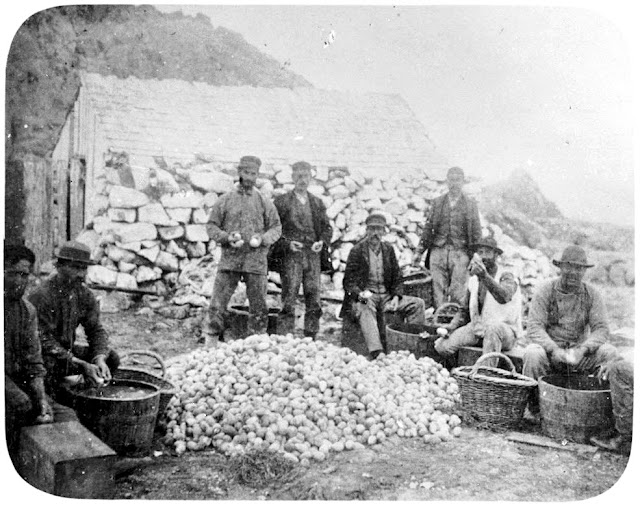
Pile of murre eggs at the Farallon Islands, circa 1870s.

While in Monterey, California, with my wife on a well-deserved week of rest and recuperation a little over a month or so ago, we decided to do "the tourist thing" and take in the sights, try the various restaurants, drive around as much as $6 a gallon of gas would allow us, and kick back at the ocean for a while. At one point during our trip, I found myself thinking about how certain places make me think of certain things.

For example, back in 2016, while my wife and I visited Yosemite National Park, I remember thinking about the fairly short-lived Mariposa Indian War. The reason that I call it "short-lived" is because it officially started in December of 1850 and was essentially over by July 1851. When I returned home, I immediately set out to write about it.

I remember writing about how "with the discovery of gold, the California Trail was forged. It actually forked off of the Oregon Trail and headed southward into California. With the trail open, hundreds of thousands of gold seekers, settlers, and other opportunists, crossed that trail over the Sierra Nevada mountains and into Northern California. At that time, California consisted of a large number of different Indian tribes and Californios. Californios were the descendants of Spanish California.

By the end of May 1849, it's estimated that tens of thousands of settlers of every nationality had entered California. Many have the notion that those gold seekers were all Whites or all Americans from back East, but that wasn't the case. While the majority may have been from the United States, thousands of miles away, many were from places such as Europe, Mexico, Latin America, South America, Australia, China, and even Hawaii.

Just within a few years, California's non-Indian population swelled from some 14,000 in 1848 to well over 200,000 by 1852. And while some Indian tribes actually joined in and took up mining, many Indians opted to work for mines, and some of the Indian tribes had the idea that they 'could more easily supply their wants by stealing.'

The fact is, with the influx of miners and settlers, there was a marked depletion of natural game. Because folks shot up all of the game, to survive, local Indians learned that horses and mules were viable substitutes for the missing game. Of course, the problem was that horses and mules were valuable property of the miners and settlers. Soon, raids for supplies and food became common on both sides. Normally, those raids consisted of things being stolen -- not killings."

As I wrote about the huge influx of people into California, I remember thinking about how the lack of available food was one aspect of the California Gold Rush that most don't think about. And while people want to hear stories about stagecoach robbers like Black Bart, killings, hangings, vigilantes, and the extreme violence of the Old West, most don't think about the negative impact of food shortages and the horrible consequences that it had on everyone, including the local tribes during the California Gold Rush. Crime involving the theft of food was huge at the time.

While in Monterey with my wife, we watched the seals and sea lions, the otters, and the many different seabirds. The pelicans formed winged formations that were reminiscent of World War II warplanes on patrol. As they peeled off and dived into the sea from high above the ocean, they looked so much like a squadron of Douglas SBD Dauntless dive bombers going in for the kill.

I was glad to see what's known as the "Common Murre." To this old Marine, who, by the way, spent my fair share of time at sea while in the Corps, I've always thought that the murre is an interesting seabird.

What makes them so interesting? Well, first of all, they spend most of their time at sea. They spend eight or nine months of each year continuously at sea. While that's longer than most Sailors stay at sea, they have something very in common with Sailors in that when they come ashore -- it's to mate. Of course, in the case of the murres, it's on rocky cliffs on shore and tiny islands off the California coast.

But more than that, I find it extremely interesting that they are some swimming fools. It's true. Their short wings are perfect for diving and "flying" underwater. And believe it or not, it is said that they are actually more maneuverable underwater than they are in the air. Also, something that might surprise you, they can dive to almost 200 feet down for fish. And no, although they resemble penguins, they are not related to them.

As for their mating habits which may or may not be akin to Sailors, murres breed in colonies at high densities. They nest in pairs and may nest right next to another pair of murres. Yes, actually in contact with their "neighbors." As for their nest, they don't make a nest as we think of when we think of other nest-building birds. Their "single egg is incubated on a bare rock ledge on a cliff face." Imagine that.

One place along the Pacific Coast of California that the murre has used as a breeding ground for untold millennia or more is the small group of rocky islands off of San Francisco known as the Farallon Islands also known as "the Farallones." The tiny group of islands and sea stacks are only about 200 acres in size, but seabirds of all sorts love the place. They are located approximately 25 miles off the coast from San Francisco.

So about now you're probably wondering what those seabirds have to do with the lack of available food during the California Gold Rush. Well, with people arriving in California during the Gold Rush in droves, and food becoming so scarce, people started raiding the murre's nests. Yes, the early newcomers to San Francisco started regular trips out to the tiny cliff faces of the Farallon Islands to harvest murre eggs. Obviously, this proves the old saying to be true, "When you're hungry, you'll eat almost anything."

How hungry were they? Well, believe it or not, the birds and their eggs were in big demand. In fact, while dark and quite oily bird meat was consumed, their eggs were what folks were after. They were harvested in huge numbers.

Those who would board boats from San Francisco to go to the Farallones to harvest murre eggs became known as "Eggers." So how many eggs were harvested? Well, here's another believe it or not. Eggers are believed to have taken at least half a million eggs a year from the Farallon Islands in the mid-19th century to feed the folks in San Francisco.

If that sounds too hard to believe, imagine this, one man actually ended up doing time in San Quentin over killing someone over the harvesting of murre eggs. His fate had to do with what became known as the Great Egg Wars of the Farallon Islands.

What was that about? Imagine that you have murre eggs that sell for $1 per dozen? That's probably not enough money today to make you go out of your way to find murre eggs for sale. But, what do you think would happen if people found out that murre eggs sell for almost $40 a dozen? Yes, there would be a scramble to gather and sell them.

And really, that was the case. Since $1 in 1849 is equivalent in purchasing power to about $38.55 today, selling murre eggs was a very lucrative enterprise. At the time, because murre eggs fetched $1 per dozen, and there was so much money to be made from selling them to a desperate public clamoring for more eggs, the great California egg rush was on. Of course, as with any endeavor of that sort, there is going to be competition, rivalries, and clashes.

California's Farallon Islands' rocky craggy cliffs make up the largest murre breeding colony of rooks in the contiguous United States. And as I said before, that nesting area for those seabirds is only used when they show up to mate. Remember, the murre, a seabird very similar to a seagull or a penguin, for the most part, lives on the sea. They only come ashore during mating season, which is between May and August to mate. So obviously, that's when the eggs are there. And yes, that's when the Eggers fought for control of the islands.

By 1850, a group of Eggers launched the Farallon Egg Company which was also known as the Pacific Egg Company. It is interesting to note that by 1854, a half-million eggs were harvested from the Farallon Islands each year. While harvesting was bad enough, the Eggers smashed the murre eggs on the first day of the season. That was so that they would know which eggs would be fresh for the taking.

Clashes broke out. As the years went by, more and more clashes took place. This went on for years until the Pacific Egg Company claimed exclusive harvesting rights to the Farallon Islands. They were so serious about claiming those murre eggs that they hired armed guards to keep rival egg poachers at bay.

Things got so heated that even the federal government was told to stay off those islands. That came about right after a couple of ships carrying goods and people to San Francisco during the Gold Rush wrecked on the islands' rocky shores. To fix the problem, the federal government decided to build a lighthouse on the islands. When the government sent a construction crew to build the lighthouse, they were initially turned away by the Pacific Egg Company's armed guards. In one report dealing with the building of the lighthouse, it said that even after the construction crews finally made it ashore to build the much-needed lighthouse, Eggers fought with the construction crew and then later fought with the lighthouse keepers. In more than one case, the Eggers drove the lighthouse keepers off the islands.

When a ship's Captain by the name of David Batchelder and his crew repeatedly tried to go ashore, they were turned away. And since the eggs were seen as treasure, Capt. Batchelder was determined to get them. While he and his crew were turned away once, on June 3rd, 1863, he returned with three ships loaded with 28 armed men. Waiting for them was a private security force also armed and ready.

While the headlines of what was taking place in the East and down South during the Civil War took precedence of what took place off the coast of San Francisco, the story goes that first there were insults hurled between those on the ships and those ashore. Then Capt. Batchelder's ships pulled away. Then whiskey was added to the mix. After a while, Capt. Batchelder and the other three ships returned to resume their effort to go ashore. They did so in full force while opening fire on the guards. Of course, the egg company security guards returned fire.

What took place during the 20-minute gun battle would definitely qualify as a "Firefight" today, And yes, this wasn't a 30-second shooting in a small lot. This was one of the lengthier gun battles to ever take place in the Old West. Capt. Batchelder's crew and three ships with 28 armed men were facing off against about ten of Pacific Egg Company's armed security guards.

An egg company security guard by the name of Edward Perkins was one of the first struck by gunfire. Though he was killed, it's believed that Perkins was able to return fire even after being shot. As for the egg company's other security guards, they reportedly shot five of the "invaders" to successfully make them retreat to their ships. It was reported that the Captain of one of the ships was actually shot in the throat during the skirmish. That ship's Captain died two weeks later.

As for Capt. Batchelder? He and four members of his crew were later arrested. He and one of the crewmen ended up going to trial for manslaughter. During the trial, the Pacific Egg Company security guards one by one recounted what took place during the lengthy gun battle. While it would definitely qualify as a "Fire Fight" today, that was one of the lengthier gun battles to take place in the Old West.

The security force's foreman Isaac Harrington corroborated the accounts from his men while placing full blame on Capt. Batchelder. He said, "Perkins was shot during the first volley. He fired a musket first, subsequently drawing a revolver, fired two shots after he was struck, and then fell back and expired. The fatal shot came from a boat under Batchelder’s command. I am positive that the first shot came from the boats."

Found guilty of manslaughter, his appeal failed, David Batchelder was sentenced to a year at San Quentin for the manslaughter death of Edward Perkins. Batchelder was given number 2692, and he was received at San Quentin on February 26, 1864. The prison register listed him as 36 years old, born in Massachusetts, with a whale tattoo on his left forearm. His occupation is listed as Seaman. He was released after serving nine months of his one-year sentence.

By the mid-1860s, domestic chicken egg production increased and soon murre eggs were replaced. No longer was there the need to gather the murre eggs. By the mid-1870s, chicken ranches sprang up in places like the town of Petaluma just north of San Francisco. It is interesting to note that Petaluma soon became known for its chicken processing industries. And yes, there was a time when Petaluma was known as the "Egg Capital of the World," even to the extent of having the nickname "Chickaluma". Another bit of trivia is that Petaluma is the place where the egg incubator was invented by Lyman Byce in 1879.

As for the Pacific Egg Company of San Francisco and the Farallon Islands, by 1881, U.S. Marshals had to forcibly evict that company and all of its personnel from the islands. And while the demand for murre eggs had almost died away completely, the federal government had guards posted there just to stop poachers from gathering eggs there. And finally, by the early 1900s, there was a complete ban placed on all egg gathering on the Farallon Islands. That ban was put in place through a presidential executive order signed by President Theodore Roosevelt.

As for the murre seabird, it is said that prior to the Gold Rush there were close to 1 million murre seabirds. In the 1980s, only about 40,000 murre seabirds could be found on California's Farallon Islands. Imagine that.

Tom Correa


Monday, October 3, 2022

Calaveras County Sheriff's Office -- Undersheriff Jim Macedo Retires

Calaveras County Undersheriff Jim Macedo

Story by Capt. Rachelle Whiting
Calaveras County Sheriff's Office

Undersheriff Jim Macedo has either worked in, supervised, or managed every division, unit, and team in the Sheriff’s Office during his career. It would be impossible to list all of his accomplishments and highlights throughout this time, however, here is some information to memorialize Jim:

Undersheriff Macedo holds degrees in both Biology and Criminal Justice Management. He is married to a prosecutor and they raised two sons during his time working for the Sheriff’s Office. He is second-generation law enforcement.

Macedo started working for the Sheriff’s Office on November 14, 1994. He carried his father’s service 357 Revolver as his first duty weapon. He was hired by Sheriff Bill Nuttall and worked through FIVE Sheriffs (including himself, but we’ll get to that later) throughout his 28-year career with the Calaveras County Sheriff’s Office. Sheriffs Nuttall, Downum, Kuntz, Macedo and DiBasilio.

Macedo worked as a patrol Deputy during the days when you had to check out a portable radio as well as your vehicle and check them both back in at the end of shift because there were not enough radios or cars for everyone. At this time, the department had a total of two computers, both of which were located in Dispatch. Deputies hand-wrote their reports. I’m not making this up as a joke, this is fact.

Macedo was the Sheriff’s Office Employee of the Year in 1998. He worked on the Special Enforcement Team including monitoring 290 registrants. One highlight that Macedo remembers from working SET was when he identified a convicted sex offender from San Jose who was hiding out in the Forest Meadows area. Jim did surveillance for days and figured out where the suspect was located in order to take him into custody. We do not know who was more surprised about the arrest, the suspect, or the parents of the kids that the suspect was giving piano lessons to.

Macedo worked in Narcotics for years and held a position on the Narcotics Entry Team. For the newer Deputies, an assignment to work narcotics during those times is nothing like the current MET Team now. While working in an undercover capacity in Calaveras, Alpine, and Amador counties; Macedo made no less than a hundred undercover buys of all kinds of drugs including marijuana, meth, mushrooms, and MDMA, to name a few. During this time working Narcotics, Macedo and his team investigated and dismantled numerous clandestine drug labs. He once took down 2 labs in one day. During one notable case, Macedo and his Narcotics Unit co-workers investigated a Mexican National drug cartel that was producing 150 pounds of methamphetamine per cook. They coordinated seven search warrants served simultaneously to take down the drug ring. During his time working in Narcotics, Macedo also assisted detectives with numerous investigations including high-profile cases.

As a Field Training Officer, Macedo trained around 24 to 26 deputy sheriff trainees. That is quite a number of brand new deputies who cycled through Jim’s patrol car. Yes car, because according to Jim real cops drove the cars, not the SUVs. Some of those trainees are now Lieutenants with our Department. If you see the ones with a nervous tick, now you know where it started. Not to mention those of us that had to fight Jim during defensive tactics training when he wore the red man suit.

Macedo is a former Treasurer for the Deputy Sheriff’s Association and later spent time as President of the Sheriff’s Management Union.

He testified during the trial and death penalty for the Speed Freak Killers (Shermantine and Hertzog) serial killer case. He is a court-certified expert for testimony in narcotics and gangs in both state and federal courts.

Macedo was promoted to Sergeant and supervised shifts on patrol. For those of us that worked under then Sergeant Macedo, we got used to not knowing where Jim would pop up next to keep us on our toes and learning quickly how to write reports for the stuff that Jim would initiate.

Macedo spent about 3 years as a Lieutenant working as the Jail Commander and the Patrol Division Commander. He was involved for many years on SARB, the School Attendance Review Board.

12 years as a Captain, Macedo has helped lead the department’s upper management Sheriff’s Administration. This included through the Butte Fire in 2015 that devastated our county. With the unfortunate death of Sheriff Gary Kuntz, Macedo was our acting Sheriff from October 2015 to June 2016 until the appointment of our current Sheriff Rick DiBasilio, who would later appoint Macedo to the Undersheriff position.

Macedo has spent many years managing the Sheriff’s Volunteer Unit and is not only a leader amongst that group, but also a friend to many.

Macedo worked to create the new CSI position at our agency. He was also integral in getting our Budget Analyst position and the structure of our current Financial Division.

Macedo has provided testimony for state committees on various topics. He has lobbied and worked with other leaders in law enforcement in Sacramento and Washington D.C. for funding for our department.

Undersheriff Macedo participated in and completed Calaveras Leadership. He is a member of the International Association of Chiefs of Police. He received recognition by the California State Assembly and the California State Senate for his efforts in combating crime and serving victims. Undersheriff Macedo authored several articles about behavioral health interactions, which are published in the California State Sheriff’s Association and FBI National Academy magazines.

Macedo was awarded the Sheriff’s Office Medal of Valor for his bravery and heroic actions during a hostage situation whereas the suspect had doused people with gasoline and was about to set the room on fire that included the suspect, hostages, and deputies.

Undersheriff Macedo is a long-time member of the California State Sheriff’s Association (CSSA) Seconds in Command. With this, he is a coordinator for the group and is seen by his peers as a leader. In 2017, Macedo won the CSSA “John Sully Second in Command of the Year Award.

Undersheriff Macedo is a graduate of the prestigious FBI National Academy and is currently the Sacramento Area representative and soon-to-be Vice President. With this, comes his involvement and participation in FBI Law Enforcement Executive Development Seminars. He is a member of ATAP – Association of Threat Professionals. He is currently an instructor for the POST Management Course through the South Bay Regional Public Safety Training Consortium.

About the Author:

Captain Rachelle Whiting

Captain Rachelle Whiting is the Calaveras County Sheriff's Office Operations Bureau Commander. Over her 22 years with the Calaveras County Sheriff’s Office, Captain Whiting has proven herself to be a fine leader who has received several awards and commendations from the Sheriff’s Office. They include Deputy Sheriff of the Year, Campaign Ribbons, Unit Citations, and Medals of Merit commendations. She will be promoted to the position of Calaveras County Undersheriff on October 8th, 2022. 

Editor's Note:

First, I want to congratulate Captain Whiting on her promotion. She's a fine officer and has worked hard to earn it. I really believe she deserves it.  

As for Undersheriff Jim Macedo, his actual date of retirement is October 7th, 2022. As a Volunteer at the Sheriff's Office, I have to say that I feel very privileged to have been there when the Sheriff’s Office wished him a very fond farewell at a small going away party. Congratulating him on his retirement, and then being part of those escorting him home, hearing him radio in 10-10 for the last time after a 28-year career, all was a real honor.

During his party, I enjoyed meeting some of the people who have known him for so many years. The fact is, that unlike most there, I've only known Undersheriff Macedo for a very short time. But, even though that's the case, during the short time that I've known him, he has always impressed me. And frankly, that's really saying a lot -- especially since most people stopped impressing me long ago. 

From what I know of him, he is a good man. He treasures his family and he's a man of good character in a world starving for such men. Since he's an old fashion, honest, brave, no-nonsense sort of lawman, I see him as a great American with true Cowboy values of courage, optimism, and hard work. Frankly, as for being one of the most well-rounded people I've ever met, I really believe he sets a great example of being a good role model for others.

As for him being very professional and still personable, he garners the respect and cooperation of others through his excellent leadership style.  This also extends to his understanding of people. I believe he is one of those rare individuals who is both street-smart and extremely intelligent while also having a wonderful ability to read people correctly. While those are all great attributes for anyone to have, they are especially important for a career law enforcement officer. 

So yes my friends, that's why I have so much admiration for Undersheriff Macedo. That's why I asked Captain Whiting if she would give me permission to print her story about him here on my blog. That's why I'm glad she did. And that's why I wish Undersheriff Macedo all the best.  

Tom Correa

Saturday, October 1, 2022

The Terror That Was The Bremen School Shooting

The Bremen School Shooting took place at approximately 11:00 a.m., when a shooter entered St. Mary's Catholic School, carrying a briefcase packed with ten handguns and hundreds of rounds of ammunition. The killer's name was Heinz Schmidt. He was 29 years old. 

Reports of what took place say that after entering the school, he met up with teacher Marie Pohl in the hallway on the first floor. Pohl had just stepped out of her class when she encountered Schmidt. Pohl questioned Schmidt about what he was doing there. She knew Schmidt because he was also a teacher at that school before being recently fired. Schmidt shot at her. He barely missed shooting her in the head.

In a panic, Pohl runs into a nearby classroom. At the same time, Schmidt entered the classroom that Pohl initially came out of. In that classroom, he came into contact with 65 students, all girls between 6 and 7 years old. He immediately began opening fire at the children. 

The frightened children didn't know where to run so they hid under their tables. That didn't stop Schmidt from instantly killing two of them and wounding another. And when the children tried to run out of the classroom, Schmidt followed them. 

Shooting at them as pursued them, one girl is said to have fallen down some stairs and actually broke her neck and died. He then tried to enter another classroom but found the door locked. Inside, a quick-thinking teacher realized what was taking place and locked herself and her class in. 

At some point, a janitor appeared and tried to subdue Schmidt. He shot at the school janitor, hitting him in the face. Schmidt then tried going up some stairs but was tackled by a teacher. Sadly, Schmidt broke free and shot that teacher in his stomach and shoulder. After that, Schmidt started shooting out a window at children in a schoolyard. He shot five boys. Right after that, teachers, school employees, and the janitor, all rushed and finally subdued Schmidt.
 
When Schmidt was led away by police, an angry group of parents met the police outside. The police were outnumbered as they beat up Schmidt. The crowd of angry citizens then attempted to lynch Schmidt. It was only because the police managed to hold back the mob that Schmidt wasn't lynched on the spot. 

The 29-year-old killer indiscriminately shot at students and teachers alike, actually killing five girls and wounding more than 20 others children and staff. Heinz Jakob Friedrich Ernst Schmidt was in fact a recently fired teacher at the school. The unemployed teacher was never tried for the crime and was instead sent directly to an insane asylum where he died almost 20 years later of tuberculosis.

The Bremen School Shooting took place on June 20th, 1913, at St Mary's Catholic School in Bremen, Germany. Which of course proves such heinous acts are also nothing new to Europe.

Tom Correa


Saturday, September 24, 2022

Letters between Wyatt and Josephine Earp, and William S. Hart

Below are some interesting letters between Wyatt and Josephine Earp, and silent-film actor William S. Hart.

On Nov. 13, 1928, Wyatt Earp wrote:

“Here is something that will make you laugh. I picked [Al] Smith for the winner of the election; just in my mind, you know, so it didn't cost me anything — no new hat to buy nor any peanuts to roll along the thoroughfare with a tooth-pick nor anything else to make me wish I hadn't. It just furnishes my friends a lot of fun by guying me. Hoover will make an excellent president, and the nation will have no regrets at having chosen him."
——————————————————————
On Nov. 16, 1924, Earp wrote to his friend Bill:

“Even the paragraph about Doc Holliday shooting a man in Los Angeles was without foundation. Holliday to my positive knowledge never had been in Los Angeles."
———————————————————————
Oct. 21, 1920:

My Dear Hart:

I am sending you the quirt that I promised you some time ago and I am also adding a word of apology for the delay. My time has been so occupied with business affairs during recent weeks requiring my absence. I just did not get the opportunity to mail the quirt to you. Although I have though of you. I believed I explained to you the quirt was made a number of years back in 1885 by a Mexican woman who was serving time in the penitentiary at Yuma, Arizona for the murder of her husband so you can see that a good quirt was made by a bad woman. It ought to stand hard usage and last a lifetime and I am sure it will. In your leisure moments may you occasionally remember that this is just a token of appreciation from me who hold you in deepest regards and esteem.
 
Your friend,
Wyatt S. Earp
4021 Pasadena Ave.
Los Angeles, Calif.
——————————————————————-
Oct. 16, 1922
Mr. William S. Hart
8341 De Longpre Drive
Hollywood, Calif.

Dear Mr. Hart,

After a long absence I have now returned to the city for a short stay. It must all come to you with mixed joy. I wish to make no comment because I am your friend and I know you have nothing to regret. You have hosts of friends Mr. Hart and the world thinks of you with a spirit of great loyalty [more] now than it ever has.
But I can rejoice with you in the great happiness that comes to you as a father. In this you are especially blessed. Your son is likewise because he has a good father. I say this modestly and if his purposes in life are as noble, he will be a success. It is the earnest [wish] of Mrs. Earp and myself that he shall live to be all of that.
I trust your recent illness is just of the passing sort and that you will be yourself again within a few days. Mrs. Earp joins me in best wishes.

Sincerely yours,
Wyatt Earp
———————————————————————
In the next letter Mrs. Earp tells Hart that her husband wishes to dedicate a book to him — a book about which few Western buffs will ever reach total agreement.

2703 Telegraph Ave., Oakland, Calif.
Mr. William S. Hart
Newhall, Calif.

My dear Mr. Hart:

Am inclosing a letter from Mr. Lake which is self explanatory. I was rather surprised Mr. Leussler told him he had spoken with me. If you will recall it was agreed that he was not to tell ... we had met. I cannot understand that and so presuming your good nature for your valuable advice in this matter, will you kindly return the inclosed [sic] letter to me.

I tried to get in touch with Mr. Leussler three times, but was informed he was south and would not be back until the end of the week. I would like to get in touch with him as I cannot get any information from Mr. Lake.

I want to thank you Mr. Hart for all of your wonderful kindness to Mr. Earp and myself. And it shall be my great pleasure to follow Mr. Earp's wishes in having his book dedicated to you — a real friend.
Trusting you and your dear sister are in good health. I am with kindest regards.

Most sincerely yours,
Josephine Earp
——————————————————————
Another letter from Mrs. Earp would come under the heading of "fan mail.”

Dec. 18, 1923
My dear Mr. Hart:

Just a line to congratulate you upon your new picture "Wild Bill Hickok." I saw it twice with several friends and each time the house was packed. When you appeared upon the screen the applause was wonderful. Am happy to say that you have staged a remarkable "come back."
Trusting your future pictures will be as successful as your first.
With kindest regards

I am sincerely yours,
Mrs. Wyatt Earp
——————————————————————
William S. Hart often contacted his friend during Wyatt's stay at the mines.

Oct. 21, 1925
Mr. Wyatt Earp
Vidal, Calif.

My dear friend Wyatt Earp:

I am mighty glad to hear from you. I am returning Mr. Sutton's letter which I presume you want to keep. Sutton has been a great admirer of my pictures for many years. I have many letters from him. His account of the opening of the Strip from the Oklahoma side is most interesting. The picture which I have just finished, "Tumbleweeds," shows the action which takes place on the other side starting at Caldwell, Kansas.
Mr. Wilstach the man who is writing the Hickok articles wrote to me a couple of weeks ago for some information which, fortunately, I was able to give him. One of the things he wanted to know was the whereabouts of Bat Masterson when Hickok was killed. I was able to tell him Masterson told me personally he was in Denver at the time.
When you return please let me know and I sure would be glad to see you and Mrs. Earp.

Always your friend,
William S. Hart

Saturday, September 3, 2022

The Death Knell of the Confederacy -- The Surrender of Fort Fisher


On January 15, 1865, the Confederacy surrendered Fort Fisher, North Carolina.
 
During the early days of the Civil War, the Confederacy built the "L" shaped earthen Fort Fisher in a strategic location near the mouth of North Carolina's Cape Fear River. The fort was there to make sure that the port of Wilmington remained open. The earthen stronghold mounted 39 large-caliber guns that were augmented by several mortars. The fort's nine feet high and 25 feet thick walls were thought to be formidable and able to repel any invader.

The fort was the primary defense for the Wilmington supply line which was in fact the central supply artery that brought food and munitions to Robert E. Lee's Army of Northern Virginia. By January of 1865, that fort safeguarded the Confederacy's last operational Atlantic port.

On December 14, 1864, the morning saw a fleet of 75 Union warships and transports commanded by Admiral David Dixon Porter steamed south from Hampton Roads, Virginia, toward Fort Fisher. Aboard the troopships were 6,500 Union Army soldiers under the command of Maj. Gen. Benjamin Butler.

Because of a storm, the Union Armada didn't start its bombardment of Fort Fisher until Christmas Eve, December 24. During that bombardment, the Union Navy fired over 20,000 shells of all calibers at the fort.

Believe it or not, even after such a barrage, the Union landing party of 2,500 troops came to within only 75 yards of the fort when their assault started on Christmas Day. Seeing his men chopped to ribbons and driven back, General Butler called off the attack. By that night, Admiral Porter realizing that his ships were in danger withdrew the fleet out of range of Fort Fisher's artillery pieces. No, I could not find out how many Union Soldiers died during that first attempted landing. Butler's action there resulted in him being replaced by Brig. Gen. Alfred Terry.

In early January of 1865, Gen. Terry and Adm. Porter decided to launch a second landing. What would take place would be the largest amphibious attack during the Civil War. An attack that combined land and naval forces. And here's something else, that amphibious assault would remain the largest U.S. amphibious attack until D-Day in World War II. 

There were nearly 10,000 Union troops and 58 Union naval ships involved in the attack. Of those, it is said that an 8,000-man landing force of Union troops went ashore after two days of naval bombardment. Among those making that landing would be a detachment of 400 Marines and 1,600 Sailors.

Let's keep in mind that at the opening of the Civil War in 1861, the U.S. Marine Corps' total strength numbered at 63 officers and 1,712 enlisted personnel. While U.S. Navy ships had Marines stationed aboard them, many located around the world and far from the chaos that was the Civil War, there were Marines at the landing of Fort Fisher for that amphibious assault.

Of the 8,000 Union troops there that day, were 1,600 sailors and 400 Marines divided into four companies under the command of Marine Captain Lucien L. Dawson. All were armed with rifles, revolvers, and cutlasses. Union Navy Commander Randolph Breeze led the Sailors during the attack.

For some unknown reason, Union Army Brig. Gen. Alfred Terry held back his Army troops in reserve on the Confederate left. So instead of simultaneous attack, Marines and Sailors fought hand-to-hand with Confederate defenders at Fort Fisher in what was a completely uncoordinated assault. That hand-to-hand fighting lasted for six hours.

Captain Dawson reported later that during the fighting he "received two or three orders from Captain Breeze to ‘bring up the Marines at once. That we would be late if not." Dawson went on to say, "I took the Marines up and filed across the peninsula in front of the Sailors with skirmishers thrown out."

Dawson rallied two companies of Marines to provide cover fire. After Gen. Terry committed the Army's troops, it was reported that several of the Marines aided the Army's attack on the main parapet and helped overrun Fort Fisher. It is interesting to note that on the last day of fighting as Union forces began to make their way through the defenses of the Fort, Confederate Col. William Lamb began to roust the injured and sick Confederate soldiers from the fort's hospital in a desperate last attempt to get the upper hand.

As a result of the surrender of Fort Fisher, 400 Confederate troops were killed or wounded, and more than 2,000 were taken prisoner of war.

The Union Army lost 900 men. The joint Navy-Marine force lost 200 men with 46 wounded or missing. Of those killed, 14 were Marines. Of the 54 Medals of Honor that were awarded for their actions at Fort Fisher, six were Marines. By the way, among the reinforcements were the Union Army's USCT (United States Colored Troops). One of those USCT Soldiers was awarded the Medal of Honor.

With its surrender of Fort Fisher, Union troops took control of Wilmington and severed the supply lines leading to Robert E. Lee's Army. Wilmington's fall eliminated any sort of protection for Confederate blockade runners bringing in needed supplies. This little know battle was in fact one of the defining battles of the Civil War.

The fall of Fort Fisher meant the Confederacy was even more vulnerable to Union General William Tecumseh Sherman's advancing troops. But it meant more than just that. For months, Condferate supply lines were already in trouble. It is said that starving Confederate soldiers had already been deserting Lee's Army of Northern Virginia. And even though Confederal President Jefferson Davis approved the arming of African slaves as a means of augmenting those deserting the shrinking Confederate Army, they were losing manpower because of the lack of food and supplies.

So, while there are those who will say that it was Sherman's march or their loss at Gettysburg that toll the end of the Confederacy, I believe that the surrender of Fort Fisher was truly the death knell of the Confederacy. Nothing at that stage of the war had such an impact on the Confederacy's ability to wage war than the fall of Fort Fisher and those severed supply lines. 

With its great importance to keep Gen. Lee's Army fed and supplied, losing Fort Fisher meant the war for the Confederacy was lost. In fact, with the Confederacy and General Robert E. Lee struggling to keep the war going with their limited supplies running out, they would ultimately surrender within 90 days of losing Fort Fisher.

Tom Correa


Thursday, August 25, 2022

Alferd Packer -- The Beloved Hatchet-Murdering Cannibal Of Colorado


Many years ago while driving through Colorado, I was sort of surprised to hear about a local celebrity of sorts. I say, "of sorts," because that man who seems to be quite the Colorado celebrity was a mass murderer and cannibal. His name was Alferd Packer and his horrid acts of crime have not stopped people in Colorado from celebrating his name in some very interesting ways.

For example, folks knowing that Alferd Parker killed five men and ate them hasn't stopped someone from creating the Alferd E. Packer Memorial Grill at the University of Colorado in Boulder. And if that's not enough to make you wonder what's wrong with some folks out there, there was once a writer who actually published a book titled, "Alferd Packer's Wilderness Cookbook." In Littleton, Colorado, the folks there hold the "Alferd Packer Cannibal Fast Food 5K/10K Run/Walk." And not to miss a chance at 15 minutes of fame, believe it or not, a sculpture once created a bust of Alferd Packer that somehow ended up sitting in the Colorado State Capitol right next to Colorado's more prestigious citizens.

So why would anyone make a mass murderer and cannibal famous, and in fact, do it so much so that a whole town celebrates "Al Packer Days" as is the case in one Colorado town? Frankly, there's no rhyme or reason why the macabre and gruesome interests people like it does. It's true. Just as there is no telling why anyone would start a restaurant and name it the "Packer Saloon & Cannibal Grill." No, there is no telling why anyone would make a mass murderer and a cannibal famous -- especially a man who is said to have killed and eaten five of his traveling companions,

As in any story, whether it's a story in the newspapers or found in a good book, our learning the who, what, when, where, how, and why of a story is the key to our understanding of all that took place. When writing, the who, what, when, where, how, and why of a story ensures that we examine all aspects of a story.

As for the who, what, when, where, how, and why of the story dealing with Alfred Packer, we know who he was. Alferd Packer was born sometime in 1842. Different sources give different months and days of his birth that year. While that's true, there's no confusion about him being raised in Allegheny County, Pennsylvania, near Pittsburgh.

We also know that he was in Minnesota by the time he was 19 years of age. We know that because he was 19 when he enlisted in the Union Army with the 16th US Infantry in Wynona, Minnesota at the outbreak of the Civil War. Sources say that he received an Honorable Discharge in late 1862. His short time in the Union Army was supposedly due to him having epilepsy. If true, that didn't stop him from trying to enlist again in June of 1863. It's believed that he was able to join the Union Army's 8th Regiment of the Iowa Cavalry until he was again mustered out due to epilepsy.

From there, it is sort of a mystery what he did for about 10 years. Some say he traveled West to California. Some say he turned into a drunk while taking whatever job he could find. Some say he went from mining camp to mining camp looking to strike it rich like so many others.

We do know that by late 1873, Alferd Packer and about two dozen other prospectors left Utah and headed to the San Juan Mountains of Colorado. Traveling late in the year to the mountains is not the smartest thing anyone can do -- even today. The Winter of 1873 and 1874 was one of the worst on record. To find shelter, the men stayed at the Ute Indian village of Chief Ouray. It is said that they got there in January of 1874, hungry and desperate.

The Ute Indian hospitality was what kept Packer and the others alive. It's too bad they didn't heed the Ute Chief's warning about continuing on and waiting until Spring to travel. The snow was deep and the mountains were treacherous. The Ute Chief tried to warn them, but the lust for gold was too much for a few. Soon, five of the men made plans to go on. For some reason, they believed that Packer was their man to hire as their guide. That being the case, on February 9, 1874, Alferd Packer, Wilson Bell, James Humphrey, Frank Miller, George Noon, and Israel Swan, left the Ute Indian village and headed into the San Juan Mountains. The lure of gold and riches waiting for them had blinded their senses.

Soon, they found themselves with 10-days of food trapped in the mountains with snow up to their shoulders. It wouldn't be long before they would be buried in snow and out of food. Packer was their guide, and now they were lost and on what has been described as a gravel terrace just up from what is present-day Lake City, Colorado.

What happened next had everyone there trying to piece the story together in an effort to find the truth of what really took place. Most things simply didn't add up at first. Then the stories started to make less and less sense. Soon, no one believed a work Alferd Packer had to say pertaining to the deaths of Packer's traveling companions.

That all started in April of 1874 when only one of the six men made it out of the mountains. That was Alferd Packer who walked out looking too well for someone who said he had been living on rabbits and shrubs. Of course, Packer would tell many versions of what took place before coming out of the mountains that April. All of his stories were different.

When I went driving through the small town of Saguache, Colorado. I was told about Alferd Packer who served time in the Saguache Jail as a suspected "cannibal." I was told that Alferd Packer, Wilson Bell, James Humphrey, Frank Miller, George Noon, and Israel Swan, became stranded in the mountains and that Packer killed them -- and ate them while stuck there for a couple of months. That's what I was told.

I was told that most from around those parts at the time believed that the six died in the blizzard high in the mountains. It surely wasn't that unusual for those hunting gold to get so involved in their search for gold, that they put off eating, sleeping, or even seeking shelter when they should. There are stories of travelers finding prospectors frozen, just dead where they lay or sat. I know of one story about two travelers who found a prospector dead near his sluice box. There was no foul play involved. The prospector simply decided to work his claim in the harsh weather instead of finding shelter and warmth. It's believed he may have simply tired and died from the cold. So no, there was no reason to believe that Packer and the other men were still alive.

In mid-April, to everyone's surprise, Alferd Packer surfaced. He had come out of the mountains. And yes, he was alone. Things started going downhill for Packer almost as soon as he walked out of the mountains. Whether he was ready for it or not, folks wanted to know what happened to the other five men that he was last seen with in February. And sadly for Packer, his stories of what took place in the mountains didn't add up. In fact, as I said before, he gave several conflicting stories about the fate of the other men.

Packer initially said that he had been abandoned by his party. Then he said that he had hurt his leg and that they had dropped and left without him. He then admitted that those were lies. After a few more tales that didn't add up, he said that the whole party had resorted to cannibalism of a dead member. He said they did it to stay alive when they became lost. But really, even that was a lie.

He changed his story a number of times and even confessed to him being the only one who lived off of the flesh of his companions. He said that one of the others in his party, Shannon Bell, had killed the others. Packer said he had to kill Bell in self-defense. He also confessed to eating Bell and the others while stranded in the mountains -- and while he was walking out of the mountains. Yes, almost two and a half months later. That's probably why everyone commented on how good he looked for someone who said he'd been struggling through heavy snow for ten weeks.

I found it interesting that the authorities forced Packer to lead a search party into the mountains in an effort to try to locate the bodies of his companions. Packer is said to have led them to the wrong place where nothing was found. Since no one believed Packer's stories, it didn't take long before this all landed him in jail in Saguache. Actually, I was told that he was held somewhere just outside of Saguache and not in jail. He was held while people there were trying to piece together what really happened.

But then in August, with the help of someone there, he escaped. The day of his escape is important because it was the same day that the authorities found the remains of his missing companions. Evidence pointed to foul play and worst -- cannibalism. As the word spread of what took place, the area where the bodies were found soon became known as the "Cannibal Plateau."

For the next nine years, the authorities tracked him down. He was believed to have been living in Washington, Montana, Wyoming, and as far South as Arizona. After those long nine years, he was found living under the name John Schwartze in Fort Fetterman, Wyoming. The story of how he was found is sort of interesting. It is said that a member of Packer's original 20-man party that had started out with him from Utah, a man by the name of Frenchy Cabizon, was in a saloon when he heard Packer laughing in that same saloon. When Cabizon realized who it was, he turned him in to the authorities in Wyoming. Packer was then returned to Lake City, Colorado, where he was tried for the hatchet-murders of his five companions. Surprisingly, Packer was never charged with cannibalism.

On April 6, 1883, Alferd Packer's trial began at the Hinsdale County Courthouse in Lake City, Colorado. During the trial, among other information, witnesses said that Packer walked out of the mountains with several items in his possession that belonged to the men that he killed. He also walked out with what was described as "rolls of money" on him.

Packer took the stand in his own defense and went on for more than two hours. The whole while telling new lies about what supposedly took place. It is interesting that Packer is said to have supposedly lied about his age, what he did while in the Union Army, and even the cause of his epilepsy. I was told that no one could confirm anything he said.

On the stand, Packer also claimed that he had a struggle with Bell and had shot him in self-defense. But Swan's remains showed evidence of a hand-to-hand struggle, not Bell. That inconsistency was in itself enough evidence that there was much more violence than what Packer said there was. While he denied killing anyone except Wilson Bell in self-defense, he did in fact admit to eating portions of Bell and Miller.

While I'm not going to go into the facts of the case regarding who he killed first, about how most of his victims were half-frozen and asleep when he took a hatchet to them, I'm sure there are writers out there who will furnish everyone with their suspicions of how the crimes were committed. Since no one was there, most of what's known about how he killed his five companions, and how he was still eating parts of them on his way out of the mountain, was pieced together in court. It was pieced together enough for the evidence to be clear to the jury for a guilty verdict. On Friday, April 13, 1883, Alferd Packer was found guilty. He was convicted of five counts of premeditated murder, and ordered to hang for what he did. 

In the next two years, he used whatever legal avenue he had available. He and his lawyers are known to have used the question of court jurisdiction because the murders may have been perpetrated on Indian Reservation lands, and they tried to say that because there was no murder statute in the Colorado Territorial law -- that he technically had committed no crime.

Using these sorts of legal ploys, Packer avoided hanging and actually won the right to a new trial with a change in venue to Gunnison which is 30 miles away. The Colorado Supreme Court overturned his murder conviction, just because he had committed the crimes in the Colorado Territory and the laws had changed when Colorado became a state. During the retrial, that trial in Gunnison went no different for Packer and he was convicted of five counts of voluntary manslaughter. He was sentenced to 40 years in prison.

In August of 1897, Packer wrote letters to The Rocky Mountain News and The Denver Post. One particular newspaper columnist who took a definite interest in Packer was with The Denver Post. She wrote under the name of Polly Pry. She is said to have started an effort to get Packer's conviction overturned on the grounds that she was convinced of his innocence -- even though Packer confessed to committing the crimes. In fact, she believed that so much, that she published a series of heartfelt articles to get him paroled. And, while this might answer why folks in Colorado fell in love with their self-confessed hatchet-murdering cannibal, Polly Pry is the reason that public opinion turned in Packer's favor.

She did such a good job at making that killer look like the victim, that it wasn't long before other newspaper reporters and Colorado politicians got involved. Soon, there was such an outcry for Packer's release that Colorado Governor Charles S. Thomas is said to have looked forward to receiving Packer's request for parole. And yes indeed, Governor Thomas approved it as soon as he got it.

Packer, serving less than half of his 40-year sentence, was released from prison in 1901. So while many of us have this notion that murdering criminals didn't get off so easily in the Old West, it is interesting to note that he was paroled after only serving 17 years of his 40-year sentence in the Wyoming Territorial Penitentiary.

After his release from prison, he took a job as a guard at The Denver Post. It's said he took that job instead of taking a job as a side-show freak with the Sells-Floto Circus. Of course, it is remarkable to think that he is said to have talked about his exploits and even told stories to children about his adventures in the Colorado Territory before he died at age 60 on April 24, 1907. It's also hard to believe that he was buried with full military honors all paid for at the government's expense since he was a veteran of the Civil War.

Over the years, it's said that grave robbers wanted to steal his body. Others say the concrete over his grave is to stop vandals. Whatever the reason, concrete was poured over his grave to keep him securely in place.

That is, minus his head. Yes, without his head. Believe it or not, a representative from Ripley’s! Believe It or Not confirmed that the company has Packer's mummified head in its collection. Imagine that. While we know that his head is not buried with him, we don't know who removed it from his body, when they did it, and where it went before the Ripley’s! Believe It or Not folks got it. We also don't know how they come into possession of his head, or why Packer's head was taken in the first place. It all remains a mystery.

Of course, even though the whole story of Alferd Packer and what he did is one of the most horrible crimes against nature in Old West history, some folks don't care about that. And really, I'm thinking that Packer not being buried with his head is a mystery that I'm almost certain will help the folks in Colorado celebrate their beloved hatchet-murdering cannibal just that much more.

Tom Correa


Friday, July 29, 2022

Aboard a Whaling Ship, 1850


A story by Henry T. Cheever, Rev., 
Written in 1853.
"Thar She Blows!"

"The boat spun after him with almost the swiftness of a top..."

"For the first time in our now ten weeks' passage from the Hawaiian Islands, on this New Zealand Cruising Ground, we heard, day before yesterday, that life-kindling sound to a weary whaleman, THERE SHE BLOWS! The usual questions and orders from the deck quickly followed.

'Where away?'

'Two points on the weather bow!'

'How far off?'

'A mile and a half!'

'Keep your eye on her!'

'Sing out when we head right!'

It turned out that three whales were descried from aloft in different parts, and in a short time, when we were deemed near enough, the captain gave orders to 'Stand by and lower' for one a little more than half a mile to windward.

Three boats' crews pulled merrily away, glad of something to stir their blood, and with eager hope to obtain the oily material wherewith to fill their ship and make good their 'lay.' The whale was going leisurely to windward, blowing every now and again two or three times, then 'turning tail,' 'up flukes,' and sinking. The boats 'headed' after him, keeping a distance of nearly one-quarter of a mile from each other, to scatter (as it is called) their chances.

Fortunately, as the oarsmen were 'hove up,' that is, had their oars a-peak, about the place where they expected the whale would next appear, the huge creature rose hard by the captain's boat, and all the harpooner in the bow had to do was to plunge his two keen cold irons, which are always secured to one tow-line, into the monster's blubber-sides. This he did so well as to hit the 'fish's life' at once, and make him spout blood forthwith. It was the first notice the poor fellow had of the proximity of his powerful captors, and the sudden piercing of the barbed harpoons to his very vitals made him caper and run most furiously.

The boat spun after him with almost the swiftness of a top, now diving through the seas and tossing the spray, and then lying still while the whale sounded; anon in swift motion again when the game rose, for the space of an hour. During this time another boat 'got fast' to him with its harpoons, and the captain's cruel lance had several times struck his vitals. He was killed, as whalemen call it, that is, mortally wounded, an hour before he went into 'his flurry,' and was really dead or turned up on his back.

The loose boat then came to the ship for a hawser to fasten round his flukes; which being done, the captain left his irons in the carcass and pulled for the ship, in order to beat to windward, and, after getting alongside, to 'cut him in.' This done, and the mammoth carcass secured to the ship by a chain round the bitts, they proceeded to reeve the huge blocks that are always made fast for the purpose to the fore and main mast head, and to fasten the cutting-in tackle. 

he captain and two mates then went over the sides on steps well secured, and having each a breast-rope to steady them and lean upon. The cooper then passed them the long-handled spades, which he was all the time grinding and whetting, and they fell lustily to work chopping off the blubber.

Soon after we had finished cutting in, about eight o'clock in the evening, the wind increased almost to a gale, making it impossible to try out that night. But to-day, while the ship is lying to, the business has begun in good earnest; the blubber-men cutting up in the blubberroom; others pitching it on deck; others forking it over to the side of the 'try-works;' two men standing by a 'horse' with a mincing knife to cleave the pieces into many parts for the more easy trying out, as the rind of a joint of pork is cut by the cook for roasting: the boatsteerers and one of the mates are pitching it into the kettles, feeding the fires with the scraps, and bailing the boiling fluid into copper tanks, from which it is the duty of another to dip into casks.

The whale now taken proves to be a cow whale, forty-five feet long and twenty-five round, and it will yield between seventy and eighty barrels of right whale oil. This is about the ordinary size of the New Zealand whale, a mere dwarf in comparison with that of the northwest, which sometimes yields, it is said, three hundred barrels, ordinarily one hundred and fifty, or one hundred and eighty."

-- end of the article.

According to Eyewitness to History: In the days before the discovery of petroleum, whale oil supplied the fuel for the lamps that illuminated the nights in American homes. In addition, the whale was the source of a boney substance called baleen used in women's corsets, hairbrushes, buggy whips, collar stays, and various other products.

During the 19th century, whaling was a lucrative business and it made many East Coast seaports rich. Ports such as New Bedford, Massachusetts, and Nantucket thrived as their whaling ships roamed the seas of the world on voyages lasting up to four years. These special-purpose vessels were fast, rugged and versatile. Not only did they carry the equipment necessary for hunting and killing their prey, but the technology for processing, storing and preserving their catch until their return to port. They were the forerunners of today's factory ships

For the whaleman, it was a rough and dangerous life. Once a whale was sighted, the crew took to their whaleboats in pursuit with the immediate objective of harpooning their prey. If the harpooner successfully speared a victim, the whaleboat and its crew were treated to what was called a "Nantucket Sleigh Ride" as the whale dragged its hunters through the sea in an attempt to escape. After two to three hours of this rollercoaster ride, the whale would tire, be finished off and hauled to the mother ship. Here it was cut up and its blubber boiled down to yield its precious oil.

The author, Reverend Henry T. Cheever, was a missionary who, in 1850, was a passenger aboard the Commodore Preble, a whaling ship out of Boston, and recorded the experience of a whale hunt. 

Reverend Cheever's account appeared in Cheever, Henry T., The Whale and His Captors (1853); Stackpole, Edouard, A., The Sea-Hunters, The New England Whalemen During Two Centuries 1635-1835 (1953).

"Aboard a Whaling Ship, 1850," is from EyeWitness to History, www.eyewitnesstohistory.com (2004).

Tuesday, July 26, 2022

Charles Eugene "Chip" Roy is a Great American

This is very good. 

Charles Eugene "Chip" Roy is an American attorney and politician serving as the U.S. representative for Texas's 21st congressional district. A member of the Republican Party, Roy took office on January 3, 2019. 

He does very well at handling those who want to neuter our 2nd Amendment and defund our police. 

Tom Correa