Sunday, April 17, 2022

Let's Talk About Easter Sunday

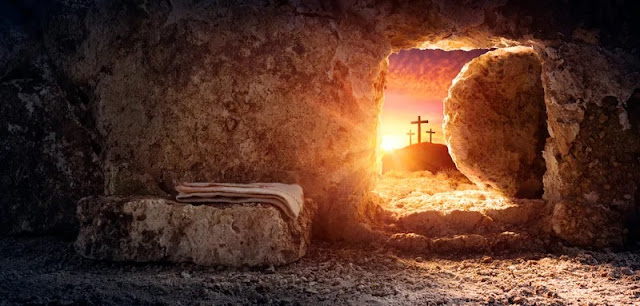
Let's talk about how Easter is a Christian celebration of the resurrection of Jesus Christ.

As for the Easter Bunny, the Bible makes no mention of a long-eared, short-tailed creature who delivers decorated and painted eggs to children on Easter Sunday. But the Easter Bunny has become a prominent symbol of Christianity's most important holiday. The reason is interesting because, while the exact origins of the mythical Easter Bunny are unclear, rabbits and hares are known to be prolific procreators and have been an ancient symbol of fertility and new life for more years than most realize.

According to some, the Easter Bunny first arrived in America in the 1700s with German immigrants who settled in Pennsylvania. They brought their tradition of an egg-laying hare called "Osterhase" or "Oschter Haws." Yes, an egg-laying hare! And for you city folks who might not know it, rabbits and hares don't lay eggs.

During that period, the tradition was for children to make nests in which the "egg-laying" rabbits and hares kept their colored eggs. Eventually, the custom spread across the United States, and the fabled rabbit's Easter morning deliveries expanded to include chocolate and other types of candies and gifts. Decorated baskets replaced nests. 

Easter is a Christian holiday brought to America by Europeans, but some of its customs, such as Easter eggs, should not be surprising since the egg is an ancient symbol of new life. European immigrants celebrating Easter as a religious festival used eggs as a way to symbolize the renewal of life. We know for a fact that such a tradition goes back to Medieval times when the egg was seen as a sign of new life. Of course, since Easter is considered the start of Spring, and Spring represents new beginnings, it fits our Christian belief that Easter and the resurrection of Christ is man's new beginning.

Eggs would often be painted with elaborate designs and given to lucky children. From a Christian perspective, Easter eggs are said to represent Jesus' emergence from the tomb and resurrection. Of course, decorating eggs for Easter is a tradition that dates back to at least the 13th century. One explanation for this custom is that eggs were formerly a forbidden food during Lent, so people would paint and decorate them to mark the end of the period of penance and fasting, then eat them on Easter as a celebration.

Easter egg hunts and egg rolling are two popular egg-related traditions. In the United States, the White House Easter Egg Roll, a race in which children push decorated, hard-boiled eggs across the White House lawn, is an annual event held the Monday after Easter. The first official White House egg roll took place in 1878 when Rutherford B. Hayes was president. The event has no religious significance, although some people have considered egg rolling symbolic of the stone blocking Jesus' tomb being rolled away, leading to his resurrection.

As for Easter Candy? Easter is the second best-selling candy holiday in America after Halloween. And really, among the most popular sweet treats associated with this day are chocolate eggs, which date back to early 19th century Europe. So yes, folks in the Old West were lucky enough to have gifts of candy eggs. 

Another egg-shaped candy, the jelly bean, became associated with Easter in the 1930s. And yes, according to the National Confectioners Association, over 16 billion jelly beans are made in the U.S. each year just for Easter. That, my friends, is a lot of jelly beans!  

My father-in-law, in Single Action Shooting circles, alias Nickel Jim will be glad to hear that for the past few decades, the top-selling non-chocolate Easter candy has been the marshmallow Peep - a sugary, pastel-colored confection. The Bethlehem, Pennsylvania, based candy manufacturer Just Born, which was founded by Russian immigrant Sam Born back in 1923, began selling Peeps in the 1950s. The original Peeps were handmade, marshmallow-flavored yellow chicks, but other shapes and flavors were later introduced, including chocolate mousse bunnies. My father-in-law lives for the yellow ones!

In New York City, the annual Easter Parade is a tradition that dates back to the mid-1800s when the upper crust of New York society would attend Easter services at various Fifth Avenue churches and then stroll outside afterward to show off their new spring outfits and hats. Average citizens started showing up along Fifth Avenue to check out the action. The tradition reached its peak by the mid-20th century, and in 1948, the popular film Easter Parade was released, starring Fred Astaire and Judy Garland and featuring the music of Irving Berlin. The title song includes the lyrics: "In your Easter bonnet, with all the frills upon it - You'll be the grandest lady in the Easter parade."

Today, the Easter Parade tradition lives on in Manhattan, with Fifth Avenue from 49th Street to 57th Street being shut down during the day to traffic. Participants often sport elaborately decorated bonnets and hats. The event has no religious significance, but sources note that Easter processions have been a part of Christianity since its earliest days. 

It's interesting to note that even though public schools are banning the word "Easter" from being used by children, there are cities across America that are also holding their own Easter Parades. And while it is okay in public schools today to live out Muslim holidays in dress and language, Christian symbolism is of any sort is being treated as bad as the Black Plague. 

Let me make something clear, while I don't really care if some devout Atheist Communist ass doesn't believe in what I believe, sadly, today it is extremely fashionable among the Atheist Communists on the Left in America and elsewhere to attack Christians and our most sacred holidays. And what's worst is that the Left has convinced others that any reference to Christian beliefs must be banned. Yes, even if the reference that they seek to ban on grounds that it applies to Christians has absolutely nothing to do with the Holy Bible, our Christian faith, or Christian traditions.  

Take, for example, Heritage Elementary School in Madison, Alabama, which in 2013 banned the "E" word, "Easter." The kids there were absolutely forbidden from saying the words "Easter Bunny" or even "Easter Eggs." Why? Well, according to Lydia Davenport, the principal at the school says, it was because "people relate the Easter Bunny to religion."  Imagine that coming from a supposedly educated person, "people relate the Easter Bunny to religion." Imagine how threatening Christianity must be to such people. 

As I said earlier, there is no mention of an Easter Rabbit, Hare, or Bunny of any sort in the Holy Bible. No, there was no Easter Bunny who healed the sick; no Easter Bunny walked on water; no Easter Bunny turned water into wine; no Easter Bunny was ever arrested for preaching peace; no Easter Bunny was crucified on a cross for the sins of the world. 

Since kids were not allowed to say the word "Easter," it was fairly reasonable to presume that teachers and political correctness had gone over the edge of sanity. And yes, as another writer asked, "What will students call Easter Island now? Will teachers take it upon themselves to rename Easter Island to Spring Island?" No, but it just shows the stupidity of such things. Of course, what happened did make national news.

Below is a copy of the 2013 letter sent out to parents regarding the use of the word "Easter" at Heritage Elementary School in Madison, Alabama. After getting pressure to observe American traditions and heritage, you will notice that this school official gets the point. It's just a shame that it had to become an issue.

Dear Parents and Guardians,

I hope you are all enjoying spring break. Please allow me to infringe on your break for a moment to bring you up to speed on a topic that has garnered national attention.

The controversy centers around an Easter egg hunt for the second grade and kindergarten classes at Heritage Elementary School. The activity was planned but the principal stepped in and asked that the activity not occur because the activity carried the title Easter. As you know, we walk a fine line in public education working to stay within the guidelines of recent court decisions. After the conversation, it was decided that the hunt was not in violation of any policies or procedures and that it could proceed as planned. I am pleased to inform you that it took place last week before we were dismissed for spring break.

At a previously planned elementary principals’ meeting last week, I informed the principals that in Madison City we would continue to have seasonal celebrations and activities such as Christmas gifts and Easter egg hunts. These traditions are a part of our rich heritage and I do not see them as infringing on ones’ religious rights. Additionally, words such as Christmas and Easter are not banned at our schools.

In all the national media reports they fail to mention that the Easter egg hunt occurred last week and that all our elementary principals have been advised that seasonal activities are acceptable. Sorry to disturb your break but I wanted you to be informed.

Respectfully,
Dee O. Fowler
Superintendent of Education
Madison City Schools

Now, as for so-called "educators" who would say incredibly dumb things like "people relate the Easter Bunny to religion," allow me to inform them of a few things. Nowhere is there any mention of the Easter Bunny in the Bible. And really, there is a good reason for that. Easter is not about a bunny, it's about the lamb of God. The lamb symbolizes Jesus. The lamb embodies purity and goodness, but it also represents sacrifice.

Easter is a Christian festival and holiday celebrating the resurrection of Jesus Christ on the third day after his crucifixion, his sacrifice for our sins, at Calvary as described in the New Testament. Easter is the culmination of the Passion of Christ, preceded by Lent, a forty-day period of fasting, prayer, and penance. The last week of Lent is called Holy Week, and it contains the days of the Easter Triduum, including Holy Thursday, commemorating the Last Supper and its preceding foot washing, as well as Good Friday, commemorating the crucifixion and death of Jesus. 

Easter in the Bible is mentioned in the biblical account of Jesus' death on the cross, his crucifixion, his burial, his resurrection, and his rising from the dead, which can be found in the following passages of Scripture: Matthew 27:27-28:8; Mark 15:16-16:19; Luke 23:26-24:35; John 19:16-20:30; 1 Corinthians 15:12-20; 1Peter 1:3; Colossians 2:12; and Romans 6:4.

Sadly, even when shown that Scripture in the Holy Bible was written in three languages, Hebrew, Greek, and Aramaic, over a period of more than fifteen hundred years by more than forty authors in three separate Continents, Asia, Africa, and Europe, all men of different backgrounds and ages, there are non-believers who question the first-hand accounts, the teachings of Christ, the motives of those who wrote it, and of course the very message of Christ "to do justly, to love kindness, and to walk humbly with your God." (Micah 6:8).

As stated in the Holy Bible, Easter celebrates his death on a cross as a redemptive sacrifice, as the source of humanity's salvation. The Resurrection of Jesus Christ is the very foundation of our Christian faith. Through our faith in the working of God, we Christians are spiritually resurrected with Jesus. We are redeemed so that we may walk in a new way of life.

On Easter Sunday, Christians celebrate the resurrection of the Lord, Jesus Christ. It is typically the most well-attended Sunday service of the year for Christian churches. As a Catholic, as a Christian, I know that Christianity is about believing. According to Scripture, Jesus came back to life and was raised from the dead -- three days after his death on the cross. As part of Easter, the death of Jesus Christ by crucifixion is commemorated on Good Friday, always the Friday just before Easter.

The word "Easter" is derived from the Hebrew word "Pesach" for "he passed over." In Spanish and Italian, the word for "Easter" is "Pascua. " In French, it is "Paques." In Portuguese, it is "Pascoa,"

In the year 325AD, the Catholic Church declared in a proclamation that Easter is celebrated on the first Sunday after the first full moon on or after the Vernal Equinox. This date was determined by noting that the Last Supper, as Christians know it, was actually a Passover seder, and Jesus's resurrection occurred on that Sunday. Jewish Passover occurs on the 14th day of the Hebrew month of Nisan on the first full moon on or after the Equinox. A further connection to Jewish Passover is the fact that it celebrates the angel of death passing over the houses where the doors were marked with the blood of a sacrificial lamb. Remember, the lamb symbolizes Jesus. As I said before, while the lamb embodies purity and goodness, it also represents sacrifice.

Jesus is seen by Christians as the sacrificial lamb whose blood was shed so that we would have everlasting life. God has given Christians "a new birth into a living hope through the resurrection of Jesus Christ from the dead."

As for the true meaning of Easter? It is a day when Christians celebrate the miracle of God who "so loved the world, that He gave His only begotten Son, that whoever believes in Him shall not perish, but have eternal life." His resurrection established Jesus as the powerful Son of God and is proof that God will judge the world in righteousness.

The New Testament teaches that the resurrection of Jesus, which Easter celebrates, is a foundation of the Christian faith. Christians, through faith in the working of God, are spiritually resurrected with Jesus so that they may walk in a new way of life. Through his death, burial, and resurrection, Jesus paid the penalty for our sins, thus purchasing for all who believe in him, eternal life in Christ Jesus.

So now, did I mention how eggs have long been associated with Easter as a symbol of new life and Jesus' resurrection? Don't you hate it when someone repeats himself over and over again to hammer a point home? Yes, even when that point concerns how some folks have a very hard time understanding symbolism such as how an egg can represent new life. Yes, the exact same way that some so-called "educators" would say something as dumb as "people relate the Easter Bunny to religion." 

So, while the resurrection of Christ is what Christianity is based upon, Easter Sunday commemorates Jesus Christ's resurrection from death, as written in the Holy Bible. But, throughout the Holy Bible, Scripture never mentions an Easter Bunny. While rabbits are often used as a symbol of fertility and rebirth, that rabbit is never mentioned in the Holy Bible.

Tom Correa

Wednesday, April 13, 2022

Blacks Too Profited From The Slave Trade


I received an email recently from a reader wanting to know if former slaves were ever hired to go after runaway slaves? The short answer to that is yes. There were bounty hunters, also known as "slave catchers," who were Black just like there were Black slave owners. 

Historians agree that Black bounty hunters did exist. Also, there were freemen, former slaves, who actually worked together with other bounty hunters to catch runaway slaves. Bounty hunters were not always White. They were White, Mexican, and some were Blacks. Some Black slaves were also used as "trackers" and slave catchers by their owners. As surprising as it sounds, there were instances when slaves were used by their owners to assist in the capture of runaways.  

As with the Whites and Mexicans who hunted people for a living, most Black bounty hunters found it very profitable. From the letters that I've gotten on this subject, it seems there is this myth that freed African slaves would never hunt other African slaves -- profitable or not. Some believe that slaves saw it as "morally wrong" to hunt fugitive slaves. 

These same people who write and tell me this seem to forget that African slaves were provided to European and Muslim slave traders for hundreds of years before our nation ever existed by other Africans. Africans did not see it "morally wrong" to round up and sell their own people to Muslim slave traders for hundreds of years before selling them to European slave traders for a couple of hundred years. Morals did not stop Blacks from making a profit off of selling their own people. So really, why should any of us assume that somehow morals played a part in stopping Blacks from profiting off of the return of runaway slaves? 

We somehow neglect to see history as to how it really took place. For hundreds of years before African kings and chiefs captured and sold slaves to the Portuguese, French, and British, they were capturing and selling their own people to Muslims. The legacy of Africans profiting off of the selling of their own people may have been "disgraceful" -- but it was also extremely profitable for African Blacks who saw the lives of their own people as a commodity to make them wealthy. 

Today, we have people attempting to re-write what took place by saying such things as the following: "August marked 400 years since the first documented enslaved Africans arrived in the United States. In 1619, a ship reached the Jamestown settlement in the colony of Virginia, carrying some 20 and odd Negroes who were kidnapped from their villages in present-day Angola." 

The problem with that is that's all a lie. First, the United States did not exist in 1619. The United States was not formed, it did not exist, for another 157 years after what took place in Jamestown, Virginia. We forget that Virginia was a British Colony in 1619. No, not part of the United States.

Second, the Spanish brought the first documented African slaves to North America when they shipped African slaves to what is today South Carolina and Florida in the early 1500s. Florida was a Spanish Colony that had a huge slave trade going on there for almost 100 years before 1619. We also forget that the Spanish, Portuguese, and French took African slaves to the Caribbean, Mexico, Central America, and South American countries such as Brazil and Peru in the 1500s. 

Third, the 20 African slaves that landed in Jamestown, Virginia, in 1619 were not kidnapped by the British. They were among more than 300 Africans who were rounded up by African chiefs in what is today Angola -- and then sold to Portuguese merchants for transport to Brazil. A British raider ship stole them from that Portuguese ship while at sea.
 
Lastly, the 20 "African slaves" who arrived at Jamestown were not "slaves" and were in fact considered "Indentured Servants" the same as the Irish and German "Indentured Servants" in Jamestown at the time. The fact is, in 1619, slavery was not codified by law. Slavery did not yet exist in Virginia at the time. It is a fact that most Africans in the British Colonies were held under contracts of limited "indentured servitude." They were released after a contracted period ended. The exception was those indentured for life. And by the way, there were also Whites who were "indentured for life."

The status of "Indentured Servants," Black or otherwise, in the British Colonies changed with the passage of the Virginia Slave Codes of 1705. Those series of laws effectively stripped away legal rights and legalized slavery. What's ironic is that the first legally acknowledged slave owner in the American British Colonies was a Black man who got rich on owning Black slaves. He profited heavily from owning slaves. His name was Anthony Johnson.

It is a sort of shame that Americans mistakenly focus on England and the British Colonies as though they were the start of Europeans in North America. The British Colony of Virginia was founded in 1607. We somehow ignore, or simply don't realize that the French and Spanish established Colonies in North America almost 100 years before the British did. 

As for Parris Island, South Carolina, history tells us that the French had troops there in 1562. Of course, St. Augustine, Florida, was founded by Spanish explorers in 1565. In fact, St. Augustine became the center of the Spanish slave trade in North America long before Britain established its first settlement of Jamestown in North America in 1607. Sadly, we tend to ignore the colonization of the Americas by other European nations. Sadly, schools don't teach about what took place in North America prior to the British arriving.

It's the same as with the history of Black freemen, freed Black slaves, who hunted runaway Black slaves. We don't teach how the lives of Black slaves did not matter to them -- especially when there was big money to be made catching them and returning them to their owners. Just as there was huge profitability to be made in selling Africans in Africa, or owning African slaves as freedman Anthony Johnson and other Black slave owners found out, catching them and returning them to their White, Black, and Native American slave owners made Black bounty hunters, also known as "slave catchers," a lot of money. 

As one historian put it, "You could buy a farm for $400 and feed your family and live a good enough life. All you'd have to do was go out and capture one or two runaway slaves and you were set." 

Let's keep in mind that many of the Northern states outlawed slavery either before or right after the Revolutionary War. Many provided refuge for escaped Black slaves. Many slaves who reached those states believed they were safe. Of course, Southern slave owners pressured Congress to help them retrieve fugitive slaves and indentured servants. In 1793, Congress passed the first Fugitive Slave Law.

The first Fugitive Slave Law left it up to the slave owners to hire slave catchers to capture and return runaway slaves and indentured servants. Slave owners hired both freed Blacks and White bounty hunters. Many of the freed Black slaves were extremely useful in retrieving runaway slaves. The reason for that had to do with the "Underground Railroad." Let's remember that at the same time, there were freed Blacks and anti-slavery Whites organizing a system to help slaves escape their bondage. That system became known as the "Underground Railroad."

During that time, President Thomas Jefferson was successful in stopping the importation of African slaves into the United States. The law forbidding the importation of African slaves into the United States took effect on January 1st, 1808. With the passing of that law, slaves already in bondage here became expensive commodities. Subsequently, slave owners put even larger bounties on the heads of escaped slaves. Among the bounty hunters who chased them down were other former Black slaves. 

The irony of the Underground Railroad is that even though it involved safe-houses, escape routes, and guides called "conductors" to help escaped slaves reach refuge in the Northern states, there were a few freed Black slave bounty hunters who themselves used the Underground Railroad to escape to freedom. They knew the secret routes, the houses where slaves were hidden, and they knew where to ferret out runaways. Those Black bounty hunters were extremely good at hunting fugitive slaves, and are said to have profited greatly by catching and returning escaped slaves because they knew where to look for them. It was all about making a lot of money. 

Tom Correa


Wednesday, April 6, 2022

1895 -- 8th Grade Final Exam & Answers -- Subject Grammar

A Completed 8th Grade Final Exam 
Salina, Kansas, 1895

Here is a completed 8th Grade Final Exam -- Subject: Grammar

1. Give nine rules for the use of Capital Letters. 
  1. Capitalize the first word in a sentence. 
  2. Capitalize the pronoun I and the interjection O
  3. Capitalize the first word in a quotation. 
  4. Capitalize the first word in a direct question falling within a sentence. 
  5. Capitalize all nouns referring to the deity and to the Bible and other sacred books. 
  6. Use a capital letter for President and Presidency when these refer to the office of President of the United States. 
  7. Use a capital letter for official titles before the names of officials. 
  8. Capitalize proper nouns and adjectives formed from proper nouns. 
  9. Capitalize every word, except conjunctions, articles, and short prepositions in the titles of works of literature, music, art, books, etc. The first word of a title is always capitalized. 
2. Name the Parts of Speech and define those that have no modifications. 
  1. Noun 
  2. Verb 
  3. Adjective 
  4. Adverb 
  5. Pronoun 
  6. Preposition 
  7. Conjunction 
  8. Interjection 
  9. Article Articles, interjections, conjunctions, and prepositions have no modifications. 
3. Define Verse, Stanza, and Paragraph. 
  1. Verse - A sequence of words arranged metrically according to some system of design; a single line of poetry. 
  2. Stanza - A group of lines of verse forming one of the divisions of a poem or song. It is typically made of four or more lines of verse and typically has a regular pattern in the number of lines and the arrangement of meter and rhyme. 
  3. Paragraph - A distinct section or subdivision of a chapter, letter, etc. usually dealing with a particular point. It is begun on a new line, often indented. 
4. What are the Principal Parts of a verb? Give Principal Parts of do, lie, lay and run. 

For verb forms regarded as regular and not normally indicated include: 
  1. Present tenses formed by adding -s to the infinitive (or -es after o, s, x, z, ch, and sh) as waits, searches; 
  2. Past tenses and past participles formed by simply adding -ed to the infinitive with no other changes in the verb form, as waited, searched; 
  3. Present participles formed by simply adding -ing to the infinitive with no other changes in the verb form, as waiting, searching; 
Principal Parts - do, does, did, doing; lie, lies, lied, lying; lay, lays, laid, laying; run, runs, ran, running. 
These are all irregular verbs. 

5. Define Case, Illustrate each Case. 
  1. a.) In English syntax the term "case" refers to the subjective (or nominative), objective, and possessive forms of pronouns and the possessive form of nouns. 
  2. I is the subjective (or nominative) case of the personal pronoun, me is the objective case, and my or mine are the possessive case. 
  3. Example: Mary's is the possessive case of Mary showing ownership by Mary herself. 
6. What is Punctuation? Give rules for principal marks of Punctuation. 
  1. Punctuation - the act, practice or system of using standardized marks in writing and printing in separate sentences or sentence elements, or to make the meaning clearer. 
  2. The Period [.] - use a period at the end of declarative sentences, indirect questions and most imperative sentences, after most abbreviations. Do no use a period at the end of a title of a book, article, poem, etc.; In a typed manuscript, abbreviations and the initials of names do not have spacing after the periods, i.e., U.S.A., T.S.Eliot, e.g. 
  3. The Question Mark [?] - use a question mark at the end of a direct question, after each query in a series if you wish to emphasize each element. Use a question mark enclosed in parentheses to express doubt about a word, fact or number. Do not use a question mark at the end of an indirect question. 
  4. The Exclamation Mark [!} - use the exclamation mark after a particularly forceful interjection or imperative sentence. 
  5. The Semicolon [;] - Use a semicolon between two independent clauses when they are not joined by a coordinating conjunction; to separate clauses joined only by conjunctive adverbs. 
  6. The Colon [:] - Use a colon before a long formal quotation, formal statement, or a list of items. Use a colon after a main clause when the succeeding clause or clauses explain the first clause. 
  7. The Dash [-] - Use a dash to indicate an abrupt break in the structure of the sentence or an unfinished statement. Use a dash to set off a summary or a long appositive. 
  8. Parentheses [()] - Use parentheses to enclose material that is explanatory, supplementary, or exemplifying. Use parentheses to enclose cross-references. 
  9. Quotation Marks [" "] - Use quotation marks to enclose all direct quotations. Use single quotation marks [' '] to enclose a quotation within another quotation. Use quotation marks to enclose words spoken of as words, words used in special senses, or words emphasized. 
  10. The Apostrophe ['] - Use the apostrophe to indicate the possessive case of the noun or pronoun. Use the apostrophe to indicate the omission of letters or figures. Use the apostrophe to indicate the plurals of figures, letters, and words referred to as such, i.e., Watch your p's and q's. There are too many "and's" in your sentence. 
  11. The Hyphen [-] - Use the hyphen to divide a word at the end of a line. Use a hyphen between parts of a compound modifier preceding a noun. 
7-10. Write a composition of about 150 words and show therein that you understand the practical use of the rules of grammar. 

Language can be thought of as articulate mind, as the means of becoming human, as the record of wit at play, as the right hand of thought, or as a great reservoir of symbol, but as a working tool it results from the use mankind has made of it. 

Literally, no one can discover how a language is being employed, since language is always changing, and the shifts and appearances only become apparent later. Practically, however, we have devices for discovering what a language has been, what it is now, and even what it is becoming. 

Not always has man improved his language. As more widespread communication between peoples comes to pass, most languages are losing their "purity", becoming a polyglot of the many. This is not all bad. Each people and language have something to give, something to share, and something to take, to enrich the lives of all mankind.

--- end of 1895 8th Grade Final Exam and Answers in Grammar.

Time to take this exam: 1 hour

Editor's Note:

First, after reading these questions and answers, I realized how much was expected of children in the past. Second, while I've been able to determine that the test is real and from 1895, I have not been able to find out who wrote these answers. And yes, my friends, I had to look them up to make sure they are correct -- and they are. 

As for the questions that we all must have regarding how well we would do taking this 1895 8th Grade Final Exam? Well, I would have failed. And do I think a 4-year college student today can pass this exam? Or do I think teachers today would pass this exam? Frankly, I don't know if they would be able to pass this test.

The reason that many would fail this test today has to do with our focus in regards to priorities in education today versus years ago. We used to say the basics were vital. Today, the notion of what constitutes "the basics" has changed. It's doesn't seem as though reading, writing, and arithmetic are the focus. Instead, the focus today has to do more with what the government believes children should be taught in the way of social changes.  

Lastly, I have to wonder why 8th Grade children in 1895 were able to pass this test versus 8th Graders today? Have we allowed things to change for the worst? Is it because the government had no input in the education system in 1895 versus their control over what children are learning today?

Just some things to think about. 

More to come! 

Tom Correa


Friday, April 1, 2022

The Day Wyatt Earp Was Knocked Out With Single Punch


San Francisco Call, Volume 87, Number 161, 30 April 1900

GUN FIGHTER IS KNOCKED OUT BY BOLD HORSEMAN

Wyatt Earp Floored by a Single Blow From Tom Mulqueen.

Engaged in a Saloon Row Over the Recent Turf Scandal and the Gambler Gets the Worst of It. 

Wyatt Earp, gunfighter and all-around bad-man, was knocked down and out late Saturday night by Tom Mulqueen, the well-known racehorse man. 

The trouble occurred in a Market Street resort, near Stockton Street, and was precipitated by Earp. Both men had been drinking at the bar, when Earp brought up the subject of the recent scandal at the Tanforan track. He made several disparaging remarks about a jockey who is on very friendly terms with Mulqueen. 

When called down he became belligerently indignant and threatened to wipe the floor with the horse owner. Instantly Mulqueen grabbed him and after throwing him against the bar landed a blow on the gunfighter's face, knocking him out. 

John Farley, the proprietor of the saloon, fearing serious trouble between the two men, managed to induce Mulqueen to leave the place. Earp, after recovering from the effects of the blow, was also led from the saloon and placed aboard a passing streetcar. Earp was not armed at the time, having left his trusted "gun" with a friend shortly before the occurrence. 

Mulqueen was around as usual yesterday but refused to discuss the affair. He gained considerable notoriety several years ago by calling down Bob Fitzsimmons, the prize-fighter. They were in a saloon drinking when the ex-champion referred to Jim Corbett as a looking-glass fighter. Mulqueen promptly resented the remark and threatened to break Fitzsimmnns' head if he repeated it. 

Fitzsimmons, scenting trouble, left the place, not caring to mix it with the plucky horseman. Earp first came into prominence in this city when he officiated as a referee in the fight between Fitzsimmons and Sharkey several years ago and gave the decision to the sailor on an alleged foul after he had been knocked out, a decision that created general dissatisfaction.

--- end of the article as published in the San Francisco Call, Volume 87, Number 161, 30 April 1900.

San Francisco Call, Volume 87, Number 161, 30 April 1900

This incident above is not spoken of too often by Wyatt Earp historians who make all sorts of excuses for Earp's shady character. Besides their claims of him being the bravest of the brave, fearless, bold, and unafraid at the 30-second gunfight that he's famous for today, his fans claim he was as honest, a champion pugilist, a fist-fighter who never lost, and contend that Earp never drank -- and was never known to be drunk. But that Hollywood myth doesn't hold water when looking at a couple of well-known incidents when he was drinking, was noted to be obnoxious, and paid the price for it.

The above incident where he got his clock cleaned by a single punch from a racehorse owner made the newspapers because he was, just a few years earlier, found to have been part of a plan to fix the Fitzsimmons versus Sharkey Heavyweight Championship boxing match. Wyatt Earp was the referee who awarded the fight to Sharkey after Fitzsimmons knocked Sharkey to the mat.

Earp ruled that Fitzsimmons hit Sharkey below the belt, but no one witnessed the supposed foul. The fans at the December 2, 1896 fight in San Francisco booed Earp, and some called for a rope, especially since Earp made the call and then skedaddled out of the ring and out an exit before anyone knew that he ran off. It was Wyatt Earp's involvement in the match between Bob Fitzsimmons and Tom Sharkey, and the investigation afterward, that made Earp infamous from coast to coast. It was after that that he was seen as a notorious individual who was anything but honest.

Of course, a couple of years before he was involved with fixing a fight or when Earp was knocked out by Tom Mulqueen, there was an incident that embarrassed him. That took place one day when he was drinking heavily in a saloon in Alaska. Witnesses say Earp was bragging about how he was a bad hombre in Arizona. He is said to have drawn a pistol with some speed, and said, "That's how it's done down Arizona way!"

Nearby was U.S. Marshal Albert Lowe. He stepped in, slapped Earp, and disarmed him. Then, according to witnesses, Marshal Lowe supposedly told Earp, "That's how we do it in Alaska!"

According to one eyewitness, "U.S. Marshal Albert Lowe took his (Earp's) gun away, slapped his face, and told him to go home and go to bed or he would run him in."

Another eyewitness said, "Wyatt got a drink or two too much and got the idea he was a bad man from Arizona and was going to pull some rough stuff when U.S. Marshal Albert Lowe slapped his face and took his gun away from him."

U.S. Marshal Albert Lowe told Earp that he was checking his pistol at his office and could pick it up in the morning. Wyatt Earp was in Alaska off and on for four years. He did not stay during the rough winter months, instead always traveled south to California for the winter -- where he worked on his autobiography.

As I've said before, after years of reading about Wyatt Earp, I really believe that he was a lot like a lot of those who self-promoted themselves as being the badest of the bad. Wyatt Earp had been mostly a saloon keeper, a bartender, a gambler, an opportunist, and yes a confidence-man. Remember that he was arrested in 1911 for running a crooked faro game to bilk money from an unsuspected sucker. The Los Angeles police did their job even though they knew he was a notorious badman with a reputation as a killer who was charged but never tried for the murder of Frank Stilwell.

His time as a peace officer was relatively short, sporadic, and interrupted with firings over dishonorable conduct such as not turning in taxes and fines collected, fighting with superiors, and hiding behind his badge to skirt the law. And yes, using his badge to commit murder when he felt the courts wouldn't side with him as they usually did.

But let's not get the facts in the way of the legend. After all, as I've said before, there are people out there who want the legend to survive even when the facts disprove what many are still today being made to believe. There are books to be sold. Thus, some folks have a vested interest in perpetuating the legend and promoting the lies, no matter what the truth about him really is.

Tom Correa

Saturday, March 26, 2022

West Texas Wildfire Relief Fund Needs Our Help


Story by Julie Tomascik
Editor/ Texas Farm Bureau

Wildfires have swept across Central and West Texas this month, burning over 86,000 acres. Some of those fires are still not fully contained. The damage from the burning fires sparked Gov. Greg Abbott to issue a disaster declaration for 15 counties. Those counties include Brooks, Brown, Coleman, Comanche, Eastland, Grayson, Mason, Potter, Randall, Williamson, Blanco, Erath, Hood, Runnels and Starr.

In an effort to help farmers and ranchers impacted, Texas Farm Bureau (TFB) established the West Texas Wildfire Relief Fund.

“Although we don’t know the full extent of the damage caused by the fires, we do know the losses will be staggering,” TFB President Russell Boening said. “Farm Bureau members have always stepped up to help their neighbors in need, and this wildfire relief fund will collect tax-deductible donations to meet the needs in affected areas.”

The program will collect and distribute monetary contributions only. TFB will match 50% of any donation to the West Texas Wildfire Relief Fund made by a county Farm Bureau up to $2,000. Other efforts are ongoing by various organizations to collect donations of hay, feed, and fencing supplies for those impacted by the fires.

Burning Situation

Fueled by dry, windy conditions, the fires swept across Texas in March. The Eastland Complex wildfires consisted of seven fires and spanned more than 54,000 acres. It was considered a Southern Plains Wildfire Outbreak (SPWO) and began on March 17. This event supported the rapid growth and extreme fire behavior in Eastland County.

SPWO events, according to the Texas A&M Forest Service, have caused some of the most destructive wildfires in Texas history. While SPWO fires account for 3% of reported wildfires, Texas A&M Forest Service officials noted they account for 49% of the acres burned.

SPWO events are extremely dangerous fire weather phenomenon characterized by an environment of dry vegetation, dry west-southwest winds across an area with low relative humidity, above-average surface temperatures, an unstable atmosphere, and clear, sunny skies. 

Another SPWO fire was the Perryton fire located in the Texas Panhandle in 2017 that burned 318,156 acres. Fires also burned in West Texas, devouring acres of pastureland and farmland, as well as livestock, homes, barns, and equipment.

Farmers and ranchers sprang into action — moving cattle, packing up families, and building fire breaks. They worked alongside state agencies to try to contain the fires.

“During this tragedy, we saw neighbors helping neighbors, lending trailers to haul livestock and housing livestock, horses and pets,” Boening said. “Texas is doing what Texas does best—helping one another, and Farm Bureau is doing its part, too.”

Some rain has since fallen, helping the charred countryside begin to heal. But it will take time, rain, and more help from Mother Nature, but Texas farmers and ranchers will rise from the ashes.

How To Donate

Credit card donations may be made via PayPal on the TFB website at texasfarmbureau.org/wildfire-relief-fund.

Checks may be made out to: 
Texas Farm Bureau Agriculture Research and Education Foundation 

and mailed to: 
West Texas Wildfire Relief Fund, 
P.O. Box 2689, 
Waco, Texas 76702-2689. 
Attention: Chris Daughtery 

Please include this information on donation envelopes.
The charitable donations are tax-deductible.

How To Apply

Farmers and ranchers with unreimbursed agricultural losses are encouraged to apply. The application form is available on the West Texas Wildfire Relief Fund webpage.

Applications are due May 31.

Wildfire Updates

For more information on the relief fund and the latest update on supplies needed, visit the West Texas Wildfire Relief Fund webpage.

To view the Texas A&M Forest Service statewide active fire response map, navigate to public.tfswildfires.com.
_______________________________________________________

Note From The American Cowboy Chronicles

To my dear readers, my friends, 

It is not every day that I ask for your help in an emergency. So please understand that the wildfires which swept across Central and West Texas in March have burned over 86,000 acres and are still not out. This has hurt all Americans. No, no just the good folks in Texas. 

I remember being evacuated and not knowing if my home was still there during the 2015 Butte Fire. I remember thinking about what would happen, where would I start to pick up the pieces. I thank God every day that my home, my property, my family were spared. We did not have to go through the horrible task of rebuilding. That's not the case in Texas right now. Sadly, many have lost everything and now need our help.

So yes, this is your chance to do so. If you are looking for ways to help farmers and ranchers devastated by the wildfires, the Texas Farm Bureau Agriculture Research and Education Foundation established the West Texas Wildfire Relief Fund to facilitate getting financial assistance to those in need.

And remember, help is there for farmers and ranchers who have been hit hard by this. If you are a farmer or rancher affected by the wildfires and need help covering unreimbursed agricultural-related losses, please contact the Texas Farm Bureau’s West Texas Wildfire Relief Fund for help.

Download the application to help cover unreimbursed agricultural losses. Return completed applications to your county office or the address below by May 31.

Texas Farm Bureau Agriculture Research and Education Foundation
West Texas Wildfire Relief Committee
P.O. Box 2689
Waco, TX 76702-2689
Attn: Chris Daughtery

Get the application here!

The link above should take you to a PDF Application that looks like below:

I hope the above example helps. Of course, you can make a tax-deductible donation today. 

Texas Farm Bureau’s Agriculture Research and Education Foundation is accepting tax-deductible donations to aid in the relief effort following the devastation from the wildfires in Central and West Texas. This fund will collect and distribute monetary contributions only.

Do not hesitate to contact Chris Daughtery at cdaughtery@txfb.org with monetary donation questions.

Allow me to go over this information again. If you prefer to pay by check, it should be made out and sent to:

Texas Farm Bureau Agriculture Research and Education Foundation
West Texas Wildfire Relief Fund
P.O. Box 2689
Waco, TX 76702-2689
Attn: Chris Daughtery

If you live in the area and want to help with hay, feed, and fencing supplies. Those are needed and are appreciated. Hay, feed, and fencing supplies can be dropped off at the address below from 8 a.m. to 5 p.m.:

Gorman Milling Co., Inc.
Fiber Plant 1200 E Townsend
Gorman, TX 76454
Contact: Luke Fritts,
Phone 254-485-9193


Texas A&M AgriLife Extension
Contact: 979-314-8200


The relief fund is accepting monetary donations only. So please, make your tax-deductible donation at txfb.us/wildfirerelieffund.

I'm donating what I can along with sending my prayers to our fellow Americans who are in trouble. And yes, I know full well that these are tough times. And frankly, we all understand that we can only do what we can to help others. But really, big or small, any help that those folks can get is useful and grateful.

God bless you and yours for helping.

Thank you,
Tom Correa

Thursday, March 17, 2022

Hung By Vigilantes In Los Angeles 1870

The Sacramento Daily Union, Volume 40, Number 7055, 23 December 1870, reported the following:

A MURDER HUNG BY THE VIGILANTES AT LOS ANGELES

The Los Angeles Star, of December 18th, famishes the annexed particulars of the execution of Lachenais in that city: For some time past, the escape of criminals by legal process has become too common, and the perpetration of murder on our streets so frequent, that tho people were driven to the conclusion that the great criminals could not be punished by law — were, in fact, above law. 

This growing feeling culminated on the murder of Jacob Bell, a highly esteemed citizen of Los Angeles, by an individual named Lachenais, and preparatory arrangements must have been maturing since the night of the murder; for yesterday forenoon, about 11 o'clock, an armed and organized body of men marched through the streets and to the jail. 

This Lachenais was a notoriously bad character, who had killed three men, and was supposed to have compassed the death of others, his own wife among the number.

Early yesterday morning, notice was given to the authorities that, if Lachenais were brought out of jail for his examination on the charge of murdering Bell, a Vigilance Committee, which rumor stated had been organized with special reference to his punishment, would take him from the hands of the officers and hang him. 

It was thought best to defer his examination and take measures for his protection. A posse was summoned for this purpose by the Sheriff, only two of whom obeyed the summons and appeared at the jail— they were H. M. Smith of the Los Angeles Bar and General J. M. Baldwin of the National Guard.

By half-past 10 o'clock in the morning, an immense crowd assembled on Spring street, in the neighborhood of the jail in which the prisoner was confined. At the same hour, the Vigilance Committee, numbering about 200 armed men, assembled at Teutonia Hall, on Lot Angeles Street, formed in procession four abreast, marched silently and in good order down Los Angeles Street, and up Market to Spring, and down Spring to tho jail, in front of which they formed, facing the building, at the front entrance to which stood Under Sheriff Wiley and the jailer, Frank Carpenter; a few deputies and the little posse wore stationed at the inner door of the entrance to the jailyard, which on this side is fenced in with adobe buildings, used as a dwelling for the jailer, council-room, etc. 

An armed committee then approached Wiley and demanded the keys of the jail and the prisoner Lachcnais. Wiley refused tho demand and endeavored to prevent the entrance of the committee, who pushed by him and commenced battering on the outer door which opens upon the jail-yard, in the center of which is the jail proper, a strong brick building provided with the usual iron doors, bolts, bars, etc. 

In the meantime another party proceeded to the side of the yard fronting on Jail street, which is protected by a high plunk fence, in which is a gate; this was soon broken open, and the crowd generally entered the yard, the committee entering at the main entrance and again forming in the yard. 

The jail doors were found locked and bared, and an attempt was made to force the keys from the jailer, who refused to give them up. and declared that he "would die " before yielding up his trust to a mob. Foiled in the attempt to obtain possession of the keys, sledgehammers were sent for, and in strong hands wrung the death knell of the murderer upon the iron door on the north side of the jail. 

After half an hour's work upon the door, during which another unsuccessful attempt was made to get the keys from the jailer and the fastenings gave way. The prisoner was found in one of the upper cells, a rope was placed about his neck, and surrounded by a detachment of the committee, he walked out of the building and faced the crowd, without a tremor of the muscles of his face, or the slightest exhibition of fear. 

He was led out of the yard closely guarded, and followed by the crowd to an old corral on Temple Street, over the gate of which are cross-pieces, at the height of ten or twelve feet from the ground. A dry goods box was placed under the transverse beam of the western gate. Here Father Birmingham, of the Catholic Church administered the last consolation of religion and gave absolution to Michel Lachenais, who, at fifteen minutes to 12 o'clock, was launched into eternity. 

After taking leave of the Reverend Father, Lachenais mounted the box, and the rope was fastened to the beam overhead. He spoke in Spanish to those nearest him, protesting against the crime they were committing. His last words were: "I am guiltless of murder; if I had not killed Mr, Bell, whom I liked and esteemed, he would have killed me. It was done in the excitement." 

The box was removed from under him, and he fell from vigorous life and health into the arms of death. At a quarter to 1 o'clock, after hanging exactly one hour, the body was cut down, and, after an inquest had been held upon it, was delivered to his friends for interment.

-- end of the article in The Sacramento Daily Union on December 23, 1870. 

Such was Vigilante Justice in Los Angeles, California, in 1870. With a population of only 5,728 at the time, it was not one of the larger towns in California. But it was a violent place, and the hanging of Michel Lachenais was merely one such incident in a town that was among the most violent in all of America during the mid-1800s. 

Tom Correa 

Monday, March 7, 2022

American Cattle Inventory Down & Fuel Prices Up in 2022


Dear Friends,

No one needs to tell us just how tough times are getting under Joe Biden. And no, no one needs to tell us that a little over a year ago when President Trump was in office about how we had a booming economy. No one really needs to remind us of how China and North Korea were in check, or of how there was peace in Ukraine. Most of us know that our Southern border with Mexico was secure, how we were close to finishing a wall to keep out drugs, or how we were keeping child sex traffickers, MS-13, Mexican drug cartels, and Middle-Easterners on the terrorist watch list out of our country. 

It wasn't that long ago when we Americans, for the first time since the 1950s, had become energy independent again. Of course, most of us know that gas prices today, the price per gallon, have more than doubled since Joe Biden entered office. 

Years ago, I wrote about how oil is more than just fuel for our electricity and transportation needs. I spoke about, as often as I could, how more than 45% of every barrel of oil that we use does not go to our energy needs. It's true. Almost half of every barrel of oil that we manufacture or import into our nation goes to our manufacturing needs. 

The computer that you are reading this blog on is made of oil. So are your cellphones, smartphones, much of our cars, radios, televisions, the plastic shields that were everywhere during COVID-19, our clothing, and over 6,000 other products that we take for granted on a daily basis are all made from oil. 

What that means is simple. If we produce our own oil then our manufacturing flourishes because it can make products cheaper than our having to import oil into our country. It means we are not dependent on other oil-producing countries to build computers and other petroleum-based products here at home. This influences the growth of our economy and whether or not jobs are being created.  

Of course, besides manufacturing, besides our ability as Americans to build things for ourselves and not have to be dependent on foreign companies to make and ship up what we need, we have transportation and energy needs to be concerned about. And really, while heating oil and propane are going up, a lot having to do with the cost of transporting them, gasoline and diesel fuel are at an all-time high. If we have American oil production, then we should be paying less than half of what we are paying right now. With American oil production, we will be paying less to heat our homes. American oil production also means cheaper electricity for those electric cars that some people want. You know, the electric cars that will be powered by electric power plants which Environmentalist are stopping us from building. 

Supporting American oil production means that while we have cheaper fuel at the gas pump, be able to heat our homes, be able to charge electric cars, and also supply our American manufacturers with cheaper oil to make American products. All can be done even when there is an oil crisis in the world. Of course, one has to want to do it to make it happen. Sadly, the Biden administration is against all of the above. 

Yesterday, I spent $100 to buy 19 gallons of gas for my car. Two days before that, I bought hay for my horses at an incredible price of $19 per bale of alfalfa. I have rescue horses. If the cost keeps going up, I may not be able to afford to keep them. Frankly, for the first time since the Obama days, I'm worried about how to keep them fed.

I feed my horses alfalfa because of its high nutritional quality. While some people feed oat hay, I don't because of its high protein content and high digestibility. Because of that, it takes less hay to keep their weight on them. I would have to use a lot more oat hay to do what I do with smaller amounts of alfalfa. That makes alfalfa more economical to feed -- even though alfalfa is more expensive per bale.

Alfalfa hay is widely used as a protein and fiber source by people like me who feed horses. Just as a side note, while I've heard of cattlemen finishing beef cattle on alfalfa, I've also heard that they are very cautious when doing so because alfalfa can cause boat in cattle. Most cattlemen that I've known will use grain to finish their cattle before market. 

The rule of thumb that I was taught is that a good finishing daily ration is 10-15 lbs. per day of corn, oats, or barley fed for grazing cattle. If fed to a 900-pound steer for anywhere from 3 to 4 months should give a cattle producer a nicely finished animal. Of course, this depends on availability to pasture and whether or not you are finishing your cattle during the winter months. If that's the case, then you might want to increase the amount of grain by a few pounds per day.

What does that have to do with fuel? Because of rising fuel prices brought on by Joe Biden's desire to cater to the Climate Change crazies, his actions of shutting down American oil producers, the cost of raising beef is going through the roof. And no, I'm not talking about the horrible impact higher fuel and fertilizer prices have had on farmers. I'm just talking about the terrible effects that attacking America's oil industry has had on cattle producers -- and subsequently the higher prices that we Americans pay for our food. 

Friends, an annual report from the U.S. Department of Agriculture's National Agricultural Statistics Service (NASS) comes out every January. On January 31, 2022, the latest report told us that America's cattle inventory is down 2% from 2021. That's not good news.

Other key findings in the NASS report states:
  • There is 91.9 million head of cattle and calves on U.S. farms as of January 1st, 2022.
  • Of the 91.9 million head inventory, all cows and heifers that have calved totaled 39.5 million.
  • There are 30.1 million beef cows in the United States as of January 1st, 2022, down 2% from last year.
  • The number of milk cows in the United States decreased to 9.38 million.
  • U.S. calf crop was estimated at 35.1 million head, down 1% from 2020.
  • All cattle on feed were at 14.7 million head, which is up slightly from 2021.
So folks can understand where this information comes from, to get an "accurate measurement of the current state of the U.S. cattle industry, the NASS surveys approximately 34,800 operators across the nation during the first half of January. Surveyed producers were asked to report their cattle inventories as of January 1, 2022, and their calf crop for the entire year of 2021."

According to the Livestock Marketing Information Center, they reported that the NASS report detailed beef cow herd size and changes at the state level. While there is some good news about how Idaho increased its production by 34,000 head, Washington is up by 13,000 head, and California increased its overall cattle production by 20,000 head, the bad news is that the U.S. beef cow herd has declined 719,000 head from a year ago. Among the largest declines in beef cow herds were South Dakota which is down 189,000 head, Texas which is down 160,000 head, Missouri which is down 94,000 head, and Montana which is showing a decline of 90,000 head of cattle. 

Some cattlemen who I know say there is a worse indicator of how bad things are getting. That would be the calf crop report because they say it's an indicator of what the future holds for the cattle industry. Friends, the calf crop for 2021 was reported at 35 million head. That's down 1.2%. And also, inventories of calves under 500 pounds were down significantly --  decreasing by 2.6%. 

Other highlights from the cattle inventory report include supplies of cattle outside of feedlots shrank by more than 600,000 head. The cattle inventory was slightly lower on the breeding herd and indicates tighter cattle supplies through smaller numbers of under 500 pounds and those outside of feedlots. 

This all leads to higher prices for cattle producers. How much are the higher prices? Per the NASS report: "This will be supportive of feeder cattle prices in 2022. LMIC revised its cattle price forecasts to reflect tighter feeder cattle supplies in 2022 and smaller production in 2023. LMIC has 2022 annual fed cattle prices $135-137 in the five-state area, 700-800 pound feeders in the Southern Plains $164-166, and 500-600 pound calves $189-193 per cwt." Yes, higher prices to buy and raise them means higher prices for consumers. 

And by the way, if you are thinking that sheep and goats might be the way to go, the NASS also reported that "sheep and lamb inventory continued its downward trend falling 2%, the lowest on record." That means their prices are also going up. 

One livestock market analyst put it this way, "While markets are one component of the cattle cycle, the critical factor driving the cattle cycle and the cow-calf sector of the cattle industry is forage and fuel prices." 

What does this all mean? All of the information that I'm giving you proves that feed and fuel affect the ag industry. It affects the amount of money that ranchers need to stay in business. And really, that translates to how many cattle they can afford to buy, feed, and transport. All of that and more consequently affects what American consumers are paying for food. If our cattle producers and farmers are having a hard time affording to grow crops and produce cattle, we will have an equal or worst time affording food. 

So, if you have to make the choice of buying gas versus buying food under Joe Biden, don't let political analysts fool you into thinking that this is not a result of lousy economic and political policies coming from the Biden admin. Friends, if you have to make the choice of buying gas versus buying needed medications under Joe Biden's pathetic economic policies, don't let political analysts fool you into thinking that this is not a result of Biden being completely out of touch with the American people. The wealthy are doing fine under Biden, we who are not wealthy are not.

This is all a direct result of taking economic and energy policies that exceeded expectations and worked in a positive way for years under President Trump -- and deliberately changing those policies for no other reason than Democrats' hatred for Trump. Yes, it's all about Democrats hating Trump. And no matter if their hatred for him negatively affects us, that's why we are in the pickle that we are in today. 

Friends, frustration is defined as "the feeling of being upset or annoyed, especially because of one's inability to change or achieve something." I hate being frustrated over things that I know damn well could be better -- especially since things don't need to be the way they are if people would simply go back to doing things the right way. And by the way, the "right way" should be defined as "the way that benefits Americans." 

And frankly, knowing that Biden refuses to do things that have been proven to benefit Americans is the biggest frustration of all. Of course, while I, like many Americans, am fairly powerless to do anything right now about the ineptness and incompetence of Biden and the Democrats in charge of Washington, I can assure everyone that my frustration and powerlessness will be alleviated during this November's election when I try to vote the anti-American bastards out of office.  

Tom Correa


Tuesday, March 1, 2022

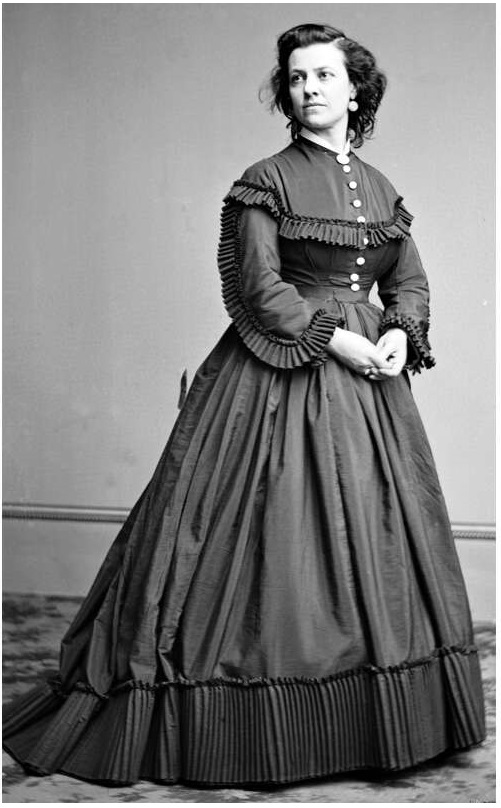
Pauline Cushman -- Union Spy


She was born Harriet Wood in New Orleans, Louisiana, on June 10th, 1833. By the late 1830s, her family left Louisiana for Grand Rapids, Michigan. It was there that they established a Native American Trading Post. And it was there, where young Harriet and her seven brothers grew up learning the skills needed to survive in the Northern frontier.

While it's said she was a "tomboy," it's also said that she dreamed of a glamorous life as an actress. By the time she was 18 years old, she left her family for a career on the stages of New York City. It was there that she learned how New York City can be an unkind place for anyone on their own. And yes, it was there while trying to make it in show business, as with many others throughout the ages in that line of work, that she found that her real name didn't have enough appeal. That's when Harriet Wood changed her name to Pauline Cushman.

Though she learned that she couldn’t find work in New York, she was hired by a theater manager who was based in New Orleans. As you'll recall, it was the city of her birth. New Orleans is said to have been a much kinder place than New York City, but then again just about anywhere has always been nicer than New York City. It was in New Orleans that she became well-known for her "full-figure and seductive charms" on and off the stage. It was also in New Orleans where she met and married Charles Dickinson who was a music teacher and theater musician.

As for their marriage, all in all, it was short-lived. Soon after getting married, the couple moved to Cleveland, Ohio, to be closer to his family. There they had two children. Sadly, both died in infancy. Then, when the Civil War started, her husband Charles enlisted in the Union Army. Some say he was in the infantry while other sources say he was a unit musician. Either way, he didn't make it home.

While folks might think it was gunshots and cannons that killed the most soldiers in the Civil War, it's a fact that dysentery was the single greatest killer of Civil War soldiers on both sides. And no, it wasn't simply a case of diarrhea. Dysentery differed from common diarrhea because dysentery was caused by a bacterial infection that gave soldiers loose and bloody bowels. Her husband Charles died of dysentery in 1862.

On her own again, she returned to the stage. By 1863, Pauline Cushman Dickinson dropped her widowed name of Dickinson and simply went by her stage name Pauline Cushman. In April of that year, she was performing on stage in Louisville, Kentucky. She had a leading part in the play The Seven Sisters at a theater that was frequented by all -- including Confederate sympathizers. 

Louisville, Kentucky, in 1863 was like a pressure cooker. While Union troops were in control of the city, the place was filled with paroled Confederate prisoners of war. There is a legend about how two paroled Confederate officers approached Pauline one day and asked her to make a toast to the Confederacy during the performance. They knew that she gave a dinner toast during one scene of the play. They wanted her to change the script and dedicate the toast to the Confederacy. They even offered her $300 to do it.

Pauline Cushman was not a dumb actress by any means and knew she needed to let someone know about what she was being asked to do. She knew full well that something like that could ignite things in the already tense city. Knowing this, she went directly to Colonel Orlando Hurley Moore for his advice. Col. Moore was the U.S. Provost Marshal in Louisville. 

After explaining what was asked of her, the amount of money that she was offered to do it, and her fears of what would happen if she did it, Moore told her to accept the proposition and report back to his office the next day. His response surprised her. In fact, she was extremely surprised that Col. Moore wanted her to go along with the plan and she had no idea why the Colonel told her to do it. 

During that night's performance, when the toast scene came, Pauline stood up from the table, raised her glass, and proclaimed, "Here's to Jeff Davis and the Southern Confederacy; may the South always maintain her honor and her rights."

The San Francisco Call remembered the incident three decades later when it wrote, "The sentiment fell upon the audience like a bombshell. All the Union persons present were mortified and indignant, while Southern sympathizers were delighted."

Years later, the San Francisco Examiner will write, "Romances of the lovely young actress who was persecuted and driven out of the two cities by the Union soldiers filled the South, and she was the Confederate heroine of the hour." 

Among those angry at her toast was her boss, who promptly fired her after the performance. When she returned the next day to see Col. Moore, he offered her a job as a Union spy. Because of what she did on stage, she became an immediate Star for the Southern cause. Subsequently, Pauline Cushman became the perfect person to be a Union spy. This was all part of Col. Moore's plan.

As a Union Spy, Pauline Cushman used her sudden celebrity status as well as her acting skills to pose as a Confederate sympathizer in order to gain information. She once posed as a Southern woman in a boarding house where she was able to stop the poisoning of Union Army officers. The boardinghouse's mistress revealed to Pauline that she bought powdered poison to sprinkle on the Union officers' food and drink. It was because of Pauline Cushman that those Union officers' lives were saved. The officers were assigned to a different boardinghouse. As for the boardinghouse mistress who wanted to poison them, she was arrested.

There is a story about how Pauline Cushman dressed as a man was able to infiltrate a Confederate ring of smugglers. In fact, it's said that she actually convinced a Southern sympathizer that she was an undercover Confederate official en route from Canada to Richmond with important, time-sensitive information. The Southern sympathizer was a woman who was supposed to smuggle supplies and important documents to the Southern underground working in that area. Cushman was able to notify Col. Moore and Union forces had the woman and her associates arrested. The documents and supplies that the woman was smuggling were confiscated.

As for her biggest mission, by the summer of 1863, Pauline Cushman was sent to Nashville, Tennessee. She was placed under the command of Union Army Gen. William Rosecrans. She was assigned to gather intelligence in the way of Confederate troop movements, the size of the Confederate forces, how well were they supplied, and if they were building any fortifications. To do that, she was ordered to gain access to Confederate camps in Tennessee to get that information. Gen. Rosecrans needed that information before launching his Tullahoma Campaign, also known as the Middle Tennessee Campaign, which took place in June and July of 1863. 

She devised a plan to infiltrate the Southern lines. She figured that Confederates would allow her free passage if they believed she was simply a sister looking for her lost brother. So under the guise of a Southern woman "searching for a lost brother," she entered the Confederate camps. For the next few months, she was one of the Union’s most productive spies. Using the ruse was pretending to be the sister of a missing Confederate soldier, she used her sob story to sneak into Confederate camps to assess their strength, supplies, and obtain their plans. It is said that she drew maps from memory and coaxed Confederate soldiers into giving her intel.

At one point during her mission, it's said she was faced with a dilemma that almost got her hanged as a spy. While in a camp, she came upon a Confederate officer drawing up fortification plans. She immediately knew that those plans needed to get back to Gen. Rosecrans. So now, she was faced with the dilemma of following through with her mission to get as much intelligence as possible from other camps -- or to try to steal those plans and get them back to the Union lines. 

She chooses to steal the plans. And while in the process of doing so, she is captured by Confederate soldiers and arrested for being a Union spy. She escaped from where she was being held but was recaptured and tried for espionage. She was found guilty and sentenced to be hanged. During this time, believe it or not, she was diagnosed with contracting typhoid fever. Or at least that's what the Confederate doctors believed.

Years later, Pauline Cushman would tell the story of how she knew that she needed to buy some time knowing that Gen. Rosecrans Army was on the way. To do so, she said she mustered all her acting skills to fake an illness so severe that her captors would delay her execution. And believe it or not, the ruse worked and the Confederates made the decision not to hang her until after she gets well enough to hang. 

About that time, Union Gen. Rosecrans launched his Tullahoma Campaign. As for Pauline Cushman, she is left behind in Shelbyville, Tennessee, as the Confederates retreat from that city. The Union Army enters the city and finds that the Confederates left Pauline Cushman behind because she was "too ill to be moved" -- even though they were going to hang her when she got well. 

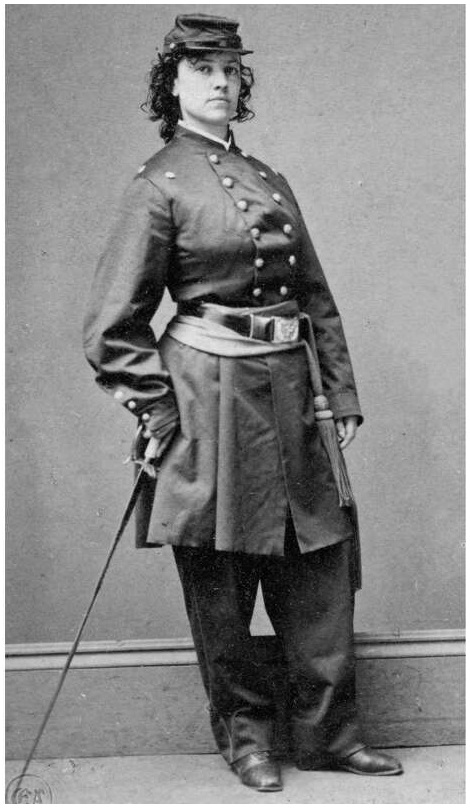
Union spy Pauline Cushman made a surprisingly sudden recovery. And while in Nashville, the Union Army received a telegram from President Lincoln bestowing on her an honorary commission of Major for her work and risking her life for the Union. It was said her exploits made it all the way to Abraham Lincoln himself, who allegedly remarked, "She has done more to earn her title than many a male who wore the shoulder straps of Major during the war." After that, she became known as Miss "Major" Cushman. 


During that same time, the Union Ladies of Nashville presented her with a Union Major's Army uniform and a sword. It is said that she wore her uniform complete with a sword as she traveled throughout the Union. She left the Army soon after being outed as a spy and later performed a one-woman show for P.T. Barnum about her espionage exploits. It was billed as The Spy of the Cumberland and The Greatest Heroine of the Age.

Writer Ferdinand Sarmiento, who later became a friend of hers, interviewed her at length to write her biography titled Life of Pauline Cushman: The Celebrated Union Spy and Scout. 


The biography of Pauline Cushman was written in 1865 by Ferdinand Sarmiento using her notes and recollections. While many consider the book exaggerated, it's not much different than books written about others at the time or later. Like books written about Wild Bill, John Wesly Hardin, and Wyatt Earp, the book about Pauline Cushman has all sorts of exploits that are unprovable. 

But, unlike the exaggerated exploits of Wild Bill, John Wesly Hardin, and Wyatt Earp, the book about Pauline Cushman's exploits, and the nature of the secret work she was doing on behalf of the Union, can't help but make someone wonder if they were exaggerated. After all, it's one thing to make false claims that can be proven false, like Wild Bill's false claim about taking on a non-existent gang of outlaws, and Hardin's lie about how he out-drew a famous marshal, or like Wyatt Earp's many false claims, versus the tales of a Union Army spy who lacks corroboration simply as a matter of the nature of that profession. 

In the early 1870s, Pauline Cushman moved to San Francisco. In 1872, she married again. And again, her husband whose name is lost to history died. Then a few years later in 1877, she met and married Jere Fryer in Casa Grande, Arizona Territory. The marriage lasted almost 13 years before they separated in 1890. After that, she returned to San Francisco. As Pauline Cushman Fryer, she moved into a small, third-floor room in a boarding house at 1118 Market Street.

She made a little cash by selling poetry and giving interviews to whoever wanted to listen. Her arthritis was so bad that most of that money that she made went toward buying painkillers. It was later reported that she didn't have enough money for food. In April 1893, after 30 years of petitioning the U.S. government, the government awarded Pauline Cashman with her first husband's small Army pension. 

It's said that long-term pain and poverty beat her down. Then on the morning of December 2nd, 1893, her landlady went into Pauline's room to wake her and found Pauline unconscious in bed. Because she was still breathing, two doctors were brought in -- but nothing could be done for her. 

Major Pauline Cushman, a Civil War hero, died at 2 p.m. It's said that she died of a morphine overdose after three years of living from hand to mouth, three years of battling chronic rheumatism and arthritis pain. The painkillers that she took to alleviate her pain, killed her. An inquest ruled the death an accidental overdose. 

On December 3rd, 1893, The San Francisco Call newspaper wrote the following, "A childless, gray-haired, penniless broken woman, almost without friends, died a lonely death in a Market Street lodging house yesterday."

The San Francisco Call newspaper reported that because she died destitute that she was going to be buried in one of San Francisco's potter's fields. The newspaper went on to say that she would probably be interned in an unmarked grave. 

It is said that the reports in the newspaper "horrified veterans groups" to the point where they took action and pulled together the funds to give her a proper funeral. On the day of her funeral, crowds gathered at the funeral home. Flowers were being wired in came in from across the country. There were so many flowers that it's said her flag-covered casket was almost buried under them. A long procession of mourners accompanied her to her gravesite in the Veterans Cemetery at the U.S. Army Fort in San Francisco. Yes, the Presidio. 

The San Francisco Call reported, "A salute was fired across the grave and taps were sounded by Bugler Mitchell from the Presidio, and the drama of the federal spy's life was ended."

Buried in San Francisco's Presidio is a woman who gave so much to America. Her deeds saved lives and sadly are now only forgotten tales of adventure, intrigue, and tragedy. It should be noted that in 1864, the story of Pauline Cashman made headlines across the nation. She was in reality a household name. While she was cursed by the Confederacy, she was venerated by the Union. 

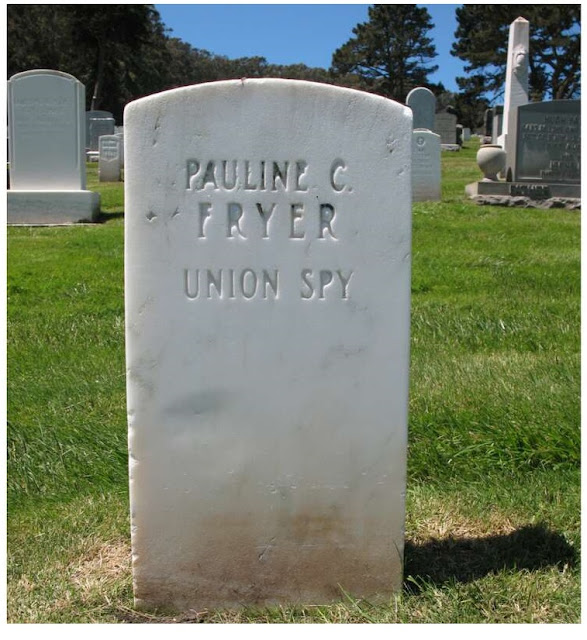
Pauline Cushman Fryer died on December 2nd, 1893. The picture below is of her gravestone located in the San Francisco National Cemetery in the Presidio. Carved in its marble are simply the words:

PAULINE C. FRYER
UNION SPY
 
May God bless her, and our country not forget her.

Tom Correa

Wednesday, February 16, 2022

What The Battle of Iwo Jima Means To Marines


As the present Commandant of Marine Corps League Mother Lode Detachment #1080, I'm extremely honored to speak at the upcoming ceremony commemorating the Iwo Jima flag-raising this coming Saturday, February 19th. During the observance ceremony, we will also take a moment to remember Marine Brigadier General Harry Bluett Liversedge’s dedication to God, Country, and Corps.

There is no getting around how that iconic moment and the man are forever linked. How so, you ask? Well, the Marines responsible for the flag-raising on Mount Suribachi on Iwo Jima were from the 28th Marine Regiment. As a Colonel at the time, Harry Liversedge was the commanding officer of the 28th Marines.

While Marines fondly remember General Liversedge as "Harry the Horse" because of his resilience, members of the small community of Volcano, California, may want to know a little more about their hometown hero. After all, he was born in the small California Gold Rush town of Volcano on September 21, 1894.

While it is anyone's guess what sort of young man he was growing up, it's a safe bet to say that he was a typical American youth who celebrated America's greatness. After all, Americans at the time saw the future as one of optimism and hope. And really, why not? We were in a period of economic prosperity. America had become the world's champion of freedom and democracy after we freed Cuba and the Philippines of Spanish tranny. And when Europe went to war in 1914, an American Expeditionary Force arrived in Europe in 1917. 

As a young man, Harry Liversedge, left the quiet town of Volcano to begin his career as a Marine in May of 1917 when he was 21. He enlisted in the Corps as a Private (E-1). While I can't find information about his service in France other than the fact that he served with the 5th Marines that famously fought at the Battle of Belleau Wood in June 1918. I suspect he distinguished himself in battle.

What makes me say such a thing? Well, it's not every day that a young man enlists in the Marine Corps as a Private, and then just a mere year and a half later in September of 1918, he is commissioned as a Second Lieutenant. Yes, just two months before World War I ended on November 11, 1918, the young man from Volcano, California, was a Marine Second Lieutenant. That’s impressive to anyone’s standards.

During his career, Harry Liversedge was selected for the 1919 Inter-Allied Games, played football in the Army-Marine Corps game at Baltimore, Maryland, and later represented the United States in the 1920 Olympics at Antwerp, Belgium. He won a bronze medal in the shot put. He served at the Naval Academy at Annapolis and Quantico Virginia, took part in the Banana Wars in Haiti and the Dominican Republic, served at the Marine Barracks at Mare Island, California, and later served in China. And yes, as an exemplary Marine, he steadily moved up the rank structure.

As we know, Pearl Harbor, Hawaii, was attacked by the Japanese Navy on December 7th, 1941. As with all our services, the Marine Corps was hit hard that day. On that Sunday, there were about 4,500 Marines stationed at Pearl Harbor. There were over 800 officers and enlisted Marines in Marine Detachments aboard ships at Pearl at the time of the Japanese attack. The heaviest Marine losses came from the ship's detachment of the USS Arizona. Of the 82 Marines that made up that single ship’s Marine Detachment, only 15 survived.

The war would see several battles in the Pacific. By January of 1944, Colonel Liversedge was transferred to the 5th Marine Division and was placed in command of the 28th Marine Regiment. Of the battles they would see, the 28th Marines went ashore at Iwo Jima.

Following World War II, Col. Harry Liversedge was promoted to Brigadier General. He was active in the Marine Corps and was instrumental in reforming the 1st Marine Division in 1950 during the Korean War. He died at the Navy Medical Center in Bethesda, Maryland, on November 25, 1951, at the age of 57. Today, an athletic field on Camp Lejeune is named after him.

It should be noted that in August of 1942, Congress made the Navy Cross a combat-only decoration that follows the Medal of Honor in order of precedence. Harry Liversedge received two Navy Crosses during his career. His 2nd Navy Cross was for his actions during the battle of Iwo Jima.

And really, imagine the scene for a moment. It is February 1945, a very small black sand 2-mile wide by 4-mile-long island about 600 miles from Tokyo, Japan, is the location for one of the last great island-hopping campaigns of World War II in the Pacific Theater. It is said that the Empire of Japan spent almost 20 years constructing heavily fortified positions, a network of bunkers, hidden artillery positions, and more than 11 miles of tunnels in and around Mt. Suribachi.

Naval guns and an air bombardment pounded the island for three days prior to the start of what was Operation Detachment. Three divisions of Marines, thousands of U.S. Marines, went ashore to slug it out in advances that were in some cases measured in a few yards at a time. They hit that island on a Monday morning. It was 9:00 a.m., February 19, 1945. 

For Americans in Volcano, California, and the rest of the West Coast, they were either ending their workday or maybe starting the swing shift that day. The fact is, when the Battle for Iwo Jima started over 5,500 miles away, it was 5:00 p.m. here on the West Coast.  

By the evening of the first day, despite the 15-foot high ash embankments and massive incoming fire, 30,000 U.S. Marines commanded by General Holland Smith managed to establish a solid beachhead on the island. For the next month, Japanese defenders were dug into bunkers deep within the volcanic rocks. And yes indeed, they waged an incredibly bloody fight to keep the island. It wasn't until March 3rd that Marines controlled all three airfields on Iwo Jima. And really, it wasn't until March 26th that the last Japanese defenders on Iwo Jima were wiped out. 

And let's remember, the need to project American airpower to take the fight even closer to Japan was what dictated the American decision to assault the Japanese-held island of Iwo Jima. And also, our securing Iwo Jima prepared the way for the last and largest battle in the Pacific Theater. That was the invasion of Okinawa. The Battle of Iwo Jima came at a high cost, but it is believed to have saved tens of thousands of American lives since our Army Air Corps needed to run operations closer to Okinawa and the Japanese mainland.

In the end, a little over 230 Japanese soldiers were captured. Yes, only a little over 230. The other almost 22,000 Japanese soldiers there were killed because they refused to surrender. History tells us that while the island of Iwo Jima was finally declared "secured" on March 26, 1945, at a huge cost. It is known as one of the bloodiest battles in Marine Corps history because after 36 days of fighting. As a result of that single battle, over 6,200 Marines and almost 800 Sailors were killed. And of the wounded, almost 25,000 Marines were wounded before it was over.

As for the iconic flag-raising atop Mt. Suribachi? During the battle which immediately became one of the bloodiest in the Pacific Theater, Japanese forces on the island used Mt. Suribachi as a vantage point to direct artillery fire onto the Marines. That's why soon after the start of the battle, Marines made it their mission to capture that strategic position. 

On February 23, the 28th Marines succeeded in capturing the island's primary observation point which was the peak of Mount Suribachi. That took place on February 23, 1945. Yes, four full days after the battle began. 

As for the now-famous photograph of the flag-raising, if you're curious, there were actually two flag-raisings. The first took place when Marines of the 2nd Battalion, 28th Marines led by 1st Lt. Harold G. Schrier, were the first Marines to reach the summit of the mountain. With them, they carried an American flag that was taken from the USS Missoula. The USS Missoula was a tank transport ship that delivered troops and cargo to Iwo Jima during the invasion. 

The story goes that 1st Lt. Harold G. Schrier had been handed the flag by his Batallion's Adjutant and was told, "If you get to the top, put it up." They reached the top and did exactly that. The flag from the USS Missoula was raised by Lt. Schrier and two other Marines at around 10:30 a.m.

It should be noted that a photograph of the first U.S. flag-raising on Iwo Jima was taken by Marine Staff Sergeant Louis R. Lowery who was a staff photographer for Leatherneck magazine. Of course, it was soon brought to the attention of all involved that the original flag planted by Lt. Schrier and his men was considered too small. It could hardly be seen from the northern side of Mt. Suribachi. 

Because of that problem, it's said that Marines searched for a replacement flag. According to historian Robert E. Allen's book "The First Battalion of the 28th Marines on Iwo Jima" (McFarland, 1999), the second flag, that flag shown in Joe Rosenthal's famous photograph, was delivered by USS LST-779 and measured 56 inches by 96 inches.

So, as for the famous photograph of five Marines and one Navy Corpsman raising the flag atop Mt. Suribachi, Associated Press photographer Joe Rosenthal took the photo. U.S. Marines from the 3rd Platoon, E Company, 2nd Battalion, 28th Regiment of the 5th Division took the crest of Mt. Suribachi which was both the island’s highest peak and its most strategic position. Staff Sgt Louis Lowery was with them to record the event.

Along with Staff Sgt Lowery, and a motion-picture cameraman, Associated Press photographer Joe Rosenthal met them along the way to record the raising of the second flag-raising. As for the photograph itself, it's said that Joe Rosenthal quickly photographed the Marines using his Speed Graphic camera. And here's something interesting, he later said that "at the time," he himself "did not realize the significance of the photograph."

The photograph of the Iwo Jima flag-raising was a wonderful source of motivation for our country in those long dark days of sacrifice for the war effort. The three surviving Marines in the famous photo were returned home to a hero's welcome and immediately toured across the U.S. in support of the Seventh War Bond Drive.  According to historians, the Seventh War Bond Drive, because of the support from the touring Iwo Jima survivors, raised a record-breaking $26 billion for the war effort. 

By the end of World War II, Rosenthal's photograph had become famous worldwide. The photograph, which won the Pulitzer Prize in 1945, served as inspiration for the United States Marine Corps War Memorial, in Arlington Ridge Park, Virginia. The United States Marine Corps War Memorial was unveiled by President Dwight D. Eisenhower on November 10, 1954. Then just a few years later in 1961, President John F. Kennedy proclaimed that the U.S. flag atop our Marine Memorial should fly over the memorial 24 hours a day. 

In closing, here are my final thoughts on this. It’s said that in battle, especially during such an epic battle as that which Marines endured on Iwo Jima, most acts of heroism go unnoticed. Of those that were noted, there were 27 Medals of Honor awarded to Marines and Navy servicemen there. That’s the highest number awarded in a single American battle. Of those 27 Medals of Honor awarded, 14 Medals of Honor were awarded posthumously. It is no wonder that Admiral Chester Nimitz said of those who fought on Iwo Jima, "Uncommon valor was a common virtue."

On Saturday, February 19th, 2022, we will again have the honor to recognize the valor and the sacrifice made on that small island not too many miles from Japan. Of those moments which define greatness, that battle would brand the United States Marine Corps and Marines forevermore. The actions of those World War II Marines embody our Corps’ values of honor, courage, and commitment. 

There are reasons why we honor those at the battle of Iwo Jima. We remember them, not only because of their commitment to liberty and the defeat of an enemy but also because their actions define who we are as Marines, how we Marines think, how we act, how we fight, our tenaciousness, our resolve. These are the reasons why we commemorate their deeds, sacrifice, and courage. This is why we take pride in doing so.

Just as the Marines did when holding their position against the Chinese Boxers in 1900 and the Marines did at Belleau Wood, the Marines on Iwo Jima set the standard for us to live by. And yes, we not only thank them for it -- we respect them for doing it. So with that, may God bless them. May God bless America. And of course, may God bless our Corps. 

Semper Fi.
Tom Correa


Wednesday, February 9, 2022

Rossell G. O'Brien Started An American Tradition


His name is Rossell Galbraith O'Brien. He was a U.S. Army 2nd Lieutenant during the Civil War and later rose to the rank of Brigadier General. He is buried in Oakland California's Mountain View Cemetery. Actually, he is Plot 6 of that cemetery.

What American tradition did he start? Believe it or not, he is the man who originated the custom of standing during the rendition of the Star-Spangled Banner


O'Brien was elected the 15th Mayor of Olympia, Washington, in 1891.

According to the Washington National Guard Pamphlet: "General O'Brien was born in Ireland in l846. He first entered the military service as a private in the Ellsworth Zouaves (Governor's Guard) of Chicago in 1862, serving until 28 April 1864 when he enlisted in Co. D, 134th Illinois Volunteer regiment. He was appointed 2nd Lieut. in this regiment on May 31, 1864, and served with this regiment in the Summer campaigns in Kentucky until Sept. 1864. He was then ordered to St. Louis with this regiment and served in the campaign against the rebel General Price in Missouri. He was honorably mustered out of the Volunteer service on October 25, 1864. He served as a First Lieut. of the Governor's Guards of Chicago from 1865 to 1870 when he came to Washington Territory with newly appointed Governor Edward S. Saloman. 

He was appointed Deputy Collector of Internal Revenue in 1871 and later served as Chief Clerk of the House of Representatives of the Legislative Assembly. He served on the City Council of Olympia from 1886 to 1888 and as Mayor in 1891. In the meantime, he served as Clerk of the Supreme Court and as Quartermaster and Adjutant General of the Territorial Militia from 1880 to 1895 when he was placed on the retired list. He is credited with being the "Father" of the National Guard in Washington."


Later, when the Star-Spangled Banner was first recognized as our National Anthem by law in 1931, there was no prescription as to behavior during its playing. During World War II, the law was revised directing those in uniform should salute during its playing, while others should simply stand at attention, men removing their hats. The same code also required that women should place their hands over their hearts when the flag is displayed during the playing of the national anthem, but not if the flag was not present. 

Later, during World War II, the law was revised again. This time it "instructed men and women to stand at attention and face in the direction of the music when it was played. That revision also directed men and women to place their hands over their hearts only if the flag was displayed." Of course, as with military protocol, those in uniform were required to salute. 

"On July 7, 1976, the law was simplified. Men and women were instructed to stand with their hands over their hearts, men removing their hats, irrespective of whether or not the flag was displayed and those in uniform saluting. 

On August 12, 1998, the law was rewritten keeping the same instructions, but differentiating between "those in uniform" and "members of the Armed Forces and veterans" who were both instructed to salute during the playing whether or not the flag was displayed." It is said that after 9/11, our custom of placing our hand over our heart "during the playing of the national anthem became nearly universal."

In 2008, the law was amended to instruct all members of our Armed Forces and military veterans to salute even when out of uniform. Their salute should be rendered at the first note of the anthem and maintain that position until the last note. 

While failure to follow the suggestions is not a violation of the law, some will take it as a sign of disrespect to our nation, those who have died to keep us free, and those serving today.

I hope you found that interesting.

Tom Correa